


EN ISO 80601-2-79:2019
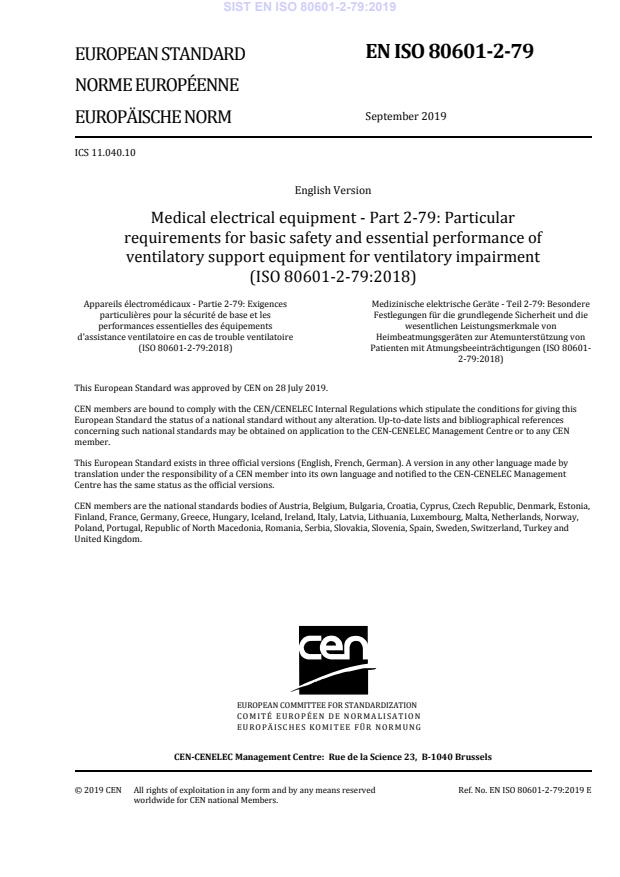
(Main)Medical electrical equipment - Part 2-79: Particular requirements for basic safety and essential performance of ventilatory support equipment for ventilatory impairment (ISO 80601-2-79:2018)
Medical electrical equipment - Part 2-79: Particular requirements for basic safety and essential performance of ventilatory support equipment for ventilatory impairment (ISO 80601-2-79:2018)
This document applies to the basic safety and essential performance of ventilatory support equipment, as defined in 201.3.205, for ventilatory impairment, as defined in 201.3.202, hereafter also referred to as me equipment, in combination with its accessories:
— intended for use in the home healthcare environment;
— intended for use by a lay operator; and
— intended for use with patients who have ventilatory impairment, the most fragile of these patients, would not likely experience injury with the loss of this artificial ventilation; and
— not intended for patients who are dependent on artificial ventilation for their immediate life support.
EXAMPLE 1 Patients with mild to moderate chronic obstructive pulmonary disease (COPD).
NOTE 1 In the home healthcare environment, the supply mains is often not reliable.
NOTE 2 Such ventilatory support equipment can also be used in non-critical care applications of professional health care facilities.
This document is also applicable to those accessories intended by their manufacturer to be connected to the breathing system of ventilatory support equipment for ventilatory impairment, where the characteristics of those accessories can affect the basic safety or essential performance of the ventilatory support equipment for ventilatory impairment.
EXAMPLE 2 Breathing sets, connectors, water traps, expiratory valve, humidifier, breathing system filter, external electrical power source, distributed alarm system.
If a clause or subclause is specifically intended to be applicable to me equipment only, or to me systems only, the title and content of that clause or subclause will say so. If that is not the case, the clause or subclause applies both to me equipment and to me systems, as relevant.
Hazards inherent in the intended physiological function of me equipment or me systems within the scope of this document are not covered by specific requirements in this document except in IEC 60601‑1:2005+AMD1:2012, 7.2.13 and 8.4.1.
NOTE 3 Additional information can be found in IEC 60601‑1:2005+AMD1:2012, 4.2.
This document does not specify the requirements for:
— ventilators or accessories for ventilator-dependent patients intended for critical care applications, which are given in ISO 80601‑2‑12;
— ventilators or accessories intended for anaesthetic applications, which are given in ISO 80601‑2‑13[4];
— ventilators or accessories intended for the emergency medical services environment, which are given in ISO 80601‑2‑84 [5] [1], the future replacement for ISO 10651‑3[6];
— ventilators or accessories intended for ventilator-dependent patients in the home healthcare environment, which are given in ISO 80601‑2‑72;
— ventilatory support equipment or accessories intended for ventilatory insufficiency, which are given in ISO 80601‑2‑80[1];
— sleep apnoea therapy me equipment, which are given in ISO 80601‑2‑70[7];
— continuous positive airway pressure (CPAP) me equipment;
— high-frequency jet ventilators (HFJVs);
— high-frequency oscillatory ventilators (HFOVs)[8];
— oxygen therapy constant flow me equipment;
— cuirass or "iron-lung" ventilation equipment.
This document is a document in the IEC 60601 and IEC/ISO 80601 series of documents.
[1] Under preparation. Stage at the time of publication: ISO/DIS 80601-2-84:2017.
Medizinische elektrische Geräte - Teil 2-79: Besondere Festlegungen für die grundlegende Sicherheit und die wesentlichen Leistungsmerkmale von Heimbeatmungsgeräten zur Atemunterstützung von Patienten mit Atmungsbeeinträchtigungen (ISO 80601-2-79:2018)
Dieses Dokument gilt für die BASISSICHERHEIT und die WESENTLICHEN LEISTUNGSMERKMALE eines HEIMBEATMUNGSGERÄTS ZUR ATEMUNTERSTÜTZUNG nach 201.3.205 für PATIENTEN mit ATMUNGSBEEINTRÄCHTIGUNGEN nach 201.3.202 in Kombination mit dessen ZUBEHÖR, nachfolgend auch als ME GERÄT bezeichnet, das:
— für die Anwendung in der medizinischen Versorgung in häuslicher Umgebung vorgesehen ist;
— für die Anwendung durch einen NICHT FACHKUNDIGEN BEDIENER vorgesehen ist; und
— für PATIENTEN mit ATMUNGSBEEINTRÄCHTIGUNGEN vorgesehen ist, wobei die fragilsten dieser PATIENTEN bei Verlust dieser künstlichen Beatmung wahrscheinlich keine gesundheitlichen Schäden erleiden würden; und
— nicht für PATIENTEN vorgesehen ist, die für die unmittelbare Erhaltung ihres Lebens von künstlicher Beatmung abhängig sind.
BEISPIEL 1 PATIENTEN mit leichter bis mittelschwerer chronisch obstruktiver Lungenerkrankung (COPD).
ANMERKUNG 1 Bei der MEDIZINISCHEN VERSORGUNG IN HÄUSLICHER UMGEBUNG ist das VERSORGUNGSNETZ häufig nicht zuverlässig.
ANMERKUNG 2 Derartige HEIMBEATMUNGSGERÄTE ZUR ATEMUNTERSTÜTZUNG können auch bei nichtkritischen Pflegeanwendungen in professionellen Einrichtungen des Gesundheitswesens eingesetzt werden.
Appareils électromédicaux - Partie 2-79: Exigences particulières pour la sécurité de base et les performances essentielles des équipements d'assistance ventilatoire en cas de trouble ventilatoire (ISO 80601-2-79:2018)
Le présent document s'applique à la sécurité de base et aux performances essentielles des équipements d'assistance ventilatoire, tels que définis en 201.3.205, pour le trouble ventilatoire, tels que définis en 201.3.202, ci-après également désignés par appareils em, en association avec leurs accessoires:
— destinés à être utilisés dans l'environnement des soins à domicile;
— destinés à être utilisés par un opérateur non spécialiste; et
— destinés à être utilisés avec des patients souffrant d'un trouble ventilatoire, les plus fragiles de ces patients ayant peu de risque d'être blessés en cas de perte de cette ventilation artificielle; et
— non destinés à être utilisés chez les patients dont le maintien immédiat des fonctions vitales dépend d'une ventilation artificielle.
EXEMPLE 1 Patients souffrant d'une bronchopneumopathie chronique obstructive (BPCO) légère à modérée.
NOTE 1 Dans l'environnement des soins à domicile, il est fréquent que le réseau d'alimentation ne soit pas fiable.
NOTE 2 Ces équipements d'assistance ventilatoire peuvent également être utilisés dans les établissements de santé professionnels, pour d'autres applications qu'en soins intensifs.
Le présent document s'applique également aux accessoires conçus par leur fabricant pour être raccordés au système respiratoire des équipements d'assistance ventilatoire en cas de trouble ventilatoire, lorsque les caractéristiques de ces accessoires peuvent affecter la sécurité de base ou les performances essentielles des équipements d'assistance ventilatoire en cas de trouble ventilatoire.
EXEMPLE 2 Ensembles respiratoires, raccords, pièges à eau, valve expiratoire, humidificateur, filtre pour système respiratoire, source d'énergie électrique externe et système d'alarme réparti.
Si un article ou un paragraphe est spécifiquement destiné à être applicable uniquement aux appareils em ou uniquement aux systèmes em, le titre et le contenu de cet article ou de ce paragraphe l'indiquent. Dans le cas contraire, l'article ou le paragraphe s'applique à la fois aux appareils em et aux systèmes em, selon le cas.
Les dangers inhérents à la fonction physiologique prévue des appareils em ou des systèmes em dans le cadre du domaine d'application du présent document ne sont pas couverts par des exigences spécifiques contenues dans le présent document, à l'exception de l'IEC 60601‑1:2005+AMD1:2012, 7.2.13 et 8.4.1.
NOTE 3 Des informations supplémentaires peuvent être trouvées dans l'IEC 60601‑1:2005+AMD1:2012, 4.2.
Le présent document ne spécifie pas les exigences relatives aux:
— ventilateurs ou accessoires pour patients ventilo-dépendants prévus pour les applications en soins intensifs, qui sont données dans l'ISO 80601‑2‑12;
— ventilateurs ou accessoires prévus pour les applications en anesthésie, qui sont données dans l'ISO 80601‑2‑13[4];
— ventilateurs ou accessoires destinés à l'environnement des services médicaux d'urgence, qui sont données dans l'ISO 80601‑2‑84[5] [1]), qui remplacera l'ISO 10651‑3[6];
— ventilateurs ou accessoires pour patients ventilo-dépendants dans l'environnement des soins à domicile, qui sont données dans l'ISO 80601‑2‑72;
— équipements d'assistance ventilatoire ou accessoires prévus en cas d'insuffisance ventilatoire, qui sont données dans l'ISO 80601‑2‑80[1];
— appareils em de traitement de l'apnée du sommeil, qui sont données dans l'ISO 80601‑2‑70[7];
—
Medicinska električna oprema - 2-79. del: Posebne zahteve za osnovno varnost in bistvene lastnosti pomožne ventilacijske opreme pri okvari ventilatorja (ISO 80601-2-79:2018)
Ta dokument se uporablja za osnovno varnost in bistvene lastnosti pomožne ventilacijske opreme, kot je opredeljeno v točki 201.3.205, pri okvari ventilatorja, kot je določeno v točki 201.3.202, v nadaljevanju poimenovane tudi elektromedicinska oprema, in sicer skupaj z dodatno opremo:
– ki je namenjena za uporabo v okolju domače zdravstvene oskrbe;
– ki je namenjena nestrokovnjakom; in
– ki je namenjena za uporabo pri bolnikih z okvaro ventilatorja, pri čemer pri bolnikih najšibkejšega zdravja verjetno ne bo prišlo do telesnih poškodb zaradi izgube te umetne ventilacije; in
– ki ni namenjena bolnikom, ki so odvisni od umetne ventilacije za neposredno ohranjanje pri življenju.
PRIMER 1: Bolniki z blago ali zmerno kronično obstruktivno pljučno boleznijo (COPD).
OPOMBA 1: V okolju domače zdravstvene oskrbe napajalno omrežje pogosto ni zanesljivo.
OPOMBA 2: Taka pomožna ventilacijska oprema se lahko uporablja tudi pri nekritični oskrbi v zdravstvenih ustanovah.
Ta dokument se uporablja tudi za tisto dodatno opremo, ki jo je proizvajalec predvidel za priklop na dihalni sistem pomožne ventilacijske opreme pri okvari ventilatorja, pri čemer lahko lastnosti te dodatne opreme vplivajo na osnovno varnost ali bistvene lastnosti pomožne ventilacijske opreme pri okvari ventilatorja.
PRIMER 2: Dihalni seti, priključki, sifoni, ventil za izdihavanje, vlažilnik, filter dihalnega sistema, zunanji vir električne energije, distribuiran alarmni sistem.
Če je točka ali podtočka namenjena samo obravnavi elektromedicinske opreme ali elektromedicinskih sistemov, bo to zapisano v naslovu in vsebini dane točke ali podtočke. Če ni zapisano, točka ali podtočka obravnava elektromedicinsko opremo in elektromedicinske sisteme.
Posebne zahteve tega dokumenta ne vključujejo inherentnih tveganj pri predvideni fiziološki funkciji elektromedicinske opreme ali elektromedicinskih sistemov, ki sodijo na področje uporabe tega dokumenta, razen v točkah 7.2.13 in 8.4.1 standarda IEC 60601 1:2005+AMD1:2012.
OPOMBA 3: Dodatne informacije so navedene v točki 4.2 standarda IEC 60601 1:2005+AMD1:2012.
Ta dokument ne določa zahtev za:
– ventilatorje ali dodatno opremo za od aparata odvisne bolnike za uporabo pri intenzivni negi, ki so podani v standardu ISO 80601 2 12;
– ventilatorje ali dodatno opremo za anestezijsko uporabo, ki so podani v standardu ISO 80601 2 13[4];
– ventilatorje ali dodatno opremo za uporabo v okolju nujnih zdravstvenih storitev, ki so podani v standardu ISO 80601 2 84 [5] [1], ki bo v prihodnje nadomeščal standard ISO 10651 3[6];
– ventilatorje ali dodatno opremo za uporabo pri od aparata odvisnih bolnikih v okolju domače zdravstvene oskrbe, ki so podani v standardu ISO 80601 2 72;
– pomožno ventilacijsko opremo ali dodatno opremo pri nezadostnem prezračevanju, ki je podana v standardu ISO 80601 2 80[1];
– elektromedicinsko opremo za zdravljenje motenj dihanja v spanju, ki je podana v standardu ISO 80601 2 70[7];
– elektromedicinsko opremo za vzdrževanje stalnega tlaka v dihalnih poteh (CPAP);
– ventilatorje za visokofrekvenčno pospešeno predihavanje (HFJV);
– ventilatorje za visokofrekvenčno oscilacijsko predihavanje (HFOV)[8];
– elektromedicinsko opremo za kisikovo terapijo s stalnim pretokom;
– opremo za ventilacijo pljuč, t.i. »curiass« ali »železna pljuča«.
Ta dokument je dokument iz skupin dokumentov IEC 60601 in IEC/ISO 80601.
[1] V pripravi. Faza v času objave: ISO/DIS 80601-2-84:2017.
General Information
- Status
- Withdrawn
- Publication Date
- 17-Sep-2019
- Withdrawal Date
- 13-Apr-2025
- Technical Committee
- CEN/TC 215 - Respiratory and anaesthetic equipment
- Drafting Committee
- CEN/TC 215/WG 2 - Lung ventilators
- Current Stage
- 9960 - Withdrawal effective - Withdrawal
- Start Date
- 04-Sep-2024
- Completion Date
- 14-Apr-2025
Relations
- Effective Date
- 30-Oct-2019
- Effective Date
- 28-Jul-2021


Frequently Asked Questions
EN ISO 80601-2-79:2019 is a standard published by the European Committee for Standardization (CEN). Its full title is "Medical electrical equipment - Part 2-79: Particular requirements for basic safety and essential performance of ventilatory support equipment for ventilatory impairment (ISO 80601-2-79:2018)". This standard covers: This document applies to the basic safety and essential performance of ventilatory support equipment, as defined in 201.3.205, for ventilatory impairment, as defined in 201.3.202, hereafter also referred to as me equipment, in combination with its accessories: — intended for use in the home healthcare environment; — intended for use by a lay operator; and — intended for use with patients who have ventilatory impairment, the most fragile of these patients, would not likely experience injury with the loss of this artificial ventilation; and — not intended for patients who are dependent on artificial ventilation for their immediate life support. EXAMPLE 1 Patients with mild to moderate chronic obstructive pulmonary disease (COPD). NOTE 1 In the home healthcare environment, the supply mains is often not reliable. NOTE 2 Such ventilatory support equipment can also be used in non-critical care applications of professional health care facilities. This document is also applicable to those accessories intended by their manufacturer to be connected to the breathing system of ventilatory support equipment for ventilatory impairment, where the characteristics of those accessories can affect the basic safety or essential performance of the ventilatory support equipment for ventilatory impairment. EXAMPLE 2 Breathing sets, connectors, water traps, expiratory valve, humidifier, breathing system filter, external electrical power source, distributed alarm system. If a clause or subclause is specifically intended to be applicable to me equipment only, or to me systems only, the title and content of that clause or subclause will say so. If that is not the case, the clause or subclause applies both to me equipment and to me systems, as relevant. Hazards inherent in the intended physiological function of me equipment or me systems within the scope of this document are not covered by specific requirements in this document except in IEC 60601‑1:2005+AMD1:2012, 7.2.13 and 8.4.1. NOTE 3 Additional information can be found in IEC 60601‑1:2005+AMD1:2012, 4.2. This document does not specify the requirements for: — ventilators or accessories for ventilator-dependent patients intended for critical care applications, which are given in ISO 80601‑2‑12; — ventilators or accessories intended for anaesthetic applications, which are given in ISO 80601‑2‑13[4]; — ventilators or accessories intended for the emergency medical services environment, which are given in ISO 80601‑2‑84 [5] [1], the future replacement for ISO 10651‑3[6]; — ventilators or accessories intended for ventilator-dependent patients in the home healthcare environment, which are given in ISO 80601‑2‑72; — ventilatory support equipment or accessories intended for ventilatory insufficiency, which are given in ISO 80601‑2‑80[1]; — sleep apnoea therapy me equipment, which are given in ISO 80601‑2‑70[7]; — continuous positive airway pressure (CPAP) me equipment; — high-frequency jet ventilators (HFJVs); — high-frequency oscillatory ventilators (HFOVs)[8]; — oxygen therapy constant flow me equipment; — cuirass or "iron-lung" ventilation equipment. This document is a document in the IEC 60601 and IEC/ISO 80601 series of documents. [1] Under preparation. Stage at the time of publication: ISO/DIS 80601-2-84:2017.
This document applies to the basic safety and essential performance of ventilatory support equipment, as defined in 201.3.205, for ventilatory impairment, as defined in 201.3.202, hereafter also referred to as me equipment, in combination with its accessories: — intended for use in the home healthcare environment; — intended for use by a lay operator; and — intended for use with patients who have ventilatory impairment, the most fragile of these patients, would not likely experience injury with the loss of this artificial ventilation; and — not intended for patients who are dependent on artificial ventilation for their immediate life support. EXAMPLE 1 Patients with mild to moderate chronic obstructive pulmonary disease (COPD). NOTE 1 In the home healthcare environment, the supply mains is often not reliable. NOTE 2 Such ventilatory support equipment can also be used in non-critical care applications of professional health care facilities. This document is also applicable to those accessories intended by their manufacturer to be connected to the breathing system of ventilatory support equipment for ventilatory impairment, where the characteristics of those accessories can affect the basic safety or essential performance of the ventilatory support equipment for ventilatory impairment. EXAMPLE 2 Breathing sets, connectors, water traps, expiratory valve, humidifier, breathing system filter, external electrical power source, distributed alarm system. If a clause or subclause is specifically intended to be applicable to me equipment only, or to me systems only, the title and content of that clause or subclause will say so. If that is not the case, the clause or subclause applies both to me equipment and to me systems, as relevant. Hazards inherent in the intended physiological function of me equipment or me systems within the scope of this document are not covered by specific requirements in this document except in IEC 60601‑1:2005+AMD1:2012, 7.2.13 and 8.4.1. NOTE 3 Additional information can be found in IEC 60601‑1:2005+AMD1:2012, 4.2. This document does not specify the requirements for: — ventilators or accessories for ventilator-dependent patients intended for critical care applications, which are given in ISO 80601‑2‑12; — ventilators or accessories intended for anaesthetic applications, which are given in ISO 80601‑2‑13[4]; — ventilators or accessories intended for the emergency medical services environment, which are given in ISO 80601‑2‑84 [5] [1], the future replacement for ISO 10651‑3[6]; — ventilators or accessories intended for ventilator-dependent patients in the home healthcare environment, which are given in ISO 80601‑2‑72; — ventilatory support equipment or accessories intended for ventilatory insufficiency, which are given in ISO 80601‑2‑80[1]; — sleep apnoea therapy me equipment, which are given in ISO 80601‑2‑70[7]; — continuous positive airway pressure (CPAP) me equipment; — high-frequency jet ventilators (HFJVs); — high-frequency oscillatory ventilators (HFOVs)[8]; — oxygen therapy constant flow me equipment; — cuirass or "iron-lung" ventilation equipment. This document is a document in the IEC 60601 and IEC/ISO 80601 series of documents. [1] Under preparation. Stage at the time of publication: ISO/DIS 80601-2-84:2017.
EN ISO 80601-2-79:2019 is classified under the following ICS (International Classification for Standards) categories: 11.040.10 - Anaesthetic, respiratory and reanimation equipment. The ICS classification helps identify the subject area and facilitates finding related standards.
EN ISO 80601-2-79:2019 has the following relationships with other standards: It is inter standard links to EN ISO 10651-6:2009, EN ISO 80601-2-79:2024. Understanding these relationships helps ensure you are using the most current and applicable version of the standard.
You can purchase EN ISO 80601-2-79:2019 directly from iTeh Standards. The document is available in PDF format and is delivered instantly after payment. Add the standard to your cart and complete the secure checkout process. iTeh Standards is an authorized distributor of CEN standards.
Standards Content (Sample)
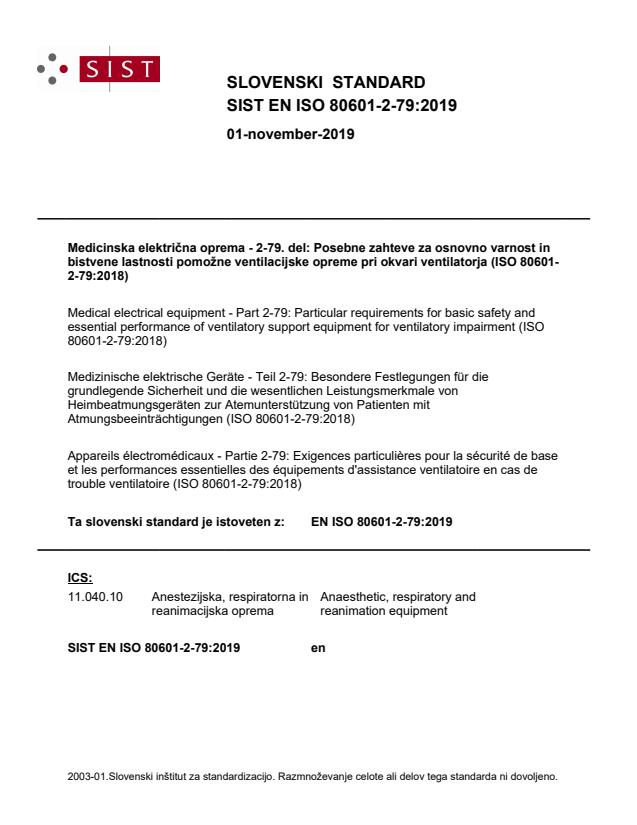
SLOVENSKI STANDARD
01-november-2019
Medicinska električna oprema - 2-79. del: Posebne zahteve za osnovno varnost in
bistvene lastnosti pomožne ventilacijske opreme pri okvari ventilatorja (ISO 80601-
2-79:2018)
Medical electrical equipment - Part 2-79: Particular requirements for basic safety and
essential performance of ventilatory support equipment for ventilatory impairment (ISO
80601-2-79:2018)
Medizinische elektrische Geräte - Teil 2-79: Besondere Festlegungen für die
grundlegende Sicherheit und die wesentlichen Leistungsmerkmale von
Heimbeatmungsgeräten zur Atemunterstützung von Patienten mit
Atmungsbeeinträchtigungen (ISO 80601-2-79:2018)
Appareils électromédicaux - Partie 2-79: Exigences particulières pour la sécurité de base
et les performances essentielles des équipements d'assistance ventilatoire en cas de
trouble ventilatoire (ISO 80601-2-79:2018)
Ta slovenski standard je istoveten z: EN ISO 80601-2-79:2019
ICS:
11.040.10 Anestezijska, respiratorna in Anaesthetic, respiratory and
reanimacijska oprema reanimation equipment
2003-01.Slovenski inštitut za standardizacijo. Razmnoževanje celote ali delov tega standarda ni dovoljeno.
EN ISO 80601-2-79
EUROPEAN STANDARD
NORME EUROPÉENNE
September 2019
EUROPÄISCHE NORM
ICS 11.040.10
English Version
Medical electrical equipment - Part 2-79: Particular
requirements for basic safety and essential performance of
ventilatory support equipment for ventilatory impairment
(ISO 80601-2-79:2018)
Appareils électromédicaux - Partie 2-79: Exigences Medizinische elektrische Geräte - Teil 2-79: Besondere
particulières pour la sécurité de base et les Festlegungen für die grundlegende Sicherheit und die
performances essentielles des équipements wesentlichen Leistungsmerkmale von
d'assistance ventilatoire en cas de trouble ventilatoire Heimbeatmungsgeräten zur Atemunterstützung von
(ISO 80601-2-79:2018) Patienten mit Atmungsbeeinträchtigungen (ISO 80601-
2-79:2018)
This European Standard was approved by CEN on 28 July 2019.
CEN members are bound to comply with the CEN/CENELEC Internal Regulations which stipulate the conditions for giving this
European Standard the status of a national standard without any alteration. Up-to-date lists and bibliographical references
concerning such national standards may be obtained on application to the CEN-CENELEC Management Centre or to any CEN
member.
This European Standard exists in three official versions (English, French, German). A version in any other language made by
translation under the responsibility of a CEN member into its own language and notified to the CEN-CENELEC Management
Centre has the same status as the official versions.
CEN members are the national standards bodies of Austria, Belgium, Bulgaria, Croatia, Cyprus, Czech Republic, Denmark, Estonia,
Finland, France, Germany, Greece, Hungary, Iceland, Ireland, Italy, Latvia, Lithuania, Luxembourg, Malta, Netherlands, Norway,
Poland, Portugal, Republic of North Macedonia, Romania, Serbia, Slovakia, Slovenia, Spain, Sweden, Switzerland, Turkey and
United Kingdom.
EUROPEAN COMMITTEE FOR STANDARDIZATION
COMITÉ EUROPÉEN DE NORMALISATION
EUROPÄISCHES KOMITEE FÜR NORMUNG
CEN-CENELEC Management Centre: Rue de la Science 23, B-1040 Brussels
© 2019 CEN All rights of exploitation in any form and by any means reserved Ref. No. EN ISO 80601-2-79:2019 E
worldwide for CEN national Members.
Contents Page
European foreword . 3
European foreword
The text of ISO 80601-2-79:2018 has been prepared by Technical Committee ISO/TC 121 "Anaesthetic
and respiratory equipment” of the International Organization for Standardization (ISO) and has been
taken over as EN ISO 80601-2-79:2019 by Technical Committee CEN/TC 215 “Respiratory and
anaesthetic equipment” the secretariat of which is held by BSI.
This European Standard shall be given the status of a national standard, either by publication of an
identical text or by endorsement, at the latest by March 2020, and conflicting national standards shall
be withdrawn at the latest by March 2020.
Attention is drawn to the possibility that some of the elements of this document may be the subject of
patent rights. CEN shall not be held responsible for identifying any or all such patent rights.
According to the CEN-CENELEC Internal Regulations, the national standards organizations of the
following countries are bound to implement this European Standard: Austria, Belgium, Bulgaria,
Croatia, Cyprus, Czech Republic, Denmark, Estonia, Finland, France, Germany, Greece, Hungary, Iceland,
Ireland, Italy, Latvia, Lithuania, Luxembourg, Malta, Netherlands, Norway, Poland, Portugal, Republic of
North Macedonia, Romania, Serbia, Slovakia, Slovenia, Spain, Sweden, Switzerland, Turkey and the
United Kingdom.
Endorsement notice
The text of ISO 80601-2-79:2018 has been approved by CEN as EN ISO 80601-2-79:2019 without any
modification.
INTERNATIONAL ISO
STANDARD 80601-2-79
First edition
2018-07
Medical electrical equipment —
Part 2-79:
Particular requirements for basic
safety and essential performance of
ventilatory support equipment for
ventilatory impairment
Appareils électromédicaux —
Partie 2-79: Exigences particulières pour la sécurité de base et les
performances essentielles des équipements d'assistance ventilatoire
en cas de trouble ventilatoire
Reference number
ISO 80601-2-79:2018(E)
©
ISO 2018
ISO 80601-2-79:2018(E)
© ISO 2018
All rights reserved. Unless otherwise specified, or required in the context of its implementation, no part of this publication may
be reproduced or utilized otherwise in any form or by any means, electronic or mechanical, including photocopying, or posting
on the internet or an intranet, without prior written permission. Permission can be requested from either ISO at the address
below or ISO’s member body in the country of the requester.
ISO copyright office
CP 401 • Ch. de Blandonnet 8
CH-1214 Vernier, Geneva
Phone: +41 22 749 01 11
Fax: +41 22 749 09 47
Email: copyright@iso.org
Website: www.iso.org
Published in Switzerland
ii © ISO 2018 – All rights reserved
ISO 80601-2-79:2018(E)
Contents
Foreword . iv
Introduction . vi
201.1 Scope, object and related standards . 1
201.2 Normative references . 4
201.3 Terms and definitions . 6
201.4 General requirements . 7
201.5 General requirements for testing of ME EQUIPMENT . 9
201.6 Classification of ME EQUIPMENT and ME SYSTEMS . 10
201.7 ME EQUIPMENT identification, marking and documents . 10
201.8 Protection against electrical HAZARDS from ME EQUIPMENT . 16
201.9 Protection against mechanical hazards of ME EQUIPMENT and ME SYSTEMS . 16
201.10 Protection against unwanted and excessive radiation HAZARDS . 17
201.11 Protection against excessive temperatures and other HAZARDS . 17
201.12 Accuracy of controls and instruments and protection against hazardous outputs . 20
201.13 Hazardous situations and fault conditions for ME EQUIPMENT . 30
201.14 PROGRAMMABLE ELECTRICAL MEDICAL SYSTEMS (PEMS) . 30
201.15 Construction of ME EQUIPMENT . 30
201.17 Electromagnetic compatibility of ME EQUIPMENT and ME SYSTEMS . 31
201.101 Gas connections . 31
201.102 Requirements for the VBS and ACCESSORIES . 33
201.103 * Training . 34
201.104 * Indication of duration of operation . 34
201.105 FUNCTIONAL CONNECTION . 35
201.106 Display loops . 35
201.107 Spontaneous breathing during loss of ventilation . 36
202 Electromagnetic disturbances — Requirements and tests . 36
206 Usability . 37
211 Requirements for medical electrical equipment and medical electrical
systems used in the home healthcare environment . 38
ME EQUIPMENT
Annex C (informative) Guide to marking and labelling requirements for
and ME SYSTEMS . 40
Annex D (informative) Symbols on marking . 46
Annex AA (informative) Particular guidance and rationale . 48
Annex BB (informative) Data interface requirements . 61
Annex CC (informative) Reference to the ESSENTIAL PRINCIPLES . 67
Annex DD (informative) Terminology — Alphabetized index of defined terms . 71
Bibliography . 75
ISO 80601-2-79:2018(E)
Foreword
ISO (the International Organization for Standardization) is a worldwide federation of national standards
bodies (ISO member bodies). The work of preparing International Standards is normally carried out
through ISO technical committees. Each member body interested in a subject for which a technical
committee has been established has the right to be represented on that committee. International
organizations, governmental and non-governmental, in liaison with ISO, also take part in the work. ISO
collaborates closely with the International Electrotechnical Commission (IEC) on all matters of
electrotechnical standardization.
The procedures used to develop this document and those intended for its further maintenance are
described in the ISO/IEC Directives, Part 1. In particular the different approval criteria needed for the
different types of ISO documents should be noted. This document was drafted in accordance with the
editorial rules of the ISO/IEC Directives, Part 2. www.iso.org/directives
Attention is drawn to the possibility that some of the elements of this document may be the subject of
patent rights. ISO shall not be held responsible for identifying any or all such patent rights. Details of any
patent rights identified during the development of the document will be in the Introduction and/or on
the ISO list of patent declarations received. www.iso.org/patents
Any trade name used in this document is information given for the convenience of users and does not
constitute an endorsement.
ISO 80601-2-79 was prepared by Technical Committee ISO/TC 121, Anaesthetic and respiratory
equipment, Subcommittee SC 3, Lung ventilators and related equipment, and Technical Committee
IEC/TC 62, Electrical equipment in medical practice, Subcommittee SC D, Electrical equipment. The draft
was circulated for voting to the national bodies of both ISO and IEC.
[1]1
This first edition of ISO 80601-2-79, in combination with ISO 80601-2-80 , cancels and replaces
[2]
ISO 10651-6:2004 . This edition of ISO 80601-2-79 constitutes a major technical revision of
ISO 10651-6:2004 and includes an alignment with the third edition of IEC 60601-1, the fourth edition of
IEC 60601-1-2, the third edition of IEC 60601-1-6, the second edition of IEC 60601-1-8 and the second
edition of IEC 60601-1-11.
The most significant changes are the following modifications:
[2]
— splitting the scope of ISO 10651-6:2004 into two parts:
— one for VENTILATORY IMPAIRMENT, also known as RESPIRATORY IMPAIRMENT, (this document) and
— one for VENTILATORY INSUFFIENCY, also known as RESPIRATORY INSUFFICIENCY (ISO 80601-2-80);
— extending the scope to include the VENTILATORY SUPPORT EQUIPMENT and its ACCESSORIES, where the
characteristics of those ACCESSORIES can affect the BASIC SAFETY or ESSENTIAL PERFORMANCE of the
VENTILATORY SUPPORT EQUIPMENT, and thus not the VENTILATORY SUPPORT EQUIPMENT itself;
— identification of ESSENTIAL PERFORMANCE for VENTILATORY SUPPORT EQUIPMENT and its ACCESSORIES;
and the following additions:
— tests for ventilation performance;
Numbers in square brackets refer to the Bibliography.
iv © ISO 2018 – All rights reserved
ISO 80601-2-79:2018(E)
— tests for mechanical strength (via IEC 60601-1-11);
— new symbols;
— requirements for VENTILATORY SUPPORT EQUIPMENT as a component of an ME SYSTEM;
— tests for ENCLOSURE integrity (water ingress via IEC 60601-1-11);
— tests for CLEANING and DISINFECTION PROCEDURES (via IEC 60601-1-11);
— consideration of contamination of the breathing gas delivered to the PATIENT from the GAS PATHWAYS.
ISO 80601-2-79:2018(E)
Introduction
This document specifies requirements for VENTILATORY SUPPORT EQUIPMENT that is intended for use in the
HOME HEALTHCARE ENVIRONMENT for PATIENTS who are not dependent on ventilation for their life support.
VENTILATORY SUPPORT EQUIPMENT is frequently used in locations where SUPPLY MAINS is not reliable.
VENTILATORY SUPPORT EQUIPMENT is often supervised by non-healthcare personnel (LAY OPERATORS) with
varying levels of training. VENTILATORY SUPPORT EQUIPMENT complying with this document can be used
elsewhere (i.e. in healthcare facilities).
Ventilatory support is often needed for PATIENTS who have stable ventilatory needs. This document
addresses PATIENTS who have significant respiratory dysfunction resulting in an abnormality of a
sufficient degree to be noticeable by the PATIENT. This is best characterized by lung functions not worse
[3]
than :
— FEV /FVC < 70 %; or
— 50 % ≤ FEV < 80 % predicted
where
FEV is the forced expiratory volume in 1 s, and
FVC is the forced vital capacity.
Examples of diseases that require ventilation support are
— mild to moderate Chronic Obstructive Pulmonary Disease (COPD);
— neuromuscular/ amyotrophic lateral sclerosis (ALS);
— obese PATIENTS Obese Hypoventilation Syndrome (OHS);
— Cheyne–Stokes respiration (CSR/CSA).
CSR/CSA is an abnormal pattern of breathing characterized by progressively deeper and sometimes
faster breathing, followed by a gradual decrease that results in a temporary stop in breathing called an
apnoea. The pattern repeats, with each cycle usually taking 30 s to 2 min.
Cardiac PATIENTS with CSR/CSA might be breathless without having significant reduction in FEV .
Reducing the work of breathing can help normalize their breathing.
This VENTILATORY SUPPORT EQUIPMENT is intended for PATIENTS who are spontaneously breathing and do
not require ventilation for life support or intermittent periods of ventilation to maintain vital signs.
VENTILATORY SUPPORT EQUIPMENT intended for this group of PATIENTS typically does not require
PHYSIOLOGICAL ALARM CONDITIONS as no ESSENTIAL PERFORMANCE exists. These PATIENTS can gain adequate
relief from fatigue related to the work of breathing by using VENTILATORY SUPPORT EQUIPMENT during the
night and while taking breaks during the day. This can enable a PATIENT with VENTILATORY IMPAIRMENT to
continue to move about and participate in the activities of daily living. Non-TRANSIT-OPERABLE VENTILATORY
SUPPORT EQUIPMENT that provides ventilatory support at the bedside and beside a chair or other resting
place should be adequate in this application.
This publication has been drafted in accordance with the ISO/IEC Directives, Part 2.
In this document, the following print types are used:
— Requirements and definitions: roman type;
This is also known as the Tiffeneau-Pinelli index.
vi © ISO 2018 – All rights reserved
ISO 80601-2-79:2018(E)
— Test specifications: italic type;
— Informative material appearing outside of tables, such as notes, examples and references: in smaller type;
normative text of tables is also in a smaller type;
— TERMS DEFINED IN CLAUSE 3 OF THE GENERAL STANDARD , IN THIS DOCUMENT OR AS NOTED: SMALL CAPITALS.
In referring to the structure of this document, the term
— “clause” means one of the five numbered divisions within the table of contents, inclusive of all
subdivisions (e.g. Clause 201 includes subclauses 201.7, 201.8);
— “subclause” means a numbered subdivision of a clause (e.g. 201.7, 201.8 and 201.9 are all subclauses
of Clause 201).
References to clauses within this document are preceded by the term “Clause” followed by the clause
number. References to subclauses within this particular document are by number only.
In this document, the conjunctive “or” is used as an “inclusive or” so a statement is true if any combination
of the conditions is true.
The verbal forms used in this document conform to usage described in ISO/IEC Directives, Part 2. For the
purposes of this document, the auxiliary verb:
— “shall” means that compliance with a requirement or a test is mandatory for compliance with this
document;
— “should” means that compliance with a requirement or a test is recommended but is not mandatory
for compliance with this document;
— “may” is used to describe permission (e.g. a permissible way to achieve compliance with a
requirement or test);
— “can” is used to describe a possibility or capability; and
— “must” is used express an external constraint.
An asterisk (*) as the first character of a title or at the beginning of a paragraph or table title indicates
that there is guidance or rationale related to that item in Annex AA.
The ISO and IEC 80601 family of documents are also parts of the IEC 60601 family of documents
The general standard is IEC 60601-1:2005+AMD1:2012, Medical electrical equipment – Part 1: General requirements for basic safety and
essential performance.
INTERNATIONAL STANDARD ISO 80601-2-79:2018(E)
Medical electrical equipment
Part 2-79:
Particular requirements for the basic safety and essential
performance of ventilatory support equipment for ventilatory
impairment
201.1 Scope, object and related standards
IEC 60601-1:2005+AMD1:2012, Clause 1, applies, except as follows:
201.1.1 * Scope
Replacement:
This document applies to the BASIC SAFETY and ESSENTIAL PERFORMANCE of VENTILATORY SUPPORT EQUIPMENT,
as defined in 201.3.205, for VENTILATORY IMPAIRMENT, as defined in 201.3.202, hereafter also referred to
as ME EQUIPMENT, in combination with its ACCESSORIES:
— intended for use in the HOME HEALTHCARE ENVIRONMENT;
— intended for use by a LAY OPERATOR; and
— intended for use with PATIENTS who have VENTILATORY IMPAIRMENT, the most fragile of these PATIENTS,
would not likely experience injury with the loss of this artificial ventilation; and
— not intended for PATIENTS who are dependent on artificial ventilation for their immediate life support.
EXAMPLE 1 PATIENTS with mild to moderate chronic obstructive pulmonary disease (COPD).
NOTE 1 In the HOME HEALTHCARE ENVIRONMENT, the SUPPLY MAINS is often not reliable.
NOTE 2 Such VENTILATORY SUPPORT EQUIPMENT can also be used in non-critical care applications of professional
health care facilities.
This document is also applicable to those ACCESSORIES intended by their MANUFACTURER to be connected to
the BREATHING SYSTEM of VENTILATORY SUPPORT EQUIPMENT for VENTILATORY IMPAIRMENT, where the
characteristics of those ACCESSORIES can affect the BASIC SAFETY or ESSENTIAL PERFORMANCE of the
VENTILATORY SUPPORT EQUIPMENT for VENTILATORY IMPAIRMENT.
EXAMPLE 2 Breathing sets, connectors, water traps, expiratory valve, HUMIDIFIER, BREATHING SYSTEM FILTER,
external electrical power source, DISTRIBUTED ALARM SYSTEM.
If a clause or subclause is specifically intended to be applicable to ME EQUIPMENT only, or to ME SYSTEMS
only, the title and content of that clause or subclause will say so. If that is not the case, the clause or
subclause applies both to ME EQUIPMENT and to ME SYSTEMS, as relevant.
HAZARDS inherent in the intended physiological function of ME EQUIPMENT or ME SYSTEMS within the scope
of this document are not covered by specific requirements in this document except in
IEC 60601-1:2005+AMD1:2012, 7.2.13 and 8.4.1.
NOTE 3 Additional information can be found in IEC 60601-1:2005+AMD1:2012, 4.2.
ISO 80601-2-79:2018(E)
This document does not specify the requirements for:
— VENTILATORS or ACCESSORIES for VENTILATOR-DEPENDENT PATIENTS intended for critical care applications,
which are given in ISO 80601-2-12;
— VENTILATORS or ACCESSORIES intended for anaesthetic applications, which are given in
[4]
ISO 80601-2-13 ;
— VENTILATORS or ACCESSORIES intended for the emergency medical services environment, which are
[5] [6]
given in ISO 80601-2-84 , the future replacement for ISO 10651-3 ;
— VENTILATORS or ACCESSORIES intended for VENTILATOR-DEPENDENT PATIENTS in the HOME HEALTHCARE
ENVIRONMENT, which are given in ISO 80601-2-72;
— VENTILATORY SUPPORT EQUIPMENT or ACCESSORIES intended for VENTILATORY INSUFFICIENCY, which are
[1]
given in ISO 80601-2-80 ;
[7]
— sleep apnoea therapy ME EQUIPMENT, which are given in ISO 80601-2-70 ;
— continuous positive airway pressure (CPAP) ME EQUIPMENT;
— high-frequency jet VENTILATORS (HFJVs);
[8]
— high-frequency oscillatory VENTILATORS (HFOVs) ;
— oxygen therapy constant flow ME EQUIPMENT;
— cuirass or “iron-lung” ventilation equipment.
This document is a document in the IEC 60601 and IEC/ISO 80601 series of documents.
201.1.2 Object
Replacement:
The object of this document is to establish particular BASIC SAFETY and ESSENTIAL PERFORMANCE
requirements for VENTILATORY SUPPORT EQUIPMENT, as defined in 201.3.205, and its ACCESSORIES.
NOTE ACCESSORIES are included because the combination of the VENTILATORY SUPPORT EQUIPMENT and the
ACCESSORIES needs to be adequately safe. ACCESSORIES can have a significant impact on the BASIC SAFETY or ESSENTIAL
PERFORMANCE of the VENTILATORY SUPPORT EQUIPMENT.
Under preparation. Stage at the time of publication: ISO/DIS 80601-2-84:2017.
2 © ISO 2018 – All rights reserved
ISO 80601-2-79:2018(E)
201.1.3 Collateral standards
Addition:
This document refers to those applicable collateral standards that are listed in Clause 2 of the general
standard and Clause 201.2 of this document.
IEC 60601-1-2:2014, IEC 60601-1-6:2010+AMD1:2013, and IEC 60601-1-11:2015 apply as modified in
[26]
Clauses 202, 206 and 211 respectively. IEC 60601-1-3 does not apply. All other published collateral
standards in the IEC 60601-1 series apply as published.
201.1.4 Particular standards
Replacement:
In the IEC 60601 series, particular standards may modify, replace or delete requirements contained in
the general standard, including the collateral standards, as appropriate for the particular ME EQUIPMENT
under consideration, and may add other BASIC SAFETY or ESSENTIAL PERFORMANCE requirements.
A requirement of a particular standard takes priority over the general standard.
For brevity, IEC 60601-1:2005+AMD1:2012 is referred to in this particular document as the general
standard. Collateral standards are referred to by their document number.
The numbering of clauses and subclauses of this document corresponds to that of the general standard
with the prefix “201” (e.g. 201.1 in this document addresses the content of Clause 1 of the general
standard) or applicable collateral standard with the prefix “2xx”, where xx is the final digits of the
collateral standard document number (e.g. 202.4 in this document addresses the content of Clause 4 of
the IEC 60601-1-2 collateral standard, 211.10 in this document addresses the content of Clause 10 of the
IEC 60601-1-11 collateral standard, etc.). The changes to the text of the general standard are specified by
the use of the following words:
“Replacement” means that the clause or subclause of the general standard or applicable collateral
standard is replaced completely by the text of this document.
“Addition” means that the text of this document is additional to the requirements of the general standard
or applicable collateral standard.
“Amendment” means that the clause or subclause of the general standard or applicable collateral
standard is amended as indicated by the text of this document.
Subclauses, figures or tables that are additional to those of the general standard are numbered starting
from 201.101. However, due to the fact that definitions in the general standard are numbered 3.1 through
3.147, additional definitions in this document are numbered beginning from 201.3.201. Additional
annexes are lettered AA, BB, etc., and additional items aa), bb), etc.
Subclauses, figures or tables which are additional to those of a collateral standard are numbered starting
from 20x, where “x” is the number of the collateral standard, e.g. 202 for IEC 60601-1-2, 203 for
IEC 60601-1-3, etc.
The term “this document” is used to make reference to the general standard, any applicable collateral
standards and this particular standard taken together.
Where there is no corresponding clause or subclause in this particular document, the clause or subclause
of the general standard or applicable collateral standard, although possibly not relevant, applies without
modification; where it is intended that any part of the general standard or applicable collateral standard,
although possibly relevant, is not to be applied, a statement to that effect is given in this particular
document.
ISO 80601-2-79:2018(E)
201.2 Normative references
The following documents are referred to in the text in such a way that some or all of their content
constitutes requirements of this document. For dated references, only the edition cited applies. For
undated references, the latest edition of the referenced document (including any amendments) applies.
NOTE 1 The way in which these referenced documents are cited in normative requirements determines the
extent (in whole or in part) to which they apply.
NOTE 2 Informative references are listed in the Bibliography.
IEC 60601-1:2005+AMD1:2012, Clause 2, applies, except as follows:
Replacement:
IEC 60601-1-2:2014, Medical electrical equipment — Part 1-2: General requirements for basic safety and
essential performance — Collateral standard: Electromagnetic disturbances — Requirements and tests
IEC 60601-1-6:2010 , Medical electrical equipment — Part 1-6: General requirements for basic safety
and essential performance — Collateral standard: Usability +Amendment 1:2013+Amendment 1:2013
IEC 60601-1-8:2006 , Medical electrical equipment — Part 1-8: General requirements for basic safety and
essential performance — Collateral standard: General requirements, tests and guidance for alarm systems
in medical electrical equipment and medical electrical systems+Amendment 1:2012
IEC 60601-1-11:2015, Medical electrical equipment — Part 1-11: General requirements for basic safety and
essential performance — Collateral standard: Requirements for medical electrical equipment and medical
electrical systems used in the home healthcare environment
IEC 61672-1:2013, Electroacoustics — Sound level meters — Part 1: Specifications
Addition:
ISO 3744:2010, Acoustics — Determination of sound power levels and sound energy levels of noise sources
using sound pressure — Engineering methods for an essentially free field over a reflecting plane
ISO 4135:2001, Anaesthetic and respiratory equipment — Vocabulary
ISO 4871:1996, Acoustics — Declaration and verification of noise emission values of machinery and
equipment
ISO 5356-1:2015, Anaesthetic and respiratory equipment — Conical connectors — Part 1: Cones and
sockets
ISO 5367:2014, Anaesthetic and respiratory equipment — Breathing sets and connectors
ISO 7396-1:2016, Medical gas pipeline systems — Part 1: Pipeline systems for compressed medical gases
and vacuum
ISO 8836:2014, Suction catheters for use in the respiratory tract
ISO 9000:2015, Quality management systems — Fundamentals and vocabulary
There exists a consolidated edition 3.1(2013) including IEC 60601-1-6:2010 and its Amendment 1:2013.
There exists a consolidated edition 2.1(2012) including IEC 60601-1-8:2006 and its Amendment 1:2012.
4 © ISO 2018 – All rights reserved
ISO 80601-2-79:2018(E)
ISO 9360-1:2000, Anaesthetic and respiratory equipment — Heat and moisture exchangers (HMEs) for
humidifying respired gases in humans — Part 1: HMEs for use with minimum tidal volumes of 250 ml
ISO 9360-2:2001, Anaesthetic and respiratory equipment — Heat and moisture exchangers (HMEs) for
humidifying respired gases in humans — Part 2: HMEs for use with tracheostomized patients having
minimum tidal volumes of 250 ml
ISO 15223-1:2016, Medical devices — Symbols to be used with medical device labels, labelling and
information to be supplied — Part 1: General requirements
ISO 16142-1:2016, Medical devices — Recognized essential principles of safety and performance of medical
devices — Part 1: General essential principles and additional specific essential principles for all non-IVD
medical devices and guidance on the selection of standards
ISO 17510:2015, Medical devices — Sleep apnoea breathing therapy — Masks and application accessories
ISO 17664:2017, Processing of health care products — Information to be provided by the medical device
manufacturer for the processing of medical devices
ISO 18562-1:2017, Biocompatibility evaluation of breathing gas pathways in healthcare applications —
Part 1: Evaluation and testing within a risk management process
ISO 23328-1:2003, Breathing system filters for anaesthetic and respiratory use — Part 1: Salt test method
to assess filtration performance
ISO 23328-2:2002, Breathing system filters for anaesthetic and respiratory use — Part 2: Non-filtration
aspects
ISO 80369-1:2010, Small-bore connectors for liquids and gases in healthcare applications — Part 1:
General requirements
ISO 80369-7:2016, Small-bore connectors for liquids and gases in healthcare applications — Part 7:
Connectors for intravascular or hypodermic applications
ISO 80601-2-12:— , Medical electrical equipment — Part 2-12: Particular requirements for basic safety
and essential performance of critical care ventilators
ISO 80601-2-72:2015, Medical electrical equipment — Part 2-72: Particular requirements for basic safety
and essential performance of home healthcare environment ventilators for ventilator-dependent patients
ISO 80601-2-74:2017, Medical electrical equipment — Part 2-74: Particular requirements for basic safety
and essential performance of respiratory humidifying equipment
, Medical electrical equipment — Part 1: General requirements for basic safety and
IEC 60601-1:2005
essential performance +Amendment 1:2012
IEC 62366-1:2015, Medical devices — Part 1: Application of usability engineering to medical devices
EN 15986:2011, Symbol for use in the labelling of medical devices — Requirements for labelling of medical
devices containing phthalates
To be published. Stage at time of publication ISO/FDIS 80601-2-12:2018.
There exists a consolidated edition 3.1(2012) including IEC 60601-1:2005 and its Amendment 1:2012.
ISO 80601-2-79:2018(E)
201.3 Terms and definitions
For the purposes of this document, the terms and definitions given in ISO 4135:2001, ISO 7396-1:2016,
ISO 8836:2014, ISO 9000:2015, ISO 9360-1:2000, ISO 16142-1:2016, ISO 17510:2015, ISO 17664:2017,
ISO 18562-1:2017, ISO 23328-2:2002, IEC 60601-1:2005+AMD1:2012, IEC 60601-1-2:2014,
IEC 60601-1-6:2010+AMD1:2013, IEC 60601-1-8:2006+AMD1:2012, IEC 60601-1-11:2015,
IEC 62366-1:2015, ISO 80601-2-12:—, ISO 80601-2-72:2015, ISO 80601-2-74:2017 and the following
apply.
ISO and IEC maintain terminological databases for use in standardization at the following addresses:
— IEC Electropedia: available at http://www.electropedia.org/
— ISO Online browsing platform: available at http://www.iso.org/obp
NOTE An alphabetized index of defined terms is found Annex DD.
201.3.201
HEALTHCARE PROFESSIONAL
term referring to an individual with relevant specialized training, knowledge and skills who provides
preventive, curative, promotional or rehabilitative health care services in a systematic way to people,
families or communities
EXAMPLE HEALTHCARE PROFESSIONAL OPERATOR.
Note 1 to entry: The HEALTHCARE PROFESSIONAL OPERATOR is the supervising clinician or the HEALTHCARE PROFESSIONAL
responsible for the treatment of a PATIENT on VENTILATORY SUPPORT EQUIPMENT.
[SOURCE: ISO 80601-2-12:—, definition 201.3.210, modified — added note.]
201.3.202
VENTILATORY IMPAIRMENT
RESPIRATORY IMPAIRMENT
clinically significant respiratory dysfunction resulting in an abnormality of a sufficient degree to be
noticeable by the PATIENT
Note 1 to entry: PATIENTS with VENTILATORY IMPAIRMENT exhibit a minimal level of illness acuity, fragility, or
VENTILATORY SUPPORT EQUIPMENT to maintain adequate gas exchange is minimal.
instability. Their dependence on the
Without such support as needed, these PATIENTS would likely experience some difficulty with activities that they
might normally pursue and this might interfere with daily living. Without ventilatory support as needed, these
PATIENTS are likely to experience short periods of abnormal lung gas exchange which can result in them becoming
more sedentary.
EXAMPLE PATIENTS with mild to moderate chronic obstructive pulmonary disease (COPD).
Note 2 to entry: VENTILATORY SUPPORT EQUIPMENT for VENTILATORY IMPAIRMENT is suitable for use where PHYSIOLOGICAL
ALARM CONDITION monitoring is usually not required because the absence or degradation of the ventilatory support
is not likely to cause injury to the PATIENT (i.e. VENTILATORY SUPPORT EQUIPMENT for VENTILATORY IMPAIRMENT has no
ESSENTIAL PERFORMANCE).
201.3.203
VENTILATORY INSUFFICIENCY
RESPIRATORY INSUFFICIENCY
degradation in respiratory function severe enough to prohibit certain activities that the PATIENT might
normally pursue, and to interfere with daily living; occurring in association with measurements of
respiratory mechanics or gas exchange that are markedly abnormal
6 © ISO 2018 – All rights reserved
ISO 80601-2-79:2018(E)
Note 1 to entry: PATIENTS with VENTILATORY INSUFFICIENCY exhibit an illness acuity, fragility or instability level up to
and including a moderate to severe degradation in respiratory function. Their dependence on the VENTILATORY
SUPPORT EQUIPMENT to maintain adequate gas exchange can range from minimal to moderate dependence. Without
such support, the most fragile of these PATIENTS would likely be prohibited from certain activities that they might
normally pursue and this would likely interfere with their daily living. The most fragile of these PATIENTS would
likely experience injury with the loss of this artificial ventilation.
EXAMPLES PATIENTS with moderate to severe chronic obstructive pulmonary disease (COPD), amyotrophic
lateral sclerosis (ALS), severe bronchopulmonary dysplasia and muscular dystrophy.
Note 2 to entry: VENTILATORY SUPPORT EQUIPMENT for RESPIRATORY INSUFFICIENCY is suitable for use where some
PHYSIOLOGICAL ALARM CONDITION monitoring is required to prevent the absence or degradation of the ventilatory
support, which in turn could cause the compromise of the health of the PATIENT.
[1]
[SOURCE: ISO 80601-2-80:2018 , definition 201.3.204]
201.3.204
VENTILATOR
VENTILATOR FOR VENTILATOR-DEPENDENT PATIENT
ME EQUIPMENT intended to augment or provide ventilation of the lungs of a PATIENT who is dependent on
this ventilation in the HOME HEALTHCARE ENVIRONMENT
Note 1 to entry: For the purposes of this part of ISO 80601, dependent means needed for the majority of the day
(e.g. an average need of more than 16 h of ventilation per day).
Note 2 to entry: A VENTILATOR FOR VENTILATOR-DEPENDENT PATIENT is typically used without continuous HEALTHCARE
PROFESSIONAL supervision.
Note 3 to entry: As this VENTILATOR is intended to be applied to PATIENTS who are VENTILATOR-DEPENDENT, the
VENTILATOR is considered to be a life-sustaining ME EQUIPMENT or ME SYSTEM.
[SOURCE: ISO 80601-2-72:2015, definition 201.3.217, modified, replaced 'supporting' with 'sustaining'.]
201.3.205
VENTILATORY SUPPORT EQUIPMENT
ME EQUIPMENT, suitable for domiciliary use without continuous professional supervision, intended to
augment or provide ventilation of the lungs of a PATIENT who is not VENTILATOR-DEPENDENT
Note 1 to entry: VENTILATORY SUPPORT EQUIPMENT is a type of VENTILATOR, but is not a VENTILATOR for VENTILATOR-
DEPENDENT PATIENT.
Note 2 to entry: A PATIENT suitable for VENTILATORY SUPPORT EQUIPMENT requires a narrow spectrum of ventilation
modalities and monitoring for appropriate management.
[1]
[SOURCE: ISO 80601-2-80:2018 , definition 201.3.205]
201.4 General requirements
IEC 60601-1:2005+AMD1:2012, Clause 4, applies, except as follows:
201.4.3 ESSENTIAL PERFORMANCE
Additional subclause:
ISO 80601-2-79:2018(E)
201.4.3.101 * Additional requirements for ESSENTIAL PERFORMANCE
a) For the purposes of this document, VENTILATORY SUPPORT EQUIPMENT FOR VENTILATORY IMPAIRMENT is
considered not to have ESSENTIAL PERFORMANCE. Notwithstanding this fact, when this document refers
to ESSENTIAL PERFORMANCE as acceptance criteria, the continuous pressure shall be evaluated.
b) The method of subclause 202.8.1.101 may be used to evaluate continuous pressure as an acceptance
criterion following specific tests required by this document.
NOTE A continuous pressure mode is often referred to as a continuous positive airway pressure (CPAP) mode.
201.4.6 * ME EQUIPMENT or ME SYSTEM parts that contact the PATIENT
Amendment (add at end of 4.6 prior to the compliance check):
aa) The VBS or its parts or ACCESSORIES that can come into contact with the PATIENT shall be subject to the
requirements for APPLIED PARTS according to this subclause.
Additional subclauses:
201.4.11.101 * Additional requirements for pressurized gas input
201.4.11.101.1 Overpressure requirement
a) If the VENTILATORY SUPPORT EQUIPMENT is intended to be connected to a MEDICAL GAS PIPELINE SYSTEM
complying with ISO 7396-1, then it:
1) shall operate and meet the requirements of this part of ISO 80601 throughout its RATED range of
input pressure; and
2) shall not cause an unacceptable RISK under the SINGLE FAULT CONDITION of 1 000 kPa.
NOTE 1 Internal pressure regulators can be necessary to accommodate the SINGLE FAULT CONDITION of
maximum input pressure, as well as the RATED range of input pressure.
NOTE 2 Under the SINGLE FAULT CONDITION of overpressure, it is desirable for gas to continue to flow to
the VBS. Under this condition, the flowrate from the VENTILATORY SUPPORT EQUIPMENT is likely to be outside
of its specification.
b) If the VENTILATORY SUPPORT EQUIPMENT has a maximum RATED input pressure in excess of 600 kPa, the
VENTILATORY SUPPORT EQUIPMENT shall not cause an unacceptable RISK under the SINGLE FAULT
CONDITION of twice the maximum RATED input pressure.
Check compliance by functional testing in NORMAL USE and under NORMAL CONDITION with the most adverse
operating settings, by functional testing in SINGLE FAULT CONDITION and inspection of the RISK MANAGEMENT
FILE.
201.4.11.101.2 Compatibility requirement
If the VENTILATORY SUPPORT EQUIPMENT is intended to be connected to a MEDICAL GAS PIPELINE SYSTEM
complying with ISO 7396-1, then
a) the RATED range of input pressure shall cover the range specified in ISO 7396-1, and
b) under NORMAL CONDITION,
1) the maximum 10 s average input flowrate required by the VENTILATORY SUPPORT EQUIPMENT for
each gas shall not exceed 60 l/min at a pressure of 280 kPa, measured at the gas input port, and
8 © ISO 2018 – All rights reserved
ISO 80601-2-79:2018(E)
2) the transient input flowrate shall not exceed 200 l/min averaged for 3 s, or
3) the ACCOMPANYING DOCUMENTS shall disclose the foll
...
Questions, Comments and Discussion
Ask us and Technical Secretary will try to provide an answer. You can facilitate discussion about the standard in here.
Loading comments...