


EN ISO 9917-1:2025
(Main)Dentistry - Water-based cements - Part 1: Acid-base cements (ISO 9917-1:2025, Corrected version 2025-10)
Dentistry - Water-based cements - Part 1: Acid-base cements (ISO 9917-1:2025, Corrected version 2025-10)
This document specifies requirements and test methods for acid-base, dental cements intended for permanent cementation, lining and restoration. This document is not intended to address resin-modified water-based cements. This document is applicable to both hand-mixed and encapsulated cements for mechanical mixing. This document specifies limits for each of the properties according to whether the cement is intended for use as a luting agent, base or liner, restorative material or pit and fissure sealing cement.
Zahnheilkunde - Wasserhärtende Zemente - Teil 1: Zemente, die über eine Säure-Base-Reaktion abbinden (ISO 9917‑1:2025, korrigierte Fassung 2025-10)
Dieses Dokument legt Anforderungen und Prüfverfahren für Dentalzemente fest, die über eine Säure-Base-Reaktion abbinden und für die dauerhafte Zementierung, Unterfüllung und Restauration bestimmt sind. Dieses Dokument ist nicht dazu bestimmt, auf kunststoffmodizierte wasserhärtende Zemente einzugehen. Dieses Dokument ist sowohl für Zemente zum Handmischen als auch für Zemente in Kapseln zum mechanischen Mischen anwendbar. Dieses Dokument legt Grenzwerte für jede der Eigenschaften fest, je nachdem, ob der Zement für den Einsatz als Befestigungsmittel, als Unterfüllung oder als Füllungswerkstoff, restaurativer Werkstoff oder Versiegelungszement für Grübchen und Fissuren bestimmt ist.
Médecine bucco-dentaire - Ciments à base d’eau - Partie 1: Ciments acido-basiques (ISO 9917-1:2025, Version corrigée 2025-10)
Le présent document spécifie les exigences et les méthodes d’essai relatives aux ciments dentaires acido-basiques destinés à être utilisés pour scellement, fond de cavité et restauration permanents. Le présent document ne couvre pas les ciments à base d’eau modifiés par addition de résine. Le présent document est applicable à la fois aux ciments mélangés manuellement et aux ciments conditionnés en capsules destinés au mélange mécanique. Le présent document spécifie les limites pour chacune des propriétés selon que le ciment est destiné à être utilisé comme agent de scellement, ciment pour base ou produit pour fond de cavité, matériau de restauration ou ciment de scellement de puits et sillons.
Zobozdravstvo - Cementi na osnovi vode - 1. del: Cementi, ki se vežejo na osnovi kislinsko-bazne reakcije (ISO 9917-1:2025)
Ta dokument določa zahteve in preskusne metode za zobne cemente, ki se vežejo na osnovi kislinsko-bazne reakcije, namenjene za trajno cementiranje, prevleke in obnovo. Ta dokument ne obravnava cementov na vodni osnovi, modificiranih s smolo. Ta dokument se uporablja tako za ročno vmešane kot enkapsulirane cemente za mehansko mešanje. Ta dokument določa mejne vrednosti za posamezne lastnosti glede na to, ali je cement namenjen za uporabo kot vezivno sredstvo, podlaga ali prevleka, material za obnovo ali cement za polnjenje luknjic in razpok.
General Information
- Status
- Published
- Publication Date
- 03-Jun-2025
- Technical Committee
- CEN/TC 55 - Dentistry
- Drafting Committee
- CEN/TC 55 - Dentistry
- Current Stage
- 6060 - Definitive text made available (DAV) - Publishing
- Start Date
- 04-Jun-2025
- Completion Date
- 04-Jun-2025
Relations
- Effective Date
- 17-Aug-2016
Overview
EN ISO 9917-1:2025 - Dentistry - Water-based cements - Part 1: Acid‑base cements specifies requirements and test methods for water‑based, acid‑base dental cements used for permanent cementation, lining and restoration. Applicable to both hand‑mixed and encapsulated (mechanically mixed) cements, the standard covers materials intended as luting agents, bases/liners, restorative materials and pit and fissure sealing cements. Resin‑modified water‑based cements are explicitly excluded. This edition supersedes the 2007 version and incorporates updated test methods and declaration requirements.
Key topics and technical requirements
EN ISO 9917-1:2025 defines classification, testing and information obligations. Major technical topics include:
- Scope and classification by chemical type and clinical application (luting, base/liner, restorative, pit and fissure sealant).
- Material composition: requirements for powder and liquid components and declarations of components supplied by manufacturers.
- Test methods and performance criteria, with normative annexes for:
- Net setting time (separate methods for general use and for pit & fissure sealing cements)
- Film thickness (for luting cements)
- Compressive strength
- Acid erosion resistance
- Optical properties for polyalkenoate restorative cements
- Acid‑soluble arsenic and lead content
- Radiopacity (adopts ISO 13116 test method if radiopacity is claimed)
- Packaging, marking and labeling: mandatory information to be supplied by the manufacturer, including component declaration and intended use.
- Annex structure (A–I) gives detailed, normative procedures for reproducible laboratory testing.
Practical applications and users
This standard is relevant to:
- Dental materials manufacturers - to design, test and declare acid‑base cements that meet European/ISO requirements.
- Quality control and materials testing laboratories - to perform and report standardized tests (setting time, compressive strength, radiopacity, etc.).
- Regulatory bodies and procurement teams - to assess compliance for market access, product specifications and tendering.
- Dental researchers and clinicians - to compare material performance and select appropriate luting, restorative or sealing cements.
- Standards bodies and certification organizations - for harmonized national adoption and conformity assessment.
Related standards
- ISO 13116 (radiopacity test method) - adopted in this edition
- ISO 10993-1 and ISO 7405 - recommended references for biological/toxicological assessment
- EN/CEN adoption context: published by CEN with identical text as ISO 9917-1:2025
Keywords: EN ISO 9917-1:2025, dentistry standard, acid‑base cements, water‑based cements, luting cements, restorative materials, pit and fissure sealing, compressive strength, film thickness, radiopacity, dental material testing.

Frequently Asked Questions
EN ISO 9917-1:2025 is a standard published by the European Committee for Standardization (CEN). Its full title is "Dentistry - Water-based cements - Part 1: Acid-base cements (ISO 9917-1:2025, Corrected version 2025-10)". This standard covers: This document specifies requirements and test methods for acid-base, dental cements intended for permanent cementation, lining and restoration. This document is not intended to address resin-modified water-based cements. This document is applicable to both hand-mixed and encapsulated cements for mechanical mixing. This document specifies limits for each of the properties according to whether the cement is intended for use as a luting agent, base or liner, restorative material or pit and fissure sealing cement.
This document specifies requirements and test methods for acid-base, dental cements intended for permanent cementation, lining and restoration. This document is not intended to address resin-modified water-based cements. This document is applicable to both hand-mixed and encapsulated cements for mechanical mixing. This document specifies limits for each of the properties according to whether the cement is intended for use as a luting agent, base or liner, restorative material or pit and fissure sealing cement.
EN ISO 9917-1:2025 is classified under the following ICS (International Classification for Standards) categories: 11.060.10 - Dental materials. The ICS classification helps identify the subject area and facilitates finding related standards.
EN ISO 9917-1:2025 has the following relationships with other standards: It is inter standard links to EN ISO 9917-1:2007. Understanding these relationships helps ensure you are using the most current and applicable version of the standard.
You can purchase EN ISO 9917-1:2025 directly from iTeh Standards. The document is available in PDF format and is delivered instantly after payment. Add the standard to your cart and complete the secure checkout process. iTeh Standards is an authorized distributor of CEN standards.
Standards Content (Sample)
SLOVENSKI STANDARD
01-november-2025
Nadomešča:
SIST EN ISO 9917-1:2008
Zobozdravstvo - Cementi na osnovi vode - 1. del: Cementi, ki se vežejo na osnovi
kislinsko-bazne reakcije (ISO 9917-1:2025)
Dentistry - Water-based cements - Part 1: Acid-base cements (ISO 9917-1:2025)
Zahnheilkunde - Wasserhärtende Zemente - Teil 1: Zemente, die beim Vermischen von
Pulver und Flüssigkeit über eine Säure-Base-Reaktion abbinden (ISO 9917-1:2025)
Médecine bucco-dentaire - Ciments à base d’eau - Partie 1: Ciments acido-basiques
(ISO 9917-1:2025)
Ta slovenski standard je istoveten z: EN ISO 9917-1:2025
ICS:
11.060.10 Zobotehnični materiali Dental materials
2003-01.Slovenski inštitut za standardizacijo. Razmnoževanje celote ali delov tega standarda ni dovoljeno.
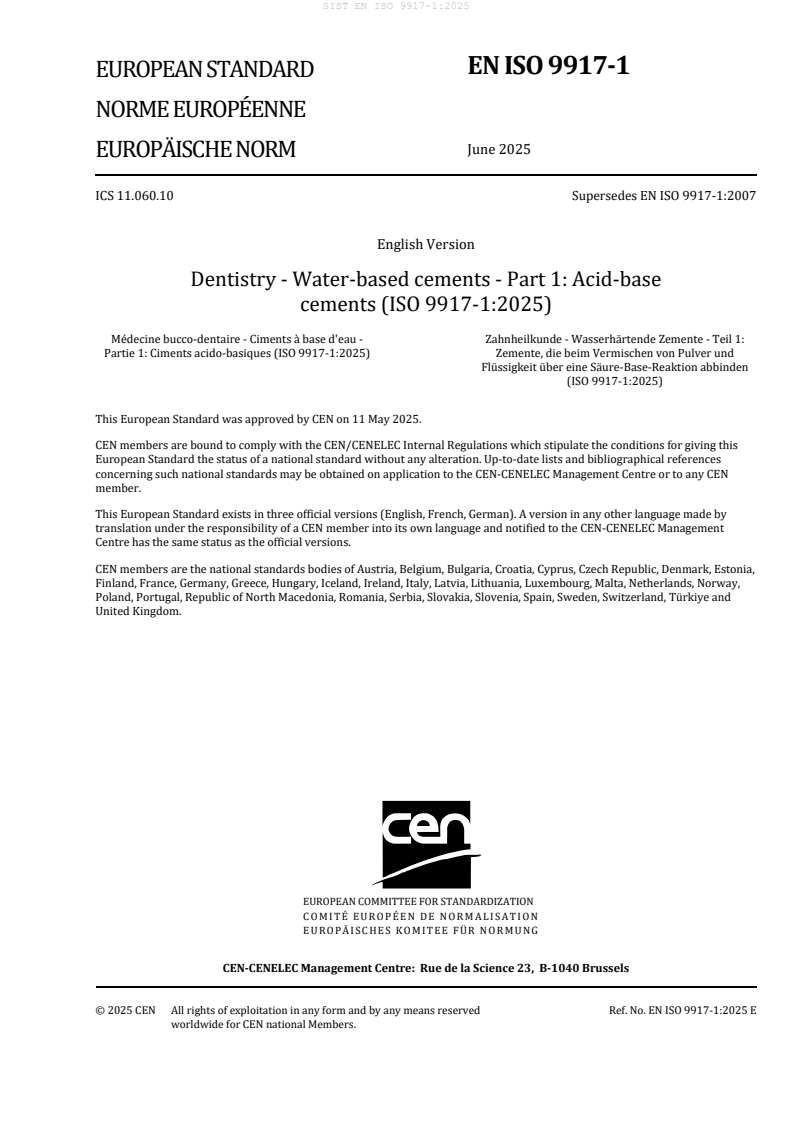
EN ISO 9917-1
EUROPEAN STANDARD
NORME EUROPÉENNE
June 2025
EUROPÄISCHE NORM
ICS 11.060.10 Supersedes EN ISO 9917-1:2007
English Version
Dentistry - Water-based cements - Part 1: Acid-base
cements (ISO 9917-1:2025)
Médecine bucco-dentaire - Ciments à base d'eau - Zahnheilkunde - Wasserhärtende Zemente - Teil 1:
Partie 1: Ciments acido-basiques (ISO 9917-1:2025) Zemente, die beim Vermischen von Pulver und
Flüssigkeit über eine Säure-Base-Reaktion abbinden
(ISO 9917-1:2025)
This European Standard was approved by CEN on 11 May 2025.
CEN members are bound to comply with the CEN/CENELEC Internal Regulations which stipulate the conditions for giving this
European Standard the status of a national standard without any alteration. Up-to-date lists and bibliographical references
concerning such national standards may be obtained on application to the CEN-CENELEC Management Centre or to any CEN
member.
This European Standard exists in three official versions (English, French, German). A version in any other language made by
translation under the responsibility of a CEN member into its own language and notified to the CEN-CENELEC Management
Centre has the same status as the official versions.
CEN members are the national standards bodies of Austria, Belgium, Bulgaria, Croatia, Cyprus, Czech Republic, Denmark, Estonia,
Finland, France, Germany, Greece, Hungary, Iceland, Ireland, Italy, Latvia, Lithuania, Luxembourg, Malta, Netherlands, Norway,
Poland, Portugal, Republic of North Macedonia, Romania, Serbia, Slovakia, Slovenia, Spain, Sweden, Switzerland, Türkiye and
United Kingdom.
EUROPEAN COMMITTEE FOR STANDARDIZATION
COMITÉ EUROPÉEN DE NORMALISATION
EUROPÄISCHES KOMITEE FÜR NORMUNG
CEN-CENELEC Management Centre: Rue de la Science 23, B-1040 Brussels
© 2025 CEN All rights of exploitation in any form and by any means reserved Ref. No. EN ISO 9917-1:2025 E
worldwide for CEN national Members.
Contents Page
European foreword . 3
European foreword
This document (EN ISO 9917-1:2025) has been prepared by Technical Committee ISO/TC 106
"Dentistry" in collaboration with Technical Committee CEN/TC 55 “Dentistry” the secretariat of which
is held by DIN.
This European Standard shall be given the status of a national standard, either by publication of an
identical text or by endorsement, at the latest by December 2025, and conflicting national standards
shall be withdrawn at the latest by December 2025.
Attention is drawn to the possibility that some of the elements of this document may be the subject of
patent rights. CEN shall not be held responsible for identifying any or all such patent rights.
This document supersedes EN ISO 9917-1:2007.
Any feedback and questions on this document should be directed to the users’ national standards
body/national committee. A complete listing of these bodies can be found on the CEN website.
According to the CEN-CENELEC Internal Regulations, the national standards organizations of the
following countries are bound to implement this European Standard: Austria, Belgium, Bulgaria,
Croatia, Cyprus, Czech Republic, Denmark, Estonia, Finland, France, Germany, Greece, Hungary, Iceland,
Ireland, Italy, Latvia, Lithuania, Luxembourg, Malta, Netherlands, Norway, Poland, Portugal, Republic of
North Macedonia, Romania, Serbia, Slovakia, Slovenia, Spain, Sweden, Switzerland, Türkiye and the
United Kingdom.
Endorsement notice
The text of ISO 9917-1:2025 has been approved by CEN as EN ISO 9917-1:2025 without any
modification.
International
Standard
ISO 9917-1
Third edition
Dentistry — Water-based
2025-05
cements —
Part 1:
Acid-base cements
Médecine bucco-dentaire — Ciments à base d’eau —
Partie 1: Ciments acido-basiques
Reference number
ISO 9917-1:2025(en) © ISO 2025
ISO 9917-1:2025(en)
© ISO 2025
All rights reserved. Unless otherwise specified, or required in the context of its implementation, no part of this publication may
be reproduced or utilized otherwise in any form or by any means, electronic or mechanical, including photocopying, or posting on
the internet or an intranet, without prior written permission. Permission can be requested from either ISO at the address below
or ISO’s member body in the country of the requester.
ISO copyright office
CP 401 • Ch. de Blandonnet 8
CH-1214 Vernier, Geneva
Phone: +41 22 749 01 11
Email: copyright@iso.org
Website: www.iso.org
Published in Switzerland
ii
ISO 9917-1:2025(en)
Contents Page
Foreword .iv
Introduction .v
1 Scope . 1
2 Normative references . 1
3 Terms and definitions . 1
4 Classification . 2
4.1 Chemical type .2
4.2 Application .2
5 Material. 3
5.1 General .3
5.2 Components .3
5.2.1 Liquid .3
5.2.2 Powder .3
5.3 Unset cement .3
6 Preparation of test specimens . 3
6.1 Ambient conditions.3
6.2 Method of mixing.3
7 Sampling . 3
7.1 Hand-mixed cements .3
7.2 Encapsulated cements .3
8 Requirements . 4
8.1 General .4
8.2 Net setting time (except pit and fissure sealing cements) .4
8.3 Film thickness (luting cements only) .4
8.4 Compressive strength .4
8.5 Acid erosion .4
8.6 Optical properties (polyalkenoate restorative cements only) .4
8.7 Acid-soluble arsenic and lead contents .4
8.7.1 Acid-soluble arsenic content .4
8.7.2 Acid-soluble lead content .4
8.8 Radiopacity (if claimed) .4
8.9 Net setting time (pit and fissure sealing cements only) .5
9 Packaging, marking, labelling and information to be supplied by manufacturer . 5
9.1 General .5
9.2 Packaging .5
9.3 Declaration of components .8
Annex A (normative) Determination of net setting time (except for pit and fissure sealing
cements) . 9
Annex B (informative) Chemical composition and applications of dental cements .11
Annex C (normative) Determination of film thickness (luting cements only) .12
Annex D (normative) Determination of compressive strength .15
Annex E (normative) Determination of acid erosion .18
Annex F (normative) Determination of optical properties (polyalkenoate restorative cements
only) .21
Annex G (normative) Determination of acid-soluble arsenic and lead contents .24
Annex H (normative) Determination of radiopacity (if claimed) .25
Annex I (normative) Determination of net setting time (pit and fissure sealing cements only) .27
Bibliography .29
iii
ISO 9917-1:2025(en)
Foreword
ISO (the International Organization for Standardization) is a worldwide federation of national standards
bodies (ISO member bodies). The work of preparing International Standards is normally carried out through
ISO technical committees. Each member body interested in a subject for which a technical committee
has been established has the right to be represented on that committee. International organizations,
governmental and non-governmental, in liaison with ISO, also take part in the work. ISO collaborates closely
with the International Electrotechnical Commission (IEC) on all matters of electrotechnical standardization.
The procedures used to develop this document and those intended for its further maintenance are described
in the ISO/IEC Directives, Part 1. In particular, the different approval criteria needed for the different types
of ISO documents should be noted. This document was drafted in accordance with the editorial rules of the
ISO/IEC Directives, Part 2 (see www.iso.org/directives).
ISO draws attention to the possibility that the implementation of this document may involve the use of (a)
patent(s). ISO takes no position concerning the evidence, validity or applicability of any claimed patent
rights in respect thereof. As of the date of publication of this document, ISO had not received notice of (a)
patent(s) which may be required to implement this document. However, implementers are cautioned that
this may not represent the latest information, which may be obtained from the patent database available at
www.iso.org/patents. ISO shall not be held responsible for identifying any or all such patent rights.
Any trade name used in this document is information given for the convenience of users and does not
constitute an endorsement.
For an explanation of the voluntary nature of standards, the meaning of ISO specific terms and expressions
related to conformity assessment, as well as information about ISO's adherence to the World Trade
Organization (WTO) principles in the Technical Barriers to Trade (TBT), see www.iso.org/iso/foreword.html.
This document was prepared by Technical Committee ISO/TC 106, Dentistry, Subcommittee SC 1, Filling and
restorative materials, in collaboration with the European Committee for Standardization (CEN) Technical
Committee CEN/TC 55, Dentistry, in accordance with the Agreement on technical cooperation between ISO
and CEN (Vienna Agreement).
This third edition cancels and replaces the second edition (ISO 9917-1:2007), which has been technically
revised.
The main changes are as follows:
— change of the title;
— inclusion of pit and fissure sealing cements in the scope;
— adoption of ISO 13116 test method for radiopacity;
— adoption of table-type formatting of requirements of marking and information;
— addition of declaration of components;
— addition of Annex I.
A list of all parts of the ISO 9917 series can be found on the ISO website.
Any feedback or questions on this document should be directed to the user’s national standards body. A
complete listing of these bodies can be found at www.iso.org/members.html.
iv
ISO 9917-1:2025(en)
Introduction
This document specifies the requirements and test methods for cements in which setting is achieved by an
acid-base reaction.
This document does not include specific qualitative and quantitative requirements for ensuring the absence
of biological hazards. It is recommended that reference be made to ISO 10993-1 and ISO 7405 when assessing
possible biological or toxicological hazards.
v
International Standard ISO 9917-1:2025(en)
Dentistry — Water-based cements —
Part 1:
Acid-base cements
1 Scope
This document specifies requirements and test methods for acid-base, dental cements intended for permanent
cementation, lining and restoration. This document is not intended to address resin-modified water-based
cements. This document is applicable to both hand-mixed and encapsulated cements for mechanical mixing.
This document specifies limits for each of the properties according to whether the cement is intended for
use as a luting agent, base or liner, restorative material or pit and fissure sealing cement.
2 Normative references
The following documents are referred to in the text in such a way that some or all of their content constitutes
requirements of this document. For dated references, only the edition cited applies. For undated references,
the latest edition of the referenced document (including any amendments) applies.
ISO 1942, Dentistry — Vocabulary
1)
ISO 2590, General method for the determination of arsenic — Silver diethyldithiocarbamate photometric method
ISO 3696, Water for analytical laboratory use — Specification and test methods
ISO 7491, Dental materials — Determination of colour stability
ISO 8601-1, Date and time — Representations for information interchange — Part 1: Basic rules
ISO 13116, Dentistry — Test method for determining radio-opacity of materials
ISO 15223-1, Medical devices — Symbols to be used with information to be supplied by the manufacturer — Part
1: General requirements
ISO 20417, Medical devices — Information to be supplied by the manufacturer
3 Terms and definitions
For the purposes of this document, the terms and definitions given in ISO 1942 and the following apply.
ISO and IEC maintain terminology databases for use in standardization at the following addresses:
— ISO Online browsing platform: available at https:// www .iso .org/ obp
— IEC Electropedia: available at https:// www .electropedia .org/
1) Withdrawn.
ISO 9917-1:2025(en)
3.1
mixing time
time measured from first contact between the components of a material, required to achieve a homogeneous
mixture of the components when they have been stored, proportioned and mixed according to the
manufacturer’s instructions
[SOURCE: ISO 1942:2020, 3.3.1.36]
3.2
working time
period of time measured from the commencement of mixing the components of a material or otherwise
activating the chemistry of the material and ending before the material has developed properties that
prevent it from being manipulated as required to achieve its purpose in a subsequent procedure or in its
intended end function
[SOURCE: ISO 1942:2020, 3.3.3.22]
3.3
net setting time
period of time from the end of mixing until the material has set according to the criteria and conditions
specified in Annex A and Annex I
Note 1 to entry: For the purposes of this document, in view of the wide variation in mixing times of cements, the net
setting time is determined from the end of mixing.
3.4
encapsulated cements
acid-base cements packaged as a unit dose whose packaging includes the powder and the liquid for mixing at
the time of use by some mechanical means other than hand apportioning
Note 1 to entry: The alternative to an encapsulated cement is a hand-mixed cement.
4 Classification
4.1 Chemical type
For the purposes of this document, acid-base cements shall be classified on the basis of their chemical
composition as follows:
a) zinc phosphate cements, see Clause B.1;
b) zinc polycarboxylate cements, see Clause B.2;
c) glass polyalkenoate cements, see Clause B.3.
Acid-base reaction setting, water-based cements other than those listed above can fall within the scope of
this document. A manufacturer shall specify whether their product shall conform to the specifications for
list items a), b) or c) and 4.2.
NOTE Materials that do not involve an acid-base reaction (e.g., “calcium silicate-based cement”) are not covered
by this document.
4.2 Application
For the purposes of this document, the applications of water-based cements shall be classified as follows:
a) luting agent;
b) bases or liner;
c) restorative material;
ISO 9917-1:2025(en)
d) pit and fissure sealing cement.
5 Material
5.1 General
The cement shall consist of a powder and liquid which, when mixed in accordance with the manufacturer’s
instructions, shall conform to requirements in this clause and Clause 8.
5.2 Components
5.2.1 Liquid
For non-encapsulated cements, visually inspect the liquid. It shall be free from deposits or filaments on the
inside of its container. There shall be no visible signs of gelation, i.e. no formation of insoluble or solid matter.
5.2.2 Powder
For non-encapsulated cements, visually inspect the powder. It shall be free from extraneous material. If the
powder is coloured, the pigment shall be uniformly dispersed throughout the powder.
5.3 Unset cement
The cement shall be mixed in accordance with Clause 6, and then visually inspected. It shall be homogeneous
and of a smooth consistency.
6 Preparation of test specimens
6.1 Ambient conditions
Specimens shall be prepared at (23 ± 1) °C and a relative humidity of (50 ± 10) %.
6.2 Method of mixing
The cement shall be prepared in accordance with the manufacturer’s instructions. Sufficient cement shall
be mixed to ensure that the preparation of each specimen is completed from one mix. A fresh mix shall be
prepared for each specimen.
NOTE For encapsulated cements, more than one capsule simultaneously mixed can be required for certain
specimens.
7 Sampling
7.1 Hand-mixed cements
A sample drawn from one batch shall provide sufficient material to complete all the prescribed tests and any
necessary repeats.
NOTE Approximately 50 g of powder can be necessary to complete the tests.
7.2 Encapsulated cements
The test sample shall comprise a retail package of enough capsules from one batch to complete all the tests
and any necessary repeats.
ISO 9917-1:2025(en)
8 Requirements
8.1 General
Calibrate all critical apparatus in accordance with the general requirements for the competence of testing
and calibration laboratories; see ISO/IEC 17025.
8.2 Net setting time (except pit and fissure sealing cements)
Net setting time shall be determined in accordance with Annex A and in accordance with the relevant
requirements specified in Table 1.
8.3 Film thickness (luting cements only)
Film thickness shall be determined in accordance with Annex C and in accordance with the relevant
requirements specified in Table 1.
8.4 Compressive strength
Compressive strength shall be determined in accordance with Annex D and in accordance with the relevant
requirements specified in Table 1.
8.5 Acid erosion
Acid erosion shall be determined in accordance with Annex E and in accordance with the relevant
requirements specified in Table 1.
8.6 Optical properties (polyalkenoate restorative cements only)
Opacity and colour shall be determined in accordance with Annex F and shall meet the following
requirements:
a) The opacity of the set restorative cements shall be within the limits specified in Table 1, unless the
restorative cement is designated as opaque by the manufacturer (see Table 2, item 13).
b) The colour of the set cement shall match the manufacturer’s shade guide. If the manufacturer does not
provide a shade guide, the manufacturer shall nominate a commercially available shade guide that shall
be used in assessing conformity with this requirement (see Table 2, item 12).
8.7 Acid-soluble arsenic and lead contents
8.7.1 Acid-soluble arsenic content
Acid-soluble arsenic content shall be determined in accordance with Annex G and in accordance with the
relevant requirements specified in Table 1.
8.7.2 Acid-soluble lead content
Acid-soluble lead content shall be determined in accordance with Annex G and in accordance with the
relevant requirements specified in Table 1.
8.8 Radiopacity (if claimed)
When the manufacturer describes the material as being radio-opaque (see Table 2, item 14), the radiopacity
shall be determined in accordance with Clause H.5, list item a) and shall be at least equivalent to that for the
same thickness of aluminium. When the manufacturer claims a greater radiopacity (see Table 2, item 15),
ISO 9917-1:2025(en)
the measured value shall not be less than the value claimed when determined in accordance with Clause H.5,
list item b).
8.9 Net setting time (pit and fissure sealing cements only)
Net setting time shall be determined in accordance with Annex I and in accordance with the relevant
requirements specified in Table 1.
Table 1 — Requirements for acid-base cements
Film Com- Acid Acid-sol- Acid-sol-
Net setting
thick- pressive ero- uble As uble Pb
Opacity
time
ness strength sion content content
C
Application Chemical type
0,70
µm minutes MPa mm mg/kg mg/kg
max. min. max. min. max. min. max. max. max.
Zinc phosphate 25 2,5 8 50 0,30 ― ― 2 100
Luting Zinc polycarboxylate 25 2,5 8 50 0,40 ― ― 2 100
a
Glass polyalkenoate 25 1,5 8 50 0,17 ― ― ― 100
Zinc phosphate ― 2,0 6 50 0,30 ― ― 2 100
Base/lining Zinc polycarboxylate ― 2,0 6 50 0,40 ― ― 2 100
a
Glass polyalkenoate ― 1,5 6 50 0,17 ― ― ― 100
a
Restoration Glass polyalkenoate ― 1,5 6 100 0,17 0,35 0,90 ― 100
Pit and fissure ― 1,5 6 50 0,17 ― ― ―
a
Glass polyalkenoate 5
sealing
a
Synonymous with “glass-ionomer”.
9 Packaging, marking, labelling and information to be supplied by manufacturer
9.1 General
Information shall be clearly marked on the outermost packaging or containers (for multi-dose packs), as
indicated in Table 2 and conform to ISO 20417.
Visually inspect to verify the requirements in Table 2.
NOTE 1 Additional information to that specified in Table 2 can be supplied at the discretion of the manufacturer or
as required by regulation.
NOTE 2 Table 2 contains optional items and serves as a guide to the manufacturer as to the type of information
which can be useful to clinicians.
9.2 Packaging
a) The cements shall be supplied in containers or capsules that afford adequate protection and have no
adverse effect on the quality of the contents.
b) For the purposes of this document, a container or capsule shall be considered to be the immediate
packaging of the cements.
c) The outermost packaging contains the material, the instructions for use and any proportioning or
mixing devices that are supplied for the material.
d) An outer pack may also be used to present the containers or capsules as a single unit.
ISO 9917-1:2025(en)
Table 2 — Requirements for marking and instructions for use
Outer
pack of
Outer- Manufacturer’s
capsule(s) Capsule
Items of marking and instructions for use most pack- instructions for
/ multiple (single dose)
aging use
dose con-
tainer
The trade name, type and application of the ce-
1 M M NA M
ment
Either the manufacturer’s name or trademark, or
2 M M OPT M
both.
3 The manufacturer’s name and contact details M OPT NA M
The manufacturer’s internet address (URL), if one
exists, is optional. However, where instructions
for use are provided on a medium other than
paper, the manufacturer should ensure the user
4 OPT OPT NA OPT
has information on how to: view the instructions
for use; access the correct version of the instruc-
tions for use; and obtain a paper version of the
instructions for use.
5 The recommended conditions of storage M OPT NA M
6 The manufacturer’s batch or lot number M M OPT NA
The expiry date, expressed in accordance with ISO
8601-1, for the material if stored under the manu-
facturer’s recommended conditions
7 M M OPT NA
Graphical symbols in accordance with ISO 15223-
1, if applicable, to avoid confusion of sizes or kits
8 The chemical type of the cement (see 4.1) M OPT OPT M
9 The clinical application (see 4.2) OPT OPT NA M
If the product is an encapsulated type, the number
10 M M NA NA
c
of capsules in the outer pack
The minimum net mass, in g, of the powder or
11 the minimum net volume, in ml, of the liquid as OPT M OPT OPT
appropriate
M
The shade of the powder according to
12 OPT M OPT (shade guide or
the manufacturer’s nominated shade guide
designation of it)
a
13 Whether the cement is designated as opaque M M OPT M
14 Whether the cement is designated as radio-opaque OPT OPT OPT M
If a specific claim on the extent of radiopacity
15 is made, the equivalent thickness of aluminium OPT OPT NA M
claimed for 1 mm thickness of the cement (see 8.8)
Key
M mandatory
OPT optional
NA not applicable
a
Opaque designation can be included in the shade.
b
For hand-mixed cements only.
c
For encapsulated cements only.
ISO 9917-1:2025(en)
TTabablele 2 2 ((ccoonnttiinnueuedd))
Outer
pack of
Outer- Manufacturer’s
capsule(s) Capsule
Items of marking and instructions for use most pack- instructions for
/ multiple (single dose)
aging use
dose con-
tainer
The recommended powder-to-liquid ratio, ex-
pressed as a mass-to-mass ratio for the recom-
mended temperature range, and an indication of
how the user may achieve this ratio
16 OPT OPT NA M
[for test purposes, the powder-to-liquid ratio on
a mass-to-mass basis to a precision of 0,01 g at
(23 ± 2) °C and a relative humidity of (50 ± 10) %
b
shall be included]
The rate of incorporation of the powder into the
17 OPT OPT NA M
b
liquid
18 The mixing time (see 3.1) OPT OPT NA M
The type of the mixing slab and spatula and their
19 OPT OPT NA M
b
condition
The method of bringing about physical contact
20 OPT OPT NA M
c
between the powder and liquid
The type of mechanical mixing device and the
21 OPT OPT NA M
c
mixing time to be employed
22 The working time (see 3.2) OPT OPT NA M
23 The net setting time (see 3.3) OPT OPT NA M
If appropriate, a statement recommending that a
24 liner should be placed between the cement and the NA NA NA OPT
dentine
The minimum deliverable volume, in ml, of mixed
25 OPT OPT NA M
c
cement in one capsule
If appropriate, the minimum time at which finish-
26 OPT OPT NA OPT
ing of a restorative may be commenced
If appropriate, the recommended method of finish-
27 OPT OPT NA OPT
ing of a restorative
If appropriate, a statement indicating that the
surface of the restorative shall be coated with a
28 OPT OPT NA OPT
protective coating and guidance on the type of
coating to be used
When necessary, special indications or warnings
in respect of properties like toxicity, hazard, flam-
29 OPT OPT OPT M
mability or tissue irritancy, for both patient and
operator
30 Date of issue of the instructions NA NA NA M
Key
M mandatory
OPT optional
NA not applicable
a
Opaque designation can be included in the shade.
b
For hand-mixed cements only.
c
For encapsulated cements only.
ISO 9917-1:2025(en)
9.3 Declaration of components
The manufacturer shall provide, either in the instructions for use or by means of a safety data sheet, the
composition and information on components present in the material ≥ 1 % by mass (irrespective of hazard
potential) and any ingredient that is classified as a carcinogen, mutagen or reproductive toxicant (CMR)
present in the material ≥ 0,1 % by mass.
The list shall include a chemical name or its common abbreviation, if available (e.g. bis-GMA, HEMA,
TEGDMA). The Chemical Abstracts Service registry number (CAS number) may be used.
Either the mass percentage range for each listed component or a listing in the order of mass from the highest
to the lowest concentration shall be provided.
NOTE CMR is defined in authoritative lists. See examples in References [4], [5], [6] and [7].
The manufacturer may include additional information at their discretion.
ISO 9917-1:2025(en)
Annex A
(normative)
Determination of net setting time (except for pit and fissure sealing
cements)
A.1 Apparatus
A.1.1 Cabinet, capable of being maintained at (37 ± 1) °C and a relative humidity of at least 90 %.
A.1.2 Indentor, of mass (400 ± 5) g, with a needle that has a flat end of diameter (1,0 ± 0,1) mm which is
plane and perpendicular to the long axis of the needle.
A.1.3 Metal mould, similar to that shown in Figure A.1. Internal corners may be square or round.
A.1.4 Metal block, of minimum dimensions 8 mm × 75 mm × 100 mm positioned within the cabinet and
maintained at (37 ± 1) °C.
A.1.5 Aluminium foil.
A.1.6 Timer, accurate to 1 s.
A.1.7 Magnifier, capable of ×2 magnification.
Dimensions in millimetres
Tolerance on dimensions:
Thickness: ±0,15
Length: ±1,0
Figure A.1 — Mould for preparation of specimens for determination of net setting time
A.2 Procedure
A.2.1 Preliminary measurement of approximate net setting time
1) Condition the metal block (A.1.4) and indentor (A.1.2) to (37 ± 1) °C.
2) Place the mould (A.1.3), conditioned to (23 ± 1) °C, on the aluminium foil (A.1.5).
ISO 9917-1:2025(en)
3) Mix the cement as required by the manufacturer’s instructions. When mixing is complete, start the
timer (A.1.6).
4) Fill the mould to a level surface with the mixed cement.
5) Sixty seconds after mixing is complete, place the assembly, comprising the mould, foil and cement, on
the block (A.1.4) in the cabinet (A.1.1), ensuring good contact between the mould, foil and block.
6) Ninety seconds after mixing is complete, carefully lower the indentor (A.1.2) vertically on to the surface
of the cement in the cabinet and allow it to remain there for 5 s.
7) Raise the indentor and inspect the indentation with the magnifier (A.1.7). Observe whether the
indentation is a complete circle. If the indentation is not a complete circle, the approximate net setting
time has been determined. If the indentation is a complete circle, close the cabinet and proceed. Clean
the needle, if necessary.
8) Repeat the indentations in the cabinet at 30 s intervals until the needle no longer makes a complete
circular indentation in the cement when viewed using ×2 magnification. Clean the needle, if necessary,
between indentations.
9) Record the approximate net setting time as the time elapsed between completion of mixing and the time
when the needle fails to make a complete circular indentation in the cement.
A.2.2 Determination of net setting time
1) Repeat steps A.2.1, 1) to 5) with a fresh sample and start the timer.
2) Thirty seconds before the approximate net setting time determined in A.2.1, 9), carefully lower the
indentor (A.1.2) vertically on to the surface of the cement in the cabinet and allow it to remain there for 5 s.
3) Raise the indentor and inspect the indentation with the magnifier (A.1.7). Observe whether the
indentation is a complete circle. If the indentation is not a complete circle, the net setting time has been
determined. If the indentation is a complete circle, close the cabinet and proceed. Clean the needle, if
necessary.
4) Repeat the indentations in the cabinet at 10 s intervals until the needle no longer makes a complete
circular indentation in the cement when viewed using ×2 magnification. Clean the needle, if necessary,
between indentations.
5) Record the net setting time as the time elapsed between completion of mixing and the time when the
needle fails to make a complete circular indentation in the cement.
6) Repeat the steps A.2.2, 1) to 5) with fresh cement samples two more times.
7) Record the average of these three tests of the net setting time to the nearest 10 s.
A.3 Treatment of results
Record the results of the three tests. Each result shall fall within the range specified in Table 1 for the
cements to meet the requirements of 8.2.
ISO 9917-1:2025(en)
Annex B
(informative)
Chemical composition and applications of dental cements
B.1 Zinc phosphate cements
Zinc phosphate cements are based on the reaction between an oxide powder (the principal constituent of
which is zinc oxide) and an aqueous solution of phosphoric acid which can contain other metal ions. They
can be used to cement dental appliances to hard oral structures or to other appliances. They can also be
used as bases for restorative materials and as temporary restorative materials.
B.2 Zinc polycarboxylate cements
Zinc polycarboxylate cements are based on the reaction between zinc oxide and aqueous solutions of
polyacrylic acid or similar polycarboxylic compounds, or zinc oxide/polycarboxylic acid powders which
are mixed with water. They can be used to cement dental appliances to hard oral structures or to other
appliances. They can also be used as a base for restorative materials and as a temporary restorative material.
B.3 Glass polyalkenoate cements
Glass polyalkenoate (glass ionomer) cements are based on the reaction between an aluminosilicate glass
powder and an aqueous solution of a polyalkenoic acid, or between an aluminosilicate glass/polyalkenoic
acid powder blend and water, or an aqueous solution of tartaric acid. These cements are used for aesthetic
restorations of teeth or as bases or liners for other restorations. They can also be used to cement dental
appliances to hard oral structures or to other appliances. This type also includes glass polyalkenoate
cements in which an aluminosilicate glass and a metal have been fused or mixed together and which are
intended for the restoration of teeth.
ISO 9917-1:2025(en)
Annex C
(normative)
Determination of film thickness (luting cements only)
C.1 Apparatus
C.1.1 Two optically flat, square or circular glass plates, which has a contact surface area
of (200 ± 25) mm . Each plate shall be of uniform thickness of not less than 5 mm.
C.1.2 Loading device, of the type illustrated in Figure C.1, or an equivalent means, whereby a force
of (150 ± 2) N may be generated vertically to the specimen via the upper glass plate.
The anvil, which is attached to the bottom of the rod carrying the load, shall be horizontal and parallel to
the base. The device shall be such that the force is applied smoothly and in such a manner that no rotation
occurs. The platen shall be flat and parallel, and normal to the load axis. A worn platen shall be replaced.
C.1.3 Screw micrometer or equivalent measuring instrument, which has graduations of 2 µm or less.
ISO 9917-1:2025(en)
Key
1 specimen
2 glass discs
3 anvil
4 platen
Figure C.1 — Loading device for use in film thickness test
C.2 Procedure
Measure and record to an accuracy of 1 µm the combined thickness of the two optically flat glass plates
(C.1.1) stacked in contact. Designate this measurement reading A. Remove the upper plate and place
(0,10 ± 0,05) ml of the mixed cement in the centre of the lower plate. Place this centrally below the loading
device (C.1.2) on the lower platen. Replace the second glass plate centrally on the cement in the same
orientation as in the original measurement.
Ten seconds before the end of the manufacturer’s stated working time, gently apply a force of (150 ± 2) N
vertically and centrally to the specimen via the top plate. Ensure that the cement fills the space between the
glass plates. When at least 10 min have elapsed after the application of the force, remove the plates from the
loading device and measure the combined thickness of the two glass plates and the cement film. Designate
this measurement reading B.
Record the difference in thickness of the plates with and without the cement film (reading B − reading A) as
the thickness of the film. Repeat the test four times.
ISO 9917-1:2025(en)
C.3 Treatment of results
At least four of the five results shall be below 25 µm for the cement to pass the requirement specified in
8.3 and Table 1. If only two or fewer results are below 25 µm, the cement shall fail the requirement. If three
results are below 25 µm, a further five specimens shall be tested. To meet the requirement specified in 8.3
and
...
SIST EN ISO 9917-1:2025は、歯科領域における水基準セメントの標準化文書であり、酸-塩基セメントに特化しています。この標準は、永久的なセメント接着、ライニングおよび修復を目的とした酸-塩基の歯科セメントに対する要求事項と試験方法を明確に示しています。この文書は、樹脂改質水基準セメントを対象としておらず、純度の高い酸-塩基セメントの特性に焦点を当てている点が特徴的です。 この標準の強みは、手混合および機械的混合用のカプセル化セメントに両方に適用できることです。この柔軟性は、異なる使用状況におけるセメントの適用性を高め、広範な実践に対応することができます。また、セメントの使用目的に応じた各特性に対する制限が規定されており、接着剤、ベースまたはライナー、修復材料、エナメル質および亀裂のシーリングの目的に応じた正確な選択を可能にします。 さらに、EN ISO 9917-1:2025は、医療品質の基準を確保するため、現行の科学的知識や技術を考慮しており、歯科医療における安全性と効果を最大限に引き出すことに貢献しています。この文書は、業界全体に対して重要な改善をもたらすものであり、今後の歯科治療における水基準セメントの利用において欠かせない基盤となるでしょう。 このように、SIST EN ISO 9917-1:2025の制定は、歯科医療分野における基準の整備を進め、医療従事者が選択する際の明確な指針を提供するものです。これにより、患者に対するサービスの質も向上することが期待されます。
Die Norm EN ISO 9917-1:2025 legt die Anforderungen und Prüfmethoden für säure-basierte dental cements fest, die für die permanente Zementierung, als Auskleidung und zur Restauration bestimmt sind. Diese Norm spricht insbesondere die Eigenschaften von sauer-basierten Zementen an und grenzt sich klar von harzmodifizierten, wasserbasierten Zementen ab, was ihre Relevanz im Bereich der Zahnmedizin unterstreicht. Die Stärken der Norm liegen in ihrer klaren Struktur und den präzisen Vorgaben, die sowohl für handgemischte als auch für verkapselte Zemente für die mechanische Mischung gelten. Dies ermöglicht eine einheitliche Anwendung in der Zahnarztpraxis, was für die Sicherstellung hoher Qualitätsstandards von entscheidender Bedeutung ist. Zudem definiert die Norm spezifische Grenzwerte für verschiedene Eigenschaften, abhängig davon, ob der Zement als Zementierungsmittel, Basis oder Auskleidung, restauratives Material oder für die Versiegelung von Grübchen und Fissuren gedacht ist. Diese Differenzierung ist unerlässlich, um die Eignung der Produkte für bestimmte klinische Anwendungen zu gewährleisten. Die Norm EN ISO 9917-1:2025 hat eine hohe Relevanz für Fachleute in der Zahnmedizin, da sie nicht nur die Qualität und Sicherheit der verwendeten Materialien garantiert, sondern auch die Patientenversorgung optimiert. Durch die Einhaltung der in der Norm festgelegten Standards können Zahnärzte sicherstellen, dass sie stets die besten Praktiken in ihrer Behandlung anwenden, was letztlich zu positiven Behandlungsergebnissen führt. Zusammenfassend lässt sich festhalten, dass die Norm EN ISO 9917-1:2025 ein unverzichtbares Dokument für alle Fachleute im Bereich der Zahnmedizin darstellt, die mit Wasser-zementierten Materialien arbeiten. Die klar definierten Anforderungen und Prüfmethoden erhöhen die Sicherheit und Effizienz in der Zahnbehandlung und tragen zur Gesundheitsförderung in der Bevölkerung bei.
The EN ISO 9917-1:2025 standard presents a comprehensive framework that stipulates essential requirements and test methods for acid-base dental cements, which are integral in the realms of permanent cementation, lining, and restoration in dentistry. This standard is particularly relevant as it distinguishes itself by specifically focusing on acid-base cements while clearly excluding resin-modified water-based cements, thereby channeling its applicability toward a well-defined category of dental materials. The strengths of this standard lie in its detailed guidance on both hand-mixed and encapsulated cements suitable for mechanical mixing. By covering these two forms of cement application, the standard accommodates a broader spectrum of clinical practices, fostering versatility in dental procedures. Moreover, the specification of limits for various properties, depending on the intended use-whether as a luting agent, base or liner, restorative material, or pit and fissure sealing cement-enhances the clarity and usability of the standard for dental professionals. The meticulous approach taken by the EN ISO 9917-1:2025 in outlining test methods and performance criteria ensures that practitioners can select materials that meet consistent quality standards, ultimately supporting better patient outcomes. As the dental field continually evolves with advancements in materials and techniques, this standard remains highly relevant by providing a validated reference point that aligns with contemporary practices and regulatory requirements. This relevance is further underscored by its potential to facilitate communication among professionals, manufacturers, and regulatory bodies involved in the development and application of dental cements. In summary, the EN ISO 9917-1:2025 standard serves as a critical resource for dentistry professionals, ensuring that acid-base cements are used effectively and safely within clinical settings, thereby enhancing the overall integrity of dental restorative procedures.
La norme SIST EN ISO 9917-1:2025 établit des exigences claires et des méthodes d'essai pour les ciments dentaires à base d'acide et d'eau, spécifiquement conçus pour les applications de cimentation permanente, de revêtement et de restauration. Ce document joue un rôle crucial dans la normalisation des ciments dentaires, fournissant un cadre précis applicable tant aux ciments mélangés à la main qu'à ceux encapsulés destinés à un mélange mécanique. Un des points forts de cette norme réside dans sa portée bien définie, qui exclut délibérément les ciments à base d'eau modifiés par des résines, ainsi permettant aux praticiens de se concentrer sur les applications traditionnelles des ciments dentaire acide-base. Les limites de chaque propriété des ciments sont clairement spécifiées en fonction de leur utilisation prévue (agent de scellement, base ou revêtement, matériau de restauration ou ciment pour le scellement de sillons et de fissures), ce qui renforce la pertinence de la norme dans le cadre des soins dentaires. La norme EN ISO 9917-1:2025 se distingue par sa capacité à garantir la qualité et la sécurité des matériaux utilisés en dentisterie, contribuant ainsi à améliorer les résultats cliniques. En structurant les exigences de manière rigoureuse tout en étant applicable à divers types de ciments dentaires, ce document répond adéquatement aux besoins des professionnels de la santé dentaire et assure une harmonisation des pratiques au niveau international.
SIST EN ISO 9917-1:2025 표준은 치과 분야에서 사용되는 수용성 시멘트의 중요한 기준을 설정하고 있습니다. 본 문서는 영구적인 접착, 기초 및 복원 등을 위한 산-염기 시멘트의 요구 사항과 시험 방법을 구체적으로 규정하고 있습니다. 이 표준은 수지 변형 수용성 시멘트에 대해서는 다루고 있지 않으며, 수동 혼합 및 기계 혼합을 위한 캡슐화된 시멘트 모두에 적용됩니다. EN ISO 9917-1:2025의 강점은 다양한 치과 치료의 필요성을 충족하도록 설계된 포괄적인 요구 사항을 제공한다는 것입니다. 시멘트의 성능은 최종 사용 목적에 따라 분류되며, 접착제, 바닥재 또는 라이너, 복원 재료 및 구멍 및 틈새 밀봉 시멘트로의 사용 용도에 대한 명확한 경계를 설정하고 있습니다. 이는 임상 환경에서 시멘트의 적절한 선택과 활용을 용이하게 하며, 치료 결과의 일관성을 높이는 데 기여합니다. 또한 이 표준의 관련성은 치과 진료의 안전성과 효과성을 증대시키는 데 있습니다. 정확한 요구 사항과 시험 방법이 설정되어 있어, 제조업체는 품질 보증을 위한 기준을 준수할 수 있으며, 사용자는 시멘트 제품이 기대하는 성능을 발휘할 것이라는 신뢰를 가질 수 있습니다. 이 표준은 치과 치료의 질적 향상을 위한 중요한 도구이며, 업계 내에서의 지속적인 발전을 위한 기초를 제공합니다.
La norme EN ISO 9917-1:2025 représente une avancée significative dans le domaine de la dentisterie, en établissant des exigences claires et des méthodes d'essai pour les ciments dentaires à base d'eau, en particulier les ciments acido-basiques. Son champ d'application se concentre sur la cimentation permanente, le revêtement et la restauration, offrant ainsi un cadre standardisé pour un large éventail d'applications cliniques. L'un des points forts de cette norme est sa capacité à définir des limites précises pour les propriétés des ciments en fonction de leur utilisation spécifique, qu'il s'agisse d'agents de scellement, de bases ou de liners, de matériaux de restauration ou de ciments d'étanchéité pour sillons et fissures. Cela permet aux praticiens de choisir le ciment le plus approprié pour chaque cas clinique, assurant ainsi la sécurité et l'efficacité des traitements dentaires. De plus, la norme s'applique tant aux ciments mélangés à la main qu'à ceux encapsulés pour un mélange mécanique, offrant ainsi une flexibilité qui répond aux divers besoins des cabinets dentaires. Bien que la norme n'aborde pas les ciments à base d'eau modifiés par résine, sa spécificité sur les ciments acido-basiques en fait un outil essentiel pour les dentistes souhaitant garantir des résultats de qualité optimale pour leurs patients. En résumé, la norme EN ISO 9917-1:2025 est un référentiel pertinent et à jour, qui renforce la standardisation dans le domaine des ciments dentaires et contribue à l'amélioration continue des pratiques cliniques en dentisterie.
EN ISO 9917-1:2025は、歯科用の水性セメント、特に酸-塩基セメントに関する重要な基準を提供しています。この文書は、永久的なセメント化、ライニング及び修復を目的とした酸-塩基型の歯科セメントに対する要件と試験方法を明確に定義しており、実用性が高いことが特徴です。 この標準化文書のスコープは、手混合及び機械混合用のカプセル入りセメントの両方に適用され、使用方法に応じてルーティング剤、ベースまたはライナー、修復材料、またはピットおよびフィッシャーシーリングセメントとして使用される際の各特性の限界を指定しています。これにより、歯科医がセメントを選択する際の明確な指針を提供し、治療の一貫性を確保する手助けをしています。 この標準の強みは、その詳細な要件定義にあります。特に、各種セメントの使用目的に応じた個別の特性が非常に明確に規定されているため、医療従事者が患者に提供する材料の信頼性を高めることが可能です。また、酸-塩基セメントに限定しているため、他の種類のセメントと混同することなく、特異性を保持しています。これにより、誤った使用によるリスクが軽減され、適切な医療が提供されることに寄与します。 さらに、EN ISO 9917-1:2025は、国際的な規格として広く受け入れられており、歯科医療の国際標準化において極めて重要であると言えます。各国の歯科医療機関においても、基準に準拠することで、全球的な治療水準を向上させることが期待されます。この文書は、今後の研究や開発においても大いに参照されることでしょう。
The EN ISO 9917-1:2025 standard offers a comprehensive framework for the evaluation and implementation of acid-base dental cements. Its broad scope encompasses requirements and test methods specifically tailored for cements used in permanent cementation, lining, and restoration, making it a crucial resource for dental professionals and manufacturers alike. One of the key strengths of this standard is its clear delineation between different types of uses for dental cements. By specifying limits for each property based on the intended application-whether as a luting agent, base or liner, restorative material, or pit and fissure sealing cement-the standard ensures that users can select appropriate products for their specific needs. This targeted approach enhances the performance and safety of dental procedures, as practitioners can rely on consistent quality and efficacy of the materials they employ. Furthermore, the EN ISO 9917-1:2025 standard recognizes the necessity of accommodating various mixing methods by including provisions for both hand-mixed and encapsulated cements suitable for mechanical mixing. This flexibility is particularly relevant in today's diverse dental practices, where efficiency and adaptability are paramount. The exclusion of resin-modified water-based cements from the scope further refines the standard’s applicability, allowing it to concentrate on traditional acid-base formulations. This fortifies its relevance for dentists and laboratory technicians who are focused on established cement technologies while also ensuring that newer materials are addressed in separate standards. Overall, the EN ISO 9917-1:2025 standard is a critical tool for ensuring quality control and standardization in the production and application of dental cements, impacting the clinical outcomes of restorative dentistry significantly. Its well-defined parameters and rigorous test methods empower dental professionals to make informed choices, ultimately enhancing patient care.
EN ISO 9917-1:2025 표준은 치과 분야에서 사용되는 수성 시멘트의 요구 사항 및 시험 방법을 자세히 규명하고 있습니다. 특히 산-염기 시멘트에 초점을 맞추어, 이 표준은 영구적인 시멘테이션, 라이닝 및 복원에 사용되는 다목적 치과 시멘트의 특성과 성능을 명확히 정의합니다. 이 표준의 주요 강점 중 하나는 각 시멘트의 사용 용도에 따라 특정 속성의 한계를 명시하고 있다는 점입니다. 시멘트가 루팅제, 바닥재 또는 라이너, 복원 재료 또는 pit 및 fissure sealing 시멘트로 사용될 경우, 각기 다른 특성 기준이 설정되어 있어 관련 제품의 성능을 정확하게 평가하는 데 큰 도움이 됩니다. 또한, 손 믹스 및 캡슐화된 기계 믹싱을 위한 시멘트 모두에 적용 가능한 이 표준은 다양한 제조 공정과 사용 조건을 포괄하고 있어, 치과 전문가들이 실제 임상에서 보다 효과적으로 활용할 수 있는 근거를 제공합니다. 따라서 EN ISO 9917-1:2025는 치과 시멘트의 품질 보장과 환자 안전성 향상을 위한 매우 중요한 문서라고 할 수 있습니다. 전반적으로, EN ISO 9917-1:2025 표준은 치과 산업에서의 수성 시멘트의 규격화와 품질 관리를 위한 필수적인 기준이자, 최신의 연구 결과 및 기술 발전을 반영하여 지속적으로 그 relevance를 높이고 있습니다.
Die Norm EN ISO 9917-1:2025 befasst sich mit den Anforderungen und Prüfmethoden für säure-basierte zahnmedizinische Zemente, die für die dauerhafte Zementierung, Linierungen und Restaurierungen vorgesehen sind. Diese Norm stellt einen wichtigen Schritt zur Sicherstellung von Qualität und Sicherheit in der Zahnmedizin dar. Sie legt spezifische Anforderungen fest, die sowohl für handgemischte als auch für in Kapseln verpackte Zemente gelten, die mechanisch gemischt werden. Ein herausragendes Merkmal dieser Norm ist die klare Definition der Eigenschaften, die jede Art von Zement erfüllen muss, um als geeigneter Lutierungsagent, Basis- oder Deckmaterial, restauratives Material oder als Material für die Versiegelung von Gruben und Fissuren verwendet zu werden. Die Norm liefert nicht nur Richtlinien, sondern auch spezifische Grenzwerte für jede Eigenschaft, was ihre Relevanz für Hersteller und Zahnärzte erhöht, die qualitativ hochwertige und verlässliche Materialien benötigen. Die Stärke der EN ISO 9917-1:2025 liegt in ihrer Fähigkeit, einen einheitlichen Standard zu schaffen, der die Konsistenz der Produkte in der zahnmedizinischen Praxis fördert. Dies ist besonders wichtig, da unterschiedliche Anwendungen spezifische Leistungsanforderungen an die Materialien stellen. Durch die Festlegung von Prüfmethoden wird auch die Vergleichbarkeit und Überprüfbarkeit der Produkte gewährleistet, die einer solch entscheidenden Rolle in der Patientensicherheit und -gesundheit dienen. Insgesamt trägt die EN ISO 9917-1:2025 dazu bei, dass die zahnmedizinische Versorgung strukturierter und zuverlässiger wird, indem sie klare Standards für die Anwendung und Qualität von säure-basierten, wasserbasierten Zementen setzt.
Questions, Comments and Discussion
Ask us and Technical Secretary will try to provide an answer. You can facilitate discussion about the standard in here.
Loading comments...