


EN 12392:2016+A1:2022
(Main + Amendment)Aluminium and aluminium alloys - Wrought products and cast products - Special requirements for products intended for the production of pressure equipment
General Information
- Abstract
This European Standard specifies the material requirements and testing procedures applicable to wrought and cast aluminium and aluminium alloys intended for use in the production of pressure equipment.
This European Standard covers:
- the products forms, grades and tempers of wrought and cast aluminium and aluminium alloys which may be used for such applications together with data for wrought and cast alloys over their permissible working temperature ranges;
- the permissible alloys/ tempers covered by this are those given in Table A.1 and in B.1 for wrought alloys and in Table A.2 and in B.2 for castings;
- the technical conditions for inspection and delivery, mechanical property limits and tolerances on form and dimensions by reference to the appropriate European standards for the relevant wrought and cast aluminium and aluminium alloys, and
- additional requirements which are specific to pressure equipment applications.
It applies to hot-rolled plate, cold-rolled sheet/ strip/ circles, extruded or extruded and cold drawn rod/bar, tube, extruded open / hollow profiles, forgings and castings, by this standard are those given in Table A.1 for wrought alloys and in Table A.2 for castings.
It is the sole objective of this standard to cover materials only for pressure purposes and it excludes any elements of fabrication or fabrication methods for pressure equipment; such information can be found in the relevant standards listed in the "Bibliography" section.
- Status
- Withdrawn
- Publication Date
- 19-Jul-2022
- Withdrawal Date
- 22-Sep-2026
- Technical Committee
- CEN/TC 132 - Aluminium and aluminium alloys
- Drafting Committee
- WG 31 - Terminology and general support
- Current Stage
- 9960 - Withdrawal effective - Withdrawal
- Start Date
- 08-Oct-2025
- Completion Date
- 23-Sep-2026

Relations
- Effective Date
- 19-Jan-2023
- Effective Date
- 19-Jan-2023
- Effective Date
- 14-Dec-2022
- Effective Date
- 25-Aug-2026
- Effective Date
- 28-Jan-2026
- Effective Date
- 28-Jan-2026
- Effective Date
- 28-Jan-2026
- Effective Date
- 28-Jan-2026
- Effective Date
- 28-Jan-2026
- Effective Date
- 28-Jan-2026
- Effective Date
- 28-Jan-2026
- Effective Date
- 28-Jan-2026
- Effective Date
- 28-Jan-2026
- Effective Date
- 28-Jan-2026
- Effective Date
- 28-Jan-2026
Get Certified
Connect with accredited certification bodies for this standard

Element Materials Technology
Materials testing and product certification.

Inštitut za kovinske materiale in tehnologije
Institute of Metals and Technology. Materials testing, metallurgical analysis, NDT.
Sponsored listings
Frequently Asked Questions
EN 12392:2016+A1:2022 is a standard published by the European Committee for Standardization (CEN). Its full title is "Aluminium and aluminium alloys - Wrought products and cast products - Special requirements for products intended for the production of pressure equipment". This standard covers: This European Standard specifies the material requirements and testing procedures applicable to wrought and cast aluminium and aluminium alloys intended for use in the production of pressure equipment. This European Standard covers: - the products forms, grades and tempers of wrought and cast aluminium and aluminium alloys which may be used for such applications together with data for wrought and cast alloys over their permissible working temperature ranges; - the permissible alloys/ tempers covered by this are those given in Table A.1 and in B.1 for wrought alloys and in Table A.2 and in B.2 for castings; - the technical conditions for inspection and delivery, mechanical property limits and tolerances on form and dimensions by reference to the appropriate European standards for the relevant wrought and cast aluminium and aluminium alloys, and - additional requirements which are specific to pressure equipment applications. It applies to hot-rolled plate, cold-rolled sheet/ strip/ circles, extruded or extruded and cold drawn rod/bar, tube, extruded open / hollow profiles, forgings and castings, by this standard are those given in Table A.1 for wrought alloys and in Table A.2 for castings. It is the sole objective of this standard to cover materials only for pressure purposes and it excludes any elements of fabrication or fabrication methods for pressure equipment; such information can be found in the relevant standards listed in the "Bibliography" section.
This European Standard specifies the material requirements and testing procedures applicable to wrought and cast aluminium and aluminium alloys intended for use in the production of pressure equipment. This European Standard covers: - the products forms, grades and tempers of wrought and cast aluminium and aluminium alloys which may be used for such applications together with data for wrought and cast alloys over their permissible working temperature ranges; - the permissible alloys/ tempers covered by this are those given in Table A.1 and in B.1 for wrought alloys and in Table A.2 and in B.2 for castings; - the technical conditions for inspection and delivery, mechanical property limits and tolerances on form and dimensions by reference to the appropriate European standards for the relevant wrought and cast aluminium and aluminium alloys, and - additional requirements which are specific to pressure equipment applications. It applies to hot-rolled plate, cold-rolled sheet/ strip/ circles, extruded or extruded and cold drawn rod/bar, tube, extruded open / hollow profiles, forgings and castings, by this standard are those given in Table A.1 for wrought alloys and in Table A.2 for castings. It is the sole objective of this standard to cover materials only for pressure purposes and it excludes any elements of fabrication or fabrication methods for pressure equipment; such information can be found in the relevant standards listed in the "Bibliography" section.
EN 12392:2016+A1:2022 is classified under the following ICS (International Classification for Standards) categories: 77.150.10 - Aluminium products. The ICS classification helps identify the subject area and facilitates finding related standards.
EN 12392:2016+A1:2022 has the following relationships with other standards: It is inter standard links to EN 12392:2016/FprA1, EN 12392:2016, EN 12392:2025, ISO 9591:2004, EN 754-4:2008, EN 12020-2:2016, EN ISO 8062-1:2007, EN 755-1:2016, EN ISO 8496:2013, EN ISO 8495:2013, EN 12020-1:2008, EN 754-3:2008, EN ISO 8493:2004, EN 755-4:2008, EN 2004-1:1993. Understanding these relationships helps ensure you are using the most current and applicable version of the standard.
EN 12392:2016+A1:2022 is associated with the following European legislation: EU Directives/Regulations: 2014/68/EU; Standardization Mandates: M/071. When a standard is cited in the Official Journal of the European Union, products manufactured in conformity with it benefit from a presumption of conformity with the essential requirements of the corresponding EU directive or regulation.
EN 12392:2016+A1:2022 is available in PDF format for immediate download after purchase. The document can be added to your cart and obtained through the secure checkout process. Digital delivery ensures instant access to the complete standard document.
Standards Content (Sample)
SLOVENSKI STANDARD
01-september-2022
Aluminij in aluminijeve zlitine - Gnetne in ulite zlitine - Posebne zahteve za
aluminijeve izdelke za izdelavo naprav, ki delajo pod tlakom
Aluminium and aluminium alloys - Wrought products and cast products - Special
requirements for products intended for the production of pressure equipment
Aluminium und Aluminium-Legierungen - Knet- und Gusserzeugnisse - Besondere
Anforderungen an Erzeugnisse für die Fertigung von Druckgeräten
Aluminium et alliages d'aluminium - Produits corroyés et moulés - Exigences
particulières pour les produits destinés à la fabrication des appareils à pression
Ta slovenski standard je istoveten z: EN 12392:2016+A1:2022
ICS:
77.150.10 Aluminijski izdelki Aluminium products
2003-01.Slovenski inštitut za standardizacijo. Razmnoževanje celote ali delov tega standarda ni dovoljeno.
EN 12392:2016+A1
EUROPEAN STANDARD
NORME EUROPÉENNE
July 2022
EUROPÄISCHE NORM
ICS 77.150.10 Supersedes EN 12392:2016
English Version
Aluminium and aluminium alloys - Wrought products and
cast products - Special requirements for products intended
for the production of pressure equipment
Aluminium et alliages d'aluminium - Produits corroyés Aluminium und Aluminium-Legierungen - Knet- und
et moulés - Exigences particulières pour les produits Gusserzeugnisse - Besondere Anforderungen an
destinés à la fabrication des appareils à pression Erzeugnisse für die Fertigung von Druckgeräten
This European Standard was approved by CEN on 18 January 2016 and includes Amendment 1 approved by CEN on 21 February
2022.
This European Standard was corrected and reissued by the CEN-CENELEC Management Centre on 3 August 2022.
CEN members are bound to comply with the CEN/CENELEC Internal Regulations which stipulate the conditions for giving this
European Standard the status of a national standard without any alteration. Up-to-date lists and bibliographical references
concerning such national standards may be obtained on application to the CEN-CENELEC Management Centre or to any CEN
member.
This European Standard exists in three official versions (English, French, German). A version in any other language made by
translation under the responsibility of a CEN member into its own language and notified to the CEN-CENELEC Management
Centre has the same status as the official versions.
CEN members are the national standards bodies of Austria, Belgium, Bulgaria, Croatia, Cyprus, Czech Republic, Denmark, Estonia,
Finland, France, Germany, Greece, Hungary, Iceland, Ireland, Italy, Latvia, Lithuania, Luxembourg, Malta, Netherlands, Norway,
Poland, Portugal, Republic of North Macedonia, Romania, Serbia, Slovakia, Slovenia, Spain, Sweden, Switzerland, Turkey and
United Kingdom.
EUROPEAN COMMITTEE FOR STANDARDIZATION
COMITÉ EUROPÉEN DE NORMALISATIO N
EUROPÄISCHES KOMITEE FÜR NORMUN G
CEN-CENELEC Management Centre: Rue de la Science 23, B-1040 Brussels
© 2022 CEN All rights of exploitation in any form and by any means reserved Ref. No. EN 12392:2016+A1:2022 E
worldwide for CEN national Members.
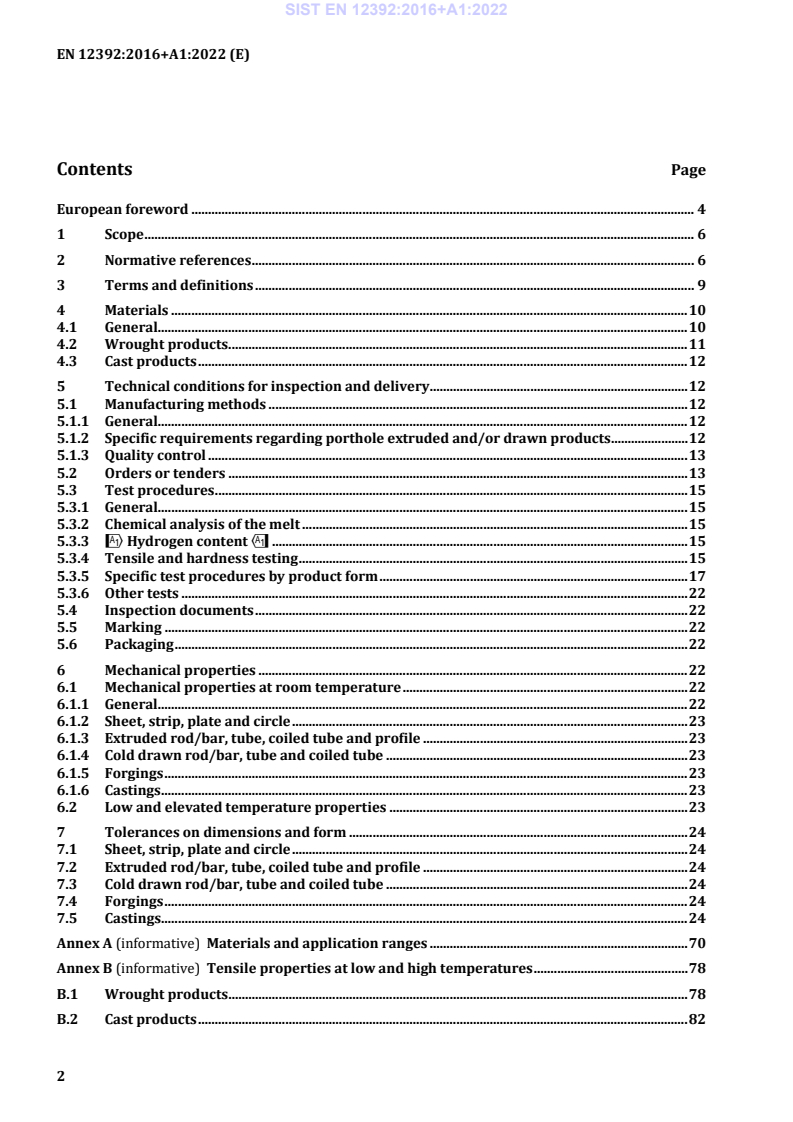
Contents Page
European foreword . 4
1 Scope . 6
2 Normative references . 6
3 Terms and definitions . 9
4 Materials . 10
4.1 General. 10
4.2 Wrought products . 11
4.3 Cast products . 12
5 Technical conditions for inspection and delivery . 12
5.1 Manufacturing methods . 12
5.1.1 General. 12
5.1.2 Specific requirements regarding porthole extruded and/or drawn products . 12
5.1.3 Quality control . 13
5.2 Orders or tenders . 13
5.3 Test procedures . 15
5.3.1 General. 15
5.3.2 Chemical analysis of the melt . 15
5.3.3 !Hydrogen content" . 15
5.3.4 Tensile and hardness testing . 15
5.3.5 Specific test procedures by product form . 17
5.3.6 Other tests . 22
5.4 Inspection documents . 22
5.5 Marking . 22
5.6 Packaging . 22
6 Mechanical properties . 22
6.1 Mechanical properties at room temperature . 22
6.1.1 General. 22
6.1.2 Sheet, strip, plate and circle . 23
6.1.3 Extruded rod/bar, tube, coiled tube and profile . 23
6.1.4 Cold drawn rod/bar, tube and coiled tube . 23
6.1.5 Forgings . 23
6.1.6 Castings . 23
6.2 Low and elevated temperature properties . 23
7 Tolerances on dimensions and form . 24
7.1 Sheet, strip, plate and circle . 24
7.2 Extruded rod/bar, tube, coiled tube and profile . 24
7.3 Cold drawn rod/bar, tube and coiled tube . 24
7.4 Forgings . 24
7.5 Castings . 24
Annex A (informative) Materials and application ranges . 70
Annex B (informative) Tensile properties at low and high temperatures . 78
B.1 Wrought products . 78
B.2 Cast products . 82
Annex C (normative) ! Empirical conversion between values of A and A " . 86
Annex ZA (informative) !Relationship between this European Standard and the essential
safety requirements of Directive 2014/68/EU aimed to be covered" . 90
Bibliography . 91
European foreword
This document (EN 12392:2016+A1:2022) has been prepared by Technical Committee CEN/TC 132
“Aluminium and aluminium alloys”, the secretariat of which is held by AFNOR.
This European Standard shall be given the status of a national standard, either by publication of an
identical text or by endorsement, at the latest by January 2023, and conflicting national standards shall
be withdrawn at the latest by January 2023.
Attention is drawn to the possibility that some of the elements of this document may be the subject of
patent rights. CEN shall not be held responsible for identifying any or all such patent rights.
This document supersedes !EN 12392:2016".
This document includes Amendment 1 approved by CEN on 21 February 2022.
The start and finish of text introduced or altered by amendment is indicated in the text by tags !".
This document has been prepared under a standardization request given to CEN by the European
Commission and the European Free Trade Association, and supports essential requirements of
EU Directive(s).
For relationship with EU Directive !2014/68/EU", see informative Annex ZA, which is an integral
part of this document.
Comparing to EN 12392:2000 the following modifications were implemented in EN 12392:2016:
— modification of the scope (extension to cast aluminium and aluminium alloys) (Clause 1);
— new normative references (Clause 2);
— new definitions (Clause 3): melt, casting, forging, tube;
— modification of Clause 4 “Materials” which covers Wrought products and Cast products;
— modification of Clause 5 “Technical conditions for inspection and delivery”: new requirements for
Manufacturing methods, Orders or tenders, Test procedures, Inspection documents, Marking,
Packaging;
— modification of Clause 6 “Mechanical properties”: different specifications are included at room
temperature and low and elevated temperature properties;
— modification of Clause 7 “Tolerances on dimensions and form”: inclusions of Tables 1 to 37;
— deletion of Clause 8 “Elevated temperature properties” (initially in 2000 version);
— new Annex A (Informative) “Materials and application range”;
— new Annex B (Informative) “Tensile properties at low and high temperature;
— new Annex ZA (Informative) “Relationship with EU Directive 2014/68”;
— new references into Bibliography.
!This Amendment 1 to EN 12392:2016 covers the following major subjects:
— replacement of all textual elements considered as business relationship items such as “to be agreed
between customer and supplier” and not allowed in harmonized standards by formal textual
elements allowed for harmonized standards and worded as “to be defined before placing an order”
and/or “to be stated on the order”;
— introduction of new alloys together with relevant information at specific related sections and/or
tables;
— re-introduction of famous and very used A/A50 conversion table for elongation;
— application of most recent European legislation directive (Annex ZA)."
Any feedback and questions on this document should be directed to the users’ national standards body.
A complete listing of these bodies can be found on the CEN website.
According to the CEN-CENELEC Internal Regulations, the national standards organisations of the
following countries are bound to implement this European Standard: Austria, Belgium, Bulgaria,
Croatia, Cyprus, Czech Republic, Denmark, Estonia, Finland, France, Germany, Greece, Hungary, Iceland,
Ireland, Italy, Latvia, Lithuania, Luxembourg, Malta, Netherlands, Norway, Poland, Portugal, Republic of
North Macedonia, Romania, Serbia, Slovakia, Slovenia, Spain, Sweden, Switzerland, Turkey and the
United Kingdom.
1 Scope
This European Standard specifies the material requirements and testing procedures applicable to
wrought and cast aluminium and aluminium alloys intended for use in the production of pressure
equipment.
This European Standard covers:
— the products forms, grades and tempers of wrought and cast aluminium and aluminium alloys
which may be used for such applications together with data for wrought and cast alloys over their
permissible working temperature ranges;
— !deleted text"
— the technical conditions for inspection and delivery, mechanical property limits and tolerances on
form and dimensions by reference to the appropriate European standards for the relevant wrought
and cast aluminium and aluminium alloys, and
— additional requirements which are specific to pressure equipment applications.
!It applies to hot-rolled plate, cold-rolled sheet/ strip/ circles, extruded or extruded and cold drawn
rod/bar, tube, extruded open / hollow profiles, forgings and castings. The materials and application
ranges covered by this document are those given in Annex A, Table A.1 for wrought alloys and Table A.2
for castings."
It is the sole objective of this standard to cover materials only for pressure purposes and it excludes any
elements of fabrication or fabrication methods for pressure equipment; such information can be found
in the relevant standards listed in the “Bibliography” section.
2 Normative references
The following documents, in whole or in part, are normatively referenced in this document and are
indispensable for its application. For dated references, only the edition cited applies. For undated
references, the latest edition of the referenced document (including any amendments) applies.
!EN 485-1:2016, Aluminium and aluminium alloys — Sheet, strip and plate — Part 1: Technical
conditions for inspection and delivery
EN 485-3:2003, Aluminium and aluminium alloys — Sheet, strip and plate — Part 3: Tolerances on
dimensions and form for hot-rolled products
EN 485-4:1993, Aluminium and aluminium alloys — Sheet, strip and plate — Part 4: Tolerances on shape
and dimensions for cold-rolled products
EN 586-1:1997, Aluminium and aluminium alloys — Forgings — Part 1: Technical conditions for
inspection and delivery
EN 586-3:2001, Aluminium and aluminium alloys — Forgings — Part 3: Tolerances on dimensions and
form
EN 754-1:2016, Aluminium and aluminium alloys — Cold drawn rod/bar and tube — Part 1: Technical
conditions for inspection and delivery
EN 754-2:2016, Aluminium and aluminium alloys — Cold drawn rod/bar and tube — Part 2: Mechanical
properties
EN 754-3:2008, Aluminium and aluminium alloys — Cold drawn rod/bar and tube — Part 3: Round bars,
tolerances on dimensions and form
EN 754-4:2008, Aluminium and aluminium alloys — Cold drawn rod/bar and tube — Part 4: Square bars,
tolerances on dimensions and form
EN 754-5:2008, Aluminium and aluminium alloys — Cold drawn rod/bar and tube — Part 5: Rectangular
bars, tolerances on dimensions and form
EN 754-6:2008, Aluminium and aluminium alloys — Cold drawn rod/bar and tube — Part 6: Hexagonal
bars, tolerances on dimensions and form
EN 754-7:2016, Aluminium and aluminium alloys — Cold drawn rod/bar and tube — Part 7: Seamless
tubes, tolerances on dimensions and form
EN 754-8:2016, Aluminium and aluminium alloys — Cold drawn rod/bar and tube — Part 8: Porthole
tubes, tolerances on dimensions and form
EN 755-1:2016, Aluminium and aluminium alloys— Extruded rod/bar, tube and profiles — Part 1:
Technical conditions for inspection and delivery
EN 755-2:2016, Aluminium and aluminium alloys — Extruded rod/bar, tube and profiles — Part 2:
Mechanical properties
EN 755-3:2008, Aluminium and aluminium alloys — Extruded rod/bar, tube and profiles — Part 3: Round
bars, tolerances on dimensions and form
EN 755-4:2008, Aluminium and aluminium alloys — Extruded rod/bar, tube and profiles — Part 4:
Square bars, tolerances on dimensions and form
EN 755-5:2008, Aluminium and aluminium alloys — Extruded rod/bar, tube and profiles — Part 5:
Rectangular bars, tolerances on dimensions and form
EN 755-6:2008, Aluminium and aluminium alloys — Extruded rod/bar, tube and profiles — Part 6:
Hexagonal bars, tolerances on dimensions and form
EN 755-7:2016, Aluminium and aluminium alloys — Extruded rod/bar, tube and profiles — Part 7:
Seamless tubes, tolerances on dimensions and form
EN 755-8:2016, Aluminium and aluminium alloys — Extruded rod/bar, tube and profiles — Part 8:
Porthole tubes, tolerances on dimensions and form
EN 755-9:2016, Aluminium and aluminium alloys — Extruded rod/bar, tube and profiles — Part 9:
Profiles, tolerances on dimensions and form
EN 941:2014, Aluminium and aluminium alloys — Circle and circle stock for the production of general
applications — Specifications
EN 1370:2011, Founding — Examination of surface condition
EN 1371-1:2011, Founding — Liquid penetrant testing — Part 1: Sand, gravity die and low pressure die
castings
EN 1559-1:2011, Founding — Technical conditions of delivery — Part 1: General
EN 1559-4:2015, Founding — Technical conditions of delivery — Part 4: Additional requirements for
aluminium alloy castings
EN 1779:1999, Non-destructive testing — Leak testing — Criteria for method and technique selection
EN 2004-1:1993, Aerospace series — Test methods for aluminium and aluminium alloy products — Part
1: Determination of electrical conductivity of wrought aluminium alloy products
EN 2101:1991, Aerospace series — Chromic acid anodizing of aluminium and wrought aluminium alloys
EN 10204:2004, Metallic products — Types of inspection documents
EN 12020-1:2008, Aluminium and aluminium alloys — Extruded precision profiles in alloys EN AW-6060
and EN AW-6063 — Part 1: Technical conditions for inspection and delivery
EN 12020-2:2016, Aluminium and aluminium alloys — Extruded precision profiles in alloys EN AW-6060
and EN AW-6063 — Part 2: Tolerances on dimensions and form
EN 12020-2:2016/AC:2017, Aluminium and aluminium alloys — Extruded precision profiles in alloys EN
AW-6060 and EN AW-6063 — Part 2: Tolerances on dimensions and form
EN 12258-1:2012, Aluminium and aluminium alloys — Terms and definitions — Part 1: General terms
EN 12681:2003, Founding — Radiographic examination
EN 13957:2008, Aluminium and aluminium alloys — Extruded round, coiled tube for general applications
— Specification
EN 13958:2008, Aluminium and aluminium alloys — Cold drawn, round, coiled tube for general
applications — Specification
EN 14361:2004, Aluminium and aluminium alloys — Chemical analysis — Sampling from metal melts
EN 14726:2019, Aluminium and aluminium alloys — Chemical analysis — Guideline for spark optical
emission spectrometric analysis
EN ISO 148-1:2016, Metallic materials — Charpy pendulum impact test — Part 1: Test method
(ISO 148-1:2016)
EN ISO 3452-1:2021, Non-destructive testing — Penetrant testing — Part 1: General principles
(ISO 3452-1:2021)
EN ISO 6506-1:2014, Metallic materials — Brinell hardness test — Part 1: Test method (ISO 6506-1:2014)
EN ISO 6892-1:2019, Metallic materials — Tensile testing — Part 1: Method of test at room temperature
(ISO 6892-1:2019)
EN ISO 8062:2007, Castings — System of dimensional tolerances and machining allowances (ISO 8062)
EN ISO 8492:2013, Metallic materials — Tube — Flattening test (ISO 8492:2013)
EN ISO 8493:2004, Metallic materials — Tube — Drift-expanding test (ISO 8493:1998)
EN ISO 8495:2013, Metallic materials — Tube — Ring-expanding test (ISO 8495:2013)
EN ISO 8496:2013, Metallic materials — Tube — Ring tensile test (ISO 8496:2013)
ISO 9591:2004, Corrosion of aluminium alloys — Determination of resistance to stress corrosion cracking
ASTM B548:2003, Standard Test Method for Ultrasonic Inspection of Aluminium-Alloy Plate for Pressure
Vessels
ASTM B594:2019, Standard Practice for Ultrasonic Inspection of Aluminium-Alloy Wrought Products
ASTM E112:2013, Standard Test Methods for Determining Average Grain Size
ASTM E215:2016, Standard Practice for Standardizing Equipment for Electromagnetic Testing of
Seamless Aluminum-Alloy Tube"
3 Terms and definitions
For the purposes of this document, the terms and definitions given in EN 12258-1 and the following
apply.
3.1
heat-treatment batch or lot
quantity of products of the same alloy or purity grade of alloy, form, thickness or cross-section and
produced in the same way and heat-treated in one furnace load; or such products solution-treated and
subsequently precipitation treated in one furnace load
Note 1 to entry: More than one solution-treatment batch can be included in one ageing furnace load.
Note 2 to entry: For heat treatment in a continuous furnace (vertical or horizontal), the products continuously
heat-treated during a specified time (e.g. 8 h) can be considered as one heat treatment lot.
Note 3 to entry: For forgings, a heat-treatment lot may consist of a group of forgings of similar size and shape.
3.2
inspection lot
consignment, or a part thereof, submitted for inspection, comprising products of the same grade or
alloy, form, thickness or cross-section, and processed in the same manner
Note 1 to entry: For forgings, an inspection lot may consist of a group of forgings of similar size and shape.
3.3
melt
quantity of molten metal that has simultaneously undergone the same preparatory treatment in the
furnace before the casting operation
3.4
cast
quantity of products cast simultaneously from the same melt
3.5
casting
product at or near finished shape, formed by solidification of the metal in a mould or a die
!
Note 1 to entry: Casting is also the process in which molten metal is poured into a mould and solidified."
Note !2" to entry: Pressure die-cast products are excluded from the scope of the present standard.
Note !3" to entry: The mould of concern can be a single use mould (sand) or a permanent mould (e.g. cast
iron or steel).
!deleted text"
3.6
forging
wrought product formed by hammering or pressing, typically when hot, such as open die forging, drop
or closed die forging or seamless rolled ring forging
3.7
tube
hollow, wrought product with a uniform cross-section, with only one enclosed void and with a uniform
wall thickness, supplied in straight lengths or in coiled form
Note 1 to entry: Cross-sections are in the shape of circles, ovals, squares, rectangles, equilateral triangles or
regular polygons and can have rounded corners, provided the inner and outer cross-sections are concentric and
have the same form and orientation.
3.8
operating temperature range
temperature range at which the material is exposed during its use
4 Materials
4.1 General
The materials covered by this standard are to be used in a wide range of pressure equipment operating
over diverse range of both pressure and temperature. The range of applications extends from relatively
low pressure automotive equipment such as heat exchangers to heavy duty applications including
unfired pressure vessels and piping used in pressure equipment. !As a result, the standard covers an
extensive range of aluminium product forms, alloys and tempers as follows:"
— sheet, strip, plate and circles (EN 485, EN 941);
— cold drawn rod/bar and tube (EN 754);
— extruded rod/bar, tube and profiles (EN 755);
— precision profiles (EN 12020);
— extruded coiled tube (EN 13957);
— cold drawn coiled tube (EN 13958);
— forgings (EN 586);
— castings (EN 1706).
Materials (alloys and tempers), which may be used in compliance with the present standard are listed
in Tables 1, A.1 and A.2, together with their welding characteristics, main field of application and
operating temperature ranges.
!deleted text"
!If the pressure equipment is operating above room temperature for times exceeding 100 h, then the
long time behaviour of the material according to Annex B, Tables B.1 to B.4 will need to be taken into
consideration."
!Materials to be used for welded components shall be produced with a hydrogen level no greater
than 0,2 ml per 100 g aluminium, or an equivalent value/level determined by an alternative agreed
method."
4.2 Wrought products
!Applicable alloys and the chemical compositions for wrought products are given in Tables 1 and 2.
The chemical compositions of aluminium and aluminium alloys are specified in percentage by mass.
Limits for impurities are expressed as maxima that also will apply to alloying elements unless
expressed as a range. Aluminium is specified as a minimum for unalloyed aluminium, and as a
remainder for aluminium alloys."
!All grades of wrought aluminium and alloys shall have a lead (Pb), tin (Sn) and bismuth (Bi) content
not exceeding 0,015 0 % by mass, per each element. For particularly safety-sensitive applications (e.g.
high volumes at high pressure), lower values shall be agreed and stated on the order.
Wrought products in aluminium and aluminium alloys used for welded parts of pressure vessels that
are subjected to cold forming (e.g. rolled shells and heads) shall have a specified minimum A value after
fracture measured on a gauge length as follows:
LS= 5,65 (4.2-1)
oo
and ≥ 14 % in the longitudinal or transverse direction.
Wrought products in aluminium and aluminium alloys used for parts of pressure vessels that are not
subjected to cold forming (e.g. straight flanges and nozzles) shall have a specified minimum elongation
after fracture measured on a gauge length as follows:
LS= 5,65 (4.2-2)
oo
and ≥ 10 % in the longitudinal or transverse direction.
The conversion of A values into A and vice versa shall be carried out as specified in Annex C.
When using minimum A values converted from A values as requirements, the converted A value
50 50
shall be taken from Table C.1 then rounded up to the next whole number (example: a converted value
A of 12,2 % shall be implemented as a minimum requirement of A value by 13 %).
EXAMPLE 1 A 12,5 mm wide rectangular test piece prepared from rolled sheet with a thickness of 2,0 mm.
Then the cross sectional area of this test piece is 25 mm , and the corresponding gauge length for a proportional
test piece is 28,3 mm. The measured value of A is 13,0 % which corresponds to an approximate elongation
value for A of 17,0 %.
EXAMPLE 2 An elongation value for A of 24,0 % measured on a proportional test piece with a gauge length of
35,7 mm. This corresponds to an approximate elongation value for A of 20,4 %, measured on a 12,5 mm wide
rectangular test piece with a thickness of 3,2 mm. The cross sectional area of this test piece is 40 mm .
EXAMPLE 3 A wrought material in thickness 12,0 mm selected for a part to be cold deformed and welded
during fabrication. The tensile test samples shall be either:
— a proportional test sample with a cross section of 150 mm and a gauge length of 69,2 mm, for which the
minimum elongation value A of 14 % will apply, or,
— a non-proportional test sample with a cross section of 150 mm and a gauge length of 50 mm. In this case the
minimum A50 value to apply will be 20 %, as rounded up to the next whole number from the indicated value of
19,1 % in Table C.1."
4.3 Cast products
!Applicable alloys and the chemical compositions for cast products are given in Table 3." The
chemical compositions of aluminium and aluminium alloys are specified in percentage by mass.
!Limits for impurities are expressed as maxima which will also apply to all alloying elements unless
expressed as a range."
5 Technical conditions for inspection and delivery
5.1 Manufacturing methods
5.1.1 General
The provisions of EN 485-1 (sheets, strips and plates), EN 941 (circles), EN 755-1 (extruded rods/bars,
tubes and profiles), EN 754-1 (cold drawn rods/bars, and tubes), EN 12020-1, EN 13957, EN 13958,
EN 586-1 (forgings incl. seamless rolled rings), EN 1559-1 (Founding) and EN 1559-4 (Founding) apply
with the amendments and additions specified in 5.2 to 5.5 below.
!The manufacturing methods used shall be left to the discretion of the producer." In addition, there
shall be no obligation on the supplier to use the same processes or process route for subsequent or
similar orders.
!When the manufacturing method to be used is restricted or fixed, it shall be stated on the purchase
order (see 5.2)."
5.1.2 Specific requirements regarding porthole extruded and/or drawn products
!Regarding porthole extruded and/or drawn products, limitations for safe application of such
products are given in Tables 4 and 5:"
— Table 4 applies to porthole extruded tube (EN 755-8), porthole extruded and drawn tube
(EN 754-8), porthole extruded hollow profiles (EN 755-9) and porthole extruded precision profiles
(EN 12020) and may be used up to and including an outside diameter !of 600 mm (DN 600) and
a maximum thickness (t) of 20 mm";
— Table 5 applies to porthole extruded coiled tube (EN 13957) and porthole extruded and drawn
coiled tube EN 13958 and may be used up to and including an outside !diameter 50 mm (DN 50)
and a maximum thickness (t) of 5 mm".
!The stated values for maximum allowable pressure (PS) and volume (V) disclosed in Tables 4 and 5
are limitations superseding those required by European Legislation for Pressure Equipment.
The purchaser is responsible to cascade the relevant design elements of the final equipment to the
producer.
As a result, the purchaser shall, when placing an order with the producer (material manufacturer),
provide the following information to ensure that the correct Hazard Category and adequate quality
assurance is applied to the particular combination of criteria:
— the type of pressure equipment being considered (vessel or piping acc. European Legislation for
Pressure Equipment and intended use);
— the state of the fluid in the equipment (gas or liquid);
— the hazard group of the fluid (acc. to European Legislation for Pressure Equipment);
— maximum pressure for which the equipment is designed (PS);
— confirmation that the completed equipment assembly is pressure tested."
!NOTE 1 Some further comment is necessary on the methods of extrusion used for tube and hollow profiles. In
particular seamless extrusion produces a product that does not contain any seams or weld lines in the product
cross-section. On the other hand, extruded products manufactured using a porthole or bridge die contains at least
one longitudinal weld or seam. The presence of such welds or seams can be a major concern on products that are
to be used for e.g. pressure vessels since the weld/seam could lead to premature failure of the vessel under
pressure."
NOTE 2 In addition despite rigorous process control during the extrusion process, there is no definitive non-
destructive test method that can provide total assurance of the integrity of the welds in the product cross-section.
In view of the safety implications of using porthole products, it is necessary to provide guidelines in this standard
as to the permitted product areas where porthole products may or may not be used.
!NOTE 3 Transverse extrusion seams (charge welds) are generally not permitted in extruded or
extruded/drawn products used for pressure equipment. However, the use of transverse extrusion seams for
coiled tubes according to EN 13957 and EN 13958 is allowed, provided that the integrity of the extrusion seams is
ensured by adequate quality assurance/testing procedures based on the recommendations given in Table 5 and
stated on the order."
!NOTE 4 It needs to be highlighted that, beside the limits for nominal size DN and thickness t, Tables 4 and 5
provide additional limitations regarding pressure PS, volume V and testing procedures. The purchaser can decide
to use porthole extrusion for products exceeding the stated limits/hazard categories but this has to be stated on
the order with defined quality assurance / testing procedures."
5.1.3 Quality control
!All inspection and tests required by the relevant European standard and/or the particular
specification shall be undertaken prior to shipment of the product. Any additional inspection required
shall be stated on the purchase order (see 5.2)."
5.2 Orders or tenders
The order or tender documents shall define the product required and contain the following minimum
information:
a) the type and form of the product. In the case of tube whether extruded, cold drawn or coiled, it is
also essential to state the method of extrusion to be used i.e. seamless or porthole (see also point i)
below);
b) reference to this particular Standard EN 12392;
c) the dimensions and shape of the particular product required;
1) plate: thickness, width and length;
2) sheet: thickness, width and length;
3) strip: thickness width and coil dimensions;
4) circles: thickness and diameter;
5) round tube: method of production, outside (OD) or inside (ID) diameter, wall thickness (WT),
and length;
NOTE 1 Two of the OD/ID/WT dimensions may be given tolerances but not all three.
6) coiled round tube: outside (OD) or inside (ID) diameter, wall thickness (WT), coil dimensions
and tube length if required in straight lengths;
NOTE 2 Two of the OD/ID/WT dimensions may be given tolerances but not all three.
7) round bar: diameter and length;
8) square and hexagonal bar: width across flats and length;
9) rectangular bar: width, thickness and length;
10) extruded profiles and hollow sections: drawing of cross section and length;
11) forgings (open-die forgings, closed-die forgings and seamless rolled rings): reference to
drawing or finished size;
12) castings: reference to a drawing.
d) the product tolerances on dimensions and form together with particular reference to the relevant
European standard for the specific product concerned;
e) quantity required: whether it is weight, number of pieces, total length and the quantity tolerance on
the total amount of the order;
f) product certification requirement with particular reference to EN 10204:2004;
g) identification marking requirements;
h) surface finish requirements particularly details of any surface treatments to be carried out;
i) the order shall clearly show if the ordered product is to be produced by the porthole extrusion
method. In case of porthole extrusion, additional information as expressed in 5.1.2 shall be
provided;
j) !any other special requirements (e.g. grain size). This applies to particular requirements such as
flattening test, leak test, ultrasonic test, etc., which shall be expressly stated together with the
criteria to which the material shall be verified."
k) any additional inspection to be carried out prior to delivery;
l) surface protection oil requirements;
m) packaging methods to be used;
!n) manufacturing method if restricted or fixed."
5.3 Test procedures
5.3.1 General
This subclause covers only chemical composition and tensile / hardness testing which are common to
all the products. The remaining test procedures and methods are given in the sections dealing with the
individual products.
Regarding the standards to be used for testing, the EN or EN ISO standards shall be used whenever
possible. !However, other standards such as ASTM may be used when compatible EN or EN ISO are
not available."
!Unless otherwise stated on the purchase order, the following test procedures disclosed in the
following sections shall apply."
5.3.2 Chemical analysis of the melt
The samples for chemical analysis shall be taken at the time of casting or melting in accordance with
EN 14361 and EN 14726. At least one specimen shall be taken from each melt. The methods of analysis
used should be at the discretion of the supplier or by agreement between the supplier and purchaser.
For castings, chemical analysis shall be carried out on samples taken from the same melt as the castings;
the samples shall be cooled quickly enough to minimize any segregation effects. !The frequency of
sampling depends on the particular process of concern." The frequency, for example, may vary from
one sample per charge to one sample per piece or per shift.
5.3.3 !Hydrogen content
The hydrogen level shall be measured on liquid metal during casting or through an agreed alternative
method stated on the order."
5.3.4 Tensile and hardness testing
The methods used shall be in compliance with EN ISO 6892-1 for tensile testing and EN ISO 6506-1 for
Brinell hardness testing. !Other methods of hardness testing e.g. Webster method can be used when
stated in the order with defined frequency of testing and minimum acceptable values."
Tensile testing shall be carried out as specified in EN 485-1, EN 754-1, EN 755-1, EN 586-1, EN 1559-1,
or EN 1559-4, as applicable, noting the following:
a) frequency of test:
1) for sheet, strip and plate at least one test-piece shall be taken from each cast represented in
each inspection lot, or heat-treatment lot where applicable, of 10 000 kg or part thereof. For
single plate or coil weighing more than 10 000 kg each, only one test-piece per plate or coil
shall be taken;
2) for extruded or extruded and cold drawn products;
i) for profiles and hollow sections having a nominal mass of up to and including 1 kg/m, a
minimum of one test piece shall be taken from each cast represented in each inspection or
heat treatment lot of 1000 kg or part thereof.
ii) for profiles and hollow sections having a nominal mass of over 1 kg/m and up to 5 kg/m, a
minimum of one test piece shall be taken from each cast represented in each inspection or
heat treatment lot of 2000 kg or part thereof.
3) for extruded and cold drawn tube (in straight lengths or coiled);
i) for tube produced by the porthole extrusion method, a minimum of one tensile test shall be
taken for every 1000 kg or part thereof for each inspection or heat treatment lot.
ii) for tube produced by the seamless extrusion method to be used for heavy duty
applications, unfired pressure vessels, or piping used in pressure equipment, a minimum
of two tensile tests shall be taken for each 1000 kg or part thereof for each cast
represented in every inspection or heat treatment lot.
4) for forgings including seamless rolled rings;
i) for forgings weighing up to 2 kg at least one test piece shall be taken from each inspection
lot or heat treatment lot of 1000 kg or part thereof;
ii) for forgings weighing over 2 kg and up to and including 10 kg, a minimum of one test piece
shall be taken from each inspection or heat treatment lot of 2000 kg or part thereof;
iii) for forgings weighing over 10 kg, a minimum of one test piece shall be taken from each
inspection or heat treatment lot of 3000 kg or part thereof.
5) for castings;
Depending on agreement between supplier and purchaser !and stated on the order", this
can be:
i) one test piece for each part;
ii) one test piece for each melting charge in case of temper designation “F”;
iii) one test piece for each melting charge and heat treatment lot.
!Position, orientation, dimensions and cooling rate of the tensile test pieces shall be stated in
the purchase order. The test pieces may be cast:"
— separately from the castings but from the same melt and in a special mould (made from the
same material as the castings themselves);
— at the same time as the castings i.e. the test piece is attached to the casting itself.
!Note: in both cases, the cooling rate of the test samples shall be adjusted to achieve a
microstructure compatible with the castings particularly in critical areas which may be
subject to subsequent heat treatment."
iv) !If test pieces are taken from castings, then their geometry, location, test frequency and
relevant values shall be determined before starting the production. Test pieces should be
taken from areas with a wall thickness between 5 mm and 25 mm."
v) For round test pieces the minimum diameter shall be 4,0 mm. Refer to the footnotes in
!Tables 37 and 38" for yield strength, tensile strength values and for elongation
values.
!deleted text"
The minimum tensile values required shall be in accordance with this Standard and these
values shall be used in conjunction with the design standard for the particular casting in
question. Mechanical properties at specified positions in the part may be adjusted by the
foundry to higher values as the minimal values given in !Table 37 and 38". !These
positions shall be determined before the start of the production."
b) yield strength measurement:
1) Rp0,2 shall be measured for all alloys, and
2) for aluminium grades EN AW-1080A, EN AW-1070A and EN AW-1050A, in temper O, H111 or
H112, Rp1,0 (proof stress at 1 % permanent elongation) shall also be measu
...