


EN ISO 17871:2020
(Main)Gas cylinders - Quick-release cylinder valves - Specification and type testing (ISO 17871:2020)
Gas cylinders - Quick-release cylinder valves - Specification and type testing (ISO 17871:2020)
This document, in conjunction with ISO 10297 and ISO 14246, specifies design, type testing, marking and manufacturing tests, and examinations requirements for quick-release cylinder valves intended to be fitted to refillable transportable gas cylinders, pressure drums and tubes which convey:
— non-toxic;
— non-oxidizing;
— non-flammable; and
— non-corrosive;
compressed or liquefied gases or extinguishing agents charged with compressed gases to be used for fire-extinguishing, explosion protection, and rescue applications.
NOTE 1 The main application of such quick-release cylinder valves is in the fire-fighting industry. However, there are other applications such as avalanche airbags, life raft inflation and similar applications.
NOTE 2 Where there is no risk of ambiguity, gas cylinders, pressure drums and tubes are addressed with the collective term "cylinders" within this document.
This document covers the function of a quick-release cylinder valve as a closure.
This document does not apply to quick-release cylinder valves for cryogenic equipment and for liquefied petroleum gas (LPG).
This document does not apply to quick-release cylinder valves if used as the main closure of portable fire extinguishers because portable fire extinguishers are not covered by transport regulation.
Quick-release cylinder valves of auxiliary refillable propellant gas cylinders used within or as part of portable fire extinguishers are covered by this document, if these cylinders are transported separately, e.g. for filling (see UN Model Regulations, Chapter 3.3, Special Provision 225, second note[1]).
Gasflaschen - Schnellöffnungs-Flaschenventile - Spezifikation und Baumusterprüfung (ISO 17871:2020)
Dieses Dokument legt zusammen mit ISO 10297 und ISO 14246 die Auslegung, Baumusterprüfung, Prüfungen und Untersuchungen während der Herstellung sowie Anforderungen an die Kennzeichnung von Schnellöffnungs-Flaschenventilen fest, die für wiederbefüllbare ortsbewegliche Gasflaschen, Druckfässer und Großflaschen für
nicht giftige,
nicht oxidierende,
nicht entzündbare und
nicht korrosive
verdichtete oder verflüssigte Gase oder mit verdichteten Gasen beaufschlagte Lösemittel für Lösch-, Explosionsschutz- und Rettungsanwendungen vorgesehen sind.
ANMERKUNG 1 Die Hauptanwendung derartiger Schnellöffnungs-Flaschenventile liegt in der Brandbekämpfungsindustrie. Es gibt jedoch auch andere Anwendungen, wie z. B. Lawinen-Airbags, Aufblasen von Rettungsinseln und ähnliche Anwendungen.
ANMERKUNG 2 Dort, wo kein Risiko der Mehrdeutigkeit besteht, werden Gasflaschen, Druckfässer und Großflaschen in diesem Dokument mit dem Sammelbegriff „Flaschen“ bezeichnet.
Dieses Dokument behandelt die Funktion eines Schnellöffnungs-Flaschenventils als Verschluss.
Dieses Dokument gilt nicht für Schnellöffnungs-Flaschenventile für Kryo-Ausrüstung und für Flüssiggas (LPG).
Dieses Dokument gilt nicht für Schnellöffnungs-Flaschenventile, wenn diese als Hauptverschlusseinrichtung für tragbare Feuerlöscher verwendet werden, weil tragbare Feuerlöscher nicht von den Beförderungsvorschriften erfasst sind.
Schnellöffnungs-Flaschenventile von als Zusatz dienenden nachfüllbaren Treibgasflaschen, die in oder als Teil von tragbaren Feuerlöschern verwendet werden, sind von diesem Dokument abgedeckt, sofern sie getrennt befördert werden, z. B. für das Befüllen (siehe UN Modellvorschriften, Kapitel 3.3, „Special Provision 225“, zweite Anmerkung [1]).
Bouteilles à gaz - Robinets de bouteilles à ouverture rapide - Spécifications et essais de type (ISO 17871:2020)
Le présent document, conjointement avec les normes ISO 10297 et ISO 14246, spécifie des exigences relatives à la conception, aux essais de type, au marquage, ainsi qu'aux essais de fabrication et contrôles, pour les robinets de bouteilles à ouverture rapide destinés à être montés sur des bouteilles à gaz transportables et rechargeables, des fûts à pression et des tubes qui sont conçus pour transporter des gaz liquéfiés ou comprimés:
— non toxiques;
— non oxydants;
— ininflammables; et
— non corrosifs;
ou encore des agents d'extinction chargés avec des gaz comprimés, qui sont destinés à être utilisés pour des applications d'extinction d'incendie, de protection contre les explosions ou de secours.
NOTE 1 Les applications principales de ces robinets de bouteilles à ouverture rapide sont liées à l'industrie de la lutte contre l'incendie. Il existe toutefois d'autres applications telles que les sacs gonflables anti-ensevelissement lors d'une avalanche, le gonflage de canots de sauvetage et d'autres applications similaires.
NOTE 2 Lorsqu'il n'y a pas de risque d'ambiguïté, le terme « bouteilles » est utilisé collectivement dans le présent document pour désigner les bouteilles à gaz, les fûts à pression et les tubes.
Le présent document couvre la fonction d'un robinet de bouteille à ouverture rapide en tant que dispositif de fermeture.
Le présent document ne s'applique pas aux robinets de bouteilles à ouverture rapide utilisés sur des équipements cryogéniques ou avec du gaz de pétrole liquéfié (GPL).
Le présent document ne s'applique pas aux robinets de bouteilles à ouverture rapide s'ils sont utilisés comme fermeture principale sur des extincteurs d'incendie portatifs, car ces derniers ne sont pas couverts par la réglementation sur le transport.
Les robinets de bouteilles à ouverture rapide montés sur des bouteilles rechargeables auxiliaires transportant du gaz propulseur faisant partie d'extincteurs d'incendie portatifs ou intégrés à ces derniers relèvent du présent document si lesdites bouteilles sont transportées séparément, par exemple pour le remplissage (voir le Règlement type de l'ONU, chapitre 3.3, Disposition spéciale 225, seconde note[1]).
Plinske jeklenke - Ventili jeklenk za hitro razbremenitev - Specifikacija in preskušanje tipa (ISO 17871:2020)
Ta dokument v povezavi s standardoma ISO 10297 in ISO 14246 določa zasnovo, tipsko preskušanje, označevanje
in preskuse izdelave ter zahteve za pregledovanje ventilov jeklenk za hitro razbremenitev,
ki se namestijo na prenosne plinske jeklenke, tlačne valje in cevi za večkratno polnjenje
– nestrupenih,
– neoksidativnih,
– nevnetljivih in
– nekorozivnih
stisnjenih ali utekočinjenih plinov ali gasilnih sredstev s stisnjenimi plini, ki se uporabljajo za
gašenje požarov, zaščito pred eksplozijami in reševanje.
OPOMBA 1: Tovrstni ventili jeklenk za hitro razbremenitev se uporabljajo predvsem v proizvodnji protipožarne opreme. Vendar
se uporabljajo tudi v proizvodnji zračnih blazin za zaščito v snežnih plazovih, napihljivih rešilnih čolnov in podobnih izdelkov.
OPOMBA 2: Če ne obstaja tveganje dvoumnosti, so plinske jeklenke, tlačni valji in cevi
v tem dokumentu imenovani s skupnim izrazom »jeklenke«.
Ta dokument zajema funkcijo ventila jeklenke za hitro razbremenitev kot zapore.
Ta dokument se ne uporablja za ventile jeklenk za hitro razbremenitev za kriogensko opremo in utekočinjeni
naftni plin (LPG).
Ta dokument se ne uporablja za ventile jeklenk za hitro razbremenitev, ki se uporabljajo kot glavna zapora prenosnih
gasilnikov, ker prenosni gasilniki niso zajeti v predpisih o prevozu.
V tem dokumentu so zajeti ventili za hitro razbremenitev pomožnih jeklenk za večkratno polnjenje pogonskega goriva, ki se uporabljajo v
prenosnem gasilniku ali kot njegov del, če se te jeklenke prevažajo ločeno,
npr. za polnjenje (glej vzorčne predpise ZN, poglavje 3.3, posebna določba 225, druga opomba [1]).
General Information
Relations
Overview
EN ISO 17871:2020 (ISO 17871:2020) specifies requirements for quick-release cylinder valves used as closures on refillable, transportable gas cylinders, pressure drums and tubes. It covers valves for non-toxic, non-oxidizing, non-flammable and non-corrosive compressed or liquefied gases and for extinguishing agents charged with compressed gas - primarily used in the fire‑fighting industry but also in avalanche airbags, life‑raft inflation and similar applications. The standard focuses on valve design, type testing, marking, manufacturing tests and examinations.
Key topics and technical requirements
- Design and function: Requirements for valve operating mechanisms (pistons, flaps, piercing or differential pressure devices) and valve operating devices for quick release of cylinder contents.
- Valve types: Defines one‑time (type A) and multiple‑operation valves (types B–E) with differing cycle limits and maintenance needs.
- Type testing and safety: Tests for mechanical strength, resistance to impact, endurance, leak tightness, and provisions for valve burst test pressure (new to this edition).
- Manufacturing tests and examinations: Production-level inspections and tests to verify conformity with the specification (see Annex A).
- Marking and documentation: Mandatory marking and documentation to support traceability, safe use and regulatory compliance.
- Scope boundaries: Does not apply to quick‑release valves for cryogenic equipment or LPG, nor to valves used as the main closure of portable fire extinguishers (except auxiliary refillable propellant cylinders transported separately).
- Regulatory alignment: Written to be referenced in the UN Model Regulations; harmonizes with ISO 10297 and ISO 14246.
Practical applications and users
Who should use EN ISO 17871:2020:
- Valve and cylinder manufacturers - design, test, certify and mark quick‑release valves to meet transport and safety requirements.
- Test laboratories and certification bodies - perform type testing, endurance and burst tests and confirm compliance.
- Fire‑fighting and safety equipment OEMs - select compliant valves for breathing apparatus, extinguishing systems, airbags and inflation devices.
- Regulators, transport authorities and procurement teams - reference the standard in safety regulations, specifications and tender documents.
- Maintenance and inspection providers - understand serviceability and reconditioning requirements for valve types.
Related standards
- ISO 10297 (cylinder valves - specification and type testing)
- ISO 14246 (cylinder valve manufacturing tests and examinations)
- ISO 22435 / ISO 22434 (related valve/regulator standards)
EN ISO 17871:2020 is essential for anyone involved with quick‑release gas cylinder valves where safety, transport compliance and verified type testing are required. Keywords: EN ISO 17871:2020, quick-release cylinder valves, gas cylinders, type testing, fire-fighting valves, valve burst test.

Frequently Asked Questions
EN ISO 17871:2020 is a standard published by the European Committee for Standardization (CEN). Its full title is "Gas cylinders - Quick-release cylinder valves - Specification and type testing (ISO 17871:2020)". This standard covers: This document, in conjunction with ISO 10297 and ISO 14246, specifies design, type testing, marking and manufacturing tests, and examinations requirements for quick-release cylinder valves intended to be fitted to refillable transportable gas cylinders, pressure drums and tubes which convey: — non-toxic; — non-oxidizing; — non-flammable; and — non-corrosive; compressed or liquefied gases or extinguishing agents charged with compressed gases to be used for fire-extinguishing, explosion protection, and rescue applications. NOTE 1 The main application of such quick-release cylinder valves is in the fire-fighting industry. However, there are other applications such as avalanche airbags, life raft inflation and similar applications. NOTE 2 Where there is no risk of ambiguity, gas cylinders, pressure drums and tubes are addressed with the collective term "cylinders" within this document. This document covers the function of a quick-release cylinder valve as a closure. This document does not apply to quick-release cylinder valves for cryogenic equipment and for liquefied petroleum gas (LPG). This document does not apply to quick-release cylinder valves if used as the main closure of portable fire extinguishers because portable fire extinguishers are not covered by transport regulation. Quick-release cylinder valves of auxiliary refillable propellant gas cylinders used within or as part of portable fire extinguishers are covered by this document, if these cylinders are transported separately, e.g. for filling (see UN Model Regulations, Chapter 3.3, Special Provision 225, second note[1]).
This document, in conjunction with ISO 10297 and ISO 14246, specifies design, type testing, marking and manufacturing tests, and examinations requirements for quick-release cylinder valves intended to be fitted to refillable transportable gas cylinders, pressure drums and tubes which convey: — non-toxic; — non-oxidizing; — non-flammable; and — non-corrosive; compressed or liquefied gases or extinguishing agents charged with compressed gases to be used for fire-extinguishing, explosion protection, and rescue applications. NOTE 1 The main application of such quick-release cylinder valves is in the fire-fighting industry. However, there are other applications such as avalanche airbags, life raft inflation and similar applications. NOTE 2 Where there is no risk of ambiguity, gas cylinders, pressure drums and tubes are addressed with the collective term "cylinders" within this document. This document covers the function of a quick-release cylinder valve as a closure. This document does not apply to quick-release cylinder valves for cryogenic equipment and for liquefied petroleum gas (LPG). This document does not apply to quick-release cylinder valves if used as the main closure of portable fire extinguishers because portable fire extinguishers are not covered by transport regulation. Quick-release cylinder valves of auxiliary refillable propellant gas cylinders used within or as part of portable fire extinguishers are covered by this document, if these cylinders are transported separately, e.g. for filling (see UN Model Regulations, Chapter 3.3, Special Provision 225, second note[1]).
EN ISO 17871:2020 is classified under the following ICS (International Classification for Standards) categories: 23.020.35 - Gas cylinders; 23.060.40 - Pressure regulators. The ICS classification helps identify the subject area and facilitates finding related standards.
EN ISO 17871:2020 has the following relationships with other standards: It is inter standard links to EN ISO 17871:2015/A1:2018, EN ISO 17871:2015, EN ISO 17871:2020/A1:2024. Understanding these relationships helps ensure you are using the most current and applicable version of the standard.
You can purchase EN ISO 17871:2020 directly from iTeh Standards. The document is available in PDF format and is delivered instantly after payment. Add the standard to your cart and complete the secure checkout process. iTeh Standards is an authorized distributor of CEN standards.
Standards Content (Sample)
SLOVENSKI STANDARD
01-oktober-2020
Nadomešča:
SIST EN ISO 17871:2015
SIST EN ISO 17871:2015/A1:2018
Plinske jeklenke - Ventili jeklenk za hitro razbremenitev - Specifikacija in
preskušanje tipa (ISO 17871:2020)
Gas cylinders - Quick-release cylinder valves - Specification and type testing (ISO
17871:2020)
Gasflaschen - Schnellöffnungs-Flaschenventile - Spezifikation und Baumusterprüfung
(ISO 17871:2020)
Bouteilles à gaz - Robinets de bouteilles à ouverture rapide - Spécifications et essais de
type (ISO 17871:2020)
Ta slovenski standard je istoveten z: EN ISO 17871:2020
ICS:
23.020.35 Plinske jeklenke Gas cylinders
23.060.40 Tlačni regulatorji Pressure regulators
2003-01.Slovenski inštitut za standardizacijo. Razmnoževanje celote ali delov tega standarda ni dovoljeno.
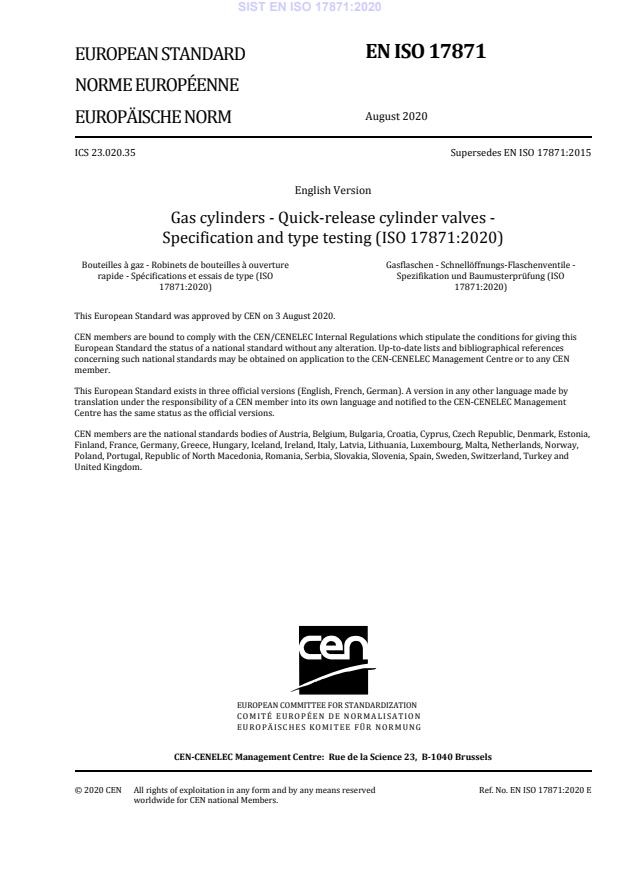
EN ISO 17871
EUROPEAN STANDARD
NORME EUROPÉENNE
August 2020
EUROPÄISCHE NORM
ICS 23.020.35 Supersedes EN ISO 17871:2015
English Version
Gas cylinders - Quick-release cylinder valves -
Specification and type testing (ISO 17871:2020)
Bouteilles à gaz - Robinets de bouteilles à ouverture Gasflaschen - Schnellöffnungs-Flaschenventile -
rapide - Spécifications et essais de type (ISO Spezifikation und Baumusterprüfung (ISO
17871:2020) 17871:2020)
This European Standard was approved by CEN on 3 August 2020.
CEN members are bound to comply with the CEN/CENELEC Internal Regulations which stipulate the conditions for giving this
European Standard the status of a national standard without any alteration. Up-to-date lists and bibliographical references
concerning such national standards may be obtained on application to the CEN-CENELEC Management Centre or to any CEN
member.
This European Standard exists in three official versions (English, French, German). A version in any other language made by
translation under the responsibility of a CEN member into its own language and notified to the CEN-CENELEC Management
Centre has the same status as the official versions.
CEN members are the national standards bodies of Austria, Belgium, Bulgaria, Croatia, Cyprus, Czech Republic, Denmark, Estonia,
Finland, France, Germany, Greece, Hungary, Iceland, Ireland, Italy, Latvia, Lithuania, Luxembourg, Malta, Netherlands, Norway,
Poland, Portugal, Republic of North Macedonia, Romania, Serbia, Slovakia, Slovenia, Spain, Sweden, Switzerland, Turkey and
United Kingdom.
EUROPEAN COMMITTEE FOR STANDARDIZATION
COMITÉ EUROPÉEN DE NORMALISATION
EUROPÄISCHES KOMITEE FÜR NORMUNG
CEN-CENELEC Management Centre: Rue de la Science 23, B-1040 Brussels
© 2020 CEN All rights of exploitation in any form and by any means reserved Ref. No. EN ISO 17871:2020 E
worldwide for CEN national Members.
Contents Page
European foreword . 3
European foreword
This document (EN ISO 17871:2020) has been prepared by Technical Committee ISO/TC 58 "Gas
cylinders" in collaboration with Technical Committee CEN/TC 23 “Transportable gas cylinders” the
secretariat of which is held by BSI.
This European Standard shall be given the status of a national standard, either by publication of an
identical text or by endorsement, at the latest by February 2021, and conflicting national standards
shall be withdrawn at the latest by February 2021.
Attention is drawn to the possibility that some of the elements of this document may be the subject of
patent rights. CEN shall not be held responsible for identifying any or all such patent rights.
This document supersedes EN ISO 17871:2015.
According to the CEN-CENELEC Internal Regulations, the national standards organizations of the
following countries are bound to implement this European Standard: Austria, Belgium, Bulgaria,
Croatia, Cyprus, Czech Republic, Denmark, Estonia, Finland, France, Germany, Greece, Hungary, Iceland,
Ireland, Italy, Latvia, Lithuania, Luxembourg, Malta, Netherlands, Norway, Poland, Portugal, Republic of
North Macedonia, Romania, Serbia, Slovakia, Slovenia, Spain, Sweden, Switzerland, Turkey and the
United Kingdom.
Endorsement notice
The text of ISO 17871:2020 has been approved by CEN as EN ISO 17871:2020 without any modification.
INTERNATIONAL ISO
STANDARD 17871
Second edition
2020-07
Gas cylinders — Quick-release
cylinder valves — Specification and
type testing
Bouteilles à gaz — Robinets de bouteilles à ouverture rapide —
Spécifications et essais de type
Reference number
ISO 17871:2020(E)
©
ISO 2020
ISO 17871:2020(E)
© ISO 2020
All rights reserved. Unless otherwise specified, or required in the context of its implementation, no part of this publication may
be reproduced or utilized otherwise in any form or by any means, electronic or mechanical, including photocopying, or posting
on the internet or an intranet, without prior written permission. Permission can be requested from either ISO at the address
below or ISO’s member body in the country of the requester.
ISO copyright office
CP 401 • Ch. de Blandonnet 8
CH-1214 Vernier, Geneva
Phone: +41 22 749 01 11
Email: copyright@iso.org
Website: www.iso.org
Published in Switzerland
ii © ISO 2020 – All rights reserved
ISO 17871:2020(E)
Contents Page
Foreword .iv
Introduction .v
1 Scope . 1
2 Normative references . 1
3 Terms and definitions . 2
4 Requirements . 3
4.1 General requirements . 3
4.2 Differing/additional requirements . 3
4.2.1 Valve connections . 3
4.2.2 Resistance to mechanical impact . 3
4.2.3 Valve operating mechanism . 3
4.2.4 Valve operating device . 3
4.2.5 Leakage . 3
4.2.6 Documentation . 4
4.2.7 Valve burst test pressure . 4
4.2.8 Valve test pressure . 4
4.2.9 Leak tightness tests . 4
4.2.10 Endurance test . 5
4.2.11 Securing arrangements . 5
4.3 Manufacturing tests and examinations . 6
5 Marking . 6
Annex A (normative) Manufacturing tests and examinations . 7
Bibliography . 8
ISO 17871:2020(E)
Foreword
ISO (the International Organization for Standardization) is a worldwide federation of national standards
bodies (ISO member bodies). The work of preparing International Standards is normally carried out
through ISO technical committees. Each member body interested in a subject for which a technical
committee has been established has the right to be represented on that committee. International
organizations, governmental and non-governmental, in liaison with ISO, also take part in the work.
ISO collaborates closely with the International Electrotechnical Commission (IEC) on all matters of
electrotechnical standardization.
The procedures used to develop this document and those intended for its further maintenance are
described in the ISO/IEC Directives, Part 1. In particular, the different approval criteria needed for the
different types of ISO documents should be noted. This document was drafted in accordance with the
editorial rules of the ISO/IEC Directives, Part 2 (see www .iso .org/ directives).
Attention is drawn to the possibility that some of the elements of this document may be the subject of
patent rights. ISO shall not be held responsible for identifying any or all such patent rights. Details of
any patent rights identified during the development of the document will be in the Introduction and/or
on the ISO list of patent declarations received (see www .iso .org/ patents).
Any trade name used in this document is information given for the convenience of users and does not
constitute an endorsement.
For an explanation of the voluntary nature of standards, the meaning of ISO specific terms and
expressions related to conformity assessment, as well as information about ISO's adherence to the
World Trade Organization (WTO) principles in the Technical Barriers to Trade (TBT), see www .iso .org/
iso/ foreword .html.
This document was prepared by Technical Committee ISO/TC 58, Gas cylinders, Subcommittee SC 2,
Cylinder fittings, in collaboration with the European Committee for Standardization (CEN) Technical
Committee CEN/TC 23, Transportable gas cylinders, in accordance with the Agreement on technical
cooperation between ISO and CEN (Vienna Agreement).
This second edition cancels and replaces the first edition (ISO 17871:2015), which has been technically
revised. It also incorporates the Amendment ISO 17871:2015/Amd 1:2018.
The main changes compared to the previous edition are as follows:
— extension of the scope to valves for pressure drums and tubes;
— addition of the valve burst test pressure;
— deletion of the flame impingement test;
— deletion of internal leak tightness test at −40 °C for quick-release cylinder valves only used for fixed
fire-fighting systems installed in buildings;
— complete revision of 4.2.11 and Annex A.
Any feedback or questions on this document should be directed to the user’s national standards body. A
complete listing of these bodies can be found at www .iso .org/ members .html.
iv © ISO 2020 – All rights reserved
ISO 17871:2020(E)
Introduction
This document covers the function of a quick-release cylinder valve as a closure (defined by the UN
Model Regulations). Additional features of a quick-release cylinder valve (e.g. pressure regulators,
residual pressure-retaining devices, non-return devices and pressure-relief devices) can be covered by
other standards and/or regulations.
Quick-release cylinder valves complying with this document can be expected to perform satisfactorily
under normal service conditions.
This document pays particular attention to:
a) suitability of materials;
b) safety (mechanical strength, impact strength, endurance, leak tightness);
c) testing;
d) marking.
[1]
This document has been written so that it is suitable to be referenced in the UN Model Regulations .
In this document, the unit bar is used due to its universal use in the field of technical gases.
However, it is noted that bar is not an SI unit, and that the corresponding SI unit for pressure is Pa
5 5 2
(1 bar = 10 Pa = 10 N/m ).
Pressure values given in this document are given as gauge pressure (pressure exceeding atmospheric
pressure) unless noted otherwise.
Charging of agents with a compressed gas is in some areas, e.g. fire-fighting, referred to as super-
pressurization.
INTERNATIONAL STANDARD ISO 17871:2020(E)
Gas cylinders — Quick-release cylinder valves —
Specification and type testing
1 Scope
This document, in conjunction with ISO 10297 and ISO 14246, specifies design, type testing, marking
and manufacturing tests, and examinations requirements for quick-release cylinder valves intended to
be fitted to refillable transportable gas cylinders, pressure drums and tubes which convey:
— non-toxic;
— non-oxidizing;
— non-flammable; and
— non-corrosive;
compressed or liquefied gases or extinguishing agents charged with compressed gases to be used for
fire-extinguishing, explosion protection, and rescue applications.
NOTE 1 The main application of such quick-release cylinder valves is in the fire-fighting industry. However,
there are other applications such as avalanche airbags, life raft inflation and similar applications.
NOTE 2 Where there is no risk of ambiguity, gas cylinders, pressure drums and tubes are addressed with the
collective term “cylinders” within this document.
This document covers the function of a quick-release cylinder valve as a closure.
This document does not apply to quick-release cylinder valves for cryogenic equipment and for liquefied
petroleum gas (LPG).
This document does not apply to quick-release cylinder valves if used as the main closure of portable
fire extinguishers because portable fire extinguishers are not covered by transport regulation.
Quick-release cylinder valves of auxiliary refillable propellant gas cylinders used within or as part of
portable fire extinguishers are covered by this document, if these cylinders are transported separately,
[1]
e.g. for filling (see UN Model Regulations, Chapter 3.3, Special Provision 225, second note ).
2 Normative references
The following documents are referred to in the text in such a way that some or all of their content
constitutes requirements of this document. For dated references, only the edition cited applies. For
undated references, the latest edition of the referenced document (including any amendments) applies.
ISO 10286, Gas cylinders — Terminology
ISO 10297:2014+Amd.1:2017, Gas cylinders — Cylinder valves — Specification and type testing
ISO 14246, Gas cylinders — Cylinder valves — Manufacturing tests and examinations
ISO 22435, Gas cylinders — Cylinde
...
The article discusses EN ISO 17871:2020, a specification for quick-release cylinder valves used in various industries. The valves are designed to be fitted to gas cylinders, pressure drums, and tubes that carry non-toxic, non-oxidizing, non-flammable, and non-corrosive compressed or liquefied gases or extinguishing agents. The document covers design, testing, marking, and manufacturing requirements for these valves. It notes that the valves are primarily used in the fire-fighting industry but also have applications in other areas such as avalanche airbags and life raft inflation. The specification does not apply to quick-release cylinder valves for cryogenic equipment or liquefied petroleum gas (LPG). Additionally, it does not cover valves used as the main closure of portable fire extinguishers, as those are not regulated by transport rules. However, it does include valves for auxiliary refillable propellant gas cylinders used within or as part of portable fire extinguishers, if those cylinders are transported separately for filling.
이 기사는 EN ISO 17871:2020에 대해 논의하고 있는데, 이는 다양한 산업에서 사용되는 퀵 리리스 실린더 밸브에 대한 명세입니다. 이 밸브는 비독성, 비산화, 비가연 및 비부식성 압축 또는 액화된 가스 또는 소화제를 운반하는 가스 실린더, 압력 드럼 및 관에 장착될 수 있도록 설계되었습니다. 이 문서는 이러한 밸브에 대한 설계, 시험, 표시 및 제조 요구사항을 다루고 있습니다. 이는 이러한 밸브가 주로 소방 산업에서 사용되지만, 산사태 에어백이나 라이프래프트 팽창과 같은 다른 분야에도 응용될 수 있다는 것을 언급합니다. 이 명세서는 크리오젠 장비나 액화 석유 가스 (LPG)용 퀵 리리스 실린더 밸브에는 적용되지 않습니다. 또한, 휴대용 소화기의 주요 폐쇄장치로 사용되는 퀵 리리스 실린더 밸브에는 적용되지 않으며, 이는 운송 규정에서 규정되지 않기 때문입니다. 그러나 이 명세서에는 휴대용 소화기의 일부로 사용되거나 독립적으로 운반되는 보조 충전식 추진 가스 실린더에 대한 밸브도 포함되어 있습니다(UN 모델 규정, 제3.3장, 특수 규정 225, 두 번째 주석 참조).
この記事はEN ISO 17871: 2020を取り上げており、さまざまな産業で使用されるクイックリリースシリンダーバルブに関する仕様について議論しています。このバルブは、無毒で酸化しない、可燃性ではない、腐食しない圧縮または液化ガスまたは消火剤を運ぶガスシリンダー、圧力ドラム、および管に取り付けるために設計されています。この文書は、これらのバルブの設計、試験、マーキング、および製造の要件をカバーしています。バルブは主に消防産業で使用されることがメインですが、雪崩エアバッグやライフラフトの膨張など、他の用途にも使用されることもあります。この仕様書は、クライオジェニック装置や液化石油ガス(LPG)用のクイックリリースシリンダーバルブには適用されません。また、携帯用消火器の主な閉塞装置として使用されるクイックリリースシリンダーバルブにも適用されません。なぜなら、携帯用消火器は輸送規則の対象外であるためです。ただし、充填のために別々に輸送される場合、携行式消火器の一部または一部として使用される補助的な充填可能推進ガスシリンダーのクイックリリースシリンダーバルブは、この文書の対象となります(UNモデル規則、第3.3章、特別規定225、第2注を参照)。
Questions, Comments and Discussion
Ask us and Technical Secretary will try to provide an answer. You can facilitate discussion about the standard in here.
Loading comments...