


EN 12767:2019/prA1
(Amendment)Passive safety of support structures for road equipment - Requirements and test methods
Passive safety of support structures for road equipment - Requirements and test methods
This document specifies performance test procedures to determine the passive safety properties of support structures such as lighting columns, sign posts, signal supports, structural elements, foundations, detachable products and any other components used to support a particular item of equipment on the roadside.
This document provides a common basis for the vehicle impact testing of items of road equipment support structures.
This document does not apply to road restraint systems.
Passive Sicherheit von Tragkonstruktionen für die Straßenausstattung - Anforderungen und Prüfverfahren
Sécurité passive des structures supports d'équipements de la route - Exigences et méthodes d'essai
Pasivna varnost nosilnih konstrukcij za opremo cest - Zahteve in preskusne metode - Dopolnilo A1
General Information
- Status
- Not Published
- Publication Date
- 05-Oct-2025
- Technical Committee
- CEN/TC 226 - Road equipment
- Drafting Committee
- CEN/TC 226/WG 10 - Break-away safety
- Current Stage
- 4097 - End of interruption of work - split/merged
- Start Date
- 18-Oct-2024
- Completion Date
- 14-Apr-2025
Relations
- Effective Date
- 07-Aug-2024
- Effective Date
- 24-May-2023
Overview
EN 12767:2019/prA1 (CEN) defines passive safety requirements and test methods for support structures for road equipment. It establishes vehicle impact test procedures to evaluate how lighting columns, sign posts, signal supports, foundations, detachable products and other roadside support components behave under vehicle impact. The amendment prA1 (2024 draft) updates classifications, test inputs and reporting rules while aligning terminology with EU construction product regulation.
Scope highlights
- Applies to support structures used to carry road equipment - not to road restraint systems.
- Excludes passive safety assessment for vulnerable road users (e.g., motorcyclists).
- Intended for laboratory and field vehicle impact testing to assess occupant risk and structural collapse.
Key topics and technical requirements
- Performance classification format: Combined code describing speed level, energy absorption, occupant safety, backfill type, collapse mode, direction sensitivity and roof indentation risk (e.g., 100-HE-A-S-SE-MD-1).
- Test speeds: High-speed levels of 50, 70 and 100 km/h plus a required low-speed test at 35 km/h; additional 50 km/h test may be required in certain cases.
- Backfill types: Three types defined - S (standard aggregates), X (special, manufacturer-defined), R (rigid).
- Energy absorption categories: HE (High), LE (Low), NE (Non-energy absorbing), determined from measured vehicle exit speed and adjusted when necessary (Formula A.1).
- Occupant safety levels: Graded A–E based on ASI/THIV metrics and impact results.
- Collapse modes: SE (Separation) - elements detach, NS (No separation) - elements remain attached.
- Direction sensitivity: SD (single), BD (bi-directional), MD (multi-directional).
- Additional provisions: Push–pull test for backfill comparability, roof deformation measurement method, installation manual requirements, test reporting and data evaluation rules, and provisions for virtual testing and risk-assessment-based extensions.
Applications and users
Who uses EN 12767:
- Manufacturers of lighting columns, signposts, signal supports and roadside fixtures - to design and declare passive safety performance.
- Testing laboratories and certification bodies - to perform standardized vehicle impact tests and produce test reports.
- Road authorities and specifiers - to select support structures based on verified performance classes for roadside safety planning.
- Design engineers and consultants - to assess product ranges, changed versions and to use virtual testing where allowed.
Practical benefits include improved occupant protection in vehicle collisions, harmonized product classification for procurement, and clearer rules for product ranges and reporting.
Related standards
- EN 12767:2019 (base standard)
- EN 16303 (virtual testing validation for restraint systems) - added reference in prA1
- EN 1317-1:2010 - referenced for risk-assessment approach
- EN 40-2 - referenced for lighting column dimension definitions
Keywords: EN 12767, passive safety, support structures, road equipment, vehicle impact testing, lighting columns, sign posts, energy absorption, occupant safety, collapse mode, CEN.

Frequently Asked Questions
EN 12767:2019/prA1 is a draft published by the European Committee for Standardization (CEN). Its full title is "Passive safety of support structures for road equipment - Requirements and test methods". This standard covers: This document specifies performance test procedures to determine the passive safety properties of support structures such as lighting columns, sign posts, signal supports, structural elements, foundations, detachable products and any other components used to support a particular item of equipment on the roadside. This document provides a common basis for the vehicle impact testing of items of road equipment support structures. This document does not apply to road restraint systems.
This document specifies performance test procedures to determine the passive safety properties of support structures such as lighting columns, sign posts, signal supports, structural elements, foundations, detachable products and any other components used to support a particular item of equipment on the roadside. This document provides a common basis for the vehicle impact testing of items of road equipment support structures. This document does not apply to road restraint systems.
EN 12767:2019/prA1 is classified under the following ICS (International Classification for Standards) categories: 93.080.30 - Road equipment and installations. The ICS classification helps identify the subject area and facilitates finding related standards.
EN 12767:2019/prA1 has the following relationships with other standards: It is inter standard links to EN 12767:2019+A1:2024, EN 12767:2019. Understanding these relationships helps ensure you are using the most current and applicable version of the standard.
You can purchase EN 12767:2019/prA1 directly from iTeh Standards. The document is available in PDF format and is delivered instantly after payment. Add the standard to your cart and complete the secure checkout process. iTeh Standards is an authorized distributor of CEN standards.
Standards Content (Sample)
SLOVENSKI STANDARD
01-april-2024
Pasivna varnost nosilnih konstrukcij za opremo cest - Zahteve in preskusne
metode - Dopolnilo A1
Passive safety of support structures for road equipment - Requirements and test
methods
Passive Sicherheit von Tragkonstruktionen für die Straßenausstattung - Anforderungen
und Prüfverfahren
Sécurité passive des structures supports d'équipements de la route - Exigences et
méthodes d'essai
Ta slovenski standard je istoveten z: EN 12767:2019/prA1
ICS:
93.080.30 Cestna oprema in pomožne Road equipment and
naprave installations
2003-01.Slovenski inštitut za standardizacijo. Razmnoževanje celote ali delov tega standarda ni dovoljeno.
DRAFT
EUROPEAN STANDARD
EN 12767:2019
NORME EUROPÉENNE
EUROPÄISCHE NORM
prA1
February 2024
ICS 93.080.30
English Version
Passive safety of support structures for road equipment -
Requirements and test methods
Sécurité passive des structures supports Passive Sicherheit von Tragkonstruktionen für die
d¿équipements de la route - Prescriptions et méthodes Straßenausstattung - Anforderungen und
d¿essai Prüfverfahren
This draft amendment is submitted to CEN members for enquiry. It has been drawn up by the Technical Committee CEN/TC 226.
This draft amendment A1, if approved, will modify the European Standard EN 12767:2019. If this draft becomes an amendment,
CEN members are bound to comply with the CEN/CENELEC Internal Regulations which stipulate the conditions for inclusion of
this amendment into the relevant national standard without any alteration.
This draft amendment was established by CEN in three official versions (English, French, German). A version in any other
language made by translation under the responsibility of a CEN member into its own language and notified to the CEN-CENELEC
Management Centre has the same status as the official versions.
CEN members are the national standards bodies of Austria, Belgium, Bulgaria, Croatia, Cyprus, Czech Republic, Denmark, Estonia,
Finland, France, Germany, Greece, Hungary, Iceland, Ireland, Italy, Latvia, Lithuania, Luxembourg, Malta, Netherlands, Norway,
Poland, Portugal, Republic of North Macedonia, Romania, Serbia, Slovakia, Slovenia, Spain, Sweden, Switzerland, Türkiye and
United Kingdom.
Recipients of this draft are invited to submit, with their comments, notification of any relevant patent rights of which they are
aware and to provide supporting documentation.
Warning : This document is not a European Standard. It is distributed for review and comments. It is subject to change without
notice and shall not be referred to as a European Standard.
EUROPEAN COMMITTEE FOR STANDARDIZATION
COMITÉ EUROPÉEN DE NORMALISATION
EUROPÄISCHES KOMITEE FÜR NORMUNG
CEN-CENELEC Management Centre: Rue de la Science 23, B-1040 Brussels
© 2024 CEN All rights of exploitation in any form and by any means reserved Ref. No. EN 12767:2019/prA1:2024 E
worldwide for CEN national Members.
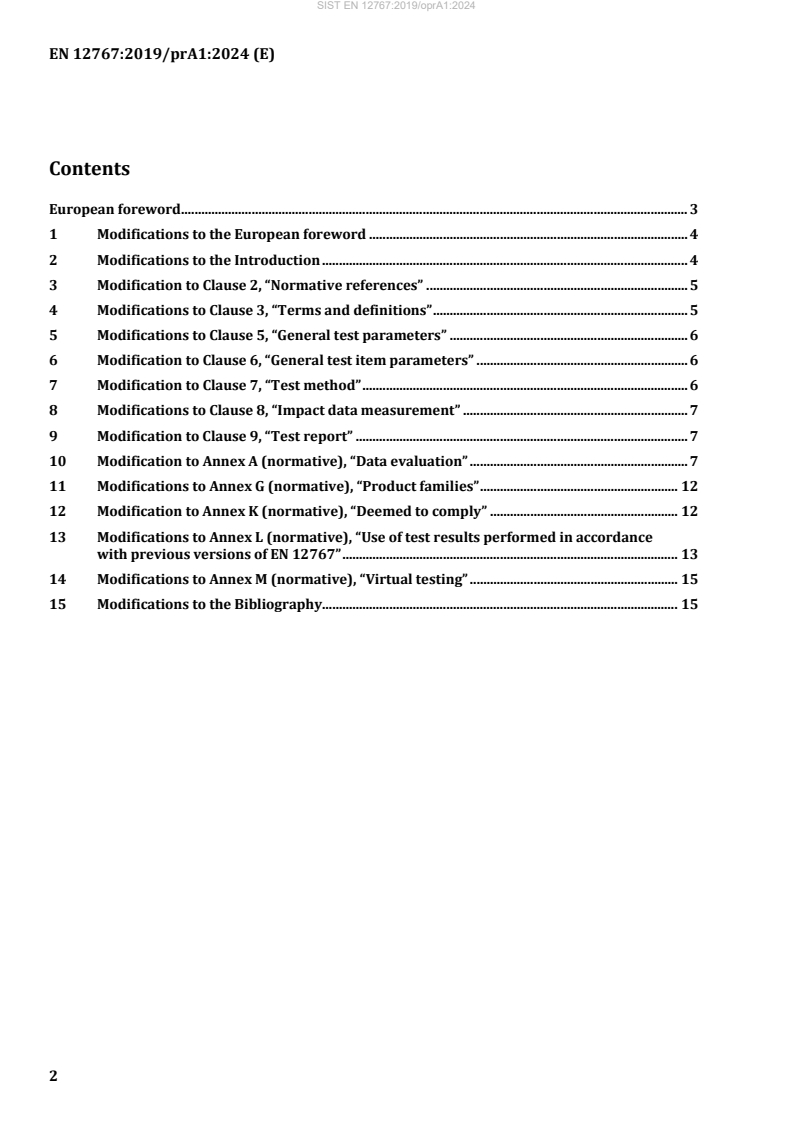
Contents
European foreword . 3
1 Modifications to the European foreword . 4
2 Modifications to the Introduction . 4
3 Modification to Clause 2, “Normative references” . 5
4 Modifications to Clause 3, “Terms and definitions” . 5
5 Modifications to Clause 5, “General test parameters” . 6
6 Modification to Clause 6, “General test item parameters” . 6
7 Modification to Clause 7, “Test method” . 6
8 Modifications to Clause 8, “Impact data measurement” . 7
9 Modification to Clause 9, “Test report” . 7
10 Modification to Annex A (normative), “Data evaluation” . 7
11 Modifications to Annex G (normative), “Product families” . 12
12 Modification to Annex K (normative), “Deemed to comply” . 12
13 Modifications to Annex L (normative), “Use of test results performed in accordance
with previous versions of EN 12767” . 13
14 Modifications to Annex M (normative), “Virtual testing” . 15
15 Modifications to the Bibliography . 15
European foreword
This document (EN 12767:2019/prA1:2024) has been prepared by Technical Committee CEN/TC 226
“Road equipment”, the secretariat of which is held by AFNOR.
This document is currently submitted to the CEN Enquiry.
1 Modifications to the European foreword
th
Replace the whole 5 paragraph with the following one:
"The significant technical changes incorporated in this revision are:
— incorporation of the Regulation (EU) No 305/2011 of the European Parliament and of the Council of
9 March 2011 laying down harmonized conditions for the marketing of construction products and
repealing Council Directive 89/106/EEC terminology;
— introduction of a push-pull test to enable a comparison to be made between the backfills used in the
test and those on-site;
— harmonization of the boundary values for occupant safety (ASI and THIV) independent of the energy
absorption class;
— replacement of the occupant safety level by an alphanumeric character instead of a number to make
a clear distinction with the old (EN 12767:2007) approach. Now, NE-C, LE-C and HE-C have the same
occupant safety. The best occupant safety is achieved for A;
— introduction of collapse modes to classify if test items become detached or do not become detached;
— introduction of direction sensitivities to take into account any sensitiveness to impact angle;
— improved test description, include installation manual and translation of roof deformation into a
measurable value, to reduce the influence of the vehicle structure on the test results;
— introduction of an extra test at 50 km/h for cases where the test-item is not activated at low speed.
An explanation of the definition of “activated” is also given;
— better rules for the determination of product ranges (former product families) based on the tested
limit(s);
— introduction of a risk assessment approach, in line with the EN 1317-1:2010, for assessing changes
of a version, and the use of (for example) virtual testing in this;
— possibility to declare, under certain conditions, intermediate speed levels.".
th
Replace the whole 7 paragraph with the following one:
"Some added changes mentioned above are expressed in a new performance classification for the
product. This results in a longer description of the overall passive safety performance, but at the end, it
gives a clearer indication of product performance. For example, an old performance classification like
“100, HE, 3” could be translated to “100-HE-C-S-SE-MD-1”. In this example, the last 4 sub-indications
stands for backfill type (S), collapse mode (SE), direction sensitivity (MD) and risk of roof indentation
(1).".
2 Modifications to the Introduction
nd
Replace the 2 paragraph with the following:
"Passive safety is intended to reduce the severity of injury to vehicle occupants of a car in an impact with
support structures of road equipment. Passive safety for vulnerable road users, e.g. motorcyclists, is not
covered by this document.”.
th
Replace the 4 paragraph with the following:
"The test procedure includes guidelines:
— for test item selection, test parameters, detailed test methods with different test conditions, the data
to record, and requirements for reporting;
— to assess the performance within product ranges and for modified products (called “changed
versions”).".
th
Replace the 5 paragraph with the following:
"This document considers:
— two kinds of test inputs:
— three speed levels (50, 70 and 100);
— three Backfill types (standard aggregates (S), special (X) and Rigid (R)).
— five kinds of test outcomes:
— three energy absorption classes: high energy absorbing (HE), low energy absorbing (LE) and
non-energy absorbing (NE);
— five occupant safety levels (from A to E);
— two modes of collapse for support structures (Separation mode (SE) and No separation collapse
mode (NS));
— three direction sensitivities (single-directional (SD), bi-directional (BD) and multi-directional
(MD));
— two classes of risk of roof indentation (0 or 1).".
3 Modification to Clause 2, “Normative references”
Add the following reference to the list:
“EN 16303 , Road restraint systems - Validation and verification process for the use of virtual testing in
crash testing against vehicle restraint system”.
4 Modifications to Clause 3, “Terms and definitions”
Replace term 3.20 with the following:
"3.20
ballast
mass added to a test vehicle, including measurement and instrumentation, to simulate cargo and/or to
achieve desired test mass".
Under term 3.26 object length, replace the Note 1 to entry with the following:
"Note 1 to entry: For lighting columns, the object length is the height above ground level (h) plus half of the longest
horizontal bracket projection (w) in case of one or two bracket in top of the support structure. h and w are defined
by EN 40-2.".
Under review
5 Modifications to Clause 5, “General test parameters”
st
In 5.1, replace the 1 paragraph with the following:
"The test site shall be generally flat and have a level, hardened surface with a gradient not exceeding
2,5 %. The area around the test item until 15 m behind the impact point shall be clear of standing water,
ice or snow at the time of the test. The test site shall be of sufficient size to enable the test vehicle to be
accelerated up to the required speed and controlled so that its approach to the test object is stable.".
rd
In 5.2.1, replace the 3 paragraph with the following:
"Within one product range, the same backfill type shall be used for all tests.".
st
In 5.2.2, replace the 1 paragraph with the following:
"Backfill type S and X identify the use of backfill material in the backfill volume.
— Backfill type S grading shall be in accordance with B.3.
— Backfill type X shall be described by a grading curve supplied by the manufacturer of the product to
be tested and included in the test report (grading shall be in accordance with EN 13285).".
In 5.2.3, replace the NOTE with the following:
"NOTE The backfill can be locally damaged in the impact area as a result of the impact test.".
6 Modification to Clause 6, “General test item parameters”
th
In 6.2.1, replace the 4 paragraph with the following:
"In those cases where several versions of a product are based on the same construction principle, the
manufacturer selects an item to be a parent member. Annex G gives explanations on how to choose the
other products in the range.".
7 Modification to Clause 7, “Test method”
Replace the whole subclause 7.4 with the following:
“7.4 Impact speed
"The manufacturer shall select the speed level to which the support structure will be tested from Table 2.
The speed level identifies the impact speed in the high-speed test.
Table 2 — Support structure speed level
Speed level Impact speed Impact speed tolerance
km/h km/h
50 50 ±3
70 70 ±5
100 100 ±5
For any speed level, a low speed test shall also be carried out at 35 km/h ± 3 km/h. An additional 50 km/h
test can be necessary following the provision given in A.2.
The overall accuracy of the impact speed measurement shall be within ±2 % of the target impact speed.
The test vehicle impact speed shall be measured along the test vehicle approach path, no further than 6 m
before the impact point. The average impact speed shall be measured over a length of at least 1 m.".
8 Modifications to Clause 8, “Impact data measurement”
nd th nd
In 8.2, 2 paragraph, 10 list item, replace the 2 bullet with the following:
"
— resistance to bending excluding any safety factor;".
rd st
In 8.4, 3 paragraph, replace the 1 sentence with the following:
"The vertical profile of the shape of the original roof line of the test vehicle shall be made along the centre
line of the vehicle prior to the impact test, using a straightedge with the lower edge shaped to the roof
profile.".
9 Modification to Clause 9, “Test report”
st
In 9.1, replace the 1 paragraph with the following:
"For each test performed, one test report shall be provided. For example, for a defined speed level, one
test report shall be produced for the low speed test and one test report shall be produced for the high-
speed test.".
10 Modification to Annex A (normative), “Data evaluation”
Replace the whole Annex A with the following one:
“
Annex A
(normative)
Data evaluation
A.1 Performance class
The performance class of each tested support structure shall be expressed as a combination of speed
level, energy absorption category, occupant safety level, backfill type, collapse mode, direction sensitivity
given, and risk of roof indentation given by the parameters shown in Table A.1. The performance class
shall be expressed in the following format; speed level-energy absorption category-occupant safety level-
backfill type-collapse mode-direction sensitivity-risk of roof indentation, e.g. 100-HE-A-S-SE-MD-1, 70-
LE-B-R-SE-SD-0 and 100-HE-C-X-NS-MD-1.
Table A.1 — Passive safety performance variables
Var. no Variable description Variable choices Clause
1 Speed level 50, 70, 100 A.2
2 Energy absorption category HE, LE or NE A.3
3 Occupant safety level A, B, C, D, E A.4
4 Backfill type S, X, R 5.2.1, Table 1
5 Collapse mode SE, NS A.5
6 Direction sensitivity SD, BD, MD A.6
7 Risk of roof indentation 0 or 1 A.7
The support structure shall successfully pass the test(s) described in this document, and shall meet the
general requirements given in A.2 to A.7.
The test vehicle shall not roll over (including rolling onto its side) within a 12 m radius of the impact
point.
Some standard metal tubes are deemed to comply with the requirements of this document, and their
performances classes are given in Annex K.
If not all variables are of interest for the specifier, the specifier can put NR (no requirement) for that
variable.
For products tested in accordance with previous versions of this standard, Annex L provides guidelines.
A.2 Evaluation of speed level
Support structures shall be classified according to speed level. Three speed levels are defined according
to the selected impact speed: 100 km/h, 70 km/h and 50 km/h.
In order to receive a speed level, the test item shall be tested at high speed (the speed level) and low
speed (35 km/h test). If the support structure is not activated in the low speed test, an additional test at
50 km/h shall be performed in speed levels 100 km/h and 70 km/h.
Activation means that one point of the support, situated in the lower 2,0 m of the support structure, has
a permanent displacement of more than 0,5 m. Rotation of the bracket or
...
Questions, Comments and Discussion
Ask us and Technical Secretary will try to provide an answer. You can facilitate discussion about the standard in here.
Loading comments...