

prEN 3874
(Main)Aerospace series - Test methods for metallic materials - Constant-amplitude force-controlled low-cycle fatigue testing
- Status
- Not Published
- Publication Date
- 04-Jul-2027
- Technical Committee
- ASD-STAN - Aerospace
- Drafting Committee
- ASD-STAN/D 4/S 5 - Test Methods
- Current Stage
- 4060 - Closure of enquiry - Enquiry
- Start Date
- 30-Apr-2026
- Completion Date
- 30-Apr-2026

Overview
prEN 3874:2026 is a draft European Standard developed by CEN under the Aerospace series. It specifies test methods for metallic materials, focusing on constant-amplitude force-controlled low-cycle fatigue (LCF) testing. The standard aims to ensure reproducibility and comparability in fatigue testing of metals, particularly for aerospace applications. The methodologies covered support the assessment of material performance under cyclic loading at both ambient and elevated temperatures, which is critical for quality assurance and reliability in the aerospace industry.
Key Topics
- Low-cycle fatigue (LCF) testing: Focus on tests that subject metallic materials to a constant amplitude cyclic force, typically resulting in less than 100,000 cycles to failure.
- Force-controlled regime: The cyclic force is applied in a controlled manner, usually via servo-controlled test machines.
- Specimens: Guidelines for geometry, preparation, and measurement of both plain and notched test pieces.
- Test equipment: Requirements for calibration, cycle counting, waveform generation, fixtures, and heating devices.
- Temperature control: Procedures for conducting tests at elevated temperatures, including uniformity, measurement, and tolerances.
- Test method: Covers specimen insertion, heating, control of force cycles, and data recording.
- Alignment and accuracy: Emphasizes the importance of proper alignment and calibration to ensure valid, repeatable results.
- Reporting: Stipulates information to be included in test reports for transparency and traceability.
Applications
The procedures and requirements in prEN 3874 support a variety of practical applications, especially in aerospace material testing:
- Material qualification: Assures that metallic alloys used in aerospace can endure cyclic loads typically experienced during service.
- Component design validation: Data derived guide engineers in predicting fatigue life and ensuring safety margins for aerospace components.
- Quality control: Manufacturers apply these test methods to verify production consistency and compliance with aerospace standards.
- Research and development: Facilitates studies on new metallic materials or treatments by providing standardized LCF testing protocols.
- Performance benchmarking: Enables the comparison of fatigue properties across materials and suppliers using harmonized methods.
While tailored for aerospace, the standard’s principles can be adapted to other sectors requiring rigorous fatigue evaluation of metals, such as automotive or energy.
Related Standards
prEN 3874 interfaces with other key international standards for consistency in materials testing:
- EN ISO 7500-1:2018: Calibration and verification requirements for static uniaxial testing machines, ensuring measurement reliability in LCF testing.
- ASTM E1012:2019: Practices for verifying testing frame and specimen alignment, a critical factor to minimize error in force-controlled fatigue tests.
- EN 4258: Organization of metallic material standards for aerospace applications, underlining the role of prEN 3874 within this framework.
- EN ISO 3785: Recommendations for sampling and identification of specimens to ensure traceability in fatigue testing procedures.
Conclusion
prEN 3874:2026 sets a comprehensive framework for constant-amplitude force-controlled low-cycle fatigue testing of metallic materials, with particular emphasis on aerospace needs. Adhering to this standard elevates the integrity, comparability, and safety of materials used in critical applications, providing manufacturers, designers, and regulators with robust procedures for assessing fatigue performance. As such, it is a valuable tool in ensuring high standards in both material development and aerospace product certification.
Get Certified
Connect with accredited certification bodies for this standard

BUREAU VERITAS Certification Germany
Bureau Veritas certification in Germany.

Element Materials Technology
Materials testing and product certification.

AQMS Ltd.
AQMS provides ISO certification to SMEs across the UK.
Sponsored listings
Frequently Asked Questions
prEN 3874 is a draft published by the European Committee for Standardization (CEN). Its full title is "Aerospace series - Test methods for metallic materials - Constant-amplitude force-controlled low-cycle fatigue testing". This standard covers: Le présent document s’applique aux essais de fatigue oligocyclique (LCF, low cycle fatigue) en contrainte imposée sur des matériaux métalliques régis par les normes EN aérospatiales. Ce document définit les propriétés mécaniques dont la détermination peut être nécessaire, les équipements, les éprouvettes, la méthodologie d’essai ainsi que la présentation des résultats. Le document s’applique aux essais sous charge uniaxiale réalisés sur des éprouvettes lisses ou à entaille, à température ambiante et à des températures élevées. Le document ne couvre pas les essais sur des éprouvettes plus complexes, des composants ou des structures à taille réelle, bien que la méthodologie puisse être adoptée pour de tels essais. L’objet du présent document est d’assurer la comparabilité et la reproductibilité des résultats d’essai. Il ne couvre pas l’évaluation ou l’interprétation des résultats.
Le présent document s’applique aux essais de fatigue oligocyclique (LCF, low cycle fatigue) en contrainte imposée sur des matériaux métalliques régis par les normes EN aérospatiales. Ce document définit les propriétés mécaniques dont la détermination peut être nécessaire, les équipements, les éprouvettes, la méthodologie d’essai ainsi que la présentation des résultats. Le document s’applique aux essais sous charge uniaxiale réalisés sur des éprouvettes lisses ou à entaille, à température ambiante et à des températures élevées. Le document ne couvre pas les essais sur des éprouvettes plus complexes, des composants ou des structures à taille réelle, bien que la méthodologie puisse être adoptée pour de tels essais. L’objet du présent document est d’assurer la comparabilité et la reproductibilité des résultats d’essai. Il ne couvre pas l’évaluation ou l’interprétation des résultats.
prEN 3874 is classified under the following ICS (International Classification for Standards) categories: 49.025.05 - Ferrous alloys in general; 49.025.15 - Non-ferrous alloys in general. The ICS classification helps identify the subject area and facilitates finding related standards.
prEN 3874 is available in PDF format for immediate download after purchase. The document can be added to your cart and obtained through the secure checkout process. Digital delivery ensures instant access to the complete standard document.
Standards Content (Sample)
SLOVENSKI STANDARD
01-april-2026
Aeronavtika - Preskusne metode za kovinske materiale - Preskusi utrujenosti z
nizkim številom ciklov s konstantno amplitudo in nadzorom sile
Aerospace series - Test methods for metallic materials - Constant-amplitude force-
controlled low-cycle fatigue testing
Luft- und Raumfahrt - Prüfverfahren für metallische Werkstoffe - Kraftgesteuerter
Kurzzeit-Ermüdungsversuch (LCF) mit konstanter Amplitude
Ta slovenski standard je istoveten z: prEN 3874
ICS:
49.025.05 Železove zlitine na splošno Ferrous alloys in general
49.025.15 Neželezove zlitine na Non-ferrous alloys in general
splošno
2003-01.Slovenski inštitut za standardizacijo. Razmnoževanje celote ali delov tega standarda ni dovoljeno.
DRAFT
EUROPEAN STANDARD
NORME EUROPÉENNE
EUROPÄISCHE NORM
February 2026
ICS 49.025.05; 49.025.15
English Version
Aerospace series - Test methods for metallic materials -
Constant-amplitude force-controlled low-cycle fatigue
testing
Luft- und Raumfahrt - Prüfverfahren für metallische
Werkstoffe - Kraftgesteuerter Kurzzeit-
Ermüdungsversuch (LCF) mit konstanter Amplitude
This draft European Standard is submitted to CEN members for enquiry. It has been drawn up by the Technical Committee ASD-
STAN.
If this draft becomes a European Standard, CEN members are bound to comply with the CEN/CENELEC Internal Regulations
which stipulate the conditions for giving this European Standard the status of a national standard without any alteration.
This draft European Standard was established by CEN in three official versions (English, French, German). A version in any other
language made by translation under the responsibility of a CEN member into its own language and notified to the CEN-CENELEC
Management Centre has the same status as the official versions.
CEN members are the national standards bodies of Austria, Belgium, Bulgaria, Croatia, Cyprus, Czech Republic, Denmark, Estonia,
Finland, France, Germany, Greece, Hungary, Iceland, Ireland, Italy, Latvia, Lithuania, Luxembourg, Malta, Netherlands, Norway,
Poland, Portugal, Republic of North Macedonia, Romania, Serbia, Slovakia, Slovenia, Spain, Sweden, Switzerland, Türkiye and
United Kingdom.
Recipients of this draft are invited to submit, with their comments, notification of any relevant patent rights of which they are
aware and to provide supporting documentation.
Warning : This document is not a European Standard. It is distributed for review and comments. It is subject to change without
notice and shall not be referred to as a European Standard.
EUROPEAN COMMITTEE FOR STANDARDIZATION
COMITÉ EUROPÉEN DE NORMALISATION
EUROPÄISCHES KOMITEE FÜR NORMUNG
CEN-CENELEC Management Centre: Rue de la Science 23, B-1040 Brussels
© 2026 CEN All rights of exploitation in any form and by any means reserved Ref. No. prEN 3874:2026 E
worldwide for CEN national Members.
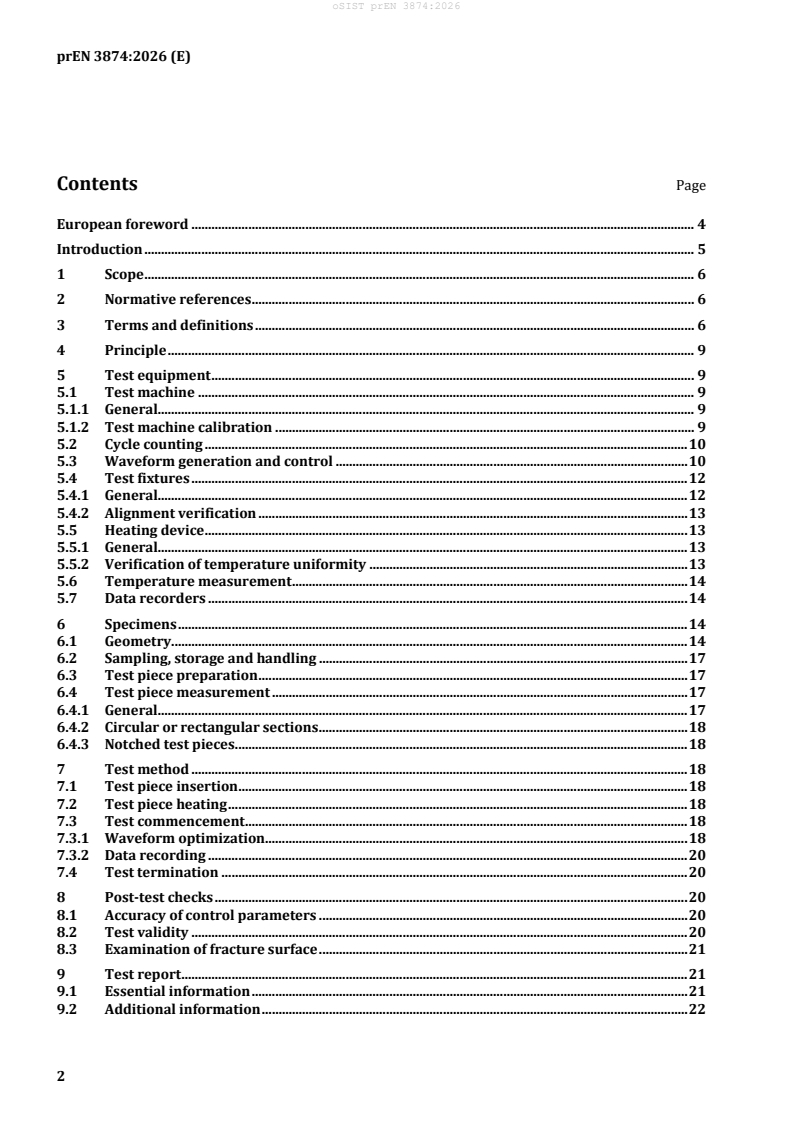
Contents Page
European foreword . 4
Introduction . 5
1 Scope . 6
2 Normative references . 6
3 Terms and definitions . 6
4 Principle . 9
5 Test equipment . 9
5.1 Test machine . 9
5.1.1 General. 9
5.1.2 Test machine calibration . 9
5.2 Cycle counting . 10
5.3 Waveform generation and control . 10
5.4 Test fixtures . 12
5.4.1 General. 12
5.4.2 Alignment verification . 13
5.5 Heating device . 13
5.5.1 General. 13
5.5.2 Verification of temperature uniformity . 13
5.6 Temperature measurement . 14
5.7 Data recorders . 14
6 Specimens . 14
6.1 Geometry . 14
6.2 Sampling, storage and handling . 17
6.3 Test piece preparation . 17
6.4 Test piece measurement . 17
6.4.1 General. 17
6.4.2 Circular or rectangular sections . 18
6.4.3 Notched test pieces . 18
7 Test method . 18
7.1 Test piece insertion . 18
7.2 Test piece heating . 18
7.3 Test commencement . 18
7.3.1 Waveform optimization . 18
7.3.2 Data recording . 20
7.4 Test termination . 20
8 Post-test checks . 20
8.1 Accuracy of control parameters . 20
8.2 Test validity . 20
8.3 Examination of fracture surface . 21
9 Test report . 21
9.1 Essential information . 21
9.2 Additional information . 22
9.3 Presentation of results . 22
Annex A (informative) Use of thermocouples . 24
Annex B (informative) Test piece preparation . 25
Annex C (normative) Guidelines on test piece handling and degreasing . 27
Annex D (informative) Guidelines on producing an S-N curve. 28
Annex E (informative) Measurement uncertainty . 29
Bibliography . 31
European foreword
This document (prEN 3874:2026) has been prepared by ASD-STAN.
After enquiries and votes carried out in accordance with the rules of this Association, this document has
received the approval of the National Associations and the Official Services of the member countries of
ASD-STAN, prior to its presentation to CEN.
This document is currently submitted to the CEN Enquiry.
Introduction
This document is part of the series of EN metallic material standards for aerospace applications. The
general organization of this series is described in EN 4258.
1 Scope
This document applies to constant-amplitude force-controlled low-cycle fatigue (LCF) testing of
metallic materials governed by EN Aerospace standards. The document defines the mechanical
properties that need to be determined, the equipment, test pieces, methodology of test and presentation
of results.
The document applies to uniaxially loaded tests carried out on plain or notched test pieces under
ambient and elevated temperatures. The document does not cover the testing of more complex test
pieces, full scale components or structures, although the methodology could well be adopted to provide
for such tests.
The purpose of this document is to ensure the comparability and reproducibility of the test results. The
document does not cover the evaluation or interpretation of the results.
2 Normative references
The following documents are referred to in the text in such a way that some or all of their content
constitutes requirements of this document. For dated references, only the edition cited applies. For
undated references, the latest edition of the referenced document (including any amendments) applies.
EN ISO 7500-1:2018, Metallic materials — Calibration and verification of static uniaxial testing
machines — Part 1: Tension/compression testing machines — Calibration and verification of the force-
measuring system (ISO 7500-1:2018)
ASTM E1012:2019, Standard Practice for Verification of Testing Frame and Specimen Alignment Under
Tensile and Compressive Axial Force Application
3 Terms and definitions
For the purposes of this document, the following terms and definitions apply.
ISO and IEC maintain terminology databases for use in standardization at the following addresses:
— ISO Online browsing platform: available at https://www.iso.org/obp/
— IEC Electropedia: available at https://www.electropedia.org/
3.1
force
F
instantaneous load applied to the test section, in kN
Note 1 to entry: Tensile forces are considered to be positive and compressive forces negative.
3.2
force-control
tests in which the force acting on a known test section is controlled
3.3
maximum force
F
max
highest algebraic value of force applied, in kN
Published by American Society for Testing and Materials (ASTM International), available at:
https://www.astm.org/.
3.4
minimum force
F
min
lowest algebraic value of force applied, in kN
3.5
force range
ΔF
algebraic difference between the maximum and minimum forces, in kN
Note 1 to entry: ΔF = Fmax − Fmin
3.6
force amplitude
F
a
half the algebraic difference between the maximum and minimum forces, in kN
Note 1 to entry: Fa = (Fmax − Fmin)/2
3.7
mean force
F
m
half the algebraic sum of the maximum and minimum forces, in kN
Note 1 to entry: F = (F + F )/2
m max min
3.8
force ratio
R
algebraic ratio of the minimum force to the maximum force
Note 1 to entry: R = Fmin/Fmax
Note 2 to entry: See Figure 2 for examples of different force ratios.
3.9
stress
σ
force divided by the nominal cross-sectional area, in MPa
Note 1 to entry: It is the independent variable in a stress-controlled fatigue test.
Note 2 to entry: The nominal cross-sectional area (engineering stress) is that calculated from measurements
taken at ambient temperature and no account is taken for the change in section as a result of expansion at
elevated temperatures.
3.10
stress ratio
R
s
ratio of minimum stress to maximum stress during a fatigue cycle
Note 1 to entry: R = σ /σ
s min max
3.11
stress range
Δσ
arithmetic difference between maximum stress and minimum stress, in MPa
Note 1 to entry: Δσ = σmax − σmin
3.12
maximum stress
σmax
highest algebraic value of stress applied, in MPa
3.13
minimum stress
σ
min
lowest algebraic value of stress applied, in MPa
3.14
theoretical stress concentration factor
K
t
ratio of the notch tip stress to net section stress, calculated in accordance with defined elastic theory, to
the nominal section stress
Note 1 to entry: Different methods used in determining K may lead to variations in reported values.
t
3.15
fatigue strength at N cycles
σ
N
value of the stress amplitude at a stated stress ratio under which the specimen would have a life of at
least N cycles with a stated probability, in MPa
3.16
fatigue life
N
f
number of cycles to failure
3.17
number of force cycles
N
number of loading and unloading sequences applied
3.18
time per cycle
t
time applied per loading and unloading sequence
3.19
maximum temperature
T
max
highest algebraic value of temperature applied, in °C
3.20
minimum temperature
T
min
lowest algebraic value of temperature applied, in °C
3.21
parallel length
L
p
length in the gauge test section of a specimen or test piece that has equal test diameter or test width and
is parallel
3.22
specimen length
L
z
overall length of test specimen
3.23
test frequency
f
expressed in Hertz
4 Principle
The uniaxially-loaded force-controlled low-cycle fatigue test consists in maintaining a test piece at a
uniform temperature and subjecting it to a constant force-amplitude waveform. The magnitude of the
applied cyclic force affects the development of microscopic plastic strain within the test section, thus
determining the fatigue life. A series of such tests, on nominally identical test pieces allows the
relationship between the applied force and the number of cycles to failure to be established.
The fatigue lives generated are typically less than 100 000 cycles to failure and the test regime is said to
be that of low cycle fatigue (LCF).
5 Test equipment
5.1 Test machine
5.1.1 General
The tests shall be carried out on a tension-compression machine designed for a smooth start-up with no
backlash when passing through zero. In order to minimize the risk of buckling of the test piece, the
machine shall have great lateral rigidity and accurate alignment between the components used to grip
the test piece ends.
The machine loading system shall be a controlled system in which the loading of the test piece is servo-
controlled. It may be hydraulic or electromechanical.
During elevated temperature tests the machine load cell shall be suitably shielded and/or cooled such
that it remains within its temperature operating range.
5.1.2 Test machine calibration
The force measurement system shall be verified at intervals not exceeding one year. The method to be
used is that of EN ISO 7500-1 with the following amendment, related to the application of test forces, to
cover calibration in tension and compression going through zero (see EN ISO 7500-1:2018, 6.4.5):
Three series of measurements shall be carried out. Each series shall comprise at least 20 force steps as
follows:
a) 5 increasing force steps in tension at regular intervals from 20 % to 100 % of the full scale;
b) 10 decreasing force steps at regular intervals from 100 % of the full scale in tension down to the full
scale in compression;
c) 5 increasing force steps at regular intervals from 100 % of the full scale in compression up to zero.
The relative errors of accuracy, repeatability, reversibility, and zero shall be within the limits stated for
EN ISO 7500-1:2018, class 1.
During the calibration process, an initial calibration shall be performed prior to adjustment of the test
machine, such that the effect of any errors outside of the grade 1,0 requirement can be understood.
Modem test machines should readily meet this requirement, however if initial errors are present then
the calibration period is to be reviewed accordingly.
5.2 Cycle counting
The number of cycles applied to the test piece shall be recorded such that for tests lasting less than
10 000 cycles, individual cycles can be resolved, while for longer tests the resolution shall be better
than 0,1 % of the indicated life.
NOTE A calibrated timer is a desirable adjunct to the cycle counter. When used to indicate total elapsed time
to failure, it provides an excellent check against the cycle counter frequency for a fixed waveform frequency.
5.3 Waveform generation and control
The force cycle waveform shall be constant and is to be applied at a fixed frequency throughout the
duration of a test programme. The waveform generator in use shall have a repeatability such that the
variation in requested force levels between successive cycles is within the calibration tolerance of the
test machine as stated in 5.1.2, for the duration of the test.
Terms have been identified relative to a trapezoidal waveform in Figure 1 and Figure 2. Other
waveform shapes may require further parameter definition although nomenclature, stated in Clause 3,
shall be retained where possible.
The waveform frequency used for low cycle fatigue tests shall not be greater than 10 Hz.
NOTE The waveform frequency will generally be between 0,1 Hz and 1,0 Hz. Although higher or lower
frequencies might be used, the effect of frequency and waveform shape on fatigue life can be significant.
Key
X time
Y force
a
mean force
b
minimum force
c
maximum force
d
force range
e
force amplitude
f
one cycle
Figure 1 — Trapezoidal fatigue force cycle
Key
X time
Y force
a
cyclic tension
b
reversed
c
cyclic compression
Figure 2 — Varying force ratio
5.4 Test fixtures
5.4.1 General
An important consideration for test piece grips and fixtures is that they can be brought into good
alignment consistently from test to test. Good alignment is achieved from very careful attention to
design details, i.e. specifying the concentricity and parallelism of critical machined parts within close
tolerances.
In order to minimize bending strains the gripping system shall be capable of alignment such that the
major axis of the test piece coincides closely with the force axis throughout each stress cycle and in the
case of push-pull zero tests (R ≤ 0) the gripping system shall also be free from backlash effects.
The occurrence of misalignment either due to twist (rotation of the grips) or to a displacement on their
axes of symmetry, shall be controlled within known limits.
A parallelism error of less than 0,2 mm/m, and an axial error of less than 0,03 mm for a distance
between the gripping supports of less than 300 mm, and less than 0,1 mm for a space of more than
300 mm, allows the alignment requirements described in 5.4.2 to be achieved. A further benefit can be
realized by minimizing the number of mechanical interfaces in the load train and the distance between
the machine actuator and crosshead.
5.4.2 Alignment verification
Alignment of the load train assembly shall be checked at intervals not exceeding one year or 100 tests,
whichever occurs sooner. In addition, it shall be checked following disassembly of the test fixtures,
movement of the machine crosshead or following a compressive failure that has caused the two test
piece halves to overlap.
It is recommended that the alignment is checked by means of a strain-gauged test piece of identical
geometry to that to be tested and that has been manufactured to the same tolerances.
The maximum bending strain determined in accordance with ASTM E1012:2019, Method 1 shall not
exceed 5 % of the mean axial strain induced at the lowest maximum tensile force and the maximum
compressive force to be encountered in the test program. This criterion shall be met at each of four
positions as the test piece is rotated through 90°.
The use of two sets of strain gauges in groups of 4, fixed at 90° intervals around the test section is
recommended. The gauges shall be equally distant from the test piece centre line, 3/4 of the parallel
gauge length apart. Any strains induced into the gauge length due to the gripping mechanism shall be
minimized to less than 100 micro strain.
The National Physical Laboratories NPL MMS 001 is recommended as a good detailed best working
practice document.
The use of dial gauge indicators in checking alignment should be avoided. When they are used, the
tolerances adopted shall ensure an equivalent alignment error to that obtained using strain gauges.
However, bending induced by an aligned, but off-centred load train, will not be detected by this
technique.
5.5 Heating device
5.5.1 General
Testing is generally conducted in air, at ambient or elevated temperatures, although there may be a
requirement to test in vacuum or in a controlled atmosphere.
Where additional apparatus is used such as furnaces, chambers, etc., it is essential that the full force
indicated by the force indicator is being applied to the test piece and is not being diverted through the
auxiliary apparatus (e.g. by friction).
For elevated temperature tests the heating device employed shall be such that the test piece can be
uniformly heated to the specified temperature, and an indicated temperature variation along the test
section of less than or equal to 4 °C can be maintained for the duration of the test.
A resistance furnace with three control zones is recommended. If a direct induction heating system is
used, it is advisable to select a generator of medium frequency (f ≤ 100 kHz) to achieve minimal radial
thermal gradient in the test piece.
5.5.2 Verification of temperature uniformity
The uniformity of temperature along the parallel length of the test piece shall be verified before every
series of tests that introduces a new test temperature, test piece geometry, or in which the cooling,
fixturing or heating device mounting arrangement are adjusted.
This verification may be made by means of a dummy test piece of identical geometry to that to be
tested, equipped with at least three thermocouples fixed along and around its test section. The
thermocouples shall be suitably screened from direct radiant heat from the heating device.
The variation in indicated temperature anywhere on the test section shall not exceed 4 °C.
Where temperature uniformity cannot be ensured by this technique, for example where it is not
possible to correctly position the heating device repeatedly, than an adequate number of temperature
sensors shall be employed during each test to ensure that the variation in indicated temperature
anywhere on the test section does not exceed 4 °C.
5.6 Temperature measurement
The temperature measuring system comprising sensors and readout equipment shall be capable of
operating continuously for the duration of the test and have a resolution of at least 1 °C and an accuracy
of ± 2 °C. It shall be verified at intervals not exceeding one year over the working temperature range,
traceable to national standards by a documented method.
The use of thermocouples is recommended. Annex A describes their method of use.
The permitted deviations due to instability between the specified test temperature and the indicated
temperature measured at the surface of the test section are as indicated in Table 1.
Table 1 — Permitted deviations between indicated temperature and specified test temperature
Test temperature Tolerance
θ ≤ 600 °C ±2 °C
600 °C < θ ≤ 800 °C ±3 °C
800 °C < θ ±5 °C
For ambient temperature tests (10 °C to 35 °C) it is not necessary to measure the test piece
temperature.
The effect of compounding errors could result in the real tolerance in temperature from the specified
level to be 3 °C greater.
The temperature rise due to plastic deformation shall be minimized (see 7.3.1) and shall be
compensated for within the tolerances in Table 1.
5.7 Data recorders
A data recorder capable of monitoring the indicated test temperature throughout the test, within the
accuracy stated in 5.6 shall be employed. A temperature observation shall be made at least every 5 min.
6 Specimens
6.1 Geometry
The type of test piece used depends on the objectives of the test programme, the type of equipment, the
equipment capacity and the form in which the material is available. The design however shall meet
certain general criteria as outlined below, see Figure 3 and Figure 4.
a) Failure shall occur within the test section for the test to be considered valid.
b) Test pieces with circular cross sections shall have a blending fillet radius of at least two times the
test section diameter to minimize the theoretical stress concentration, K , of the test piece. The test
t
section length shall be greater or equal to twice the test section diameter. Errors in concentricity
and parallelism shall be less than 0,03 mm.
c) Test pieces with rectangular cross sections may have a reduced test cross section along one
dimension, generally the width. The test section length shall be greater than twice the test section
width. The edges of the test piece shall be longitudinally polished to prevent premature crack
initiation. Errors in flatness shall be less than 0,03 mm.
d) Test pieces used for compression shall have a test section length less than or equal to twice the test
section width or diameter, to avoid buckling.
e) In view of the specialized nature of notched test pieces no restrictions are placed on the design of
the notched test piece, other than that it shall be consistent with the objectives of the programme.
Information on the associated Kt for the notch shall have the method and source of its determination
reported.
Recommended dimension of cylindrical test pieces are shown in Table 2 and recommended dimension
of flat test pieces are shown in Table 3.
a) Test piece with tangentially blending fillets between the test section and the gripping ends
b) Test piece with continuous radius between gripping ends
Figure 3 — Test section profile for cylindrical test pieces
Table 2 — Recommended dimension of cylindrical test pieces
Parameter Dimensions
Test section diameter d or d' ≥ 4,5 mm
Gripping section diameter (some materials may require a minimum D or D' ≥ 2,5 d or 2,5 d'
diameter of 3,5 d or 3,5 d' to avoid failure within the grip)
Test section length (for compression, L ≤ 2 d) 2 d ≤ L ≤ 4 d
Transition radius (a transition radius of between 2
...