


EN 1176-10:2023
(Main)Playground equipment and surfacing - Part 10: Additional specific safety requirements and test methods for fully enclosed play equipment
Playground equipment and surfacing - Part 10: Additional specific safety requirements and test methods for fully enclosed play equipment
This document is applicable to fully enclosed play equipment intended for installation inside and outside buildings, for children up to 14 years old, see 3.1.
The purpose of this document is to provide additional safety requirements covering particulars of these structures.
Spielplatzgeräte und Spielplatzböden - Teil 10: Zusätzliche besondere sicherheitstechnische Anforderungen und Prüfverfahren für vollständig umschlossene Spielgeräte
Dieses Dokument ist anwendbar für vollständig umschlossene Spielgeräte, die für die Aufstellung innerhalb und außerhalb von Gebäuden und für Kinder bis 14 Jahren vorgesehen sind, siehe 3.1.
Der Zweck dieses Dokumentes besteht darin, zusätzliche sicherheitstechnische Anforderungen bereitzustellen, die Einzelheiten dieser Konstruktionen behandeln.
Équipements et sols d’aires de jeux - Partie 10 : Exigences de sécurité et méthodes d’essai complémentaires spécifiques aux équipements de jeux totalement fermés
Le présent document s’applique aux équipements de jeux totalement fermés installés tant à l’intérieur qu’à l’extérieur des bâtiments et destinés à des enfants jusqu’à 14 ans, voir 3.1.
Le présent document a pour objectif de fournir des exigences de sécurité complémentaires couvrant les spécificités de ces structures.
Oprema in podloge otroških igrišč - 10. del: Dodatne posebne varnostne zahteve in preskusne metode za zaključene igralne enote
Ta dokument se uporablja za zaključene igralne enote, namenjene za namestitev znotraj in zunaj stavb, za otroke do starosti 14 let, glej 3.1.
Namen tega dokumenta je zagotoviti dodatne varnostne zahteve, ki zajemajo podrobnosti teh konstrukcij.
General Information
- Status
- Published
- Publication Date
- 05-Sep-2023
- Technical Committee
- CEN/TC 136 - Sports, playground and other recreational equipment
- Drafting Committee
- CEN/TC 136/SC 1 - Playground equipment for children
- Current Stage
- 6060 - Definitive text made available (DAV) - Publishing
- Start Date
- 06-Sep-2023
- Due Date
- 25-Nov-2021
- Completion Date
- 06-Sep-2023
Relations
- Effective Date
- 07-Sep-2016
Overview
EN 1176-10:2023 (CEN) is the European standard that sets additional specific safety requirements and test methods for fully enclosed play equipment intended for installation inside and outside buildings for children up to 14 years. Approved July 2023, it supersedes EN 1176-10:2008 and supplements the general requirements of EN 1176 by addressing particulars of three‑dimensional enclosed play structures (e.g., soft‑play mazes, multi‑level indoor playgrounds, enclosed towers).
Key topics and technical requirements
- Scope and definitions - Clarifies terms such as fully enclosed play equipment, drop slide, overhead track ride, traveller, ball pool, adult access route, bouncing element and spinning pole.
- Fire safety and flammability - Materials, components and composite parts should be flame retardant and tested where practical to EN ISO 11925-2 or EN 1021-1/2 (or equivalent).
- Evacuation & adult access routes - Minimum adult access route dimensions (height ≥ 1 300 mm, width ≥ 700 mm), placement rules for equipment within access routes, maximum distance from any point to the nearest exit (≤ 18 m, with specified measurement rules for slides and towers), and required numbers/locations of access/egress points to distribute evacuation.
- Design and manufacture - Additional provisions on impact protection, visibility, falling spaces, proximity to hard or projecting surfaces, platform and connection design, rope and foam play features, lighting and signage.
- Specific equipment rules - Added or updated requirements and test methods for elements commonly found in enclosed structures: slides (including drop slides), overhead track rides (traveller and linkage), spinning poles, ball pools (minimum ball diameter specified), cannons, bouncing elements and electrically powered equipment.
- Inspection, maintenance and documentation - Manufacturer/supplier information, test reports and marking requirements to support safe operation and maintenance.
Practical applications and who uses it
EN 1176-10:2023 is used by:
- Playground and indoor play designers and manufacturers to ensure compliant product design.
- Installers, operators and facility managers (shopping centres, leisure centres, schools, nurseries) for safe installation and operation.
- Inspectors, conformity assessors and local authorities for safety audits and certification.
- Architects and fire/safety engineers integrating enclosed play structures in buildings.
Practical benefits include improved occupant safety, clearer evacuation planning, reduced fire risk through material testing, and uniform test/reporting requirements to support compliance and liability management.
Related standards
- EN 1176-1:2017 (general safety requirements)
- EN 1176-3:2017 (slides)
- EN 1177 (impact‑attenuating surfacing)
- EN ISO 11925-2; EN 1021‑1 / EN 1021‑2 (flammability tests)
Keywords: EN 1176-10:2023, fully enclosed play equipment, playground safety, CEN standard, adult access route, ball pool, overhead track ride, spinning pole, flammability testing.

Frequently Asked Questions
EN 1176-10:2023 is a standard published by the European Committee for Standardization (CEN). Its full title is "Playground equipment and surfacing - Part 10: Additional specific safety requirements and test methods for fully enclosed play equipment". This standard covers: This document is applicable to fully enclosed play equipment intended for installation inside and outside buildings, for children up to 14 years old, see 3.1. The purpose of this document is to provide additional safety requirements covering particulars of these structures.
This document is applicable to fully enclosed play equipment intended for installation inside and outside buildings, for children up to 14 years old, see 3.1. The purpose of this document is to provide additional safety requirements covering particulars of these structures.
EN 1176-10:2023 is classified under the following ICS (International Classification for Standards) categories: 97.200.40 - Playgrounds. The ICS classification helps identify the subject area and facilitates finding related standards.
EN 1176-10:2023 has the following relationships with other standards: It is inter standard links to EN 1176-10:2008. Understanding these relationships helps ensure you are using the most current and applicable version of the standard.
You can purchase EN 1176-10:2023 directly from iTeh Standards. The document is available in PDF format and is delivered instantly after payment. Add the standard to your cart and complete the secure checkout process. iTeh Standards is an authorized distributor of CEN standards.
Standards Content (Sample)
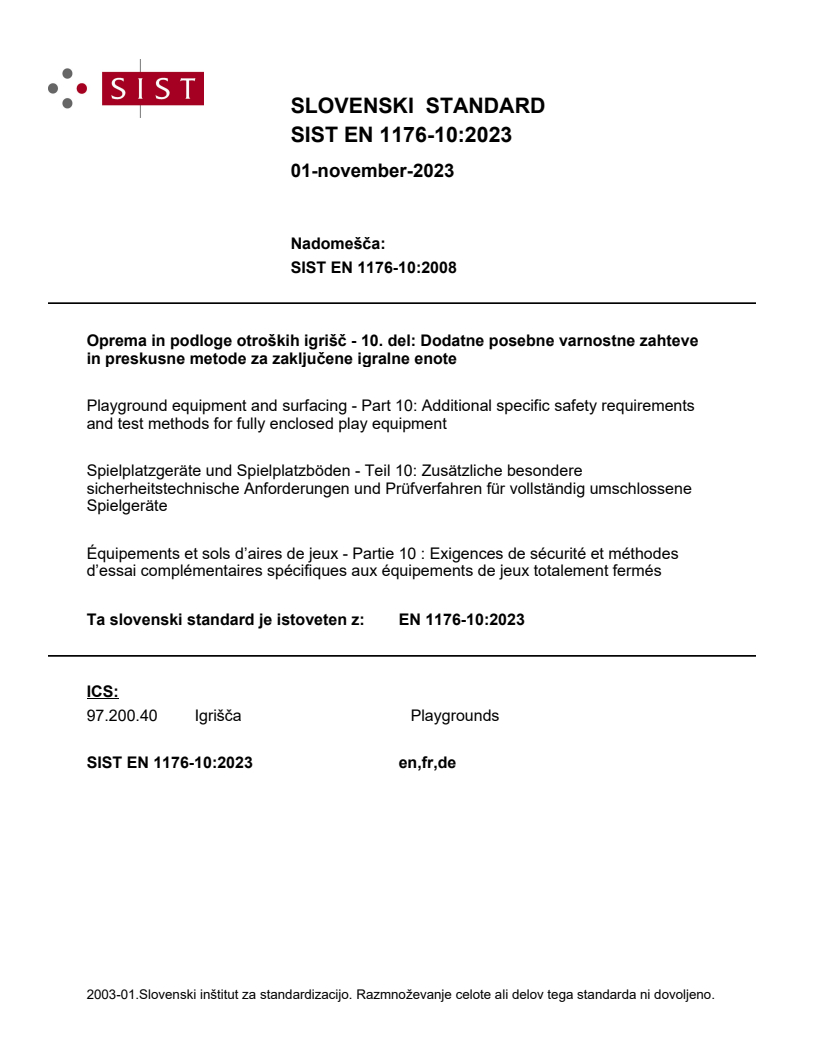
SLOVENSKI STANDARD
01-november-2023
Nadomešča:
SIST EN 1176-10:2008
Oprema in podloge otroških igrišč - 10. del: Dodatne posebne varnostne zahteve
in preskusne metode za zaključene igralne enote
Playground equipment and surfacing - Part 10: Additional specific safety requirements
and test methods for fully enclosed play equipment
Spielplatzgeräte und Spielplatzböden - Teil 10: Zusätzliche besondere
sicherheitstechnische Anforderungen und Prüfverfahren für vollständig umschlossene
Spielgeräte
Équipements et sols d’aires de jeux - Partie 10 : Exigences de sécurité et méthodes
d’essai complémentaires spécifiques aux équipements de jeux totalement fermés
Ta slovenski standard je istoveten z: EN 1176-10:2023
ICS:
97.200.40 Igrišča Playgrounds
2003-01.Slovenski inštitut za standardizacijo. Razmnoževanje celote ali delov tega standarda ni dovoljeno.
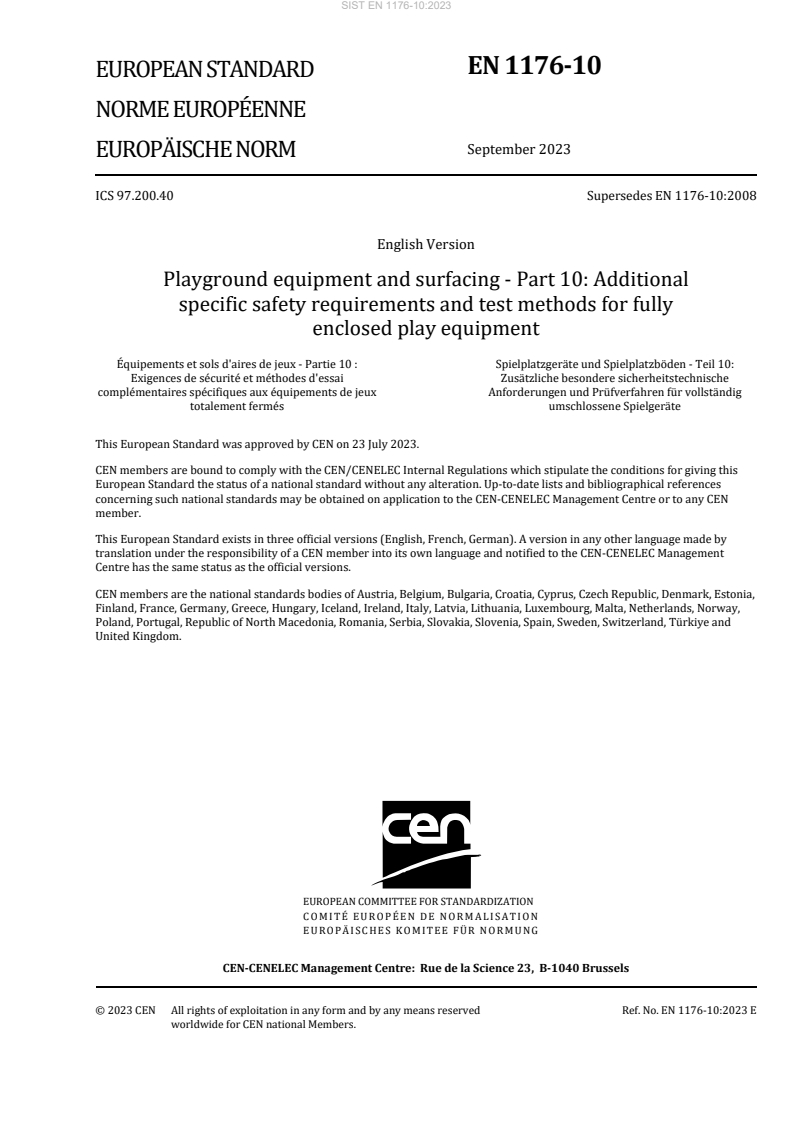
EN 1176-10
EUROPEAN STANDARD
NORME EUROPÉENNE
September 2023
EUROPÄISCHE NORM
ICS 97.200.40 Supersedes EN 1176-10:2008
English Version
Playground equipment and surfacing - Part 10: Additional
specific safety requirements and test methods for fully
enclosed play equipment
Équipements et sols d'aires de jeux - Partie 10 : Spielplatzgeräte und Spielplatzböden - Teil 10:
Exigences de sécurité et méthodes d'essai Zusätzliche besondere sicherheitstechnische
complémentaires spécifiques aux équipements de jeux Anforderungen und Prüfverfahren für vollständig
totalement fermés umschlossene Spielgeräte
This European Standard was approved by CEN on 23 July 2023.
CEN members are bound to comply with the CEN/CENELEC Internal Regulations which stipulate the conditions for giving this
European Standard the status of a national standard without any alteration. Up-to-date lists and bibliographical references
concerning such national standards may be obtained on application to the CEN-CENELEC Management Centre or to any CEN
member.
This European Standard exists in three official versions (English, French, German). A version in any other language made by
translation under the responsibility of a CEN member into its own language and notified to the CEN-CENELEC Management
Centre has the same status as the official versions.
CEN members are the national standards bodies of Austria, Belgium, Bulgaria, Croatia, Cyprus, Czech Republic, Denmark, Estonia,
Finland, France, Germany, Greece, Hungary, Iceland, Ireland, Italy, Latvia, Lithuania, Luxembourg, Malta, Netherlands, Norway,
Poland, Portugal, Republic of North Macedonia, Romania, Serbia, Slovakia, Slovenia, Spain, Sweden, Switzerland, Türkiye and
United Kingdom.
EUROPEAN COMMITTEE FOR STANDARDIZATION
COMITÉ EUROPÉEN DE NORMALISATION
EUROPÄISCHES KOMITEE FÜR NORMUNG
CEN-CENELEC Management Centre: Rue de la Science 23, B-1040 Brussels
© 2023 CEN All rights of exploitation in any form and by any means reserved Ref. No. EN 1176-10:2023 E
worldwide for CEN national Members.
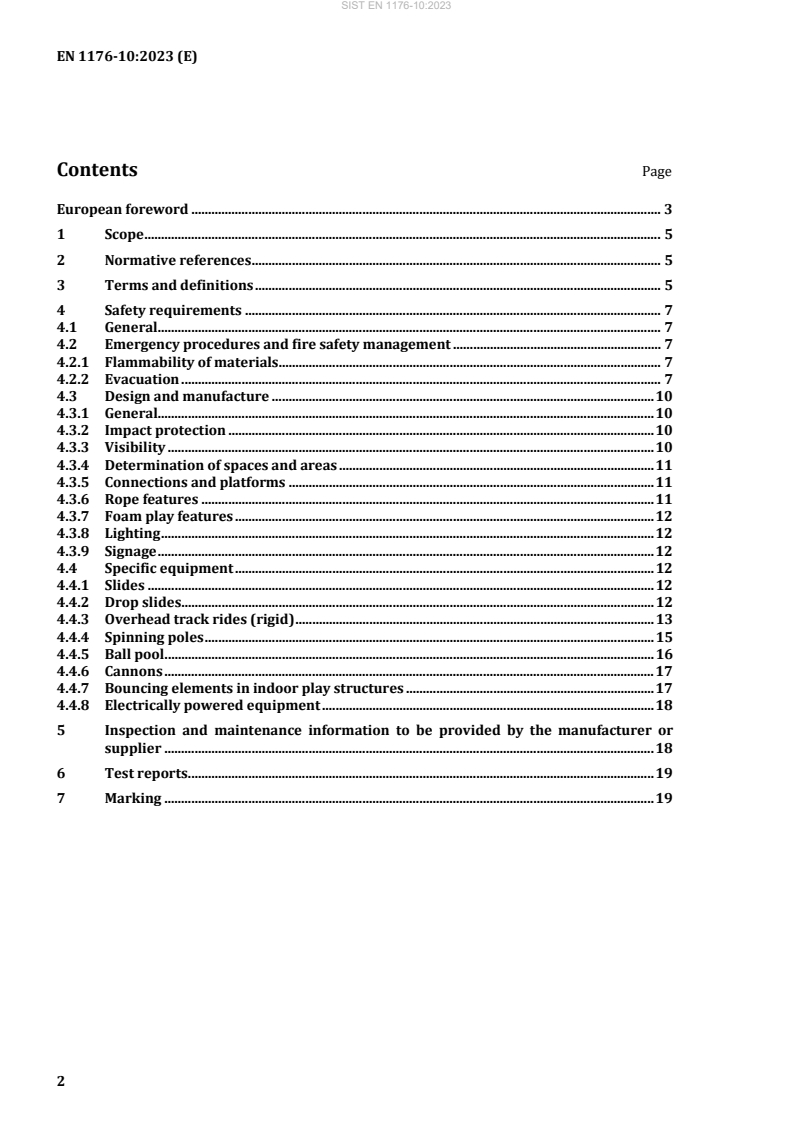
Contents Page
European foreword . 3
1 Scope . 5
2 Normative references . 5
3 Terms and definitions . 5
4 Safety requirements . 7
4.1 General. 7
4.2 Emergency procedures and fire safety management . 7
4.2.1 Flammability of materials. 7
4.2.2 Evacuation . 7
4.3 Design and manufacture . 10
4.3.1 General. 10
4.3.2 Impact protection . 10
4.3.3 Visibility . 10
4.3.4 Determination of spaces and areas . 11
4.3.5 Connections and platforms . 11
4.3.6 Rope features . 11
4.3.7 Foam play features . 12
4.3.8 Lighting . 12
4.3.9 Signage . 12
4.4 Specific equipment . 12
4.4.1 Slides . 12
4.4.2 Drop slides. 12
4.4.3 Overhead track rides (rigid) . 13
4.4.4 Spinning poles . 15
4.4.5 Ball pool . 16
4.4.6 Cannons . 17
4.4.7 Bouncing elements in indoor play structures . 17
4.4.8 Electrically powered equipment . 18
5 Inspection and maintenance information to be provided by the manufacturer or
supplier . 18
6 Test reports . 19
7 Marking . 19
European foreword
This document (EN 1176-10:2023) has been prepared by Technical Committee CEN/TC 136 “Sports,
playground and other recreational facilities and equipment”, the secretariat of which is held by DIN.
This European Standard shall be given the status of a national standard, either by publication of an
identical text or by endorsement, at the latest by March 2024, and conflicting national standards shall be
withdrawn at the latest by March 2024.
Attention is drawn to the possibility that some of the elements of this document may be the subject of
patent rights. CEN shall not be held responsible for identifying any or all such patent rights.
This document supersedes EN 1176-10:2008.
a) 1 Scope. Minor amendment made to simplify and to align with the current approach within
standards.
b) Terms and definitions updated:
1. 3.11 adult access route. New additional definition introduced
2. 3.12 bouncing element in indoor play structures. New additional definition;
3. 3.13 spinning pole. New additional definition introduced.
c) 4.2.1 Materials including flammability. The term “where practical” is introduced as it is not possible
to test some minor components;
d) 4.2.2.1 Adult access route. Re-named from evacuation routes to be more logical. Amendments made
and agreed in line with knowledge and experience gained since EN 1176-10 was issued in 2008;
e) 4.2.2.3 Table 1 revised to align with the amendments in 4.2.2 and for clarity of its content;
f) 4.2.2.4 Capacity. The formula has been revised as agreed to result in realistic operating levels;
g) 4.3 Design and manufacture. Some provisions under this general heading included in
EN 1176-10:2008 have been excluded where they can be referenced in Part 1, thus aligning with
current practice. Additional provisions and changes have though been noted;
h) 4.3.2.1 Climbability. Some minor additions/improvements made to the wording.
i) 4.3.4.2 Falling space and impact areas. This revision incorporates additional information to improve
understanding of the requirements in this document;
j) 4.3.4.3 Proximity to hard or projecting surfaces. An additional important provision, which was
omitted in EN 1176-10:2008;
k) 4.3.5 Connections and platforms. The revised wording agreed is more relevant and informative.
l) 4.3.6 Rope features. Reference to preventing limbs passing through the standing surface now
included;
m) 4.3.7 Foam play features. Additional provision agreed. It was not previously included
n) 4.4.1 Slides. Length provision amended as agreed in reference to EN 1176-3;
o) 4.4.2.7 Run-out section. The formula has been made clearer;
p) 4.4.3.3 The traveller. Additional wording incorporated improving this provision;
q) 4.4.3.7 and Figure 4. Figure 4 now covers both round section and flat seats with specific minimum
underside ground clearances. Some minor adjustments have been made to the measurements shown
in the 2008 version of Part 10 to align with current practice;
r) 4.4.4 Spinning poles. A completely new section;
s) 4.4.5.2 The floor surface provision for ball pools has been amended to be more appropriate;
t) 4.4.5.6 The minimum diameter of the balls is now specified at 60 mm aligning with current
knowledge and experience;
u) 4.4.6 Cannons. A new provision whereby a minimum ball size is specified;
v) 4.4.7 Bouncing elements in indoor play structures. A new section;
w) 5.4 Instructions for maintenance have been amended to reflect currently accepted good practice;
x) 5.5 included specifically to define separately “safety measures and procedures shall be installed” and
what they incorporate.
Any feedback and questions on this document should be directed to the users’ national standards body.
A complete listing of these bodies can be found on the CEN website.
According to the CEN-CENELEC Internal Regulations, the national standards organisations of the
following countries are bound to implement this European Standard: Austria, Belgium, Bulgaria, Croatia,
Cyprus, Czech Republic, Denmark, Estonia, Finland, France, Germany, Greece, Hungary, Iceland, Ireland,
Italy, Latvia, Lithuania, Luxembourg, Malta, Netherlands, Norway, Poland, Portugal, Republic of North
Macedonia, Romania, Serbia, Slovakia, Slovenia, Spain, Sweden, Switzerland, Türkiye and the United
Kingdom.
1 Scope
This document is applicable to fully enclosed play equipment intended for installation inside and outside
buildings, for children up to 14 years old, see 3.1.
The purpose of this document is to provide additional safety requirements covering particulars of these
structures.
2 Normative references
The following documents are referred to in the text in such a way that some or all of their content
constitutes requirements of this document. For dated references, only the edition cited applies. For
undated references, the latest edition of the referenced document (including any amendments) applies.
EN 1021-1, Furniture - Assessment of the ignitability of upholstered furniture - Part 1: Ignition source
smouldering cigarette
EN 1021-2, Furniture - Assessment of the ignitability of upholstered furniture - Part 2: Ignition source match
flame equivalent
EN 1176-1:2017, Playground equipment and surfacing - Part 1: General safety requirements and test
methods
EN 1176-3:2017, Playground equipment and surfacing - Part 3: Additional specific safety requirements and
test methods for slides
EN 1176 (all parts), Playground equipment and surfacing
EN 1177, Impact attenuating playground surfacing — Methods of test for determination of impact
attenuation
EN ISO 11925-2, Reaction to fire tests - Ignitability of products subjected to direct impingement of flame -
Part 2: Single-flame source test (ISO 11925-2)
3 Terms and definitions
For the purposes of this document, the terms and definitions given in EN 1176-1, EN 1176-3, EN 1177
and the following apply.
ISO and IEC maintain terminology databases for use in standardization at the following addresses:
— ISO Online browsing platform: available at https://www.iso.org/obp/
— IEC Electropedia: available at https://www.electropedia.org/
3.1
fully enclosed play equipment
equipment and structure, including components and constructional elements with, or on which, children
can play, that are within a three-dimensional enclosure with specified entrances and exits
3.2
drop slide
open-fronted, near vertical free-fall slide which continues into a concave curve to a near horizontal run-
out section
Note 1 to entry: See Figure 1.
Key
1 starting section 5 lateral protection
2 sliding section (includes curve) 6 concave curve
3 run-out section 7 slide angle to vertical, 15° min
4 height of slide 8 radius, 100 mm min
Figure 1 — Example for a typical drop slide, side view
3.3
overhead track ride (rigid)
equipment on which children can travel by self-propulsion along a rigid fixed horizontal or inclined
overhead track
3.4
terminus or starting point
area in which the user can reach the grip and/or “seat” and set the equipment in motion
3.5
area of travel
area in which the user can travel freely
3.6
overhead track
part of the structure that supports the traveller
3.7
traveller
moving part that, by influence of self-propulsion by the user, he/she moves along the overhead track
[SOURCE: EN 1176-4:2017+AC:2019, 3.7 - Modified: “self-propulsion” added and “cable” replaced by
“overhead track”]
3.8
linkage element
part of the structure between the traveller and the “seat” and which often also provides grip
3.9
end stop
energy absorbing material positioned to cushion the impact of the traveller at the start and end of the
overhead track
3.10
ball pool
enclosure designed to contain a depth of balls within which children can play
3.11
adult access route
path inside the equipment enabling (an) adult(s) access to bring an injured person to an exit
Note 1 to entry: This includes access/egress points.
3.12
bouncing element in indoor play structures
enclosed bouncing element with a uniform continuous surface, installed in a fully enclosed playground
equipment that, due to its flexible characteristics, has the main purpose of allowing users to become
airborne by jumping without the aid of other user(s)
3.13
spinning pole
circular disc with a vertical pole, specifically installed in fully enclosed playground equipment and
designed for use by one or more users, that revolves around a central vertical axis without oscillation
4 Safety requirements
4.1 General
Fully enclosed play equipment shall conform to all parts of EN 1176 unless specified in this document.
4.2 Emergency procedures and fire safety management
4.2.1 Flammability of materials
Materials, components and composite parts used in the construction of enclosed play equipment shall be
flame retardant. They shall be tested where practical to EN ISO 11925-2 or EN 1021-1 and EN 1021-2 or
to an equivalent suitable test.
4.2.2 Evacuation
4.2.2.1 Adult access route
Adult access routes shall conform to Table 1.
An adult access route shall have a height of at least 1 300 mm and a width of at least 700 mm.
Play equipment may be placed inside the adult access route only if it meets the following requirements:
a) Play equipment that is placed along the vertical or horizontal surfaces of the adult access route shall
not impede exit.
b) Moving play equipment hanging in the evacuation route, for example punching bags, shall allow easy
passage through when using a manual pushing action.
c) Play equipment in the evacuation route shall not reduce the route to a width of less than 700 mm or
a height of less than 1 300 mm.
d) Surface mounted Items of play equipment placed inside the adult access route shall have a depth and
height of no more than 400 mm and there shall be a distance of at least 1 000 mm between any pieces
of such play equipment which reduce the dimensions of the adult access route.
4.2.2.2 Distance to the exit
The distance from any point in the equipment to the nearest exit shall be no greater than 18 m. There are
some special cases for calculation of this distance:
a) for a slide, the distance is half the length of the sliding surface;
b) for a climbing tower, add vertical and horizontal distances between the geometric centres of the
openings (see Figure 2).
Key
1 platform
H horizontal distance
V vertical distance
Figure 2 — Measuring distances within a climbing tower
4.2.2.3 Access and egress
The number of access and egress points shall conform to Table 1.
Access/egress points shall be located so as to distribute evacuation through different zones of the play
equipment (see Table 1 and Formula (1)).
Table 1 — Adult access routes, access and egress points
a
Capacity Highest platform Minimum number of Maximum distance
access and/or egress from any point to an
b
points adult access route
1 to 20 0 m ≤ 2 m 2 10 m
> 2 m ≤ 4 m 2 10 m
> 4 m ≤ 6 m 2 10 m
> 6 m 2 10 m
21 to 50 0 m ≤ 2 m 2 10 m
> 2 m ≤ 4 m 2 10 m
> 4 m ≤ 6 m 3 10 m
> 6 m 3 10 m
51 to 100 0 m ≤ 2 m 2 10 m
> 2 m ≤ 4 m
...
SIST EN 1176-10:2023 표준은 14세 이하 아동을 위한 완전 밀폐형 놀이 기구에 적용되는 안전 요구사항과 시험 방법에 대한 내용을 담고 있습니다. 이 문서는 실내와 실외에서 설치할 수 있는 놀이 기구에 관한 특정 요구사항을 상세히 다루며, 어린이의 안전을 최우선으로 고려하였습니다. 이 표준의 주요 강점은 완전 밀폐형 놀이 기구의 특성을 반영한 추가적인 안전 요구사항을 제시함으로써, 설계 및 설치 과정에서 안전성을 높이는 데 기여한다는 점입니다. 특히, 이 표준은 안전 기준을 세분화하여 다양한 유형의 놀이 기구에 적합한 맞춤형 안전 기준을 제공합니다. 이러한 접근은 어린이들이 놀이 중 안전한 환경에서 놀이를 즐길 수 있도록 보장합니다. 또한, SIST EN 1176-10:2023 표준은 놀이 기구의 시험 방법을 명확히 규정하고 있어, 제조업체 및 설치업체가 건전한 안전성을 유지하기 위한 검증 과정을 쉽게 따를 수 있도록 만들어졌습니다. 이는 놀이 기구의 구조적 안정성과 사용 편의성을 동시에 고려한 측면에서 매우 중요합니다. 이 문서는 신뢰성 높은 기준을 마련하여, 아동용 놀이 공간의 안전성을 강화하고, 놀이 기구의 설계와 설치 시 고려해야 할 필수적인 요소들을 포괄적으로 다루므로, 관련 업계 종사자들에게 필수적으로 참조해야 할 자료로 평가됩니다. 따라서 SIST EN 1176-10:2023 표준은 어린이의 놀이 환경을 보다 안전하고 즐겁게 만드는 데 중요한 역할을 하고 있습니다.
La norme SIST EN 1176-10:2023 définit des exigences spécifiques de sécurité et des méthodes d'essai pour les équipements de jeu entièrement fermés, ce qui en fait un document essentiel pour garantir la sécurité des enfants jusqu'à 14 ans. Son champ d'application est clairement défini, s'appliquant à des structures de jeu tant à l'intérieur qu'à l'extérieur des bâtiments. Parmi les points forts de cette norme, on note l'accent mis sur la sécurité, qui est cruciale pour réduire les risques d'accidents durant le jeu. Les exigences élaborées offrent des directives précises pour les fabricants, les installateurs et les opérateurs d'équipements de jeu, assurant ainsi que les structures soient conformes aux attentes de sécurité et adaptées à l'âge des utilisateurs. Les méthodes d'essai incluent des procédures rigoureuses pour évaluer la conformité et l'intégrité des équipements, ce qui est fondamental pour le maintien de normes élevées dans l'industrie. La pertinence de la norme EN 1176-10:2023 est indéniable dans le contexte actuel où la sécurité des enfants dans les espaces de jeu devient une priorité. En fournissant des exigences additionnelles pour les équipements de jeu entièrement fermés, cette norme protège non seulement les utilisateurs, mais elle aide également à sensibiliser les concepteurs et les gestionnaires d'espaces de jeu à l'importance d'une conception sécurisée. Ainsi, la norme contribue à créer des environnements de jeu sûrs et adaptés, renforçant la confiance des parents et des autorités dans ces installations. En somme, la norme SIST EN 1176-10:2023 est un document fondamental qui renforce la sécurité des équipements de jeu tout en bénéficiant à l'ensemble de la communauté.
SIST EN 1176-10:2023は、遊具およびその下地に関する標準の重要な一部であり、特に完全に囲まれた遊具に特化した安全要件と試験方法を提供しています。この標準は、建物の内外に設置されることを意図した、14歳以下の子供向けの遊具に適用されます。このような明確な範囲を設定することにより、標準は安全性の基準を一貫して確保するための具体的な指針を示しています。 本ドキュメントの強みは、完全に囲まれた遊具に対する追加の安全要件を網羅している点です。この優れたコンテンツは、安全性における新たな側面を考慮に入れており、遊具の設計者やメーカーに対し、具体的で実用的な基準を提供します。そのため、遊具が設置される環境にかかわらず、子供たちが安心して利用できる安全な遊び場の実現に寄与します。 さらに、試験方法についても明示しているため、設計や製造が不十分な場合でも、問題点を迅速に特定できるようになります。この点も、設計者や保守担当者にとって大きな利点となり、継続的な安全性の確保を助けます。 SIST EN 1176-10:2023は、完全に囲まれた遊具の安全性を保証するための不可欠な基準であり、特に子供の安全に対する関心が高まる中で、その関連性がますます重要視されています。本標準によって、遊具の安全性が強化され、子供たちが豊かで安全な遊びの機会を享受できる環境が整えられることでしょう。
Die Norm SIST EN 1176-10:2023 bietet eine umfassende Grundlage für die Sicherheit von vollständig geschlossenen Spielgeräten, die sowohl im Innen- als auch im Außenbereich installiert werden können. Diese Norm richtet sich speziell an Spielgeräte für Kinder bis zu 14 Jahren, was ihre Zielgruppe klar definiert. Die Stärken dieser Norm liegen in der detaillierten Betrachtung zusätzlicher spezifischer Sicherheitsanforderungen und Testmethoden, die für solche Spielgeräte notwendig sind. Durch die Festlegung dieser zusätzlichen Sicherheitsanforderungen gewährleistet die Norm nicht nur den physischen Schutz der Kinder, sondern auch die allgemeine Sicherheit in Spielumgebungen. Sie bietet wertvolle Richtlinien, die den Herstellern und Betreibern von Spielanlagen helfen, die Sicherheit ihrer Produkte zu erhöhen und potenzielle Gefahren zu minimieren. Die Norm enthält klare Kriterien, die es ermöglichen, die Spielgeräte sinnvoll zu prüfen und zu validieren, sodass die Sicherheit während der Nutzung stets gewährleistet ist. Ein weiterer relevanter Aspekt ist die Anpassungsfähigkeit der Norm an verschiedene Umfeldbedingungen, sowohl drinnen als auch draußen. Diese Flexibilität macht sie besonders relevant für verschiedene Anwendungsbereiche, da Spielplätze in unterschiedlichen Umgebungen unterschiedlichen Anforderungen gegenüberstehen. Insgesamt fördert die SIST EN 1176-10:2023 ein höheres Bewusstsein für Sicherheit in der Gestaltung und im Betrieb von vollständig geschlossenen Spielgeräten und stellt sicher, dass Kinder in sicheren Umgebungen spielen können. Die Norm ist somit ein entscheidendes Instrument für alle Beteiligten in der Spielgerätebranche.
The EN 1176-10:2023 document provides a comprehensive framework specifically designed to enhance safety standards for fully enclosed play equipment. Its scope is particularly focused on equipment intended for children up to 14 years of age, applicable for both indoor and outdoor installations, which is critical for ensuring children's safety in diverse play environments. One of the primary strengths of this standard is its detailed approach to safety requirements, which addresses the unique challenges posed by fully enclosed structures. By specifying additional safety measures and test methods, it effectively enhances the protective features of such equipment, aligning with contemporary safety expectations in the playground industry. The relevance of EN 1176-10:2023 cannot be overstated, as it directly contributes to the creation of safer play spaces, which is essential for promoting healthy physical and social development among children. Furthermore, the standard facilitates compliance for manufacturers and inspectors, ensuring that safety audits are robust and transparent. This increased assurance can be pivotal in gaining trust from parents and caregivers and fostering a culture of safety in play areas. In summary, EN 1176-10:2023 stands out for its specificity and applicability, making it an essential document for stakeholders involved in the design, manufacturing, and maintenance of fully enclosed play equipment. Its focus on safety requirements tailored to this type of equipment addresses a critical gap in ensuring the well-being of children during play activities.
記事タイトル:EN 1176-10:2023 - 遊び場の設備と敷地 - パート10:完全に閉じられた遊び具に対する追加の具体的な安全要件と試験方法 記事内容:この文書は、建物の内外に設置される完全に閉じられた遊び具に適用されます。3.1で述べられているように、これらの構造物は14歳以下の子供を対象としています。この文書の目的は、これらの構造物の特定の安全要件についてカバーすることです。
기사 제목: EN 1176-10:2023 - 놀이기구 및 광장 장비 - 파트 10: 완전히 폐쇄된 놀이기구에 대한 추가적인 특별 안전 요구사항 및 시험 방법 기사 내용: 이 문서는 건물 내외에 설치되는 완전히 폐쇄된 놀이기구에 적용됩니다. 3.1에서 언급되듯이, 해당 기구는 14세 이하의 어린이들을 대상으로 합니다. 이 문서의 목적은 이러한 구조물의 특정 안전 요구사항을 제공하는 것입니다.
The article discusses EN 1176-10:2023, a document that provides specific safety requirements for fully enclosed play equipment. These requirements apply to structures installed both indoors and outdoors and are intended for children up to 14 years old. The document aims to cover the specific safety aspects of these structures.
Questions, Comments and Discussion
Ask us and Technical Secretary will try to provide an answer. You can facilitate discussion about the standard in here.
Loading comments...