

prEN 40000-11
(Main)Essential cybersecurity requirements for products - Part 11: Hardware Devices with Security Boxes incorporating a hardware physical envelope and designed to provide security functions such as secure storage and cryptographic operations in an open environment
- Abstract
This document defines cyber security requirements for products with digital elements belonging to product category “Hardware Device with Security Boxes” (hereinafter called “Product” or “HWSB product”).
The technical description of “Hardware Devices with Security Boxes” can be found in Annex II of [CRA].
The Hardware Devices with Security Boxes in scope are designed for deployment in a range of environments and where the threat landscape includes attackers with various attack potential.
HWSB are hardware-based systems intended to provide secure storage, processing and use of sensitive data, including cryptographic assets, within a protected hardware boundary (envelope).
This document applies to the HWSB part of the product. The applicability of this document to specific products is determined based on their intended purpose, use case and risk assessment.
- Status
- Not Published
- Publication Date
- 03-Feb-2027
- Technical Committee
- CEN/TC 224 - Personal identification and related personal devices with secure element, systems, operations and privacy in a multi sectorial environment
- Drafting Committee
- CEN/TC 224/WG 17 - Protection Profiles in the context of SSCD
- Current Stage
- 4060 - Closure of enquiry - Enquiry
- Start Date
- 13-Aug-2026
- Due Date
- 08-Jul-2026
- Completion Date
- 08-Jul-2026

prEN 40000-11 is a CEN draft European Standard for Hardware Devices with Security Boxes (HWSB). It specifies essential cybersecurity requirements for products with digital elements that use a protected hardware envelope for secure storage, processing, and cryptographic operations, and it is aimed at manufacturers, integrators, and assessors deciding whether an HWSB product fits a given use case and risk level. The document also defines how to select the applicable security profile and how conformity is assessed for presumption of conformity under the Cyber Resilience Act (CRA).
What does prEN 40000-11 specify?
prEN 40000-11 defines cybersecurity requirements for the HWSB part of a product with digital elements. It applies the requirements based on the product's intended purpose, use case, and risk assessment, in environments where attackers may have different attack potential.
Clause 4 gives the product context: components and architecture, the secure envelope, hardware and firmware, interfaces and connectivity, external services, users, and example HWSB use cases. Clause 5 contains the normative requirements, Clause 6 contains conformity assessment and tests, and the annexes provide selection rules, analysis, cryptography provisions, RDPS provisions, and the CRA relationship.
| Annex | What it covers |
|---|---|
| Annex A | Security profile selection, assurance profiles, and requirements modules |
| Annex B | Security analysis, IPRFU, threats, and security objectives |
| Annex C | Other verticals of interest |
| Annex K | Cryptography, including CRY-SOTA and crypto agility |
| Annex R | Additional provisions for products relying on remote data processing solutions (RDPS) |
| Annex ZA | Relationship to the CRA essential cybersecurity requirements |
What are the key requirements of prEN 40000-11?
Security profile and assessment path
prEN 40000-11 uses a security-profile approach rather than one fixed checklist for every product. Clause 5.1 makes the requirements normative and divides them into requirements that apply to all HWSB, requirements that apply if the capability is supported, and requirements selected from the product design, IPRFU, and risk assessment.
Annex A is the selection mechanism. It defines two pathways: a rule-based security profile and a template-based security profile. The rule-based path uses attacker motivation, environment, regulation, and network risk to select modules, while the template-based path pre-selects modules and an assurance profile for named use cases such as QSCD, payments terminal / Point of Interaction (POI), payments HSM, tachograph equipment, general purpose HSM, and high-security HSM.
Annex A also defines the requirement modules. Module 1 is the Baseline for all HWSB, while the other modules add specific protections: Advanced Physical Security, Advanced Non-Invasive protection, Enhanced Audit and Accountability, Hardened Device Integrity, and Enhanced Authentication. In practice, this means the manufacturer must first classify the deployment and then document why the chosen module set matches the product's real exposure.
Technical controls the product must support
Clause 5.2 covers the main security functions that HWSB products are expected to provide. The requirements span user authentication, event authorization, device authentication and attestation, sensitive data import, secure communication, secure firmware update, stored data integrity and confidentiality, code execution integrity, secure audit, assured cryptography, physical protection, secure-by-default configuration, backup and restore, processed data minimization, residual information protection, attack impact minimization, and attack surface minimization.
A practical effect of this clause is that security is not limited to one layer. The product has to control access, protect data in transit and at rest, keep firmware trustworthy, and reduce the chance that an attack can spread or expose more data than necessary.
Authentication, authorization, and device trust
The authentication clauses require explicit authentication, re-authentication where needed, binding of authentication to secure communications, and brute-force protection. Clause 5.2.1.6 and Annex A's Enhanced Authentication module add multi-factor authentication (MFA) for human users, while device authentication and attestation support machine-to-machine trust.
This matters because HWSB products are often used as trust anchors. A buyer or engineer should expect to define who can act on the device, what level of identity proof is needed, and whether the deployment needs MFA or attestation as part of the security profile.
Cryptography, firmware integrity, and tamper protection
Clause 5.2.11 covers assured cryptography, including random number generation, key generation, key deletion, best-practice cryptography, self-tests, and leakage minimization. Annex K adds state-of-the-art cryptography (CRY-SOTA) and crypto agility, so the product must be able to use appropriate algorithms and adapt when cryptographic recommendations change.
Clause 5.2.6 covers secure firmware update, including authenticated updates, authorized installation, and anti-rollback protection. Clause 5.2.9 covers code execution integrity through secure boot, data input validation, fault injection prevention, and environment failure protection. Clause 5.2.12 covers physical protection through tamper evidence, tamper resistance, and active tamper detection and response.
In practice, these clauses are what keep the HWSB boundary trustworthy. They are especially relevant when the product is deployed in an open environment or in a role where physical access, side-channel analysis, or malicious updates are realistic concerns.
Audit, recovery, and assurance evidence
Clause 5.2.10 requires secure audit functions, including logging of security events, protection of logs from modification or purge, user mapping, managed audit-log exhaustion, and audit-event opt-out handling. Clause 5.2.14 covers secure backup and restore, including controlled recovery for user data and integrity protection for recovery data. Clause 5.3 adds the assurance requirements for vulnerability handling, exploitable vulnerabilities, and Software Bill of Materials (SBOM).
These requirements matter for operations and incident response. They give the reader a clear signal that the standard expects traceability, controlled recovery, and a maintained vulnerability process, not just design-time controls.
Conformity assessment and RDPS boundary controls
Clause 6 defines the assessment approach and the evidence structure. It is inspired by Common Criteria evaluation methodology and the EUCC attack-potential approach, and it includes evidence review, functional testing, independent testing when the high assurance profile is used, and vulnerability testing.
Annex R adds extra requirements when a product relies on remote data processing solutions (RDPS) for one or more functions. It defines the product-facing trust boundary and sets requirements for authentication, authorization, integrity, confidentiality, validation, and availability, continuity, and recovery on both the local-product side and the RDPS side. For a product team, this means remote services are not treated as an afterthought - they become part of the security boundary that must be specified and assessed.
What terms does prEN 40000-11 define?
- Hardware Device with Security Boxes (HWSB) - a hardware-based system with a protected hardware boundary intended to provide secure storage, processing, and use of sensitive data, including cryptographic assets.
- Intended Purpose and Reasonably Foreseeable Use (IPRFU) - the use context that drives which security requirements and assurance level are appropriate for the product.
- Attack potential - the effort needed to exploit a vulnerability, taking into account the attacker and the vulnerability itself.
- Security profile - the combination of selected requirements modules and an assurance profile that states the confidence target for the HWSB product.
- Assurance profile - the Basic or High set of assurance activities and evidence expectations used in conformity assessment.
- Multi-factor authentication (MFA) - authentication using at least two independent factors, with the authentication data verified by the cryptographic module.
- Remote data processing solution (RDPS) - a remote service that performs one or more product functions while remaining part of the product-facing trust boundary in Annex R.
- User data - data stored and/or processed in the HWSB on behalf of the user.
Who uses prEN 40000-11?
prEN 40000-11 is used by manufacturers, security architects, firmware and hardware designers, and conformity assessment teams working on HWSB products. It is also relevant to test laboratories, auditors, and quality or regulatory teams that need to map a product to a security profile and collect the right evidence.
The standard is especially useful for products and deployments such as general purpose HSMs, payment terminals / POI, tachograph systems, embedded / OEM systems, QSCD-related use cases, and high-security HSM deployments. In practice, these users apply it to choose modules, define the assurance profile, plan tests, and document the product's IPRFU and residual risks.
Which standards are used with prEN 40000-11?
- prEN 40000-1-3:2025 - provides the vulnerability handling framework referenced by Clause 2 and supports the vulnerability-related assurance requirements.
- AIS20/31 - supplies functionality classes for random number generators, supporting the cryptography requirements.
- NIST SP800-90A, NIST SP800-90B, NIST SP800-90C - support random bit generation, entropy sources, and random bit generator constructions.
- ISO/IEC 18031:2025 - provides security techniques for random bit generation, used together with the RNG requirements.
- EN ISO/IEC 15408-1:2023 - provides source definitions for terms such as attack potential and security attribute.
- ISO/IEC 19790:2025 - provides the source definition used for multi-factor authentication.
- [CEM] - informs the assessment methodology used in Clause 6.
- [AP HWSB] - informs the attack-potential approach used in Clause 6.
- [CRA] - the Cyber Resilience Act that the standard supports, with the relationship mapped in Annex ZA.
What does the prEN 40000-11 document contain?
prEN 40000-11 contains a product-context section, a normative requirements section, a conformity-assessment section, and annexes for selection, analysis, cryptography, RDPS, and CRA mapping. The body of the document includes security requirement families for authentication, authorization, secure communications, firmware update, audit, cryptography, physical protection, backup, minimization, and vulnerability handling.
The annexes add the practical detail a project team usually needs: selection tables for security and assurance profiles, an applicability matrix for modules, a security-analysis framework based on IPRFU, cryptographic assessment criteria, and RDPS boundary requirements with their own assessment structure. The document also includes tables and assessment formats that turn the security claims into evidence, tests, and verdicts for conformity assessment.
Get Certified
Connect with accredited certification bodies for this standard

BSI Group
BSI (British Standards Institution) is the business standards company that helps organizations make excellence a habit.

Bureau Veritas
Bureau Veritas is a world leader in laboratory testing, inspection and certification services.

DNV
DNV is an independent assurance and risk management provider.
Sponsored listings
Frequently Asked Questions
prEN 40000-11 is a draft published by the European Committee for Standardization (CEN). Its full title is "Essential cybersecurity requirements for products - Part 11: Hardware Devices with Security Boxes incorporating a hardware physical envelope and designed to provide security functions such as secure storage and cryptographic operations in an open environment". This standard covers: This document defines cyber security requirements for products with digital elements belonging to product category “Hardware Device with Security Boxes” (hereinafter called “Product” or “HWSB product”). The technical description of “Hardware Devices with Security Boxes” can be found in Annex II of [CRA]. The Hardware Devices with Security Boxes in scope are designed for deployment in a range of environments and where the threat landscape includes attackers with various attack potential. HWSB are hardware-based systems intended to provide secure storage, processing and use of sensitive data, including cryptographic assets, within a protected hardware boundary (envelope). This document applies to the HWSB part of the product. The applicability of this document to specific products is determined based on their intended purpose, use case and risk assessment.
This document defines cyber security requirements for products with digital elements belonging to product category “Hardware Device with Security Boxes” (hereinafter called “Product” or “HWSB product”). The technical description of “Hardware Devices with Security Boxes” can be found in Annex II of [CRA]. The Hardware Devices with Security Boxes in scope are designed for deployment in a range of environments and where the threat landscape includes attackers with various attack potential. HWSB are hardware-based systems intended to provide secure storage, processing and use of sensitive data, including cryptographic assets, within a protected hardware boundary (envelope). This document applies to the HWSB part of the product. The applicability of this document to specific products is determined based on their intended purpose, use case and risk assessment.
prEN 40000-11 is classified under the following ICS (International Classification for Standards) categories: 35.030 - IT Security. The ICS classification helps identify the subject area and facilitates finding related standards.
prEN 40000-11 is associated with the following European legislation: EU Directives/Regulations: 2024/2847; Standardization Mandates: M/606. When a standard is cited in the Official Journal of the European Union, products manufactured in conformity with it benefit from a presumption of conformity with the essential requirements of the corresponding EU directive or regulation.
prEN 40000-11 is available in PDF format for immediate download after purchase. The document can be added to your cart and obtained through the secure checkout process. Digital delivery ensures instant access to the complete standard document.
Standards Content (Sample)
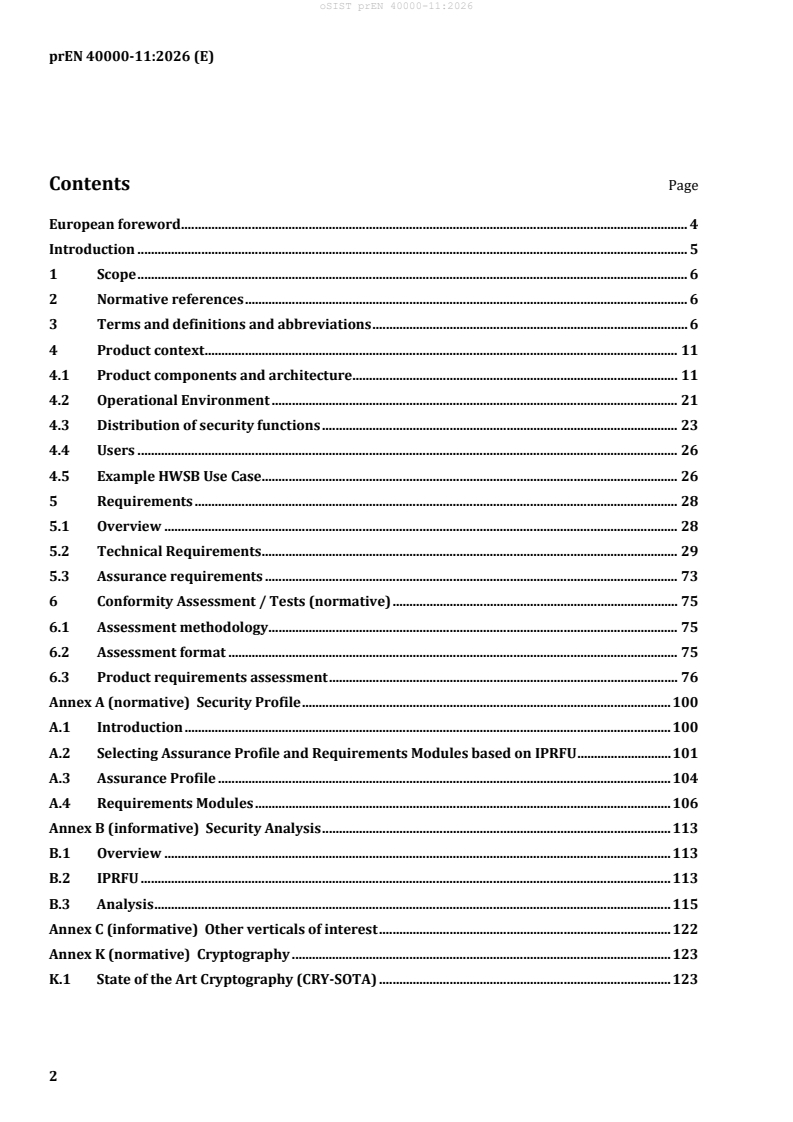
Contents
- Introduction
- 1 Scope
- 2 Normative references
- 3 Terms and definitions and abbreviations
- 3.1 application
- 3.2 attack potential
- 3.3 client application
- 3.4 firmware
- 3.5 internal application
- 3.6 local application
- 3.7 multi-factor authentication
- 3.8 remote application
- 3.9 security attribute
- 3.10 security profile
- 3.11 user
- 3.12 user data
- 4 Product context
- 4.1 Product components and architecture
- 4.2 Operational Environment
- 4.3 Distribution of security functions
- 4.4 Users
- 4.5 Example HWSB Use Case
- 5 Requirements
- 5.1 Overview
- 3. Selection based on product design, IPRFU and product risk assessment – these requirements
- 5.2 Technical Requirements
- 5.3 Assurance requirements
- 6 Conformity Assessment / Tests (normative)
- 6.1 Assessment methodology
- 6.2 Assessment format
- 6.3 Product requirements assessment
- Annex A
- Annex B
- Annex C
- Annex K
- Annex R
- Annex ZA
- 5.2.2 5.2.3
- 5.2.5 5.2.10
- 5.2.11 5.2.12
- 5.2.7 5.2.10
- 5.2.5 5.2.14
- 5.2.11 5.2.12
- Bibliography
Introduction
The present document defines cybersecurity requirements applicable to Hardware Devices in Security Boxes. It applies to products with digital elements designed to provide cryptographic services and secure storage as well as protection against physical attacks.
It supports the implementation of Regulation (EU) 2024/2847, the Cyber Resilience Act, specifically addressing the essential cybersecurity requirements defined in Annex I, Parts I and II. Application of this document In order to establish presumption of conformity using this standard, the following steps must be followed:
- Step 1: Decide on the pathway (‘template’ or ‘rule-based’) from Annex A to identify a suitable security profile for the HWSB based on its IPRFU.
The security profile will define what security requirements are applicable based on selection of requirements modules from Clause 5 alongside an ‘assurance profile’ that is used with conformity assessment activities in Clause 6.
- Step 2: Develop an HWSB compliant with applicable security requirement using examples where appropriate.
- Step 3: Develop evidence required to complete conformity assessment activities listed in Clause 6 based on applicable security requirements and required test and evidence checks overlayed with the selected assurance profile.
- Step 4: Perform the conformity assessment including:
o evidence review, o independent functional testing (if using assurance profile high), and o vulnerability testing.
Presumption of conformity as an HWSB is achieved if all checks and testing meet the listed pass criteria.
oSIST prEN 40000-11:2026 prEN 40000-11:2026 (E)
1 Scope
This document defines cyber security requirements for products with digital elements belonging to product category “Hardware Device with Security Boxes” (hereinafter called “Product” or “HWSB product”).
The technical description of “Hardware Devices with Security Boxes” can be found in Annex II of [CRA]. The Hardware Devices with Security Boxes in scope are designed for deployment in a range of environments and where the threat landscape includes attackers with various attack potential. HWSB are hardware-based systems intended to provide secure storage, processing and use of sensitive data, including cryptographic assets, within a protected hardware boundary (envelope). This document applies to the HWSB part of the product. The applicability of this document to specific products is determined based on their intended purpose, use case and risk assessment.
2 Normative references
The following documents are referred to in the text in such a way that some or all of their content constitutes requirements of this document. For dated references, only the edition cited applies. For undated references, the latest edition of the referenced document (including any amendments) applies. prEN 40000-1-3:2025, Cybersecurity requirements for products with digital elements — Part 1-3:
Vulnerability Handling AIS20/31, A proposal for: Functionality classes for random number generators, Bundesamt für Sicherheit in der Informationstechnik (BSI) NIST SP800-90A, Recommendation for Random Number Generation using Deterministic Random Bit, National Institute of Science and Technology (NIST) NIST SP800-90B, Recommendation for the entropy sources used for random bit generation, National Institute of Science and Technology (NIST) NIST SP800-90C, Recommendations for Random Bit Generator (RBG) Constructions, National Institute of Science and Technology (NIST) ISO/IEC 18031:2025, Information technology — Security techniques — Random bit generation
3 Terms and definitions and abbreviations
Terms and definitions For the purposes of this document, the following terms and definitions apply. ISO and IEC maintain terminology databases for use in standardization at the following addresses:
- ISO Online browsing platform: available at https://www.iso.org/obp
- IEC Electropedia: available at https://www.electropedia.org
3.1 application
software that provides service(s) to the user of the final product
oSIST prEN 40000-11:2026 prEN 40000-11:2026 (E)
3.2 attack potential
measure of effort needed to exploit a vulnerability in a product Note 1 to entry: The effort is expressed as a function of properties related to the attacker (e.g. expertise, resources, and motivation) and properties related to the vulnerability itself (e.g. window of opportunity, time to exposure). [SOURCE: EN ISO/IEC 15408-1:2023, 3.8]
3.3 client application
application running external to the HWSB that consumes its services either over a local or remote interface
3.4 firmware
code that is embedded inside the HWSB
3.5 internal application
application running internal to the HWSB that consumes its services over an internal interface
3.6 local application
application running external to the HWSB that consumes its services over a local interface
3.7 multi-factor authentication
authentication of an operator using at least two independent authentication factors. All authentication data is verified by the cryptographic module Note 1 to entry: An authentication factor is operator related information that resides outside the module, is used as proof of identity, and may include a method/process to produce varying or short-lived authentication data from the operator related information.
Note 2 to entry: Independent authentication factor categories for human operators include: something known, such as a secret password, something possessed, such as a physical key or token, and a physical property, such as a biometric.
[SOURCE: ISO/IEC 19790:2025, 3.86]
3.8 remote application
application running external to the HWSB that consumes its services over a remote interface
3.9 security attribute
property of subjects, users, objects, information, sessions or resources that is used in defining the security functions and whose values are used in enforcing the security functions Note 1 to entry: Users can include external IT products.
[SOURCE: EN ISO/IEC 15408-1:2023, 3.77]
oSIST prEN 40000-11:2026 prEN 40000-11:2026 (E)
3.10 security profile
suite of assurance activities and requirements modules linked pre-defined levels of confidence that the HWSB implements its selected security requirements and mitigates threats relevant to its IPRFU
3.11 user
human or machine operator accessing and consuming services from the HWSB
3.12 user data
data stored and/or processed in the HWSB on behalf of the user Abbreviations ADV (CC) Development (assurance class) AES Advanced Encryption Standard AGD (CC) Guidance Documents (assurance class) ALC (CC) Life-Cycle support (assurance class) API Application Programming Interface ASE (CC) Security Target Evaluation (assurance class) ATE (CC) Tests (assurance class) ATM Automated Teller Machine AVA (CC) Vulnerability Assessment (assurance class) CA Certificate Authority CC Common Criteria CCMC CEN-CENELEC Management Centre CEN European Committee for Standardization CEN/TC CEN Technical Committee CIK Crypto Ignition Key CPLD Complex Programmable Logic Device CPU Central Processing Unit CRA Cyber Resilience Act DICE Device Identifier Composition Engine DNA Deoxyribonucleic Acid.
DoS Denial of Service DRAM Dynamic random-access memory DRBG Deterministic Random Bit Generator DTBS Data To Be Signed DTMF Distributed Management Task Force ECC Elliptic Curve Cryptography EFP Environmental Failure Protection EN European Norm (standard) ENISA European Union Agency for Cybersecurity EU European Union
oSIST prEN 40000-11:2026 prEN 40000-11:2026 (E) EUCC European Common Criteria–based Cybersecurity Certification Scheme EFTA European Free Trade Association FIB Focused Ion Beam FIDO Fast IDentity Online FIPS Federal Information Processing Standard FPGA Field-Programmable Gate Array FRAM Ferroelectric random-access memory (CC) Resource Utilization (functional class) FW FirmWare GNSS Global Navigation Satellite System HBOM Hardware Bill of Materials HMAC Hash-based Message Authentication Code HSM Hardware Security Module HSS Hierarchal Signature Scheme HW HardWare HWSB HardWare device with Security Box I2C Inter-Integrated Circuit IC Integrated Circuit ID Identifier IEC International Electrotechnical Commission IPsec Internet Protocol security IPRFU Intended Purpose and Reasonable Foreseeable Use ISO International Organization for Standardization ISO/IEC Joint ISO / IEC standard IT Information Technology KLF Key Loading Facility LMS Leighton-Micali Signature MAC (net) Media Access Control (address) MAC (crypto) Message Authentication Code MACsec Medium Access Control (layer) security MCU Microcontroller Unit MFA Multi-Factor Authentication ML-DSA Module-Lattice Digital Signature Algorithm.
MPU Microprocessor Unit OEM Original Equipment Manufacturer OTP One Time Password PAN Primary Account Number PCB Printed Circuit Board PCI (interface) Peripheral Component Interconnect PCI (other) Payment Card Industry PCI DSS Payment Card Industry Data Security Standard PCIe Peripheral Component Interconnect express PIN Personal Identification Number
oSIST prEN 40000-11:2026 prEN 40000-11:2026 (E) PKCS Public-Key Cryptography Standards PKCS#11 Cryptoki API (PKCS #11) PKI Public Key Infrastructure POI Point of Interaction PP Protection Profile RAM Random Access Memory RBAC Role-Based Access Control RDPS Remote Data Processing Solution REQ Requirement RNG Random Number Generator RATS Remote Attestation Procedure ROM Read-Only Memory RSA Rivest-Shamir-Adelman (Asymmetric cryptographic algorithm) RTC Reat Time Clock SAR Security Assurance Requirement SBOM Software Bill Of Materials SCA Side-Channel Attack SEMA Simple EMissions Analysis SFR Security Functional Requirement SHA Secure Hash Algorithm SLH-DSA Stateless Hash-Based Signature Algorithm SPA Simple Power Analysis SPD Security Problem Definition SPDX Software Package Data Exchange (SBOM format / identifier scheme) SPDM Security Protocol and Data Model SPI Serial Peripheral Interface SRAM Static Random-Access Memory SSH Secure SHell ST Security Target SW Software TA Timing Analysis TLS Transport Layer Security TOE Target of Evaluation TPM Trusted Platform Module TR Technical Report TRNG True Random Number Generator TS Technical Specification TSF TOE Security Functions TSP Trust Service Provider UART Universal Asynchronous Receiver/Transmitter UC Use Case
oSIST prEN 40000-11:2026 prEN 40000-11:2026 (E) URI Uniform Resource Identifier USB Universal Serial Bus VU Vehicle Unit (tachograph context)
4 Product context
4.1 Product components and architecture
4.1.1 Overview
An HWSB product is composed of an HWSB and some applications. These applications use the HWSB as a provider of security services such as secure storage, cryptographic processing, authentication, integrity protection and controlled access to sensitive assets.
An HWSB comprises:
- a secure physical boundary (secure envelope),
- hardware components,
- firmware,
- security functions and services,
- interfaces for interaction with internal, local and remote applications, and
- functions that operate in a Remote Date Processing Solution (RDPS). The HWSB product may include:
- internal applications, located within the secure boundary, - local applications, operating in a controlled environment, and - remote applications, operating through potentially uncontrolled networks or environments. Figure 1 highlights the HWSB components (in green) and in scope and the additional applications (in blue) that may be part of the HWSB product and that are out of scope.
oSIST prEN 40000-11:2026 prEN 40000-11:2026 (E)
Figure 1 — HWSB product generic architecture The following subclause provides more details on each component.
4.1.2 Secure envelope
The secure envelope defines the physical security boundary of the HWSB product. It shall:
- enclose all components whose protection relies on the physical security of the device,
- provide a continuous protective boundary against unauthorized physical access,
- protect against tampering, probing, substitution and bypass,
- include tamper detection and, where applicable, tamper response mechanisms. The secure envelope may include:
- tamper-resistant or tamper-evident enclosure elements,
- fasteners, seals and intrusion detection mechanisms,
- tamper sensors and associated circuitry,
- conductive or mechanical paths crossing the boundary.
oSIST prEN 40000-11:2026 prEN 40000-11:2026 (E) Any interface traversing the secure envelope shall be protected at the point of penetration. HWSB may include multiple layers to its secure envelope where different levels of security are provided by each layer. It is also possible that HWSB consist of multiple secure enclaves each containing their own secure envelope and with interfaces between each envelope being cryptographically secured. Example layered or distributed secure envelope are provided in Figure 2 and Figure 3:
Figure 2 — Layered security envelope
Figure 3 — Distributed secure envelope with protection islands
oSIST prEN 40000-11:2026 prEN 40000-11:2026 (E)
4.1.3 Hardware components
The HWSB product commonly includes the following hardware components, as applicable to the intended use case and product design:
a) Processing components These components provide the main computing capabilities of the HWSB product and may include:
- microcontrollers,
- microprocessors,
- dedicated secure processing units,
- auxiliary controllers,
- System-on-Chip (SoC).
They shall control security-relevant operations and the interaction between internal components and external interfaces.
b) Cryptographic components These components implement or accelerate cryptographic operations and may include:
- dedicated cryptographic processors,
- hardware cryptographic engines,
- hardware accelerators,
- secure coprocessors.
They may support functions such as:
- encryption and decryption,
- digital signature generation and verification,
- hashing,
- message authentication,
- key derivation (including key agreement)
- key encapsulation and decapsulation,
- key generation,
- random number generation support (e.g. standalone DRBG).
c) Memory components The HWSB product may include several types of memory, including:
- volatile memory for execution and temporary data,
oSIST prEN 40000-11:2026 prEN 40000-11:2026 (E) - non-volatile memory for firmware and persistent configuration, - secure memory for sensitive data, - remanence protect memory for cryptographic keys.
Memory architecture shall ensure that sensitive data are protected against unauthorized disclosure or modification as applicable to the IPRFU.
d) Random number generation components The HWSB product may include:
- true random number generators,
- entropy sources and conditioning mechanisms.
These components shall support the generation of random values required for cryptographic functions. e) Tamper protection components These components may include:
- tamper sensors,
- tamper controller,
- voltage, temperature or environmental monitoring,
- secure erase or zeroization circuitry,
- protective mesh or equivalent mechanisms.
They shall support detection of abnormal physical conditions and initiation of protective responses. f) Power and support components The HWSB product may include:
- power control and regulation modules,
- backup batteries for security-critical functions,
- buffering and protection circuits,
- real-time clock components,
- interface support IC.
These components may contribute to secure operation, event logging, tamper response or continuity of security functions.
In addition to the explicitly listed components above, HWSB will also commonly use reconfigurable logic such as CPLD and FPGA to realize some of the components listed above (such as cryptographic processors alongside random number generators) alongside being used to inter-connect integrated circuits alongside managing board level logic such as global reset nets used to reset and power-on IC in sequence as part of startup of a HWSB.
oSIST prEN 40000-11:2026 prEN 40000-11:2026 (E) Specialist HWSB will in addition likely support many other forms of integrated alongside analogue circuits to support functions with some examples being:
- radio interfaces (e.g. as used to support wireless interfaces);
- specialist analogue and digital signal processing chips (e.g. as might be used to acquire and process a Global Navigation Satellite System (GNSS) signal for a HWSB tracking location such as a tachograph);
- Accelerometers (e.g. as might be used to provide measurements of multi-axis acceleration as used by tachographs).
4.1.4 Firmware
The firmware implements the security behaviour of the HWSB product. They may include the following functional groups.
a) Boot and integrity management These functions may include:
- bootloader,
- secure boot manager,
- firmware authenticity and integrity verification,
- anti-rollback protection,
- version control.
These functions shall ensure that only authorized firmware is executed. b) Cryptographic and key management functions These functions may include:
- cryptographic kernel,
- key generation,
- key import and export,
- key wrapping and unwrapping,
- key storage control,
- key backup and restore,
- key deletion and zeroization,
- entropy and random number management.
These functions shall ensure that keys and other sensitive cryptographic assets are handled securely throughout their lifecycle.
oSIST prEN 40000-11:2026 prEN 40000-11:2026 (E) c) Security policy enforcement These functions may include:
- authentication mechanisms,
- authorization mechanisms,
- access policy enforcement,
- role separation,
- resource control,
- mandatory access restrictions,
- isolation or sandboxing mechanisms.
These functions shall ensure controlled access to sensitive data, services and system resources. d) Audit and monitoring These functions may include:
- audit logging,
- event recording,
- security monitoring,
- environmental monitoring,
- self-test mechanisms.
These functions shall support detection of abnormal conditions and provide traceability of securityrelevant events. e) Tamper response and recovery These functions may include:
- tamper state handling,
- secure erase or zeroization logic,
- lockdown behaviour,
- recovery support.
These functions shall ensure that critical security actions are taken in response to tamper events or other severe faults.
f) Communication and interface support These functions may include:
- command dispatch,
- protocol handling,
oSIST prEN 40000-11:2026 prEN 40000-11:2026 (E) - interface drivers, - secure session handling, - transport protection, - update services.
These functions shall ensure that interactions with external entities are performed securely.
4.1.5 Security Functions
The HWSB product shall implement security functions appropriate to its intended use. These functions may include:
a) Secure storage The HWSB product may provide protected storage for:
- cryptographic keys,
- authentication data,
- configuration data,
- audit logs,
- other sensitive data.
Secure storage functions shall protect sensitive data against unauthorized disclosure, modification and extraction.
b) Key management The HWSB product may manage the lifecycle of cryptographic keys, including:
- generation,
- loading,
- derivation,
- storage,
- backup,
- recovery,
- revocation,
- deletion,
- zeroization.
oSIST prEN 40000-11:2026 prEN 40000-11:2026 (E) c) Cryptographic services The HWSB product may provide:
- encryption and decryption,
- signature generation and verification,
- MAC computation and verification,
- hashing,
- random number generation,
- other approved cryptographic services.
d) Access control The HWSB product shall enforce policies governing:
...