

EN 754-2:2024
(Main)Aluminium and aluminium alloys - Cold drawn rod/bar and tube - Part 2: Mechanical properties
General Information
- Abstract
This document specifies the mechanical property limits resulting from tensile testing applicable to aluminium and aluminium alloy cold drawn rod/bar and tube.
Technical conditions for inspection and delivery, including product and testing requirements, are specified in EN 754-1. Temper designations are defined in EN 515. The chemical composition limits for these materials are given in EN 573-3.
- Status
- Published
- Publication Date
- 26-Nov-2024
- Technical Committee
- CEN/TC 132 - Aluminium and aluminium alloys
- Drafting Committee
- WG 35 - Extruded products
- Current Stage
- 6060 - Definitive text made available (DAV) - Publishing
- Start Date
- 27-Nov-2024
- Due Date
- 14-Feb-2025
- Completion Date
- 27-Nov-2024
Overview
EN 754-2:2024 - Aluminium and aluminium alloys - Cold drawn rod/bar and tube - Part 2: Mechanical properties is a CEN European Standard that defines the mechanical property limits for cold drawn aluminium rod, bar and seamless tube as determined by tensile testing. Published November 2024 (approved 26 Aug 2024), this document supersedes EN 754-2:2016 and is intended for suppliers, purchasers and testing laboratories working with cold-drawn aluminium products across the CEN member states.
Key topics and technical requirements
- Scope: Specifies mechanical property limits resulting from tensile testing for cold drawn rod/bar and tube. Properties refer to longitudinal test pieces unless otherwise agreed.
- Tensile testing: Mechanical values are obtained by tensile testing in accordance with EN ISO 6892-1; sampling and specimen preparation follow EN 754-1.
- Mechanical property tables: Detailed limits (in Tables 1–50) are provided for a wide range of alloys and tempers. These include tensile strength, 0.2% proof strength, elongation (A and A50 mm), and informational Brinell hardness (HBW).
- Tempers and conditions: Temper designations referenced to EN 515. The as-fabricated condition F may be used but does not guarantee mechanical properties. Annex A lists tempers used in the tables.
- Elongation conventions: The standard defines the use of elongation measured over a gauge length of 5.65√S (A) and the alternative 50 mm gauge (A50) where applicable.
- Alloy coverage and updates: EN 754-2:2024 adds several alloys compared with the previous edition (e.g., EN AW-1070A, EN AW-1350A, EN AW-2618A, EN AW-6005 series, EN AW-6061A, among others), broadening applicability.
Practical applications and users
- Who uses it: Aluminium mills, extruders, cold-drawing manufacturers, quality/control laboratories, purchasers and engineering designers specifying mechanical performance of cold drawn aluminium products.
- Typical uses: Material specification for shafts, fasteners, structural bars, tubes for heat exchangers, hydraulic components, and any application where predictable tensile properties of cold-drawn aluminium are required.
- Benefits: Ensures consistent mechanical performance, supports procurement and inspection criteria, and facilitates conformity and interchangeability across European markets.
Related standards
- EN 754-1 - Technical conditions for inspection and delivery (product and testing requirements)
- EN 515 - Temper designations for aluminium alloys
- EN 573-3 - Chemical composition limits for wrought aluminium alloys
- EN ISO 6892-1 - Metallic materials - Tensile testing (method referenced)
EN 754-2:2024 provides the authoritative mechanical-property tables and testing conventions needed to specify, test and accept cold drawn aluminium rod/bar and tube in industrial and engineering applications.
Relations
- Effective Date
- 19-Jan-2023
- Effective Date
- 29-Jul-2026
- Effective Date
- 28-Jan-2026
- Effective Date
- 28-Jan-2026
- Effective Date
- 28-Jan-2026
- Effective Date
- 28-Jan-2026
- Effective Date
- 28-Jan-2026
- Effective Date
- 28-Jan-2026
- Effective Date
- 28-Jan-2026
- Effective Date
- 28-Jan-2026
- Effective Date
- 28-Jan-2026
- Effective Date
- 28-Jan-2026
- Effective Date
- 28-Jan-2026
- Effective Date
- 28-Jan-2026
- Effective Date
- 28-Jan-2026
Get Certified
Connect with accredited certification bodies for this standard

Element Materials Technology
Materials testing and product certification.

Inštitut za kovinske materiale in tehnologije
Institute of Metals and Technology. Materials testing, metallurgical analysis, NDT.
Sponsored listings
Frequently Asked Questions
EN 754-2:2024 is a standard published by the European Committee for Standardization (CEN). Its full title is "Aluminium and aluminium alloys - Cold drawn rod/bar and tube - Part 2: Mechanical properties". This standard covers: This document specifies the mechanical property limits resulting from tensile testing applicable to aluminium and aluminium alloy cold drawn rod/bar and tube. Technical conditions for inspection and delivery, including product and testing requirements, are specified in EN 754-1. Temper designations are defined in EN 515. The chemical composition limits for these materials are given in EN 573-3.
This document specifies the mechanical property limits resulting from tensile testing applicable to aluminium and aluminium alloy cold drawn rod/bar and tube. Technical conditions for inspection and delivery, including product and testing requirements, are specified in EN 754-1. Temper designations are defined in EN 515. The chemical composition limits for these materials are given in EN 573-3.
EN 754-2:2024 is classified under the following ICS (International Classification for Standards) categories: 77.150.10 - Aluminium products. The ICS classification helps identify the subject area and facilitates finding related standards.
EN 754-2:2024 has the following relationships with other standards: It is inter standard links to EN 754-2:2016, EN 13445-8:2026, EN 754-1:2016, EN 12516-4:2008, EN 12514:2020, EN 12392:2016, EN 13958:2008, EN 12392:2025, EN 573-3:2019, EN 286-1:1998, EN 13195:2009, EN 12392:2000, EN 13480-8:2017, EN 14015:2004, EN 754-1:2008. Understanding these relationships helps ensure you are using the most current and applicable version of the standard.
EN 754-2:2024 is available in PDF format for immediate download after purchase. The document can be added to your cart and obtained through the secure checkout process. Digital delivery ensures instant access to the complete standard document.
Standards Content (Sample)
SLOVENSKI STANDARD
01-februar-2025
Aluminij in aluminijeve zlitine - Hladno vlečene palice/drogovi in cevi - 2. del:
Mehanske lastnosti
Aluminium and aluminium alloys - Cold drawn rod/bar and tube - Part 2: Mechanical
properties
Aluminium und Aluminiumlegierungen - Gezogene Stangen und Rohre - Teil 2:
Mechanische Eigenschaften
Aluminium et alliages d'aluminium - Barres et tubes étirés - Partie 2: Caractéristiques
mécaniques
Ta slovenski standard je istoveten z: EN 754-2:2024
ICS:
77.150.10 Aluminijski izdelki Aluminium products
2003-01.Slovenski inštitut za standardizacijo. Razmnoževanje celote ali delov tega standarda ni dovoljeno.
EN 754-2
EUROPEAN STANDARD
NORME EUROPÉENNE
November 2024
EUROPÄISCHE NORM
ICS 77.150.10 Supersedes EN 754-2:2016
English Version
Aluminium and aluminium alloys - Cold drawn rod/bar
and tube - Part 2: Mechanical properties
Aluminium et alliages d'aluminium - Barres et tubes Aluminium und Aluminiumlegierungen - Gezogene
étirés - Partie 2 : Caractéristiques mécaniques Stangen und Rohre - Teil 2: Mechanische Eigenschaften
This European Standard was approved by CEN on 26 August 2024.
CEN members are bound to comply with the CEN/CENELEC Internal Regulations which stipulate the conditions for giving this
European Standard the status of a national standard without any alteration. Up-to-date lists and bibliographical references
concerning such national standards may be obtained on application to the CEN-CENELEC Management Centre or to any CEN
member.
This European Standard exists in three official versions (English, French, German). A version in any other language made by
translation under the responsibility of a CEN member into its own language and notified to the CEN-CENELEC Management
Centre has the same status as the official versions.
CEN members are the national standards bodies of Austria, Belgium, Bulgaria, Croatia, Cyprus, Czech Republic, Denmark, Estonia,
Finland, France, Germany, Greece, Hungary, Iceland, Ireland, Italy, Latvia, Lithuania, Luxembourg, Malta, Netherlands, Norway,
Poland, Portugal, Republic of North Macedonia, Romania, Serbia, Slovakia, Slovenia, Spain, Sweden, Switzerland, Türkiye and
United Kingdom.
EUROPEAN COMMITTEE FOR STANDARDIZATION
COMITÉ EUROPÉEN DE NORMALISATION
EUROPÄISCHES KOMITEE FÜR NORMUNG
CEN-CENELEC Management Centre: Rue de la Science 23, B-1040 Brussels
© 2024 CEN All rights of exploitation in any form and by any means reserved Ref. No. EN 754-2:2024 E
worldwide for CEN national Members.
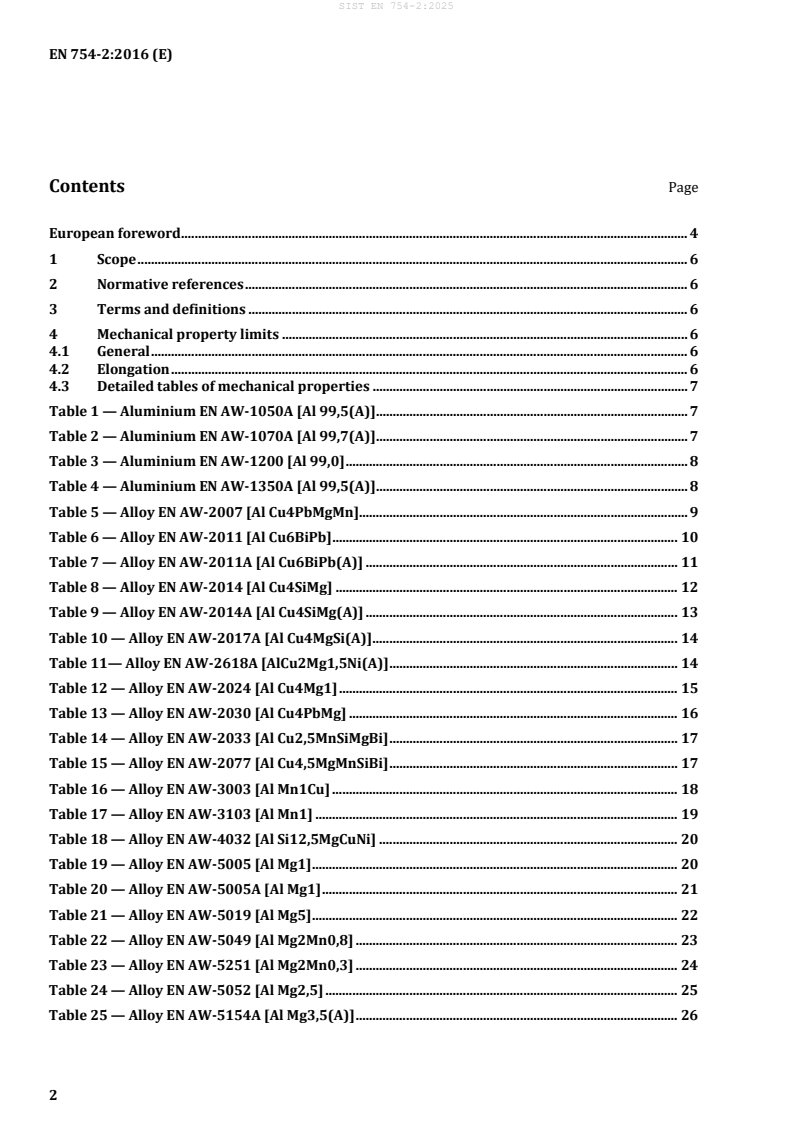
EN 754-2:2016 (E)
Contents Page
European foreword . 4
1 Scope . 6
2 Normative references . 6
3 Terms and definitions . 6
4 Mechanical property limits . 6
4.1 General . 6
4.2 Elongation . 6
4.3 Detailed tables of mechanical properties . 7
Table 1 — Aluminium EN AW-1050A [Al 99,5(A)]. 7
Table 2 — Aluminium EN AW-1070A [Al 99,7(A)]. 7
Table 3 — Aluminium EN AW-1200 [Al 99,0] . 8
Table 4 — Aluminium EN AW-1350A [Al 99,5(A)]. 8
Table 5 — Alloy EN AW-2007 [Al Cu4PbMgMn]. 9
Table 6 — Alloy EN AW-2011 [Al Cu6BiPb] . 10
Table 7 — Alloy EN AW-2011A [Al Cu6BiPb(A)] . 11
Table 8 — Alloy EN AW-2014 [Al Cu4SiMg] . 12
Table 9 — Alloy EN AW-2014A [Al Cu4SiMg(A)] . 13
Table 10 — Alloy EN AW-2017A [Al Cu4MgSi(A)] . 14
Table 11— Alloy EN AW-2618A [AlCu2Mg1,5Ni(A)] . 14
Table 12 — Alloy EN AW-2024 [Al Cu4Mg1] . 15
Table 13 — Alloy EN AW-2030 [Al Cu4PbMg] . 16
Table 14 — Alloy EN AW-2033 [Al Cu2,5MnSiMgBi] . 17
Table 15 — Alloy EN AW-2077 [Al Cu4,5MgMnSiBi] . 17
Table 16 — Alloy EN AW-3003 [Al Mn1Cu] . 18
Table 17 — Alloy EN AW-3103 [Al Mn1] . 19
Table 18 — Alloy EN AW-4032 [Al Si12,5MgCuNi] . 20
Table 19 — Alloy EN AW-5005 [Al Mg1] . 20
Table 20 — Alloy EN AW-5005A [Al Mg1] . 21
Table 21 — Alloy EN AW-5019 [Al Mg5] . 22
Table 22 — Alloy EN AW-5049 [Al Mg2Mn0,8] . 23
Table 23 — Alloy EN AW-5251 [Al Mg2Mn0,3] . 24
Table 24 — Alloy EN AW-5052 [Al Mg2,5] . 25
Table 25 — Alloy EN AW-5154A [Al Mg3,5(A)] . 26
Table 26 — Alloy EN AW-5754 [Al Mg3] . 27
Table 27 — Alloy EN AW-5083 [Al Mg4,5Mn0,7] . 28
Table 28 — Alloy EN AW-5086 [Al Mg4] . 29
Table 29 — Alloy EN AW-6005 [AlSiMg] . 29
Table 30 — Alloy EN AW-6005A [Al SiMg(A)] . 30
Table 31 — Alloy EN AW-6005B [Al SiMg(B)] . 30
Table 32 — Alloy EN AW-6012 [Al MgSiPb] . 31
Table 33 — Alloy EN AW-6023 [Al Si1Sn1MgBi] . 31
Table 34 — Alloy EN AW-6026 [Al MgSiBi] . 32
Table 35 — Alloy EN AW-6050 [Al Si1,5FeMgNi] . 32
Table 36 — Alloy EN AW-6056 [Al Si1MgCuMn] . 33
Table 37 — Alloy EN AW-6060 [Al MgSi] . 33
Table 38 — Alloy EN AW-6061 [Al Mg1SiCu] . 34
Table 39 — Alloy EN AW-6061A [Al Mg1SiCu(A)] . 34
Table 40 — Alloy EN AW-6262 [Al Mg1SiPb] . 35
Table 41 — Alloy EN AW-6262A [Al Mg1SiSn(A)] . 35
Table 42 — Alloy EN AW-6063 [Al Mg0,7Si] . 36
Table 43 — Alloy EN AW-6063A [Al Mg0,7Si(A)] . 37
Table 44 — Alloy EN AW-6064A [Al Mg1SiBi] . 38
Table 45 — Alloy EN AW-6065 [Al Mg1Bi1Si] . 38
Table 46 — Alloy EN AW-6082 [Al Si1MgMn] . 39
Table 47 — Alloy EN AW-7020 [Al Zn4,5Mg1] . 39
Table 48 — Alloy EN AW-7022 [Al Zn5Mg3Cu] . 40
Table 49 — Alloy EN AW-7049A [Al Zn8MgCu(A)] . 40
Table 50 — Alloy EN AW-7075 [Al Zn5,5MgCu] . 41
Annex A (informative) List of tempers used in Tables 1 to 50 . 42
Bibliography . 44
EN 754-2:2016 (E)
European foreword
This document (EN 754-2:2024) has been prepared by Technical Committee CEN/TC 132 “Aluminium
and aluminium alloys”, the secretariat of which is held by AFNOR.
This European Standard shall be given the status of a national standard, either by publication of an
identical text or by endorsement, at the latest by May 2025, and conflicting national standards shall be
withdrawn at the latest by May 2025.
Attention is drawn to the possibility that some of the elements of this document may be the subject of
patent rights. CEN shall not be held responsible for identifying any or all such patent rights.
This document supersedes EN 754-2:2016.
Within its programme of work, Technical Committee CEN/TC 132 entrusted CEN/TC 132/WG 5
“Extruded and drawn products” to revise EN 754-2:2016.
— addition of EN AW-1070A, EN AW-1350A, EN AW-2618A. EN AW-2033, EN AW-2077, EN AW-4032,
EN AW-6005, EN AW-6005A, EN AW-6005B, EN AW-6023, EN AW-6050, EN AW-6056 and EN AW-
6061A alloys;
— addition of the terms required by the latest CCMC template;
— addition of Clause 3 compulsory from the latest CCMC template;
— deletion of former Clause 3.3 as part of the table of contents in this document.
EN 754 comprises the following parts under the general title “Aluminium and aluminium alloys — Cold
drawn rod/bar and tube”:
— Part 1: Technical conditions for inspection and delivery
— Part 2: Mechanical properties
— Part 3: Round bars, tolerances on dimensions and form
— Part 4: Square bars, tolerances on dimensions and form
— Part 5: Rectangular bars, tolerances on dimensions and form
— Part 6: Hexagonal bars, tolerances on dimensions and form
— Part 7: Seamless tubes, tolerances on dimensions and form
— Part 8: Porthole tubes, tolerances on dimensions and form
CEN/TC 132 affirms its policy that if a patentee refuses to grant licenses on standardized products under
reasonable and not discriminatory conditions, this product will be removed from the corresponding
document.
Any feedback and questions on this document should be directed to the users’ national standards body.
A complete listing of these bodies can be found on the CEN website.
According to the CEN-CENELEC Internal Regulations, the national standards organisations of the
following countries are bound to implement this European Standard: Austria, Belgium, Bulgaria, Croatia,
Cyprus, Czech Republic, Denmark, Estonia, Finland, France, Germany, Greece, Hungary, Iceland, Ireland,
Italy, Latvia, Lithuania, Luxembourg, Malta, Netherlands, Norway, Poland, Portugal, Republic of North
Macedonia, Romania, Serbia, Slovakia, Slovenia, Spain, Sweden, Switzerland, Türkiye and the United
Kingdom.
EN 754-2:2016 (E)
1 Scope
This document specifies the mechanical property limits resulting from tensile testing applicable to
aluminium and aluminium alloy cold drawn rod/bar and tube.
Technical conditions for inspection and delivery, including product and testing requirements, are
specified in EN 754-1. Temper designations are defined in EN 515. The chemical composition limits for
these materials are given in EN 573-3.
2 Normative references
The following documents are referred to in the text in such a way that some or all of their content
constitutes requirements of this document. For dated references, only the edition cited applies. For
undated references, the latest edition of the referenced document (including any amendments) applies.
EN 754-1:2016, Aluminium and aluminium alloys — Cold drawn rod/bar and tube — Part 1: Technical
conditions for inspection and delivery
3 Terms and definitions
No terms and definitions are listed in this document.
4 Mechanical property limits
4.1 General
The mechanical properties shall be in conformity with those specified in Table 1 to Table 50 or those
agreed upon between supplier and purchaser and stated in the order document.
Definitions of tempers are provided at Annex A of this document. For all alloys the condition F (as
fabricated) can be used, but without guaranteed mechanical properties.
Table 1 to Table 50 contain limits of mechanical property values obtained by tensile testing according to
EN ISO 6892-1. Test pieces sampling, location in the specimen and preparation shall be as given in
EN 754-1.
NOTE The mechanical properties refer to test pieces taken in the longitudinal direction. Mechanical properties
of test pieces taken in other directions can differ from those for the longitudinal direction quoted in this document.
Brinell hardness values given in Table 1 to Table 50 expressed as HBW values are for information only.
4.2 Elongation
If not otherwise agreed, the A value shall be used.
The A value for elongation is the % elongation measured over a gauge length of 5,65√S (where S is the
0 0
initial cross-sectional area of the test-piece), and expressed in percent.
For certain products the supplier may choose (if not otherwise specified in the order documents) to use
the elongation based on A Consequently, values for the A are included in the following tables.
50mm. 50mm
The A value is the elongation measured over a gauge length of 50 mm and expressed in percent.
50mm
4.3 Detailed tables of mechanical properties
Table 1 — Aluminium EN AW-1050A [Al 99,5(A)]
Drawn rod/bar
R R
A
Dimensions A
m p0,2
50mm
HBW
Temper mm %
MPa MPa %
Typical
value
a b min.
min.
D S min. max. min. max.
O, H111 ≤ 80 ≤ 60 60 95 - - 25 22 20
H14 ≤ 40 ≤ 10 100 135 70 - 6 5 30
H16 ≤ 15 ≤ 5 120 160 105 - 4 3 35
H18 ≤ 10 ≤ 3 145 - 125 - 3 3 43
Drawn tube
R R A
Wall thickness A
m p0,2 50mm
HBW
Temper t %
MPa MPa %
Typical
value
mm min.
min.
min. max. min. max.
O, H111 ≤ 20 60 95 - - 25 22 20
H14 ≤ 10 100 135 70 - 6 5 30
H16 ≤ 5 120 160 105 - 4 3 35
H18 ≤ 3 145 - 125 - 3 3 43
a
D = Diameter for round bar
b
S = Width across flats for square and hexagonal bar, thickness for rectangular bar
Table 2 — Aluminium EN AW-1070A [Al 99,7(A)]
Drawn rod/bar
R
R A
Dimensions A
m p0,2
50 mm
HBW
Temper mm %
MPa MPa %
Typical
value
a b
min.
D S min. max. min. max. min.
c
O, H111 ≤ 80 ≤ 80 50 95 - - 25 22 20
c
≤ 80 ≤ 80 90 135 70 - 6 5 30
H14
a
D = Diameter for round bar.
b
S = Width across flats for square and hexagonal bar, thickness for rectangular bar.
c
Properties may be obtained by press quenching.
EN 754-2:2016 (E)
Table 3 — Aluminium EN AW-1200 [Al 99,0]
Drawn rod/bar
Dimensions R R A A
HBW
m p0,2 50mm
Temper
mm %
MPa MPa % Typical
value
a b
min.
D S min. max. min. max.
min.
O, H111 ≤ 80 ≤ 60 70 105 - - 20 16 23
H14 ≤ 40 ≤ 10 110 145 80 - 5 4 37
H16 ≤ 15 ≤ 5 135 170 115 - 3 3 45
H18 ≤ 10 ≤ 3 150 - 130 - 3 3 50
Drawn tube
R R
m p0,2 A
Wall thickness A
50mm
HBW
MPa MPa
Temper t %
%
Typical
value
mm min. max. min. max. min.
min.
O, H111 ≤ 20 70 105 - - 20 16 23
H14 ≤ 10 110 145 80 - 5 4 37
H16 ≤ 5 135 170 115 - 3 3 45
H18 ≤ 3 150 - 130 - 3 3 50
a
D = Diameter for round bar
b
S = Width across flats for square and hexagonal bar, thickness for rectangular bar
Table 4 — Aluminium EN AW-1350A [Al 99,5(A)]
Drawn rod/bar
R R
A
Dimensions A
m p0,2 50 mm
HBW
Temper mm %
MPa Mpa %
Typical
value
a b
min.
D S min. max. min. max. min.
c
O, H111 ≤ 80 ≤ 80 60 95 - - 25 22 20
c
≤ 80 ≤ 80 90 135 70 - 6 5 30
H14
c
≤ 80 ≤ 80 145 - 125 - 3 3 40
H18
a
D = Diameter for round bar.
B
S = Width across flats for square and hexagonal bar, thickness for rectangular bar.
C
Properties may be obtained by press quenching.
Table 5 — Alloy EN AW-2007 [Al Cu4PbMgMn]
Drawn rod/bar
Dimensions R R
A
A
m p0,2
50mm
HBW
mm
Temper Mpa Mpa %
%
Typical
value
a b
D S min. max. min. max. min.
min.
≤ 30 ≤ 30 370 240 7 95
T3 c - -
-
30 < D ≤ 80 30 < S ≤ 80 340 220 6 95
T351 c ≤ 80 ≤ 80 370 - 240 - 5 3 95
Drawn tube
Wall thickness R R A A
m p0,2 50mm HBW
Temper t %
Mpa Mpa %
Typical
value
mm min.
min. max. min. max. min.
T3 c ≤ 20 370 - 250 - 7 5 95
T3510 c,
≤ 20 370 - 240 - 5 3 95
T3511 c
a
D = Diameter for round bar
b
S = Width across flats for square and hexagonal bar, thickness for rectangular bar
c
Properties may be obtained by press quenching.
EN 754-2:2016 (E)
Table 6 — Alloy EN AW-2011 [Al Cu6BiPb]
Drawn rod/bar
Dimensions R R A A
HBW
m p0,2 50mm
Temper
mm %
Mpa Mpa % Typical
value
a b
min.
D S min. max. min. max.
min.
≤ 40 ≤ 40 320 - 270 - 10 8 90
T3c 40 < D ≤ 50 40 < S ≤ 50 300 - 250 - 10 - 90
50 < D ≤ 80 50 < S ≤ 80 280 - 210 - 10 - 90
T8 ≤ 80 ≤ 80 370 - 270 - 8 6 110
Drawn tube
R R A
Wall thickness A
m p0,2 50mm
HBW
Temper t %
%
Mpa Mpa
Typical
value
mm min.
min.
min. max. min. max.
≤ 5 310 - 260 - 10 8 90
T3 c
5 < t ≤ 20 290 - 240 - 8 6 90
T8 ≤ 20 370 - 275 - 8 6 110
a
D = Diameter for round bar
b
S = Width across flats for square and hexagonal bar, thickness for rectangular bar
c
Properties may be obtained by press quenching.
Table 7 — Alloy EN AW-2011A [Al Cu6BiPb(A)]
Drawn rod/bar
A
R R
Dimensions A
50mm
m p0,2
HBW
Temper %
mm
Mpa Mpa %
Typical
value
min.
a b
min.
D S min. max. min. max.
≤ 40 ≤ 40 320 - 270 - 10 8 90
T3 c 40 < D ≤ 50 40 < S ≤ 50 300 - 250 - 10 - 90
50 < D ≤ 80 50 < S ≤ 80 280 - 210 - 10 - 90
T8 ≤ 80 ≤ 80 370 - 270 - 8 6 115
Drawn tube
R R
m p0,2
A
Wall thickness A
50mm
HBW
Mpa Mpa
Temper t %
%
Typical
value
mm min.
min.
min. max. min. max.
≤ 5 310 - 260 - 10 8 90
T3 c
5 < t ≤ 20 290 - 240 - 8 6 90
T8 ≤ 20 370 - 275 - 8 6 115
a
D = Diameter for round bar
b
S = Width across flats for square and hexagonal bar, thickness for rectangular bar
c
Properties may be obtained by press quenching
EN 754-2:2016 (E)
Table 8 — Alloy EN AW-2014 [Al Cu4SiMg]
Drawn rod/bar
Dimensions R R A
A
m p0,2 50mm
HBW
mm
Temper %
Mpa Mpa %
Typical
value
a b
D S min. max. min. max. min.
min.
O, H111 ≤ 80 ≤ 80 - 240 - 125 12 10 45
T3 ≤ 80 ≤ 80 380 - 290 - 8 6 110
T351 ≤ 80 ≤ 80 380 - 290 - 6 4 110
T4 ≤ 80 ≤ 80 380 - 220 - 12 10 110
T451 ≤ 80 ≤ 80 380 - 220 - 10 8 110
T6 ≤ 80 ≤ 80 450 - 380 - 8 6 140
T651 ≤ 80 ≤ 80 450 - 380 - 6 4 140
Drawn tube
R R A
Wall thickness A
m p0,2 50mm
HBW
Temper t %
Mpa Mpa
%
Typical
value
mm min.
min.
min. max. min. max.
O, H111 ≤ 20 - 240 - 125 12 10 45
T3 ≤ 20 380 - 290 - 8 6 110
T3510,
≤ 20 380 - 290 - 6 4 110
T3511
T4 ≤ 20 380 - 240 - 12 10 110
T4510,
≤ 20 380 - 240 - 10 8 110
T4511
T6 ≤ 20 450 - 380 - 8 6 140
T6510,
≤ 20 450 - 380 - 6 4 140
T6511
a
D = Diameter for round bar
b
S = Width across flats for square and hexagonal bar, thickness for rectangular bar
Table 9 — Alloy EN AW-2014A [Al Cu4SiMg(A)]
Drawn rod/bar
R R A
Dimensions A
m p0,2 50mm
HBW
Temper mm %
Mpa Mpa %
Typical
value
a b
min.
D S min. max. min. max. min.
O, H111 ≤ 80 ≤ 80 - 240 - 125 12 10 45
T3 ≤ 80 ≤ 80 380 - 290 - 8 6 110
T351 ≤ 80 ≤ 80 380 - 290 - 6 4 110
T4 ≤ 80 ≤ 80 380 - 220 - 12 10 110
T451 ≤ 80 ≤ 80 380 - 220 - 10 8 110
T6 ≤ 80 ≤ 80 450 - 380 - 8 6 140
T651 ≤ 80 ≤ 80 450 - 380 - 6 4 140
Drawn tube
R R A
Wall thickness A
m p0,2 50mm
HBW
Temper t %
Mpa Mpa %
Typical
value
mm min.
min. max. min. max. min.
O, H111 ≤ 20 - 240 - 125 12 10 45
T3 ≤ 20 380 - 290 - 8 6 110
T3510,
≤ 20 380 - 290 - 6 4 110
T3511
T4 ≤ 20 380 - 240 - 12 10 110
T4510,
≤ 20 380 - 240 - 10 8 110
T4511
T6 ≤ 20 450 - 380 - 8 6 140
T6510,
≤ 20 450 - 380 - 6 4 140
T6511
a
D = Diameter for round bar
b
S = Width across flats for square and hexagonal bar, thickness for rectangular bar
EN 754-2:2016 (E)
Table 10 — Alloy EN AW-2017A [Al Cu4MgSi(A)]
Drawn rod/bar
R R A
Dimensions A
m p0,2 50mm
HBW
Temper mm %
Mpa Mpa %
Typical
value
a b
min.
min.
D S min. max. min. max.
O, H111 ≤ 80 ≤ 80 - 240 - 125 12 10 45
T3 c ≤ 80 ≤ 80 400 - 250 - 10 8 105
T351 c ≤ 80 ≤ 80 400 - 250 - 8 6 105
Drawn tube
R R A
Wall thickness A
m p0,2 50mm
HBW
Temper t %
Mpa Mpa %
Typical
value
mm min.
min. max. min. max. min.
O, H111 ≤ 20 - 240 - 125 12 10 45
T3 c ≤ 20 400 - 250 - 10 8 105
T3510 c,
≤ 20 400 - 250 - 8 6 105
T3511 c
a
D = Diameter for round bar
b
S = Width across flats for square and hexagonal bar, thickness for rectangular bar
c
Properties may be obtained by press quenching
Table 11— Alloy EN AW-2618A [AlCu2Mg1,5Ni(A)]
Drawn rod/bar
R R
A
Dimensions A
m p0,2
50 mm
HBW
Temper mm %
MPa MPa %
Typical
value
a b
min.
D S min. max. min. max. min.
c
≤ 80 ≤ 80 410 - 330 - 7 5 130
T6
a
D = Diameter for round bar.
b
S = Width across flats for square and hexagonal bar, thickness for rectangular bar.
c
Properties may be obtained by press quenching.
Table 12 — Alloy EN AW-2024 [Al Cu4Mg1]
Drawn rod/bar
R R A
Dimensions A
m p0,2 50mm
HBW
Temper mm %
MPa MPa %
Typical
value
a b
min.
D S min. max. min. max. min.
O, H111 ≤ 80 ≤ 80 - 250 - 150 12 10 47
≤ 10 ≤ 10 425 310 10 8 120
T3 - -
10 < D ≤ 80 10 < S ≤ 80 425 290 9 7 120
T351 ≤ 80 ≤ 80 425 - 310 - 8 6 120
T6 ≤ 80 ≤ 80 425 - 315 - 5 4 125
T651 ≤ 80 ≤ 80 425 - 315 - 4 3 125
T8 ≤ 80 ≤ 80 455 - 400 - 4 3 130
T851 ≤ 80 ≤ 80 455 - 400 - 3 2 130
Drawn tube
R R A
Wall thickness A
m p0,2 50mm
HBW
Temper t %
MPa MPa %
Typical
value
mm min.
min. max. min. max. min.
O, H111 ≤ 20 - 240 - 140 12 10 47
≤ 5 440 290 10 8 120
T3 - -
5 < t ≤ 20 420 270 10 8 120
T3510,
≤ 20 420 - 290 - 8 6 120
T3511
a
D = Diameter for round bar
b
S = Width across flats for square and hexagonal bar, thickness for rectangular bar
EN 754-2:2016 (E)
Table 13 — Alloy EN AW-2030 [Al Cu4PbMg]
Drawn rod/bar
R R A A
Dimensions
m p0,2 50mm
HBW
Temper %
mm
MPa MPa %
Typical
value
a b min.
D S min. max. min. max. min.
≤ 30 ≤ 30 370 240 7 5 115
c
T3 - -
30 < D ≤ 80 30 < S ≤ 80 340 220 6 - 115
c
T351 ≤ 80 ≤ 80 370 - 240 - 5 3 115
Drawn tube
Wall thickness R R A A
m p0,2 50mm HBW
Temper t %
MPa MPa %
Typical
value
mm min.
min. max. min. max. min.
c
T3 ≤ 20 370 - 240 - 7 5 115
c
T3510
≤ 20 370 - 240 - 5 3 115
c
T3511
a
D = Diameter for round bar
b
S = Width across flats for square and hexagonal bar, thickness for rectangular bar
c
Properties may be obtained by press quenching
Table 14 — Alloy EN AW-2033 [Al Cu2,5MnSiMgBi]
Drawn rod/bar
R R
Dimensions A A
50 mm
m p0,2 HBW
Temper
mm % %
MPa MPa Typical
a b
Value
D S min. max. min. max. min. min.
≤ 30 ≤ 30 370 - 240 - 7 - 100
c
T3
30 < D ≤ 80 30 < D ≤ 60 340 - 220 - 7 - 100
c
T351 ≤ 80 ≤ 60 370 - 240 - 5 - 100
c
T8 ≤ 80 ≤ 60 370 - 270 - 8 - 100
a
D = Diameter for round bar.
b
S = Width across flats for square and hexagonal bar, thickness for rectangular bar.
c
Properties may be obtained by press quenching
Table 15 — Alloy EN AW-2077 [Al Cu4,5MgMnSiBi]
Drawn rod/bar
R R A
Dimensions
A
m p0,2 50mm
HBW
Temper mm %
MPa MPa %
Typical
value
a b
min.
min.
D S min. max. min. max.
c
T6
≤ 80 ≤ 60 480 - 400 - 5 - 130
c
T651
a
D = Diameter for round bar
b
S = Width across flats for square and hexagonal bar, thickness for rectangular bar
c
Properties may be obtained by press quenching
------
...