


EN ISO/IEC 19790:2020
(Main)Information technology - Security techniques - Security requirements for cryptographic modules (ISO/IEC 19790:2012, including corrected version 2015-12)
Information technology - Security techniques - Security requirements for cryptographic modules (ISO/IEC 19790:2012, including corrected version 2015-12)
ISO/IEC 19790:2012 the security requirements for a cryptographic module utilised within a security system protecting sensitive information in computer and telecommunication systems. This International Standard defines four security levels for cryptographic modules to provide for a wide spectrum of data sensitivity (e.g. low value administrative data, million dollar funds transfers, life protecting data, personal identity information, and sensitive information used by government) and a diversity of application environments (e.g. a guarded facility, an office, removable media, and a completely unprotected location). This International Standard specifies four security levels for each of 11 requirement areas with each security level increasing security over the preceding level.
ISO/IEC 19790:2012 specifies security requirements specifically intended to maintain the security provided by a cryptographic module and compliance with this International Standard is not sufficient to ensure that a particular module is secure or that the security provided by the module is sufficient and acceptable to the owner of the information that is being protected.
Informationstechnik - Sicherheitstechniken - Sicherheitsanforderungen für kryptografische Module (ISO/IEC 19790:2012, einschließlich korrigierte Fassung 2015-12)
Diese Internationale Norm legt die Sicherheitsanforderungen für ein Krypto-Modul fest, das in einem Sicherheitssystem zum Schutz sensibler Informationen in Computer- und Telekommunikationssystemen genutzt wird. Diese Internationale Norm definiert vier Sicherheitsstufen für Krypto-Module, um ein breites Spektrum an Datensensibilität (z. B. Verwaltungsdaten von geringem Wert, Geldtransfers in Millionenhöhe, Lebensschutzdaten, Identitätsdaten von Personen und sensible Informationen, die von Regierungen verwendet werden) und eine Vielzahl von Anwendungsumgebungen (z. B. eine bewachte Einrichtung, ein Büro, Wechselmedien und ein völlig ungeschützter Standort) abzudecken. Diese Internationale Norm legt vier Sicherheitsstufen für jeden der elf Anforderungsbereiche fest, wobei jede Sicherheitsstufe eine höhere Sicherheit als die vorhergehende bietet.
Diese Internationale Norm legt Sicherheitsanforderungen fest, um die Sicherheit eines Krypto-Moduls aufrechtzuerhalten. Die Einhaltung dieser Internationalen Norm reicht nicht aus, um sicherzustellen, dass ein bestimmtes Modul sicher ist oder dass die vom Modul gebotene Sicherheit für den Eigentümer der zu schützenden Informationen ausreichend und annehmbar ist.
Technologies de l'information - Techniques de sécurité - Exigences de sécurité pour les modules cryptographiques (ISO/IEC 19790:2012, y compris version corrigée 2015-11)
La présente Norme internationale spécifie les exigences de sécurité pour un module cryptographique utilisé dans un système de sécurité qui protège les informations sensibles contenues dans les systèmes informatiques et de télécommunications. La présente Norme internationale définit quatre niveaux de sécurité pour les modules cryptographiques afin de couvrir un large éventail de sensibilités des données (par exemple: données administratives de faible valeur, virements bancaires de plusieurs millions de dollars, données qui protègent la vie, informations d'identité personnelles et informations sensibles utilisées par le gouvernement) et une variété d'environnements d'application (par exemple: des installations gardées, un bureau, des supports amovibles, et un emplacement totalement non protégé). La présente Norme internationale spécifie quatre niveaux de sécurité pour chacun des 11 domaines d'exigences, chaque niveau de sécurité offrant une augmentation de la sécurité par rapport au niveau précédent.
La présente Norme internationale spécifie les exigences de sécurité destinées à maintenir à jour la sécurité assurée par un module cryptographique. La conformité à la présente Norme internationale n'est pas suffisante pour garantir qu'un module donné est sûr ou que la sécurité offerte par le module est suffisante et acceptable pour le propriétaire des informations qui sont protégées.
Informacijska tehnologija - Varnostne tehnike - Varnostne zahteve za kriptografske module (ISO/IEC 19790:2012, vključno s popravljeno različico 2015-12)
General Information
- Status
- Published
- Publication Date
- 17-Mar-2020
- Withdrawal Date
- 29-Sep-2020
- Technical Committee
- CEN/CLC/TC 13 - Cybersecurity and Data Protection
- Drafting Committee
- CEN/CLC/TC 13 - Cybersecurity and Data Protection
- Current Stage
- 6060 - Definitive text made available (DAV) - Publishing
- Start Date
- 18-Mar-2020
- Due Date
- 31-Oct-2021
- Completion Date
- 18-Mar-2020
Overview
EN ISO/IEC 19790:2020 (ISO/IEC 19790:2012) specifies security requirements for cryptographic modules used to protect sensitive information in computer and telecommunication systems. The standard defines a framework of four security levels across 11 requirement areas, enabling selection of appropriate assurance for a wide spectrum of data sensitivity and deployment environments - from low-value administrative data to high-value financial transactions, personal identity information and life‑critical systems. The standard is adopted as EN ISO/IEC 19790:2020 in Europe.
Note: ISO/IEC 19790 sets requirements intended to maintain the security provided by a module. Compliance alone does not guarantee that a specific module is secure or that the protection is sufficient for a particular owner’s needs.
Key topics and technical requirements
ISO/IEC 19790 organizes technical requirements into clearly defined areas. Major topics include:
- Security levels (1–4) - progressive assurance levels to match risk and operational exposure.
- Cryptographic module specification - definition of module type, cryptographic boundary and modes of operation.
- Interfaces - clear definitions of logical, physical and administrative interfaces and trusted channel requirements.
- Roles, services and authentication - role separation, service definitions and operator/administrator authentication.
- Software/firmware security - protection and integrity of module code and firmware.
- Operational environment - requirements for modifiable vs non‑modifiable environments and OS interactions.
- Physical security - physical embodiments, environmental resilience and tamper response.
- Non‑invasive security - protection against side‑channel attacks and other indirect threats.
- Sensitive Security Parameter (SSP) management - generation, storage, entry/output and zeroisation of keys and seeds, including random bit generator considerations.
- Self‑tests and lifecycle assurance - pre‑operational and conditional self‑tests, configuration management, secure development, delivery and end‑of‑life procedures.
- Mitigation of other attacks and documentation/security policy (normative annexes).
Practical applications and who uses this standard
ISO/IEC 19790 is essential for organizations building, procuring, testing or operating cryptographic modules:
- Vendors and designers of HSMs, smart cards, TPMs and secure elements use it to design module security.
- Security architects and system integrators use it to define acceptable module assurance for applications (financial services, e‑ID, healthcare, government).
- Certification bodies and labs reference it for module validation and independent testing.
- Procurement teams and auditors rely on it to evaluate module claims and compliance.
Common applications: secure transaction processing, key management systems, authentication tokens, secure storage on removable media, cloud HSM services.
Related information
This standard was prepared by ISO/IEC JTC 1 and adopted as EN ISO/IEC 19790:2020. For full implementation, testing procedures and certifications, consult the complete standard and guidance from national validation programs or accredited test laboratories.


Get Certified
Connect with accredited certification bodies for this standard

BSI Group
BSI (British Standards Institution) is the business standards company that helps organizations make excellence a habit.

Bureau Veritas
Bureau Veritas is a world leader in laboratory testing, inspection and certification services.

DNV
DNV is an independent assurance and risk management provider.
Sponsored listings
Frequently Asked Questions
EN ISO/IEC 19790:2020 is a standard published by the European Committee for Standardization (CEN). Its full title is "Information technology - Security techniques - Security requirements for cryptographic modules (ISO/IEC 19790:2012, including corrected version 2015-12)". This standard covers: ISO/IEC 19790:2012 the security requirements for a cryptographic module utilised within a security system protecting sensitive information in computer and telecommunication systems. This International Standard defines four security levels for cryptographic modules to provide for a wide spectrum of data sensitivity (e.g. low value administrative data, million dollar funds transfers, life protecting data, personal identity information, and sensitive information used by government) and a diversity of application environments (e.g. a guarded facility, an office, removable media, and a completely unprotected location). This International Standard specifies four security levels for each of 11 requirement areas with each security level increasing security over the preceding level. ISO/IEC 19790:2012 specifies security requirements specifically intended to maintain the security provided by a cryptographic module and compliance with this International Standard is not sufficient to ensure that a particular module is secure or that the security provided by the module is sufficient and acceptable to the owner of the information that is being protected.
ISO/IEC 19790:2012 the security requirements for a cryptographic module utilised within a security system protecting sensitive information in computer and telecommunication systems. This International Standard defines four security levels for cryptographic modules to provide for a wide spectrum of data sensitivity (e.g. low value administrative data, million dollar funds transfers, life protecting data, personal identity information, and sensitive information used by government) and a diversity of application environments (e.g. a guarded facility, an office, removable media, and a completely unprotected location). This International Standard specifies four security levels for each of 11 requirement areas with each security level increasing security over the preceding level. ISO/IEC 19790:2012 specifies security requirements specifically intended to maintain the security provided by a cryptographic module and compliance with this International Standard is not sufficient to ensure that a particular module is secure or that the security provided by the module is sufficient and acceptable to the owner of the information that is being protected.
EN ISO/IEC 19790:2020 is classified under the following ICS (International Classification for Standards) categories: 35.030 - IT Security. The ICS classification helps identify the subject area and facilitates finding related standards.
EN ISO/IEC 19790:2020 is available in PDF format for immediate download after purchase. The document can be added to your cart and obtained through the secure checkout process. Digital delivery ensures instant access to the complete standard document.
Standards Content (Sample)
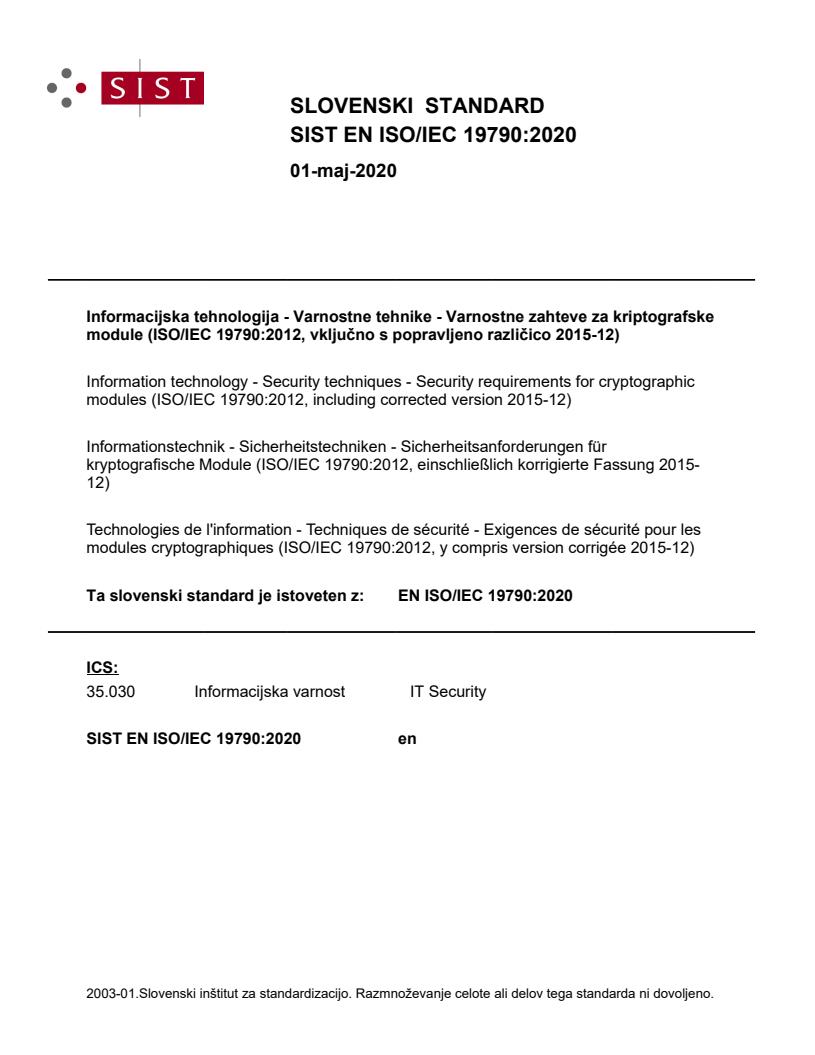
SLOVENSKI STANDARD
01-maj-2020
Informacijska tehnologija - Varnostne tehnike - Varnostne zahteve za kriptografske
module (ISO/IEC 19790:2012, vključno s popravljeno različico 2015-12)
Information technology - Security techniques - Security requirements for cryptographic
modules (ISO/IEC 19790:2012, including corrected version 2015-12)
Informationstechnik - Sicherheitstechniken - Sicherheitsanforderungen für
kryptografische Module (ISO/IEC 19790:2012, einschließlich korrigierte Fassung 2015-
12)
Technologies de l'information - Techniques de sécurité - Exigences de sécurité pour les
modules cryptographiques (ISO/IEC 19790:2012, y compris version corrigée 2015-12)
Ta slovenski standard je istoveten z: EN ISO/IEC 19790:2020
ICS:
35.030 Informacijska varnost IT Security
2003-01.Slovenski inštitut za standardizacijo. Razmnoževanje celote ali delov tega standarda ni dovoljeno.
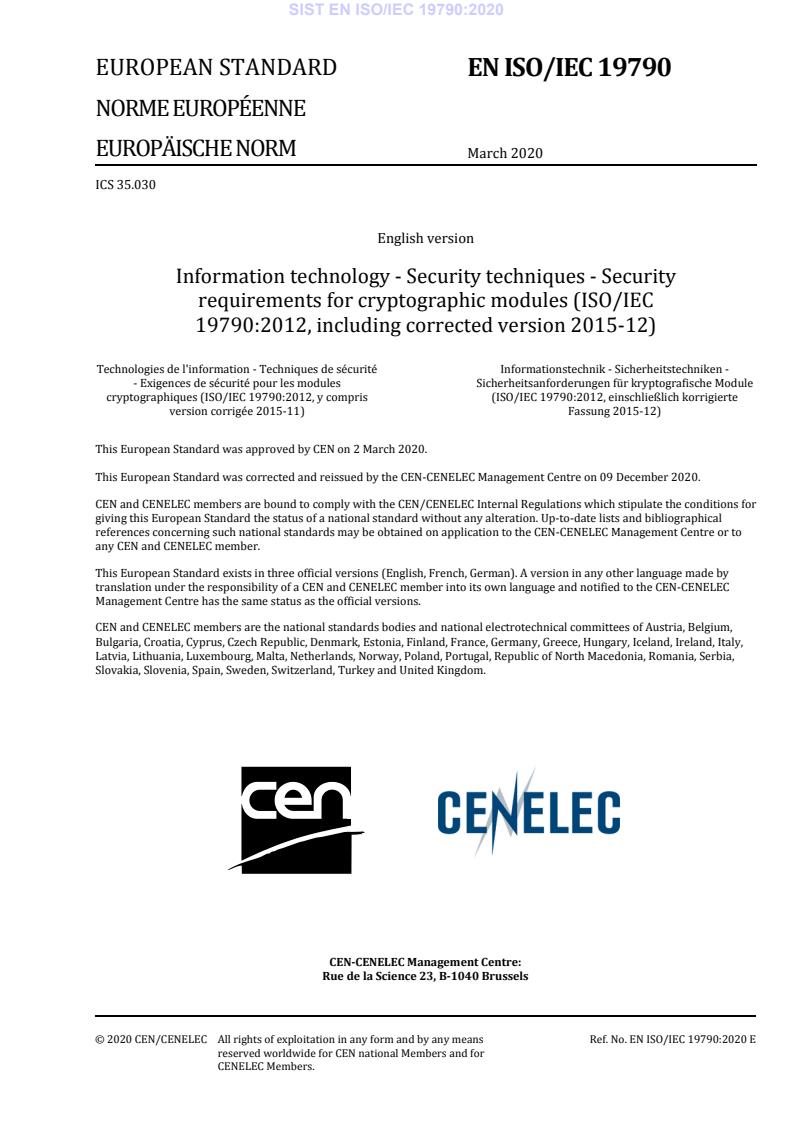
EUROPEAN STANDARD EN ISO/IEC 19790
NORME EUROPÉENNE
EUROPÄISCHE NORM
March 2020
ICS 35.030
English version
Information technology - Security techniques - Security
requirements for cryptographic modules (ISO/IEC
19790:2012, including corrected version 2015-12)
Technologies de l'information - Techniques de sécurité Informationstechnik - Sicherheitstechniken -
- Exigences de sécurité pour les modules Sicherheitsanforderungen für kryptografische Module
cryptographiques (ISO/IEC 19790:2012, y compris (ISO/IEC 19790:2012, einschließlich korrigierte
version corrigée 2015-11) Fassung 2015-12)
This European Standard was approved by CEN on 2 March 2020.
This European Standard was corrected and reissued by the CEN-CENELEC Management Centre on 09 December 2020.
CEN and CENELEC members are bound to comply with the CEN/CENELEC Internal Regulations which stipulate the conditions for
giving this European Standard the status of a national standard without any alteration. Up-to-date lists and bibliographical
references concerning such national standards may be obtained on application to the CEN-CENELEC Management Centre or to
any CEN and CENELEC member.
This European Standard exists in three official versions (English, French, German). A version in any other language made by
translation under the responsibility of a CEN and CENELEC member into its own language and notified to the CEN-CENELEC
Management Centre has the same status as the official versions.
CEN and CENELEC members are the national standards bodies and national electrotechnical committees of Austria, Belgium,
Bulgaria, Croatia, Cyprus, Czech Republic, Denmark, Estonia, Finland, France, Germany, Greece, Hungary, Iceland, Ireland, Italy,
Latvia, Lithuania, Luxembourg, Malta, Netherlands, Norway, Poland, Portugal, Republic of North Macedonia, Romania, Serbia,
Slovakia, Slovenia, Spain, Sweden, Switzerland, Turkey and United Kingdom.
CEN-CENELEC Management Centre:
Rue de la Science 23, B-1040 Brussels
© 2020 CEN/CENELEC All rights of exploitation in any form and by any means Ref. No. EN ISO/IEC 19790:2020 E
reserved worldwide for CEN national Members and for
CENELEC Members.
Contents Page
European foreword . 3
European foreword
The text of ISO/IEC 19790:2012, including corrected version 2015-12 has been prepared by Technical
Committee ISO/IEC JTC 1 "Information technology” of the International Organization for
Standardization (ISO) and has been taken over as EN ISO/IEC 19790:2020 by Technical Committee
CEN/CLC/JTC 13 “Cybersecurity and Data Protection” the secretariat of which is held by DIN.
This European Standard shall be given the status of a national standard, either by publication of an
identical text or by endorsement, at the latest by September 2020, and conflicting national standards
shall be withdrawn at the latest by September 2020.
Attention is drawn to the possibility that some of the elements of this document may be the subject of
patent rights. CEN shall not be held responsible for identifying any or all such patent rights.
According to the CEN-CENELEC Internal Regulations, the national standards organizations of the
following countries are bound to implement this European Standard: Austria, Belgium, Bulgaria,
Croatia, Cyprus, Czech Republic, Denmark, Estonia, Finland, France, Germany, Greece, Hungary, Iceland,
Ireland, Italy, Latvia, Lithuania, Luxembourg, Malta, Netherlands, Norway, Poland, Portugal, Republic of
North Macedonia, Romania, Serbia, Slovakia, Slovenia, Spain, Sweden, Switzerland, Turkey and the
United Kingdom.
Endorsement notice
The text of ISO/IEC 19790:2012, including corrected version 2015-12 has been approved by CEN as
INTERNATIONAL ISO/IEC
STANDARD 19790
Second edition
2012-08-15
Corrected version
2015-12-15
Information technology — Security
techniques — Security requirements
for cryptographic modules
Technologies de l’information — Techniques de sécurité — Exigences
de sécurité pour les modules cryptographiques
Reference number
ISO/IEC 19790:2012(E)
©
ISO/IEC 2012
ISO/IEC 19790:2012(E)
© ISO/IEC 2012, Published in Switzerland
All rights reserved. Unless otherwise specified, no part of this publication may be reproduced or utilized otherwise in any form
or by any means, electronic or mechanical, including photocopying, or posting on the internet or an intranet, without prior
written permission. Permission can be requested from either ISO at the address below or ISO’s member body in the country of
the requester.
ISO copyright office
Ch. de Blandonnet 8 • CP 401
CH-1214 Vernier, Geneva, Switzerland
Tel. +41 22 749 01 11
Fax +41 22 749 09 47
copyright@iso.org
www.iso.org
ii © ISO/IEC 2012 – All rights reserved
ISO/IEC 19790:2012(E)
Contents Page
1 Scope . 1
2 Normative references . 1
3 Terms and definitions . 1
4 Abbreviated terms .15
5 Cryptographic module security levels .15
5.1 Security Level 1 .15
5.2 Security Level 2 .16
5.3 Security Level 3 .16
5.4 Security Level 4 .17
6 Functional security objectives .17
7 Security requirements .18
7.1 General .18
7.2 Cryptographic module specification .20
7.2.1 Cryptographic module specification general requirements .20
7.2.2 Types of cryptographic modules .20
7.2.3 Cryptographic boundary .21
7.2.4 Modes of operations .22
7.3 Cryptographic module interfaces .23
7.3.1 Cryptographic module interfaces general requirements .23
7.3.2 Types of interfaces .24
7.3.3 Definition of interfaces .24
7.3.4 Trusted channel .25
7.4 Roles, services, and authentication .25
7.4.1 Roles, services, and authentication general requirements .25
7.4.2 Roles .26
7.4.3 Services .26
7.4.4 Authentication .28
7.5 Software/Firmware security .29
7.6 Operational environment .31
7.6.1 Operational environment general requirements .31
7.6.2 Operating system requirements for limited or non-modifiable operational environments .33
7.6.3 Operating system requirements for modifiable operational environments .33
7.7 Physical security .35
7.7.1 Physical security embodiments .35
7.7.2 Physical security general requirements .37
7.7.3 Physical security requirements for each physical security embodiment .39
7.7.4 Environmental failure protection/testing .42
7.8 Non-invasive security .43
7.9 Sensitive security parameter management .44
7.9.1 Sensitive security parameter management general requirements.44
7.9.2 Random bit generators .44
7.9.3 Sensitive security parameter generation .44
7.9.4 Sensitive security parameter establishment .45
7.9.5 Sensitive security parameter entry and output .45
7.9.6 Sensitive security parameter storage .46
© ISO/IEC 2012 – All rights reserved iii
ISO/IEC 19790:2012(E)
7.9.7 Sensitive security parameter zeroisation .46
7.10 Self-tests .47
7.10.1 Self-test general requirements .47
7.10.2 Pre-operational self-tests .47
7.10.3 Conditional self-tests .48
7.11 Life-cycle assurance .50
7.11.1 Life-cycle assurance general requirements .50
7.11.2 Configuration management .51
7.11.3 Design .51
7.11.4 Finite state model .51
7.11.5 Development .52
7.11.6 Vendor testing .53
7.11.7 Delivery and operation .54
7.11.8 End of life .54
7.11.9 Guidance documents .54
7.12 Mitigation of other attacks .55
Annex A (normative) Documentation requirements .56
A.1 Purpose .56
A.2 Items .56
A.2.1 General .56
A.2.2 Cryptographic module specification .56
A.2.3 Cryptographic module interfaces .57
A.2.4 Roles, services, and authentication .57
A.2.5 Software/Firmware security .57
A.2.6 Operational environment .58
A.2.7 Physical security .58
A.2.8 Non-invasive security .58
A.2.9 Sensitive security parameter management .58
A.2.10 Self-tests .59
A.2.11 Life-cycle assurance .60
A.2.12 Mitigation of other attacks .61
Annex B (normative) Cryptographic module security policy .62
B.1 General .62
B.2 Items .62
B.2.1 General .62
B.2.2 Cryptographic module specification .62
B.2.3 Cryptographic module interfaces .63
B.2.4 Roles, services, and authentication .63
B.2.5 Software/Firmware security .64
B.2.6 Operational environment .64
B.2.7 Physical security .64
B.2.8 Non-invasive security .65
B.2.9 Sensitive security parameters management .65
B.2.10 Self-tests .66
B.2.11 Life-cycle assurance .66
B.2.12 Mitigation of other attacks .66
Annex C (normative) Approved security functions .67
C.1 Purpose .67
C.1.1 Block ciphers .67
C.1.2 Stream ciphers .67
C.1.3 Asymmetric algorithms and techniques .67
C.1.4 Message authentication codes.67
C.1.5 Hash functions .67
C.1.6 Entity authentication .68
iv © ISO/IEC 2012 – All rights reserved
ISO/IEC 19790:2012(E)
C.1.7 Key management .68
C.1.8 Random bit generation .68
Annex D (normative) Approved sensitive security parameter generation and establishment methods69
D.1 Purpose .69
D.1.1 Sensitive security parameter generation .69
D.1.2 Sensitive security parameter establishment methods .69
Annex E (normative) Approved authentication mechanisms .70
E.1 Purpose .70
E.1.1 Authentication mechanisms .70
Annex F (normative) Approved non-invasive attack mitigation test metrics .71
F.1 Purpose .71
F.1.1 Non-invasive attack mitigation test metrics .71
© ISO/IEC 2012 – All rights reserved v
ISO/IEC 19790:2012(E)
Foreword
ISO (the International Organization for Standardization) and IEC (the International Electrotechnical Commission) form
the specialized system for worldwide standardization. National bodies that are members of ISO or IEC participate in the
development of International Standards through technical committees established by the respective organization to deal
with particular fields of technical activity. ISO and IEC technical committees collaborate in fields of mutual interest. Other
international organizations, governmental and non-governmental, in liaison with ISO and IEC, also take part in the work.
In the field of information technology, ISO and IEC have established a joint technical committee, ISO/IEC JTC 1.
The procedures used to develop this document and those intended for its further maintenance are described in the
ISO/IEC Directives, Part 1. In particular the different approval criteria needed for the different types of document should
be noted. This document was drafted in accordance with the editorial rules of the ISO/IEC Directives, Part 2
(see www.iso.org/directives).
Attention is drawn to the possibility that some of the elements of this document may be the subject of patent rights. ISO
and IEC shall not be held responsible for identifying any or all such patent rights. Details of any patent rights identified
during the development of the document will be in the Introduction and/or on the ISO list of patent declarations received
(see www.iso.org/patents).
Any trade name used in this document is information given for the convenience of users and does not constitute an
endorsement.
For an explanation on the meaning of ISO specific terms and expressions related to conformity assessment, as well as
information about ISO's adherence to the WTO principles in the Technical Barriers to Trade (TBT) see the following
URL: Foreword - Supplementary information
Technical corrigendum 1 to ISO/IEC 19790:2012 was prepared by Joint Technical Committee ISO/IEC JTC 1,
Information technology, Subcommittee SC 27, Security techniques.
This corrected version of Technical corrigendum 1 to ISO/IEC 19790:2012 cancels and replaces the first edition
(ISO/IEC 19790:2012/Cor 1:2015), incorporating the same technical revisions and miscellaneous editorial corrections
showing in red text instead of black underlining:
3.21: The term "cryptographic boundary" is corrected;
3.80: The term "non-security relevant" is corrected;
3.108: The term "self-test" is corrected;
7.2.2: The requirements [02.04], [02.05] and [02.06] are corrected;
7.2.4.3: The requirement [02.31] is corrected;
7.3.3: The requirement [03.14] is corrected;
7.5: The requirements [05.06] and [05.07] are added. The requirements [05.08], [05.13] and [05.17] through
[05.23] are corrected;
7.6.3: The requirement [06.06] is corrected;
vi © ISO/IEC 2012 – All rights reserved
ISO/IEC 19790:2012(E)
7.8: The requirement [08.04] is corrected;
7.9.1: The requirement [09.04] is corrected;
7.9.7: The requirement [09.37] is corrected;
7.10.2.2: The requirement [10.17] is corrected;
7.11.5: The requirement [11.26] is corrected;
7.11.7: The requirement [11.35] is corrected;
7.11.9: The requirement [11.38] is corrected;
st nd
A.2.5: The requirements of the 1 and 2 bullets are corrected;
A.2.7: The requirement of the 3rd bullet is corrected;
A.2.10: The requirement of the 4th bullet is corrected;
th
B.2.4: The requirement of the 9 bullet is corrected;
st
B.2.5: The requirement of the 1 bullet is corrected;
B.2.7: The requirement of the 2nd level 6th bullet is corrected;
D.1: Duplicate text is removed;
D.1.2: The reference to ISO/IEC 15946-3 is removed;
E.1: Duplicate text is removed; and
F.1: Duplicate text is removed.
© ISO/IEC 2012 – All rights reserved vii
ISO/IEC 19790:2012(E)
Introduction
In Information Technology there is an ever-increasing need to use cryptographic mechanisms such as the protection of
data against unauthorised disclosure or manipulation, for entity authentication and for non-repudiation. The security and
reliability of such mechanisms are directly dependent on the cryptographic modules in which they are implemented.
This International Standard provides for four increasing, qualitative levels of security requirements intended to cover a
wide range of potential applications and environments. The cryptographic techniques are identical over the four security
levels. The security requirements cover areas relative to the design and implementation of a cryptographic module.
These areas include cryptographic module specification; cryptographic module interfaces; roles, services, and
authentication; software/firmware security; operational environment; physical security; non-invasive security; sensitive
security parameter management; self-tests; life-cycle assurance; and mitigation of other attacks.
The overall security rating of a cryptographic module must be chosen to provide a level of security appropriate for the
security requirements of the application and environment in which the module is to be utilised and for the security
services that the module is to provide. The responsible authority in each organization should ensure that their computer
and telecommunication systems that utilise cryptographic modules provide an acceptable level of security for the given
application and environment. Since each authority is responsible for selecting which approved security functions are
appropriate for a given application, compliance with this International Standard does not imply either full interoperability
or mutual acceptance of compliant products. The importance of security awareness and of making information security a
management priority should be communicated to all concerned.
Information security requirements vary for different applications; organizations should identify their information resources
and determine the sensitivity to and the potential impact of a loss by implementing appropriate controls. Controls
include, but are not limited to:
physical and environmental controls;
access controls;
software development;
backup and contingency plans; and
information and data controls.
These controls are only as effective as the administration of appropriate security policies and procedures within the
operational environment.
viii © ISO/IEC 2012 – All rights reserved
INTERNATIONAL STANDARD ISO/IEC 19790:2012(E)
Information technology — Security techniques — Security
requirements for cryptographic modules
1 Scope
This International Standard specifies the security requirements for a cryptographic module utilised
within a security system protecting sensitive information in computer and telecommunication
systems. This International Standard defines four security levels for cryptographic modules to
provide for a wide spectrum of data sensitivity (e.g. low value administrative data, million dollar
funds transfers, life protecting data, personal identity information, and sensitive information used by
government) and a diversity of application environments (e.g. a guarded facility, an office,
removable media, and a completely unprotected location). This International Standard specifies four
security levels for each of 11 requirement areas with each security level increasing security over the
preceding level.
This International Standard specifies security requirements specified intended to maintain the
security provided by a cryptographic module and compliance to this International Standard is not
sufficient to ensure that a particular module is secure or that the security provided by the module is
sufficient and acceptable to the owner of the information that is being protected.
2 Normative references
The following referenced documents are indispensable for the application of this document. For
dated references, only the edition cited applies. For undated references, the latest edition of the
referenced document (including any amendments) applies.
The documents listed in ISO/IEC 19790 Annexes C, D, E and F Information technology – Security
techniques – Security requirements for cryptographic modules.
3 Terms and definitions
For the purposes of this International Standard, the following terms and definitions apply.
3.1
access control list
ACL
list of permissions to grant access to an object
3.2
administrator guidance
written material that is used by the Crypto Officer and/or other administrative roles for the correct
configuration, maintenance, and administration of the cryptographic module
3.3
automated
without manual intervention or input (e.g. electronic means such as through a computer network)
© ISO/IEC 2012 – All rights reserved 1
ISO/IEC 19790:2012(E)
3.4
approval authority
any national or international organisation/authority mandated to approve and/or evaluate security functions
NOTE An approval authority in the context of this definition evaluates and approves security functions based on their
cryptographic or mathematical merits but is not the testing entity which would test for conformance to this International Standard.
3.5
approved data authentication technique
approved method that may include the use of a digital signature, message authentication code or keyed hash (e.g.
HMAC)
3.6
approved integrity technique
approved hash, message authentication code or a digital signature algorithm
3.7
approved mode of operation
set of services which includes at least one service that utilises an approved security function or process and can include
non-security relevant services
NOTE 1 Not to be confused with a specific mode of an approved security function, e.g. Cipher Block Chaining (CBC) mode
NOTE 2 Non-approved security functions or processes are excluded.
3.8
approved security function
security function (e.g. cryptographic algorithm) that is referenced in Annex C
3.9
asymmetric cryptographic technique
cryptographic technique that uses two related transformations; a public transformation (defined by the public key) and a
private transformation (defined by the private key).
NOTE The two transformations have the property that, given the public transformation, it is computationally infeasible to derive
the private transformation in a given limited time and with given computational resources.
3.10
biometric
measurable, physical characteristic or personal behavioral trait used to recognise the identity, or verify the claimed
identity, of an operator
3.11
bypass capability
ability of a service to partially or wholly circumvent a cryptographic function
3.12
certificate
entity's data rendered unforgeable with the private or secret key of a certification authority
NOTE Not to be confused with a modules validation certificate issued by a validation authority
3.13
compromise
unauthorised disclosure, modification, substitution, or use of critical security parameters or the unauthorised modification
or substitution of public security parameters
2 © ISO/IEC 2012 – All rights reserved
ISO/IEC 19790:2012(E)
3.14
conditional self-test
test performed by a cryptographic module when the conditions specified for the test occur
3.15
confidentiality
property that information is not made available or disclosed to unauthorised entities
3.16
configuration management system
CMS
management of security features and assurances through control of changes made to hardware, software and
documentation of a cryptographic module
3.17
control information
information that is entered into a cryptographic module for the purposes of directing the operation of the module
3.18
critical security parameter
CSP
security related information whose disclosure or modification can compromise the security of a cryptographic module
EXAMPLE Secret and private cryptographic keys, authentication data such as passwords, PINs, certificates or other trust
anchors
NOTE A CSP can be plaintext or encrypted.
3.19
crypto officer
role taken by an individual or a process (i.e. subject) acting on behalf of an individual that accesses a cryptographic
module in order to perform cryptographic initialisation or management functions of a cryptographic module
3.20
cryptographic algorithm
well-defined computational procedure that takes variable inputs, which may include cryptographic keys, and produces
an output
3.21
cryptographic boundary
explicitly defined perimeter that establishes the boundary of all components (i.e. set of hardware, software or firmware
components) of the cryptographic module
3.22
cryptographic hash function
computationally efficient function mapping binary strings of arbitrary length to binary strings of fixed length, such that it is
computationally infeasible to find two distinct values that hash into a common value
3.23
cryptographic key
key
sequence of symbols that controls the operation of a cryptographic transformation
EXAMPLE A cryptographic transformation can include but not limited to encipherment, decipherment, cryptographic check
function computation, signature generation, or signature verification.
© ISO/IEC 2012 – All rights reserved 3
ISO/IEC 19790:2012(E)
3.24
cryptographic key component
key component
parameter used in conjunction with other key components in an approved security function to form a plaintext CSP or
perform a cryptographic function
3.25
cryptographic module
module
set of hardware, software, and/or firmware that implements security functions and are contained within the cryptographic
boundary
3.26
cryptographic module security policy
security policy
precise specification of the security rules under which a cryptographic module shall operate, including the rules derived
from the requirements of this International Standard and additional rules imposed by the module or validation authority
NOTE See Annex B
3.27
data path
physical or logical route over which data passes
NOTE A physical data path can be shared by multiple logical data paths.
3.28
degraded operation
operation where a subset of the entire set of algorithms, security functions, services or processes are available and/or
configurable as a result of reconfiguration from an error state
3.29
differential power analysis
DPA
analysis of the variations of the electrical power consumption of a cryptographic module, for the purpose of extracting
information correlated to cryptographic operation
3.30
digital signature
data appended to, or a cryptographic transformation of a data unit that allows the recipient of the data unit to prove the
origin and integrity of the data unit and protect against forgery (e.g. by the recipient)
3.31
direct entry
entry of a SSP or key component into a cryptographic module, using a device such as a keyboard
3.32
disjoint signature
one or more signatures which together represent an entire set of code
3.33
electromagnetic emanations
EME
intelligence-bearing signal, which, if intercepted and analyzed, potentially discloses the information that is transmitted,
received, handled, or otherwise processed by any information-processing equipment
4 © ISO/IEC 2012 – All rights reserved
ISO/IEC 19790:2012(E)
3.34
electronic entry
entry of SSPs or key components into a cryptographic module using electronic methods
NOTE The operator of the key can have no knowledge of the value of the key being entered.
3.35
encompassing signature
single signature for an entire set of code
3.36
encrypted key
cryptographic key that has been encrypted using an approved security function with a key encryption key. Considered
protected
3.37
entity
person, group, device or process
3.38
entropy
measure of the disorder, randomness or variability in a closed system
NOTE The entropy of a random variable X is a mathematical measure of the amount of information provided by an observation
of X.
3.39
environmental failure protection
EFP
use of features to protect against a compromise of the security of a cryptographic module due to environmental
conditions outside of the module's normal operating range
3.40
environmental failure testing
EFT
use of specific methods to provide reasonable assurance that the security of a cryptographic module will not be
compromised by environmental conditions outside of the module's normal operating range
3.41
error detection code
EDC
value computed from data and comprised of redundant bits of information designed to detect, but not correct,
unintentional changes in the data
3.42
executable form
form of the code in which the software or firmware is managed and controlled completely by the operational environment
of the module and does not require compilation (e.g. no source code, object code or just-in-time compiled code)
3.43
fault induction
technique to induce operating behaviour changes in hardware by the application of transient voltages, radiation, laser or
clock skewing techniques
© ISO/IEC 2012 – All rights reserved 5
ISO/IEC 19790:2012(E)
3.44
finite state model
FSM
mathematical model of a sequential machine that is comprised of a finite set of input events, a finite set of output events,
a finite set of states, a function that maps states and input to output, a function that maps states and inputs to states (a
state transition function), and a specification that describes the initial state
3.45
firmware
executable code of a cryptographic module that is stored in hardware within the cryptographic boundary and cannot be
dynamically written or modified during execution while operating in a non-modifiable or limited operational environment
EXAMPLE Storage hardware can include but not limited to PROM, EEPROM, FLASH, solid state memory, hard drives, etc
3.46
firmware module
module that is composed solely of firmware
3.47
functional specification
high-level description of the ports and interfaces visible to the operator and high-level description of the behaviour of the
cryptographic module
3.48
functional testing
testing of the cryptographic module functionality as defined by the functional specification
3.49
hard / hardness
relative resistance of a metal or other material to denting, scratching, or bending; physically toughened; rugged, and
durable
NOTE The relative resistances of the material to be penetrated by another object.
3. 50
hardware
physical equipment/components within the cryptographic boundary used to process programs and data
3.51
hardware module
module composed primarily of hardware, which may also contain firmware
3.52
hardware module interface
HMI
total set of commands used to request the services of the hardware module, including parameters that enter or leave the
module’s cryptographic boundary as part of the requested service
3.53
hash value
output of a cryptographic hash function
6 © ISO/IEC 2012 – All rights reserved
ISO/IEC 19790:2012(E)
3.54
hybrid module
module whose cryptographic boundary delimits the composite of a software or firmware component and a disjoint
hardware component
3.55
hybrid firmware module interface
HFMI
total set of commands used to request the services of the hybrid firmware module, including parameters that enter or
leave the module’s cryptographic boundary as part of the requested service
3.56
hybrid software module interface
HSMI
total set of commands used to request the services of the hybrid software module, including parameters that enter or
leave the module’s cryptographic boundary as part of the requested service
3.57
input data
information that is entered into a cryptographic module may be used for the purposes of transformation or computation
using an approved security function
3.58
integrity
property that data has not been modified or deleted in an unauthorised and undetected manner
3.59
interface
logical entry or exit point of a cryptographic module that provides access to the module for logical information flows
3.60
ISO/IEC adopted
security function that is either:
specified in an ISO/IEC standard, or
adopted/recommended in an ISO/IEC standard and specified either in an annex of the ISO/IEC standard or in a
document referenced by the ISO/IEC standard
3.61
key agreement
SSP establishment procedure where the resultant key is a function of information by two or more participants, so that no
party can predetermine the value of the key independently of the other party’s contribution using automated methods
3.62
key encryption
...
Questions, Comments and Discussion
Ask us and Technical Secretary will try to provide an answer. You can facilitate discussion about the standard in here.
Loading comments...