

EN 14067-4:2024
(Main)Railway applications - Aerodynamics - Part 4: Requirements and assessment procedures for aerodynamics on open track
- Abstract
This document establishes requirements, test procedures, assessment methods and acceptance criteria for operating rolling stock in open track. For pressure variations and slipstream effects beside the track, requirements and assessment methods are provided. For running resistance, assessment methods are addressed in this document. Load cases on infrastructure components due to train-induced pressure variations and slipstream effects are addressed in this document. For ballasted track test set-ups for ballast projection assessment are proposed.
The requirements only apply to rolling stock of the heavy rail system with maximum train speeds above 160 km/h and not to other rail systems. The document is applicable to all rolling stock and infrastructure in open air with nominal track gauges of 1 435 mm to 1 668 mm inclusive.
- Status
- Withdrawn
- Publication Date
- 16-Apr-2024
- Withdrawal Date
- 06-Oct-2026
- Technical Committee
- CEN/TC 256 - Railway applications
- Drafting Committee
- CEN/TC 256/WG 6 - Aerodynamics
- Current Stage
- 9960 - Withdrawal effective - Withdrawal
- Start Date
- 14-May-2025
- Completion Date
- 07-Oct-2026

Relations
- Effective Date
- 03-Jun-2020
- Effective Date
- 17-Mar-2025
- Effective Date
- 25-Aug-2026
- Effective Date
- 28-Jan-2026
- Effective Date
- 28-Jan-2026
- Effective Date
- 28-Jan-2026
- Effective Date
- 28-Jan-2026
- Effective Date
- 03-Jul-2024
Get Certified
Connect with accredited certification bodies for this standard

IRIS Certification (UNIFE)
International Railway Industry Standard certification.

TÜV SÜD Rail GmbH
TÜV SÜD railway certification services.

Bureau Veritas Railway Certification
Railway and transportation certification.
Sponsored listings
Frequently Asked Questions
EN 14067-4:2024 is a standard published by the European Committee for Standardization (CEN). Its full title is "Railway applications - Aerodynamics - Part 4: Requirements and assessment procedures for aerodynamics on open track". This standard covers: This document establishes requirements, test procedures, assessment methods and acceptance criteria for operating rolling stock in open track. For pressure variations and slipstream effects beside the track, requirements and assessment methods are provided. For running resistance, assessment methods are addressed in this document. Load cases on infrastructure components due to train-induced pressure variations and slipstream effects are addressed in this document. For ballasted track test set-ups for ballast projection assessment are proposed. The requirements only apply to rolling stock of the heavy rail system with maximum train speeds above 160 km/h and not to other rail systems. The document is applicable to all rolling stock and infrastructure in open air with nominal track gauges of 1 435 mm to 1 668 mm inclusive.
This document establishes requirements, test procedures, assessment methods and acceptance criteria for operating rolling stock in open track. For pressure variations and slipstream effects beside the track, requirements and assessment methods are provided. For running resistance, assessment methods are addressed in this document. Load cases on infrastructure components due to train-induced pressure variations and slipstream effects are addressed in this document. For ballasted track test set-ups for ballast projection assessment are proposed. The requirements only apply to rolling stock of the heavy rail system with maximum train speeds above 160 km/h and not to other rail systems. The document is applicable to all rolling stock and infrastructure in open air with nominal track gauges of 1 435 mm to 1 668 mm inclusive.
EN 14067-4:2024 is classified under the following ICS (International Classification for Standards) categories: 45.060.01 - Railway rolling stock in general. The ICS classification helps identify the subject area and facilitates finding related standards.
EN 14067-4:2024 has the following relationships with other standards: It is inter standard links to EN 14067-4:2013+A1:2018, EN 14067-4:2024+A1:2025, ISO 8756:1994, EN 2599:2001, EN 17343:2023, EN 16727-2-2:2016, EN 1991-2:2003, EN 14067-4:2024/prA1. Understanding these relationships helps ensure you are using the most current and applicable version of the standard.
EN 14067-4:2024 is associated with the following European legislation: EU Directives/Regulations: 2016/797/EU, 2016/797/EU, 2016/797/EU, 2016/797/EU, 2016/797/EU, 2016/797/EU, 2016/797/EU, 2016/797/EU, 2016/797/EU, 2016/797/EU, 2016/797/EU, 2016/797/EU, 2016/797/EU; Standardization Mandates: M/483, M/591. When a standard is cited in the Official Journal of the European Union, products manufactured in conformity with it benefit from a presumption of conformity with the essential requirements of the corresponding EU directive or regulation.
EN 14067-4:2024 is available in PDF format for immediate download after purchase. The document can be added to your cart and obtained through the secure checkout process. Digital delivery ensures instant access to the complete standard document.
Standards Content (Sample)
SLOVENSKI STANDARD
01-junij-2024
Železniške naprave - Aerodinamika - 4. del: Zahteve in ugotavljanje skladnosti za
aerodinamiko na odprti progi
Railway applications - Aerodynamics - Part 4: Requirements and assessment
procedures for aerodynamics on open track
Bahnanwendungen - Aerodynamik - Teil 4: Anforderungen und Bewertungsverfahren für
Aerodynamik auf offener Strecke
Applications ferroviaires - Aérodynamique - Partie 4: Exigences et procédures
d'évaluation pour l'aérodynamique à l'air libre
Ta slovenski standard je istoveten z: EN 14067-4:2024
ICS:
45.060.01 Železniška vozila na splošno Railway rolling stock in
general
2003-01.Slovenski inštitut za standardizacijo. Razmnoževanje celote ali delov tega standarda ni dovoljeno.
EN 14067-4
EUROPEAN STANDARD
NORME EUROPÉENNE
April 2024
EUROPÄISCHE NORM
ICS 45.060.01 Supersedes EN 14067-4:2013+A1:2018
English Version
Railway applications - Aerodynamics - Part 4:
Requirements and assessment procedures for
aerodynamics on open track
Applications ferroviaires - Aérodynamique - Partie 4: Bahnanwendungen - Aerodynamik - Teil 4:
Exigences et procédures d'évaluation pour Anforderungen und Bewertungsverfahren für
l'aérodynamique à l'air libre Aerodynamik auf offener Strecke
This European Standard was approved by CEN on 27 February 2024.
CEN members are bound to comply with the CEN/CENELEC Internal Regulations which stipulate the conditions for giving this
European Standard the status of a national standard without any alteration. Up-to-date lists and bibliographical references
concerning such national standards may be obtained on application to the CEN-CENELEC Management Centre or to any CEN
member.
This European Standard exists in three official versions (English, French, German). A version in any other language made by
translation under the responsibility of a CEN member into its own language and notified to the CEN-CENELEC Management
Centre has the same status as the official versions.
CEN members are the national standards bodies of Austria, Belgium, Bulgaria, Croatia, Cyprus, Czech Republic, Denmark, Estonia,
Finland, France, Germany, Greece, Hungary, Iceland, Ireland, Italy, Latvia, Lithuania, Luxembourg, Malta, Netherlands, Norway,
Poland, Portugal, Republic of North Macedonia, Romania, Serbia, Slovakia, Slovenia, Spain, Sweden, Switzerland, Türkiye and
United Kingdom.
EUROPEAN COMMITTEE FOR STANDARDIZATION
COMITÉ EUROPÉEN DE NORMALISATION
EUROPÄISCHES KOMITEE FÜR NORMUNG
CEN-CENELEC Management Centre: Rue de la Science 23, B-1040 Brussels
© 2024 CEN All rights of exploitation in any form and by any means reserved Ref. No. EN 14067-4:2024 E
worldwide for CEN national Members.
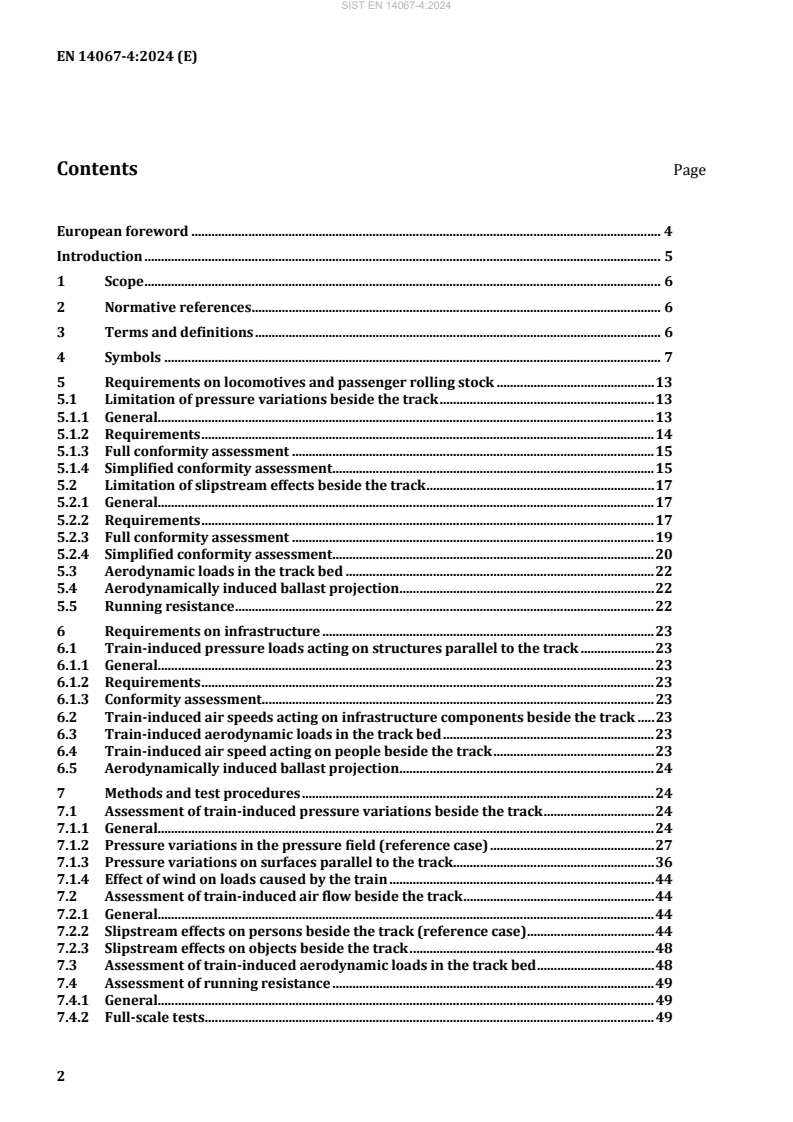
Contents Page
European foreword . 4
Introduction . 5
1 Scope . 6
2 Normative references . 6
3 Terms and definitions . 6
4 Symbols . 7
5 Requirements on locomotives and passenger rolling stock . 13
5.1 Limitation of pressure variations beside the track . 13
5.1.1 General. 13
5.1.2 Requirements . 14
5.1.3 Full conformity assessment . 15
5.1.4 Simplified conformity assessment. 15
5.2 Limitation of slipstream effects beside the track . 17
5.2.1 General. 17
5.2.2 Requirements . 17
5.2.3 Full conformity assessment . 19
5.2.4 Simplified conformity assessment. 20
5.3 Aerodynamic loads in the track bed . 22
5.4 Aerodynamically induced ballast projection . 22
5.5 Running resistance . 22
6 Requirements on infrastructure . 23
6.1 Train-induced pressure loads acting on structures parallel to the track . 23
6.1.1 General. 23
6.1.2 Requirements . 23
6.1.3 Conformity assessment . 23
6.2 Train-induced air speeds acting on infrastructure components beside the track . 23
6.3 Train-induced aerodynamic loads in the track bed . 23
6.4 Train-induced air speed acting on people beside the track . 23
6.5 Aerodynamically induced ballast projection . 24
7 Methods and test procedures . 24
7.1 Assessment of train-induced pressure variations beside the track . 24
7.1.1 General. 24
7.1.2 Pressure variations in the pressure field (reference case) . 27
7.1.3 Pressure variations on surfaces parallel to the track. 36
7.1.4 Effect of wind on loads caused by the train . 44
7.2 Assessment of train-induced air flow beside the track . 44
7.2.1 General. 44
7.2.2 Slipstream effects on persons beside the track (reference case) . 44
7.2.3 Slipstream effects on objects beside the track . 48
7.3 Assessment of train-induced aerodynamic loads in the track bed . 48
7.4 Assessment of running resistance . 49
7.4.1 General. 49
7.4.2 Full-scale tests . 49
Annex A (informative) Procedure for full-scale tests regarding train-induced air flow in the
track bed . 57
A.1 General . 57
A.2 Track set-up . 57
A.3 Vehicle configuration and test conditions . 58
A.4 Instrumentation and data acquisition . 58
A.5 Data processing . 59
Bibliography . 60
European foreword
This document (EN 14067-4:2024) has been prepared by Technical Committee CEN/TC 256 “Railway
Applications”, the secretariat of which is held by DIN.
This European Standard shall be given the status of a national standard, either by publication of an
identical text or by endorsement, at the latest by October 2024, and conflicting national standards shall
be withdrawn at the latest by October 2024.
Attention is drawn to the possibility that some of the elements of this document may be the subject of
patent rights. CEN shall not be held responsible for identifying any or all such patent rights.
This document supersedes EN 14067-4:2013+A1:2018.
Results of the EU-funded research project “AeroTRAIN” (Grant Agreement No. 233985) are contained in
this document.
In comparison with the previous edition, the following technical modifications have been made:
— The scope was amended to cover track gauges other than 1 435 mm. Minor modifications and
improvements were made throughout the whole document. The methods and test procedures for
running resistance and train-induced aerodynamic loads in the track bed were updated.
This document has been prepared under a standardization request addressed to CEN by the European
Commission.
EN 14067, Railway applications — Aerodynamics consists of the following parts:
— Part 4: Requirements and assessment procedures for aerodynamics on open track;
— Part 5: Requirements and assessment procedures for aerodynamics in tunnels;
— Part 6: Requirements and assessment procedures for cross wind assessment;
— Part 7 (TR): Fundamentals for test procedures for train-induced ballast projection.
Any feedback and questions on this document should be directed to the users’ national standards body.
A complete listing of these bodies can be found on the CEN website. According to the CEN-CENELEC
Internal Regulations, the national standards organisations of the following countries are bound to
implement this European Standard: Austria, Belgium, Bulgaria, Croatia, Cyprus, Czech Republic,
Denmark, Estonia, Finland, France, Germany, Greece, Hungary, Iceland, Ireland, Italy, Latvia, Lithuania,
Luxembourg, Malta, Netherlands, Norway, Poland, Portugal, Republic of North Macedonia, Romania,
Serbia, Slovakia, Slovenia, Spain, Sweden, Switzerland, Türkiye and the United Kingdom.
Introduction
Trains running on open track generate aerodynamic loads on objects and persons they pass. If trains are
being passed by other trains, trains are also subject to aerodynamic loading themselves. The aerodynamic
loading caused by a train passing an object or a person near the track, or when two trains pass each other,
is an important interface parameter between the subsystems of rolling stock, infrastructure and
operation. It is thus subject to regulation when specifying the trans-European railway system.
Trains running on open track must overcome a running resistance which has a strong effect on the
required engine power, achievable speed, travel time and energy consumption. Thus, running resistance
is often subject to contractual agreements and requires standardized test and assessment methods. The
test set-up for ballast projection was also updated.
1 Scope
This document establishes requirements, test procedures, assessment methods and acceptance criteria
for operating rolling stock in open track. For pressure variations and slipstream effects beside the track,
requirements and assessment methods are provided. For running resistance, assessment methods are
addressed in this document. Load cases on infrastructure components due to train-induced pressure
variations and slipstream effects are addressed in this document. For ballasted track test set-ups for
ballast projection assessment are proposed.
The requirements only apply to rolling stock of the heavy rail system with maximum train speeds above
160 km/h and not to other rail systems. The document is applicable to all rolling stock and infrastructure
in open air with nominal track gauges of 1 435 mm to 1 668 mm inclusive.
2 Normative references
The following documents are referred to in the text in such a way that some or all of their content
constitutes requirements of this document. For dated references, only the edition cited applies. For
undated references, the latest edition of the referenced document (including any amendments) applies.
EN 1991-2:2003, Eurocode 1: Actions on structures — Part 2: Traffic loads on bridges
EN 16727-2-2:2016, Railway applications - Track - Noise barriers and related devices acting on airborne
sound propagation - Non-acoustic performance - Part 2-2: Mechanical performance under dynamic loadings
caused by passing trains - Calculation method
EN 17343, Railway applications - General terms and definitions
ISO 8756, Air quality — Handling of temperature, pressure and humidity data
3 Terms and definitions
For the purposes of this document, the terms and definitions given in EN 17343 and the following apply.
ISO and IEC maintain terminological databases for use in standardization at the following addresses:
— IEC Electropedia: available at https://www.electropedia.org/
— ISO Online browsing platform: available at https://www.iso.org/obp
3.1
peak-to-peak pressure change
modulus of the difference between the maximum pressure and the minimum pressure for the relevant
load case
3.2
passage of train head
passage of the front end of the leading vehicle which is responsible for the generation of the characteristic
pressure rise and drop, over and beside the train and on the track bed
3.3
Computational Fluid Dynamics
CFD
numerical methods of approximating and solving the equations of fluid dynamics
Document impacted by AC:2010.
3.4
streamline shaped vehicle
vehicle with a closed and smooth front which does not cause flow separations in the mean flow field
greater than 5 cm from the side of the vehicle
3.5
bluff shaped vehicle
vehicle that is not streamline shaped
3.6
unit
rolling stock that may be composed of several vehicles
3.7
fixed train composition
train formation that can only be reconfigured within a workshop environment
3.8
pre-defined train compositions
train formation of one or several units coupled together, which is defined at design stage and can be
reconfigured during operation
4 Symbols
For the purposes of this document, the symbols in Table 1 apply.
Table 1 — Symbols
Symbol Unit Significance Explanation or remark
train accelerations measured
a m/s
during the coasting test
train accelerations measured
a m/s during the coasting test when
D
the train is running downhill
difference of train
accelerations between two
a m/s
d
coasting tests at the same
track location
train accelerations measured
a m/s during the coasting test when
U
the train is running uphill
coefficient of aerodynamic
C −
F
force
aerodynamic coefficient
C − depending on the distance
p1
from track centre Y
aerodynamic coefficient
C − depending on the height
p2
above top of rail h
Symbol Unit Significance Explanation or remark
aerodynamic coefficient
C − depending on the distance
p3
from track centre Y
C N mechanical resistance
approximation of mechanical
C N see 7.4.2
1,A
resistance
momentum resistance due to
air flow for traction and
C v N
2 tr
auxiliary equipment and the
air conditioning systems
aerodynamic resistance in the
C3 vtr N
running resistance formula
C
showing the density
N/Pa
C
contribution
c m/s speed of sound
dt s temporal variation
dv m/s train speed variation
tr
dx m spatial variation
load on an object, maximum
F N value of the force during the
passage
F N force see 7.4.2.2.3
d
g m/s acceleration due to gravity
h m height above top of rail
within a typical range
i − gradient of the track
of ± 0,03
factor accounting for the
k − energy stored in rotating ≥ 1,0
masses
factor accounting for multiple
k − see Formula (16)
MU
units
k − shape coefficient of the train
k − shape coefficient of the train
k − shape coefficient of the train
distance from front
end to where the full
L m length of the train nose cross section of the
n
leading vehicle is
achieved
Symbol Unit Significance Explanation or remark
L m length of test section see 7.4.2.2
s
m kg train mass
number of additional units
N − compared with test see 7.2.2.1
b
configuration
function of train speed
squared between two
P N see 7.4.2.4
d
coasting tests at the same
track location
p Pa pressure
p Pa maximum pressure
max
p Pa minimum pressure
min
characteristic value of
p Pa
1k
distributed load
characteristic value of
p Pa
2k
distributed load
characteristic value of
p Pa
3k
distributed load
based on reference
Re − maximum Reynolds number length of 3 m at full
max
scale
train contribution, see
R N running resistance
7.4.1
infrastructure
R N running resistance
contribution, see 7.4.1
reference value of curve
r
m see 7.4.2.4
C
radius
r m curve radius
S m characteristic area
s m distance see 7.4.2.2
t s time
scaled time referring to the i-
t s
i
th passage
time referring to the i-th
t s
m,i
passage
maximum resultant
U m/s
i horizontal air speed of the i-th
passage after averaging and
Symbol Unit Significance Explanation or remark
correction to the
characteristic train speed
mean value over all measured
m/s
U
maxima U
i
U m/s maximum value of U
max
upper bound of a 2σ interval
U m/s
2σ
of maximum air speed
characteristic air
maximum resultant
U m/s speed from
95 %
horizontal air speed
measurement
maximum permissible limit for characteristic
U m/s
95 %,max
horizontal air speed air speed
resultant horizontal air speed after transformation of
u (t ) m/s
i i
of the i-th passage the time base
measured resultant
u (t ) m/s horizontal air speed of the i-th
m,i m,i
passage
v m/s relative wind velocity see Figure 1
a
difference of train speed
v m/s between two coasting tests at see 7.4.2.4
d
the same track location
difference of train speed
squared between two
2/ 2
v m s see 7.4.2.4
d_q
coasting tests at the same
track location
v m/s train speed
tr
instantaneous train speed
v m/s see 7.4.2.2
trD
coasting downhill
train speed during the i-th
v m/s
tr,i
passage
maximum train speed
refers to train
operation.
maximum train speed or
if limited by
v m/s
tr,max
design speed of a train
infrastructure,
maximum train speed
may be lower than
design speed.
v m/s reference speed
tr,ref
measured speed at point S
vtr,S1 m/s see 7.4.2.2
coasting uphill
Symbol Unit Significance Explanation or remark
measured speed at point S
v m/s see 7.4.2.2
tr,S2
coasting downhill
vtr,S1a m/s measured speed at starting see 7.4.2.2.3
point S1 coasting direction 1
v m/s measured speed at end point see 7.4.2.2.3
tr,S1b
coasting direction 1
v m/s measured speed at starting see 7.4.2.2.3
tr,S2a
point S2 coasting direction 2
v m/s measured speed at end point see 7.4.2.2.3
tr,S2b
coasting direction 2
v m/s nominal test speed
tr,test
instantaneous train speed
v m/s see 7.4.2.2
trU
coasting uphill
wind speed measured
v m/s wind speed at stationary point, see
w
Figure 1
wind speed component in x-
v m/s direction during the i-th
w,x,i
passage
wind speed component in y-
v m/s direction during the i-th
w,y,i
passage
quotient of cross wind speed
W − and incident air speed in track see 7.1.2.1
y
direction
lateral distance from track
Y m
centre
minimum lateral distance
Y m
min
from track centre
maximum lateral distance
Y m
max
from track centre
+
y − dimensionless wall distance
angle between the
vehicle axis and the
relative wind acting on
the train. In a wind
tunnel with stationary
β ° yaw angle
train model, it is the
angle between the
train axis and the wind
tunnel axis, see
Figure 1.
Symbol Unit Significance Explanation or remark
ΔC − pressure change coefficient
p
upper bound of a 2 σ
interval of the peak-to-
peak pressure change
coefficient. The peak-
ΔC − pressure change coefficient
p,2σ
to-peak pressure
change coefficient is
defined in
Formula (2).
Δp Pa peak-to-peak pressure change
determined over all
mean value for peak-to-peak
Pa measurements Δp or
∆p i
pressure change
by CFD
corrected maximum peak-to-
Δp Pa peak pressure value of the i-th Formula (5)
i
passage
maximum peak-to-peak
Δp Pa pressure value measured Formula (5)
m,i
during the i-th passage
the head pressure variation
Δp Pa from unsteady CFD
sim
calculations
the average refers
the average of head pressure either to steady CFD
∆p Pa variation from CFD calculations or the
sim
calculations average of results from
unsteady simulations
head pressure variation from
∆p Pa steady CFD calculations for Formula (6)
sim,k
the k-th height
average peak-to-peak
pressure value for the 6
Δp Pa Formula (8)
test,k
heights k, taken from
measurements
upper bound of a 2σ interval
Δp Pa of the peak-to-peak pressure
2σ
change
maximum peak-to-peak characteristic pressure
Δp Pa
95 %
pressure change change
permissible
permissible maximum peak-
Δp Pa characteristic pressure
95 %,max
to-peak pressure change
change
Symbol Unit Significance Explanation or remark
passage of train head,
Δt s characteristic time interval time between
pressure peaks
relative root mean square of
the difference between a
ε -
calculated pressure variation
and test results
η Pa s dynamic viscosity of air
ρ kg/m air density
air density determined during
ρ kg/m
i
the i-th passage
3 3
ρ kg/m standard air density ρ = 1,225 kg/m
0 0
can be pressure or
σ − standard deviation
speed
standard deviation of
σ Pa
sim
simulated pressure
a) Side view b) View from behind
c) Top view d) Speed vector diagram
NOTE A positive β means that the apparent wind va is coming from the right hand side of the train.
Figure 1 — Coordinate system
5 Requirements on locomotives and passenger rolling stock
5.1 Limitation of pressure variations beside the track
5.1.1 General
A passing train generates a varying pressure field beside the track which has an effect on objects such as
crossing trains, noise barriers, platform installations, etc. To define a clear interface between the
subsystems of rolling stock and infrastructure, the train-induced aerodynamic pressure loads beside the
track need to be known and limited.
In order to describe and to limit the train-induced aerodynamic pressure loads beside the track reference
cases for rolling stock assessment are defined for track gauges from 1 435 mm to 1 668 mm inclusive.
5.1.2 Requirements
5.1.2.1 Reference case
For track gauges from 1 435 mm to 1 668 mm the pressure field generated by a passing train at a distance
according to Table 2 from the centre of the track is referred to as the reference case. The reference case
is defined for a straight track with standard track formation profile and in the absence of embankments,
cuttings and other significant trackside structures. The pressure variations occurring are limited by the
permissible pressure change Δp , which refers to the maximum pressure change that occurs
95 %, max
during the passage of the leading vehicle.
5.1.2.2 Fixed or pre-defined train compositions
A fixed or pre-defined train composition, running at the reference speed in the reference case scenario
shall not cause the maximum peak-to-peak pressure changes to exceed a value Δp as set out in
95 %, max
Table 2 over the range of heights 1,50 m to 3,00 m above the top of rail during the passage of the train
head. For non-identical end cars the requirement applies for each possible running direction.
Table 2 — Maximum permissible peak-to-peak pressure change Δp depending on
95 %,max
maximum design speed
Track gauge Maximum design speed Measurement Permissible Reference speed
distance from pressure change
at
track centre Δp95 %,max
reference speed
mm km/h m Pa km/h
any v ≤ 160 2,50 no requirement
tr,max
1 435 160 < v < 250 2,50 Δp = 800 v
tr,max 95 %,max tr,max
1 435 250 ≤ v 2,50 Δp = 800 250
tr,max 95 %,max
1 524 160 < v < 250 2,50 Δp = 1 600 v
tr,max 95 %,max tr,max
1 668 160 < v < 250 2,60 Δp = 800 v
tr,max 95 %,max tr,max
1 668 250 ≤ v 2,60 Δp = 800 250
tr,max 95 %,max
5.1.2.3 Vehicle capable of running in leading position
A vehicle capable of running in leading position shall not cause the maximum peak-to-peak pressure
changes to exceed a value Δp as set out in Table 2, when running as the leading vehicle at the
95 %,max
reference speed in the reference case scenario. The range of heights to be considered are 1,50 m to 3,00 m
above the top of rail during the passage of the front end of this vehicle. For vehicles capable of
bidirectional operation as a leading vehicle, the requirement applies when the vehicle is placed in leading
position for each running direction.
5.1.2.4 Other rolling stock
For other rolling stock which are not covered in 5.1.2.2 or 5.1.2.3 there are no requirements.
5.1.3 Full conformity assessment
A full conformity assessment of interoperable rolling stock shall be undertaken according to Table 3.
Table 3 — Methods applicable for the full conformity assessment of rolling stock
Maximum design speed Methods
v ≤ 160 km/h No assessment needed
tr,max
Assessment by:
— full-scale tests according to 7.1.2.1; or
160 km/h < vtr,max
— reduced-scale moving model tests according to 7.1.2.2; or
— computational fluid dynamics (CFD) simulations according to 7.1.2.4
5.1.4 Simplified conformity assessment
A simplified conformity assessment may be carried out for rolling stock that are subject to minor design
differences in comparison to rolling stock for which a full conformity assessment already exists.
With respect to pressure variations beside the track, the only relevant design differences are differences
in external geometry and differences in design speed.
This simplified conformity assessment shall take one of the following forms in accordance with Table 4:
— a statement and rationale that the design differences have no impact on the pressure variations
beside the track;
— a comparative evaluation of the design differences relevant to the rolling stock for which a full
conformity assessment already exists.
Table 4 — Methods and requirements applicable for simplified conformity assessment of rolling
stock
Design differences Methods and requirements
Differences in external geometry limited to Documentation of differences, statement of no impact
and reference to an existing compliant full conformity
— locations either downstream from the maximum
assessment.
cross-section of the train nose or downstream
from the minimum pressure peak relative to the
train nose,
— the inner region of the underbody of the train
(under the train and between rails),
— minor differences in external geometry,
— wipers and handles,
— antennae with a volume smaller than 5 000 cm ,
— long isolated protruding objects or gaps not
being vertical or close to the front-side radius or
edge smaller than 50 mm in the crosswise
dimensions,
— small isolated protruding objects and gaps
smaller than 50 mm in each dimension.
Other differences in external geometry (e.g. in Documentation of differences and reference to an
buffers, front couplers, snow ploughs, front or side existing compliant full conformity assessment AND
windows) keeping the basic head shape features. assessment of the relative effect of differences by
— reduced-scale moving model tests according to
7.1.2.2 or
— CFD-simulations according to 7.1.2.4, AND evidence
and documentation that
1) the difference causes changes in ∆p less
than ± 10 %,
∆pB −∆p A
( ) ( )
< 0,1
∆pA
( )
AND
2) the difference does not exceed 50 % of the margin
available on the compliance with 5.1.2.
∆pB( )−∆p(A) < 0,5× ∆p −∆p (A)
( ) ( )
95%,max 95%
NOTE B refers to the new train geometry. A refers to
the existing compliant train.
Increase of design speed Documentation of differences and reference to an
existing compliant full conformity assessment AND
— less than 10 % for a train with original design
speed < 250 km/h, evidence and documentation based on a ΔC analysis
p
that the new design under investigation still fulfils the
— for a train with original design speed ≥ 250 km/h.
requirements listed in 5.1.2.
5.2 Limitation of slipstream effects beside the track
5.2.1 General
A train generates a varying flow field beside the track which has an effect on persons and objects at the
track side and at platforms. Therefore, measurements at two heights shall be undertaken representing
the position of track workers and passengers. In order to define a clear interface between the subsystems
of the rolling stock and the infrastructure, the train-induced slipstream effects need to be known and
limited.
In order to describe and to limit the train-induced slipstream effects, reference cases for rolling stock
assessment are defined for track gauges from 1 435 mm to 1 668 mm inclusive.
NOTE Ensuring track workers' and passengers' safety at the platform involves additional measures on the
operational and infrastructure side.
5.2.2 Requirements
5.2.2.1 Reference cases
For track gauges from 1 435 mm to 1 668 mm inclusive and in the absence of embankments, cuttings and
any significant trackside structures, the undisturbed flow field generated by a passing train at a distance
according to Table 5 from the centre of a straight track with standard track formation profile is referred
to as the reference case. The air flows occurring are limited by the permissible horizontal air
speedU which refers to the whole passage of the train and its wake, see Table 5. One of the
95 %,max
following three reference cases shall be considered:
— for fixed or pre-defined train compositions, see 5.2.2.2;
— for vehicle capable of running in leading position, see 5.2.2.3; for other rolling stock, see 5.2.2.4.
5.2.2.2 Fixed or pre-defined train compositions
A maximum length, fixed or pre-defined train composition with maximum number of units, running at
reference speed in the reference case scenario shall not cause the maximum resultant horizontal air
speeds U to exceed the values U as set out in Table 5 at heights of 0,20 m and 1,40 m above
95 % 95 %,max
the top of rail during the passage of the whole train and its wake. For non-symmetrical train compositions,
the requirement applies for each possible running direction. If applicable, the choice of train
configurations assessed shall be documented addressing length and number of units as well as the
symmetry (comparing front half to back half of train). The choice of variations in positioning coaches
within the train shall be justified.
The requirement is applicable to train compositions up to 415 m. Longer train compositions require
further investigation and assessment.
Table 5 — Maximum permissible horizontal air speed U depending on maximum
95 %,max
design speed
Height Distance Permissible horizontal Reference speed
Track Maximum design
gauge speed v above the from the air speed U at v
tr,max 95 %,max tr,ref
top of rail track reference speed
mm km/h
centre
m m/s
m
any v ≤ 160 no requirement
tr,max
1 435 0,20 3,00 U = 20,0 the maximum
95 %,max
design speed
1,40 3,00 U = 15,5 200 km/h or
95 %,max
160 < v < 250
tr,max
maximum
design speed, if
lower than 200
km/h
0,20 3,00 U = 22,0 300 km/h or
95 %,max
maximum
design speed, if
250 ≤ v
tr,max
lower than 300
km/h
1,40 3,00 U = 15,5 200 km/h
95 %,max
the maximum
0,20 3,00 U = 22,5
95 %,max
design speed
1,40 3,00 U = 18,0 200 km/h or
95 %,max
1 524 160 < v < 250
tr,max
maximum
design speed, if
lower than 200
km/h
0,20 3,10 U = 20,0 the maximum
95 %,max
design speed
1,40 3,10 U = 15,5 200 km/h or
95 %,max
160 < v < 250
tr,max
maximum
design speed, if
lower than 200
km/h
1 668
0,20 3,10 U = 22,0 300 km/h or
95 %,max
maximum
design speed, if
250 ≤ v
tr,max
lower than 300
km/h
1,40 3,10 U = 15,5 200 km/h
95 %,max
NOTE 1 The measurement height of 0,20 m in Table 5 represents a situation related to track workers, see TSI HS RST 2008,
4.2.6.2.1. The height of 1,40 m represents a situation related to passengers on a platform, see TSI HS RST 2008, 4.2.6.2.2.
NOTE 2 In EN 14067-4:2005+A1:2009 and TSI HS RST 2008 there was a requirement to make measurement of velocity at
1,20 m above a low height platform as well as at trackside. The measurement at trackside at 1,40 m height was demonstrated in
a series of tests to be equivalent to the measurement on the platform.
5.2.2.3 Rail vehicle capable of running in leading position
A rail vehicle capable of running in leading position running at reference speed in the reference case
scenario shall not cause the maximum resultant horizontal air speed U to exceed a value U
95 % 95 %,max
as set out in Table 5 at heights of 0,20 m and 1,40 m above the top of rail during the passage of the whole
train and its wake.
Conformity shall be assessed for the vehicle at the front and rear of a rake of passenger carriages of at
least 100 m in length. Assessments shall be carried out with the vehicle running in leading and trailing
position. To reduce the number of test runs, two vehicles to be assessed may be placed at both ends of
the train. The carriages should be comprised of those likely to be used in operational conditions.
For non-symmetrical vehicles, the requirement applies for each possible running direction. A statement
regarding symmetry shall be provided.
NOTE The headline of this clause was changed from “Single rolling stock units fitted with a driver’s cab” to
“Vehicle capable of running in leading position” to account for automatic train operation.
5.2.2.4 Other rail vehicles
Other rail vehicles are not expected to cause critical resultant horizontal air speed U , if similar to
95 %
existing or proven compliant single rolling stock with respect to:
— design speed (lower or equal to existing); and
— bogie external arrangement (position, cavity and bogie envelope); and
— increases of less than 10 cm in train envelope dimensions above the plane of the bogies (i.e. body
width, height).
The similarity and compliance for this approach shall be documented.
If this criterion does not apply, the coach running at reference speed in the reference case scenario shall
not cause the maximum resultant horizontal air speed U to exceed a value U as set out in
95 % 95 %,max
Table 5 at heights of 0,20 m and 1,40 m above the top of rail during the passage of the whole train and its
wake. It shall be tested in two configurations with the rolling stock likely to be used in operation,
positioned directly behind an existing or proven compliant locomotive with a rake of carriages of at least
100 m in length behind it, and at the rear of a rake of carriages at least 100 m in length behind a compliant
locomotive. If the coach has a dedicated purpose, e.g. restaurant car, which will dictate its position to be
always mid-train, it should be tested only in the middle of a rake of carriages at least 100 m long.
5.2.3 Full conformity assessment
A full conformity assessment of rolling stock shall be undertaken according to Table 6.
Table 6 — Methods applicable for full conformity assessment of rolling stock
Maximum design speed Methods
v ≤ 160 km/h no assessment needed
tr,max
assessment by full-scale tests according to 7.2.2.1 or documentation of
160 km/h < v
tr,max
compliance according to 5.2.2.4 for other rolling stock, if applicable
5.2.4 Simplified conformity assessment
A simplified conformity assessment may be carried out for rolling stock which are subject to minor design
differences in comparison to rolling stock for which a full conformity assessment already exists.
With respect to resultant horizontal air speeds beside the track, the only relevant design differences are
differences in external geometry and differences in design speed.
This simplified conformity assessment shall take one of the following forms in accordance with Table 7:
— a statement and rationale that the design differences have no impact on the resultant horizontal air
speeds beside the track;
— a comparative evaluation of the design differences relevant to the rolling stock for which a full
conformity assessment already exists.
For a train composition that has been fully assessed for one direction of running, a simplified conformity
assessment to cover minor differences may be used for the other direction of running based on the full
assessment.
Table 7 — Methods and requirements applicable for simplified conformity assessment of rolling
stock
Design differences Methods and requirements
Differences in external geometry limited to Documentation of differences, statement of no
impact and reference to an existing compliant full
— the inner region of the underbody of the train
conformity assessment.
(under the train and between rails),
— roof equipment, namely pantographs,
antennae, electrical wiring and pipes,
— other roof equipment changes smaller than
20 cm in each physical dimension,
— fittings, seals, bonded joints, handles and
handle bars, wipers, rear view installations,
surface roughness, doors, windows, glazing,
signal lights, pipes, cabling and plugs,
— other equipments with changes in lateral
dimensions smaller than 10 cm,
— parts or equipment that have been shown to
have no significant effect on the flow
influencing U (e.g. by CFD).
95 %
Other differences in external geometry keeping Documentation of differences and reference to an
the basic head shape features. existing compliant full conformity assessment
AND assessment of relative effect of differences
by
— moving model test, see 7.2.2.2, AND evidence
and documentation that
1) the difference does not increase U more
95 %
than 10 %
AND
2) the new design under investigation still
fulfils (on the basis of the original value from
a compliant full conformity assessment and
found relative difference) the requirements
listed in 5.2.2.
Decrease in design speed Documentation of differences and reference to an
existing compliant full conformity assessment.
Increase of design speed Documentation of differences and reference to an
existing compliant full conformity assessment
— less than the smaller of 20 km/h or 10 % for a
AND evidence and documentation based on linear
train with original design speed < 300 km/h,
extrapolation of slipstream velocity U at new
95 %
— for a train with original design
design speed that the new design under
speed ≥ 300 km/h.
investigation still fulfils the requirements listed in
5.2.2.
5.3 Aerodynamic loads in the track bed
Train-induced airspeeds and pressure variations in the underbody region of a train can provide a load
case for infrastructure components especially on high speed lines, see 6.3 and 6.5. There is no
requirement for this point provided in this document.
NOTE 1 National regulations might exist which cover this point.
NOTE 2 EN 50125-3:2003 addresses the environmental conditions for signalling and telecommunication
equipment.
NOTE 3 A test method for the measurement of aerodynamic loads in the track bed in connection with the
assessment of ballast projection is described in Annex A (informative).
5.4 Aerodynamically induced ballast projection
Trains operated at high speeds induce a fast moving airflow that interacts with the infrastructure in the
underbody region. Therefore, vehicle underbody properties have an influence on this effect. When
operating on ballasted tracks the related aerodynamic loads can cause the pick-up and projection of
ballast stones.
Aerodynamically induced ballast projection can occur on ballasted tracks if operating at speeds higher
than 250 km/h, see 6.5. Units with maximum design speed higher than 250 km/h should be assessed. It
is recommended to document the results in the vehicle register.
There are no commonly agreed European assessment procedures. CEN/TR 14067-7:2021 provides an
overview of methodologies applied within Europe, and proposes two methods for investigation based on
full scale measurement results. Annex A describes a measurement set-up in the track suitable to provide
data for both approaches to avoid diverging national approaches.
NO
...