Eurocode 3: Design of steel structures - Part 1-9: Fatigue

TC - Modifications to Clauses 2, 3, 4, 5, 8 and Subclause 7.1 (including modifications from EN 1993-1-9:2005/AC:2005).
2013: Originator of XML version: first setup pilot of CCMC in 2012

Eurocode 3: Bemessung und Konstruktion von Stahlbauten - Teil 1-9: Ermüdung

Eurocode 3: Calcul des structures en acier - Partie 1-9: Fatigue

Evrokod 3: Projektiranje jeklenih konstrukcij - 1-9. del: Utrujanje

General Information

Status
Withdrawn
Publication Date
31-Mar-2009
Withdrawal Date
13-Apr-2025
Current Stage
9960 - Withdrawal effective - Withdrawal
Start Date
05-Mar-2025
Completion Date
14-Apr-2025

Relations

Corrigendum
EN 1993-1-9:2005/AC:2009
English language
5 pages
sale 10% off
Preview
sale 10% off
Preview
e-Library read for
1 day

Frequently Asked Questions

EN 1993-1-9:2005/AC:2009 is a corrigendum published by the European Committee for Standardization (CEN). Its full title is "Eurocode 3: Design of steel structures - Part 1-9: Fatigue". This standard covers: TC - Modifications to Clauses 2, 3, 4, 5, 8 and Subclause 7.1 (including modifications from EN 1993-1-9:2005/AC:2005). 2013: Originator of XML version: first setup pilot of CCMC in 2012

TC - Modifications to Clauses 2, 3, 4, 5, 8 and Subclause 7.1 (including modifications from EN 1993-1-9:2005/AC:2005). 2013: Originator of XML version: first setup pilot of CCMC in 2012

EN 1993-1-9:2005/AC:2009 is classified under the following ICS (International Classification for Standards) categories: 91.010.30 - Technical aspects; 91.080.13 - Steel structures. The ICS classification helps identify the subject area and facilitates finding related standards.

EN 1993-1-9:2005/AC:2009 has the following relationships with other standards: It is inter standard links to EN 1993-1-9:2025, EN 1993-1-9:2005. Understanding these relationships helps ensure you are using the most current and applicable version of the standard.

EN 1993-1-9:2005/AC:2009 is associated with the following European legislation: EU Directives/Regulations: 305/2011, 89/106/EEC; Standardization Mandates: M/265, M/BC/CEN/89/11. When a standard is cited in the Official Journal of the European Union, products manufactured in conformity with it benefit from a presumption of conformity with the essential requirements of the corresponding EU directive or regulation.

You can purchase EN 1993-1-9:2005/AC:2009 directly from iTeh Standards. The document is available in PDF format and is delivered instantly after payment. Add the standard to your cart and complete the secure checkout process. iTeh Standards is an authorized distributor of CEN standards.

Standards Content (Sample)


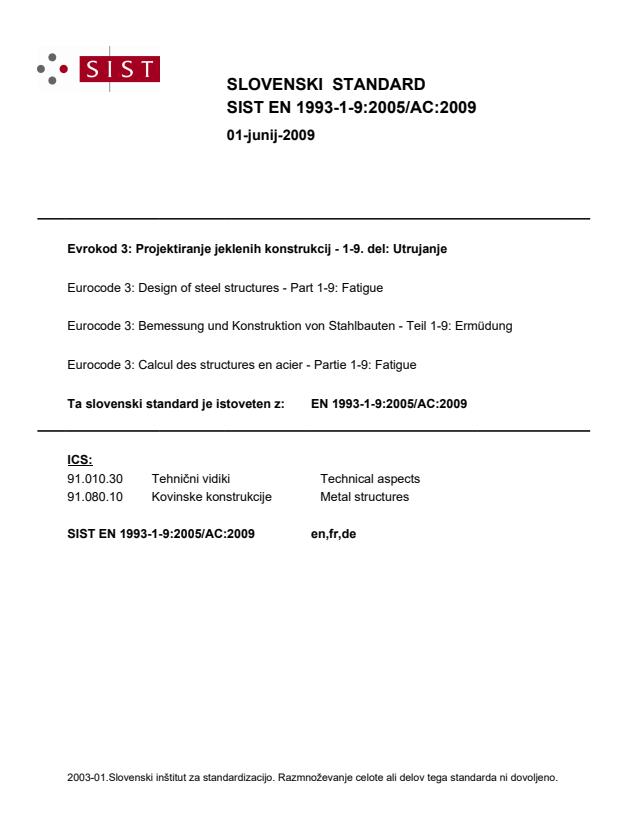
2003-01.Slovenski inštitut za standardizacijo. Razmnoževanje celote ali delov tega standarda ni dovoljeno.Evrokod 3: Projektiranje jeklenih konstrukcij - 1-9. del: UtrujanjeEurocode 3: Bemessung und Konstruktion von Stahlbauten - Teil 1-9: ErmüdungEurocode 3: Calcul des structures en acier - Partie 1-9: FatigueEurocode 3: Design of steel structures - Part 1-9: Fatigue91.080.10Kovinske konstrukcijeMetal structures91.010.30Technical aspectsICS:Ta slovenski standard je istoveten z:EN 1993-1-9:2005/AC:2009SIST EN 1993-1-9:2005/AC:2009en,fr,de01-junij-2009SIST EN 1993-1-9:2005/AC:2009SLOVENSKI
STANDARD
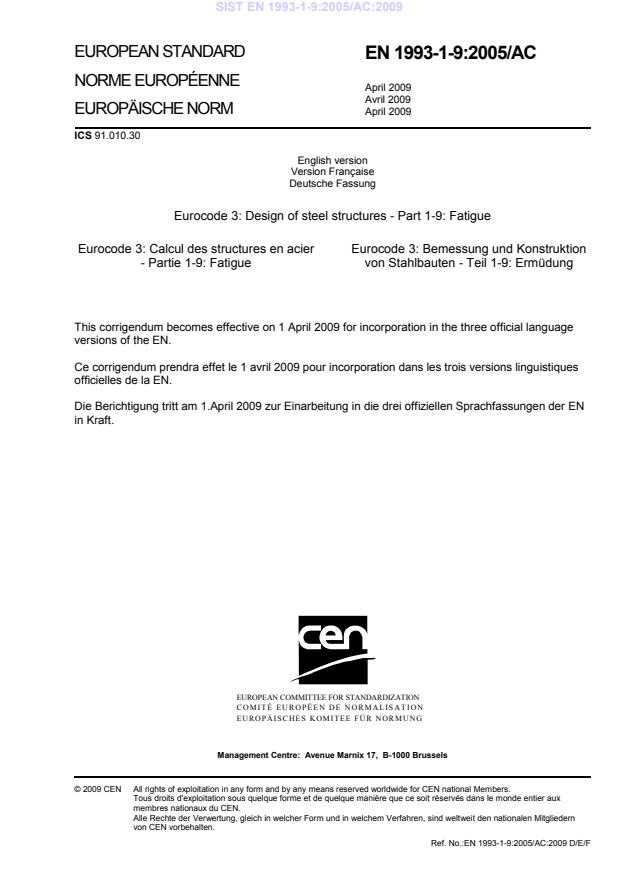
EUROPEAN STANDARD NORME EUROPÉENNE EUROPÄISCHE NORM
EN 1993-1-9:2005/AC
April 2009
Avril 2009
April 2009 ICS 91.010.30 English version Version Française Deutsche Fassung
Eurocode 3: Design of steel structures - Part 1-9: Fatigue
Eurocode 3: Calcul des structures en acier - Partie 1-9: Fatigue
Eurocode 3: Bemessung und Konstruktion von Stahlbauten - Teil 1-9: Ermüdung This corrigendum becomes effective on 1 April 2009 for incorporation in the three official language versions of the EN.
Ce corrigendum prendra effet le 1 avril 2009 pour incorporation dans les trois versions linguistiques officielles de la EN.
Die Berichtigung tritt am 1.April 2009 zur Einarbeitung in die drei offiziellen Sprachfassungen der EN in Kraft.
EUROPEAN COMMITTEE FOR STANDARDIZATION
COMITÉ EUROPÉEN DE NORMALISATION EUROPÄISCHES KOMITEE FÜR NORMUNG
Management Centre:
Avenue Marnix 17,
B-1000 Brussels © 2009 CEN All rights of exploitation in any form and by any means reserved worldwide for CEN national Members. Tous droits d'exploitation sous quelque forme et de quelque manière que ce soit réservés dans le monde entier aux membres nationaux du CEN. Alle Rechte der Verwertung, gleich in welcher Form und in welchem Verfahren, sind weltweit den nationalen Mitgliedern von CEN vorbehalten. Ref. No.:EN 1993-1-9:2005/AC:2009 D/E/FSIST EN 1993-1-9:2005/AC:2009

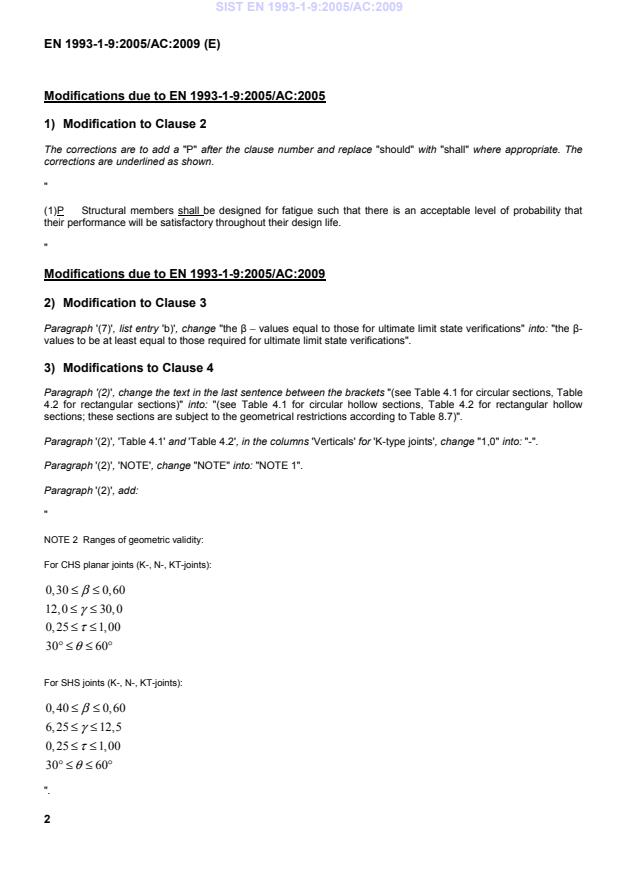
" (1)P Structural members shall be designed for fatigue such that there is an acceptable level of probability that their performance will be satisfactory throughout their design life. " Modifications due to EN 1993-1-9:2005/AC:2009 2) Modification to Clause 3 Paragraph '(7)', list entry 'b)', change "the
– values equal to those for ultimate limit state verifications" into: "the -values to be at least equal to those required for ultimate limit state verifications". 3) Modifications to Clause 4 Paragraph '(2)', change the text in the last sentence between the brackets "(see Table 4.1 for circular sections, Table 4.2 for rectangular sections)" into: "(see Table 4.1 for circular hollow sections, Table 4.2 for rectangular hollow sections; these sections are subject to the geometrical restrictions ac
...

Questions, Comments and Discussion

Ask us and Technical Secretary will try to provide an answer. You can facilitate discussion about the standard in here.

Loading comments...

La norme SIST EN 1993-1-9:2005/AC:2009 se positionne comme un élément fondamental dans la conception des structures en acier, en particulier en ce qui concerne l'analyse de la fatigue. Son domaine d'application est défini par les modifications apportées aux articles 2, 3, 4, 5, 8 et à la sous-clause 7.1, intégrant ainsi les mises à jour de la norme EN 1993-1-9:2005/AC:2005. Cela témoigne de l'effort continu pour ajuster et affiner les directives afin de répondre aux exigences contemporaines du secteur. Parmi les forces de cette norme, on note une approche systématique pour évaluer la résistance à la fatigue des structures en acier, prenant en compte divers facteurs tels que les charges répétitives et les conditions environnementales. Cette prise en compte des différents paramètres assure que les ingénieurs peuvent concevoir des structures non seulement efficaces mais aussi durables. La clarté et la précision des clauses fournies permettent une application directe et sans ambiguïté dans des projets concrets. La pertinence de la norme EN 1993-1-9:2005/AC:2009 ne saurait être sous-estimée dans le contexte actuel de construction, où les préoccupations en matière de sécurité structurelle et de durabilité sont primordiales. En intégrant des modifications basées sur des retours d'expérience et des avancées techniques, elle offre un cadre robuste pour faire face aux défis futurs de l'ingénierie. En somme, cette norme se distingue par sa méthodologie accessible et sa mise à jour continue, rendant ainsi sa démarche rigoureuse et applicable face aux exigences de conception modernes pour les structures en acier.

Die Norm EN 1993-1-9:2005/AC:2009, auch bekannt als Eurocode 3, befasst sich mit dem Entwurf von Stahlbauwerken, speziell im Hinblick auf Ermüdung. Der Bereich dieser Norm ist essenziell für die Festlegung stabiler und langlebiger Stahlkonstruktionen. Durch die Modifikationen der Paragraphen 2, 3, 4, 5, 8 und des Unterparagraphs 7.1 wird eine präzise und aktualisierte Grundlage für Ingenieure und Konstrukteure geschaffen. Ein hervorstechendes Merkmal dieser Norm ist ihre Fokussierung auf die theoretischen und praktischen Aspekte der Ermüdung von Stahlkonstruktionen. Die Norm behandelt die zentralen Parameter und Belastungen, die im Lebenszyklus von Stahlstrukturen auftreten können, und bietet relevante Berechnungsansätze. Dadurch unterstützt sie die Ingenieure dabei, die Lebensdauer von Bauwerken zu maximieren und potenzielle Ermüdungsrisse frühzeitig zu identifizieren. Ein weiterer Vorteil dieser Norm ist ihre Flexibilität und Anpassungsfähigkeit an verschiedene Anwendungsbereiche innerhalb der Stahlbauindustrie. Die Norm fördert eine einheitliche und systematische Herangehensweise an das Design und integriert die neuesten wissenschaftlichen Erkenntnisse und technische Entwicklungen in den Entwurfsprozess. Die Relevanz der EN 1993-1-9:2005/AC:2009 kann nicht hoch genug eingeschätzt werden, da sie nicht nur die Sicherheit und Langlebigkeit von Stahlkonstruktionen gewährleistet, sondern auch beiträgt, die Standards der Branche global zu harmonisieren. In Zeiten zunehmender Anforderungen an Wirtschaftlichkeit und Nachhaltigkeit stellt diese Norm einen unverzichtbaren Leitfaden dar, der den Ingenieuren ermöglicht, innovative und effiziente Lösungen zu entwickeln. Insgesamt bietet die Norm EN 1993-1-9:2005/AC:2009 eine robuste Grundlage für den Entwurf von Stahlkonstruktionen und hebt sich durch ihre detaillierte Analyse zu Ermüdungsverhalten und -prognosen hervor. Sie ist sowohl für die Ausbildung als auch für die praktische Anwendung in der Stahlbauindustrie von großer Bedeutung.

표준 문서 SIST EN 1993-1-9:2005/AC:2009는 Eurocode 3의 일환으로 철강 구조물 설계에 관한 부분 1-9를 다루고 있으며, 주로 피로로 인한 영향을 분석하고 평가하는 데 중점을 두고 있습니다. 이 표준은 TC의 수정을 포함하여 조항 2, 3, 4, 5, 8 및 서브클라우스 7.1에 대한 수정을 명시하고 있습니다. 이 표준의 가장 큰 강점은 피로가 구조물의 내구성에 미치는 영향을 체계적으로 다룬다는 점입니다. 철강 구조물은 다양한 하중에 노출되므로, 이 표준은 이러한 하중에 대한 피로 저항력을 고려하여 설계 기준을 제공함으로써 구조물의 안전성을 높이는 데 기여합니다. 또한, 이 문서는 수정된 조항을 통해 최신 기술과 연구 결과를 반영하여 사용자에게 실용적인 가이드라인을 제시합니다. SIST EN 1993-1-9:2005/AC:2009는 유럽 전역에서 널리 사용되며, 국제 표준에 부합하는 설계 기준을 제공하여 엔지니어들이 유사한 기준으로 작업할 수 있도록 돕습니다. 이로 인해, 표준의 적용은 다양한 프로젝트에서 통일성을 유지하고, 품질을 보장하는 데 매우 중요합니다. 또한, 문서가 XML 형식으로 준비되어 있다는 점은 최신 기술 환경에 발맞춘 자료 제공 방식을 시사합니다. 이는 데이터 접근성을 높이고, 사용자들이 필요한 정보를 쉽고 빠르게 찾을 수 있도록 도와줍니다. 이 표준은 그 자체로도 중요하지만, 건축 및 토목 공학 분야에서 피로 관련 설계의 중요성을 인식하고, 이를 통해 구조물의 신뢰성과 안전성을 높이는 데 기여합니다. 이러한 이유로 SIST EN 1993-1-9:2005/AC:2009는 현대 건설 산업에서 필수적인 문서로 자리 잡고 있습니다.

SIST EN 1993-1-9:2005/AC:2009は、鉄鋼構造の設計における疲労に特化した標準であり、主にEN 1993-1-9:2005の修正が含まれています。この標準は、特に第2、3、4、5、8条および第7.1項の修正に焦点を当てており、建物や橋梁などの鋼構造物の疲労抵抗を確保するための基準を示しています。 この標準の強みは、鋼構造設計における疲労分析の重要性を強調し、実務での応用を促進する点にあります。さまざまな荷重条件や使用状況に対する適切な評価方法が示されており、設計者がその理論を具体的な設計に落とし込む手助けをしています。特に、疲労性能に関する指針が明確であり、構造物が長寿命であるための基盤を提供します。 さらに、ユーザビリティにおいても、標準文書は導入が容易であり、さまざまな工学的背景を持つ設計者にとって理解しやすい構成となっています。このように、SIST EN 1993-1-9:2005/AC:2009は、鋼構造の耐久性を向上させるための信頼性の高い基準といえます。また、業界の最新の動向や要求事項にも対応しており、現代の鋼構造設計において不可欠なリソースとなっています。

The EN 1993-1-9:2005/AC:2009 standard, part of Eurocode 3, focuses on the design of steel structures with a particular emphasis on fatigue. This standard is integral for engineers and designers who are involved in the structural integrity of steel constructions, providing essential guidelines on fatigue assessment to ensure safety and reliability throughout the service life of structures. The scope of EN 1993-1-9 encompasses modifications to key clauses, specifically Clauses 2, 3, 4, 5, 8, and Subclause 7.1, alongside updates based on EN 1993-1-9:2005/AC:2005. These modifications are crucial as they reflect advancements in structural design practices and incorporate lessons learned from practical applications and international feedback. As such, the standard remains relevant in addressing contemporary challenges faced in steel structure design and fatigue analysis. One of the notable strengths of this standard is its comprehensive coverage of fatigue design considerations. It provides detailed methodologies for the assessment of fatigue life, enabling designers to effectively anticipate and mitigate the risk of fatigue failure in steel structures. Additionally, the standard aligns with global best practices, making it a reliable resource for professionals working on international projects where compliance with robust engineering practices is paramount. Furthermore, the emphasis on standardization helps streamline the design process, facilitating communication and understanding among engineers, architects, and contractors. This harmonization is particularly beneficial in the increasingly interconnected construction industry, where diverse teams collaborate on projects across various jurisdictions. In summary, EN 1993-1-9:2005/AC:2009 excels in offering a clear framework for addressing fatigue-related concerns in steel structures. Its thorough scope and modernized approach ensure that it remains a vital tool for engineers seeking to enhance the longevity and safety of their designs, while staying aligned with the latest global standards and practices in structural engineering.