

EN 15649-5:2009
(Main)Floating leisure articles for use on and in the water - Part 5: Additional specific safety requirements and test methods for Class C devices
- Abstract
This European Standard is applicable for CLASS C classified floating leisure articles for use on or in water according to EN 15649-1 regardless of whether the buoyancy is achieved by inflation or inherent buoyant ma-terial.
This document (EN 15649-5) is applicable with EN 15649-1 and EN 15649-2.
NOTE 1 Typical products forming class C:
- tube riders with interior holding facility and closed cockpit;
- raft riders;
- board riders;
- banana riders.
NOTE 2 Typical places for application:
- distant from bathing areas and other frequented water surfaces, wide empty spaces, dedicated racetracks (par-cours);
- no to little waves;
- no strong currents.
- Status
- Withdrawn
- Publication Date
- 10-Nov-2009
- Withdrawal Date
- 06-Oct-2026
- Technical Committee
- CEN/TC 136 - Sports, playground and other recreational equipment
- Drafting Committee
- CEN/TC 136/WG 13 - Floating leisure articles for use on water
- Current Stage
- 9960 - Withdrawal effective - Withdrawal
- Start Date
- 11-Oct-2017
- Completion Date
- 07-Oct-2026
- Directive
- 2001/95/EC - General product safetyOJ Ref: C, C 254 OJ Date: 04-Sep-2013


Relations
- Effective Date
- 18-Oct-2017
- Effective Date
- 28-Jan-2026
- Effective Date
- 28-Jan-2026
- Effective Date
- 28-Jan-2026
- Effective Date
- 28-Jan-2026
Frequently Asked Questions
EN 15649-5:2009 is a standard published by the European Committee for Standardization (CEN). Its full title is "Floating leisure articles for use on and in the water - Part 5: Additional specific safety requirements and test methods for Class C devices". This standard covers: This European Standard is applicable for CLASS C classified floating leisure articles for use on or in water according to EN 15649-1 regardless of whether the buoyancy is achieved by inflation or inherent buoyant ma-terial. This document (EN 15649-5) is applicable with EN 15649-1 and EN 15649-2. NOTE 1 Typical products forming class C: - tube riders with interior holding facility and closed cockpit; - raft riders; - board riders; - banana riders. NOTE 2 Typical places for application: - distant from bathing areas and other frequented water surfaces, wide empty spaces, dedicated racetracks (par-cours); - no to little waves; - no strong currents.
This European Standard is applicable for CLASS C classified floating leisure articles for use on or in water according to EN 15649-1 regardless of whether the buoyancy is achieved by inflation or inherent buoyant ma-terial. This document (EN 15649-5) is applicable with EN 15649-1 and EN 15649-2. NOTE 1 Typical products forming class C: - tube riders with interior holding facility and closed cockpit; - raft riders; - board riders; - banana riders. NOTE 2 Typical places for application: - distant from bathing areas and other frequented water surfaces, wide empty spaces, dedicated racetracks (par-cours); - no to little waves; - no strong currents.
EN 15649-5:2009 is classified under the following ICS (International Classification for Standards) categories: 97.200.50 - Toys. The ICS classification helps identify the subject area and facilitates finding related standards.
EN 15649-5:2009 has the following relationships with other standards: It is inter standard links to EN ISO 25649-5:2017, EN 15649-1:2009, EN ISO 25649-2:2024, EN ISO 6185-1:2001, EN ISO 12402-1:2005. Understanding these relationships helps ensure you are using the most current and applicable version of the standard.
EN 15649-5:2009 is associated with the following European legislation: EU Directives/Regulations: 2001/95/EC; Standardization Mandates: M/372. When a standard is cited in the Official Journal of the European Union, products manufactured in conformity with it benefit from a presumption of conformity with the essential requirements of the corresponding EU directive or regulation.
EN 15649-5:2009 is available in PDF format for immediate download after purchase. The document can be added to your cart and obtained through the secure checkout process. Digital delivery ensures instant access to the complete standard document.
Standards Content (Sample)
2003-01.Slovenski inštitut za standardizacijo. Razmnoževanje celote ali delov tega standarda ni dovoljeno.&Schwimmende Freizeitartikel zum Gebrauch auf und im Wasser - Teil 5: Zusätzliche spezifische sicherheitstechnische Anforderungen und Prüfverfahren für Klasse C-GeräteArticles de loisirs flottants a utiliser sur ou dans l'eau - Partie 5: Exigences de sécurité et méthodes d'essai complémentaires propres aux dispositifs de classe CFloating leisure articles for use on and in the water - Part 5: Additional specific safety requirements and test methods for Class C devices97.220.40Oprema za športe na prostem in vodne športeOutdoor and water sports equipmentICS:Ta slovenski standard je istoveten z:EN 15649-5:2009SIST EN 15649-5:2010en,fr,de01-februar-2010SIST EN 15649-5:2010SLOVENSKI
STANDARD
EUROPEAN STANDARD NORME EUROPÉENNE EUROPÄISCHE NORM
EN 15649-5
November 2009 ICS 97.200.50 English Version
Floating leisure articles for use on and in the water - Part 5: Additional specific safety requirements and test methods for Class C devices
Articles de loisirs flottants à utiliser sur ou dans l'eau - Partie 5 : Exigences de sécurité et méthodes d'essai complémentaires propres aux dispositifs de Classe C
Schwimmende Freizeitartikel zum Gebrauch auf und im Wasser - Teil 5: Zusätzliche besondere sicherheitstechnische Anforderungen und Prüfverfahren für Artikel der Klasse C This European Standard was approved by CEN on 11 September 2009.
CEN members are bound to comply with the CEN/CENELEC Internal Regulations which stipulate the conditions for giving this European Standard the status of a national standard without any alteration. Up-to-date lists and bibliographical references concerning such national standards may be obtained on application to the CEN Management Centre or to any CEN member.
This European Standard exists in three official versions (English, French, German). A version in any other language made by translation under the responsibility of a CEN member into its own language and notified to the CEN Management Centre has the same status as the official versions.
CEN members are the national standards bodies of Austria, Belgium, Bulgaria, Cyprus, Czech Republic, Denmark, Estonia, Finland, France, Germany, Greece, Hungary, Iceland, Ireland, Italy, Latvia, Lithuania, Luxembourg, Malta, Netherlands, Norway, Poland, Portugal, Romania, Slovakia, Slovenia, Spain, Sweden, Switzerland and United Kingdom.
EUROPEAN COMMITTEE FOR STANDARDIZATION
COMITÉ EUROPÉEN DE NORMALISATION EUROPÄISCHES KOMITEE FÜR NORMUNG
Management Centre:
Avenue Marnix 17,
B-1000 Brussels © 2009 CEN All rights of exploitation in any form and by any means reserved worldwide for CEN national Members. Ref. No. EN 15649-5:2009: ESIST EN 15649-5:2010
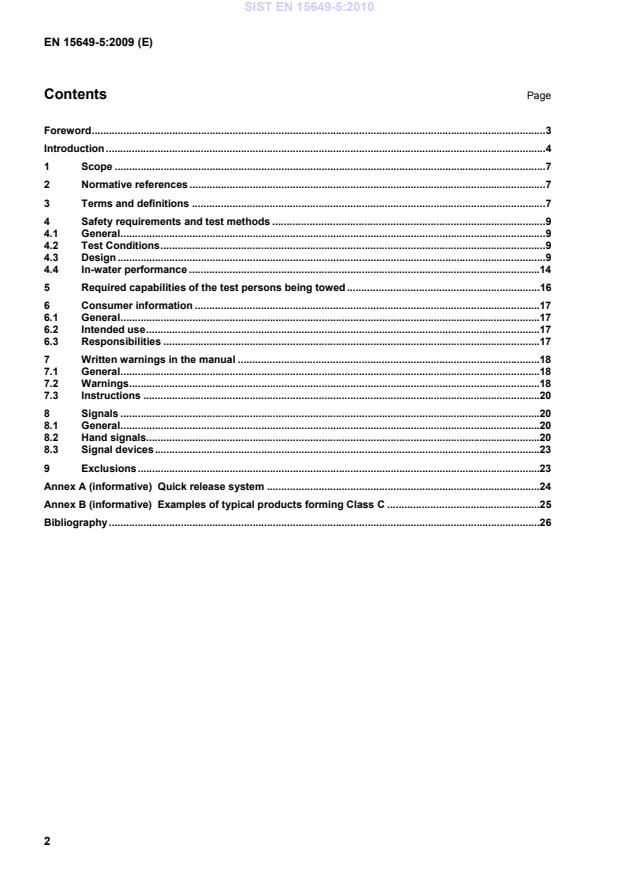
Quick release system .24Annex B (informative)
Examples of typical products forming Class C .25Bibliography .26 SIST EN 15649-5:2010
This European Standard is one of a series consisting of seven standards dealing with floating leisure articles for use on and in the water.
Compliance of a product to this standard requires that the requirements of the relevant specific part and,
additionally, the requirements of EN 15649-1 and EN 15649-2 have to be met. If a product includes multiple use related to several classes, it has to meet the requirements of all these classes. Annex A and Annex B are informative.
According to the CEN/CENELEC Internal Regulations, the national standards organizations of the following countries are bound to implement this European Standard: Austria, Belgium, Bulgaria, Cyprus, Czech Repub-lic, Denmark, Estonia, Finland, France, Germany, Greece, Hungary, Iceland, Ireland, Italy, Latvia, Lithuania, Luxembourg, Malta, Netherlands, Norway, Poland, Portugal, Romania, Slovakia, Slovenia, Spain, Sweden, Switzerland and United Kingdom. SIST EN 15649-5:2010
products Place of
usage Function; range of usage; target / age
group Type of movement / propulsion Position of user in regard to the
equipment,
elevation above
water Predictable misuse Partial risk related to water environment Final risk Protection aims standard / regula-tion C tube riders with interior holding facility and closed cockpit; raft riders; board riders;
banana riders (all to be towed by
motor boats) sea shore / close to shore; lakes, rivers; large space for
action is needed adolescents; adults; children accompanied by adults (minimum age group)
high speed
movement; devices towed by motor boats; other means of
propulsion
users are sitting on or inside the device; elevation from water level about maximum 60 cm sitting height; kneeling, lying;
standing
use by non-swimmers; no use of PFD;
excessive speed; improper load distribution/
seating position; close vicinity to other users; overload;
inadmissible
number of
passengers collision of persons in the case of capsizing; fall from the device; device turning; catapulting out of the device; impact through device; nose dipping; sudden stop; crash down of kite type towables;
rupture of the towing rope; entrapment/
entanglement; nose dive; use of rumps
D R OWN I N G age limits; warning notes; quick
release; gripping; escape in case of danger; residual buoyancy; use of PFD; length, strength and elasticity of rope; reliability of quick release, user qualifications and capabilities SIST EN 15649-5:2010
NOTE 1 Typical products forming class C: tube riders towable with interior holding facility and closed cockpit; raft riders towable; board riders towable; banana type towable. NOTE 2 Typical places for application: distant from bathing areas and other frequented water surfaces, wide empty spaces, dedicated racetracks (parcours); no to little waves; no strong currents. 2 Normative references The following referenced documents are indispensable for the application of this document. For dated refer-ences, only the edition cited applies. For undated references, the latest edition of the referenced document (including any amendments) applies. EN 15649-1:2009, Floating leisure articles for use on and in the water — Part 1: Classification, materials, general requirements and test methods EN 15649-2, Floating leisure articles for use on or in the water — Part 2: Consumer information EN ISO 6185-1:2001, Inflatable boats — Part 1: Boats with a maximum motor power rating of 4,5 kW
(ISO 6185-1:2001) EN ISO 12402-1:2005, Personal flotation devices — Part 1: Lifejackets for seagoing ships — Safety require-ments (ISO 12402-1:2005) 3 Terms and definitions For the purposes of this document, the terms and definitions given in EN 15649-1:2009 and the following ap-ply. 3.1 residual buoyancy provision of remaining buoyancy in case of a defect of any buoyancy chamber SIST EN 15649-5:2010
application at high speed application in which the floating device is towed rapidly through external means of propulsion (motor boat, towing installation, etc.) 3.4 means to assist re-embarkation means which helps the user to climb back on board of the floatable device from an in-water position regardless whether the buoyant structure is fully inflated or any air chamber is deflated 3.5 towable floating leisure article (inflatable or inherently buoyant) for dynamic use towed by mechanical means 3.6 rider user of the towable positioned on the towed device 3.7 water craft driver/operator person having the responsibility for the towed and the towing device (watercraft or towing device) 3.8 observer additional person observing the towed device in permanent eye contact 3.9 tow rope connection between towing device and the towable 3.10 towing streamer signalisation flag attached to the rear of the towing device according to national rules 3.11 quick release system means to release the towable from the tow rope manually or automatically in case of an emergency by trigger-ing a release mechanism 3.12 available area area on or inside a floating article which can be used unrestrictedly for user accommodation when taking the intended posture(s)
1 in accordance with intended use. SIST EN 15649-5:2010
EN 15649-1:2009, A.1.2 fits in to the available area. 4.3.3.1.2 Test method Apply seat template as specified in EN 15649-1:2009, A.1.
Check whether this template can be placed into the interior sitting area without the need to bend or fold it.
4.3.3.2 C1 bikes, bananas, etc. (user sitting in row on the product) 4.3.3.2.1 Requirements C1 devices providing the available seat area in row shall have a seat length of 60 cm per person. If the device implies sitting in line of more than one user, the sitting space for each user shall have at least a length of: child = 50 cm if the thighs follow the seat surface.
adult = 70 cm if the thighs follow the seat surface. 4.3.3.2.2 Test method Apply seat template as specified in EN 15649-1:2009, A.1.
Check whether this template can be placed into the interior sitting area without the need to bend or fold it. 4.3.4 C2 and C3 devices, space per person C2 and C3 devices are used in a much more divert manner. There are no requirements with regard to mini-mum available areas for these categories.
4.3.5.2 Test methods Visual inspection and measurement. For measuring strength of handles, apply the test method as given in EN ISO 6185-1:2001, 6.7.2. The pulling force shall be at least 1 kN. 4.3.6 Buoyancy and load capacity 4.3.6.1 Requirements During the practical test it shall be proven that the device provides sufficient buoyancy to meet all in-water per-formance test also with the maximum number of admissible persons. 4.3.6.2 Test methods See practical test in 4.4. 4.3.7 Residual buoyancy 4.3.7.1 Requirements All floating class C devices shall provide residual buoyancy after failure of the air chamber most likely to cause failure. The amount of residual buoyancy shall be not less than 60 N per admissible person. During the practi-cal in-water tests, it shall be proven that each admissible person can get hold to the remaining structure (de-tails see 4.4). 4.3.7.2 Test method Open one valve to deflate the chamber most likely to fail and measure both volumes and compare the values before and after. 4.3.8 Foot, leg and torso entrapment 4.3.8.1 General Requirements and test procedure
...