


EN 3475-410:2002
(Main)Aerospace series - Cables, electrical, aircraft use - Test methods - Part 410: Thermal endurance
Aerospace series - Cables, electrical, aircraft use - Test methods - Part 410: Thermal endurance
This standard specifies a method of measuring the thermal endurance of a finished cable.
It shall be used together with EN 3475-100 and ASTM-D-3032-86 paragraph 14 - Thermal endurance.
Luft- und Raumfahrt - Elektrische Leitungen für Luftahrtverwendung - Prüfverfahren - Teil 410: Thermische Gebrauchsdauer
Diese Norm legt ein Verfahren zur Prüfung der thermischen Gebrauchsdauer einer fertigen Leitung fest.
Sie ist in Verbindung mit EN 3475-100 und ASTM-D-3032-86, Abschnitt 14 - Thermische Gebrauchsdauer - anzuwenden.
Série aérospatiale - Câbles électriques à usage aéronautique - Méthodes d'essai - Partie 410: Endurance thermique
Cette norme définit une méthode d'essai d'endurance thermique d'un câble terminé.
Elle doit être utilisée conjointement avec EN 3475-100 et ASTM-D-3032-86 paragraphe 14 - Endurance thermique.
Aerospace series - Cables, electrical, aircraft use - Test methods - Part 410: Thermal endurance
General Information
- Status
- Published
- Publication Date
- 15-Jan-2002
- Withdrawal Date
- 30-Jul-2002
- Technical Committee
- ASD-STAN - Aerospace
- Drafting Committee
- ASD-STAN/D 2 - Electrical
- Current Stage
- 9093 - Decision to confirm - Review Enquiry
- Start Date
- 30-Jun-2017
- Completion Date
- 11-Feb-2026
Relations
- Effective Date
- 28-Jan-2026
- Effective Date
- 28-Jan-2026
- Effective Date
- 28-Jan-2026
- Effective Date
- 28-Jan-2026
- Effective Date
- 28-Jan-2026
- Referred By
EN 2234:2018 - Aerospace series - Cable, electrical, fire resistant - Technical specification - Effective Date
- 28-Jan-2026
- Effective Date
- 28-Jan-2026
- Effective Date
- 28-Jan-2026
- Effective Date
- 28-Jan-2026
- Effective Date
- 28-Jan-2026
- Effective Date
- 28-Jan-2026
- Effective Date
- 28-Jan-2026
- Effective Date
- 28-Jan-2026
- Effective Date
- 28-Jan-2026
- Effective Date
- 28-Jan-2026
Overview
EN 3475-410:2002 is a European Standard developed by CEN for the aerospace industry, specifically focusing on electrical cables used in aircraft. Titled "Aerospace series - Cables, electrical, aircraft use - Test methods - Part 410: Thermal endurance," this standard outlines test methods to determine the thermal endurance of finished electrical cables. Ensuring the reliability and safety of electrical systems in aerospace applications, EN 3475-410 is essential for manufacturers, suppliers, and regulators involved with aerospace cables.
Key Topics
- Thermal Endurance Test: The central focus of EN 3475-410 is the specification of a standardized method to measure how well finished aerospace cables withstand prolonged exposure to high temperatures.
- Reference Standards: Use of EN 3475-100 and ASTM-D-3032-86 (paragraph 14 on thermal endurance) is required for the complete test process, ensuring alignment with both European and international protocols.
- Product Lifetime and Temperature: The standard provides for the determination and reporting of cable lifetime and endurance temperatures as specified in corresponding product standards.
- Standardization Objectives: By providing a consistent testing methodology, EN 3475-410 helps ensure the comparability, reliability, and safety of aerospace cables across different manufacturers and national markets.
Applications
EN 3475-410 is relevant to a variety of industry professionals and organizations, including:
- Aerospace Cable Manufacturers: To certify new cable products for aircraft using recognized and standardized test methods for thermal endurance.
- Quality Assurance and Testing Laboratories: For performing compliance testing to verify cables meet the specified thermal endurance requirements.
- Aircraft OEMs and Suppliers: To ensure that electrical systems utilize cables tested for performance in demanding operational conditions.
- Regulatory Authorities and Auditors: To reference standardized testing in compliance reviews and safety assessments.
- Aircraft Maintenance and Repair: To qualify replacement cables for use in existing assemblies based on proven thermal performance.
This standard’s role in establishing a harmonized approach ensures that all stakeholders can depend on consistent cable performance when subjected to thermal stress, which is critical for maintaining safety and reliability in modern aircraft electrical systems.
Related Standards
EN 3475-410 operates within a broader framework of international and European aerospace standards:
- EN 3475-100: Aerospace series – Cables, electrical, aircraft use – Test methods – Part 100: General. This is the base document specifying general principles of cable testing within the EN 3475 series.
- ASTM-D-3032-86: Standard Test Methods for Hook-Up Wire Insulation, particularly paragraph 14, which is referenced for the thermal endurance test method.
- Other EN 3475 Parts: Cover various specialized test methods for aerospace electrical cables, such as mechanical, chemical, and electrical properties.
- ICS 49.060: This International Classification for Standards segment pertains to aerospace electric equipment and systems, providing context for EN 3475-410’s role within aerospace component testing.
Practical Value
The adoption and use of EN 3475-410:2002 in the aerospace sector:
- Enhances cable reliability by verifying thermal endurance.
- Fosters innovation as manufacturers improve cable materials and constructions to meet standardized requirements.
- Reduces incidents related to electrical failure in aircraft due to inadequate cable thermal performance.
- Simplifies regulatory approval and market access across European and international regions.
EN 3475-410:2002 is a key reference for ensuring aerospace cables deliver consistent performance, safety, and durability throughout their operational life.

Get Certified
Connect with accredited certification bodies for this standard

BUREAU VERITAS Certification Germany
Bureau Veritas certification in Germany.

Element Materials Technology
Materials testing and product certification.

AQMS Ltd.
AQMS provides ISO certification to SMEs across the UK.
Sponsored listings
Frequently Asked Questions
EN 3475-410:2002 is a standard published by the European Committee for Standardization (CEN). Its full title is "Aerospace series - Cables, electrical, aircraft use - Test methods - Part 410: Thermal endurance". This standard covers: This standard specifies a method of measuring the thermal endurance of a finished cable. It shall be used together with EN 3475-100 and ASTM-D-3032-86 paragraph 14 - Thermal endurance.
This standard specifies a method of measuring the thermal endurance of a finished cable. It shall be used together with EN 3475-100 and ASTM-D-3032-86 paragraph 14 - Thermal endurance.
EN 3475-410:2002 is classified under the following ICS (International Classification for Standards) categories: 49.060 - Aerospace electric equipment and systems. The ICS classification helps identify the subject area and facilitates finding related standards.
EN 3475-410:2002 has the following relationships with other standards: It is inter standard links to EN 3475-100:2010, EN 2713-004:2006, EN 4612-002:2019, EN 4611-007:2018, EN 4611-003:2018, EN 2234:2018, EN 2267-012:2015, EN 2267-005:2006, EN 2854-003:2021, EN 4604-003:2019, EN 4612-011:2011, EN 4612-008:2011, EN 4604-007:2019, EN 2714-006:2006, EN 3375-012:2013. Understanding these relationships helps ensure you are using the most current and applicable version of the standard.
EN 3475-410:2002 is available in PDF format for immediate download after purchase. The document can be added to your cart and obtained through the secure checkout process. Digital delivery ensures instant access to the complete standard document.
Standards Content (Sample)
2003-01.Slovenski inštitut za standardizacijo. Razmnoževanje celote ali delov tega standarda ni dovoljeno.Aerospace series - Cables, electrical, aircraft use - Test methods - Part 410: Thermal enduranceLuft- und Raumfahrt - Elektrische Leitungen für Luftfahrt, Verwendung - Prüfverfahren - Teil 410: Thermische GebrauchsdauerSérie aérospatiale - Câbles électriques a usage aéronautique - Méthodes d'essai - Partie 410: Endurance thermiqueAerospace series - Cables, electrical, aircraft use - Test methods - Part 410: Thermal endurance49.060Aerospace electric equipment and systemsICS:Ta slovenski standard je istoveten z:EN 3475-410:2002SIST EN 3475-410:2004en01-maj-2004SIST EN 3475-410:2004SLOVENSKI
STANDARD
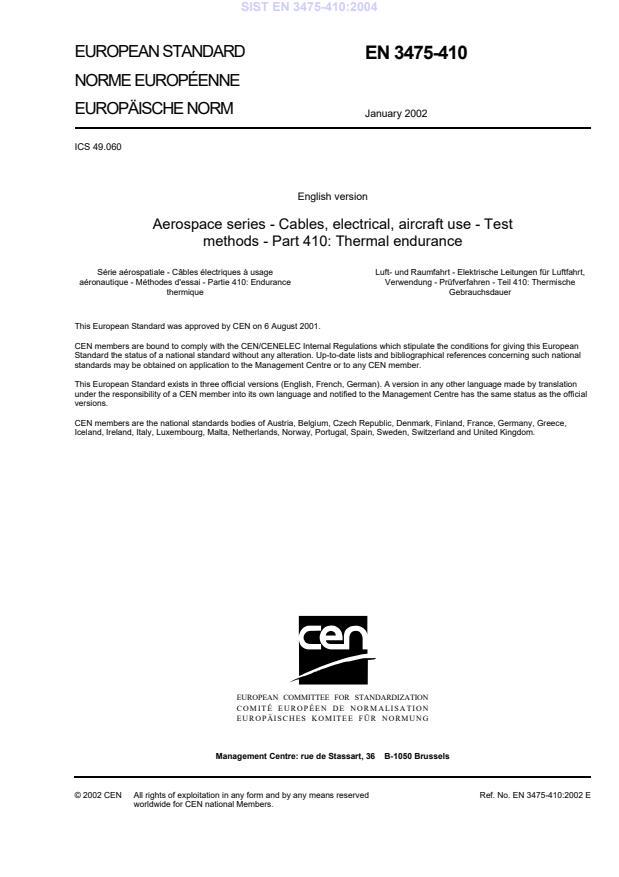
EUROPEAN STANDARDNORME EUROPÉENNEEUROPÄISCHE NORMEN 3475-410January 2002ICS 49.060English versionAerospace series - Cables, electrical, aircraft use - Testmethods - Part 410: Thermal enduranceSérie aérospatiale - Câbles électriques à usageaéronautique - Méthodes d'essai - Partie 410: EndurancethermiqueLuft- und Raumfahrt - Elektrische Leitungen für Luftfahrt,Verwendung - Prüfverfahren - Teil 410: ThermischeGebrauchsdauerThis European Standard was approved by CEN on 6 August 2001.CEN members are bound to comply with the CEN/CENELEC Internal Regulations which stipulate the conditions for giving this EuropeanStandard the status of a national standard without any alteration. Up-to-date lists and bibliographical references concerning such nationalstandards may be obtained on application to the Management Centre or to any CEN member.This European Standard exists in three official versions (English, French, German). A version in any other language made by translationunder the responsibility of a CEN member into its own language and notified to the Management Centre has the same status as the officialversions.CEN members are the national standards bodies of Austria, Belgium, Czech Republic, Denmark, Finland, France, Germany, Greece,Iceland, Ireland, Italy, Luxembourg, Malta, Netherlands, Norway, Portugal, Spain, Sweden, Switzerland and United Kingdom.EUROPEAN COMMITTEE FOR STANDARDIZATIONCOMITÉ EUROPÉEN DE NORMALISATIONEUROPÄISCHES KOMITEE FÜR NORMUNGManagement Centre: rue de Stassart, 36
B-1050 Brussels© 2002 CENAll rights of exploita
...
Questions, Comments and Discussion
Ask us and Technical Secretary will try to provide an answer. You can facilitate discussion about the standard in here.
Loading comments...