

EN 13263-1:2005
(Main)Silica fume for concrete - Part 1: Definitions, requirements and conformity criteria
- Abstract
This European Standard applies to the silica fume which is a by-product of the smelting process used to produce silicon metal and ferro-silicon alloys.
This part of EN 13263 gives requirements for chemical and physical properties for silica fume to be used as a type II addition in concrete conforming to EN 206-1, or in mortars, grouts and other mixes. This part of EN 13263 also states conformity criteria and related rules.
EN 13263 does not give rules for the use of silica fume in concrete. Some rules are given in EN 206 1.
NOTE 1 Supplementary rules related to the use of silica fume in concrete may be given in non conflicting national standards for concrete.
NOTE 2 EN 206-1 (5.2.5.1 in the 2000 edition) provides conditions for national acceptance of silica fumes coming from calcium silicon alloys production or other silica fumes, not conforming completely to EN 13263, as type II additions for use in concrete.
- Status
- Withdrawn
- Publication Date
- 28-Jun-2005
- Withdrawal Date
- 10-Mar-2009
- Technical Committee
- CEN/TC 104 - Concrete ( performance, production, placing and compliance criteria )
- Drafting Committee
- CEN/TC 104/WG 9 - Silica fume for concrete
- Current Stage
- 9960 - Withdrawal effective - Withdrawal
- Start Date
- 11-Mar-2009
- Completion Date
- 11-Mar-2009
89/106/EEC - Construction productsOJ Ref: C, C 319 OJ Date: 14-Dec-2005

Relations
- Effective Date
- 19-Jan-2023
- Effective Date
- 28-Jan-2026
- Effective Date
- 28-Jan-2026
- Effective Date
- 22-Dec-2008
Get Certified
Connect with accredited certification bodies for this standard

DIBt (Deutsches Institut für Bautechnik)
German Institute for Building Technology.
DIN CERTCO
DIN Group product certification.

Aboma Certification B.V.
Specialized in construction, metal, and transport sectors.
Sponsored listings
Frequently Asked Questions
EN 13263-1:2005 is a standard published by the European Committee for Standardization (CEN). Its full title is "Silica fume for concrete - Part 1: Definitions, requirements and conformity criteria". This standard covers: This European Standard applies to the silica fume which is a by-product of the smelting process used to produce silicon metal and ferro-silicon alloys. This part of EN 13263 gives requirements for chemical and physical properties for silica fume to be used as a type II addition in concrete conforming to EN 206-1, or in mortars, grouts and other mixes. This part of EN 13263 also states conformity criteria and related rules. EN 13263 does not give rules for the use of silica fume in concrete. Some rules are given in EN 206 1. NOTE 1 Supplementary rules related to the use of silica fume in concrete may be given in non conflicting national standards for concrete. NOTE 2 EN 206-1 (5.2.5.1 in the 2000 edition) provides conditions for national acceptance of silica fumes coming from calcium silicon alloys production or other silica fumes, not conforming completely to EN 13263, as type II additions for use in concrete.
This European Standard applies to the silica fume which is a by-product of the smelting process used to produce silicon metal and ferro-silicon alloys. This part of EN 13263 gives requirements for chemical and physical properties for silica fume to be used as a type II addition in concrete conforming to EN 206-1, or in mortars, grouts and other mixes. This part of EN 13263 also states conformity criteria and related rules. EN 13263 does not give rules for the use of silica fume in concrete. Some rules are given in EN 206 1. NOTE 1 Supplementary rules related to the use of silica fume in concrete may be given in non conflicting national standards for concrete. NOTE 2 EN 206-1 (5.2.5.1 in the 2000 edition) provides conditions for national acceptance of silica fumes coming from calcium silicon alloys production or other silica fumes, not conforming completely to EN 13263, as type II additions for use in concrete.
EN 13263-1:2005 is classified under the following ICS (International Classification for Standards) categories: 91.100.30 - Concrete and concrete products. The ICS classification helps identify the subject area and facilitates finding related standards.
EN 13263-1:2005 has the following relationships with other standards: It is inter standard links to EN 13263-1:2005+A1:2009, EN 206-1:2000, EN 13263-2:2005+A1:2009, EN 13263-1:2005/prA1. Understanding these relationships helps ensure you are using the most current and applicable version of the standard.
EN 13263-1:2005 is associated with the following European legislation: EU Directives/Regulations: 305/2011, 89/106/EEC; Standardization Mandates: M/128. When a standard is cited in the Official Journal of the European Union, products manufactured in conformity with it benefit from a presumption of conformity with the essential requirements of the corresponding EU directive or regulation.
EN 13263-1:2005 is available in PDF format for immediate download after purchase. The document can be added to your cart and obtained through the secure checkout process. Digital delivery ensures instant access to the complete standard document.
Standards Content (Sample)
2003-01.Slovenski inštitut za standardizacijo. Razmnoževanje celote ali delov tega standarda ni dovoljeno.Silica fume for concrete - Part 1: Definitions, requirements and conformity criteriaMikro silika za beton – 1. del: Definicije, zahteve in merila skladnostiFumée de silice pour béton - Partie 1: Définitions, exigences et criteres de conformitéSilikastaub für Beton - Teil 1: Definitionen, Anforderungen und Konformitätskriterien91.100.30Beton in betonski izdelkiConcrete and concrete productsICS:SIST EN 13263-1:2005enTa slovenski standard je istoveten z:EN 13263-1:200501-september-2005SIST EN 13263-1:2005SLOVENSKI
STANDARD
EUROPEAN STANDARDNORME EUROPÉENNEEUROPÄISCHE NORMEN 13263-1June 2005ICS 91.100.30English versionSilica fume for concrete - Part 1: Definitions, requirements andconformity criteriaFumée de silice pour béton - Partie 1: Définitions,exigences et critères de conformitéSilikastaub für Beton - Teil 1: Definitionen, Anforderungenund KonformitätskriterienThis European Standard was approved by CEN on 19 May 2005.CEN members are bound to comply with the CEN/CENELEC Internal Regulations which stipulate the conditions for giving this EuropeanStandard the status of a national standard without any alteration. Up-to-date lists and bibliographical references concerning such nationalstandards may be obtained on application to the Central Secretariat or to any CEN member.This European Standard exists in three official versions (English, French, German). A version in any other language made by translationunder the responsibility of a CEN member into its own language and notified to the Central Secretariat has the same status as the officialversions.CEN members are the national standards bodies of Austria, Belgium, Cyprus, Czech Republic, Denmark, Estonia, Finland, France,Germany, Greece, Hungary, Iceland, Ireland, Italy, Latvia, Lithuania, Luxembourg, Malta, Netherlands, Norway, Poland, Portugal, Slovakia,Slovenia, Spain, Sweden, Switzerland and United Kingdom.EUROPEAN COMMITTEE FOR STANDARDIZATIONCOMITÉ EUROPÉEN DE NORMALISATIONEUROPÄISCHES KOMITEE FÜR NORMUNGManagement Centre: rue de Stassart, 36
B-1050 Brussels© 2005 CENAll rights of exploitation in any form and by any means reservedworldwide for CEN national Members.Ref. No. EN 13263-1:2005: E
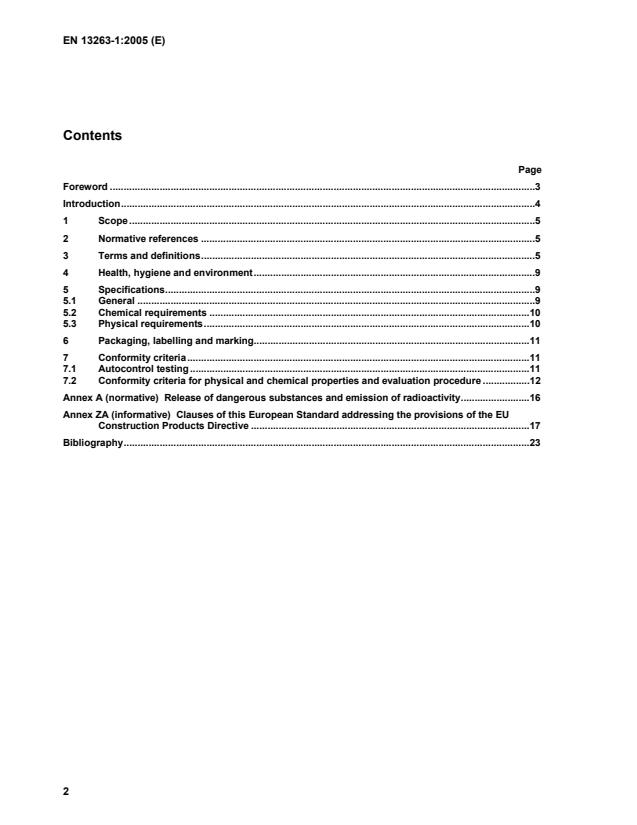
Release of dangerous substances and emission of radioactivity.16 Annex ZA (informative)
Clauses of this European Standard addressing the provisions of the EU Construction Products Directive.17 Bibliography.23
CR for a given sampling plan, the allowed probability of acceptance of silica fume with a characteristic value outside the specified characteristic value 3.3 autocontrol continuous statistical quality control of the silica fume based on the testing of samples taken by the manufacturer at point(s) of release from the silica fume production plant 3.4 autocontrol testing continual testing by the manufacturer of silica fume spot samples taken at the point(s) of release from the production plant
3.5 certificate of conformity to EN 13263-1 document issued under the rules of a certain scheme for the evaluation of conformity indicating that adequate confidence is provided that a silica fume is in conformity with this part of EN 13263 3.6 certification procedure by which a third party gives written assurance that a product, process or service conforms to specified requirements [EN 45020:1998] 3.7 certification body impartial body, governmental or non-governmental, possessing the necessary competence and responsibility to carry out conformity certification according to given rules of procedure and management 3.8 certified silica fume silica fume for which a certificate of conformity (see 3.5) has been issued 3.9 characteristic value value having a prescribed probability of not being attained in a hypothetical unlimited test series [ISO 8930: 1987] NOTE Equivalent to "fractile" which is defined in ISO 3534-1:1993. 3.10 conformity mark protected mark applied on the basis of the certificate of conformity (see 3.5) 3.11 control period period of production and dispatch identified for the evaluation of the autocontrol test results 3.12 densified silica fume silica fume that has been treated to increase the bulk density by particle agglomeration, the bulk density typically being above 500 kg/m3
3.15 factory production control permanent internal control of silica fume production exercised by the manufacturer including internal quality control and autocontrol testing NOTE The required activities are stated in 4.1 to 4.3 in EN 13263-2:2005. 3.16 further testing of samples testing according to 4.4 in EN 13263-2:2005 3.17 initial period immediate period after the first issuing of the certificate of conformity for a silica fume (see 5.6.1 in EN 13263-2:2005 for duration) 3.18 intitial type testing testing of the first audit sample according to 5.4 in EN 13263-2:2005 3.19 inspection body impartial body having the organization, staffing, competence and integrity to perform according to specified criteria functions such as assessing, recommending for acceptance and subsequent audit of manufacturers´ quality control operations, and selection and evaluation of products on site or in factories or elsewhere, according to specific criteria 3.20 new production plant production plant which is not already producing silica fume under the certification scheme 3.21 production plant facility used by a manufacturer for the production of silica fume: a) silicon metal or silicon alloy production plant; b) processing plant, for example for the selection, slurrifying, blending or densifying of silica fume. 3.22 quality control part of quality management focused on fulfilling quality requirements [EN ISO 9000:2000] 3.23 sampling plan specific plan which states the (statistical) sample size(s) to be used, the percentage Pk on which the characteristic value is based, and the allowable probability of acceptance CR
NOTE 2 Other names used for silica fume are condensed silica fume and microsilica. 3.25 silica fume slurry homogeneous, pH regulated liquid suspension of silica fume in water, typically with a dry content of 50 % by mass, corresponding to about 700 kg of silica fume per m³ of slurry 3.26 single result limit value value of a chemical or physical property which for any single test result – in the case of an upper limit is not to be exceeded or in the case of a lower limit is, as a minimum, to be reached 3.27 specified characteristic value characteristic value of a chemical or physical property which in the case of an upper limit is not to be exceeded or in the case of a lower limit is, as a minimum, to be reached NOTE Conformity with the specified characteristic values in this part of EN 13263 is verified by the methods in 7.2. 3.28 spot sample sample taken at the same time and from one and the same place, relating to the intended tests. It can be obtained by combining one or more immediately consecutive increments [EN 196-7:1989] 3.29 test technical operation that consists of the determination of a characteristic of a product according to a specified procedure [Adapted from EN 45020:1998] 3.30 test cement selected brand of Portland cement of type CEM I, strength class 42,5 N or higher, conforming to EN 197-1 to be used for carrying out the tests needed to evaluate conformity to the requirement of 5.3.3 in this part of EN 13263 Test cement is selected by the silica fume manufacturer and is further characterized by its fineness and contents of tricalcium aluminate and alkalis as follows: Fineness:
300 m2/kg to 400 m2/kg when determined in accordance with EN 196-6; Tricalcium aluminate:
8 % to 12 % when determined in accordance with EN 196-2; Alkalis (Na2O eqv):
0,6 % to 1,2 % when determined in accordance with EN 196-2.
5.3.2 Dry mass content in slurry The dry mass content shall not deviate from the value declared by the supplier by more than ± 2 % by mass of the slurry when determined by drying a representative sample of at least 5 g of slurry in a well ventilated oven at (105 ± 5) °C to constant mass. Constant mass is considered to be reached when successive weighings at least 1 hour apart during drying at (105 ± 5) °C do not differ by more than 0,2 %. 5.3.3 Activity index The activity index is determined as the ratio (in percent) of the compressive strength of standard mortar bars, prepared with 90 % test cement plus 10 % silica fume per mass of total binder, to the compressive strength of standard mortar bars prepared with 100 % test cement, when tested at the same age. Preparation of standard mortar bars and determination of the compressive strength shall be carried out in accordance with the method described in EN 196-1. The mortar containing silica fume shall be mixed with an amount of superplasticizer (conforming to EN 934-2) so that the mortar has a consistency equivalent to the reference mortar when tested by the flow table method given in EN 413-2. The activity index shall be at least 100 % when tested at a mortar age of 28 days. NOTE 1 The result of the activity index tests gives no direct information on the strength contribution of silica fume in concrete, nor is the use of silica fume limited to mixing ratio used in these
...