

FprEN 40000-1-3:2026
(Main)Cybersecurity requirements for products with digital elements - Part 1-3: Vulnerability handling
- Abstract
This standards shall provide specifications applicable to vulnerability handling processes, covering all relevant product categories, to
be put in place by manufacturers of the products with digital elements. Those processes shall at least allow to:
(a) identify and document vulnerabilities and components contained in the product, including by drawing up a software bill of materials in a commonly used and machinereadable format covering at the very least the top-level dependencies of the product;
(b) in relation to the risks posed to the products with digital elements, address and remediate vulnerabilities without delay, including by providing security updates; where technically feasible, new security updates shall be provided separately from functionality updates;
(c) apply effective and regular tests and reviews of the security of the product with digital elements;
(d) once a security update has been made available, share and publicly disclose information about fixed vulnerabilities, including a description of the vulnerabilities, information allowing users to identify the product with digital elements affected, the impacts of the vulnerabilities, their severity and clear and accessible information helping users to remediate the vulnerabilities; in duly justified cases, where manufacturers consider the security risks of publication to outweigh the security benefits, they may delay making public information regarding a fixed vulnerability until after users have been given the possibility to apply the relevant patch;
(e) put in place and enforce a policy on coordinated vulnerability disclosure;
(f) take measures to facilitate the sharing of information about potential vulnerabilities in their product with digital elements as well as in third party components contained in that product, including by providing a standardised contact address for the reporting of the
vulnerabilities discovered in the product with digital elements;
(g) provide for mechanisms to securely distribute updates for products with digital elements to ensure that vulnerabilities are fixed or mitigated in a timely manner, and, where applicable for security updates, in an automatic manner;
(h) ensure that, where security updates are available to address identified security issues, they are disseminated without delay and, unless otherwise agreed between manufacturer and business user in relation to a tailor-made product with digital elements, free of charge, accompanied by advisory messages providing users with the relevant information, including on potential action to be taken.
- Status
- Not Published
- Publication Date
- 10-Feb-2027
- Technical Committee
- CEN/CLC/JTC 13 - Cybersecurity and Data Protection
- Current Stage
- 5020 - Submission to Vote - Formal Approval
- Start Date
- 19-Nov-2026
- Due Date
- 15-Aug-2025
- Completion Date
- 15-Aug-2025

FprEN 40000-1-3:2026 is a CEN draft European Standard on cybersecurity requirements for products with digital elements, focused on vulnerability handling. It specifies the process requirements manufacturers use to identify, receive, verify, remediate, release and follow up on vulnerabilities across all product categories, in support of the Cyber Resilience Act.
What does FprEN 40000-1-3:2026 specify?
FprEN 40000-1-3:2026 specifies process requirements for vulnerability handling by manufacturers of products with digital elements. It is written to support the Cyber Resilience Act, especially the essential cybersecurity requirements in Annex I, Part II, and it applies across all product categories with risk-based requirement enhancements.
The document is organized as follows:
- Clause 1 - Scope
- Clause 2 - Normative references
- Clause 3 - Terms and definitions
- Clause 4 - General
- Clause 5 - Vulnerability handling, with the phases Preparation, Receipt, Verification, Remediation, Release and Post-release
- Annex ZA - relationship to the Cyber Resilience Act
- Bibliography
Clause 4 also explains how the document labels requirements, recommendations and permissions, and how requirement enhancements are marked with RE. Annex ZA maps the normative clauses to the essential cybersecurity requirements of Regulation (EU) 2024/2847.
What are the key requirements of FprEN 40000-1-3:2026?
Risk-based applicability and policies
- Applicability is risk-based - Clause 5.2.2 requires the manufacturer to decide which requirement enhancements apply based on product risks, using the product context and risk assessment from prEN 40000-1-2. In practice, the depth of vulnerability handling must match the product’s risk profile, and the decision needs to be documented.
- A vulnerability handling policy and a coordinated vulnerability disclosure policy are required - Clause 5.3.2 requires an internal policy on vulnerability handling, and Clause 5.3.3 requires an external policy on coordinated vulnerability disclosure. These policies need to define responsibilities, remediation targets, communication expectations, and contact mechanisms so reports can be handled consistently.
Identification, reporting and monitoring
- Products, software and hardware must be identifiable - Clauses 5.3.7 to 5.3.9 require product identification, identification of software components and identification of hardware components. For software, the document requires a Software Bill of Materials (SBOM) in a structured, machine-readable format that includes at least top-level dependencies, and it can be extended to transitive dependencies when technically feasible. This matters because component traceability is what allows a manufacturer to see whether a vulnerability affects the product.
- Reporting and monitoring must be continuous - Clauses 5.4.2 and 5.4.3 require a publicly accessible reporting mechanism, tracking of reports with an identifier, monitoring of internal and external sources, and use of the EU Vulnerability Database (EUVD) among the external sources. Clause 5.4.8 also requires periodic review of the assumptions and inputs to the product cybersecurity risk assessment, at least once a year. In practice, the manufacturer needs a standing intake and monitoring routine, not a one-time review.
Verification, remediation and release
- Reported vulnerabilities must be verified and prioritized - Clauses 5.5.2 and 5.5.3 require assessment of the report, requests for more information when needed, determination of severity, and prioritization based on risk. If the risk exceeds the manufacturer’s defined threshold, resolution must be expedited. This means the manufacturer must separate low-impact findings from vulnerabilities that need fast action.
- Remediation must be planned, built, tested and released - Clauses 5.6.2 to 5.6.4 require a remediation decision, a remediation plan with timeline, production of the remediation, and testing to confirm that the risk is mitigated and the impact on product and users is acceptable. Clause 5.6.3 also requires security updates to be provided separately from functionality updates where technically feasible.
- Security updates and advisories must be distributed and disclosed - Clause 5.7.2 requires timely distribution of security updates, free of charge unless otherwise agreed for a tailor-made product with digital elements, and with installation instructions unless distribution is fully automated. Clause 5.7.3 requires public information about fixed vulnerabilities, including the vulnerability description, identifier, affected product information, impact, severity, remediation guidance, release date and update date. Where appropriate, this information is also to be made available in a widely recognized machine-readable format.
What terms does FprEN 40000-1-3:2026 define?
- Test - An activity where a system or component is executed under specified conditions and the results are observed or recorded.
- Review - An activity used to determine the suitability, adequacy and effectiveness of the subject matter against established objectives.
- Coordination - A set of activities including stakeholder identification, engagement, mediation and communication in support of vulnerability disclosure.
- Upstream - Handling and movements that occur before an organization takes custody of goods in the supply chain.
- Downstream - Handling and movements that occur after an organization no longer has custody of goods in the supply chain.
- Software Bill of Materials (SBOM) - A structured list of software components and their relationships, used to trace dependencies and support vulnerability handling.
- Coordinated vulnerability disclosure (CVD) - A disclosure process that includes coordination between the manufacturer, the reporter and any other involved stakeholders.
Who uses FprEN 40000-1-3:2026?
FprEN 40000-1-3:2026 is used by manufacturers of products with digital elements, because the document is built around their vulnerability handling processes. It is also relevant to product security incident response teams, vulnerability coordinators, security engineers, and the people responsible for release, testing and remediation.
The document also speaks directly to customer support, public relations and legal functions, because Clause 5.3.2 and Clause 5.3.3 call for defined roles and external disclosure practices. Suppliers, open-source stewards and maintainers are relevant too, because the document addresses upstream components, third-party components and multi-party coordinated vulnerability disclosure.
Users and business users are also part of the process, because they receive advisories, installation information and security updates, and they may agree different terms for tailor-made products with digital elements.
Which standards are used with FprEN 40000-1-3:2026?
| Reference | What it contributes |
|---|---|
| prEN 40000-1-1 | Vocabulary for the series |
| prEN 40000-1-2:2025 | Principles for cyber resilience, including product context, risk assessment, architecture, verification and validation, and secure update distribution |
| EN ISO/IEC 30111:2020 | Vulnerability handling processes for investigation, processing and resolution |
| EN ISO/IEC 29147:2020 | Vulnerability disclosure guidance, including report intake and advisory publication |
| ISO/IEC TR 5895:2022 | Multi-party coordinated vulnerability disclosure and handling |
| EN 301 549 v3.2.1 | Accessibility requirements for reporting and communication methods |
| ISO/IEC 5962:2021 | SPDX format reference for software bills of materials |
| ISO/IEC 20153:2025 | Machine-readable security advisory format reference |
| RFC 9116:2022 | Security.txt guidance for vulnerability reporting |
| ISO 8601-1:2019 | Timestamp format for SBOM metadata |
| ISO/IEC/IEEE 29119-2:2021 | Test terminology used for the definition of “test” |
What does the FprEN 40000-1-3:2026 document contain?
FprEN 40000-1-3:2026 contains a clause structure that turns vulnerability handling into a documented process, with outputs and assessment criteria at each step. Clause 5 is organized into phases that cover preparation, receipt, verification, remediation, release and post-release, so a manufacturer can build a complete workflow from intake to follow-up.
The document also includes a figure showing the vulnerability life cycle and a figure showing relationships between the referenced standards and this document. Annex ZA gives the correspondence between the clauses and the essential cybersecurity requirements of the Cyber Resilience Act, which is the key part used for regulatory mapping.
Get Certified
Connect with accredited certification bodies for this standard

BSI Group
BSI (British Standards Institution) is the business standards company that helps organizations make excellence a habit.

Bureau Veritas
Bureau Veritas is a world leader in laboratory testing, inspection and certification services.

DNV
DNV is an independent assurance and risk management provider.
Sponsored listings
Frequently Asked Questions
FprEN 40000-1-3:2026 is a draft published by the European Committee for Standardization (CEN). Its full title is "Cybersecurity requirements for products with digital elements - Part 1-3: Vulnerability handling". This standard covers: This standards shall provide specifications applicable to vulnerability handling processes, covering all relevant product categories, to be put in place by manufacturers of the products with digital elements. Those processes shall at least allow to: (a) identify and document vulnerabilities and components contained in the product, including by drawing up a software bill of materials in a commonly used and machinereadable format covering at the very least the top-level dependencies of the product; (b) in relation to the risks posed to the products with digital elements, address and remediate vulnerabilities without delay, including by providing security updates; where technically feasible, new security updates shall be provided separately from functionality updates; (c) apply effective and regular tests and reviews of the security of the product with digital elements; (d) once a security update has been made available, share and publicly disclose information about fixed vulnerabilities, including a description of the vulnerabilities, information allowing users to identify the product with digital elements affected, the impacts of the vulnerabilities, their severity and clear and accessible information helping users to remediate the vulnerabilities; in duly justified cases, where manufacturers consider the security risks of publication to outweigh the security benefits, they may delay making public information regarding a fixed vulnerability until after users have been given the possibility to apply the relevant patch; (e) put in place and enforce a policy on coordinated vulnerability disclosure; (f) take measures to facilitate the sharing of information about potential vulnerabilities in their product with digital elements as well as in third party components contained in that product, including by providing a standardised contact address for the reporting of the vulnerabilities discovered in the product with digital elements; (g) provide for mechanisms to securely distribute updates for products with digital elements to ensure that vulnerabilities are fixed or mitigated in a timely manner, and, where applicable for security updates, in an automatic manner; (h) ensure that, where security updates are available to address identified security issues, they are disseminated without delay and, unless otherwise agreed between manufacturer and business user in relation to a tailor-made product with digital elements, free of charge, accompanied by advisory messages providing users with the relevant information, including on potential action to be taken.
This standards shall provide specifications applicable to vulnerability handling processes, covering all relevant product categories, to be put in place by manufacturers of the products with digital elements. Those processes shall at least allow to: (a) identify and document vulnerabilities and components contained in the product, including by drawing up a software bill of materials in a commonly used and machinereadable format covering at the very least the top-level dependencies of the product; (b) in relation to the risks posed to the products with digital elements, address and remediate vulnerabilities without delay, including by providing security updates; where technically feasible, new security updates shall be provided separately from functionality updates; (c) apply effective and regular tests and reviews of the security of the product with digital elements; (d) once a security update has been made available, share and publicly disclose information about fixed vulnerabilities, including a description of the vulnerabilities, information allowing users to identify the product with digital elements affected, the impacts of the vulnerabilities, their severity and clear and accessible information helping users to remediate the vulnerabilities; in duly justified cases, where manufacturers consider the security risks of publication to outweigh the security benefits, they may delay making public information regarding a fixed vulnerability until after users have been given the possibility to apply the relevant patch; (e) put in place and enforce a policy on coordinated vulnerability disclosure; (f) take measures to facilitate the sharing of information about potential vulnerabilities in their product with digital elements as well as in third party components contained in that product, including by providing a standardised contact address for the reporting of the vulnerabilities discovered in the product with digital elements; (g) provide for mechanisms to securely distribute updates for products with digital elements to ensure that vulnerabilities are fixed or mitigated in a timely manner, and, where applicable for security updates, in an automatic manner; (h) ensure that, where security updates are available to address identified security issues, they are disseminated without delay and, unless otherwise agreed between manufacturer and business user in relation to a tailor-made product with digital elements, free of charge, accompanied by advisory messages providing users with the relevant information, including on potential action to be taken.
FprEN 40000-1-3:2026 is classified under the following ICS (International Classification for Standards) categories: 35.030 - IT Security. The ICS classification helps identify the subject area and facilitates finding related standards.
FprEN 40000-1-3:2026 is associated with the following European legislation: EU Directives/Regulations: 2024/2847; Standardization Mandates: M/606. When a standard is cited in the Official Journal of the European Union, products manufactured in conformity with it benefit from a presumption of conformity with the essential requirements of the corresponding EU directive or regulation.
FprEN 40000-1-3:2026 is available in PDF format for immediate download after purchase. The document can be added to your cart and obtained through the secure checkout process. Digital delivery ensures instant access to the complete standard document.
Standards Content (Sample)
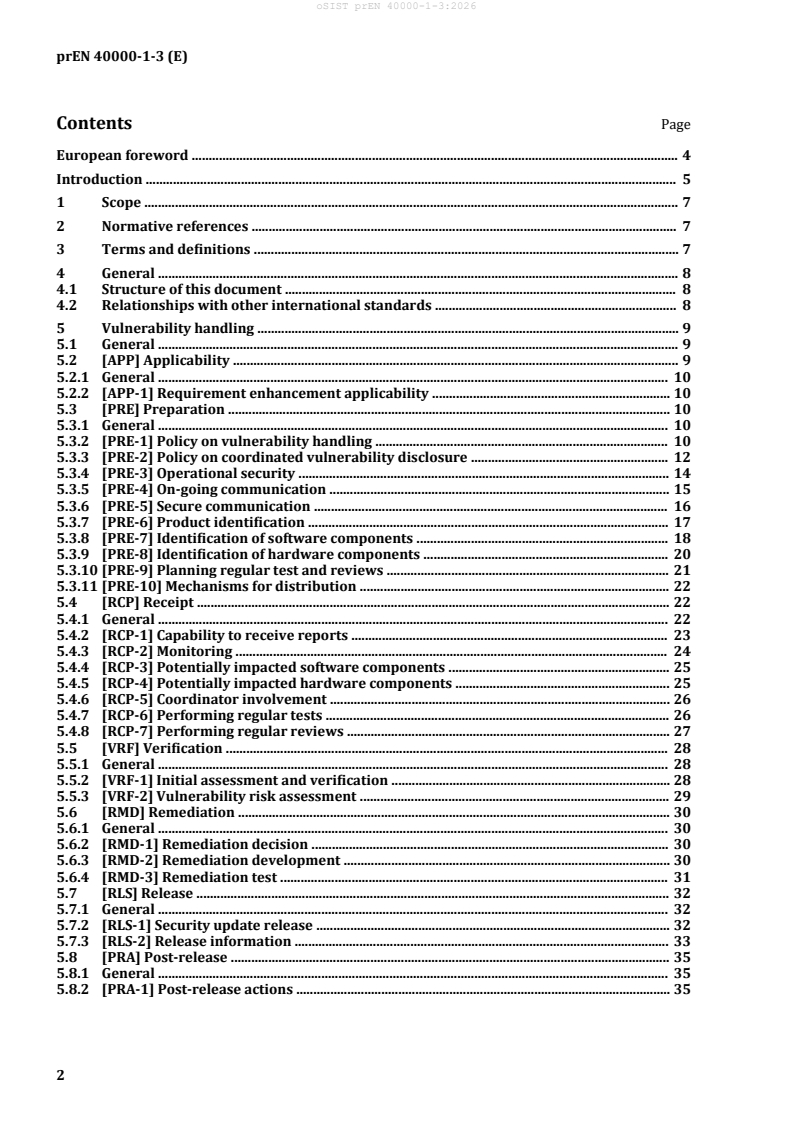
Contents
- Introduction
- 1 Scope
- 2 Normative references
- 3 Terms and definitions
- 3.1 test
- 3.2 review
- 3.3 coordination
- 3.4 upstream
- 3.5 downstream
- 4 General
- 4.1 Structure of this document
- 4.2 Relationships with other international standards
- 5 Vulnerability handling
- 5.1 General
- Annex ZA
- Bibliography
Introduction
Vulnerabilities are likely to emerge over time during the life cycle of a product with digital elements (hereinafter referred to as "product"), including its software and hardware components, despite adherence to cybersecurity principles defined in prEN 40000-1-2 [1]. It is important to prepare for those events by developing an effective strategy for the management of vulnerabilities during the product life cycle, including regular monitoring, testing, risk assessment, prioritization, remediation, and verification, as well as communication, which are all essential activities to discover and fix new vulnerabilities and maintain cybersecurity coverage. This vulnerability handling document refines the activities that are part of international standards such as EN ISO/IEC 30111:2020 [2], EN ISO/IEC 29147:2020 [3] and ISO/IEC TR 5895:2022 [4]. It elevates, where appropriate, recommendations to mandatory requirements to ensure conformity with the Cyber Resilience Act (CRA) obligations. It integrates essential elements such as Software Bill of Materials (SBOM), regular testing and review activities, secure update mechanisms, and explicit requirements to support effective Coordinated Vulnerability Disclosure (CVD) and vulnerability-handling processes. The rigor with which vulnerability handling activities are expected to be executed are expected to adhere to a risk-based approach, determined by the potential societal impact of a product's security failure. For example, the regular test and other monitoring activities are expected to be executed more frequently for products with higher criticality, and having a more detailed SBOM can improve the detection of vulnerabilities in components used by the product. The horizontal standards for the Cyber Resilience Act cannot be too prescriptive and thus require appropriate product risk-based criteria to be documented in the risk assessment and the cybersecurity plan for the product. Identifying a product that can cause high-risk impact, which can be found across all categories covered by the Cyber Resilience Act, is integral to the regulatory risk assessment that needs to be conducted by the manufacturer. To support a risk-based approach, this document defines requirement enhancements. Figure 1 illustrates an example of the vulnerability life cycle model, where the period between vulnerability discovery and the application of security updates prolongs the window of opportunity for threat actors to exploit the vulnerability and to conduct a cybersecurity attack. a Derived from ENISA — STATE OF VULNERABILITIES 2018/2019 — Analysis of Events in the life of Vulnerabilities ( December 2019 / Page 9 / Figure 2: Vulnerability life cycle ) Figure 1 — Vulnerability life cycle
oSIST prEN 40000-1-3:2026 prEN 40000-1-3 (E) The vulnerability handling activities defined in this document are organized into the following distinct phases:
- Preparation: Establishing policies, processes, and capabilities for vulnerability intake and disclosure.
- Receipt: Receiving and monitoring vulnerability reports from internal and external sources.
- Verification: Assessing the validity, applicability, and severity of reported vulnerabilities.
- Remediation: Planning, developing, and testing fixes or mitigations.
- Release: Distributing security updates and publishing advisories.
- Post-Release: Monitoring effectiveness and applying lessons learned. Manufacturers implementing this document will be equipped to demonstrate due diligence in vulnerability handling, maintain product security over time, and support transparency and trust across the digital ecosystem.
oSIST prEN 40000-1-3:2026 prEN 40000-1-3 (E)
1 Scope
This document specifies the requirements and activities that focus on the process aspects of vulnerability handling applicable to manufacturers of products with digital elements (hereinafter referred to as "product").
The document is intended to support compliance with the Cyber Resilience Act (CRA) Regulation (EU) 2024/2847, particularly the essential requirements outlined in Annex I, Part II. This document, with the appropriate requirement enhancements, is applicable across all product categories. Implementing these requirements enables a manufacturer to ensure security is maintained throughout the product life cycle.
2 Normative references
The following documents are referred to in the text in such a way that some or all of their content constitutes requirements of this document. For dated references, only the edition cited applies. For undated references, the latest edition of the referenced document (including any amendments) applies. prEN 40000-1-1, Cybersecurity requirements for products with digital elements - Vocabulary prEN 40000-1-2:2025, Cybersecurity requirements for products with digital elements - Part 1-2: Principles for cyber resilience
3 Terms and definitions
For the purposes of this document, the terms and definitions given in prEN 40000-1-1 and the following apply.
ISO and IEC maintain terminology databases for use in standardization at the following addresses:
- ISO Online browsing platform: available at http://www.iso.org/obp
- IEC Electropedia: available at http://www.electropedia.org/
3.1 test
activity in which a system or component is executed under specified conditions, the results are observed or recorded, and an evaluation is made of some aspect of the system or component Note 1 to entry: A test is carried out to measure or classify a characteristic or a property of an item by applying to the item a set of environmental and operating conditions and/or requirements. [SOURCE: ISO/IEC/IEEE 29119-2:2021 [5], 3.21]
3.2 review
activity undertaken to determine the suitability, adequacy and effectiveness of the subject matter to achieve established objectives [SOURCE: ISO 31073:2022 [6], 3.3.41]
oSIST prEN 40000-1-3:2026 prEN 40000-1-3 (E)
3.3 coordination
set of activities including identifying and engaging stakeholders, mediating, communicating, and other planning in support of vulnerability disclosure Note 1 to entry: The term “coordinated vulnerability disclosure” is used to denote a disclosure process that includes coordination.
[SOURCE: EN ISO/IEC 29147:2020 [3], 3.3]
3.4 upstream
handling, processes and movements of goods that occur before the organization in the supply chain takes custody of the goods [SOURCE: ISO 28001:2007 [7], 3.27]
3.5 downstream
handling, processes and movements of goods when they no longer are in the custody of the organization in the supply chain [SOURCE: ISO 28001:2007 [7], 3.10]
4 General
4.1 Structure of this document
Requirements in this document are assigned unique identifiers consisting of a three letter abbreviation for clause and for the requirement a two-letter abbreviation (“RQ” for a requirement, “RC” for a recommendation, and “PM” for a permission, all numbered independently, each starting at 01), followed by a number, separated by a hyphen.
This document supports the risk-based approach by providing requirement enhancements that are listed into the document with the acronym RE.
EXAMPLE 5.X.X [XXX-1] Title of the Section
5.X.X.X Requirement
[XXX-X-RQ-XX] Description of a requirement [XXX-X-RQ-XX-RE] Description of a requirement enhancement [XXX-X-RC-XX] Description of a recommendation [XXX-X-PM-XX] Description of a permission
4.2 Relationships with other international standards
This document uses as building blocks the following standards and technical reports:
- EN ISO/IEC 29147:2020 [3] - Vulnerability disclosure - provides guidelines for manufacturers on how to process and remediate potential vulnerability reports reported by internal or external individuals or organizations. The major focus is on receiving reports about potential vulnerabilities and when distributing vulnerability remediation information to affected users.
oSIST prEN 40000-1-3:2026 prEN 40000-1-3 (E) - EN ISO/IEC 30111:2020 [2] - Vulnerability handling processes - provides guidelines on how to investigate, process and resolve potential vulnerability reports. To enhance the multi-party essence of the CVD and to capture the complexity of the supply chain and multiple stakeholder involved in the coordinated vulnerability disclosure process this document has been augmented with ISO/IEC TR 5895:2022 [4].
- ISO/IEC TR 5895:2022 [4] - Multi-party coordinated vulnerability disclosure and handling - clarifies and increases the application and implementation of EN ISO/IEC 30111:2020 [2] and ISO/IEC 29147:2018 [8] in multi-party coordinated vulnerability disclosure (MPCVD) settings. NOTE EN ISO/IEC 30111:2020 [2] and EN ISO/IEC 29147:2020 [3] use the term “vendor” where CRA uses “manufacturer”.
The relationships between the referenced standards are shown in Figure 2, which highlights the components that were introduced or substantially modified to align with the Cyber Resilience Act essential requirements.
a Derived from ISO/IEC TR 5895:2022 [4] — Figure 2: The relationship between ISO/IEC 29147 and ISO/IEC 30111 with respect to MPCVD Figure 2 — Relationships between referred standards and this document
5 Vulnerability handling
5.1 General
This clause defines the key activities and requirements for vulnerability disclosure and handling, providing manufacturers with a structured foundation for designing and implementing their own processes. These processes enable manufacturers to manage communication among stakeholders, proactively discover and collect vulnerability information and reports, and diagnose and remediate vulnerabilities before they become public, thereby preventing malicious actors from exploiting them. 5.2 [APP] Applicability
oSIST prEN 40000-1-3:2026 prEN 40000-1-3 (E)
5.2.1 General
The rigor applied to vulnerability handling activities follows a risk-based approach aligned with the product's risks.
5.2.2 [APP-1] Requirement enhancement applicability
5.2.2.1 General
Manufacturers are normally responsible for conducting a risk assessment to assess the risks associated with the use of the product to determine the appropriate rigor for vulnerability handling. Dependent upon the risks, there is an expectation to implement the relevant requirement enhancements in one or more of the following identified activities:
- [PRE-5-RQ-01-RE] Secure communication - [PRE-7-RQ-03-RE] SBOM completeness - [PRE-7-RQ-07-RE] SBOM software component hash - [RLS-2-RQ-03-RE] Machine-readable advisories NOTE EDITORIAL NOTE: CEN-CENELEC JTC13/WG9 invites feedback from the national organizations on the approach for requirement enhancements to better support the risk based approach.
5.2.2.2 Input
- Product context (prEN 40000-1-2 [1], 6.2)
- Risk assessment (prEN 40000-1-2 [1], 6.4)
5.2.2.3 Requirement
[APP-1-RQ-01] The applicability of the requirement enhancements shall be determined based on the product risks.
NOTE Requirement Enhancement: Requirements marked with “RE” indicate risk-based enhancements that apply where the regulatory risk assessment determines that additional rigor is necessary.
5.2.2.4 Output
- Statement of applicability
5.2.2.5 Assessment criteria
- Evaluation of the applicability criteria based on the product context and risk assessment 5.3 [PRE] Preparation
5.3.1 General
The preparation phase lays the foundation for establishing appropriate vulnerability handling and disclosure processes and policies to support the subsequent phases, providing a structured, methodological approach to identify, verify, and address vulnerabilities, including communication. This phase also includes requirements such as identifying software and hardware components, focusing on creating the Software Bill of Materials (SBOM), and establishing a coordinated vulnerability disclosure and vulnerability handling policy.
5.3.2 [PRE-1] Policy on vulnerability handling
oSIST prEN 40000-1-3:2026 prEN 40000-1-3 (E)
5.3.2.1 General
A manufacturer establishes and maintains an internal vulnerability handling policy to clearly define their approach for investigating and remediating security vulnerabilities. An additional important aspect covered is the testing strategy that should be defined to support effective and regular tests and reviews of its products. This policy forms a core part of the manufacturer’s overall vulnerability handling process and is compatible with the external coordinated vulnerability disclosure policy as per 5.3.3. The intended audience for the vulnerability handling policy is the internal staff.
5.3.2.2 Input
- Coordinated Vulnerability Disclosure policy
- 5.3.10
- Software bill of materials
5.3.2.3 Requirement
[PRE-1-RQ-01] A policy on vulnerability handling shall be created, put in place and adhered to. NOTE 1 For additional guidance on the vulnerability handling policy, refer to EN ISO/IEC 30111:2020 [2], 6.3. [PRE-1-RC-01] An organizational framework should be created to support the activities defined in the vulnerability handling process as per [PRE-1-RQ-01].
NOTE 2 For additional guidance on organizational framework, refer to EN ISO/IEC 30111:2020 [2], 6.4. [PRE-1-RQ-02] The vulnerability handling policy shall include:
- basic guidance, principles, and responsibilities for handling potential vulnerabilities in products - measures to prevent premature disclosure of information about potential vulnerabilities before they are fixed - a target schedule for remediation development NOTE 3 The target schedule serves as a guide for completing the activities of remediation development, as described in 5.6.
NOTE 4 The target schedule depends on different aspects such as the complexity of the remediation to be developed, and the potential risk of the vulnerability, as assessed in 5.5.2. Additional variables include the complexity of the interactions with the supply chain and entities involved in the investigation and remediation activities.
- strategies related to the regular test (3.1) and review (3.2) activities, as defined in 5.3.10. [PRE-1-RC-02] A policy on vulnerability handling should include:
- the full process description that is aligned with the expectations of this document - the roles and responsibilities that will be assigned to handle the potential vulnerabilities in the product NOTE 5 For additional guidance on role and responsibilities including definition of usual activities refer to EN ISO/IEC 30111:2020 [2]:
- 6.5 Vendor CSIRT or PSIRT
- 6.6 Responsibilities of the product business division
- 6.7 Responsibilities of customer support and public relations
oSIST prEN 40000-1-3:2026 prEN 40000-1-3 (E) - 6.8 Legal consultation - measures to prevent premature disclosure of information about potential vulnerabilities before they are fixed, as defined in 5.3.6 - activities and criteria to define a target schedule for the remediation of the vulnerability, which depends on the embargo period, established and inflüenced by the complexity of the case by case situation with impacted upstream stakeholders, and on the criticality of the vulnerability and the product itself - where known and appropriate, it is important to list the downstream stakeholders that are using the product under scope NOTE 6 Appropriateness depends on privacy and confidentiality agreements with downstream stakeholders.
- the mapping of upstream stakeholders to support the component identification required by 5.3.8 and 5.3.9 NOTE 7 For additional guidance on roles and responsibilities in a multi-party configüration that includes definition of usual activities, refer to ISO/IEC TR 5895:2022 [4], Clause 8. [PRE-1-RQ-03] The effectiveness of the vulnerability handling process shall be monitored. NOTE 8 For additional guidance on ways to monitor the effectiveness of the vulnerability handling process, refer to EN ISO/IEC 30111:2020 [2], 7.2.
[PRE-1-RQ-04] For a timely resolution of the issues, a mapping of upstream interdependencies, including open source, is required to support the coordination and notification activities when a vulnerability is discovered.
[PRE-1-RQ-05] A policy on vulnerability handling shall support all the activities that are defined in the vulnerability disclosure policy, as described in 5.3.3.
5.3.2.4 Output
- Policy on vulnerability handling
- List of the upstream stakeholders
- Data collection on target with the schedule remediation activities
5.3.2.5 Assessment criteria
- Policy on vulnerability handling that covers the activities defined within this document
- Existence of a list of upstream stakeholders linked to the components integrated into the product with a completeness check using the SBOM
- Policy on vulnerability handling that includes:
- appropriate alignment with the coordinated vulnerability disclosure
- demonstrated organizational capabilities, roles and responsibilities to deal timely and in a systematic way in the event of a vulnerability
- Appropriate testing and review policies defined including regularity and timeline of those activities as aligned with 5.3.10
- Evidence of process monitoring for vulnerability handling effectiveness 5.3.3 [PRE-2] Policy on coordinated vulnerability disclosure
oSIST prEN 40000-1-3:2026 prEN 40000-1-3 (E)
5.3.3.1 General
The purpose of the coordinated vulnerability disclosure policy is to communicate the manufacturer's intentions, responsibilities, and expectations regarding vulnerability disclosure. A coordinated vulnerability disclosure policy encompasses both two-party coordination (e.g. between the reporter and the manufacturer) and multi-party disclosure involving multiple stakeholders. To support this, the manufacturer develops and publishes an external coordinated vulnerability disclosure policy and ensures the related internal activities are in place to effectively coordinate the disclosure of vulnerabilities.
In addition, to prevent attackers from gaining early access to sensitive information, reporters typically notify manufacturers privately, and refrain from public disclosure until a fix is available after an agreedupon embargo period has passed. The receipt, verification, and remediation development stages are generally conducted within this embargo period, ensuring that vulnerabilities are addressed securely and responsibly by all the parties involved in the process.
5.3.3.2 Input
- Vulnerability handling policy
5.3.3.3 Requirement
[PRE-2-RQ-01] A policy on coordinated vulnerability disclosure (CVD) shall be created, published in an accessible format and adhered to.
NOTE 1 Accessibility requirements and advice can be found in EN 301 549 v3.2.1 [9]. [PRE-2-RQ-02] A coordinated vulnerability disclosure policy shall include one or more contact mechanisms.
NOTE 2 Contact information can be available for both reporting vulnerabilities and for requesting additional information about the coordinated vulnerability program.
For additional guidance on policy elements refer to EN ISO/IEC 29147:2020 [3], 9.2.2. A list of possible contact mechanisms includes, but is not limited to:
- e-mail address;
- phone number;
- web form;
- contact information for customer service.
[PRE-2-RC-01] The contact mechanisms should provide accessibility via more than one sensory channel.
EXAMPLE The purpose of providing more than one sensory channel is to address situations in which a potential user with a writing impediment can still, for example, call a phone number to ask for and provide information. NOTE 3 Accessibility requirements and advice can be found in EN 301 549 v3.2.1 [9]. [PRE-2-RQ-03] Setting expectations for on-going communication shall be stated in this policy. NOTE 4 The reference for this requirement is 5.3.5.
[PRE-2-RC-02] A vulnerability disclosure policy should include following elements:
- vulnerability report contents;
- secure communication options as detailed in 5.3.6;
- scope;
...