

prEN 1849-1
(Main)Flexible sheets for waterproofing - Determination of thickness and mass per unit area - Part 1: Bitumen sheets for roof waterproofing
- Abstract
This document specifies a method for the determination of thickness and mass per unit area of bitumen sheets for roof waterproofing. The measurement of thickness is appropriate for most bitumen sheets including sheets with a factory applied mineral finish.
The determination of thickness is not applicable to sheets with pronounced surface texture or to sheets with a substantial fibrous backing. Where it is required to characterize these products, mass per unit area should be used instead.
The determination of mass per unit area serves to verify the value stated by the manufacturer for information and is not applicable to perforated materials.
- Status
- Not Published
- Publication Date
- 10-Jan-2028
- Technical Committee
- CEN/TC 254 - Flexible sheets for water proofing
- Drafting Committee
- CEN/TC 254/SC 1 - Bitumen sheets
- Current Stage
- 4020 - Submission to enquiry - Enquiry
- Start Date
- 15-Oct-2026
- Due Date
- 29-Sep-2026
- Completion Date
- 15-Oct-2026

prEN 1849-1 is a CEN draft European Standard for flexible sheets for waterproofing. It specifies methods for determining thickness and mass per unit area of bitumen sheets for roof waterproofing, so manufacturers, test laboratories, and buyers can use the same approach when checking product data.
What does prEN 1849-1 specify?
prEN 1849-1 specifies a test method for the thickness and mass per unit area of bitumen sheets used for roof waterproofing. The thickness method is intended for most bitumen sheets, including sheets with a factory-applied mineral finish, while the mass per unit area method is used where thickness is not suitable.
Clause 1 also sets the main limits of use. Thickness is not used for sheets with a pronounced surface texture or a substantial fibrous backing, and mass per unit area is used instead when those products need to be characterized. Mass per unit area is also used to verify the value stated by the manufacturer for information, and it is not applicable to perforated materials.
The document is organized into six clauses:
- Clause 1 - Scope
- Clause 2 - Normative references
- Clause 3 - Terms and definitions
- Clause 4 - Determination of thickness
- Clause 5 - Determination of mass per unit area
- Clause 6 - Test report
What are the key requirements of prEN 1849-1?
prEN 1849-1 gives two separate laboratory methods: one for thickness and one for mass per unit area. The methods are built around representative sampling, controlled specimen preparation, and simple arithmetic on measured results, which makes them practical for routine product checking.
Thickness
Clause 4 requires thickness to be measured directly in 10 places across the width of the sheet, then reported as the mean of those measurements. In practice, this means the result is intended to describe the sheet as a whole, not a single local point.
Clause 4.2 specifies a measuring device capable of reading to the nearest 0.01 mm, with planar measuring surfaces of 10 mm diameter and a specified pressure on the sheet surface. This matters because the device must be sensitive enough to detect small differences without deforming the material during measurement.
Clause 4.3 and 4.4 require a complete undamaged roll selected according to EN 13416, a test specimen at least 100 mm long and full width, and measurements taken under ambient conditions unless a dispute requires conditioning at 23 °C. The practical effect is that the sample must represent normal production, and the dispute condition gives a common reference state.
Clause 4.5 requires the mean thickness to be rounded and expressed to the nearest 0.1 mm. The document also notes that precision is not specified, so users should treat the result as a test output rather than a certified precision statement.
Mass per unit area
Clause 5 uses three test specimens cut from a test piece at least 0.4 m long and full width of the sample. The specimens are taken in a defined pattern, with care to avoid any selvedge, so that edge treatment does not distort the result.
Clause 5.3 requires conditioning for at least 20 h at 23 ± 2 °C and 50 ± 5 % relative humidity. This matters when comparing results between laboratories, because it reduces the effect of moisture and temperature on weight.
Clause 5.4 requires each specimen to be weighed to the nearest 0.1 g, and Clause 5.5 calculates the mass per unit area from the three specimen masses and rounds the result to the nearest 0.01 kg/m². In practice, the method gives a straightforward check against the manufacturer’s declared value for information.
Test report
Clause 6 requires the report to identify the product, state compliance with prEN 1849-1 and any deviation, describe sampling and specimen preparation, record the results, and give the test dates. That makes the report usable for quality control, technical comparison, and traceability.
What terms does prEN 1849-1 define?
- Thickness - the dimension normal to the surface of the sheet.
- Pronounced surface texture - a textured pattern or emboss that changes thickness by more than 10%.
- Substantial fibrous backing - a woven or non-woven synthetic fibre layer weighing more than 80 g/m² and fixed to the bottom of the sheet.
- Emboss - a textured pattern intentionally impressed into one or both surfaces during manufacture.
- Selvedge - the area left free of granules or similar surface protection to help jointing of laps.
Who uses prEN 1849-1?
prEN 1849-1 is used by manufacturers of bitumen sheets for roof waterproofing, testing laboratories, and quality control staff who need a consistent way to measure thickness or mass per unit area. It is also relevant to buyers, specifiers, and inspectors who compare declared product values with test results.
What changed in prEN 1849-1 from the previous edition?
prEN 1849-1 is drafted to supersede EN 1849-1:1999.
Which standards are used with prEN 1849-1?
- EN 13416 - provides the sampling rules used to select a complete undamaged roll of the bitumen sheet for testing.
What does the prEN 1849-1 document contain?
prEN 1849-1 contains two test methods with a parallel structure: principle, apparatus, sampling and preparation of test specimens, conditioning, procedure, and expression of results. Clause 4 provides the thickness method, including the measurement pattern across the sheet width and the calculation of the mean thickness.
Clause 5 provides the mass per unit area method, including specimen layout, conditioning, weighing, and calculation from three specimen masses. Figure 1 shows an example of the specimen arrangement for the mass per unit area test.
Clause 6 gives the test report items needed for traceability and comparison. The document also includes the normative reference to EN 13416 and a terms-and-definitions clause that fixes the meaning of the key product features used in the methods.
Relations
- Effective Date
- 12-Nov-2025
Get Certified
Connect with accredited certification bodies for this standard

DIBt (Deutsches Institut für Bautechnik)
German Institute for Building Technology.

DIN CERTCO
DIN Group product certification.

Aboma Certification B.V.
Specialized in construction, metal, and transport sectors.
Sponsored listings
Frequently Asked Questions
prEN 1849-1 is a draft published by the European Committee for Standardization (CEN). Its full title is "Flexible sheets for waterproofing - Determination of thickness and mass per unit area - Part 1: Bitumen sheets for roof waterproofing". This standard covers: This document specifies a method for the determination of thickness and mass per unit area of bitumen sheets for roof waterproofing. The measurement of thickness is appropriate for most bitumen sheets including sheets with a factory applied mineral finish. The determination of thickness is not applicable to sheets with pronounced surface texture or to sheets with a substantial fibrous backing. Where it is required to characterize these products, mass per unit area should be used instead. The determination of mass per unit area serves to verify the value stated by the manufacturer for information and is not applicable to perforated materials.
This document specifies a method for the determination of thickness and mass per unit area of bitumen sheets for roof waterproofing. The measurement of thickness is appropriate for most bitumen sheets including sheets with a factory applied mineral finish. The determination of thickness is not applicable to sheets with pronounced surface texture or to sheets with a substantial fibrous backing. Where it is required to characterize these products, mass per unit area should be used instead. The determination of mass per unit area serves to verify the value stated by the manufacturer for information and is not applicable to perforated materials.
prEN 1849-1 is classified under the following ICS (International Classification for Standards) categories: 91.100.50 - Binders. Sealing materials. The ICS classification helps identify the subject area and facilitates finding related standards.
prEN 1849-1 has the following relationships with other standards: It is inter standard links to EN 1849-1:1999. Understanding these relationships helps ensure you are using the most current and applicable version of the standard.
prEN 1849-1 is associated with the following European legislation: EU Directives/Regulations: 305/2011. When a standard is cited in the Official Journal of the European Union, products manufactured in conformity with it benefit from a presumption of conformity with the essential requirements of the corresponding EU directive or regulation.
prEN 1849-1 is available in PDF format for immediate download after purchase. The document can be added to your cart and obtained through the secure checkout process. Digital delivery ensures instant access to the complete standard document.
Standards Content (Sample)
SLOVENSKI STANDARD
01-december-2026
Hidroizolacijski trakovi - Določanje debeline in mase na enoto površine - 1. del:
Bitumenski trakovi za tesnjenje streh
Flexible sheets for waterproofing - Determination of thickness and mass per unit area -
Part 1: Bitumen sheets for roof waterproofing
Abdichtungsbahnen - Bestimmung der Dicke und der flächenbezogenen Masse - Teil 1:
Bitumenbahnen für Dachabdichtungen
Feuilles souples d'étanchéité - Détermination de l'épaisseur et de la masse surfacique -
Partie 1 : Feuilles d'étanchéité de toiture bitumineuses
Ta slovenski standard je istoveten z: prEN 1849-1
ICS:
91.060.20 Strehe Roofs
91.100.50 Veziva. Tesnilni materiali Binders. Sealing materials
2003-01.Slovenski inštitut za standardizacijo. Razmnoževanje celote ali delov tega standarda ni dovoljeno.
DRAFT
EUROPEAN STANDARD
NORME EUROPÉENNE
EUROPÄISCHE NORM
October 2026
ICS 91.100.50 Will supersede EN 1849-1:1999
English Version
Flexible sheets for waterproofing - Determination of
thickness and mass per unit area - Part 1: Bitumen sheets
for roof waterproofing
Feuilles souples d'étanchéité - Détermination de Abdichtungsbahnen - Bestimmung der Dicke und der
l'épaisseur et de la masse surfacique - Partie 1 : flächenbezogenen Masse - Teil 1: Bitumenbahnen für
Feuilles d'étanchéité de toiture bitumineuses Dachabdichtungen
This draft European Standard is submitted to CEN members for enquiry. It has been drawn up by the Technical Committee
CEN/TC 254.
If this draft becomes a European Standard, CEN members are bound to comply with the CEN/CENELEC Internal Regulations
which stipulate the conditions for giving this European Standard the status of a national standard without any alteration.
This draft European Standard was established by CEN in three official versions (English, French, German). A version in any other
language made by translation under the responsibility of a CEN member into its own language and notified to the CEN-CENELEC
Management Centre has the same status as the official versions.
CEN members are the national standards bodies of Austria, Belgium, Bulgaria, Croatia, Cyprus, Czech Republic, Denmark,
Estonia, Finland, France, Germany, Greece, Hungary, Iceland, Ireland, Italy, Latvia, Lithuania, Luxembourg, Malta, Netherlands,
Norway, Poland, Portugal, Republic of North Macedonia, Romania, Serbia, Slovakia, Slovenia, Spain, Sweden, Switzerland, Türkiye
and United Kingdom.
Recipients of this draft are invited to submit, with their comments, notification of any relevant patent rights of which they are
aware and to provide supporting documentation.
Warning : This document is not a European Standard. It is distributed for review and comments. It is subject to change without
notice and shall not be referred to as a European Standard.
EUROPEAN COMMITTEE FOR STANDARDIZATION
C O M I T É E U R O P É E N D E N O R M A L I S A T I O N
E U R O P Ä I S C H E S K O M I T E E F Ü R N O R M U N G
CEN-CENELEC Management Centre: Rue de la Science 23, B-1040 Brussels
© 2026 CEN All rights of exploitation in any form and by any means reserved Ref. No. prEN 1849-1:2026 E
worldwide for CEN national Members.
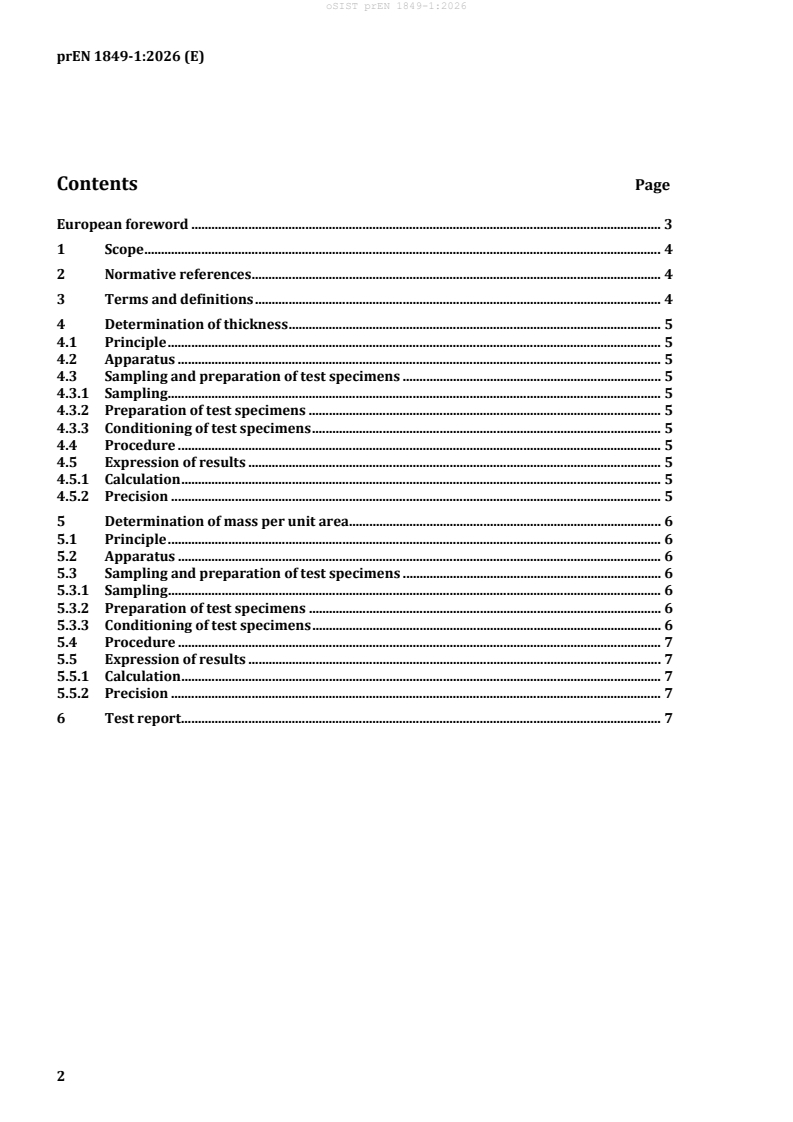
Contents Page
European foreword . 3
1 Scope . 4
2 Normative references . 4
3 Terms and definitions . 4
4 Determination of thickness . 5
4.1 Principle . 5
4.2 Apparatus . 5
4.3 Sampling and preparation of test specimens . 5
4.3.1 Sampling . 5
4.3.2 Preparation of test specimens . 5
4.3.3 Conditioning of test specimens . 5
4.4 Procedure . 5
4.5 Expression of results . 5
4.5.1 Calculation . 5
4.5.2 Precision . 5
5 Determination of mass per unit area . 6
5.1 Principle . 6
5.2 Apparatus . 6
5.3 Sampling and preparation of test specimens . 6
5.3.1 Sampling . 6
5.3.2 Preparation of test specimens . 6
5.3.3 Conditioning of test specimens . 6
5.4 Procedure . 7
5.5 Expression of results . 7
5.5.1 Calculation .
...