


EN 12420:2024
(Main)Copper and copper alloys - Forgings
Copper and copper alloys - Forgings
This European Standard specifies the composition, the property requirements and tolerances on dimensions and form for copper and copper alloy die and hand forgings.
The sampling procedures, the methods of test for verification of conformity to the requirements of this standard, and the delivery conditions are also specified.
Kupfer und Kupferlegierungen - Schmiedestücke
Dieses Dokument legt die Zusammensetzung, die Anforderungen an die Eigenschaften und Maß- und Formtoleranzen für Gesenk- und Freiformschmiedestücke aus Kupfer und Kupferlegierungen fest.
Der Ablauf der Probenentnahme, die Prüfverfahren zur Feststellung der Übereinstimmung mit den Anforderungen dieses Dokuments und die Lieferbedingungen sind ebenfalls festgelegt.
Cuivre et alliages de cuivre - Pièces forgées
Le présent document spécifie la composition, les exigences de propriétés et les tolérances de dimensions et de forme des pièces forgées par matriçage et des pièces forgées libres en cuivre et alliages de cuivre.
Les modes opératoires d’échantillonnage, les méthodes d’essai pour la vérification de la conformité aux exigences du présent document et les conditions de livraison sont également spécifiés.
Baker in bakrove zlitine - Izkovki
Ta evropski standard določa sestavo, zahteve za lastnosti ter odstopanja glede mer in oblike za prosto in utopno kovane izkovke iz bakra in bakrovih zlitin.
Določeni so tudi postopki vzorčenja, preskusne metode za preverjanje skladnosti z zahtevami tega evropskega standarda in dobavni pogoji.
General Information
- Status
- Published
- Publication Date
- 15-Oct-2024
- Technical Committee
- CEN/TC 133 - Copper and copper alloys
- Drafting Committee
- CEN/TC 133/WG 4 - Extruded and drawn products, forgings and scrap
- Current Stage
- 6060 - Definitive text made available (DAV) - Publishing
- Start Date
- 16-Oct-2024
- Due Date
- 27-Nov-2023
- Completion Date
- 16-Oct-2024
Relations
- Effective Date
- 18-Jan-2023
Overview
EN 12420:2024 / EN 12420:2024 - "Copper and copper alloys - Forgings" - is the updated European standard that defines requirements for die and hand forgings made from copper and copper alloys. Issued by CEN and adopted as a Slovenian national standard, this 2024 edition supersedes EN 12420:2014 and sets out composition limits, mechanical and electrical property requirements, dimensional and form tolerances, sampling procedures, test methods and delivery conditions for forged copper products.
Key topics and technical requirements
- Material composition and designation: Chemical composition limits and material symbols/numbers for a wide range of copper alloys used for forgings, including additions and updates of new alloys in the 2024 revision.
- Mechanical and physical properties: Requirements for tensile properties, hardness, electrical conductivity and residual stress levels.
- Corrosion resistance tests: Methods and acceptance criteria for resistance to dezincification and stress corrosion.
- Dimensional and form tolerances: Detailed tolerances for die forgings, cored forgings and hand forgings (including mismatch, flash, ejector marks, flatness and angular tolerances).
- Sampling and test methods: Procedures for sampling, chemical analysis, hardness testing, electrical conductivity testing, dezincification and stress corrosion tests, plus retest rules and rounding of results.
- Certification and delivery: Requirements for certificates of compliance, inspection documentation, marking, labelling and packaging.
- Informative guidance: Annex A provides recommended design guidelines (drafts, wall thicknesses, ribs, cores, machining allowances) and Annex ZA relates the standard to the Pressure Equipment Directive (PED).
Note: the 2024 edition documents specific technical changes (new alloys added, composition updates and a new hardness table for material group III). The standard also flags potential patent claims for certain alloys.
Practical applications
EN 12420:2024 is essential where reliable, specification-driven copper forgings are required, such as:
- Valves, fittings and plumbing components
- Pump and compressor parts
- Electrical connectors and conductive components
- Marine hardware and corrosion-sensitive parts
- Components for pressure equipment where PED conformity is relevant
Using the standard helps ensure consistent material performance, manufacturability, machinability and long-term corrosion behavior.
Who should use this standard
- Forging manufacturers and foundries producing copper and copper-alloy parts
- Design and mechanical engineers specifying forged components
- Quality and inspection personnel, test laboratories and certification bodies
- Procurement and compliance teams verifying supplier conformity to EN 12420:2024
Related standards
- EN 12163, EN 12164, EN 12165, EN 12166, EN 12167, EN 12168 - related CEN standards for copper products (rod, wire, profiles, hollow rod) that complement EN 12420 for broader material selection and supply chain requirements.
Keywords: EN 12420:2024, EN 12420:2024, copper forgings standard, copper and copper alloys, die forgings, hand forgings, tolerances, sampling procedures, dezincification, electrical conductivity, pressure equipment.

Frequently Asked Questions
EN 12420:2024 is a standard published by the European Committee for Standardization (CEN). Its full title is "Copper and copper alloys - Forgings". This standard covers: This European Standard specifies the composition, the property requirements and tolerances on dimensions and form for copper and copper alloy die and hand forgings. The sampling procedures, the methods of test for verification of conformity to the requirements of this standard, and the delivery conditions are also specified.
This European Standard specifies the composition, the property requirements and tolerances on dimensions and form for copper and copper alloy die and hand forgings. The sampling procedures, the methods of test for verification of conformity to the requirements of this standard, and the delivery conditions are also specified.
EN 12420:2024 is classified under the following ICS (International Classification for Standards) categories: 77.150.30 - Copper products. The ICS classification helps identify the subject area and facilitates finding related standards.
EN 12420:2024 has the following relationships with other standards: It is inter standard links to EN 12420:2014. Understanding these relationships helps ensure you are using the most current and applicable version of the standard.
EN 12420:2024 is associated with the following European legislation: EU Directives/Regulations: 2014/68/EU; Standardization Mandates: M/071, M/601. When a standard is cited in the Official Journal of the European Union, products manufactured in conformity with it benefit from a presumption of conformity with the essential requirements of the corresponding EU directive or regulation.
You can purchase EN 12420:2024 directly from iTeh Standards. The document is available in PDF format and is delivered instantly after payment. Add the standard to your cart and complete the secure checkout process. iTeh Standards is an authorized distributor of CEN standards.
Standards Content (Sample)
SLOVENSKI STANDARD
01-december-2024
Baker in bakrove zlitine - Izkovki
Copper and copper alloys - Forgings
Kupfer und Kupferlegierungen - Schmiedestücke
Cuivre et alliages de cuivre - Pièces forgées
Ta slovenski standard je istoveten z: EN 12420:2024
ICS:
77.150.30 Bakreni izdelki Copper products
2003-01.Slovenski inštitut za standardizacijo. Razmnoževanje celote ali delov tega standarda ni dovoljeno.
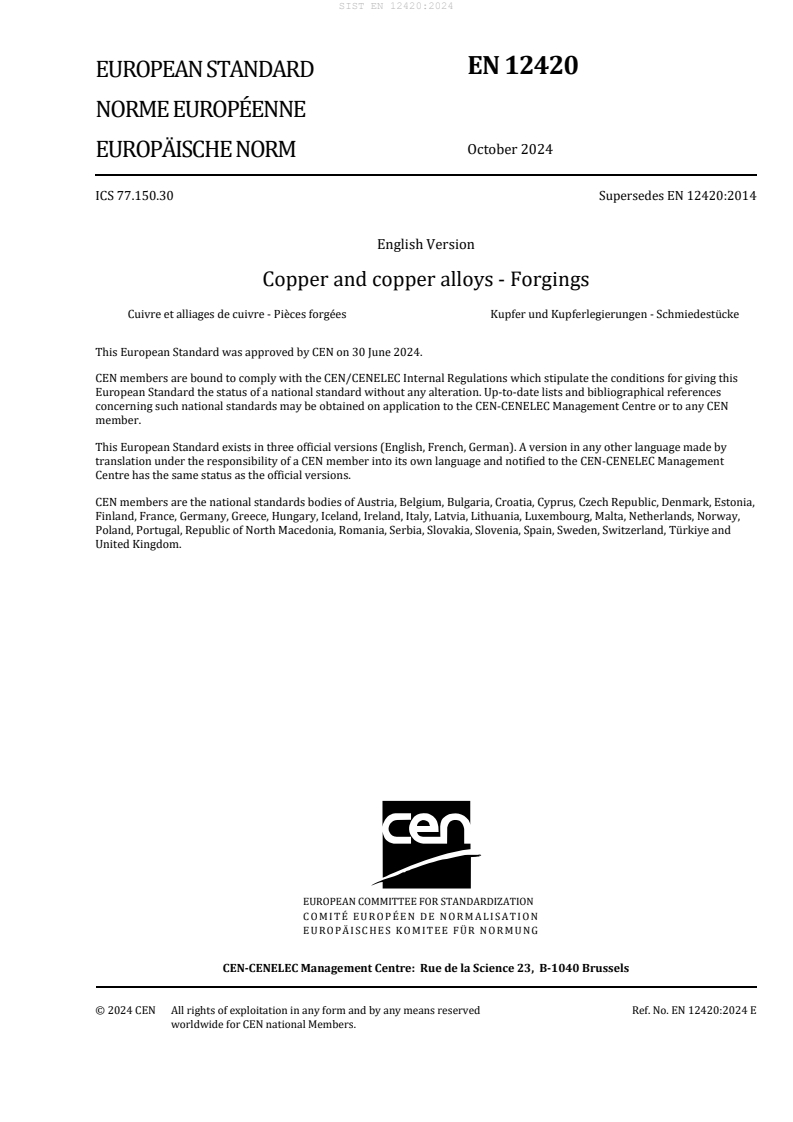
EN 12420
EUROPEAN STANDARD
NORME EUROPÉENNE
October 2024
EUROPÄISCHE NORM
ICS 77.150.30 Supersedes EN 12420:2014
English Version
Copper and copper alloys - Forgings
Cuivre et alliages de cuivre - Pièces forgées Kupfer und Kupferlegierungen - Schmiedestücke
This European Standard was approved by CEN on 30 June 2024.
CEN members are bound to comply with the CEN/CENELEC Internal Regulations which stipulate the conditions for giving this
European Standard the status of a national standard without any alteration. Up-to-date lists and bibliographical references
concerning such national standards may be obtained on application to the CEN-CENELEC Management Centre or to any CEN
member.
This European Standard exists in three official versions (English, French, German). A version in any other language made by
translation under the responsibility of a CEN member into its own language and notified to the CEN-CENELEC Management
Centre has the same status as the official versions.
CEN members are the national standards bodies of Austria, Belgium, Bulgaria, Croatia, Cyprus, Czech Republic, Denmark, Estonia,
Finland, France, Germany, Greece, Hungary, Iceland, Ireland, Italy, Latvia, Lithuania, Luxembourg, Malta, Netherlands, Norway,
Poland, Portugal, Republic of North Macedonia, Romania, Serbia, Slovakia, Slovenia, Spain, Sweden, Switzerland, Türkiye and
United Kingdom.
EUROPEAN COMMITTEE FOR STANDARDIZATION
COMITÉ EUROPÉEN DE NORMALISATION
EUROPÄISCHES KOMITEE FÜR NORMUNG
CEN-CENELEC Management Centre: Rue de la Science 23, B-1040 Brussels
© 2024 CEN All rights of exploitation in any form and by any means reserved Ref. No. EN 12420:2024 E
worldwide for CEN national Members.
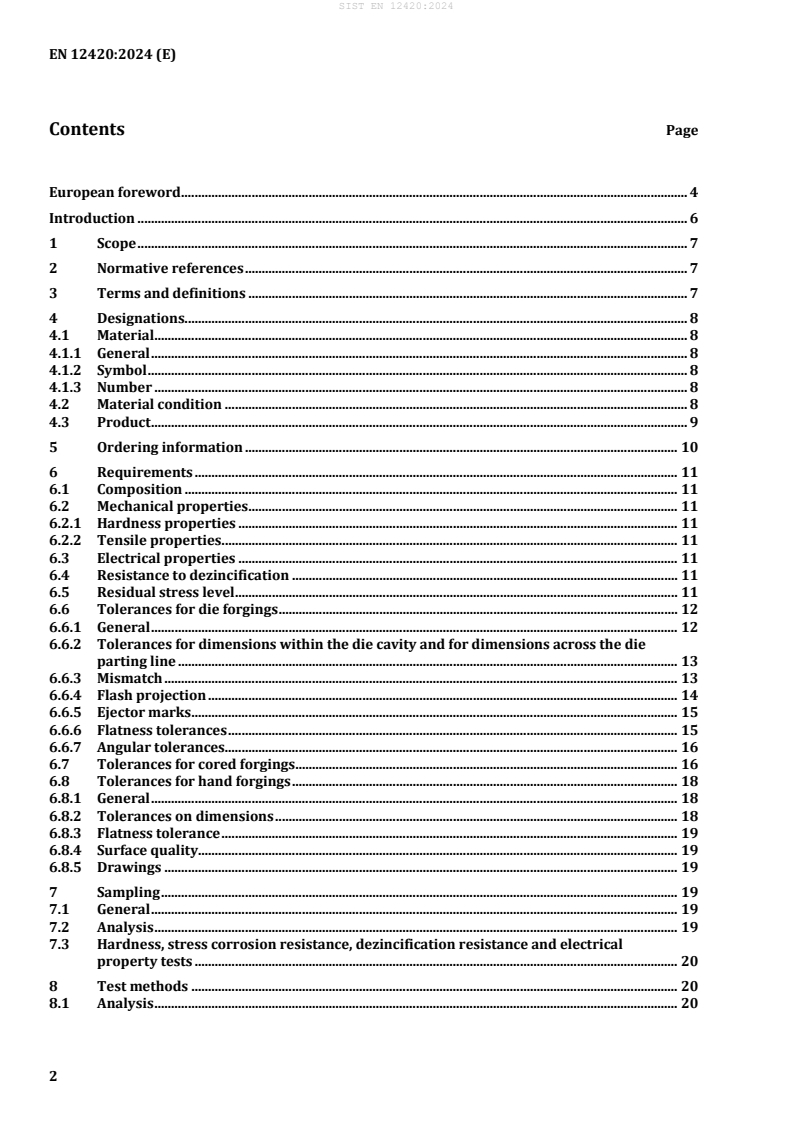
Contents Page
European foreword . 4
Introduction . 6
1 Scope . 7
2 Normative references . 7
3 Terms and definitions . 7
4 Designations. 8
4.1 Material . 8
4.1.1 General . 8
4.1.2 Symbol . 8
4.1.3 Number . 8
4.2 Material condition . 8
4.3 Product . 9
5 Ordering information . 10
6 Requirements . 11
6.1 Composition . 11
6.2 Mechanical properties . 11
6.2.1 Hardness properties . 11
6.2.2 Tensile properties. 11
6.3 Electrical properties . 11
6.4 Resistance to dezincification . 11
6.5 Residual stress level . 11
6.6 Tolerances for die forgings . 12
6.6.1 General . 12
6.6.2 Tolerances for dimensions within the die cavity and for dimensions across the die
parting line . 13
6.6.3 Mismatch . 13
6.6.4 Flash projection . 14
6.6.5 Ejector marks. 15
6.6.6 Flatness tolerances . 15
6.6.7 Angular tolerances. 16
6.7 Tolerances for cored forgings . 16
6.8 Tolerances for hand forgings . 18
6.8.1 General . 18
6.8.2 Tolerances on dimensions . 18
6.8.3 Flatness tolerance . 19
6.8.4 Surface quality. 19
6.8.5 Drawings . 19
7 Sampling . 19
7.1 General . 19
7.2 Analysis . 19
7.3 Hardness, stress corrosion resistance, dezincification resistance and electrical
property tests . 20
8 Test methods . 20
8.1 Analysis . 20
8.2 Hardness test . 20
8.3 Electrical conductivity test . 20
8.4 Dezincification resistance test . 20
8.5 Stress corrosion resistance test . 20
8.6 Retests . 21
8.6.1 Analysis, hardness, electrical conductivity and dezincification resistance tests . 21
8.6.2 Stress corrosion resistance test . 21
8.7 Rounding of results . 21
9 Certificate of compliance and inspection documentation . 21
9.1 Certificate of compliance . 21
9.2 Inspection documentation . 21
10 Marking, labelling, packaging . 22
Annex A (informative) Recommended guidelines for design . 41
A.1 Introduction. 41
A.2 General information . 41
A.3 Guidelines for die forgings . 42
A.3.1 Drafts . 42
A.3.2 Web thicknesses . 42
A.3.3 Side wall thicknesses . 43
A.3.4 Rib design . 44
A.3.5 Cores . 45
A.3.6 Flash . 46
A.3.7 Transition radii . 47
A.3.8 Clamping lengths and clamping areas for finish machining . 49
A.3.9 Design for cross-sectional shapes . 49
A.3.10 Recommended machining allowances and total allowances . 50
A.4 Guidelines for hand forgings . 52
A.4.1 General . 52
A.4.2 General information . 52
A.4.3 Section changes and transitions . 53
A.4.4 Recommended machining allowances . 53
A.4.5 Total allowances per side of forging . 54
A.5 Guidelines for marking . 55
Annex B (informative) Tensile properties . 56
Annex ZA (informative) Relationship between this European Standard and the essential
requirements of Directive 2014/68/EU (Pressure equipment Directive) aimed to be
covered . 60
Bibliography . 61
European foreword
This document (EN 12420:2024) has been prepared by Technical Committee CEN/TC 133 “Copper and
copper alloys”, the secretariat of which is held by DIN.
This European Standard shall be given the status of a national standard, either by publication of an
identical text or by endorsement, at the latest by April 2025, and conflicting national standards shall be
withdrawn at the latest by April 2025.
Attention is drawn to the possibility that some of the elements of this document may be the subject of
patent rights. CEN shall not be held responsible for identifying any or all such patent rights.
This document supersedes EN 12420:2014.
In comparison with EN 12420:2014, the following significant technical changes were made:
1) Introduction in the chemical composition Tables of a footnote to explain the meaning of elements for
which no upper and lower limits are specified;
2) CuSi4Zn4MnP (CW245E) and CuSi4Zn9MnP (CW246E) added in the new Table 3 and Table 10;
3) Chemical composition of CuZn39Pb3 (CW614N), CuZn40Pb2 (CW617N), CuZn35Pb1,5AlAs
(CW625N) and CuZn33Pb1,5AlAs (CW626N) modified in Table 8;
4) Added a new alloy CuZn40Pb1 (CW627N) in Table 8, Table 10 and Table B.1;
5) Chemical composition of CuZn33Pb1AlSiAs (CW725R) modified in Table 9;
6) Added a new alloy CuZn36Si1P (CW726R) in Table 9, Table 10 and Table B.1;
7) Added new Table 12 for Hardness properties for forgings of material group III.
This is one of a series of European Standards for the copper and copper alloy products rod, wire, profile
and forgings. Other products are specified as follows:
— EN 12163, Copper and copper alloys — Rod for general purposes;
— EN 12164, Copper and copper alloys — Rod for free machining purposes;
— EN 12165, Copper and copper alloys — Wrought and unwrought forging stock;
— EN 12166, Copper and copper alloys — Wire for general purposes;
— EN 12167, Copper and copper alloys — Profiles and rectangular bars for general purposes;
— EN 12168, Copper and copper alloys — Hollow rod for free machining purposes.
This document has been prepared under a standardization request addressed to CEN by the European
Commission. The Standing Committee of the EFTA States subsequently approves these requests for its
Member States.
For the relationship with EU Legislation, see informative Annex ZA, which is an integral part of this
document.
Any feedback and questions on this document should be directed to the users’ national standards body.
A complete listing of these bodies can be found on the CEN website.
According to the CEN-CENELEC Internal Regulations, the national standards organisations of the
following countries are bound to implement this European Standard: Austria, Belgium, Bulgaria, Croatia,
Cyprus, Czech Republic, Denmark, Estonia, Finland, France, Germany, Greece, Hungary, Iceland, Ireland,
Italy, Latvia, Lithuania, Luxembourg, Malta, Netherlands, Norway, Poland, Portugal, Republic of North
Macedonia, Romania, Serbia, Slovakia, Slovenia, Spain, Sweden, Switzerland, Türkiye and the United
Kingdom.
Introduction
The European Committee for Standardization (CEN) draws attention to the fact that it is claimed that
compliance with this document may involve the use of a patent concerning the alloys
CuSi4Zn4MnP (CW245E), CuSi4Zn9MnP (CW246E) and CuZn36Si1P (CW726R) given in 6.1.
CEN takes no position concerning the evidence, validity and scope of this patent right.
The holder of this patent right has ensured the CEN that he/she is willing to negotiate licences under
reasonable and not-discriminatory terms and conditions with applicants throughout the world. In this
respect, the statement of the holder of this patent right is registered with CEN.
— For CuSi4Zn4MnP (CW245E) and CuSi4Zn9MnP (CW246E) information may be obtained from:
Viega Technology GmbH & Co. KG
Viega Platz 1
57439 Attendorn
GERMANY
— For CuZn36Si1P (CW726R) information may be obtained from:
Luvata Oy
Kuparitie 5
28330 Pori
FINLAND
Attention is drawn to the possibility that some of the elements of this document may be the subject of
patent rights other than those identified above. CEN shall not be held responsible for identifying any or
all such patent rights.
CEN (http://www.cen.eu/cen/WorkArea/IPR/Pages/default.aspx) and CENELEC
(http://www.cenelec.eu/membersandexperts/toolsandapplications/index.html) maintain online lists of
patents relevant to their standards. Users are encouraged to consult the lists for the most up to date
information concerning patents.
Due to developing legislation, the composition of a material may be restricted to the composition
specified in this European Standard with respect to individual uses (e.g. for the use in contact with
drinking water in some Member States of the European Union). These individual restrictions are not part
of this European Standard. Nevertheless, for materials for which traditional and major uses are affected,
these restrictions are indicated. The absence of an indication, however, does not imply that the material
can be used in any application without any legal restriction.
1 Scope
This document specifies the composition, the property requirements and tolerances on dimensions and
form for copper and copper alloy die and hand forgings.
The sampling procedures, the methods of test for verification of conformity to the requirements of this
document, and the delivery conditions are also specified.
2 Normative references
The following documents are referred to in the text in such a way that some or all of their content
constitutes requirements of this document. For dated references, only the edition cited applies. For
undated references, the latest edition of the referenced document (including any amendments) applies.
EN 764-5:2014, Pressure equipment - Part 5: Inspection documentation of metallic materials and
compliance with the material specification
EN 1173:2008, Copper and copper alloys - Material condition designation
EN 1412:2016, Copper and copper alloys - European numbering system
EN 1976:2012, Copper and copper alloys - Cast unwrought copper products
EN 14977:2006, Copper and copper alloys - Detection of tensile stress - 5 % ammonia test
EN ISO 6506-1:2014, Metallic materials - Brinell hardness test - Part 1: Test method (ISO 6506-1:2014)
EN ISO 6509-1:2014, Corrosion of metals and alloys - Determination of dezincification resistance of copper
alloys with zinc - Part 1: Test method (ISO 6509-1:2014)
ISO 1190-1:1982, Copper and copper alloys — Code of designation — Part 1: Designation of materials
ISO 2768-1:1989, General tolerances — Part 1: Tolerances for linear and angular dimensions without
individual tolerance indications
ISO 6957:1988, Copper alloys — Ammonia test for stress corrosion resistance
3 Terms and definitions
For the purposes of this document, the following terms and definitions apply.
ISO and IEC maintain terminology databases for use in standardization at the following addresses:
• IEC Electropedia: available at http://www.electropedia.org/
• ISO Online browsing platform: available at http://www.iso.org/obp
3.1
forging
wrought product, hot formed by hammering or pressing
3.1.1
die forging
forging produced between closed dies
3.1.2
hand forging
forging produced between open dies
3.1.3
cored forging
forging produced between closed dies including cores
3.2
deviation from concentricity
half of the difference between the maximum and the minimum wall thickness (s and s ), measured
max min
in the same plane perpendicular to the axis of the forging
Note 1 to entry: Deviation from concentricity (mm) = (s − s )/2.
max min
3.3
inspection lot
definite quantity of products of the same cross-sectional dimensions, the same material and material
condition, collected together for inspection (testing)
4 Designations
4.1 Material
4.1.1 General
The material is designated either by symbol or number (see Tables 1 to 9).
4.1.2 Symbol
The material symbol designation shall be based on the designation system given in ISO 1190-1:1982.
NOTE Although material symbol designations used in this standard might be the same as those in other
standards using the designation system given in ISO 1190-1:1982, the detailed composition requirements are not
necessarily the same.
4.1.3 Number
The material number designation shall be in accordance with the system given in EN 1412:2016.
4.2 Material condition
For the purposes of this document, the following designations, which are in accordance with the system
given in EN 1173:2008, apply for the material condition:
M Material condition for the product as manufactured without specified mechanical
properties;
H. Material condition designated by the minimum value of hardness requirement for the
product with mandatory hardness requirements;
S (suffix) Material condition for a product which is stress relieved.
Products in the M or H. condition may be specially processed (i.e. mechanically or thermally stress
relieved) in order to lower the residual stress level to improve the resistance to stress corrosion and the
dimensional stability on machining [see Clause 5, list entry g) and list entry i)].
Except when the suffix S is used, material condition is designated by only one of the above designations.
4.3 Product
The product designation provides a standardized pattern of designation from which a rapid and
unequivocal description of a product is conveyed in communication. It provides mutual comprehension
at the international level with regard to products which meet the requirements of the relevant European
Standard.
The product designation is no substitute for the full content of the standard.
The product designation for products to this standard shall consist of:
— denomination (Forging);
— number of this document (EN 12420);
— material designation, either symbol or number (see Tables 1 to 9);
— for the use in contact with drinking water: DW for compliance in the chemical composition according
to 4 MS Common Composition List (see Bibliography [5]);
— material condition designation (see Tables 10 and 12).
The derivation of a product designation is shown in the following examples.
EXAMPLE 1 Forging conforming to this standard, in material designated either CuZn40Pb2 or CW617N, for
standard applications, in material condition H070, will be designated as follows:
EXAMPLE 2 Forging conforming to this standard, in material designed either CuZn40Pb2 or CW617N, for the
use in contact with drinking water DW, in material condition H070, will be designated as follows:
5 Ordering information
In order to facilitate the enquiry, order and confirmation of order procedures the following information
shall be specified:
a) quantity of product required (mass or number of pieces);
b) denomination (Forging);
c) number of this document (EN 12420);
d) material designation (see Tables 1 to 9);
e) material condition designation (see 4.2 and Tables 10 to 12) if it is other than M;
f) for the use in contact with drinking water: DW for compliance in the chemical composition according
to 4 MS Common Composition List;
g) nominal dimensions and/or tolerance drawing of the forging or finished part including the number
of the drawing (see 6.6).
It is recommended that the product designation, as described in 4.3, is used for items b) to e).
In addition, it shall also state on the enquiry and order any of the following, if required:
h) whether the products according to 6.3, are required to pass a dezincification resistance test (see 8.4)
i) whether the products are required to pass a stress corrosion resistance test. If so, which test method
is to be used (see 8.5) if the choice is not to be left to the discretion of the supplier. If it is chosen
ISO 6957:1988, the pH value for the test solution is to be selected;
j) whether the products are to be supplied in a thermally stress relieved condition;
k) when requested, tensile properties have to be agreed between the involved parties (see 6.2.2 and
Tables B.1 to B.3);
l) whether a certificate of compliance is required (see 9.1);
m) whether an inspection document is required, and if so, which type (see 9.2);
n) whether there are any special requirements for marking, labelling or packaging (see Clause 10).
EXAMPLE Ordering details for 200 forgings conforming to EN 12420, in material designated either
CuZn40Pb2 or CW617N, for the use in contact with drinking water DW, in material condition H070, according to
drawing number XY000:
200 pieces Forging EN 12420 — CuZn40Pb2 — DW — H070 — drawing number XY000
or
200 pieces Forging EN 12420 — CW617N — DW — H070 — drawing number XY000
6 Requirements
6.1 Composition
The composition shall conform to the requirements for the appropriate material given in Tables 1 to 9.
In the same tables the hot working attitude is also reported.
Due to developing legislation, specific applications (see 4.3) may require restrictions in the chemical
composition. In this case the limitations shall be stated in the ordering information [see Clause 5 list
entry f)].
NOTE As the materials specified in this standard vary considerably e.g. in their resistance to forming, forging
temperature and pressure, die wear and stresses, they have been classified into three groups of similar hot working
attitudes (I, II or III in descending order of hot working attitude).
A direct proportionality exists between the group and preheating temperature.
6.2 Mechanical properties
6.2.1 Hardness properties
The hardness properties shall conform to the appropriate requirements given in Tables 10 to 12. For the
alloys not mentioned in these tables the hardness values shall be agreed between the involved parties.
6.2.2 Tensile properties
This standard does not specify mandatory tensile properties. The values for the tensile properties given
in Tables B.1 to B.3 of Annex B are for information only.
6.3 Electrical properties
Forgings materials listed in Table 13 shall conform to the electrical properties specified in the same table.
6.4 Resistance to dezincification
This requirement only applies to materials that are declared resistant to dezincification.
The maximum depth of dezincification, in any direction, of CuZn38As (CW511L), CuZn36Pb2As
(CW602N), CuZn35Pb1,5AlAs (CW625N), CuZn33Pb1,5AlAs (CW626N), CuZn32Pb2AsFeSi (CW709R),
CuZn21Si3P (CW724R) and CuZn33Pb1AlSiAs (CW725R) products shall not exceed 150 µm.
The amount of β phase for CuZn38As (CW511L), CuZn36Pb2As (CW602N), CuZn35Pb1,5AlAs (CW625N),
CuZn33Pb1,5AlAs (CW626N), CuZn32Pb2AsFeSi (CW709R) and CuZn33Pb1AlSiAs (CW725R) shall be
less than 3 %.
The test shall be carried out in accordance with 8.4.
Products in alloys other than CuZn21Si3P (CW724R) shall be subjected to heat treatment approximately
in the range 500 °C to 550 °C after hot stamping. Should the user need to heat the material above 530 °C
(i.e. soldering, brazing or welding operations) then advice should be sought from the supplier.
6.5 Residual stress level
Forgings ordered in the stress relieved condition (see 4.2, 2nd paragraph) shall show no evidence of
cracking when tested. The tests shall be carried out in accordance with 8.5.
6.6 Tolerances for die forgings
6.6.1 General
Tolerances on dimensions and on form indicated in the drawings of a forging shall conform to the
tolerances specified in this standard. If no tolerances are indicated in the drawings, the tolerances
according to ISO 2768-1:1989, Tolerance Class c, shall apply. When more than one general tolerance is
applicable, the larger of the possible general tolerances shall be used.
It is recommended that reference to this standard is made on the drawings.
Two different types of dimensions are distinguished for die forgings:
a) dimensions within the die cavity which originate from the forging shape in one separate die part and
which does not have components moving towards one another, see dimensions n in Figure 1.
These die parts may consist of one single piece or of several components immovable towards one another.
b) dimensions across the die parting line which originate from two or more die parts moving towards
one another, see dimensions t in Figure 2.
The die forging produced in the dies demonstrated in Figure 1 and Figure 2 is shown in Figure 3.
Key
a direction of forging a direction of forging
Figure 1 — Dimensions n within the die cavity Figure 2 — Dimensions t across the die
parting line
Figure 3 — Die forging
For recommended machining allowances and total allowances see A.3.10 and Table A.6.
6.6.2 Tolerances for dimensions within the die cavity and for dimensions across the die parting
line
The dimensions n and t shall conform to the tolerances given in Table 14 for material group I, Table 15
for material group II and Table 16 for material group III.
The polygonal shapes shall conform to the tolerances given in Table 17 for material group I.
The largest dimension t in the direction of forging is the basic dimension for applying tolerances for
max
dimensions t across the die parting line. The tolerance for t depends on the area A of the part viewed
max
in the direction of blow. The area A in the case of round parts is equal to the area of the circle and in the
case of irregularly shaped parts is equal to the area of the circumscribing rectangle (see Figure 4). All
smaller dimensions t have the same tolerance as t .
max
Key
n largest nominal dimension
max
n nominal dimension
Figure 4 — Area A (in mm ) = n × n
max
The tolerances given in Tables 14 to 16 are also applicable for die forgings which are produced with a die
cavity in one die half only facing a plane opposite die half.
The tolerance need not necessarily be applied symmetrically about the nominal dimension; it may be all
plus or all minus.
6.6.3 Mismatch
Mismatch is not associated with a particular direction (see Figure 5).
The mismatch shall be determined by reference to the largest nominal dimension n as viewed in the
max
direction of forging (see Figure 5).
The permissible mismatch is given in Tables 14 to 16.
The maximum permitted mismatch shall be indicated above the title block or in the title block of the
drawing of the forging, e.g.: mismatch max. 0,5 mm.
Mismatch is not included in the tolerances for dimensions within the die cavity: the tolerances for
dimensions within the die cavity and for mismatch are in this case independently applied (see Figure 6
and Figure 7).
Dimensions in millimetres
Key Key
a mismatch a mismatch
b reference dimension for mismatch
n largest nominal dimension
max
Figure 5 — Mismatch Figure 6 — Intended Figure 7 — Permanent
construction actual dimensions
6.6.4 Flash projection
The flash projection is determined by reference to the largest nominal dimension n perpendicular to
max
the direction of forging (see Figure 8).
The permissible flash projection is given in Tables 14 to 16.
The flash originating from the die parting line shall be trimmed by the manufacturer.
Flash caused by deburring, punching or piercing or through-die inserts (see G1, G2, G3 and G4 in Figure 9)
is permissible, provided that it is either removed during machining or is not objectionable if left on the
finished part. This flash shall be indicated in the drawing and shall not exceed 1,5 mm.
Key Key
a direction of forging a production by choice
n largest nominal dimension b work-holder
max
c finished part
d permitted flash projection
Figure 8 — Dimension n used as reference Figure 9 — Types of flash
max
dimension for flash projection
Flash projection is applied independently of dimensional tolerances.
Key
a mismatch
b residual flash projection
Figure 10 — Flash projection
NOTE As the flash of type samples is generally trimmed by hand they do not represent the quality of trimming
during bulk production.
6.6.5 Ejector marks
If ejectors are necessary for manufacturing reasons, ejector marks can result as ridges (convex) or
indentations (concave) (see Figure 11 and Tables 14 to 16). If the ejector marks may be either concave
only or convex only, the total permissible variation applies.
EXAMPLE
— Permissible ejector mark: ±0,3 mm;
— Ejector mark only raised: + 0,6 mm;
— Ejector mark only recessed: – 0,6 mm.
Key
a ejector mark recessed
b ejector mark raised
Figure 11 — Ejector marks
6.6.6 Flatness tolerances
In addition to the tolerances caused by the forging process, deviation from flatness may result from
distortion, when ejecting, flash clipping, or any heat treatment.
Flatness tolerances shall be determined by reference to the largest nominal dimension n as viewed
max
in the direction of forging, see Figure 12 and Tables 14 to 16, and they are applied independently from all
tolerances of form or position.
Key
n reference dimension for the flatness tolerance
max
Figure 12 — Dimension n used as reference dimension of flatness tolerance
max
6.6.7 Angular tolerances
The tolerances in Table 18 apply to all angles α (see Figure 13) except draft angles.
NOTE For draft angles see guidelines for design in Annex A.
Key
a shorter leg
Figure 13 — Definition of shorter leg
6.7 Tolerances for cored forgings
Internal diameter a and External diameter b and depth of core penetration h for cored forgings shown
schematically in Figure 14 and 15 shall conform to the tolerances given in Table 19.
Circularity tolerance relating to outer diameter shall be calculated by summing the absolute values of n
or t of Table 14.
max
Key
1 parting line
a internal diameter
b external diameter
h depth of core penetration
Figure 14 — Cored forgings (products cored in the forging direction)
Key
1 parting line
a internal diameter
b external diameter
h depth of core penetration
s thickness of cored forgings
Figure 15 — Cored forgings (products cored normally to the forging direction)
6.8 Tolerances for hand forgings
6.8.1 General
At the time of the order may be supplied nominal dimensions and/or a toleranced drawing of the forging
or finished part but the tolerances on dimensions and on form shall conform to the requirements of 6.8.2
and 6.8.3.
It is recommended that reference to this standard is made on drawings.
In order to facilitate the preparation of drawings and the manufacture of sawing templates, all sawed
length and sawed width dimensions shall carry identical tolerances; the tolerance band being governed
by the maximum length.
NOTE For recommended machining allowances and total allowances see A.4.4, A.4.5 and Table A.7.
6.8.2 Tolerances on dimensions
Dimensions generally produced by machining n-dimensions and by forging t-dimensions shall conform
to the tolerances given in Table 20 (see Figures 16 and 17).
Figure 16 — Dimensions t (+b) and n (-a/+a)
Figure 17 — Dimensions t (+b) and n (-a/+a)
As variations in the finished diameter of discs and stepped hand forgings are difficult to control due to
spread and edge distortion, no tolerances are specified. It is recommended either that these tolerances
be agreed between the involved parties or that these parts are supplied in the pre-machined condition.
6.8.3 Flatness tolerance
In addition to the tolerances caused by the forging operation, there will be deviations from flatness due
to bending, twisting or the release of stresses, particularly during any subsequent heat treatment.
Forgings shall conform to the flatness tolerances given in Table 21, which are related to the length of the
forging and are applied independently from dimensional tolerances.
Dependent on the forging geometry (e.g. different section thicknesses) the deviation from flatness may
be checked using a straightedge or surface plate. Where this is not possible, a datum plane shall be
established by positioning the forging on three datum points.
6.8.4 Surface quality
Forgings as blanks have a surface corresponding to the manufacturing process.
Ridges, indentations, folds, mechanical damage on the surface of forgings, which will have no detrimental
effect on the use of the forgings, shall not be cause for rejection. Such surface irregularities and
imperfections may be removed by suitable means provided that this does not invalidate the specified
tolerances.
Special surface requirements are subjected to agreement between the involved parties.
NOTE Hand forgings are generally completely machined.
6.8.5 Drawings
At the time of the order may be supplied a drawing of the finished part for die and cored forgings and if
necessary for hand forgings. If possible, also a drawing of the forging showing the dimensions and
tolerances as well as the tooling points of first-stage machining should be supplied.
Guidelines for the design of forgings are given in Annex A.
The manufacturer of die forgings shall prepare a drawing of the forging, including tolerances, from the
data submitted at the time of order. This drawing shall be checked and approved by who made the order
and returned to the manufacturer before die-production is started.
Unless otherwise agreed between the involved parties the manufacturer shall produce type samples for
testing. When approved, the type sample and the drawing of the forging shall be the basis of agreement
for bulk production.
7 Sampling
7.1 General
When required or for use in cases of dispute, an inspection lot shall be sampled in accordance with 7.2
and 7.3.
7.2 Analysis
The sampling rate shall be in accordance with Table 22. A test sample, depending on the analytical
technique to be employed, shall be prepared from each sampling unit and used for the determination of
the composition.
When preparing the test sample, care should be taken to avoid contaminating or overheating the test
sample. Carbide tipped tools are recommended; steel tools, if used, should be made of magnetic material
to assist in the subsequent removal of extraneous iron. If the test samples are in finely divided form (e.g.
drillings, millings), they should be treated carefully with a strong magnet to remove any particles of iron
introduced during preparation.
In cases of dispute concerning the results of analysis, the full procedure given in ISO 1811-2 should be
followed.
Results may be used from analyses carried out at an earlier stage of manufacturing the product, e.g. at the
forging stock stage, if the material identity is maintained and if the manufacturer can ensure the
traceability of the product.
7.3 Hardness, stress corrosion resistance, dezincification resistance and electrical
property tests
The sampling rate shall be in accordance with Table 22. Sampling units shall be selected from the finished
products. The test samples shall be cut from the sampling units. Except in cases of dispute, the location of
the point in which the hardness is determined shall be on a representative surface. Test samples, and test
pieces prepared from them, shall not be subjected to any further treatment, other than any machining
operations necessary in the preparation of the test pieces.
8 Test methods
8.1 Analysis
Analysis shall be carried out on the test pieces, or test portions, prepared from the test samples obtained
in accordance with 7.2. Except in cases of dispute, the analytical methods used shall be at the discretion
of the supplier. For expression of results, the rounding rules given in 8.7 shall be used.
In cases of dispute concerning the results of analysis, the methods of analysis to be used should be agreed
between the disputing parties.
8.2
...
Die Norm EN 12420:2024 legt die Anforderungen an die Zusammensetzung, die Eigenschaften sowie die Toleranzen hinsichtlich der Dimensionen und der Form für Bronze- und Kupferlegierungsformen fest. Dieser Begriff umfasst sowohl Gesenkschmiedeteile als auch Handgeschmiedeteile aus Kupfer und Kupferlegierungen. Die klare Definition der Materialanforderungen in dieser Norm stärkt die Qualität und Konsistenz der Produktfertigung. Ein wesentlicher Vorteil der Norm ist die Festlegung spezifischer Prüfmethoden zur Überprüfung der Konformität, was zu einer einheitlichen Anwendung in der Industrie führt. Diese Prüfmethoden ermöglichen eine zuverlässige Bewertung der Produkteigenschaften, wodurch Hersteller und Verbraucher von erhöhtem Vertrauen in die gefertigten Erzeugnisse profitieren. Des Weiteren definiert die EN 12420:2024 die geeigneten Lieferbedingungen, die die Transparenz und Nachvollziehbarkeit der gelieferten Produkte gewährleisten. Die Berücksichtigung von Dimensionstoleranzen ist besonders relevant, um sicherzustellen, dass die Endprodukte den spezifischen Anforderungen und Anwendungen in verschiedenen Bereichen der Industrie gerecht werden. Die Relevanz dieser Norm in der aktuellen industriellen Landschaft kann nicht hoch genug eingeschätzt werden. Mit der kontinuierlichen Technologisierung und den steigenden Anforderungen an die Materialqualität bietet die EN 12420:2024 eine wertvolle Grundlage für Hersteller von Kupfer- und Kupferlegierungsprodukten, um wettbewerbsfähig zu bleiben und den internationalen Standards gerecht zu werden.
La norme SIST EN 12420:2024 traite de la composition, des exigences de propriétés et des tolérances dimensionnelles et de forme pour les forges de cuivre et de ses alliages, tant en matriçage qu'à la main. Cette normalisation est essentielle pour garantir la qualité et la précision des produits en cuivre dans diverses applications industrielles. L'un des points forts de cette norme est la clarté des exigences qu’elle établit pour les forges. En spécifiant les propriétés mécaniques et chimiques des alliages, elle permet aux fabricants de répondre aux attentes spécifiques des utilisateurs finaux. De plus, les tolérances sur les dimensions et la forme sont clairement définies, ce qui réduit les risques de non-conformité et améliore l'efficacité des processus de fabrication. La norme inclut également des procédures d'échantillonnage et des méthodes de vérification, ce qui assure une conformité constante aux exigences. Ceci est particulièrement pertinent pour les entreprises cherchant à maintenir des niveaux de qualité élevés tout en respectant les normes de l'industrie. Les conditions de livraison mentionnées dans la norme garantissent que les produits sont fournis de manière cohérente et fiable, ce qui contribue à la satisfaction des clients. En ce qui concerne la pertinence, la norme SIST EN 12420:2024 répond à un besoin croissant dans l'industrie pour des produits en cuivre de haute qualité et conformes aux standards européens. Avec l'augmentation de l'utilisation de cuivre et d'alliages de cuivre dans des secteurs variés tels que l'électronique, la plomberie et l'automobile, cette norme devient un outil précieux pour les fabricants et les clients. La standardisation des forges en cuivre et alliages de cuivre permet non seulement de garantir la sécurité et la fonctionnalité des produits, mais elle renforce également la compétitivité des entreprises sur le marché européen et international. En résumé, la norme SIST EN 12420:2024 est un cadre indispensable pour assurer la qualité, la fiabilité et la conformité des forges en cuivre, tout en soutenant les exigences de l'industrie moderne.
SIST EN 12420:2024는 구리 및 구리 합금 단조품에 대한 유럽 표준으로, 구리 합금의 조성, 성질 요구사항, 치수 및 형상에 대한 공차를 명확하게 규정하고 있습니다. 이 표준은 특히 다이 및 핸드 단조에 필요한 기준을 설정하여, 산업계에서의 품질 및 안전성을 보장하는 데 큰 역할을 합니다. 이 표준의 주된 강점은 구리 및 구리 합금 제품의 일관된 품질 보장을 위한 구체적인 기준을 제공한다는 점입니다. 표준은 조성 요구사항과 더불어 성질 요구사항을 명확하고 구체적으로 규정하여 제조업체가 제품을 일관되게 생산할 수 있도록 돕습니다. 또한, 치수와 형상에 대한 공차를 제공함으로써 최종 제품의 정확성을 확보하게 합니다. 추가로 이 표준은 샘플링 절차와 규정에 대한 적합성을 검증하기 위한 시험 방법을 자세히 설명하고 있어, 제조 과정에서의 품질 관리에 큰 도움이 됩니다. 더 나아가, 배송 조건에 대해서도 명확하게 규정하고 있어, 구매자와 판매자 간의 신뢰성을 높이는 데 기여합니다. SIST EN 12420:2024는 구리 및 구리 합금 단조품의 품질을 확보하고, 다양한 산업 분야에서의 응용 가능성을 높이기 위한 중요한 기준으로, 구리 제품의 제조 및 사용행태를 표준화하는 데 중대한 역할을 수행하고 있습니다.
The EN 12420:2024 standard provides a comprehensive framework for the production and assessment of copper and copper alloy forgings, establishing essential guidelines for manufacturers and quality assurance professionals. The scope of this standard extends to outlining the specific chemical composition and property requirements for both die and hand forgings, ensuring that products meet rigorous industry standards. One of the key strengths of EN 12420:2024 lies in its detailed requirements on tolerances concerning dimensions and form. This precision is crucial in applications where forgings must integrate seamlessly into larger systems or assemblies. By standardizing these specifications, manufacturers can minimize variations, thereby improving product quality and performance. Additionally, the standard incorporates well-defined sampling procedures and methods of testing to verify conformity. This aspect not only enhances the reliability of the forgings but also fosters confidence among consumers and stakeholders regarding the material's compliance with safety and performance expectations. The relevance of EN 12420:2024 in contemporary manufacturing cannot be overstated. As industries increasingly push for improved efficiency and sustainability, this standard provides an essential reference that aids in minimizing waste and ensuring that production processes adhere to the highest standards of quality. The comprehensive nature of the standard ensures that it is applicable across various sectors where copper and copper alloys are utilized, signifying its broad impact on metal fabrication practices. Overall, EN 12420:2024 exemplifies a robust approach to standardization in the manufacturing of copper and copper alloy forgings, offering significant benefits in terms of product quality, reliability, and industry-wide conformity.
SIST EN 12420:2024は、銅および銅合金の鍛造品に関するヨーロッパの標準であり、その範囲は銅および銅合金のダイ鍛造および手鍛造に必要な組成、特性要件、寸法および形の公差を明確に定義しています。この標準は、鍛造品の製造に関与するすべての関係者に対して、製品の一貫性と品質の確保を促進します。 この標準の強みは、その明確な仕様にあります。具体的には、銅および銅合金の鍛造における化学成分、機械的特性、ならびにサイズおよび形状に関する公差が詳細に規定されています。これにより、製造業者は必要な基準を理解し、製品が市場で求められる品質基準を満たすことを保証できます。 さらに、SIST EN 12420:2024は、サンプリング手順や、要求事項への適合性を確認するための試験方法も記載しており、これが標準の実用性を高めています。これにより、ユーザーは鍛造製品の品質を容易に評価できるとともに、必要な変更や改善を迅速に実施することが可能となります。 また、この標準文書は、銅および銅合金の鍛造品の供給条件を明確化することで、供給チェーン全体における透明性と信頼性を向上させます。このことは、特に国際的な取引やプロジェクトにおいて、異なる国や地域間での商取引を円滑に進めるために重要です。 このように、SIST EN 12420:2024は、鋳造業界における銅および銅合金の鍛造品についての基準を明確にしており、その強力な枠組みが業界の発展に寄与しています。この標準は、企業が規制に準拠し、高品質の製品を持続的に提供するために不可欠なガイドラインを示しています。
Questions, Comments and Discussion
Ask us and Technical Secretary will try to provide an answer. You can facilitate discussion about the standard in here.
Loading comments...