

FprEN 206-3
(Main)Concrete - Specification, performance, production and conformity - Part 3: Additional requirements for specification and conformity of concrete for special geotechnical works
- Abstract
(1) This document specifies additional requirements to FprEN 206 1 for the constituents, specification and conformity control of concrete used in:
— bored piles constructed in accordance with EN 1536;
— diaphragm walls constructed in accordance with EN 1538;
— cast-in-place displacement piles constructed in accordance with EN 12699;
— micropiles constructed in accordance with EN 14199.
NOTE 1 The requirements provided in this document are specified in accordance with FprEN 206 1:2025, 7.2 Specifications for designed concrete.
(2) This document can also apply to applications in special geotechnical works other than those listed above.
NOTE 2 For other special geotechnical works than those listed in paragraph (1) (e.g. cut-off walls or temporary works) provisions valid in the place of use can have provisions on cement types and suitability, minimum total binder content, minimum fines content, maximum water/total binder ratio, target values of fresh concrete properties and maximum tolerances for target values deviating from the provisions in FprEN 206 1.
(3) This document is based on the assumption that the specification is based on considerations including the site conditions and the conditions for execution of concrete used in special geotechnical works.
NOTE 3 Guidance for the specification of concrete used in special geotechnical works can be found in Annex A.
(4) Annex C specifies requirements applying to plastic concrete which is generally used for non-structural structures and groundwater barrier walls (cut-off walls).
- Status
- Not Published
- Publication Date
- 11-Feb-2026
- Current Stage
- 5060 - Closure of Vote - Formal Approval
- Start Date
- 18-Dec-2025
- Due Date
- 02-Mar-2026
- Completion Date
- 18-Dec-2025

Overview - FprEN 206-3 (Concrete for special geotechnical works)
FprEN 206-3 is a CEN draft European standard that provides additional specification and conformity requirements to prEN 206-1 for concrete used in special geotechnical works. It targets in-situ geotechnical elements such as bored piles (EN 1536), diaphragm walls (EN 1538), cast-in-place displacement piles (EN 12699) and micropiles (EN 14199), and can be applied to other special geotechnical applications (e.g., cut-off walls, temporary works). The document supplements the EN 206 family with tailored provisions on constituents, fresh concrete properties, and conformity control for these specialised uses.
Key topics and technical requirements
- Scope and interface with execution standards: Aligns concrete specification with execution standards for geotechnical works and assumes the specifier considers site and execution conditions.
- Constituents and composition:
- Cement and cementitious compounds must have established suitability for the geotechnical application; national provisions may define suitability.
- Use of cementitious compounds and specific admixtures is allowed where accepted in the place of use.
- Water/binder ratio:
- Maximum water/binder ratio can differ from exposure-class limits where justified for geotechnical uses (e.g., plastic concrete).
- Fines content:
- Minimum fines content generally not less than 350 kg/m³; for concrete gravity fed under submerged conditions the minimum is 400 kg/m³.
- Fines from aggregates may be counted up to 50 kg/m³.
- Fresh concrete properties:
- Workability, stability, bleeding, filtration and workability retention are specifically addressed for geotechnical placement methods (pumped through hollow stem, gravity feed, submerged conditions).
- Annex B references test methods including EN 12350 series (slump, flow table, slump‑flow).
- Plastic concrete:
- Special provisions in Annex C for low-strength, high-deformation plastic concretes used as non‑structural or groundwater barrier elements.
Practical applications and users
This standard is practical guidance for:
- Geotechnical and foundation engineers specifying concrete for piles, diaphragm walls and cut-off walls.
- Concrete producers formulating and controlling mixes for special geotechnical execution.
- Site contractors and specialist piling/diaphragm wall crews executing cast‑in‑place works.
- Testing laboratories and conformity assessors performing fresh concrete testing and production control.
Related standards
- prEN 206-1, prEN 206-2 (EN 206 series)
- EN 206:2013+A2:2021 (superseded elements)
- EN 1536, EN 1538, EN 12699, EN 14199 (execution standards)
- EN 12350 series (testing fresh concrete)
- EN 1992-1-1, EN 13670 (design and execution references)
Keywords: FprEN 206-3, concrete for special geotechnical works, bored piles, diaphragm walls, micropiles, specification and conformity, water/binder ratio, fines content, plastic concrete, workability, fresh concrete testing.
Relations
- Effective Date
- 09-Jun-2024
Get Certified
Connect with accredited certification bodies for this standard

DIBt (Deutsches Institut für Bautechnik)
German Institute for Building Technology.
DIN CERTCO
DIN Group product certification.

Aboma Certification B.V.
Specialized in construction, metal, and transport sectors.
Sponsored listings
Frequently Asked Questions
FprEN 206-3 is a draft published by the European Committee for Standardization (CEN). Its full title is "Concrete - Specification, performance, production and conformity - Part 3: Additional requirements for specification and conformity of concrete for special geotechnical works". This standard covers: (1) This document specifies additional requirements to FprEN 206 1 for the constituents, specification and conformity control of concrete used in: — bored piles constructed in accordance with EN 1536; — diaphragm walls constructed in accordance with EN 1538; — cast-in-place displacement piles constructed in accordance with EN 12699; — micropiles constructed in accordance with EN 14199. NOTE 1 The requirements provided in this document are specified in accordance with FprEN 206 1:2025, 7.2 Specifications for designed concrete. (2) This document can also apply to applications in special geotechnical works other than those listed above. NOTE 2 For other special geotechnical works than those listed in paragraph (1) (e.g. cut-off walls or temporary works) provisions valid in the place of use can have provisions on cement types and suitability, minimum total binder content, minimum fines content, maximum water/total binder ratio, target values of fresh concrete properties and maximum tolerances for target values deviating from the provisions in FprEN 206 1. (3) This document is based on the assumption that the specification is based on considerations including the site conditions and the conditions for execution of concrete used in special geotechnical works. NOTE 3 Guidance for the specification of concrete used in special geotechnical works can be found in Annex A. (4) Annex C specifies requirements applying to plastic concrete which is generally used for non-structural structures and groundwater barrier walls (cut-off walls).
(1) This document specifies additional requirements to FprEN 206 1 for the constituents, specification and conformity control of concrete used in: — bored piles constructed in accordance with EN 1536; — diaphragm walls constructed in accordance with EN 1538; — cast-in-place displacement piles constructed in accordance with EN 12699; — micropiles constructed in accordance with EN 14199. NOTE 1 The requirements provided in this document are specified in accordance with FprEN 206 1:2025, 7.2 Specifications for designed concrete. (2) This document can also apply to applications in special geotechnical works other than those listed above. NOTE 2 For other special geotechnical works than those listed in paragraph (1) (e.g. cut-off walls or temporary works) provisions valid in the place of use can have provisions on cement types and suitability, minimum total binder content, minimum fines content, maximum water/total binder ratio, target values of fresh concrete properties and maximum tolerances for target values deviating from the provisions in FprEN 206 1. (3) This document is based on the assumption that the specification is based on considerations including the site conditions and the conditions for execution of concrete used in special geotechnical works. NOTE 3 Guidance for the specification of concrete used in special geotechnical works can be found in Annex A. (4) Annex C specifies requirements applying to plastic concrete which is generally used for non-structural structures and groundwater barrier walls (cut-off walls).
FprEN 206-3 is classified under the following ICS (International Classification for Standards) categories: 91.100.30 - Concrete and concrete products. The ICS classification helps identify the subject area and facilitates finding related standards.
FprEN 206-3 has the following relationships with other standards: It is inter standard links to EN 206:2013+A2:2021. Understanding these relationships helps ensure you are using the most current and applicable version of the standard.
FprEN 206-3 is associated with the following European legislation: Standardization Mandates: M/114, M/128. When a standard is cited in the Official Journal of the European Union, products manufactured in conformity with it benefit from a presumption of conformity with the essential requirements of the corresponding EU directive or regulation.
FprEN 206-3 is available in PDF format for immediate download after purchase. The document can be added to your cart and obtained through the secure checkout process. Digital delivery ensures instant access to the complete standard document.
Standards Content (Sample)
SLOVENSKI STANDARD
oSIST prEN 206-3:2024
01-oktober-2024
Beton - Specifikacija, lastnosti, proizvodnja in skladnost - 3. del: Dodatne zahteve
za specifikacijo in skladnost betona za posebna geotehnična dela
Concrete - Specification, performance, production and conformity - Part 3: Additional
requirements for specification and conformity of concrete for special geotechnical works
Beton - Festlegung, Eigenschaften, Herstellung und Konformität - Teil 3: Zusätzliche
Anforderungen an die Festlegung und Konformität von Beton für spezielle geotechnische
Arbeiten
Béton - Spécification, performances, production et conformité - Partie 3 : Exigences
complémentaires relatives à la spécification et à la conformité du béton destiné aux
travaux géotechniques spéciaux
Ta slovenski standard je istoveten z: prEN 206-3
ICS:
91.100.30 Beton in betonski izdelki Concrete and concrete
products
93.020 Zemeljska dela. Izkopavanja. Earthworks. Excavations.
Gradnja temeljev. Dela pod Foundation construction.
zemljo Underground works
oSIST prEN 206-3:2024 en,fr,de
2003-01.Slovenski inštitut za standardizacijo. Razmnoževanje celote ali delov tega standarda ni dovoljeno.
oSIST prEN 206-3:2024
oSIST prEN 206-3:2024
DRAFT
EUROPEAN STANDARD
prEN 206-3
NORME EUROPÉENNE
EUROPÄISCHE NORM
August 2024
ICS 91.100.30 Will supersede EN 206:2013+A2:2021
English Version
Concrete - Specification, performance, production and
conformity - Part 3: Additional requirements for
specification and conformity of concrete for special
geotechnical works
Béton - Spécification, performances, production et Beton - Festlegung, Eigenschaften, Herstellung und
conformité - Partie 3 : Exigences supplémentaires pour Konformität - Teil 3: Zusätzliche Anforderungen an die
la définition et la conformité du béton destiné à des Festlegung und Konformität von Beton für spezielle
travaux géotechniques spécifiques geotechnische Arbeiten
This draft European Standard is submitted to CEN members for enquiry. It has been drawn up by the Technical Committee
CEN/TC 104.
If this draft becomes a European Standard, CEN members are bound to comply with the CEN/CENELEC Internal Regulations
which stipulate the conditions for giving this European Standard the status of a national standard without any alteration.
This draft European Standard was established by CEN in three official versions (English, French, German). A version in any other
language made by translation under the responsibility of a CEN member into its own language and notified to the CEN-CENELEC
Management Centre has the same status as the official versions.
CEN members are the national standards bodies of Austria, Belgium, Bulgaria, Croatia, Cyprus, Czech Republic, Denmark, Estonia,
Finland, France, Germany, Greece, Hungary, Iceland, Ireland, Italy, Latvia, Lithuania, Luxembourg, Malta, Netherlands, Norway,
Poland, Portugal, Republic of North Macedonia, Romania, Serbia, Slovakia, Slovenia, Spain, Sweden, Switzerland, Türkiye and
United Kingdom.
Recipients of this draft are invited to submit, with their comments, notification of any relevant patent rights of which they are
aware and to provide supporting documentation.
Warning : This document is not a European Standard. It is distributed for review and comments. It is subject to change without
notice and shall not be referred to as a European Standard.
EUROPEAN COMMITTEE FOR STANDARDIZATION
COMITÉ EUROPÉEN DE NORMALISATION
EUROPÄISCHES KOMITEE FÜR NORMUNG
CEN-CENELEC Management Centre: Rue de la Science 23, B-1040 Brussels
© 2024 CEN All rights of exploitation in any form and by any means reserved Ref. No. prEN 206-3:2024 E
worldwide for CEN national Members.
oSIST prEN 206-3:2024
prEN 206-3:2024 (E)
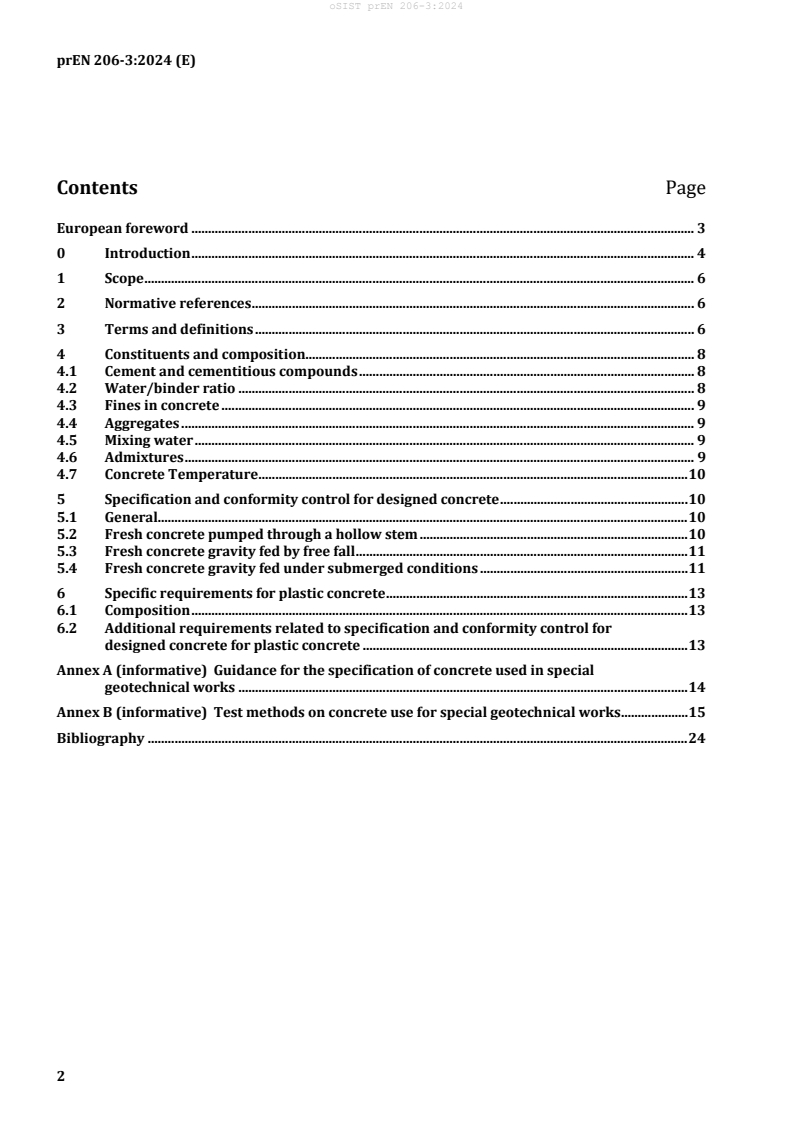
Contents Page
European foreword . 3
0 Introduction . 4
1 Scope . 6
2 Normative references . 6
3 Terms and definitions . 6
4 Constituents and composition. 8
4.1 Cement and cementitious compounds . 8
4.2 Water/binder ratio . 8
4.3 Fines in concrete . 9
4.4 Aggregates . 9
4.5 Mixing water . 9
4.6 Admixtures . 9
4.7 Concrete Temperature . 10
5 Specification and conformity control for designed concrete . 10
5.1 General. 10
5.2 Fresh concrete pumped through a hollow stem . 10
5.3 Fresh concrete gravity fed by free fall . 11
5.4 Fresh concrete gravity fed under submerged conditions . 11
6 Specific requirements for plastic concrete . 13
6.1 Composition . 13
6.2 Additional requirements related to specification and conformity control for
designed concrete for plastic concrete . 13
Annex A (informative) Guidance for the specification of concrete used in special
geotechnical works . 14
Annex B (informative) Test methods on concrete use for special geotechnical works . 15
Bibliography . 24
oSIST prEN 206-3:2024
prEN 206-3:2024 (E)
European foreword
This document (prEN 206-3:2024) has been prepared by Technical Committee CEN/TC 104 “Concrete
and related products”, the secretariat of which is held by SN.
This document is currently submitted to the CEN Enquiry.
This document will partially supersede EN 206:2013+A2:2021.
EN 206-3 was based on the contents of Annex D (Additional requirements for the specification and
conformity of concrete for special geotechnical works [foundation engineering]) from the previous
EN 206:2013+A2:2021. Annex D has been completely incorporated into EN 206-3. In particular, the
following new key points were included in the development of EN 206-3:
a) testing standards on fresh concrete properties as an addition to the EN 12350-series;
b) reference to non-specified material like cementitious compound, clay minerals or “special
admixtures”;
c) reference to temporary works;
d) reference to non-structural members.
This document forms part of three European Standards, written by CEN/TC 104 and covering
specification, performance, production and conformity of concrete.
— Concrete — Specification, performance, production and conformity — Part 1: Performance,
requirements, factory production control and assessment criteria for individual values.
— Concrete — Specification, performance, production and conformity — Part 2: Conformity
assessment and certification.
— Concrete — Concrete — Specification, performance, production and conformity — Part 3: Additional
requirements for specification and conformity of concrete for special geotechnical works
oSIST prEN 206-3:2024
prEN 206-3:2024 (E)
0 Introduction
0.1 Introduction to prEN 206-3
(1) This document defines tasks for the specifier, producer and user.
(2) If the concrete is in conformity with this document or provisions in prEN 206-1 and prEN 206-2, the
concrete in the structure is deemed to satisfy the durability requirements for the intended use in the
specific environmental condition, provided:
— the appropriate exposure classes were selected;
— the concrete has the minimum cover to reinforcement in accordance with the relevant design
standard required for the specific environmental condition, e.g. EN 1992-1-1;
— the concrete is properly placed, compacted and cured, e.g. in accordance with EN 13670 or other
relevant standards;
— the appropriate maintenance is applied during the working life.
(3) This document deals with parts of the interface between prEN 206 and standards for the execution
of special geotechnical works, see Figure 1.
Figure 1 — Relationship between prEN 206-3 and the standards for the execution of special
geotechnical works – concrete related standards
0.2 Provisions valid in the place of use for prEN 206-3
(1) This document will be applied under different climatic and geographical conditions, different levels
of protection and under different, well established, regional traditions and experience. Classes for
concrete properties have been introduced to cover these situations. Where such general solutions were
not possible, the relevant clauses contain permission for the application of provisions valid in the place
of use of the concrete.
(2) National choice is allowed in this document where explicitly stated that provisions valid in the place
of use may be given.
(3) The national standard implementing prEN 206-3 can have a National Annex or complementary
standard containing all national choices to be used in the relevant country.
(4) National choice is allowed in prEN 206-3 in the following:
oSIST prEN 206-3:2024
prEN 206-3:2024 (E)
4.1 (1) 4.1 (2) 4.2 (1) 4.3 (4)
4.6 (1) 4.6 (2) 5.1 (1) 5.4.1 (3)
NOTE The National Annex can contain, directly or by reference, non-contradictory complementary information
for ease of implementation, provided it does not alter any provisions of this document.
oSIST prEN 206-3:2024
prEN 206-3:2024 (E)
1 Scope
(1) This document specifies additional requirements to prEN 206-1 for the constituents, specification
and conformity control of concrete used in:
— bored piles constructed in accordance with EN 1536;
— diaphragm walls constructed in accordance with EN 1538;
— cast-in-place displacement piles constructed in accordance with EN 12699;
— micropiles constructed in accordance with EN 14199.
(2) The requirements provided in this document are specified in accordance with prEN 206-1:2024, 7.2
Specifications for designed concrete.
(3) This document can also apply to applications in special geotechnical works other than those listed
above.
NOTE 1 For special geotechnical works provisions on cement, minimum cement content, minimum fines content,
maximum water/binder ratio, target values of fresh concrete properties and maximum tolerances for target values
can deviate from the provisions for other works in prEN 206-1.
(4) This document is based on the assumption that the specification is based on considerations including
the site conditions and the conditions for execution of concrete used in special geotechnical works.
NOTE 2 Guidance for the specification of concrete used in special geotechnical works can be found in the
informative Annex A.
2 Normative references
The following documents are referred to in the text in such a way that some or all of their content
constitutes requirements of this document. For dated references, only the edition cited applies. For
undated references, the latest edition of the referenced document (including any amendments) applies.
EN 206:2013+A2:2021, Concrete - Specification, performance, production and conformity
prEN 206-1, Concrete — Specification, performance, production and conformity — Part 1: Performance,
requirements, factory production control and assessment criteria for individual values
prEN 206-2, Concrete - Specification, performance, production and conformity - Part 2: Conformity
assessment and certification
EN 12350-1, Testing fresh concrete - Part 1: Sampling and common apparatus
EN 12350-2, Testing fresh concrete - Part 2: Slump test
EN 12350-5, Testing fresh concrete - Part 5: Flow table test
EN 12350-8, Testing fresh concrete - Part 8: Self-compacting concrete - Slump-flow test
3 Terms and definitions
For the purposes of this document, the terms and definitions given in prEN 206-1 and prEN 206-2 and
the following apply.
ISO and IEC maintain terminology databases for use in standardization at the following addresses:
oSIST prEN 206-3:2024
prEN 206-3:2024 (E)
— ISO Online browsing platform: available at https://www.iso.org/obp/
— IEC Electropedia: available at https://www.electropedia.org/
3.1
cementitious compound
fr .
de .
mixture of inorganic materials, often containing cement, additions and clay minerals, which, when mixed
with water, form a paste that sets and hardens by hydration or other chemical reactions and processes
which, after hardening, retains its strength and stability even under water
3.2
clay minerals
fr .
de .
fine-grained minerals generally built of silicate and hydroxide sheets, often in form of bentonite (mainly
containing montmorillonite), used to stabilize fresh non-structural concrete or plastic concrete with a
high water-cement ratio
3.3
plastic concrete
fr beton plastique
de Plastic Concrete
special geotechnical concrete with high deformation capacity under imposed deformations; typically a
non-structural, non-reinforced, low-strength, low-stiffness, and low-permeability concrete
3.4
workability
fr .
de .
property of freshly mixed concrete defined by its rheology which determines a set of fresh concrete
characteristics such as flowing, passing and filling ability
3.5
stability
fr .
de .
resistance of a concrete to segregation, bleeding and filtration
3.6
workability retention
fr .
de .
retention of specified properties of fresh concrete, such as consistence, for a specified duration of time
3.7
consistence
fr .
de .
relative mobility, or ability of freshly mixed concrete to flow i.e. an indication of workability, measured
in accordance with EN 12350-2, EN 12350-5 or EN 12350-8
oSIST prEN 206-3:2024
prEN 206-3:2024 (E)
3.8
bleeding
fr .
de .
form of segregation in which some of the mixing water in the concrete mix tends to rise to the surface of
freshly placed concrete, caused by the settlement of the solid constituents
3.9
filtration
fr .
de .
process of separating water from a concrete which has not yet set, where the surrounding, permeable
ground under hydrostatic pressure is acting as a filter
3.10
slump-flow velocity
fr .
de .
measure of the workability which can be directly related to the viscosity, hereby determined as the travel
distance at the final slump-flow diameter in slump-flow testing divided by the required time to obtain
said diameter
3.11
Visual Stability Index
VSI
fr .
de .
result of a visual assessment which classifies the segregation resistance performed by visual inspection
of the concrete spread obtained after the slump-flow test
Note 1 to entry: Slump-flow test according to EN 12350-8 (in accordance with ASTM C1611, or EFFC/DFI Tremie
Guide, ed 2).
4 Constituents and composition
4.1 Cement and cementitious compounds
(1) The cement shall conform to the provisions valid in the place of use for the specified exposure classes
and shall have established suitability for use in the geotechnical applications covered in this standard.
NOTE The competence for defining the criteria for an established suitability of cements is given to national
implementation because there is not sufficient data for standardization on a European basis.
(2) Cementitious compounds may be used, or cement may be substituted by additions, where the
suitability for the use in the geotechnical applications covered by this standard is established in
provisions valid in the place of use of the concrete.
NOTE Cementitious compounds are typically used for non-structural and unreinforced concrete.
4.2 Water/binder ratio
(1) The specified maximum water-binder ratio may be greater than that required by the exposure
classes, provided the suitability for the use in the geotechnical applications covered by this standard is
established in provisions valid in the place of use of the concrete.
oSIST prEN 206-3:2024
prEN 206-3:2024 (E)
NOTE Applications for (1) can be plastic concrete or concrete for primary piles of retaining walls.
4.3 Fines in concrete
(1) Content of fines in concrete shall generally not be less than 350 kg/m . The only exception is in
concrete gravity fed under submerged conditions, see (2).
(2) Content of fines in concrete gravity fed under submerged conditions shall not be less than 400 kg/m .
(3) The content of fines from the aggregates should be accounted for with no more than 50 kg/m .
NOTE Cement and additions are generally considered more consistent than fines from aggregate in their
properties contributing fresh concrete properties.
(4) The content of fines may be reduced where the suitability for the use in the geotechnical applications
covered by this standard is established in provisions valid in the place of use of the concrete.
4.4 Aggregates
(1) In order to minimize segregation, aggregates should be continuously graded.
NOTE 1 The use of recycled or porous aggregate can affect the workability and stability over time.
NOTE 2 Round shaped aggregates can improve workability characteristics.
NOTE 3 A coarser grading, i.e. a higher proportion of larger aggregates makes the concrete more prone to
segregation.
NOTE 4 A finer grading, i.e. a higher proportion of fines gives a more cohesive concrete mix (higher yield).
(2) The specified D shall not exceed
max
— 32 mm in general;
— 1/4 of the clear space between the longitudinal bars or bundle of bars in general, or 1/3 for
displacement piles with dynamically withdrawn casing or if the reinforcement cage is installed
into the already placed concrete;
— 1/6 of the internal diameter of the tremie or pumping pipe, or hollow stem;
whichever is the lowest.
4.5 Mixing water
(1) If recycled water is to be used (prEN 206-1:2024, 6.2.4), initial type tests shall demonstrate that fresh
concrete properties are adequate, taking into account the variations of solid content and chemical
analysis of recycled water at the given concrete batching plant.
4.6 Admixtures
(1) Special admixtures may be used where the suitability for the use in the geotechnical applications
covered by this standard is established in provisions valid in the place of use of the concrete.
(2) Air entraining admixtures shall only be used where the suitability for the use in the geotechnical
applications covered by this standard is established in provisions valid in the place of use of the concrete.
NOTE As air is compressible the in situ behaviour of fresh concrete with entrained air can be affected by the
placement depth.
oSIST prEN 206-3:2024
prEN 206-3:2024 (E)
4.7 Concrete Temperature
(1) The influence of concrete temperature on workability retention shall be considered where relevant.
NOTE The composition of a concrete mix can be adapted to compensate for significantly different concrete
temperatures, e.g. by dosage of viscosity modifying or retarding admixtures.
5 Specification and conformity control for designed concrete
5.1 General
(1) The mix design shall follow the specification and therefore shall be subject of consideration involving
producer and the user prior to production. Coordination of these considerations between the specifier,
producer and user may follow rule-based procedures that are described at contractual level or in
regulations valid in the place of use.
(2) The specification of fresh concrete shall take into account in particular:
— the need for stability;
— adequate resistance against segregation and bleeding;
— adequate resistance against filtration under hydrostatic pressure;
— the need for workability;
— adequate ability to fill the excavation;
— adequate flowing ability and self-levelling ability;
— adequate ability to compact under gravity;
— adequate passing ability through reinforcement cages;
— the need for workability retention defined as the minimum time concrete shall remain above a
specified consistence value, taking into account element volume and size, concrete delivery rate
and duration of the placement procedure, including the removal of any temporary casings.
NOTE 1 Additional requirements depend on the specific application (see Annex A).
NOTE 2 The passing ability depends on the fresh concrete rheology, but it is also taken into account by the
and the minimum clear spacing required in accordance with the relevant standards
descriptive limitation of D
max
for the execution of special geotechnical works.
NOTE 3 Test methods for specifying additional requirements for concrete to be used in special geotechnical
works e.g. related to the special method of placing or consistence retention time can be found in the informative
Annex B.
5.2 Fresh concrete pumped through a hollow stem
(1) Fresh concrete pumped through a hollow stem shall be specified based on a detailed engineering
assessment.
(2) Consistence should be specified by a target value, by slump, slump flow or flow, in accordance with
EN 12350-2, EN 12350-5 or EN 12350-8, see Table 1 for typical target values, with maximum tolerances
in accordance with prEN 206-1:2024, 10.3, Table 24.
oSIST prEN 206-3:2024
prEN 206-3:2024 (E)
Table 1 — Typical target values of consistence for fresh concrete pumped through a hollow stem
Flow diameter in Slump flow in
Slump in accordance
accordance with accordance with
with EN 12350-2
EN 12350-5 EN 12350-8
560 mm 210 mm 450 mm
(3) Depending on the technology applied, a consistence class may be specified.
(4) A higher or lower target value than given in Table 1 may be specified, where the clear spacing of
horizontal and vertical reinforcement bars require an improved concrete passing ability, or where the
size of element and estimated pour duration require an impr
...