

CEN/TS 12697-50:2016
(Main)Bituminous mixtures - Test methods - Part 50: Resistance to scuffing
- Abstract
This European Technical Specification specifies a test method for determining the resistance to scuffing of asphalt mixtures which are used in surface layers and are loaded with high shear stresses in road or airfield pavement. These shear stresses occur in the contact area between tyre and pavement surface and can be caused by cornering of the vehicle. Due to these shear stresses, material loss will occur at the surface of these layers. The test is normally performed on asphalt layers with a high amount of air voids (e.g. porous asphalt), but can also be applied on other asphaltic mixtures. Test specimens are used either produced in a laboratory or cut from the pavement.
NOTE The test is developed to determine the resistance to scuffing for noise reducing surface layers where raveling is the normative damage criterion. The test can also be performed on other surface mixtures with a high resistance to permanent deformation. In case a mixture has a low resistance to permanent deformation, rutting can occur during the test. This can influence the test results.
- Status
- Withdrawn
- Publication Date
- 19-Apr-2016
- Withdrawal Date
- 06-Oct-2026
- Technical Committee
- CEN/TC 227 - Road materials
- Drafting Committee
- CEN/TC 227/WG 1 - Bituminous mixtures
- Current Stage
- 9960 - Withdrawal effective - Withdrawal
- Start Date
- 23-May-2018
- Completion Date
- 07-Oct-2026

Relations
- Replaced By
CEN/TS 12697-50:2018 - Bituminous mixtures - Test methods - Part 50: Resistance to scuffing - Effective Date
- 08-Jun-2022
- Effective Date
- 28-Jan-2026
- Effective Date
- 28-Jan-2026
- Effective Date
- 28-Jan-2026
Get Certified
Connect with accredited certification bodies for this standard

Zavod za gradbeništvo Slovenije (ZAG) - Inšpekcija
ZAG inspection body for construction products, structures, and materials.
Sponsored listings
Frequently Asked Questions
CEN/TS 12697-50:2016 is a technical specification published by the European Committee for Standardization (CEN). Its full title is "Bituminous mixtures - Test methods - Part 50: Resistance to scuffing". This standard covers: This European Technical Specification specifies a test method for determining the resistance to scuffing of asphalt mixtures which are used in surface layers and are loaded with high shear stresses in road or airfield pavement. These shear stresses occur in the contact area between tyre and pavement surface and can be caused by cornering of the vehicle. Due to these shear stresses, material loss will occur at the surface of these layers. The test is normally performed on asphalt layers with a high amount of air voids (e.g. porous asphalt), but can also be applied on other asphaltic mixtures. Test specimens are used either produced in a laboratory or cut from the pavement. NOTE The test is developed to determine the resistance to scuffing for noise reducing surface layers where raveling is the normative damage criterion. The test can also be performed on other surface mixtures with a high resistance to permanent deformation. In case a mixture has a low resistance to permanent deformation, rutting can occur during the test. This can influence the test results.
This European Technical Specification specifies a test method for determining the resistance to scuffing of asphalt mixtures which are used in surface layers and are loaded with high shear stresses in road or airfield pavement. These shear stresses occur in the contact area between tyre and pavement surface and can be caused by cornering of the vehicle. Due to these shear stresses, material loss will occur at the surface of these layers. The test is normally performed on asphalt layers with a high amount of air voids (e.g. porous asphalt), but can also be applied on other asphaltic mixtures. Test specimens are used either produced in a laboratory or cut from the pavement. NOTE The test is developed to determine the resistance to scuffing for noise reducing surface layers where raveling is the normative damage criterion. The test can also be performed on other surface mixtures with a high resistance to permanent deformation. In case a mixture has a low resistance to permanent deformation, rutting can occur during the test. This can influence the test results.
CEN/TS 12697-50:2016 is classified under the following ICS (International Classification for Standards) categories: 93.080.20 - Road construction materials. The ICS classification helps identify the subject area and facilitates finding related standards.
CEN/TS 12697-50:2016 has the following relationships with other standards: It is inter standard links to CEN/TS 12697-50:2018, EN 12697-6:2020, EN 12697-33:2019+A1:2022, EN 12697-29:2020. Understanding these relationships helps ensure you are using the most current and applicable version of the standard.
CEN/TS 12697-50:2016 is available in PDF format for immediate download after purchase. The document can be added to your cart and obtained through the secure checkout process. Digital delivery ensures instant access to the complete standard document.
Standards Content (Sample)
SLOVENSKI STANDARD
01-junij-2016
Bitumenske zmesi - Preskusne metode - 50. del: Odpornost proti površinski obrabi
Bituminous mixtures - Test methods - Part 50: Resistance to scuffing
Asphalt - Prüfverfahren - Teil 50: Widerstand gegen Oberflächenverschleiß
Mélanges bitumineux - Méthodes d'essai - Partie 50: Résistance aux arrachements
superficiels
Ta slovenski standard je istoveten z: CEN/TS 12697-50:2016
ICS:
93.080.20 Materiali za gradnjo cest Road construction materials
2003-01.Slovenski inštitut za standardizacijo. Razmnoževanje celote ali delov tega standarda ni dovoljeno.
CEN/TS 12697-50
TECHNICAL SPECIFICATION
SPÉCIFICATION TECHNIQUE
April 2016
TECHNISCHE SPEZIFIKATION
ICS 93.080.20
English Version
Bituminous mixtures - Test methods - Part 50: Resistance
to scuffing
Mélanges bitumineux - Méthodes d'essai - Partie 50: Asphalt - Prüfverfahren - Teil 50: Widerstand gegen
Résistance aux arrachements superficiels Oberflächenverschleiß
This Technical Specification (CEN/TS) was approved by CEN on 11 February 2016 for provisional application.
The period of validity of this CEN/TS is limited initially to three years. After two years the members of CEN will be requested to
submit their comments, particularly on the question whether the CEN/TS can be converted into a European Standard.
CEN members are required to announce the existence of this CEN/TS in the same way as for an EN and to make the CEN/TS
available promptly at national level in an appropriate form. It is permissible to keep conflicting national standards in force (in
parallel to the CEN/TS) until the final decision about the possible conversion of the CEN/TS into an EN is reached.
CEN members are the national standards bodies of Austria, Belgium, Bulgaria, Croatia, Cyprus, Czech Republic, Denmark, Estonia,
Finland, Former Yugoslav Republic of Macedonia, France, Germany, Greece, Hungary, Iceland, Ireland, Italy, Latvia, Lithuania,
Luxembourg, Malta, Netherlands, Norway, Poland, Portugal, Romania, Slovakia, Slovenia, Spain, Sweden, Switzerland, Turkey and
United Kingdom.
EUROPEAN COMMITTEE FOR STANDARDIZATION
COMITÉ EUROPÉEN DE NORMALISATION
EUROPÄISCHES KOMITEE FÜR NORMUNG
CEN-CENELEC Management Centre: Avenue Marnix 17, B-1000 Brussels
© 2016 CEN All rights of exploitation in any form and by any means reserved Ref. No. CEN/TS 12697-50:2016 E
worldwide for CEN national Members.
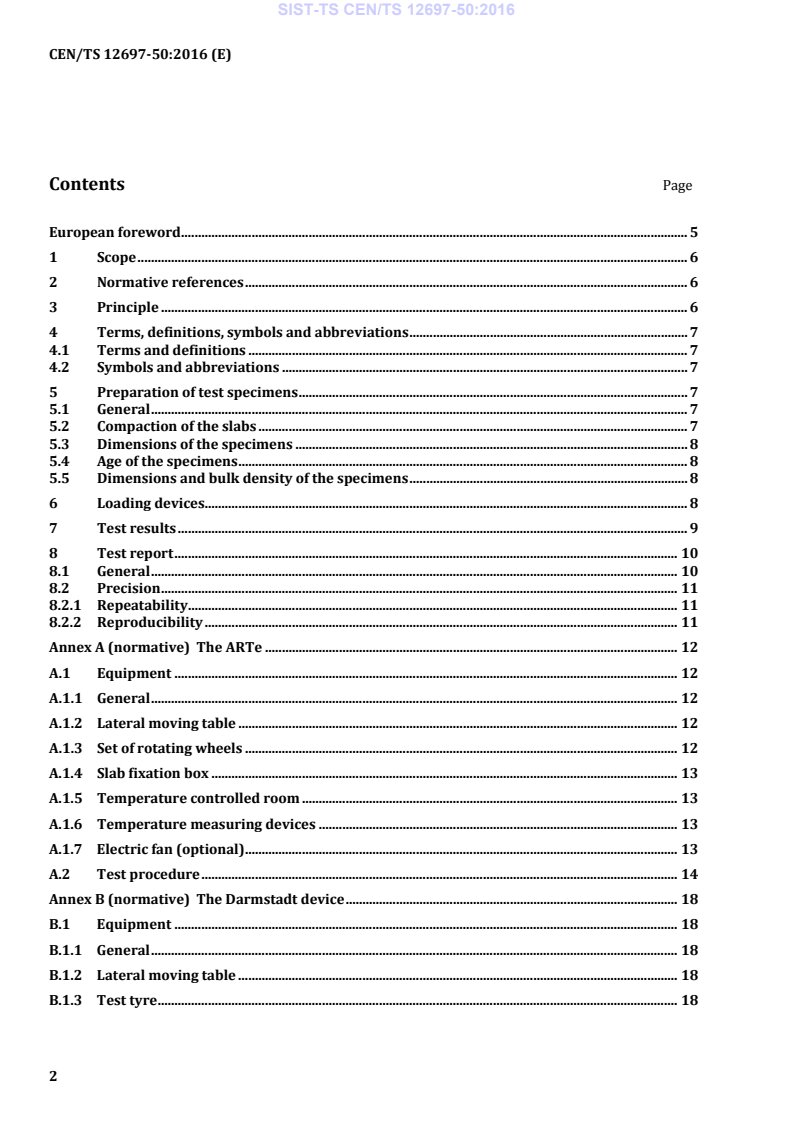
Contents Page
European foreword . 5
1 Scope . 6
2 Normative references . 6
3 Principle . 6
4 Terms, definitions, symbols and abbreviations . 7
4.1 Terms and definitions . 7
4.2 Symbols and abbreviations . 7
5 Preparation of test specimens . 7
5.1 General . 7
5.2 Compaction of the slabs . 7
5.3 Dimensions of the specimens . 8
5.4 Age of the specimens . 8
5.5 Dimensions and bulk density of the specimens . 8
6 Loading devices . 8
7 Test results . 9
8 Test report . 10
8.1 General . 10
8.2 Precision . 11
8.2.1 Repeatability . 11
8.2.2 Reproducibility . 11
Annex A (normative) The ARTe . 12
A.1 Equipment . 12
A.1.1 General . 12
A.1.2 Lateral moving table . 12
A.1.3 Set of rotating wheels . 12
A.1.4 Slab fixation box . 13
A.1.5 Temperature controlled room . 13
A.1.6 Temperature measuring devices . 13
A.1.7 Electric fan (optional) . 13
A.2 Test procedure . 14
Annex B (normative) The Darmstadt device . 18
B.1 Equipment . 18
B.1.1 General . 18
B.1.2 Lateral moving table . 18
B.1.3 Test tyre . 18
B.1.4 Asphalt specimen fixture . 18
B.1.5 Heating/temperature . 18
B.1.6 Vacuum wipe-off apparatus . 19
B.1.7 Temperature measurements . 19
B.1.8 Oven . 19
B.2 Test procedure . 19
Annex C (informative) The Rotating Surface Abrasion Test (RSAT) . 22
C.1 General . 22
C.2 Equipment . 22
C.2.1 Motion mechanism . 22
C.2.2 Test tyre . 23
C.2.3 Wheel load and contact pressure. 23
C.2.4 Wheel arm guide . 24
C.2.5 Attachment of the wheel to the wheel arm . 24
C.2.6 Rotation hinge (wheel arm guide) . 24
C.2.7 Slab holder test specimen RSAT . 24
C.2.8 Bearing and rotary axle, consisting of a ring bearer . 25
C.2.9 Braking mechanism . 25
C.2.10 Asphalt specimen fixture . 25
C.2.11 Vacuum wipe-off apparatus . 26
C.3 Test temperature . 26
C.3.1 Heating/temperature . 26
C.3.2 Temperature measurements . 26
Annex D (informative) The TRD (TriboRoute Device) . 29
D.1 Equipment . 29
D.1.1 General . 29
D.1.2 Load applicator . 29
D.1.3 Lateral moving table . 30
D.1.4 Asphalt specimen fixture . 30
D.1.5 Heating/temperature . 30
D.1.6 Vacuum wipe-off apparatus . 31
D.2 Test procedure . 31
D.2.1 Specimen preparation . 31
D.2.2 Control of the specimen surface characteristics . 31
D.2.3 Test performance . 32
D.2.3.1 General . 32
D.2.3.2 Test performed with controlled force (TRD-CF). 32
D.2.3.3 Test performed with controlled displacement rate (TRD-CD) . 33
Bibliography . 34
European foreword
This document (CEN/TS 12697-50:2016) has been prepared by Technical Committee CEN/TC 227
“Road materials”, the secretariat of which is held by DIN.
Attention is drawn to the possibility that some of the elements of this document may be the subject of
patent rights. CEN [and/or CENELEC] shall not be held responsible for identifying any or all such patent
rights.
According to the CEN-CENELEC Internal Regulations, the national standards organizations of the
following countries are bound to announce this Technical Specification: Austria, Belgium, Bulgaria,
Croatia, Cyprus, Czech Republic, Denmark, Estonia, Finland, Former Yugoslav Republic of Macedonia,
France, Germany, Greece, Hungary, Iceland, Ireland, Italy, Latvia, Lithuania, Luxembourg, Malta,
Netherlands, Norway, Poland, Portugal, Romania, Slovakia, Slovenia, Spain, Sweden, Switzerland,
Turkey and the United Kingdom.
1 Scope
This European Technical Specification specifies a test method for determining the resistance to scuffing
of asphalt mixtures which are used in surface layers and are loaded with high shear stresses in road or
airfield pavement. These shear stresses occur in the contact area between tyre and pavement surface
and can be caused by cornering of the vehicle. Due to these shear stresses, material loss will occur at the
surface of these layers. The test is normally performed on asphalt layers with a high amount of air voids
(e.g. porous asphalt), but can also be applied on other asphaltic mixtures. Test specimens are used
either produced in a laboratory or cut from the pavement.
NOTE The test is developed to determine the resistance to scuffing for noise reducing surface layers where
raveling is the normative damage criterion. The test can also be performed on other surface mixtures with a high
resistance to permanent deformation. In case a mixture has a low resistance to permanent deformation, rutting
can occur during the test. This can influence the test results.
2 Normative references
The following documents, in whole or in part, are normatively referenced in this document and are
indispensable for its application. For dated references, only the edition cited applies. For undated
references, the latest edition of the referenced document (including any amendments) applies.
EN 12697-6, Bituminous mixtures — Test methods for hot mix asphalt — Part 6: Determination of bulk
density of bituminous specimens
EN 12697-29, Bituminous mixtures — Test method for hot mix asphalt — Part 29: Determination of the
dimensions of a bituminous specimen
EN 12697-33, Bituminous mixtures — Test methods for hot mix asphalt — Part 33: Specimen prepared by
roller compactor
3 Principle
Laboratory compacted asphalt specimens or asphalt specimens cut from a pavement is fixed in a test
facility. In this facility, the asphalt material is loaded simultaneously with both normal and shear
stresses. Due to these stresses, material loss will occur from the surface of the slab. This material loss
depends on the resistance to scuffing of the tested asphalt mixture: the higher the resistance, the less
material will disappear.
To determine the resistance to scuffing, two slabs or (set of) cores shall be tested. The average of both
test results is reported as the resistance to scuffing.
In this Technical Specification four different kinds of loading facilities are described:
— The ARTe (the Aachener Raveling Tester);
— The DSD (the Darmstadt Scuffing Device);
— The RSAT (the Rotating Surface Abrasion Test) and
— The Triboroute.
4 Terms, definitions, symbols and abbreviations
For the purposes of this document, the following term and definition, symbols and abbreviations apply.
4.1 Terms and definitions
4.1.1
material loss
amount of material that has been lost from the surface of the slab due to the test
Note 1 to entry: The amount of material loss can be determined in 3 different ways:
— Visually and/or by taking pictures;
— by weighing the mass of the slab before and after the test. The difference in mass per area is a measure for the
resistance to scuffing of the tested asphalt mixture;
— by scanning the surface of the slab before and after the test. The scans provide a 3D picture from the surface
of the slab. After subtracting mathematically the 3D picture after the test from the one before the test, an
accurate 3D overview of the material loss can be generated. The calculated volume of this 3D overview of the
material loss is a accurate value for the resistance to scuffing of the tested asphalt mixture.
Note 2 to entry: If permanent deformation occurs during the test, the results of the surface scan have to be
compensated for this phenomenon.
4.2 Symbols and abbreviations
T is the thickness of the slab, in 0,1 mm;
W is the width of the slab, in 0,1 mm;
L is the length of the slab, in 0,1 mm;
A 2
is the surface of the tested slab, in 0,01 mm ;
M is the mass of the slab before performing the test, in 1 grams;
M is the mass of the slab after performing the test, in 1 grams;
ΔM is the loss of mass due to performing the test, in 1 grams;
V 3
0 is the volume of the texture of the slab before performing the test, in 0,1 mm ;
V 3
1 is the volume of the texture of the slab after performing the test, in 0,1 mm ;
ΔV 3
is the loss of volume of the texture of the slab due to performing the test, in 0,1 mm .
5 Preparation of test specimens
5.1 General
To determine the resistance to scuffing of an asphalt mixture, 2 slabs or 2 (sets of) cores of that material
shall be tested. The average of both test results shall be considered to determine the resistance to
scuffing.
5.2 Compaction of the slabs
In the scuffing device, asphalt slabs or (sets of) cores shall be tested. These slabs or (sets of) cores shall
be prepared according to EN 12697-33 or can be cut from pavements.
5.3 Dimensions of the specimens
The test can be performed on specimens with various dimensions. However, standard dimensions of
the slabs are (500 ± 20) mm by (500 ± 20) mm or (500 ± 20) mm by (320 ± 20) mm. Cores shall have a
standard diameter of (150 ± 2) mm. The thickness of the specimen can vary between 30 mm and
80 mm.
NOTE Also larger slabs or cores can be prepared which are fit to the correct dimensions by sawing.
5.4 Age of the specimens
Prior to the start of testing, the specimen shall be stored on a flat surface at a temperature of not more
than 20 °C for between 14 days and 42 days from the time of their manufacture. In the case of samples
requiring cutting, the cutting shall be performed no more than 8 days after compaction of the asphalt.
The time of manufacture for these samples is the time when they are cut.
NOTE Not only fresh asphalt mixtures can be tested, also aged specimens can be examined in the scuffing
test. In literature several aging procedure can be found. The choice of a proper aging procedure depends on the
characteristics of the tested material.
5.5 Dimensions and bulk density of the specimens
The dimensions of the slab shall be determined according to EN 12697-29. The length, L, and width, W,
of the slab are measured at four positions of the slab, equally divided over the area. The accuracy of the
measurements shall be 0,1 mm. The average of the four individual measurements are respective the
length, L, and width, W, of the slab.
The thickness, T, of the slab shall be determined at eight points. Each point shall be taken 100 mm from
the edge of the slab using a vernier calliper. All eight point shall be equally divided over the surface of
the slab. The accuracy of each measurement shall be 0,1 mm. The maximum difference between the
eight individual measurements shall be 2,5 mm. If not, the specimen shall not be tested. The average of
the eight measurements is the thickness, T, of the slab.
If cores are tested, the diameter and thickness of each core shall be determined according to
EN 12697-29 using a vernier calliper. The diameter, D, and the thickness, T, are measured at four
positions of the slab, equally divided over the area. The accuracy of the measurements shall be 0,1 mm.
The average of the four individual measurements shall be deemed to be the diameter of the core.
The bulk density of the slab or the core shall be determined according to EN 12697-6 using the bulk
density by dimensions procedure. Before measuring the mass, M , of the slab, the specimen shall be
dried to constant mass in air at a relative air humidity of less than 80 % at a temperature not more than
20 °C. A test specimen shall be considered to be dry after at least 8 h drying time and when two
weighings performed minimum 4 h apart differ by less than 0,1 %.
6 Loading devices
The resistance to scuffing can be determined using one of the following test devices:
— The ARTe (the Aachener Raveling Tester) see Annex A;
— The DSD (the Darmstadt Scuffing Device) see Annex B;
— The RSAT (the Rotating Surface Abrasion Test) see Annex C and
— The Triboroute see Annex D.
7 Test results
The results of the tests shall be reported using the results of the visual inspection and/or pictures
before and after the test and the material loss per covered area (= MLpA). Alternatively, the increase in
texture per covered area, ΔV, can be used. The following formulae shall be used:
— Material loss per covered area MLpA when slabs are tested determine by
MM−
∆M
0,i 1,i
i
MLpA with i = 1,2 (1)
i
WL WL
i i i i
MLpA
i
∑
i=1
MLpA= (2)
where
M is the mass of the slab i (i = 1,2) before performing the test, in 1 g (grams);
0,i
M is the mass of the slab i (i = 1,2) after performing the test, in 1 g (grams);
1,i
W is the width of the slab i (i = 1,2) in 0,1 mm (millimeter);
i
L is the length of the slab i (i = 1,2) in 0,1 mm (millimeter.
i
— Material loss per covered area MLpA when a (set of) cores are tested determine
MM−
∆M
0,i 1,i
i
with i = 1,2 (3)
MLpA
i
ppDD
i i
MLpA
∑ i
i=1
(4)
MLpA=
where
M is the mass of the (set of) core i (i = 1,2) before performing the test, in 1 g (grams);
0,i
M is the mass of the (set of) core i (i = 1,2) after performing the test, in 1 g (grams);
1,i
D is the diameter of the (set of) core i (i = 1,2) in 0,1 mm (millimetre).
i
— Increase in texture ΔV per covered area using 3D laser measurements when using slabs or (a set of)
cores determine
VV−
1,i 0,i
∆=V with i = 1,2 (5)
i
WL
i i
∆V
∑ i
i=1
∆V= (6)
where
V is the volume of the texture of the slab or (a set of) cores i (I = 1, 2) before performing the test, in
0,i
==
==
0,1 mm (cubic millimetre);
V is the volume of the texture of the slab or (a set of) cores i (I = 1, 2) after performing the test, in
1,i
0,1 mm (cubic millimetre);
W is the width of the slab or (a set of) cores i (I = 1, 2) in 0,1 mm (millimetre);
i
L is the length of the slab or (a set of) cores i (I = 1, 2) in 0,1 mm (millimetre).
i
— Increase in texture ΔV per covered area using 3D laser measurements when using (a set of) cores
determine
VV−
1,i 0,i
∆V= with i = 1,2 (7)
i
pD
i
∆V
∑ i
i=1
∆V= (8)
where
V 3
0,i is the volume of the texture of (a set of) cores i (I = 1, 2) before performing the test, in 0,1 mm (cubic
millimetre);
V 3
1,i is the volume of the texture of (a set of) cores i (I = 1, 2) after performing the test, in 0,1 mm (cubic
millimetre);
D is the diameter of (a set of) cores i (i = 1,2) in 0,1 mm (millimetre).
i
NOTE Sometimes a substantial part of the scuffing occurs close to the edges of the slab or the core. This
phenomenon especially occurs when course graded porous asphalt specimens are tested. In this situation, the
increase in volume can be determined for a smaller area of the slab or core. If, for example, a slab of 500 mm by
500 mm shows excessive scuffing close to the edges, ΔV can be determined over an area of 400 mm by 400 mm,
skipping the material loss which occurs in the outer strip with a width of 50 mm of the slab. It is essential to
mention the considered area in the report.
8 Test report
8.1 General
The test report shall contain not less than the following information:
a) name of organisation carrying out the test;
b) date of the test;
c) reference to this test method and test conditions;
d) characterization and the origin (lab compacted slabs or cut from a pavement) of the tested
material;
e) short description of the test facility.
For each specimen tested, report:
f) length, width and thickness of the tested slab, expressed to the nearest 0,1 mm;
g) results of the visual inspection of the surface of the slab before and after the test;
h) mass of the slab before, M , and after the test, M , expressed to the nearest 1 grams;
0,I 1,i
i) material loss per covered area MLpA , expressed to the nearest 1 g/mm ;
i
j) if available, the volume of the texture of the surface of the slab before, V and after, V , the test in
0,i 1,I
0,1 mm ;
k) if available, the change in volume of the texture of the surface of the slab, ΔV , in 0,1 mm .
i
As an average of the two tested slabs per asphalt mixture:
l) general conclusion about material loss, based on the results of the visual inspection of both slabs;
m) average material loss per covered area, MLpA, expressed to the nearest 1 g/mm ;
n) if available, the average change in volume of the texture of the surface of the slab, ΔV, in 0,1 mm .
8.2 Precision
8.2.1 Repeatability
Currently, repeatability data are not yet available.
8.2.2 Reproducibility
The reproducibility for this test method has not been determined.
Annex A
(normative)
The ARTe
A.1 Equipment
A.1.1 General
In order to create high shear stresses on the surface of an asphalt slab, a special scuffing device shall be
used. In this scuffing device, the slab is fixed in a slab fixation box and is moving forwards and
backwards. This movement shall be created by mounting the slab and the slab fixation box on a lateral
moving table, which is travelling for- and back-wards. During this movement, a set of two wheel tyres
shall rotate over the loading table and the asphalt slab, creating large shear stresses due to the
combination of the lateral movement of the table and the rotation of the wheel set.
NOTE An example of the test facility is given in Figure A.1 and an overview is shown in Figure A.2.
A.1.2 Lateral moving table
The lateral moving table shall consist of a loading frame on wheels which travels over a fixed distance
using rails. By using rails, the table shall move only in one direction.
On the loading frame, on both sides of the specimen, a horizontal surface shall be created. Together with
the slab fixation box and the surface of the slab, a horizontal surface shall be created where the set of
rotating wheels can move around without creating extra vertical dynamic forces due to jumping of the
set of wheels.
The lateral movement of the table shall be realised by using, for example, a belt which is driven by an
electro motor. The speed of the moving table does not need to be constant during the test, so
acceleration and deceleration is possible. However, during the time the set of wheels is travelling over
the slab, the speed of the loading table shall be (0,30 ± 0,03) m/s.
A.1.3 Set of rotating wheels
To create a set of rotating wheels, an electro motor with a vertical axis shall be mounted about
mid-length of the rails on a loading frame. This frame shall consist of two vertical bars which are
connected by a horizontal bar. The connection between the horizontal bar and the two vertical bars
shall not be completely fixed.
NOTE 1 Vertical movement of the horizontal bar is allowed and even necessary to be sure that during the test
the set of wheels are always in contact with the asphaltic slab, also when material loss occurs from the slab.
The vertical axis from the electro motor on the horizontal bar shall have a rotation speed of
(47 ± 1) rpm. On the vertical axis, two smooth unprofiled PIARC test tyres shall be mounted.
NOTE 2 165 R 15 tyres are also used in the test devices mentioned in CEN/TS 13036-2; detailed information
about this tyre can be found in [1].
The tyre pressure shall be (200 ± 10) kPa during the test. Both tyres shall rotate freely when the set of
loading wheels does not touch the lateral moving table. The distance between the centre of both tyres
shall be (460 ± 5) mm, giving the total area of the slab that will be loaded during the test.
The total mass of the horizontal bar, electro motor and set of rotating wheels shall be (250 ± 5) kg. To
prevent any loss of vertical forces during the test, the vertical movement of the horizontal bar shall be
as free as possible.
NOTE 3 An example of a cross section of the scuffing device with a set of rotating wheels is given in Figure A.3.
A.1.4 Slab fixation box
The slab shall be built in the lateral moving table in such a way that the surface of the slab and of the
lateral moving table are in one horizontal plane.
NOTE 1 In this way, the variation of the vertical force due to jumping of the set of rotating wheels can be
limited to acceptable values.
To accomplish the correct setting of the asphalt slab in the lateral moving table, the slab shall be fixed in
a slab fixation box.
NOTE 2 To ease the fixation of the slab in the scuffing device, the slab fixation box can be taken from the lateral
moving table. This box consists of a large squared bottom plate and four vertical plates. These plates are fixed
together in such a way that an undeformable box arises.
NOTE 3 An example of a slab fixation box is given in Figure A.4.
The inner dimensions of the box shall be chosen in such a way that the asphalt slab fits easily in the
inner volume of the box. The height of the box shall be chosen so that the surface of the slab fixation box
and the lateral moving table are in one horizontal plane when the slab fixation box is built in in the
lateral moving table.
To be able to test asphalt slabs with various thicknesses, the surface of the asphalt slab shall be in one
horizontal plane with the surface of the lateral moving table. This positioning shall be accomplished by
applying various metal and/or wooden plates with the same surface as the asphalt slab between the
bottom of the slab fixation box and the slab.
At several points in the vertical walls of the slab fixation box, horizontal holes shall be drilled. These
holes shall be provided with screw-threads and bolts. Between the inner walls of the slab fixation box
and the asphalt slab, metal or wooden inlays shall be applied. By regularly tightening all screws, the
asphalt slab shall be complete fixed in the slab fixation box. Attention shall be paid to the fact that the
surface of the inlays between slab and slab fixation box is in one horizontal plane with the lateral
moving table. All vertical planes of the asphalt slab shall be completely supported by the inlays. There
shall be no gap between the asphalt slab and the inlays.
NOTE 4 For tests on dense graded asphalt mixtures, gypsum can be used to fix the slab in the slab fixation box.
A.1.5 Temperature controlled room
The temperature controlled room shall be ventilated and capable of allowing the temperature of the
slab fixation box and the average temperature of the air draught at tens of centimetres from the slab to
be fixed at a temperature of (20 ± 2) °C throughout the duration of the test.
A.1.6 Temperature measuring devices
During the test, the temperature of the slab and tyres shall be measured. These devices shall measure
the temperatures with an accuracy of 1 °C.
NOTE Infra-red measuring devices can be used.
A.1.7 Electric fan (optional)
An electric fan can be used during the test to cool the slab and the tyres.
A.2 Test procedure
Before starting the test, the slab and the slab fixation box shall be in the temperature controlled room
for at least 4 h. In this period, both slab and slab fixation box shall meet the requirements with respect
to the test temperature of (20 ± 2) °C. During this acclimatisation period, the slab can be mounted in the
slab fixation box. Before mounting the slab, the dimensions L, W and T and the mass M of the slab shall
be determined. The surface of the slab shall be inspected visually. During this visual inspection, at least
one photo shall be taken of the total area of the slab and any irregularity of the surface shall be
recorded. An alternative way is measuring the 3-dimensional texture of the slab surface by means of
laser texture measurements. Based on these measurements, the volume V of the texture shall be
calculated.
After mounting the slab in the slab fixation box, the slab fixation box shall be mounted in the lateral
moving table, making sure that the surface of the lateral moving table, the slab fixation box and the
surface of the slab are in one plane. In this way, extra vertical forces due to bouncing of the set of
rotating wheels shall be limited.
During the test, the lateral moving table travels 600 times forwards and backwards (so 600 times
forward and 600 times backwards) over the slab. During that time, the wheels are rotating with
(47 ± 1) rpm. After half the number of load repetitions, the slab fixation box shall be rotated 180° and
the bolts in the slab fixation box shall be re-tightened.
NOTE 1 The rotation of the slab is necessary to be sure that the surface of the slab is equally loaded over the
whole surface. If, for example, there is some misalignment in the set of rotating wheels or a small difference in tyre
pressure, this influence on the ravelling process is eliminated.
After rotation of the slab halfway through the test, the test can be continued until the end.
Due to the high shear stresses in the contact area between tyre and slab surface, both slab and tyres will
raise in temperature. The maximum allowed temperature of the slab during the test shall be 25 °C and
the temperature of the slab shall never be lower than 18 °C.
NOTE 2 The temperature of the slab and the tyres can be controlled by using an electric fan.
After finishing the test, the slab shall be removed from the slab fixation box. Loose material shall be
removed from the surface of the slab using a vacuum cleaner. The surface shall be inspected visually
and any differences between the initial and end surface shall be reported. One or more pictures of the
surface shall be taken. If available, the three-dimensional texture of the slab surface shall be measured.
Based on these measurements, the volume V of the texture of the slab after testing shall be calculated.
Figure A.1 — Example of the scuffing device
Figure A.2 — Example of a longitudinal view of the scuffing device with the lateral moving table
in the left position (the slab fixation box is in the middle of this lateral moving table)
Figure A.3 — Example of the set of rotating wheels of the scuffing device
Figure A.4 — Example of the slab fixation box of the scuffing device
Annex B
(normative)
The Darmstadt device
B.1 Equipment
B.1.1 General
To determine shear stress resistance on asphalt surface courses, a special machine shall be applied. In
this machine, the asphalt specimen shall be attached in a fixture oscillating 180 °, which shall be
mounted on a horizontal table moving back and forth. During this movement, a test tyre under load
shall be lowered onto the specimen.
NOTE Figure B.1 shows an example of such a machine. Figure B.2 shows a system drawing.
B.1.2 Lateral moving table
The horizontal table shall be guided by a rail through which the table is movable. Powered with an
electric motor linked with the table via scotch yoke, the feed speed shall be held constant at 0,04 m/s
during the test. The rail shall be fixed on a foundation via framework.
On top of the table there shall be a fixture for the specimen that is turning about the axis with an
oscillating amplitude of 180°. Rotational angular velocity shall be kept at 5 turns per minute and can be
applied through the same electric motor that powers the table.
B.1.3 Test tyre
The test tyre shall be a pneumatic tyre without tread (10*4.5-5, slick) mounted onto an axis held by a
fork carriage and freely turnable.
NOTE The fork carriage can be held vertically by a pneumatic cylinder. This provides the possibility to apply
load to the asphalt specimen through the test tyre.
Vertical load shall be chosen to apply a pressure of 0,25 N/mm . With the aforementioned tyre size, a
vertical load of (1000 ± 10) N is necessary.
Tyre pressure shall be (300 ± 10) kPa.
The test tyre shall be fixed in place horizontally. Rolling movement and shear stress shall be exclusively
from the back and forth movement of the table and the oscillating fixture under the surface tension of
the test tyre.
B.1.4 Asphalt specimen fixture
The under B.1.3 aforementioned fixture shall hold an asphalt specimen of 260 mm by 260 mm, which is
secured with adjustable screw. To avoid tension within the specimen, the screws shall be be tightened
by hand.
B.1.5 Heating/temperature
Underneath the fixture a heating element shall be positioned, which heats the specimen during testing.
An adjusted, constant room temperature shall not be used due to the short testing time. The heating
element shall heat the specimen so that a surface temperature of (40 ± 1) °C can be measured
throughout the whole test.
B.1.6 Vacuum wipe-off apparatus
The apparatus for vacuuming and wiping off the surfaces of tyre and asphalt specimen shall be
positioned in such a way that loose grains can be removed. Shear stress applied through loose grains on
the specimen or material sticking to the tyre has to be avoided.
For vacuuming, an industrial vacuum cleaner with 1800 W to 2500 W of power shall be used.
Optionally, the wiping off apparatus can be used to remove material from the slick tyre and can be
implemented through some kind of broom.
B.1.7 Temperature measurements
Before and after testing the asphalt specimen, the surface temperature shall be measured with an
accuracy of 1 °C. For this measurement, surface contact thermometers can be used. Additionally, the
temperature of the fixture shall be monitored.
B.1.8 Oven
Before testing, the asphalt specimen shall be heated to (40 ± 1) °C in an oven or in the fixture.
B.2 Test procedure
Specimens shall have a standard size of (260 ± 5) mm by (260 ± 5) mm, to which the aforementioned
specimens (with a size of 260 mm by 320 mm) shall be cut down. The usual thickness of the specimens
shall be 40 mm. For cutting the specimens prepared in a laboratory, cutting shall not be only done from
one side. On the long side (320 mm), 30 mm shall be cut off at each end. During testing, shear stresses
shall be applied to the middle of the specimen on a circular plane with a diameter of about 200 mm.
Before testing starts, the asphalt specimens shall be photographed for later visual evaluation. The
asphalt specimen shall be heated to (40 ± 1) °C. Heating shall be done in an oven, optionally heating can
be done directly in the fixture of the testing machine. Heating time needed in the fixture is about 2,5 h to
achieve a constant specimen temperature of (40 ± 1) °C throughout the whole testing period. The
scuffing test shall only begin when surface temperature of the asphalt specimen is (40 ± 1) °C in at least
4 spots.
Before the scuffing test, the asphalt specimen shall be weighted. The specimen shall then be fixed in the
fixture. Screws shall be tightened by hand so that the material of the asphalt specimen is not
compressed.
After fixation, the test temperature (40 ± 1) °C and the number of double shear load cycles shall be
established. The asphalt specimen shall be put under load by lowering the test tyre and applying
(1,000 ± 10) N of pressure through the pneumatic pressure cylinder. When the targeted pressure is
reached, the test shall be started.
NOTE 1 It is important to start testing directly when the pressure is reached to prevent unwanted deformation
of the asphalt specimen.
Simultaneously to the movement of the table and the oscillating fixture, the vacuuming of lose grains
takes
...