


EN ISO 179-1:2023
(Main)Plastics - Determination of Charpy impact properties - Part 1: Non-instrumented impact test (ISO 179-1:2023)
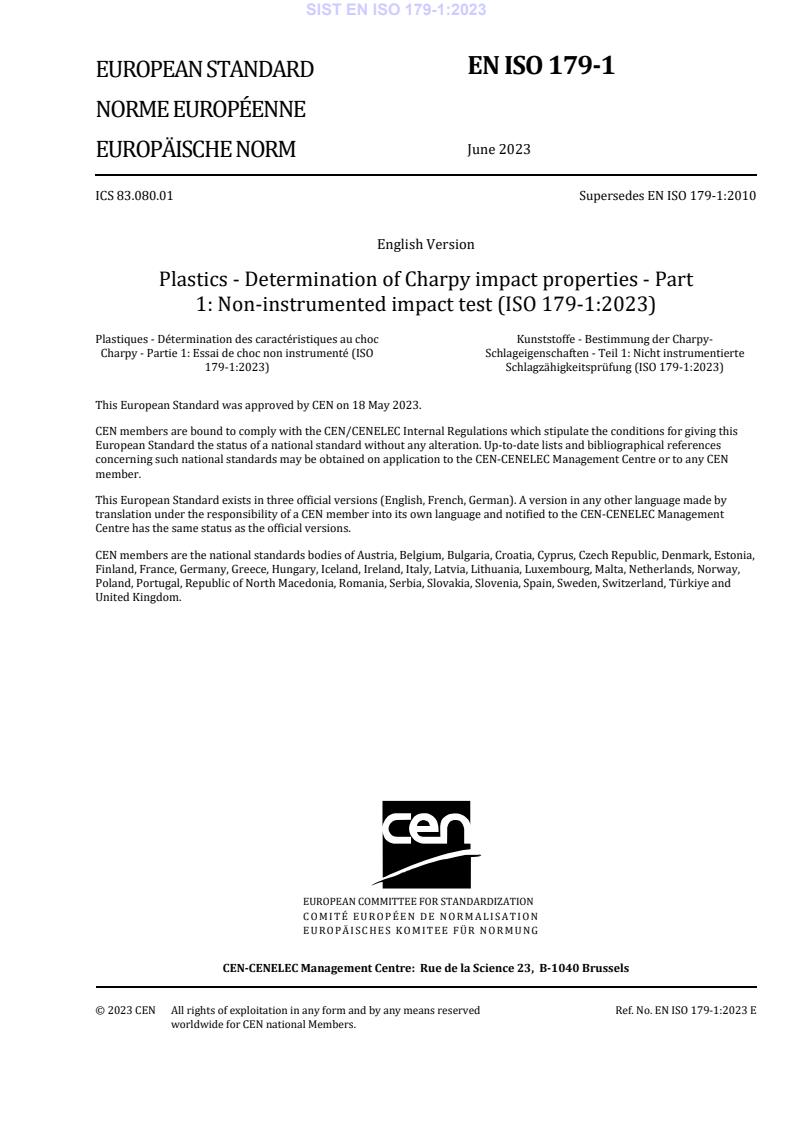
Plastics - Determination of Charpy impact properties - Part 1: Non-instrumented impact test (ISO 179-1:2023)
This document specifies a method for determining the Charpy impact strength of plastics under defined conditions. A number of different types of specimen and test configurations are defined. Different test parameters are specified according to the type of material, the type of test specimen and the type of notch.
The method can be used to investigate the behaviour of specified types of specimen under the impact conditions defined and for estimating the brittleness or toughness of specimens within the limitations inherent in the test conditions. It can also be used for the determination of comparative data from similar types of material.
Kunststoffe - Bestimmung der Charpy-Schlageigenschaften - Teil 1: Nicht instrumentierte Schlagzähigkeitsprüfung (ISO 179-1:2023)
Dieses Dokument legt ein Verfahren für die Bestimmung der Charpy-Schlagzähigkeit von Kunststoffen unter festgelegten Bedingungen fest. Eine Anzahl von unterschiedlichen Probekörpertypen und Prüfanordnungen wird festgelegt. Unterschiedliche Prüfbedingungen werden entsprechend dem Werkstofftyp, dem Probekörpertyp und der Kerbart festgelegt.
Das Prüfverfahren kann angewendet werden, um das Verhalten festgelegter Probekörpertypen bei den festgelegten Schlagbedingungen zu untersuchen und die Sprödigkeit oder Zähigkeit von Probekörpern innerhalb der Grenzen der Prüfbedingungen zu beurteilen. Es kann ebenfalls für die Bestimmung von Vergleichsdaten von ähnlichen Werkstofftypen angewendet werden.
Plastiques - Détermination des caractéristiques au choc Charpy - Partie 1: Essai de choc non instrumenté (ISO 179-1:2023)
Le présent document spécifie une méthode de détermination de la résistance au choc Charpy des plastiques dans des conditions définies. De nombreux types d’éprouvettes et de configurations d’essai différents sont définis. Divers paramètres d’essai sont spécifiés selon le type de matière, le type d’éprouvette et le type d’entaille.
La présente méthode peut être utilisée pour l’étude du comportement des types d’éprouvettes spécifiés soumises à des conditions de choc définies et pour l’estimation de la fragilité ou de la ténacité des éprouvettes dans les limites inhérentes aux conditions d’essai. Elle peut également être utilisée pour déterminer des résultats comparatifs propres à des types similaires de matériaux.
Polimerni materiali - Ugotavljanje udarne žilavosti pa Charpyju - 1. del: Preskus udarne žilavosti z neinstrumentalno metodo (ISO 179-1:2023)
Standard ISO 179-1:2010 določa metodo za ugotavljanje udarne žilavosti polimernih materialov po Charpyju pod določenimi pogoji. Določenih je več različnih vrst vzorcev in preskusnih konfiguracij. Različni preskusni parametri so določeni glede na vrsto materiala, vrsto preskusnega vzorca in vrsto zareze.
Metodo je mogoče uporabiti za preiskovanje vedenja določenih vrst vzorcev pod določenimi udarnimi pogoji in ocenjevanje krhkosti ali žilavosti vzorcev v okviru omejitev preskusnih pogojev. Uporabiti jo je mogoče tudi za ugotavljanje primerljivih podatkov za podobne vrste materiala.
Metoda ima širši razpon uporabnosti kot metoda, navedena v standardu ISO 180 (preskušanje udarne žilavosti po Izodu), in je primernejša za preskušanje materialov, na katerih se kaže medlaminarni strižni lom, ali materialov, na katerih se kažejo površinski učinki dejavnikov okolja.
Metoda je ustrezna za naslednje vrste materialov:
trdni plastomerni materiali za brizganje ali iztiskanje (vključno s polnjenimi in ojačanimi spojinami, poleg nepolnjenih vrst) in trdni plastomerni trakovi;
trdni termoreaktivni materiali za brizganje (vključno s polnjenimi in ojačanimi spojinami) in trdni termoreaktivni trakovi (vključno z laminati);
z vlakni ojačani termoreaktivni in plastomerni kompoziti, ki vsebujejo enosmerne ali večsmerne ojačitve (kot so mati, tkanine, tkani rovingi, rezane niti, kombinacijske in hibridne ojačitve, rovingi in brušena vlakna) ali vsebujejo trakove iz predhodno impregniranih materialov, vključno s polnjenimi in ojačanimi spojinami;
termotropni polimeri iz tekočih kristalov.
General Information
Relations
Overview
EN ISO 179-1:2023 - "Plastics - Determination of Charpy impact properties - Part 1: Non‑instrumented impact test" (CEN adoption of ISO 179-1:2023) specifies a standardized method for measuring Charpy impact strength of plastics using a non‑instrumented pendulum (classic Charpy) test. The standard defines specimen types, notching, test configurations and conditioning so users can estimate toughness or brittleness and generate comparative impact data under defined conditions.
Key topics and requirements
- Scope and principle: A Charpy pendulum test to determine energy absorbed by a specimen during fracture; applicable to a wide range of rigid thermoplastics, thermosets, reinforced composites and thermotropic liquid‑crystal polymers.
- Specimen preparation: Detailed requirements for moulding, extrusion and machining of specimens, plus checks for anisotropy and dimensional tolerances.
- Notching and specimen types: Definitions for notched and unnotched specimens; guidance when notched samples are unsuitable (e.g., long‑fibre composites, cellular materials) and when unnotched specimens should be used.
- Apparatus and measurement tools: Specifications for the test machine (pendulum), micrometers, gauges and methods to determine notch tip radius (see informative Annex C).
- Conditioning and environment: Reference to standard atmospheres for conditioning (e.g., ISO 291) and requirements for pre‑test conditioning of specimens.
- Procedure and calculations: Stepwise test procedure, expression of results (impact strength), statistical treatment, significant figures and reporting requirements.
- Precision and validation: Precision data from interlaboratory work (Annex B) and guidance for additional surface‑effect investigations (Annex A).
- Documentation: Required test report details including material identification, specimen geometry, notch type, conditioning, number of replicates and statistical parameters.
Applications and who uses it
- Materials testing laboratories performing plastics impact testing and quality control.
- Product designers and materials engineers evaluating toughness vs. brittleness for design decisions.
- Composite manufacturers (thermoplastic/thermoset) assessing fracture behaviour of reinforced systems.
- Certification bodies and R&D teams generating comparative data for material selection or specifications.
- Useful where Charpy data are needed for safety assessments, failure analysis or benchmarking.
Related standards
- ISO 179 series (other parts)
- ISO 291 (conditioning atmospheres)
- ISO 293, ISO 294‑1 (specimen moulding)
- ISO 16012 (reference for measurement tools)
- EN adoption: supersedes EN ISO 179‑1:2010
EN ISO 179-1:2023 remains a primary reference for reliable, repeatable Charpy impact testing of plastics using a non‑instrumented impact test method.

Standards Content (Sample)
SLOVENSKI STANDARD
01-september-2023
Polimerni materiali - Ugotavljanje udarne žilavosti pa Charpyju - 1. del: Preskus
udarne žilavosti z neinstrumentalno metodo (ISO 179-1:2023)
Plastics - Determination of Charpy impact properties - Part 1: Non-instrumented impact
test (ISO 179-1:2023)
Kunststoffe - Bestimmung der Charpy-Schlageigenschaften - Teil 1: Nicht instrumentierte
Schlagzähigkeitsprüfung (ISO 179-1:2023)
Plastiques - Détermination des caractéristiques au choc Charpy - Partie 1: Essai de choc
non instrumenté (ISO 179-1:2023)
Ta slovenski standard je istoveten z: EN ISO 179-1:2023
ICS:
83.080.01 Polimerni materiali na Plastics in general
splošno
2003-01.Slovenski inštitut za standardizacijo. Razmnoževanje celote ali delov tega standarda ni dovoljeno.
EN ISO 179-1
EUROPEAN STANDARD
NORME EUROPÉENNE
June 2023
EUROPÄISCHE NORM
ICS 83.080.01 Supersedes EN ISO 179-1:2010
English Version
Plastics - Determination of Charpy impact properties - Part
1: Non-instrumented impact test (ISO 179-1:2023)
Plastiques - Détermination des caractéristiques au choc Kunststoffe - Bestimmung der Charpy-
Charpy - Partie 1: Essai de choc non instrumenté (ISO Schlageigenschaften - Teil 1: Nicht instrumentierte
179-1:2023) Schlagzähigkeitsprüfung (ISO 179-1:2023)
This European Standard was approved by CEN on 18 May 2023.
CEN members are bound to comply with the CEN/CENELEC Internal Regulations which stipulate the conditions for giving this
European Standard the status of a national standard without any alteration. Up-to-date lists and bibliographical references
concerning such national standards may be obtained on application to the CEN-CENELEC Management Centre or to any CEN
member.
This European Standard exists in three official versions (English, French, German). A version in any other language made by
translation under the responsibility of a CEN member into its own language and notified to the CEN-CENELEC Management
Centre has the same status as the official versions.
CEN members are the national standards bodies of Austria, Belgium, Bulgaria, Croatia, Cyprus, Czech Republic, Denmark, Estonia,
Finland, France, Germany, Greece, Hungary, Iceland, Ireland, Italy, Latvia, Lithuania, Luxembourg, Malta, Netherlands, Norway,
Poland, Portugal, Republic of North Macedonia, Romania, Serbia, Slovakia, Slovenia, Spain, Sweden, Switzerland, Türkiye and
United Kingdom.
EUROPEAN COMMITTEE FOR STANDARDIZATION
COMITÉ EUROPÉEN DE NORMALISATION
EUROPÄISCHES KOMITEE FÜR NORMUNG
CEN-CENELEC Management Centre: Rue de la Science 23, B-1040 Brussels
© 2023 CEN All rights of exploitation in any form and by any means reserved Ref. No. EN ISO 179-1:2023 E
worldwide for CEN national Members.
Contents Page
European foreword . 3
European foreword
This document (EN ISO 179-1:2023) has been prepared by Technical Committee ISO/TC 61 "Plastics" in
collaboration with Technical Committee CEN/TC 249 “Plastics” the secretariat of which is held by SIS.
This European Standard shall be given the status of a national standard, either by publication of an
identical text or by endorsement, at the latest by December 2023, and conflicting national standards
shall be withdrawn at the latest by December 2023.
Attention is drawn to the possibility that some of the elements of this document may be the subject of
patent rights. CEN shall not be held responsible for identifying any or all such patent rights.
This document supersedes EN ISO 179-1:2010.
Any feedback and questions on this document should be directed to the users’ national standards
body/national committee. A complete listing of these bodies can be found on the CEN website.
According to the CEN-CENELEC Internal Regulations, the national standards organizations of the
following countries are bound to implement this European Standard: Austria, Belgium, Bulgaria,
Croatia, Cyprus, Czech Republic, Denmark, Estonia, Finland, France, Germany, Greece, Hungary, Iceland,
Ireland, Italy, Latvia, Lithuania, Luxembourg, Malta, Netherlands, Norway, Poland, Portugal, Republic of
North Macedonia, Romania, Serbia, Slovakia, Slovenia, Spain, Sweden, Switzerland, Türkiye and the
United Kingdom.
Endorsement notice
The text of ISO 179-1:2023 has been approved by CEN as EN ISO 179-1:2023 without any modification.
INTERNATIONAL ISO
STANDARD 179-1
Third edition
2023-06
Plastics — Determination of Charpy
impact properties —
Part 1:
Non-instrumented impact test
Plastiques — Détermination des caractéristiques au choc Charpy —
Partie 1: Essai de choc non instrumenté
Reference number
ISO 179-1:2023(E)
ISO 179-1:2023(E)
© ISO 2023
All rights reserved. Unless otherwise specified, or required in the context of its implementation, no part of this publication may
be reproduced or utilized otherwise in any form or by any means, electronic or mechanical, including photocopying, or posting on
the internet or an intranet, without prior written permission. Permission can be requested from either ISO at the address below
or ISO’s member body in the country of the requester.
ISO copyright office
CP 401 • Ch. de Blandonnet 8
CH-1214 Vernier, Geneva
Phone: +41 22 749 01 11
Email: copyright@iso.org
Website: www.iso.org
Published in Switzerland
ii
ISO 179-1:2023(E)
Contents Page
Foreword .iv
Introduction .v
1 Scope . 1
2 Normative references . 1
3 Terms and definitions . 1
4 Principle . 2
5 Apparatus . 3
5.1 Test machine . 3
5.2 Micrometers and gauges . 3
6 Test specimens . 4
6.1 Preparation . 4
6.1.1 Moulding and extrusion compounds . 4
6.1.2 Sheets . 4
6.1.3 Long-fibre-reinforced materials . . 4
6.1.4 Checking . . 6
6.1.5 Notching . 7
6.2 Anisotropy . 7
6.3 Shape and dimensions . 7
6.3.1 Materials not exhibiting interlaminar shear fracture . 7
6.3.2 Materials exhibiting interlaminar shear fracture (e.g. long-fibre-reinforced
materials) . 9
6.4 Number of test specimens . 9
6.5 Span between specimen supports, L . 10
6.6 Conditioning. 10
7 Procedure .11
8 Calculation and expression of results .12
8.1 Unnotched specimens .12
8.2 Notched specimens .12
8.3 Statistical parameters. 12
8.4 Significant figures.12
9 Precision .12
10 Test report .13
Annex A (informative) Additional methods for investigating the influence of surface effects .15
Annex B (informative) Precision data .17
Annex C (informative) Determining the notch tip radius using a CCD microscope .19
Bibliography .22
iii
ISO 179-1:2023(E)
Foreword
ISO (the International Organization for Standardization) is a worldwide federation of national standards
bodies (ISO member bodies). The work of preparing International Standards is normally carried out
through ISO technical committees. Each member body interested in a subject for which a technical
committee has been established has the right to be represented on that committee. International
organizations, governmental and non-governmental, in liaison with ISO, also take part in the work.
ISO collaborates closely with the International Electrotechnical Commission (IEC) on all matters of
electrotechnical standardization.
The procedures used to develop this document and those intended for its further maintenance are
described in the ISO/IEC Directives, Part 1. In particular, the different approval criteria needed for the
different types of ISO document should be noted. This document was drafted in accordance with the
editorial rules of the ISO/IEC Directives, Part 2 (see www.iso.org/directives).
ISO draws attention to the possibility that the implementation of this document may involve the use
of (a) patent(s). ISO takes no position concerning the evidence, validity or applicability of any claimed
patent rights in respect thereof. As of the date of publication of this document, ISO had not received
notice of (a) patent(s) which may be required to implement this document. However, implementers are
cautioned that this may not represent the latest information, which may be obtained from the patent
database available at www.iso.org/patents. ISO shall not be held responsible for identifying any or all
such patent rights.
Any trade name used in this document is information given for the convenience of users and does not
constitute an endorsement.
For an explanation of the voluntary nature of standards, the meaning of ISO specific terms and
expressions related to conformity assessment, as well as information about ISO's adherence to
the World Trade Organization (WTO) principles in the Technical Barriers to Trade (TBT), see
www.iso.org/iso/foreword.html.
This document was prepared by Technical Committee ISO/TC 61, Plastics, Subcommittee SC 2,
Mechanical behavior, in collaboration with the European Committee for Standardization (CEN) Technical
Committee CEN/TC 249, Plastics, in accordance with the Agreement on technical cooperation between
ISO and CEN (Vienna Agreement).
This third edition cancels and replaces the second edition (ISO 179-1:2010), which has been technically
revised.
The main changes are as follows:
— results of a round robin for unnotched specimens (see Annex B) have been added;
— reference to standard ISO 16012 (see the Bibliography and subclause 5.2) has been added;
— improvements of the micrometers and gauges subclause (see 5.2) have been addressed;
— symbols used in Formulae (1) and (2) have been reviewed and updated.
A list of all parts in the ISO 179 series can be found on the ISO website.
Any feedback or questions on this document should be directed to the user’s national standards body. A
complete listing of these bodies can be found at www.iso.org/members.html.
iv
ISO 179-1:2023(E)
Introduction
The Charpy impact properties determination method described in the ISO 179 series has a greater
range of applicability than that given in ISO 180 and is more suitable for the testing of materials showing
interlaminar shear fracture or of materials exhibiting surface effects due to environmental factors.
The method is suitable for use with the following range of materials:
— rigid thermoplastic moulding and extrusion materials (including filled and reinforced compounds
in addition to unfilled types) and rigid thermoplastics sheets;
— rigid thermosetting moulding materials (including filled and reinforced compounds) and rigid
thermosetting sheets (including laminates);
— fibre-reinforced thermosetting and thermoplastic composites incorporating unidirectional or
multi-directional reinforcements (such as mats, woven fabrics, woven rovings, chopped strands,
combination and hybrid reinforcements, rovings and milled fibres) or incorporating sheets made
from pre-impregnated materials (prepregs), including filled and reinforced compounds;
— thermotropic liquid-crystal polymers.
Notched samples are not normally suitable for use with rigid cellular materials, long-fibre-reinforced
composites or thermotropic liquid-crystal polymers. In these cases, unnotched samples may be used.
The method is suited to the use of specimens moulded to the chosen dimensions, machined from the
central portion of a standard multipurpose test specimen (see ISO 20753) or machined from finished or
semifinished products such as mouldings, laminates and extruded or cast sheet.
v
INTERNATIONAL STANDARD ISO 179-1:2023(E)
Plastics — Determination of Charpy impact properties —
Part 1:
Non-instrumented impact test
1 Scope
This document specifies a method for determining the Charpy impact strength of plastics under defined
conditions. A number of different types of specimen and test configurations are defined. Different test
parameters are specified according to the type of material, the type of test specimen and the type of
notch.
The method can be used to investigate the behaviour of specified types of specimen under the impact
conditions defined and for estimating the brittleness or toughness of specimens within the limitations
inherent in the test conditions. It can also be used for the determination of comparative data from
similar types of material.
2 Normative references
The following documents are referred to in the text in such a way that some or all of their content
constitutes requirements of this document. For dated references, only the edition cited applies. For
undated references, the latest edition of the referenced document (including any amendments) applies.
ISO 291, Plastics — Standard atmospheres for conditioning and testing
ISO 293, Plastics — Compression moulding of test specimens of thermoplastic materials
ISO 294-1, Plastics — Injection moulding of test specimens of thermoplastic materials — Part 1: General
principles, and moulding of multipurpose and bar test specimens
ISO 294-3, Plastics — Injection moulding of test specimens of thermoplastic materials — Part 3: Small
plates
ISO 295, Plastics — Compression moulding of test specimens of thermosetting materials
ISO 1268-11, Fibre-reinforced plastics — Methods of producing test plates — Part 11: Injection moulding of
BMC and other long-fibre moulding compounds — Small plates
ISO 2818, Plastics — Preparation of test specimens by machining
ISO 10724-1, Plastics — Injection moulding of test specimens of thermosetting powder moulding compounds
(PMCs) — Part 1: General principles and moulding of multipurpose test specimens
ISO 13802, Plastics — Verification of pendulum impact-testing machines — Charpy, Izod and tensile
impact-testing
3 Terms and definitions
For the purposes of this document, the following terms and definitions apply.
ISO and IEC maintain terminology databases for use in standardization at the following addresses:
— ISO Online browsing platform: available at https:// www .iso .org/ obp
— IEC Electropedia: available at https:// www .electropedia .org/
ISO 179-1:2023(E)
3.1
Charpy impact strength of unnotched specimens
a
cU
impact energy absorbed in breaking an unnotched specimen, referred to the original cross-sectional
area of the specimen
Note 1 to entry: It is expressed in kilojoules per square metre (kJ/m ).
3.2
Charpy impact strength of notched specimens
a
cN
impact energy absorbed in breaking a notched specimen, referred to the original cross-sectional area
of the specimen at the notch, where N = A, B or C, depending on the notch type
Note 1 to entry: See 6.3.1.1.2.
Note 2 to entry: It is expressed in kilojoules per square metre (kJ/m ).
3.3
edgewise impact
e
direction of blow parallel to the dimension b, with impact on the narrow longitudinal surface h × l of the
specimen
Note 1 to entry: See Figure 1 a) and Figures 2 and 4.
3.4
flatwise impact
f
direction of blow parallel to the dimension h, with impact on the broad longitudinal surface b × l of the
specimen
Note 1 to entry: See Figure 1 b) and Figures 3 and 4.
3.5
normal direction of blow
n
impact with the direction of blow normal to the plane of reinforcement
Note 1 to entry: See Figure 4.
3.6
parallel direction of blow
p
impact with the direction of blow parallel to the plane of reinforcement
Note 1 to entry: See Figure 4.
4 Principle
The test specimen, supported near its ends as a horizontal beam, is impacted by a single blow of a
striker, with the line of impact midway between the supports, and bent at a high, nominally constant,
velocity.
In the case of edgewise impact with notched specimens, the line of impact is directly opposite the single
notch [see Figure 1 a) and Figure 2].
The method specifies preferred dimensions for the test specimen. Tests which are carried out on
specimens of different dimensions or with different notches, or specimens which are prepared under
different conditions, can produce results which are not comparable. Other factors, such as the energy
capacity of the apparatus, the impact velocity and the conditioning of the specimens can also influence
ISO 179-1:2023(E)
the results. Consequently, when comparative data are required, these factors shall be carefully
controlled and recorded.
The method is not intended to be used as a source of data for design calculations. Information on the
typical behaviour of a material can be obtained, however, by testing at different temperatures, by
varying the notch radius and/or the specimen thickness and by testing specimens prepared under
different conditions.
5 Apparatus
5.1 Test machine
The principles, characteristics and verification of suitable test machines are detailed in ISO 13802.
ISO 13802 describes partial verification and full verification. In the case of full verification, some items
are difficult to verify when the apparatus is assembled. Such verifications are assumed to be incumbent
on the manufacturer.
5.2 Micrometers and gauges
Micrometers and gauges shall allow to determine the relevant dimensions of the test specimens
with an uncertainty not larger than 0,02 mm. For the determination of the dimension b of notched
N
test specimens measuring tips appropriate for the contour of the notch shall be used. For general
information on the determination of test specimen dimensions, see ISO 16012.
a) Edgewise impact b) Flatwise impact
Key
1 direction of blow
2 rod of pendulum
3 test specimen
4 notch
5 support
Figure 1 — Striking edge and support blocks for type 1 test specimen at moment of impact
ISO 179-1:2023(E)
6 Test specimens
6.1 Preparation
6.1.1 Moulding and extrusion compounds
Specimens shall be prepared in accordance with the relevant material specification. The specimens
shall be either directly compression moulded in accordance with ISO 293 or ISO 295 or injection
moulded from the material in accordance with ISO 294-1, ISO 294-3 or ISO 10724-1, as appropriate,
or machined in accordance with ISO 2818 from sheet that has been compression or injection moulded
from the compound. Type 1 specimens may be cut from multipurpose test specimens complying with
ISO 20753:—, type A1.
6.1.2 Sheets
Specimens shall be machined from sheets in accordance with ISO 2818.
6.1.3 Long-fibre-reinforced materials
A panel shall be prepared in accordance with ISO 1268-11 or another specified or agreed upon
preparation procedure. Specimens shall be machined in accordance with ISO 2818.
Key
1 direction of blow
Figure 2 — Charpy edgewise impact (e) with single-notched specimen
ISO 179-1:2023(E)
Key
1 direction of blow
Figure 3 — Charpy flatwise impact (f)
ISO 179-1:2023(E)
Key
1 direction of blow
e edgewise
f flatwise
n normal
p parallel
NOTE 1 Edgewise (e) and flatwise (f) indicate the direction of the blow with respect to the specimen
thickness, h, and specimen width, b. Normal (n) and parallel (p) indicate the direction of the blow with respect to
the laminate plane.
NOTE 2 Th
...
Frequently Asked Questions
EN ISO 179-1:2023 is a standard published by the European Committee for Standardization (CEN). Its full title is "Plastics - Determination of Charpy impact properties - Part 1: Non-instrumented impact test (ISO 179-1:2023)". This standard covers: This document specifies a method for determining the Charpy impact strength of plastics under defined conditions. A number of different types of specimen and test configurations are defined. Different test parameters are specified according to the type of material, the type of test specimen and the type of notch. The method can be used to investigate the behaviour of specified types of specimen under the impact conditions defined and for estimating the brittleness or toughness of specimens within the limitations inherent in the test conditions. It can also be used for the determination of comparative data from similar types of material.
This document specifies a method for determining the Charpy impact strength of plastics under defined conditions. A number of different types of specimen and test configurations are defined. Different test parameters are specified according to the type of material, the type of test specimen and the type of notch. The method can be used to investigate the behaviour of specified types of specimen under the impact conditions defined and for estimating the brittleness or toughness of specimens within the limitations inherent in the test conditions. It can also be used for the determination of comparative data from similar types of material.
EN ISO 179-1:2023 is classified under the following ICS (International Classification for Standards) categories: 83.080.01 - Plastics in general. The ICS classification helps identify the subject area and facilitates finding related standards.
EN ISO 179-1:2023 has the following relationships with other standards: It is inter standard links to EN ISO 179-1:2010, prEN ISO 179-1. Understanding these relationships helps ensure you are using the most current and applicable version of the standard.
You can purchase EN ISO 179-1:2023 directly from iTeh Standards. The document is available in PDF format and is delivered instantly after payment. Add the standard to your cart and complete the secure checkout process. iTeh Standards is an authorized distributor of CEN standards.
기사 제목: EN ISO 179-1:2023 - 플라스틱 - 차르피 충격 특성 결정 - 파트 1: 비계기 충격 시험 (ISO 179-1:2023) 기사 내용: 이 문서는 정의된 조건에서 플라스틱의 차르피 충격 강도를 결정하기 위한 방법을 명시한다. 여러 종류의 시편과 시험 구성이 정의된다. 재료의 종류, 시편의 종류, 그리고 단면의 종류에 따라 다른 시험 매개변수가 지정된다. 이 방법은 정의된 충격 조건에서 특정 종류의 시편의 행동을 조사하고, 시험 조건에 내재된 제한 사항 내에서 시편의 취성 또는 인성을 추정하기 위해 사용될 수 있다. 또한 비슷한 종류의 재료로부터 비교 데이터를 결정하는 데에도 사용될 수 있다.
The article discusses EN ISO 179-1:2023, which is a standard for determining the Charpy impact properties of plastics. The standard defines various specimen and test configurations, as well as different test parameters based on the material, specimen, and notch type. This method can be used to study the impact behavior of specific specimens, determine their brittleness or toughness, and compare data from similar materials.
記事タイトル:EN ISO 179-1:2023 - プラスチック - チャーピー衝撃特性の決定 - 第1部:非計測衝撃試験(ISO 179-1:2023) 記事内容:この文書は、定義された条件下でプラスチックのチャーピー衝撃強度を決定するための方法を指定しています。さまざまな種類の試験片と試験構成が定義されています。材料の種類、試験片の種類、切り込みの種類に応じて、異なる試験パラメータが指定されます。 この方法は、定義された衝撃条件下で特定の種類の試験片の挙動を調査するために使用することができます。また、試験条件に固有の制限内で試験片の脆弱性や靭性を推定するためにも使用できます。同様の材料からの比較データを決定するためにも使用できます。
この記事はEN ISO 179-1:2023について説明しています。この規格は、定義された条件のもとでプラスチックのシャーピー衝撃強度を決定するための方法を定めています。さまざまな種類の試験片や試験構成が定義されています。材料の種類、試験片の種類、切り込みの種類に応じて異なる試験パラメータが指定されています。 この方法は、定義された衝撃条件のもとで異なる試験片がどのように振る舞うかを調査し、試験条件の制約に伴う試験片の脆さや靭性を推定するために使用することができます。また、同様の材料の比較データを決定するためにも使用することができます。
해당 기사는 EN ISO 179-1:2023에 대해 다루고 있습니다. 이 기준은 정의된 조건 하에서 플라스틱의 샤르피 충격 강도를 결정하는 방법을 제시합니다. 다양한 종류의 시편과 실험 환경이 정의되어 있습니다. 재료 종류, 시편 종류 및 노치 종류에 따라 다른 실험 매개 변수가 지정됩니다. 이 방법은 정의된 충격 조건에서 특정 종류의 시편의 동작을 조사하고, 테스트 조건의 한계 내에서 시편의 취성 또는 인성을 추정하기 위해 사용될 수 있습니다. 또한 비슷한 종류의 재료로부터 비교 데이터를 결정하는 데에도 사용될 수 있습니다.
The article discusses EN ISO 179-1:2023, which is a standard for determining the Charpy impact strength of plastics. The standard specifies different types of specimens, test configurations, and parameters based on the material, test specimen, and notch type. This method can be used to study how different specimens behave under defined impact conditions and to determine the brittleness or toughness of the specimens. It can also be used to compare similar types of materials.
Questions, Comments and Discussion
Ask us and Technical Secretary will try to provide an answer. You can facilitate discussion about the standard in here.
Loading comments...