

EN 17263:2019
(Main)Copper and copper alloys - Eddy current testing on the outer surface of rods, bars, hollow rods and wires for the detection of defects by encircling test coil
- Abstract
This document specifies a procedure for fully automatic eddy current testing with no operator involvement with an encircling test coil for detecting defects on the surface of copper and copper alloy rods, bars, hollow rods and wires with a minimum diameter or width across flats defined in the relevant product standards.
This test method can be continuous or discontinuous depending on the product.
The product size range and test acceptance level are defined in the relevant product standards.
- Status
- Published
- Publication Date
- 02-Jul-2019
- Withdrawal Date
- 30-Jan-2020
- Technical Committee
- CEN/TC 133 - Copper and copper alloys
- Drafting Committee
- CEN/TC 133/WG 4 - Extruded and drawn products, forgings and scrap
- Current Stage
- 9093 - Decision to confirm - Review Enquiry
- Start Date
- 06-Nov-2025
- Completion Date
- 07-Oct-2026

Overview
EN 17263:2019 - Copper and copper alloys - Eddy current testing on the outer surface of rods, bars, hollow rods and wires for the detection of defects by encircling test coil - is a CEN standard that defines a procedure for fully automatic, operator‑free eddy current testing (ET) using an encircling test coil. The standard applies to copper and copper‑alloy rods, bars, hollow rods and wires (size and acceptance levels are set in the applicable product standards) and supports both continuous and discontinuous testing modes.
Key topics and technical requirements
- Scope and purpose: Non‑destructive detection of surface and near‑surface discontinuities (short, abrupt defects such as cracks, laps, fins or rolled‑in matter) using encircling coil systems. Extended longitudinal inhomogeneities may not be reliably detected.
- Test equipment and layout:
- Typical excitation frequencies: 1 kHz to 100 kHz (penetration depth depends on frequency and material conductivity).
- Use of differential or multi‑differential encircling coils; coil internal diameter ideally only slightly larger than the product (guidance: <10 mm → ≤2 mm larger; 10–40 mm → ≤4 mm; >40 mm → ≤6 mm).
- Mechanical arrangement must ensure concentric, vibration‑free passage; dynamic speed compensation required.
- Reference standards and calibration:
- Calibration uses reference samples of identical shape, near‑equal size (±0.5 mm for <10 mm, ±1.0 mm for ≥10 mm) and comparable conductivity.
- Reference specimens contain artificial discontinuities (drilled holes arranged by product geometry) and are used to set sensitivity so the smallest reference signal just exceeds the acceptance threshold.
- Verification intervals and sensitivity checks are required; unless agreed otherwise, sensitivity loss must not exceed 2 dB before re‑testing.
- Personnel and documentation:
- Supervision by trained operators; supervisory qualification can be certified to EN ISO 9712 when agreed.
- Full documentation of calibration, verification, coil identification and test results is required.
- Acceptance criteria:
- Acceptance level corresponds to the smallest signal produced by the reference defect; procedures for detecting multiple small discontinuities and use of secondary thresholds are included.
Applications and users
- Manufacturing quality control for copper and copper‑alloy rods, bars, hollow rods and wires.
- Inline production inspection (continuous or discontinuous lines), final inspection prior to cutting or shipment, and NDT laboratories developing automated inspection systems.
- Stakeholders: producers, NDT engineers, equipment manufacturers, purchasers specifying inspection criteria, and certification bodies.
Related standards
- EN ISO 12718 - Eddy current testing vocabulary
- EN ISO 15549 - Eddy current testing - General principles
- EN ISO 9712 - Qualification and certification of NDT personnel
Keywords: EN 17263:2019, eddy current testing, copper and copper alloys, encircling test coil, automatic ET, non‑destructive testing, NDT calibration, rod inspection.
Relations
- Refers
EN ISO 12718:2019 - Non-destructive testing - Eddy current testing - Vocabulary (ISO 12718:2019) - Effective Date
- 28-Jan-2026
- Effective Date
- 28-Jan-2026
- Effective Date
- 28-Jan-2026
- Effective Date
- 28-Jan-2026
- Effective Date
- 28-Jan-2026
- Effective Date
- 28-Jan-2026
- Effective Date
- 28-Jan-2026
Get Certified
Connect with accredited certification bodies for this standard

Element Materials Technology
Materials testing and product certification.

Inštitut za kovinske materiale in tehnologije
Institute of Metals and Technology. Materials testing, metallurgical analysis, NDT.
Sponsored listings
Frequently Asked Questions
EN 17263:2019 is a standard published by the European Committee for Standardization (CEN). Its full title is "Copper and copper alloys - Eddy current testing on the outer surface of rods, bars, hollow rods and wires for the detection of defects by encircling test coil". This standard covers: This document specifies a procedure for fully automatic eddy current testing with no operator involvement with an encircling test coil for detecting defects on the surface of copper and copper alloy rods, bars, hollow rods and wires with a minimum diameter or width across flats defined in the relevant product standards. This test method can be continuous or discontinuous depending on the product. The product size range and test acceptance level are defined in the relevant product standards.
This document specifies a procedure for fully automatic eddy current testing with no operator involvement with an encircling test coil for detecting defects on the surface of copper and copper alloy rods, bars, hollow rods and wires with a minimum diameter or width across flats defined in the relevant product standards. This test method can be continuous or discontinuous depending on the product. The product size range and test acceptance level are defined in the relevant product standards.
EN 17263:2019 is classified under the following ICS (International Classification for Standards) categories: 77.150.30 - Copper products. The ICS classification helps identify the subject area and facilitates finding related standards.
EN 17263:2019 has the following relationships with other standards: It is inter standard links to EN ISO 12718:2019, EN ISO 15549:2019, EN ISO 9712:2022, EN 12168:2024, EN 12166:2024, EN 12164:2024, EN 12165:2024. Understanding these relationships helps ensure you are using the most current and applicable version of the standard.
EN 17263:2019 is available in PDF format for immediate download after purchase. The document can be added to your cart and obtained through the secure checkout process. Digital delivery ensures instant access to the complete standard document.
Standards Content (Sample)
SLOVENSKI STANDARD
01-september-2019
Baker in bakrove zlitine - Preskušanje z vrtinčnimi tokovi na zunanji površini
drogov, palic, votlih drogov in žic za odkrivanje napak s preskusno tuljavo
Copper and copper alloys - Eddy current testing on the outer surface of rods, bars,
hollow rods and wires for the detection of defects by encircling test coil
Kupfer und Kupferlegierungen - Wirbelstromprüfung an der Oberfläche von Stangen,
Rechteckstangen, Hohlstangen und Drähten zur Messung von Fehlern mit umfassender
Prüfspule
Cuivre et alliages de cuivre - Contrôle par courants de Foucault de la surface externe
des barres, des barres rectangulaires, des barres creuses et des fils pour la détection
des défauts avec une bobine encerclante
Ta slovenski standard je istoveten z: EN 17263:2019
ICS:
77.150.30 Bakreni izdelki Copper products
2003-01.Slovenski inštitut za standardizacijo. Razmnoževanje celote ali delov tega standarda ni dovoljeno.
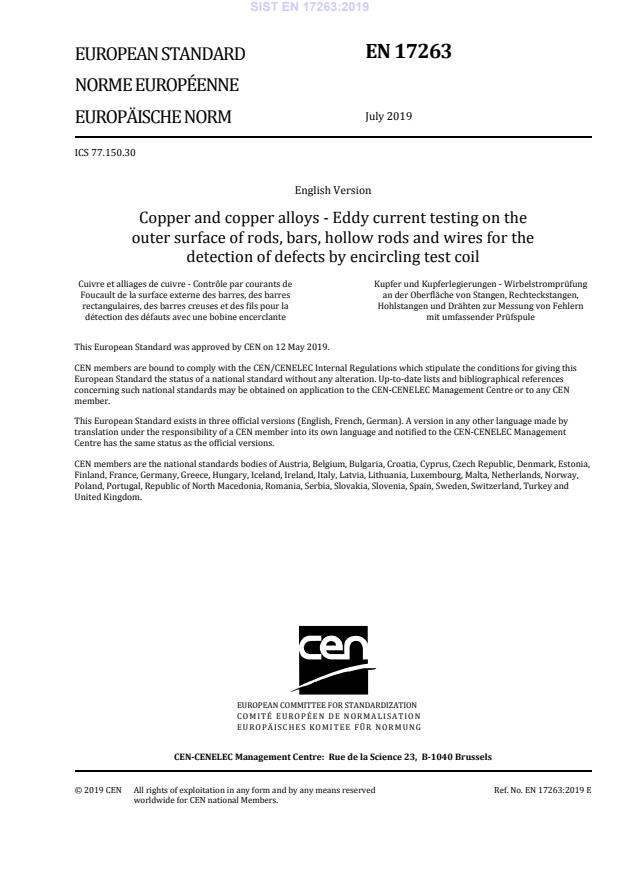
EN 17263
EUROPEAN STANDARD
NORME EUROPÉENNE
July 2019
EUROPÄISCHE NORM
ICS 77.150.30
English Version
Copper and copper alloys - Eddy current testing on the
outer surface of rods, bars, hollow rods and wires for the
detection of defects by encircling test coil
Cuivre et alliages de cuivre - Contrôle par courants de Kupfer und Kupferlegierungen - Wirbelstromprüfung
Foucault de la surface externe des barres, des barres an der Oberfläche von Stangen, Rechteckstangen,
rectangulaires, des barres creuses et des fils pour la Hohlstangen und Drähten zur Messung von Fehlern
détection des défauts avec une bobine encerclante mit umfassender Prüfspule
This European Standard was approved by CEN on 12 May 2019.
CEN members are bound to comply with the CEN/CENELEC Internal Regulations which stipulate the conditions for giving this
European Standard the status of a national standard without any alteration. Up-to-date lists and bibliographical references
concerning such national standards may be obtained on application to the CEN-CENELEC Management Centre or to any CEN
member.
This European Standard exists in three official versions (English, French, German). A version in any other language made by
translation under the responsibility of a CEN member into its own language and notified to the CEN-CENELEC Management
Centre has the same status as the official versions.
CEN members are the national standards bodies of Austria, Belgium, Bulgaria, Croatia, Cyprus, Czech Republic, Denmark, Estonia,
Finland, France, Germany, Greece, Hungary, Iceland, Ireland, Italy, Latvia, Lithuania, Luxembourg, Malta, Netherlands, Norway,
Poland, Portugal, Republic of North Macedonia, Romania, Serbia, Slovakia, Slovenia, Spain, Sweden, Switzerland, Turkey and
United Kingdom.
EUROPEAN COMMITTEE FOR STANDARDIZATION
COMITÉ EUROPÉEN DE NORMALISATION
EUROPÄISCHES KOMITEE FÜR NORMUNG
CEN-CENELEC Management Centre: Rue de la Science 23, B-1040 Brussels
© 2019 CEN All rights of exploitation in any form and by any means reserved Ref. No. EN 17263:2019 E
worldwide for CEN national Members.
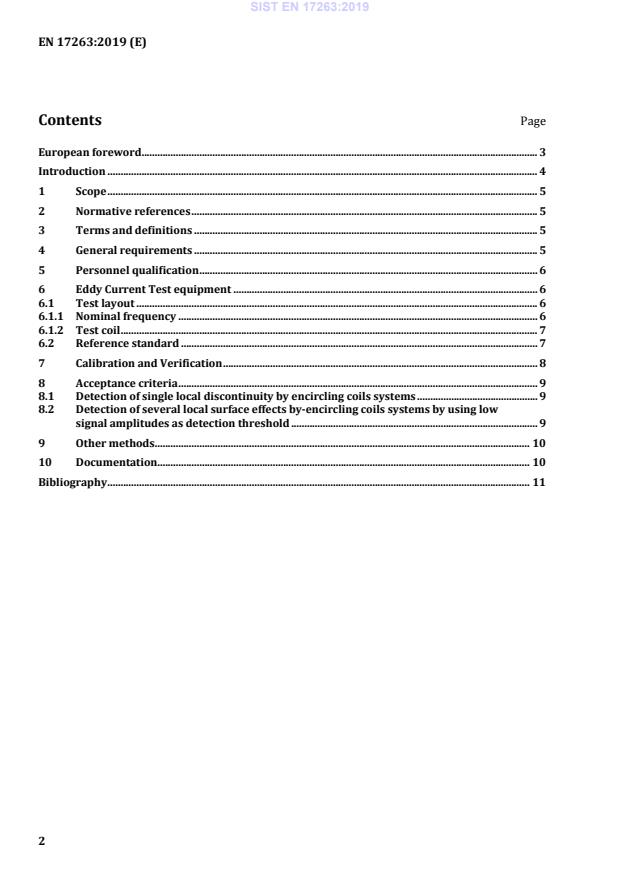
Contents Page
European foreword . 3
Introduction . 4
1 Scope . 5
2 Normative references . 5
3 Terms and definitions . 5
4 General requirements . 5
5 Personnel qualification . 6
6 Eddy Current Test equipment . 6
6.1 Test layout . 6
6.1.1 Nominal frequency . 6
6.1.2 Test coil . 7
6.2 Reference standard . 7
7 Calibration and Verification . 8
8 Acceptance criteria . 9
8.1 Detection of single local discontinuity by encircling coils systems . 9
8.2 Detection of several local surface effects by-encircling coils systems by using low
signal amplitudes as detection threshold . 9
9 Other methods . 10
10 Documentation . 10
Bibliography . 11
European foreword
This document (EN 17263:2019) has been prepared by Technical Committee CEN/TC 133 “Copper and
copper alloys”, the secretariat of which is held by DIN.
This European Standard shall be given the status of a national standard, either by publication of an
identical text or by endorsement, at the latest by January 2020, and conflicting national standards shall
be withdrawn at the latest by January 2020.
Attention is drawn to the possibility that some of the elements of this document may be the subject of
patent rights. CEN shall not be held responsible for identifying any or all such patent rights.
According to the CEN-CENELEC Internal Regulations, the national standards organisations of the
following countries are bound to implement this European Standard: Austria, Belgium, Bulgaria,
Croatia, Cyprus, Czech Republic, Denmark, Estonia, Finland, France, Germany, Greece, Hungary, Iceland,
Ireland, Italy, Latvia, Lithuania, Luxembourg, Malta, Netherlands, Norway, Poland, Portugal, Republic of
North Macedonia, Romania, Serbia, Slovakia, Slovenia, Spain, Sweden, Switzerland, Turkey and the
United Kingdom.
Introduction
The eddy current testing (ET) described in this document has the objective of detecting defects located
on or near the surface in copper and copper alloy rods, bars, hollow rods and wires in a non-destructive
way.
The eddy current test referenced in this document is able to detect significant discontinuities of the
short abrupt type (typical defects e.g. cracks, laps, fins, shells, rolled-in matter) by the differential
method with encircling test coils. Inhomogeneities evenly extending longitudinally over a large area
cannot always be detected with this method.
The purpose of this document is not to define a method of measuring the actual extent of the material
inhomogeneities, as the signal amplitude is also depending of factors e.g. volume, form and position of
the inhomogeneity.
For the tested rods, bars, hollow rods and wires with no inhomogeneities detected, no conclusions can
be drawn as to the functionality of the parts made from these rods, bars, hollow rods and wires.
1 Scope
This document specifies a procedure for fully automatic eddy current testing with no operator
involvement with an encircling test coil for detecting defects on the surface of copper and copper alloy
rods, bars, hollow rods and wires with a minimum diameter or width across flats defined in the relevant
product standards.
This test method can be continuous or discontinuous depending on the product.
The product size range and test acceptance level are defined in the relevant product standards.
2 Normative references
The following documents are referred to in the text in such a way that some or all of their content
constitutes requirements of this document. For dated references, only the edition cited applies. For
undated references, the latest edition of the referenced document (including any amendments) applies.
EN ISO 12718, Non-destructive testing — Eddy current testing — Vocabulary (ISO 12718)
EN ISO 9712, Non-destructive testing — Qualification and certification of NDT personnel (ISO 9712)
EN ISO 15549, Non-destructive testing — Eddy current testing — General principles (ISO 15549)
3 Terms and definitions
For the purposes of this document, the terms and definitions given in EN ISO 12718 apply.
ISO and IEC maintain terminological databases for use in standardization at the following addresses:
— IEC Electropedia: available at http://www.electropedia.org/
— ISO Online browsing platform: available at http://www.iso.org/obp
4 General requirements
The eddy current testing method with self-comparison mode using encircling test coils is employed. A
suitable encircling test coil corresponding to the dimension of the rods, bars, hollow rods or wires to be
tested is chosen. Since the distribution density of eddy currents decreases as the distance from the test
coil increases, the amplitude of defect signals also decreases with increasing distance from the test coil.
The mechanical arrangement shall be chosen in order that the material can pass through the test coil as
concentrically and vibration-
...