

FprEN 18299
(Main)Soil improvers and growing media - Methods for the detection of Salmonella spp. and the enumeration of Escherichia coli and enterococci
- Abstract
This document specifies references to methods to be used for the detection of Salmonella spp. and the enumeration of Escherichia coli and enterococci in soil improvers and growing media, but does not contain the methods themselves.
This document is applicable to the fertilizing product blends where a blend is a mix of two or more fertilizing products belonging to the categories of fertilizers, liming material, soil improvers, growing media, inhibitors and plant biostimulants, and where soil improvers and/or growing media are the components with the highest percentage in the blend by mass or volume, or in the case of products in liquid form by dry mass. If the soil improvers and/or growing media are not the components with the highest percentage in the blend, the European Standard relevant to the component with the highest percentage in the blend applies. In case a blend is composed of fertilizing products mixed in equal quantities, the user of the standard decides which standard to apply.
NOTE A soil improver or a growing medium consists of a single bulky (volume-building) component or a mix of bulky (volume-building) components (for example peat, wood fibres, coconut coir, compost, expanded perlite).
- Status
- Not Published
- Publication Date
- 17-Feb-2027
- Technical Committee
- CEN/TC 223 - Soil improvers and growing media
- Drafting Committee
- CEN/TC 223/WG 6 - Harmonization
- Current Stage
- 5020 - Submission to Vote - Formal Approval
- Start Date
- 29-Oct-2026
- Due Date
- 05-Nov-2026
- Completion Date
- 05-Nov-2026
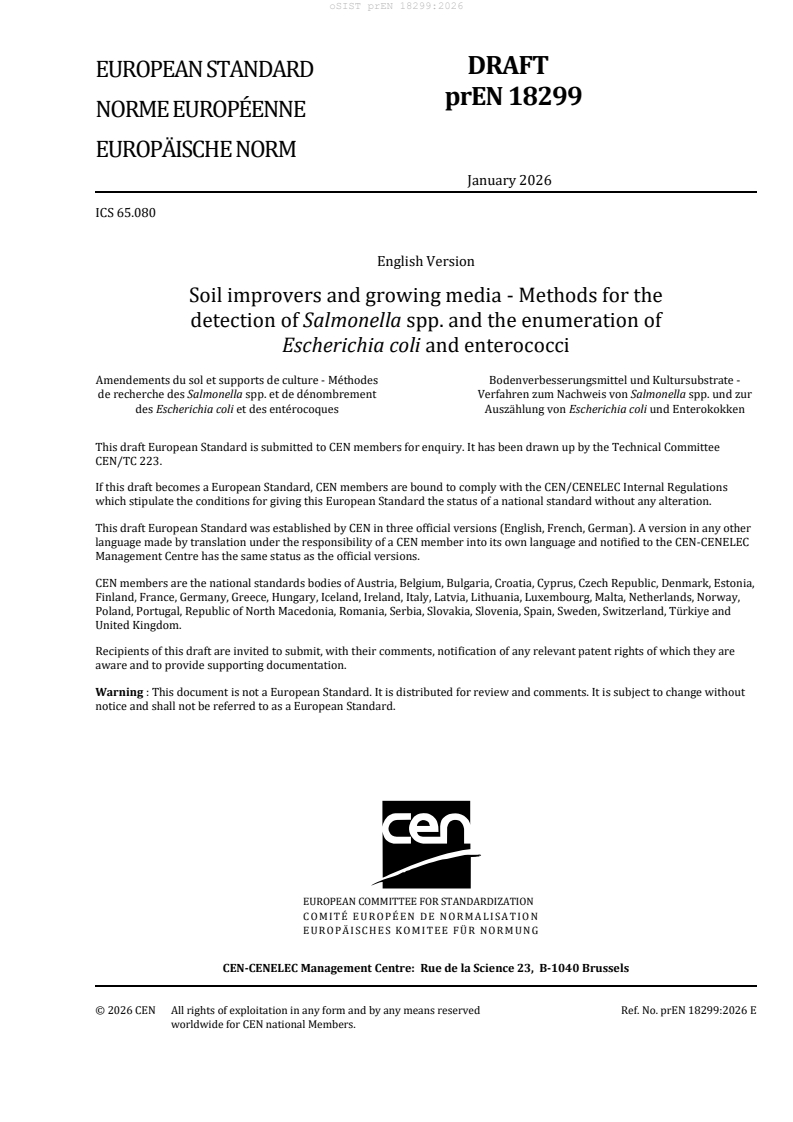

FprEN 18299 is a draft European Standard from CEN for soil improvers and growing media. It specifies the reference methods to use for detecting Salmonella spp. and enumerating Escherichia coli and enterococci in these products and in certain fertilising product blends. The document is for people who need to choose the correct sampling, sample-preparation, and microbiological test standards for compliance work.
What does FprEN 18299 specify?
FprEN 18299 specifies which other standards are to be used for sampling, sample preparation, detection, and enumeration, but it does not contain the laboratory methods themselves. It is intended for soil improvers and growing media, plus blends where those materials are the main components.
The scope matters because blend classification changes which standard applies. If soil improvers and/or growing media are the highest-percentage components in the blend, this document applies; if another fertilising product category dominates, the standard for that dominant component applies instead. For equal blends, the user decides which standard to use.
| Annex | What it covers |
|---|---|
| Annex ZA | Relationship between this European Standard and the essential requirements of Regulation (EU) 2019/1009 |
What are the key requirements of FprEN 18299?
FprEN 18299 is mainly a routing document: it tells the reader which standards to follow at each step of microbiological checking. In practice, that means the user must link the product type, sampling route, sample preparation route, and the final detection or enumeration method.
Sampling and sample preparation
Clause 4 requires sampling in accordance with EN 12579:2024 and sample preparation in accordance with prEN 13040-2:2025. This matters because incorrect sampling or preparation can distort the microbiological result before testing even begins.
Detection of Salmonella spp.
Clause 5.1 requires detection of Salmonella spp. in accordance with prEN 18278:2026. For the reader, this means the standard points to the separate method that must be used when Salmonella spp. is the target organism.
Enumeration of Escherichia coli
Clause 5.2 requires enumeration of Escherichia coli in accordance with prEN 18280:2026. In practice, users do not design their own counting approach here - they follow the referenced enumeration standard for the result they need.
Enumeration of enterococci
Clause 5.3 requires enumeration of enterococci in accordance with prEN 18279:2026. This is relevant where a specification, regulation, or contract asks for enterococci results alongside Salmonella spp. or Escherichia coli.
Terms and definitions
Clause 3 uses the terms and definitions from prEN 17732:2025. That keeps the vocabulary aligned with the wider soil improvers and growing media series, which helps when documents are used together in procurement, testing, and compliance files.
EU regulatory link
Annex ZA ties the document to Regulation (EU) 2019/1009. It maps clause 4 and clause 5.1 to 5.3 to the essential safety requirements for PFC 3 organic soil improvers, PFC 3 inorganic soil improvers, and PFC 4 growing media, which is why the document is useful in conformity assessment.
What terms does FprEN 18299 define?
FprEN 18299 relies on the terminology in prEN 17732:2025, and the following terms are central to how the document is used:
- Soil improvers - products intended to improve the properties of soil; in this document they are one of the main product types in scope.
- Growing media - bulky materials or mixes used as a substrate for plant growth; they are the other main product type in scope.
- Blend - a mix of two or more fertilising products, where the dominant component determines which standard applies.
- Salmonella spp. - the target pathogen for detection in this document.
- Escherichia coli - the organism whose amount is enumerated as part of microbiological checking.
- enterococci - the organism group whose amount is enumerated alongside Escherichia coli.
- PFC - product function category under Regulation (EU) 2019/1009, used here for soil improvers and growing media.
Who uses FprEN 18299?
FprEN 18299 is used by laboratories, manufacturers, and conformity assessment teams working with soil improvers, growing media, and qualifying fertilising blends. It is also relevant to quality managers, technical buyers, and regulatory specialists who need to specify the correct microbiological test route.
In practice, it helps users decide which standards to apply for sampling, sample preparation, and the three microbiological determinations covered by the document. It is especially relevant where results are needed for product release, specification checks, or evidence of alignment with Regulation (EU) 2019/1009.
Which standards are used with FprEN 18299?
FprEN 18299 depends on several companion standards:
- prEN 17732:2025 - provides the terminology and definitions used across the series.
- EN 12579:2024 - gives the sampling method.
- prEN 13040-2:2025 - gives sample preparation for microbiological examination.
- prEN 18278:2026 - gives the method for detection of Salmonella spp.
- prEN 18280:2026 - gives the method for enumeration of Escherichia coli.
- prEN 18279:2026 - gives the method for enumeration of enterococci.
These references are important because FprEN 18299 itself does not duplicate the procedures.
What does the FprEN 18299 document contain?
The document contains a foreword, an introduction, five clauses, Annex ZA, and a bibliography. Clause 4 covers sampling and sample preparation, and clause 5 covers detection and enumeration by pointing to the relevant separate standards.
Annex ZA is informative and gives the relationship to Regulation (EU) 2019/1009, including a correspondence table that links the clauses of this standard to the essential safety requirements for the relevant product function categories. For a reader, the document is therefore a map from product type to the correct test standards and the EU conformity context, not a full microbiology method description.
Get Certified
Connect with accredited certification bodies for this standard

Control Union Certifications
Global certification for agriculture and sustainability.

ECOCERT
Organic and sustainability certification.

FSC International
Forest Stewardship Council certification.
Sponsored listings
Frequently Asked Questions
FprEN 18299 is a draft published by the European Committee for Standardization (CEN). Its full title is "Soil improvers and growing media - Methods for the detection of Salmonella spp. and the enumeration of Escherichia coli and enterococci". This standard covers: This document specifies references to methods to be used for the detection of Salmonella spp. and the enumeration of Escherichia coli and enterococci in soil improvers and growing media, but does not contain the methods themselves. This document is applicable to the fertilizing product blends where a blend is a mix of two or more fertilizing products belonging to the categories of fertilizers, liming material, soil improvers, growing media, inhibitors and plant biostimulants, and where soil improvers and/or growing media are the components with the highest percentage in the blend by mass or volume, or in the case of products in liquid form by dry mass. If the soil improvers and/or growing media are not the components with the highest percentage in the blend, the European Standard relevant to the component with the highest percentage in the blend applies. In case a blend is composed of fertilizing products mixed in equal quantities, the user of the standard decides which standard to apply. NOTE A soil improver or a growing medium consists of a single bulky (volume-building) component or a mix of bulky (volume-building) components (for example peat, wood fibres, coconut coir, compost, expanded perlite).
This document specifies references to methods to be used for the detection of Salmonella spp. and the enumeration of Escherichia coli and enterococci in soil improvers and growing media, but does not contain the methods themselves. This document is applicable to the fertilizing product blends where a blend is a mix of two or more fertilizing products belonging to the categories of fertilizers, liming material, soil improvers, growing media, inhibitors and plant biostimulants, and where soil improvers and/or growing media are the components with the highest percentage in the blend by mass or volume, or in the case of products in liquid form by dry mass. If the soil improvers and/or growing media are not the components with the highest percentage in the blend, the European Standard relevant to the component with the highest percentage in the blend applies. In case a blend is composed of fertilizing products mixed in equal quantities, the user of the standard decides which standard to apply. NOTE A soil improver or a growing medium consists of a single bulky (volume-building) component or a mix of bulky (volume-building) components (for example peat, wood fibres, coconut coir, compost, expanded perlite).
FprEN 18299 is classified under the following ICS (International Classification for Standards) categories: 65.080 - Fertilizers. The ICS classification helps identify the subject area and facilitates finding related standards.
FprEN 18299 is associated with the following European legislation: EU Directives/Regulations: 2003/2003, 2019/1009; Standardization Mandates: M/564, M/564 Amd 1, M/564 Amd 2, M/XXX. When a standard is cited in the Official Journal of the European Union, products manufactured in conformity with it benefit from a presumption of conformity with the essential requirements of the corresponding EU directive or regulation.
FprEN 18299 is available in PDF format for immediate download after purchase. The document can be added to your cart and obtained through the secure checkout process. Digital delivery ensures instant access to the complete standard document.
Standards Content (Sample)
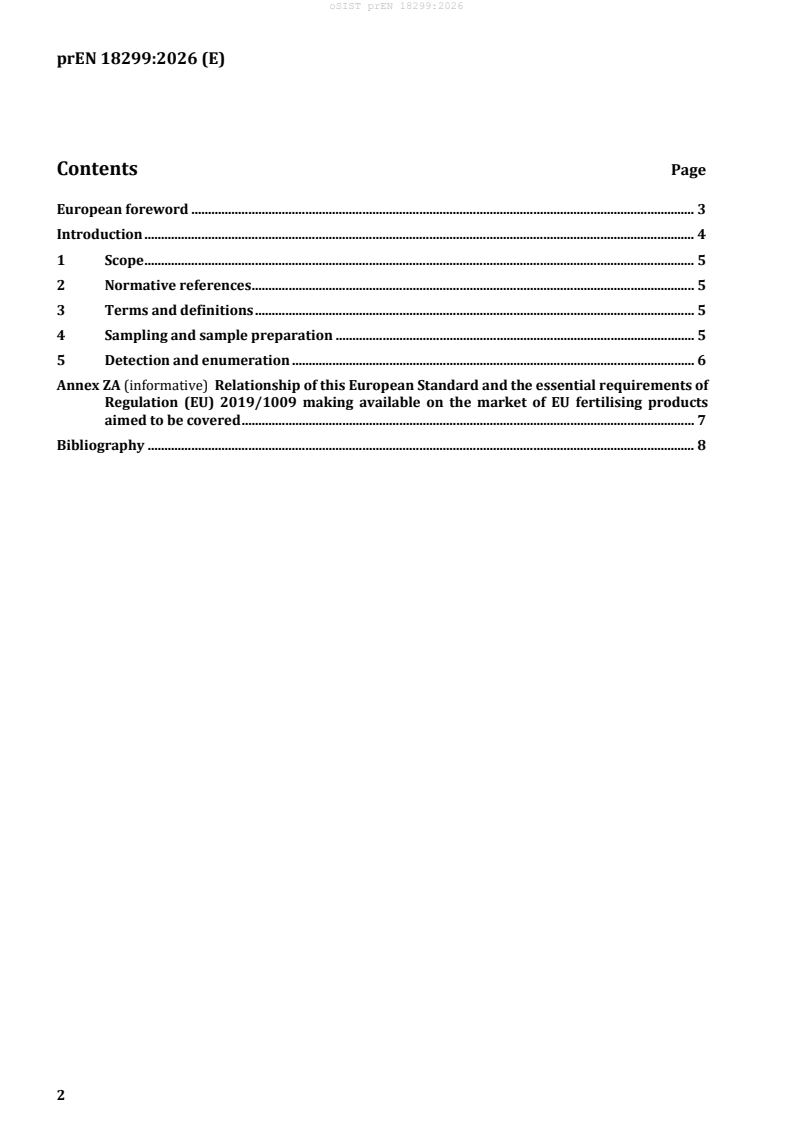
Contents
- Introduction
- 1 Scope
- 2 Normative references
- 3 Terms and definitions
- 4 Sampling and sample preparation
- 4.1 Sampling
- 4.2 Sample preparation
- 5 Detection and enumeration
- 5.2 Enumeration of Escherichia coli
- 5.3 Enumeration of enterococci
- Annex ZA
- Bibliography
Introduction
Different product functions warrant different product safety, quality and quantity requirements adapted to their different intended uses. EU fertilizing products have therefore been divided into different product function categories (PFCs), which are subject to specific safety, quality and quantity requirements, as specified in the Regulation (EU) 2019/1009 [1].
Soil improvers have been classified as PFC 3, growing media have been classified as PFC 4. The specific requirements in relation to specific pathogens (Escherichia coli, enterococci and Salmonella spp.) are specified in this document, as well as normative references of the test methods to be used to assess the compliance with the related requirement.
oSIST prEN 18299:2026 prEN 18299:2026 (E)
1 Scope
This document refers to methods to be used for the detection of Salmonella spp. and the enumeration of Escherichia coli and enterococci in soil improvers and growing media, but does not contain the methods themselves.
This document is applicable to the fertilizing product blends where a blend is a mix of two or more fertilising products belonging to the categories of fertilizers, liming material, soil improvers, growing media, inhibitors and plant biostimulants, and where soil improvers and/or growing media are the components with the highest percentage in the blend by mass or volume, or in the case of products in liquid form by dry mass. If the soil improvers and/or growing media are not the components with the highest percentage in the blend, the European Standard relevant to the component with the highest percentage in the blend applies. In case a blend is composed of fertilising products mixed in equal quantities, the user of the standard decides which standard to apply. NOTE A soil improver or a growing medium consists of a single bulky (volume-building) component or a mix of bulky (volume-building) components (for example peat, wood fibres, coconut coir, compost, expanded perlite).
...