

EN 3049:1998
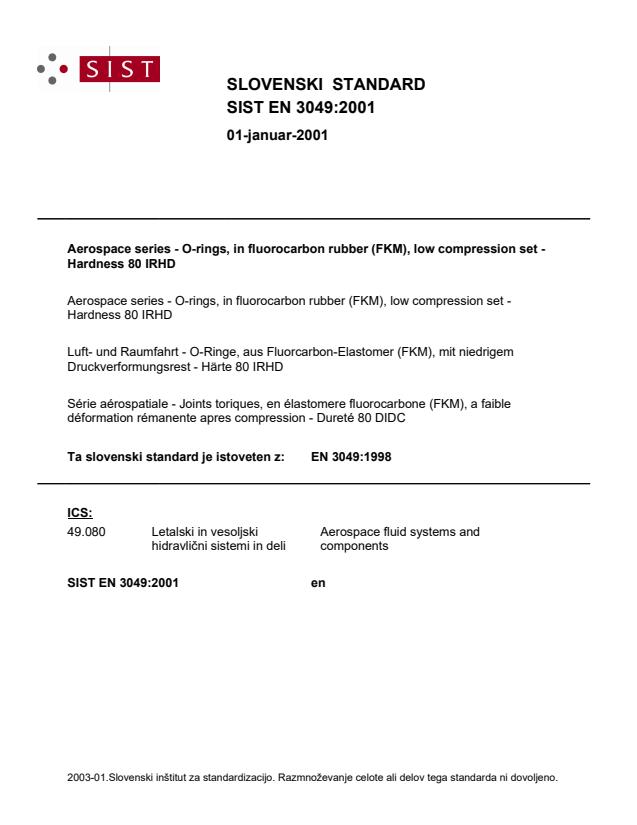
(Main)Aerospace series - O-rings, in fluorocarbon rubber (FKM), low compression set - Hardness 80 IRHD
General Information
- Abstract
This standard specifies the characteristics of O-rings in fluorocarbon rubber FKM, low compression set, hardness 80 IRHD, for aerospace applications. They are intended to be used in air, mineral/synthetic oil and fuel systems. Operating conditions - Temperature: a) Continuous operation: -20°C to +225°C; b) Static applications minimum temperature of use: -50°C. Limitation: not to be used with phosphoric ester type hydraulic fluids (permanent or temporary immersion).
- Status
- Withdrawn
- Publication Date
- 19-May-1998
- Withdrawal Date
- 22-Sep-2026
- Technical Committee
- ASD-STAN - Aerospace
- Drafting Committee
- ASD-STAN/D 3 - Mechanical
- Current Stage
- 9960 - Withdrawal effective - Withdrawal
- Start Date
- 24-Dec-2025
- Completion Date
- 23-Sep-2026


Overview
EN 3049:1998 (CEN) is an aerospace series specification for O-rings made from fluorocarbon rubber (FKM) with low compression set and a nominal hardness of 80 IRHD. The standard defines the intended use environment and key performance limits for these elastomer seals in aerospace fluid systems, especially where resistance to air, mineral/synthetic oils and fuels is required. It also states clear limitations for incompatible fluids.
Key topics and requirements
- Material: Fluorocarbon rubber (FKM) formulated for low compression set to improve seal life under sustained deformation.
- Hardness: Specified at 80 IRHD, suitable for high-pressure and high-temperature aerospace applications needing firmer sealing elements.
- Intended media: Approved for use with air, mineral/synthetic oils, and fuels commonly found in aircraft systems.
- Temperature limits:
- Continuous operation: -20°C to +225°C
- Static applications (minimum): -50°C
- Chemical limitation: Not to be used with phosphoric ester (phosphate ester) type hydraulic fluids, either in permanent or temporary immersion - a critical compatibility restriction for systems using fire-resistant hydraulic fluids.
- Application scope: Targeted at aerospace fluid systems and components where standardized O-ring performance and interchangeability are required.
Applications
- Selection and specification of sealing elements for air systems, fuel lines, and oil/wetted components on aircraft and spacecraft.
- Use by aerospace design engineers, systems integrators, and maintenance/repair organizations to ensure appropriate material choice and temperature compatibility.
- Procurement and quality assurance teams for supplier evaluation, part acceptance, and conformity to aerospace sealing requirements.
- Seal and elastomer manufacturers for product design, verification, and labeling when producing FKM O-rings intended for aerospace use.
Practical considerations
- Verify system fluid compatibility before selecting EN 3049 FKM O-rings; avoid phosphate-ester hydraulic fluids to prevent rapid degradation.
- Consider dynamic vs static installation: the standard gives a lower minimum temperature for static use (-50°C) than for continuous/dynamic operation.
- Use hardness and low compression set specifications to balance leak-tight performance with ease of installation and groove design.
Related standards
- EN 3049 is part of a broader set of aerospace sealing standards covering elastomer materials and O-ring specifications. For system-level design, consult complementary ISO/SAE and other EN aerospace seal standards and material data sheets for FKM compounds.
Keywords: EN 3049, FKM O-rings, aerospace O-rings, low compression set, hardness 80 IRHD, temperature range, fuel systems, phosphate ester fluids, seal compatibility.
Relations
- Effective Date
- 08-Apr-2024
- Effective Date
- 25-Aug-2026
- Effective Date
- 28-Jan-2026
- Effective Date
- 28-Jan-2026
Get Certified
Connect with accredited certification bodies for this standard

BUREAU VERITAS Certification Germany
Bureau Veritas certification in Germany.

Element Materials Technology
Materials testing and product certification.

AQMS Ltd.
AQMS provides ISO certification to SMEs across the UK.
Sponsored listings
Frequently Asked Questions
EN 3049:1998 is a standard published by the European Committee for Standardization (CEN). Its full title is "Aerospace series - O-rings, in fluorocarbon rubber (FKM), low compression set - Hardness 80 IRHD". This standard covers: This standard specifies the characteristics of O-rings in fluorocarbon rubber FKM, low compression set, hardness 80 IRHD, for aerospace applications. They are intended to be used in air, mineral/synthetic oil and fuel systems. Operating conditions - Temperature: a) Continuous operation: -20°C to +225°C; b) Static applications minimum temperature of use: -50°C. Limitation: not to be used with phosphoric ester type hydraulic fluids (permanent or temporary immersion).
This standard specifies the characteristics of O-rings in fluorocarbon rubber FKM, low compression set, hardness 80 IRHD, for aerospace applications. They are intended to be used in air, mineral/synthetic oil and fuel systems. Operating conditions - Temperature: a) Continuous operation: -20°C to +225°C; b) Static applications minimum temperature of use: -50°C. Limitation: not to be used with phosphoric ester type hydraulic fluids (permanent or temporary immersion).
EN 3049:1998 is classified under the following ICS (International Classification for Standards) categories: 49.080 - Aerospace fluid systems and components. The ICS classification helps identify the subject area and facilitates finding related standards.
EN 3049:1998 has the following relationships with other standards: It is inter standard links to EN 3049:2025, ISO 3601-1:1988, EN 3050:2025, EN 12980:2000. Understanding these relationships helps ensure you are using the most current and applicable version of the standard.
EN 3049:1998 is available in PDF format for immediate download after purchase. The document can be added to your cart and obtained through the secure checkout process. Digital delivery ensures instant access to the complete standard document.
Standards Content (Sample)
2003-01.Slovenski inštitut za standardizacijo. Razmnoževanje celote ali delov tega standarda ni dovoljeno.Aerospace series - O-rings, in fluorocarbon rubber (FKM), low compression set - Hardness 80 IRHDLuft- und Raumfahrt - O-Ringe, aus Fluorcarbon-Elastomer (FKM), mit niedrigem Druckverformungsrest - Härte 80 IRHDSérie aérospatiale - Joints toriques, en élastomere fluorocarbone (FKM), a faible déformation rémanente apres compression - Dureté 80 DIDCAerospace series -
...