


EN 13503-3:2000
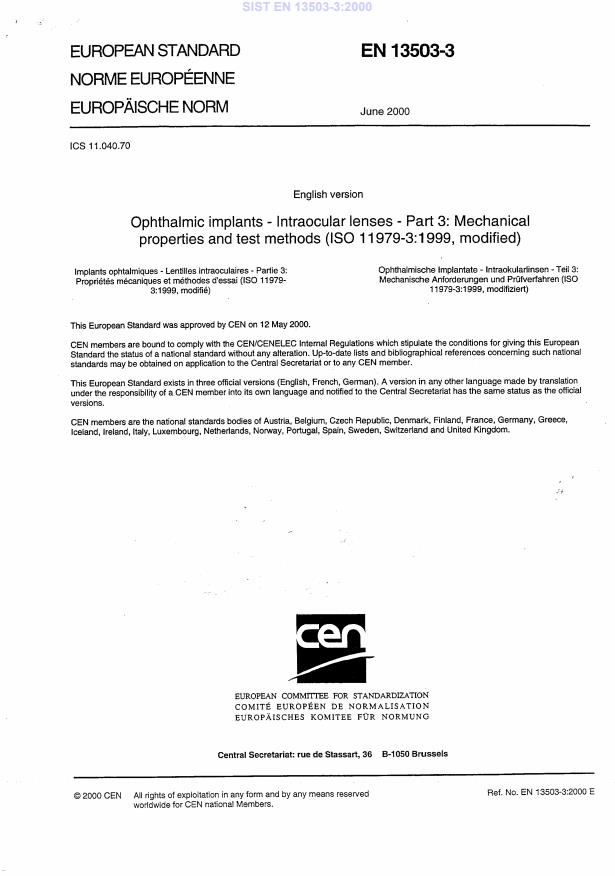
(Main)Ophthalmic implants - Intraocular lenses - Part 3: Mechanical properties and test methods (ISO 11979-3:1999, modified)
Ophthalmic implants - Intraocular lenses - Part 3: Mechanical properties and test methods (ISO 11979-3:1999, modified)
This part of EN 13503 specifies requirements and test methods for certain mechanical properties of intraocular lenses (IOLs). It is applicable to all types of IOLs intended for implantation in the anterior segment of the human eye, excluding corneal implants, provided that the test method is appropriate to the particular design. NOTE: For certain designs and certain applications, a specific test method described in this part of EN 13503 may not be applicable. In such instances the IOL manufacturer should devise corresponding test methods and provide validation and rationale for them.
Ophthalmische Implantate - Intraokularlinsen - Teil 3: Mechanische Anforderungen und Prüfverfahren (ISO 11979-3:1999, modifiziert)
Dieser Teil von EN 13503 legt Anforderungen und Prüfverfahren für bestimmte mechanische Eigenschaften von Intraokularlinsen (IOLs) fest. Er gilt - mit der Ausnahme von Hornhautimplantaten - für alle Typen von IOLs, die für die Implantation in das vordere Segment des menschlichen Auges vorgesehen sind, sofern das angegebene Verfahren für das fragliche Design geeignet ist. ANMERKUNG: Für bestimmte Designs und bestimmte Anwendungen kann ein spezielles Prüfverfahren, das in diesem Teil von EN 13503 beschrieben wird, möglicherweise nicht anwendbar sein.
Implants ophtalmiques - Lentilles intraoculaires - Partie 3: Propriétés mécaniques et méthodes d'essai (ISO 11979-3:1999, modifié)
La présente partie de l'EN 13503 définit les exigences et les méthodes d'essai applicables à certaines propriétés mécaniques des lentilles intraoculaires (LIOs). Elle est applicable à tous les types de LIOs destinées à être implantées dans le segment antérieur de l'oeil humain, à l'exception des implants cornéens, dans la mesure où cette méthode peut être employée pour le modèle considéré. NOTE: Pour certains modèles et certaines applications, il est possible qu'une méthode d'essai spécifique, décrite dans la présente partie de l'EN 13503, ne soit pas applicable.
Očesni vsadki (implantati) - Intraokularne leče - 3. del: Mehanske lastnosti in preskusne metode (ISO 11979-3:1999, spremenjen)
General Information
- Status
- Withdrawn
- Publication Date
- 20-Jun-2000
- Withdrawal Date
- 02-May-2006
- Technical Committee
- CEN/TC 170 - Ophthalmic optics
- Drafting Committee
- CEN/TC 170 - Ophthalmic optics
- Current Stage
- 9960 - Withdrawal effective - Withdrawal
- Start Date
- 03-May-2006
- Completion Date
- 03-May-2006
Relations
- Effective Date
- 22-Dec-2008

Get Certified
Connect with accredited certification bodies for this standard

BSI Group
BSI (British Standards Institution) is the business standards company that helps organizations make excellence a habit.

TÜV Rheinland
TÜV Rheinland is a leading international provider of technical services.

TÜV SÜD
TÜV SÜD is a trusted partner of choice for safety, security and sustainability solutions.
Sponsored listings
Frequently Asked Questions
EN 13503-3:2000 is a standard published by the European Committee for Standardization (CEN). Its full title is "Ophthalmic implants - Intraocular lenses - Part 3: Mechanical properties and test methods (ISO 11979-3:1999, modified)". This standard covers: This part of EN 13503 specifies requirements and test methods for certain mechanical properties of intraocular lenses (IOLs). It is applicable to all types of IOLs intended for implantation in the anterior segment of the human eye, excluding corneal implants, provided that the test method is appropriate to the particular design. NOTE: For certain designs and certain applications, a specific test method described in this part of EN 13503 may not be applicable. In such instances the IOL manufacturer should devise corresponding test methods and provide validation and rationale for them.
This part of EN 13503 specifies requirements and test methods for certain mechanical properties of intraocular lenses (IOLs). It is applicable to all types of IOLs intended for implantation in the anterior segment of the human eye, excluding corneal implants, provided that the test method is appropriate to the particular design. NOTE: For certain designs and certain applications, a specific test method described in this part of EN 13503 may not be applicable. In such instances the IOL manufacturer should devise corresponding test methods and provide validation and rationale for them.
EN 13503-3:2000 is classified under the following ICS (International Classification for Standards) categories: 11.040.70 - Ophthalmic equipment. The ICS classification helps identify the subject area and facilitates finding related standards.
EN 13503-3:2000 has the following relationships with other standards: It is inter standard links to EN ISO 11979-3:2006. Understanding these relationships helps ensure you are using the most current and applicable version of the standard.
EN 13503-3:2000 is available in PDF format for immediate download after purchase. The document can be added to your cart and obtained through the secure checkout process. Digital delivery ensures instant access to the complete standard document.
Standards Content (Sample)
2003-01.Slovenski inštitut za standardizacijo. Razmnoževanje celote ali delov tega standarda ni dovoljeno.Ophthalmische Implantate - Intraokularlinsen - Teil 3: Mechanische Anforderungen und Prüfverfahren (ISO 11979-3:1999, modifiziert)Implants ophtalmiques - Lentilles intraoculaires - Partie 3: Propriétés mécaniques et méthodes d'essai (ISO 11979-3:1999, modifié)Ophthalmic implants - Intraocular lenses - Part 3: Mechanical properties and test methods (ISO 11979-3:1999, modified)11.040.70Oftalmološka opremaOphthalmic equipmentICS:Ta slovenski standard je istoveten z:EN 13503-3:2000SIST EN 13503-3:2000en01-november-2000SIST EN 13503-3:2000SLOVENSKI
STANDARD
...
Questions, Comments and Discussion
Ask us and Technical Secretary will try to provide an answer. You can facilitate discussion about the standard in here.
Loading comments...