


EN 13286-2:2010
(Main)Unbound and hydraulically bound mixtures - Part 2: Test methods for laboratory reference density and water content - Proctor compaction
Unbound and hydraulically bound mixtures - Part 2: Test methods for laboratory reference density and water content - Proctor compaction
This European Standard specifies test methods for the determination of the relationship between the water content and the dry density of hydraulically bound or unbound mixtures after compaction under specified test conditions using Proctor compaction. It allows an estimate of the mixture density that can be achieved on construction sites and provides a reference parameter for assessing the density of the compacted layer of the mixture.
This European Standard applies only to unbound and hydraulically bound mixtures of aggregates used in road construction and civil engineering work. It is not applicable to soils for earthworks. The results of this test method can be used as a basis for comparing mixtures before use in road construction. The test results also allow a conclusion to be drawn as to the water content at which mixtures can be satisfactorily compacted in order to achieve a given dry density.
This test is suitable for mixtures with different values of upper sieve (D) size up to 63 mm and an oversize up to 25 % by mass.
Ungebundene und hydraulisch gebundene Gemische - Teil 2: Laborprüfverfahren zur Bestimmung der Referenz-Trockendichte und des Wassergehaltes - Proctorversuch
Diese Europäische Norm legt Verfahren zur Bestimmung der Beziehung zwischen dem Wassergehalt und der
Trockendichte ungebundener und hydraulisch gebundener Gemische nach einer Proctorverdichtung unter
vorgegebenen Prüfbedingungen fest. Sie liefert einen Anhaltswert für die auf der Baustelle erreichbare Dichte
des Gemisches und einen Bezugsparameter zur Beurteilung der Dichte einer verdichteten Schicht des
Gemisches.
Diese Europäische Norm gilt nur für ungebundene und hydraulisch gebundene Gemische von Gesteinskörnungen,
die für Straßenbau- und Tiefbauarbeiten angewendet werden. Sie ist nicht auf die Böden bei Erdarbeiten
anwendbar. Die Prüfergebnisse können als Grundlage für den Vergleich von Gemischen vor ihrer
Verwendung im Straßenbau angewendet werden. Die Prüfergebnisse lassen auch erkennen, bei welchem
Wassergehalt sich ein Gemisch günstig verdichten lässt, um eine bestimmte Trockendichte zu erreichen.
Diese Prüfung ist für Gemische mit einer oberen Siebgröße (D) bis 63 mm und mit Überkornanteilen bis
25 Massenanteilen in Prozent geeignet.
Mélanges traités et mélanges non traités aux liants hydrauliques - Partie 2: Méthodes d'essai de détermination en laboratoire de la masse volumique de référence et de la teneur en eau - Compactage Proctor
La présente Norme européenne spécifie une méthode de détermination du rapport existant entre la teneur en
eau et la masse volumique sèche d’un matériau non traité ou traité aux liants hydrauliques après compactage
dans des conditions d'essai spécifiées selon le compactage Proctor. Les résultats d'essai donnent une
estimation de la masse volumique qu'il est possible de conférer au matériau sur les chantiers et constituent un
paramètre de référence pour évaluer la masse volumique de la couche de matériau une fois compactée.
La présente Norme européenne s’applique seulement aux mélanges non traités ou traités aux liants
hydrauliques, à partir de granulats utilisés pour la construction des routes et le génie civil. Elle n’est pas
applicable aux sols en terrassement. Les résultats de cette méthode d'essai peuvent être utilisés comme base
pour comparer les mélanges avant de les utiliser dans la construction des chaussées. Ces résultats d'essai
permettent aussi de déduire la teneur en eau à laquelle le matériau est le plus facile à compacter pour obtenir
une masse volumique sèche donnée.
Cet essai est applicable à des mélanges avec des dimensions granulaires supérieures (D) variables pouvant
aller jusqu’à 63 mm et dont le refus ne dépasse pas 25 % en masse.
Nevezane in hidravlično vezane zmesi - 2. del: Preskusne metode za določanje laboratorijske referenčne gostote in deleža vlage - Preskus po Proctorju
Ta evropski standard določa preskusne metode za določanje razmerja med deležem vlage in suho gostoto hidravlično vezanih ali nevezanih zmesi po stiskanju pod določenimi preskusnimi pogoji s preskusom po Proctorju. Omogoča oceno gostote zmesi, ki se lahko doseže na gradbiščih, in zagotavlja referenčni parameter za ocenjevanje gostote stisnjene plasti zmesi. Ta evropski standard velja za le nevezane in hidravlično vezane zmesi agregatov, ki se uporabljajo pri gradnji cest in v gradbeništvu. Ne velja za prsti pri zemeljskih delih. Rezultati te preskusne metode se lahko uporabljajo kot osnova za primerjavo zmesi pred uporabo za gradnjo cest. Rezultati preskusa omogočajo tudi oblikovanje ugotovitev v zvezi z deležem vlage, pri katerem se zmesi zadovoljivo stisnejo in dosežejo dano suho gostoto. Ta preskus je primeren za zmesi z različnimi vrednostmi zgornje velikosti zrn (D) do 63 mm in z največ 25-odstotnim masnim presežkom.
General Information
Relations
Overview
EN 13286-2:2010 is a CEN European Standard that defines laboratory Proctor compaction test methods to determine the relationship between water content and dry density for unbound and hydraulically bound mixtures used in road construction and civil engineering. The standard provides a laboratory reference density (Proctor and modified Proctor) that estimates the density achievable on site and serves as a reference parameter for assessing the compaction quality of pavement layers. It applies to aggregates mixtures (upper sieve D up to 63 mm) with an oversize up to 25% by mass and is not applicable to soils for earthworks.
Key Topics and Requirements
- Scope and purpose: Establish the dry density / water content curve to determine optimal compaction moisture and compare mixtures prior to use in road construction.
- Test variants: Six similar Proctor and modified Proctor procedures are specified to suit different maximum particle sizes and sample/mould sizes.
- Proctor vs Modified Proctor:
- Proctor test: specific compaction energy ≈ 0.6 MJ/m³ (standard Proctor).
- Modified Proctor: higher energy ≈ 2.7 MJ/m³ for denser compaction.
- Apparatus essentials:
- Rammers with defined masses and drop heights (examples: Rammer A 2.50 kg, 305 mm drop; Rammer B 4.50 kg, 457 mm; Rammer C 15.00 kg, 600 mm).
- Cylindrical moulds sized to the mixture particle size (mould types A, B, C).
- Balances, sieves (EN 933-x), oven (EN 1097-5) and depth gauges for accurate measurement.
- Sample preparation and limitations:
- Procedures for mixtures passing particular sieve sizes, correction methods for oversize material, and handling of self-draining mixtures are described.
- Test not suitable where >25% of material is retained on the 63 mm sieve.
Applications and Who Uses It
- Pavement engineers and designers: to determine target dry density and optimum moisture for base and sub-base layers.
- Construction contractors and site QA/QC teams: for verifying compaction specifications and predicting achievable field densities.
- Materials laboratories and testing bodies: to compare mix designs, control material quality, and produce reference Proctor curves.
- Specifiers and procurement professionals: for setting contractual density and moisture criteria in roadworks and civil engineering projects.
Practical outcomes include establishing the optimum water content for satisfactory compaction, estimating achievable on-site density, and providing a reproducible basis for mix comparison and specification compliance.
Related Standards
- EN 13286-1 (general requirements, sampling)
- EN 933-1 / EN 933-2 (aggregate particle size and test sieves)
- EN 1097-5 / EN 1097-6 (water content, particle density)
- Other parts of the EN 13286 series covering vibrocompression, vibrating hammer, and specimen manufacture
Keywords: EN 13286-2:2010, Proctor compaction, reference density, water content, unbound mixtures, hydraulically bound mixtures, road construction, compaction test.
Standards Content (Sample)
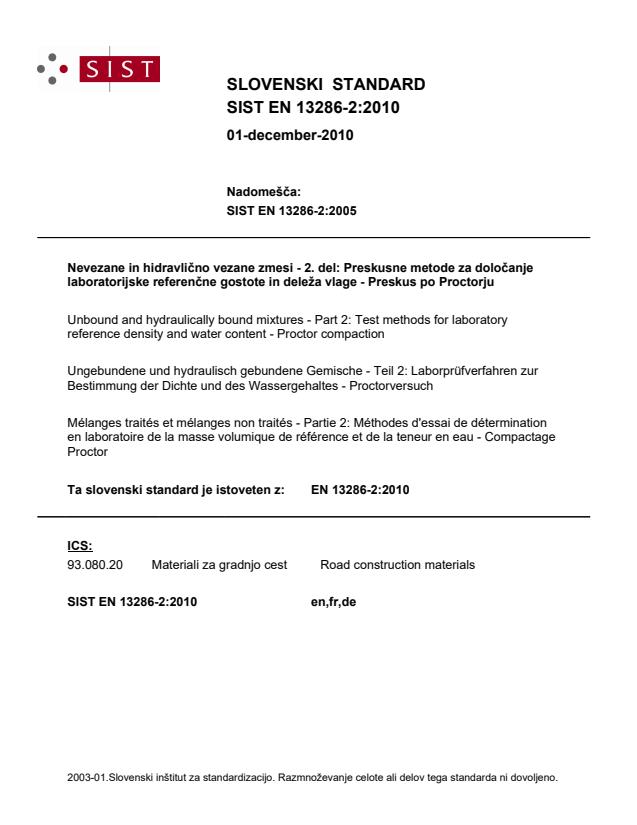
2003-01.Slovenski inštitut za standardizacijo. Razmnoževanje celote ali delov tega standarda ni dovoljeno.RFWRUMXUngebundene und hydraulisch gebundene Gemische - Teil 2: Laborprüfverfahren zur Bestimmung der Dichte und des Wassergehaltes - ProctorversuchMélanges traités et mélanges non traités - Partie 2: Méthodes d'essai de détermination en laboratoire de la masse volumique de référence et de la teneur en eau - Compactage ProctorUnbound and hydraulically bound mixtures - Part 2: Test methods for laboratory reference density and water content - Proctor compaction93.080.20Materiali za gradnjo cestRoad construction materialsICS:Ta slovenski standard je istoveten z:EN 13286-2:2010SIST EN 13286-2:2010en,fr,de01-december-2010SIST EN 13286-2:2010SLOVENSKI
STANDARDSIST EN 13286-2:20051DGRPHãþD
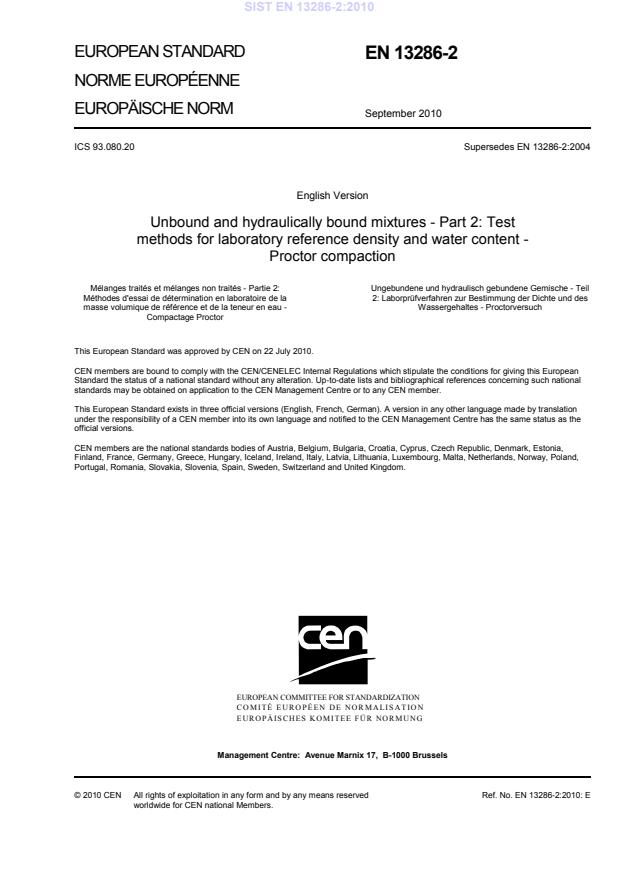
EUROPEAN STANDARD NORME EUROPÉENNE EUROPÄISCHE NORM
EN 13286-2
September 2010 ICS 93.080.20 Supersedes EN 13286-2:2004English Version
Unbound and hydraulically bound mixtures - Part 2: Test methods for laboratory reference density and water content - Proctor compaction
Mélanges traités et mélanges non traités - Partie 2: Méthodes d'essai de détermination en laboratoire de la masse volumique de référence et de la teneur en eau - Compactage Proctor
Ungebundene und hydraulisch gebundene Gemische -Teil 2: Laborprüfverfahren zur Bestimmung der Dichte und des Wassergehaltes - Proctorversuch This European Standard was approved by CEN on 22 July 2010.
CEN members are bound to comply with the CEN/CENELEC Internal Regulations which stipulate the conditions for giving this European Standard the status of a national standard without any alteration. Up-to-date lists and bibliographical references concerning such national standards may be obtained on application to the CEN Management Centre or to any CEN member.
This European Standard exists in three official versions (English, French, German). A version in any other language made by translation under the responsibility of a CEN member into its own language and notified to the CEN Management Centre has the same status as the official versions.
CEN members are the national standards bodies of Austria, Belgium, Bulgaria, Croatia, Cyprus, Czech Republic, Denmark, Estonia, Finland, France, Germany, Greece, Hungary, Iceland, Ireland, Italy, Latvia, Lithuania, Luxembourg, Malta, Netherlands, Norway, Poland, Portugal, Romania, Slovakia, Slovenia, Spain, Sweden, Switzerland and United Kingdom.
EUROPEAN COMMITTEE FOR STANDARDIZATION
COMITÉ EUROPÉEN DE NORMALISATION EUROPÄISCHES KOMITEE FÜR NORMUNG
Management Centre:
Avenue Marnix 17,
B-1000 Brussels © 2010 CEN All rights of exploitation in any form and by any means reserved worldwide for CEN national Members. Ref. No. EN 13286-2:2010: ESIST EN 13286-2:2010
Dimensions of alternative apparatus . 19Annex B (normative)
One point Proctor test . 22Annex C (informative)
Correction for oversize (material retained on the 16 mm, 31,5 mm and 63 mm test sieves) . 26Annex D (informative)
Proctor test for self-draining mixtures. 27 SIST EN 13286-2:2010
Figure 1 — Principle of Proctor mould SIST EN 13286-2:2010
Key 1 4 holes ∅6 2 12 holes ∅6 Figure 2 — Principle of rammer and guide SIST EN 13286-2:2010
Dimensions in millimetres
Key 1 Thread for screwing in handle Figure 3 — Principle of steel plate 5.4 Test sieves, conforming to EN 933-2. 5.5 Balances, readable to 0,1 % of the compacted sample mass. 5.6 Corrosion-resistant metal or plastics mixing tray, with sides about 80 mm deep, of a size suitable for the quantity of material to be used. 5.7 Spatula, trowel or similar tool. 5.8 Steel straightedge, of length 200 mm or more; one edge shall be bevelled if the rule is thicker than 3 mm, or palette knife with straight blade. 5.9 Apparatus for determination of water content, conforming to EN 1097-5. 5.10 Vernier depth gauge, readable to 0,02 mm. 5.11 Mixer, with a volume of at least 0,01 m3. 5.12 Concrete block (min. 50 kg), as support for the compaction by means of manually operated rammer. SIST EN 13286-2:2010
...
Frequently Asked Questions
EN 13286-2:2010 is a standard published by the European Committee for Standardization (CEN). Its full title is "Unbound and hydraulically bound mixtures - Part 2: Test methods for laboratory reference density and water content - Proctor compaction". This standard covers: This European Standard specifies test methods for the determination of the relationship between the water content and the dry density of hydraulically bound or unbound mixtures after compaction under specified test conditions using Proctor compaction. It allows an estimate of the mixture density that can be achieved on construction sites and provides a reference parameter for assessing the density of the compacted layer of the mixture. This European Standard applies only to unbound and hydraulically bound mixtures of aggregates used in road construction and civil engineering work. It is not applicable to soils for earthworks. The results of this test method can be used as a basis for comparing mixtures before use in road construction. The test results also allow a conclusion to be drawn as to the water content at which mixtures can be satisfactorily compacted in order to achieve a given dry density. This test is suitable for mixtures with different values of upper sieve (D) size up to 63 mm and an oversize up to 25 % by mass.
This European Standard specifies test methods for the determination of the relationship between the water content and the dry density of hydraulically bound or unbound mixtures after compaction under specified test conditions using Proctor compaction. It allows an estimate of the mixture density that can be achieved on construction sites and provides a reference parameter for assessing the density of the compacted layer of the mixture. This European Standard applies only to unbound and hydraulically bound mixtures of aggregates used in road construction and civil engineering work. It is not applicable to soils for earthworks. The results of this test method can be used as a basis for comparing mixtures before use in road construction. The test results also allow a conclusion to be drawn as to the water content at which mixtures can be satisfactorily compacted in order to achieve a given dry density. This test is suitable for mixtures with different values of upper sieve (D) size up to 63 mm and an oversize up to 25 % by mass.
EN 13286-2:2010 is classified under the following ICS (International Classification for Standards) categories: 93.080.20 - Road construction materials. The ICS classification helps identify the subject area and facilitates finding related standards.
EN 13286-2:2010 has the following relationships with other standards: It is inter standard links to EN 13286-2:2004, EN 13286-2:2010/AC:2012. Understanding these relationships helps ensure you are using the most current and applicable version of the standard.
You can purchase EN 13286-2:2010 directly from iTeh Standards. The document is available in PDF format and is delivered instantly after payment. Add the standard to your cart and complete the secure checkout process. iTeh Standards is an authorized distributor of CEN standards.
The article discusses the European Standard EN 13286-2:2010, which provides test methods for determining the relationship between water content and dry density of hydraulically bound or unbound mixtures. The tests are carried out using Proctor compaction under specific conditions. The standard is applicable to aggregates used in road construction and civil engineering but not for soils in earthworks. The results of these tests can be used to compare mixtures before their use in road construction and to determine the water content needed for satisfactory compaction to achieve the desired dry density. The test is suitable for mixtures with different sizes and an oversize of up to 25% by mass.
Questions, Comments and Discussion
Ask us and Technical Secretary will try to provide an answer. You can facilitate discussion about the standard in here.
Loading comments...