

EN 13445-2:2026/prA1
(Amendment)Unfired pressure vessels - Part 2: Materials
- Abstract
This document specifies the requirements for steel products used for unfired pressure vessels.
For some metallic materials other than steel, such as spheroidal graphite cast iron, aluminium, nickel, copper, titanium, requirements are or will be formulated in separate parts of this document.
For metallic materials which are not covered by a harmonized material standard and are not likely to be in near future, specific rules are given in this part or the above cited parts of this document.
- Status
- Not Published
- Publication Date
- 21-Jul-2026
- Technical Committee
- CEN/TC 54 - Unfired pressure vessels
- Drafting Committee
- CEN/TC 54/WG 52 - B - Material selection
- Current Stage
- 4060 - Closure of enquiry - Enquiry
- Start Date
- 05-Mar-2026
- Due Date
- 28-May-2026
- Completion Date
- 28-May-2026


EN 13445-2:2026/prA1 is a CEN draft amendment to EN 13445-2, Unfired pressure vessels - Part 2: Materials. It sets and updates the material rules for steel products used in unfired pressure vessels, and it gives special rules for some other metallic materials and for steel parts attached to the vessel. It is written for vessel designers, manufacturers, materials engineers, quality staff and buyers who need to select and verify pressure-vessel materials.
What does EN 13445-2:2026/prA1 specify?
EN 13445-2:2026/prA1 specifies material requirements for steel products used for unfired pressure vessels. It also points some other metallic materials, such as spheroidal graphite cast iron, aluminium, nickel, copper and titanium, to separate parts of the EN 13445 series, and it gives special rules for metallic materials that are not covered by a harmonized material standard.
This amendment is organized as targeted changes to Clause 2 on normative references, Clause 5 on non-pressure parts, Annex B on brittle-fracture selection methods, Annex E on European standardized steels by product form, and Annex ZA on the link with EU law.
| Annex / clause area | What it covers |
|---|---|
| Clause 5 | Materials for non-pressure parts such as lugs, skirts and baffles |
| Annex B | Method 1 and Method 2 for brittle-fracture prevention and impact testing |
| Annex E | European standardized steels grouped according to product form |
| Annex ZA | Relationship with Directive 2014/68/EU |
What are the key requirements of EN 13445-2:2026/prA1?
EN 13445-2:2026/prA1 mainly updates how material properties are used in design and how steels are selected for brittle-fracture resistance. In practice, it tells the user which material data to take from standards, how to adjust them for temperature, and which product forms and grades can be used in the vessel context.
Materials for non-pressure parts
Clause 5 requires materials for non-pressure parts, such as supporting lugs, skirts and baffles, to meet at least chemical composition and tensile-property requirements. They must not restrict the operating conditions of the part they are attached to, so the attachment material cannot become the weak link.
For steels other than austenitic steels, Clause 5 distinguishes steels with specified elevated-temperature proof strength from structural steels without such data. For the latter, the room-temperature minimum yield strength can be used up to 50 °C, and higher temperatures are handled with the reduction factors in Table 5-1. That matters when you size welded attachments, because you need temperature-adjusted strength values, not only catalog values.
For austenitic steels, Clause 5 uses the elevated-temperature 0,2 % proof strength when it is specified. When it is not specified, the tensile strength above 20 °C is calculated with a temperature factor and Table 5-3. The maximum nominal design stress for normal operating, exceptional and testing conditions is then taken from these material properties together with the safety factors in EN 13445-3.
Brittle-fracture prevention
Annex B, Method 1, uses selection tables for plates and strips, seamless and welded tubes, bars, forgings and fittings, ferritic castings, and nickel-alloyed steels. These tables combine product form, steel group, reference thickness and minimum temperature, so the designer can check whether the selected material is suitable for the intended service temperature and thickness.
The updated notes also flag practical limits: some materials need special welding precautions, thermomechanically treated steels shall not be post weld heat treated, and some nickel-alloyed steels have specific heat-treatment or welding conditions. For a buyer or manufacturer, this means the material certificate alone is not enough - the applicable note in Annex B has to be checked as part of the material selection.
Annex B, Method 2, links the design reference temperature to the impact test temperature. For applications below the dotted-line boundary in the figures, steels have to be impact tested at -40 °C or lower, and if the calculated test temperature is lower still, the lower value applies. This matters for low-temperature service because it controls the Charpy impact test condition, not just the nominal steel grade.
Product-form grouping
Annex E groups European standardized steels by product form. The table ties each grade to a product form, a referenced standard, a thickness limit and a note category, which helps when checking whether a plate, bar, tube, forging, casting or fitting is acceptable for a pressure-vessel application.
The notes attached to Annex E also carry practical restrictions, such as special precautions for welding because of carbon content, no welding on certain fasteners, no hot forming for thermomechanically treated steels, and a temperature limit for ferritic stainless steels of -10 °C and above. It also identifies specific bolting materials that can be used when the cited requirements are met.
What terms does EN 13445-2:2026/prA1 define?
- 0,2 % proof strength - the stress level used to represent the onset of permanent deformation, and the value Clause 5 uses for several elevated-temperature checks.
- Nominal design stress - the maximum stress allowed for normal operating, exceptional and testing load cases after applying the material data and safety factors.
- Design reference temperature (TR) - the temperature used in Annex B Method 2 to relate service conditions to impact testing.
- Impact test temperature (TKV) - the temperature at which the steel has to be impact tested for brittle-fracture verification.
- Reference thickness (eB) - the thickness used in Annex B tables and figures when linking product form, temperature and brittle-fracture resistance.
- PWHT - post weld heat treatment, a heat-treatment step that is restricted or required for some materials in the annex notes.
- TMCP - thermomechanically treated steels, which Annex B and Annex E treat with special restrictions on post-weld heat treatment and forming.
- AW - as-welded condition, the condition used in the Annex B Method 2 figures.
Who uses EN 13445-2:2026/prA1?
EN 13445-2:2026/prA1 is used by pressure-vessel designers, materials engineers, welding coordinators, manufacturers, inspectors and purchasers. They use it when choosing steel grades, checking temperature-dependent strength, setting impact-test conditions, reviewing material certificates, or deciding whether a specific product form can be used for an unfired pressure vessel.
It is also relevant for quality managers and buyers who need to compare supplier material specifications with the vessel design rules and with the pressure-equipment framework in the EU.
What changed in EN 13445-2:2026/prA1 from the previous edition?
EN 13445-2:2026/prA1 is a draft amendment that will modify EN 13445-2:2021+A1:2023. The changes stated in the document are:
- updated normative references in Clause 2, including revised references to EN 13445-4 and EN 13445-5
- added references to EN 10088-2, EN 10088-3, EN 10088-4, EN 10088-5, EN 10213 and EN 10253-2
- a rewritten Clause 5 for non-pressure parts, including temperature-dependent strength rules for steels and austenitic steels
- revised Annex B Method 1 selection tables for brittle-fracture prevention
- revised Annex B Method 2 figures and the related impact-testing rule for low-temperature applications
- a revised Annex E table grouping European standardized steels by product form
- updated Annex ZA wording for the relationship with Directive 2014/68/EU
- bibliography updates, including EN 10216-2:2024, EN 10216-5:2021, EN 10222-5:2017 and EN 10253-4:2008
Which standards are used with EN 13445-2:2026/prA1?
EN 13445-2:2026/prA1 works with other parts of the EN 13445 series and with material and product standards. The most important companion documents named in the amendment are:
- EN 13445-3 - provides the safety factors used to determine maximum nominal design stress
- EN 13445-4 - covers fabrication, including PWHT and hot-forming rules
- EN 13445-5 - covers inspection and testing
- EN 10088-2 / -3 / -4 / -5 - provide delivery conditions for stainless steels used in Clause 5
- EN 10213 - provides requirements for steel castings for pressure purposes
- EN 10253-2 - provides specific inspection requirements for butt-welding pipe fittings
The annex tables also draw on many product standards for plates, strips, tubes, bars, forgings, castings, fasteners and fittings, because those standards supply the grades that Annex B and Annex E group for vessel use.
What does the EN 13445-2:2026/prA1 document contain?
The document contains replacement tables and figures rather than a full rewrite of the base part. It includes updated selection tables for brittle-fracture prevention, with product form, grade, reference thickness and temperature data, plus notes on heat treatment, welding and temperature limits.
It also contains temperature-dependent calculation rules in Clause 5, including reduction-factor tables and a formula-based path for austenitic steels. Annex B adds figures that relate design reference temperature to impact test temperature, and Annex E gives a long product-form table for standardized steels used in pressure-vessel applications.
Annex ZA states the document’s relationship to Directive 2014/68/EU, so users working on pressure equipment for the EU can trace how the material rules fit the legal framework.
Relations
- Effective Date
- 29-Apr-2026
- Effective Date
- 14-May-2025
Get Certified
Connect with accredited certification bodies for this standard

Institut za varilstvo d.o.o. (Welding Institute)
Slovenia's leading welding institute since 1952. ISO 3834, EN 1090, pressure equipment certification, NDT personnel, welder qualification. Only IIW Au
Sponsored listings
Frequently Asked Questions
EN 13445-2:2026/prA1 is a draft published by the European Committee for Standardization (CEN). Its full title is "Unfired pressure vessels - Part 2: Materials". This standard covers: This document specifies the requirements for steel products used for unfired pressure vessels. For some metallic materials other than steel, such as spheroidal graphite cast iron, aluminium, nickel, copper, titanium, requirements are or will be formulated in separate parts of this document. For metallic materials which are not covered by a harmonized material standard and are not likely to be in near future, specific rules are given in this part or the above cited parts of this document.
This document specifies the requirements for steel products used for unfired pressure vessels. For some metallic materials other than steel, such as spheroidal graphite cast iron, aluminium, nickel, copper, titanium, requirements are or will be formulated in separate parts of this document. For metallic materials which are not covered by a harmonized material standard and are not likely to be in near future, specific rules are given in this part or the above cited parts of this document.
EN 13445-2:2026/prA1 is classified under the following ICS (International Classification for Standards) categories: 23.020.30 - Pressure vessels. The ICS classification helps identify the subject area and facilitates finding related standards.
EN 13445-2:2026/prA1 has the following relationships with other standards: It is inter standard links to EN 13445-2:2026, EN 13445-2:2021+A1:2023. Understanding these relationships helps ensure you are using the most current and applicable version of the standard.
EN 13445-2:2026/prA1 is associated with the following European legislation: EU Directives/Regulations: 2014/68/EU; Standardization Mandates: M/071, M/601. When a standard is cited in the Official Journal of the European Union, products manufactured in conformity with it benefit from a presumption of conformity with the essential requirements of the corresponding EU directive or regulation.
EN 13445-2:2026/prA1 is available in PDF format for immediate download after purchase. The document can be added to your cart and obtained through the secure checkout process. Digital delivery ensures instant access to the complete standard document.
Standards Content (Sample)
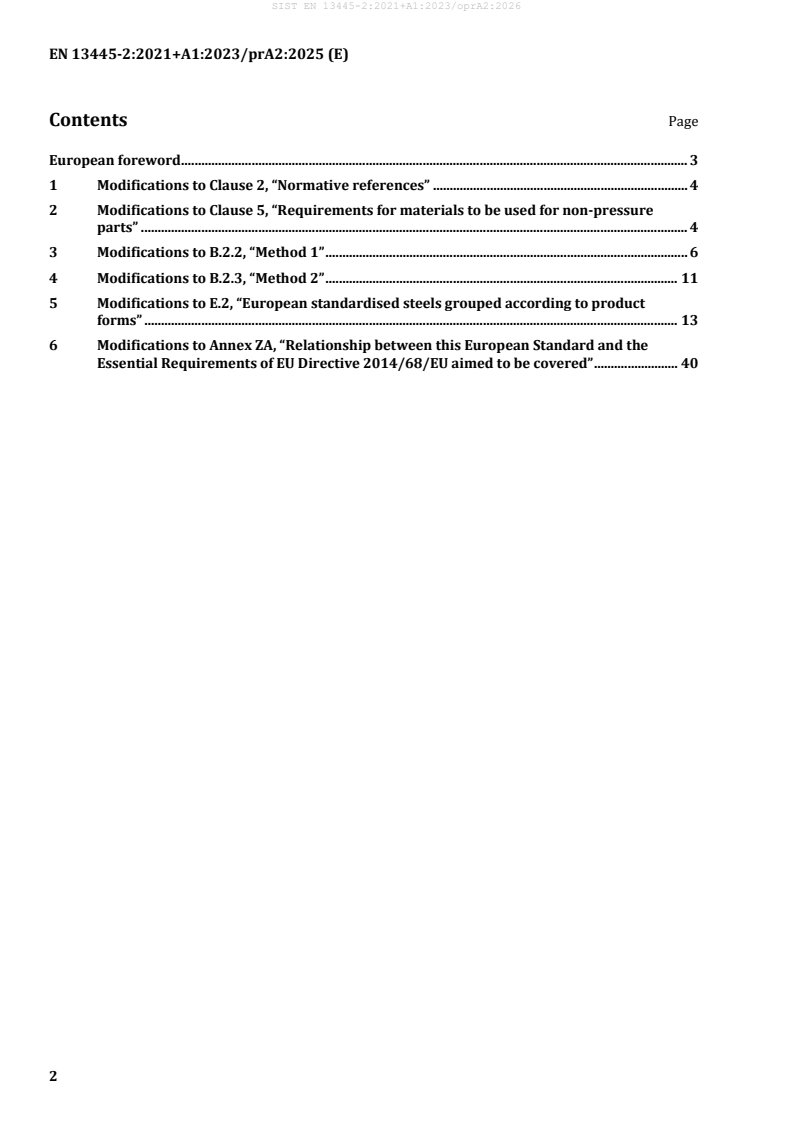
Contents
- European foreword
- 1 Modifications to Clause 2, “Normative references”
- 2 Modifications to Clause 5, “Requirements for materials to be used for
- 5.1 General
- 5.3 Yield strength and tensile strength of austenitic steels used for non-pressure parts
- 3 Modifications to B.2.2, “Method 1”
- 1.1 P265GH 1.0425 35 200
- 1.2 P355GH 1.0473 35 70
- 1.2 P355NL1 1.0566 35 70 – 40
- 1.2 P355NL1 1.0566 35 70 – 40
- 4 Modifications to B.2.3, “Method 2”
- 5 Modifications to E.2, “European standardised steels grouped according to
- 6 Modifications to Annex ZA, “Relationship between this European Standard and
- 7 Modifications to the Bibliography
European foreword
This document (EN 13445-2:2021+A1:2023/prA2:2025) has been prepared by Technical Committee CEN/TC 54 “Unfired pressure vessels”, the secretariat of which is held by BSI. This document is currently submitted to the CEN Enquiry.
This document has been prepared under a standardization request addressed to CEN by the European Commission. The Standing Committee of the EFTA States subsequently approves these requests for its Member States.
For the relationship with EU Legislation, see informative Annex ZA, which is an integral part of EN 13445-2:2021.
This document includes the text of the amendment itself. The amendment will be consolidated within EN 13445-2:2021+A1:2023 in accordance with the maintenance system of EN 13445 series approved by the CEN/BT Decision C172/2021.
SIST EN 13445-2:2021+A1:2023/oprA2:2026 EN 13445-2:2021+A1:2023/prA2:2025 (E)
1 Modifications to Clause 2, “Normative references”
Replace the following normative references:
“EN 13445-4:2021, Unfired pressure vessels — Part 4: Fabrication EN 13445-5:2021, Unfired pressure vessels — Part 5: Inspection and testing” with:
“EN 13445-4:2021+A1:2023, Unfired pressure vessels — Part 4: Fabrication EN 13445-5:2021+A1:2024, Unfired pressure vessels — Part 5: Inspection and testing” and update the references throughout the text.
Add the following new normative references:
“EN 10088-2:2024, Stainless steels — Part 2: Technical delivery conditions for sheet/plate and strip of corrosion resistant steels for general purposes EN 10088-3:2023, Stainless steels — Part 3: Technical delivery conditions for semi-finished products, bars, rods, wire, sections and bright products of corrosion resistant steels for general purposes EN 10088-4:2009, Stainless steels — Part 4: Technical delivery conditions for sheet/plate and strip of corrosion resisting steels for construction purposes EN 10088-5:2009, Stainless steels — Part 5: Technical delivery conditions for bars, rods, wire, sections and bright products of corrosion resisting steels for construction purposes EN 10213:2007+A1:2016, Steel castings for pressure purposes EN 10253-2:2021, Butt-welding pipe fittings — Part 2: Non alloy and ferritic alloy steels with specific inspection requirements”.
2 Modifications to Clause 5, “Requirements for materials to be used for
non-pressure parts” Replace the current text of Clause 5 with the following:
"5 Requirements for materials to be used for non-pressure parts
5.1 General
For non-pressure parts, e.g. for supporting lugs, skirts, baffles and similar parts welded to pressure vessels, materials shall be used which are supplied to material specifications covering at least requirements for the chemical compositions and tensile properties. These materials shall not limit the operating conditions of the material to which they are attached. 5.2 Yield strength and tensile strength of steels other than austenitic steels used for non- pressure parts 5.2.1 For steel with specified minimum values of 0,2 % proof strength at elevated temperatures, including ferritic and austenitic-ferritic steels in the annealed condition according to EN 10088-2:2024 and EN 10088-3:2023, the 0,2 % proof strength above 20 °C shall be determined in accordance with the procedure as specified in 4.2.2.
5.2.2 For structural steels without specified elevated temperature properties, including those listed in Table 5-2, the specified value of minimum yield strength R at room temperature can be used for R eH p0,2/T
at temperatures less than or equal to 50 °C . The yield strength reduction factor for higher temperatures are given in Table 5-1.
SIST EN 13445-2:2021+A1:2023/oprA2:2026 EN 13445-2:2021+A1:2023/prA2:2025 (E) Table 5-1 — Yield strength reduction factor for structural steel Temperature °C 20 100 150 200 250 300 350 Factor K 1,000 0,800 0,730 0,660 0,590 0,520 0,450
Linear interpolation shall be performed between the values given in Table 5-1. For temperatures between 50 °C and 100 °C, interpolation shall be performed between 20 °C and 100 °C. The values of the minimum yield strength R and tensile strength R shall be as given in the technical eH m specification for the material.
Table 5-2 — Steels used for non-pressure parts Standard Steel grade S235JR, S235J0, S235J2 EN 10025-2:2019 S275JR, S275J0, S275J2 S355JR, S355J0, S355J2, S355K2 S275N, S275NL EN 10025-3:2019 S355N, S355NL S275M, S275ML EN 10025-4:2019+A1:2022 S355M, S355ML S235J0W, S235J2W EN 10025-5:2019 S355J0W. S355J2W, S355K2W S355J0WP, S3J2WP S235JRH S275J0H, S275J2H EN 10210-1:2006 S275NH, S275NHL S355J0H, S355J2H, S355K2H S355NH, S355NLH S235JRH EN 10219-1:2006 S275J0H, S275J2H S275NH, S275NLH, S275MH, S275MLH S355J0H, S355J2H, S355K2H, S355NH, S355NLH, S355MH, S355MLH
5.2.3 The maximum values of the nominal design stress for normal operating, exceptional and testing load cases shall be determined from the material properties as specified in 5.2.1 or 5.2.2 and the safety factors given in EN 13445-3:2021, Clause 6.
SIST EN 13445-2:2021+A1:2023/oprA2:2026 EN 13445-2:2021+A1:2023/prA2:2025 (E)
5.3 Yield strength and tensile strength of austenitic steels used for non-pressure parts
5.3.1 For austenitic steels with specified minimum values of 0,2 % proof strength at elevated
temperatures, including austenitic steels according to EN 10088-2:2024, EN 10028-3:2023, EN 10088-4:2009 and EN 10088-5:2009, the 0,2 % proof strength above 20 °C shall be determined in accordance with the procedure as specified in 4.2.2.
5.3.2 For austenitic steels without specified minimum values of 0,2 % proof strength at elevated
temperatures, including austenitic steels according to EN 10088-2:2024, EN 10028-3:2023, EN 10088-4:2009 and EN 10088-5:2009, the tensile strength above 20 °C shall be calculated as follows:
R = K *R (5.3-1) m/T m m/20 where K is obtained from Formula (5.3-2) or Table 5-3.
m K = max (1,07-0,003 5*T; 0,82-000 09*T; 0,688-0,000 24*T) (5.3-2) m where T is the temperature in °C.
Table 5-3 — Tensile strength reduction factor for austenitic steels Temperature °C 20 50 100 150 200 250 300 350 400 Factor K 1,000 0,895 0,730 0,685 0,640 0,628 0,616 0,604 0,592 m
5.3.3 The maximum values of the nominal design stress for normal operating, exceptional and testing condition shall be determined from the material properties as specified in 5.3.1 or 5.3.2 and the safety factors given in EN 13445-3:2021, Clause 6.".
3 Modifications to B.2.2, “Method 1”
Replace Tables B.2-1, B.2-2, B.2-3, B.2-4, B.2-5, B.2-6 and B.2-7 with the following:
"Table B.2-1 ― Guide to material selection Table Material or product form Steel group Clause B.2-2 Plates and strips B.2-3 Seamless and welded pipes Ferritic steels B.2.2.2 B.2-4 Bars, forgings and fittings B.2-5 Ferritic castings Ni alloyed steels and castings B.2-6 (1,5 < Ni ≤ 5 %) Ferritic steels B.2.2.3 B.2-7 Ni-alloyed steel (9 % Ni) B.2-8 Ferritic steels B.2-9 Bolts and nuts B.2.2.4 Austenitic steels B.2-10 B.2-11 Austenitic steel grades Austenitic steels B.2.2.5
SIST EN 13445-2:2021+A1:2023/oprA2:2026 EN 13445-2:2021+A1:2023/prA2:2025 (E) Table B.2-2 — General requirements for prevention of brittle fracture — Reference thicknesses for plates and strips Plates and strips Max. reference Design Material thickness European reference Material group to e B temperature standard Grade Notes CEN ISO/TR No.
mm T R
15608:2017 °C AW PWHT P235GH 1.0345 35 200
1.1 P265GH 1.0425 35 200
EN 10028-2:2017 – 20 P295GH 1.0481 35 110
1.2 P355GH 1.0473 35 70
P275NH 1.0487 35 200 – 20 P275NL1 1.0488 35 200 – 40 1.1 P275NL2 1.1104 35 200 – 50 EN 10028-3:2017 P355N 1.0562 35 70 – 20 P355NH 1.0565 35 70 – 20
1.2 P355NL1 1.0566 35 70 – 40
P355NL2 1.1106 35 70 – 50 11MnNi5-3 1.6212 35 80 – 60 EN 10028-4:2017 13MnNi6-3 1.6217 35 70 – 60 9.1 15NiMn6 1.6228 35 70 – 80 a P355M 1.8821 35 - – 20 a P355ML1 1.8832 35 - – 40 1.2 a P355ML2 1.8833 35 - – 50 EN 10028-5:2017 a P420M 1.8824 35 - – 20 a P420ML1 1.8835 35 - – 40 2.1 a P420ML2 1.8828 35 - – 50 P355Q 1.8866 35 70 – 20 P355QH 1.8867 35 70 – 20 EN 10028-6:2017 1.2 P355QL1 1.8868 35 70 – 40 P355QL2 1.8869 35 70 – 60 a TMCP steels shall not be Post Weld Heat Treated.
SIST EN 13445-2:2021+A1:2023/oprA2:2026 EN 13445-2:2021+A1:2023/prA2:2025 (E) Table B.2-3 — General requirements for prevention of brittle fracture — Reference thicknesses for seamless and welded tubes Seamless and welded tubes Max. reference Design Material thickness reference European Material group to e B temperature Grade Notes CEN ISO/TR standard No.
mm T R 15608:2017 °C AW PWHT a P275NL1 1.0488 35 100 – 40 1.1 a P275NL2 1.1104 35 100 – 50 P355N 1.0562 35 70 – 20 EN 10216-3:2013 P355NH 1.0565 35 70 – 20
1.2 P355NL1 1.0566 35 70 – 40
P355NL2 1.1106 35 70 – 50 a P215NL 1.0451 10 10 – 40 a P255QL 1.0452 35 40 – 40 1.1 a P265NL 1.0453 25 25 – 40 EN 10216-4:2013 a 26CrMo4-2 1.7219 15 40 – 60 5.1 a 11MnNi5-3 1.6212 35 40 – 60 9.1 a 13MnNi6-3 1.6217 35 40 – 60 9.1 a P275NL1 1.0488 35 40 – 40 1.1 a P275NL2 1.1104 35 40 – 50 a P355N 1.0562 35 40 – 20 EN 10217-3:2019 a P355NH 1.0565 35 40 – 20 1.2 a P355NL1 1.0566 35 40 – 40 a P355NL2 1.1106 35 40 – 50 a P215NL 1.0451 10 10 – 40 1.1 EN 10217-4:2019 a P265NL 1.0453 16 16 – 40 1.1 a P215NL 1.0451 10 10 – 40 1.1 EN 10217-6:2019 a P265NL 1.0453 25 25 – 40 1.1 a Thickness limitation results from wall thickness limitation in the European material standards and in the European component standards respectively.
SIST EN 13445-2:2021+A1:2023/oprA2:2026 EN 13445-2:2021+A1:2023/prA2:2025 (E) Table B.2-4 — General requirements for prevention of brittle fracture with reference thickness for bars, forgings and fittings Bars, forgings and fittings Max. reference Design Material thickness European Material reference group to Grade Notes temperature e CEN ISO/TR B standard No.
15608:2017 TR (°C) AW PWHT P275NH 1.0487 35 75 1.1 EN 10273:2016 P355NH 1.0565 35 55 – 20 1.2 P355QH 1.8867 35 55 1.2 EN 10222-3:2017 13MnNi6-3 1.6217 35 50 – 60 9.1 15NiMn6 1.6228 35 50 – 80 9.1 P285QH 1.0478 35 85 – 20 1.2 P355QH1 1.0571 35 60 – 20 1.2 P420QH 1.8936 35 50 – 20 3.1 P285NH 1.0477 35 95 – 20 1.2 P355NH 1.0565 35 70 – 20 1.2 P420NH 1.8932 35 67 – 20 1.3 EN 10222- P355NL1 1.0566 35 70 – 40 1.2 4:2017+A1:2021 P355NL2 1.1106 35 70 – 50 1.2 P355QL1 1.8868 35 70 – 40 1.2 P355QL2 1.8869 35 70 – 40 1.2 P460QH 1.8871 35 65 – 20 3.1 P460QL1 1.8872 35 65 – 40 3.1 P460QL2 1.8864 35 65 – 50 3.1 EN 10253-2:2021 P355N 1.0562 35 70 – 20 1.2 P355NH 1.0565 35 70 – 20 1.2 P355NL1 1.0566 35 70 – 40 1.2 P215NL 1.0451 10 10 – 40 1.1 P265NL 1.0453 25 25 – 40 1.1
SIST EN 13445-2:2021+A1:2023/oprA2:2026 EN 13445-2:2021+A1:2023/prA2:2025 (E) Table B.2-5 — General requirements for prevention of brittle fracture with reference thickness for ferritic castings Ferritic castings Max. reference Design Material European thickness Material reference group to standard Grade Notes temperature e CEN ISO/TR B No.
15608:2017 TR (°C) a
EN 10213:2007+ G17Mn5 1.1131 50 – 40 1.1 A1:2016 G20Mn5 1.6220 100 – 30 1.2 G18Mo5 1.5422 100 – 45 1.1 a Heat treatment as specified in EN 10213:2007+A1:2016.
Table B.2-6 — General requirements for prevention of brittle fracture with reference thickness for Ni-alloyed steels with 1,5 % < Ni ≤ 5 % a Ni-alloyed steel, 1,5 % < Ni ≤ 5 % Max. reference Design Material European thickness Material reference group to standard Grade Notes e temperature B CEN ISO/TR No.
15608:2017 T (°C) R AW PWHT plates and strips b 12Ni14 1.5637 35 80 – 100 EN 10028-4:2017 9.2 X12Ni5 1.5680 35 50 – 120 seamless tubes b 12Ni14 25 ― – 100 1.5637 b 12Ni14 35 40 – 90 EN 10216-4:2013 9.2 X12Ni5 25 ― – 120 1.5680 X12Ni5 35 40 – 110 fittings b 12Ni14 1.5637 25 ― – 100 EN 10253-2:2021 9.2 b 12Ni14 35 40 – 90 forgings b 12Ni14 35 ― b 12Ni14 1.5637 35 50 – 100 b EN 10222-3:2017 12Ni14 35 70 9.2 X12Ni5 35 ― 1.5680 – 120 X12Ni5 35 50
SIST EN 13445-2:2021+A1:2023/oprA2:2026 EN 13445-2:2021+A1:2023/prA2:2025 (E) a Ni-alloyed steel, 1,5 % < Ni ≤ 5 % Max. reference Design Material European thickness Material reference group to standard Grade Notes e temperature B CEN ISO/TR No.
15608:2017 T (°C) R AW PWHT castings c, d G9Ni10 1.5636 As per – 70 9.1 EN G17NiCrMo 13-6 1.6781 – 80 9.2 EN 10213:2007+A1:
10213:2007+A1:
2016 G9Ni14 1.5638 – 90 9.2 2016, Table 3 GXCrNi13-4 1.6982 – 120 9.2 NOTE Thickness limitation result from wall thickness limitation in European material standards.
a Nickel content is nominal.
b If used at – 105 °C (e. g. ethylene application), then 27 J shall be guaranteed at this temperature.
See EN 10213:2007+A1:2016, Table A.1 for recommended preheating and interpass temperature when welding is applied. d PWHT, if required, shall be performed in accordance with EN 13445-4:2021+A1:2023, Clause 10 with a minimum temperature not lower than the temperature specified in EN 10213:2007+A1:2016, Table A.1.
Table B.2-7 — General requirements for prevention of brittle fracture with reference thickness for Ni-alloyed steels with 9 % Ni a 9 % - Ni alloys Max. reference Material Design European group to thickness Material reference standard Grade CEN ISO/TR Notes temperature eB No.
15608:201
TR (°C)
AW PWHT plates and strips b X8Ni9 1.5662 EN 10028-4:2017 ― – 196 9.3 b X7Ni9 1.5663 seamless tubes and fittings EN 10216-4:2013 b X10Ni9 1.5682 ― – 196 9.3 EN 10253-2:2021 forgings b EN 10222-3:2017 X8Ni9 1.5662 ― – 196 9.3 a Nickel content is nominal.
b Materials can be used to maximum thickness permitted in harmonized European material standards.
4 Modifications to B.2.3, “Method 2”
Add the following text before Table B.2-13 in B.2.3.1:
"For applications that fall below the dotted line in the Figures B.2-2 and B.2-4 (T below -60 °C with R T = 0 °C), steels shall be impact tested at -40 °C or at lower temperatures.". A
SIST EN 13445-2:2021+A1:2023/oprA2:2026 EN 13445-2:2021+A1:2023/prA2:2025 (E) Replace Figures B.2-2 and B.2-4 in B.2.3.3 with the following:
Key T design reference temperature R T material impact test temperature KV e reference thickness B For applications that fall below the dotted line (T below -60 °C with T = 0 °C), test temperature T shall R A KV
not be higher than -40 °C independent of thickness e .
B If any combination of thickness e and T result in a lower test temperature T as -40 °C, the lower test B R KV temperature shall be taken, always rounded up to the next lowest level (e.g T =-63 °C becomes T = - KV KV 70 °C).
Figure B.2-2 — METHOD 2: Design reference temperature and impact test temperature aswelded (AW) condition, for Re ≤ 265 MPa and KV ≥ 27 J
SIST EN 13445-2:2021+A1:2023/oprA2:2026 EN 13445-2:2021+A1:2023/prA2:2025 (E)
Key T design reference temperature R T material impact test temperature KV e reference thickness B For applications that fall below the dotted line (T below -60 °C with T = 0 °C), test temperature T shall R A KV
not be higher than -40 °C independent of thickness e .
B If any combination of thickness e and T result in a lower test temperature T as -40 °C, the lower test B R KV temperature shall be taken, always rounded up to the next lowest level (e.g T =-63 °C becomes T = - KV KV 70 °C).
Figure B.2-4 — METHOD 2: Design reference temperature and impact test temperature aswelded (AW) condition, Re ≤ 355 MPa and KV ≥ 27 J
5 Modifications to E.2, “European standardised steels grouped according to
product forms” Delete the first sentence.
Replace Table E.2-1 with the following:
SIST EN 13445-2:2021+A1:2023/oprA2:2026 EN 13445-2:2021+A1:2023/prA2:2025 (E) “Table E.2-1 — European standardised steels grouped according to product forms Material Max.
European Material group to b Product form Grade thickness Notes standard number CEN ISO/TR mm 15608:2017 plate and strip EN 10028-2 P235GH 1.0345 250 1.1 plate and strip EN 10028-2 P265GH 1.0425 250 1.1 plate and strip EN 10028-2 P295GH 1.0481 250 1.2 plate and strip EN 10028-2 P355GH 1.0473 250 1.2
...