

ENV 13730-2:2002
(Main)Healthcare Informatics - Blood transfusion related messages - Part 2: Production related messages (BTR-PROD)
- Abstract
Transfusion of blood [3.10] and blood components[3.12] to subjects of care[3.56] is a medical activity that is subject to many legal regulations and constraints. Many problems may be encountered during treatment due to immunological conditions, transmitted diseases, sustainability and other difficulties. Mistakes and failures may have serious or even fatal consequences. Minimising human activity through the increased use of data processing and automated messaging will introduce an additional safety mechanism.
This prENV specifies general messages[3.43] for electronic information interchange between computer systems used by healthcare [3.34] parties [3.38] in the blood transfusion [3.18] domain. The content and structure of the messages specified in this prENV have been developed with the aim of optimising the safety of Blood transfusion activity and to facilitate compliance monitoring and secure audit trails [3.4].
This prENV is applicable to Blood transfusion related messages including those for:
- the collection of blood/blood components[3.25] from donor
- manufacturing [3.47]and processing[3.52] of blood components
- classification [3.19]of Blood donations
- dispensing [3.28]of blood components (to be transfused) to the recipient
- Status
- Withdrawn
- Publication Date
- 17-Sep-2002
- Withdrawal Date
- 29-Sep-2026
- Technical Committee
- CEN/TC 251 - Medical informatics
- Drafting Committee
- CEN/TC 251/WG 1 - Information models
- Current Stage
- 9960 - Withdrawal effective - Withdrawal
- Start Date
- 17-Jun-2020
- Completion Date
- 30-Sep-2026

Relations
- Effective Date
- 25-Aug-2026
- Effective Date
- 25-Aug-2026
- Effective Date
- 25-Aug-2026
- Effective Date
- 25-Aug-2026
- Effective Date
- 28-Jan-2026
- Effective Date
- 28-Jan-2026
- Refers
EN 419-1:1999/A3:2002 - Non-domestic gas-fired overhead luminous radiant heaters - Part 1: Safety - Effective Date
- 28-Jan-2026
- Effective Date
- 28-Jan-2026
- Effective Date
- 22-Dec-2008
Get Certified
Connect with accredited certification bodies for this standard

BSI Group
BSI (British Standards Institution) is the business standards company that helps organizations make excellence a habit.

NYCE
Mexican standards and certification body.
Sponsored listings
Frequently Asked Questions
ENV 13730-2:2002 is a standardization document published by the European Committee for Standardization (CEN). Its full title is "Healthcare Informatics - Blood transfusion related messages - Part 2: Production related messages (BTR-PROD)". This standard covers: Transfusion of blood [3.10] and blood components[3.12] to subjects of care[3.56] is a medical activity that is subject to many legal regulations and constraints. Many problems may be encountered during treatment due to immunological conditions, transmitted diseases, sustainability and other difficulties. Mistakes and failures may have serious or even fatal consequences. Minimising human activity through the increased use of data processing and automated messaging will introduce an additional safety mechanism. This prENV specifies general messages[3.43] for electronic information interchange between computer systems used by healthcare [3.34] parties [3.38] in the blood transfusion [3.18] domain. The content and structure of the messages specified in this prENV have been developed with the aim of optimising the safety of Blood transfusion activity and to facilitate compliance monitoring and secure audit trails [3.4]. This prENV is applicable to Blood transfusion related messages including those for: - the collection of blood/blood components[3.25] from donor - manufacturing [3.47]and processing[3.52] of blood components - classification [3.19]of Blood donations - dispensing [3.28]of blood components (to be transfused) to the recipient
Transfusion of blood [3.10] and blood components[3.12] to subjects of care[3.56] is a medical activity that is subject to many legal regulations and constraints. Many problems may be encountered during treatment due to immunological conditions, transmitted diseases, sustainability and other difficulties. Mistakes and failures may have serious or even fatal consequences. Minimising human activity through the increased use of data processing and automated messaging will introduce an additional safety mechanism. This prENV specifies general messages[3.43] for electronic information interchange between computer systems used by healthcare [3.34] parties [3.38] in the blood transfusion [3.18] domain. The content and structure of the messages specified in this prENV have been developed with the aim of optimising the safety of Blood transfusion activity and to facilitate compliance monitoring and secure audit trails [3.4]. This prENV is applicable to Blood transfusion related messages including those for: - the collection of blood/blood components[3.25] from donor - manufacturing [3.47]and processing[3.52] of blood components - classification [3.19]of Blood donations - dispensing [3.28]of blood components (to be transfused) to the recipient
ENV 13730-2:2002 is classified under the following ICS (International Classification for Standards) categories: 35.240.80 - IT applications in health care technology. The ICS classification helps identify the subject area and facilitates finding related standards.
ENV 13730-2:2002 has the following relationships with other standards: It is inter standard links to ISO 5281:1980, ISO/IEC 7826-2:1994, ISO 2382-4:1987, ISO/IEC 7826-1:1994, EN ISO 1211:2001, ENV 12539:1997, EN 419-1:1999/A3:2002, ENV 1613:1995; is excused to ENV 13730-1:2001. Understanding these relationships helps ensure you are using the most current and applicable version of the standard.
ENV 13730-2:2002 is available in PDF format for immediate download after purchase. The document can be added to your cart and obtained through the secure checkout process. Digital delivery ensures instant access to the complete standard document.
Standards Content (Sample)
SLOVENSKI STANDARD
01-oktober-2003
Healthcare Informatics - Blood transfusion related messages - Part 2: Production
related messages (BTR-PROD)
Healthcare Informatics - Blood transfusion related messages - Part 2: Production related
messages (BTR-PROD)
Ta slovenski standard je istoveten z: ENV 13730-2:2002
ICS:
35.240.80 Uporabniške rešitve IT v IT applications in health care
zdravstveni tehniki technology
2003-01.Slovenski inštitut za standardizacijo. Razmnoževanje celote ali delov tega standarda ni dovoljeno.
EUROPEAN PRESTANDARD
ENV 13730-2
PRÉNORME EUROPÉENNE
EUROPÄISCHE VORNORM
September 2002
ICS 35.240.80
English version
Healthcare Informatics - Blood transfusion related messages -
Part 2: Production related messages (BTR-PROD)
This European Prestandard (ENV) was approved by CEN on 18 October 2001 as a prospective standard for provisional application.
The period of validity of this ENV is limited initially to three years. After two years the members of CEN will be requested to submit their
comments, particularly on the question whether the ENV can be converted into a European Standard.
CEN members are required to announce the existence of this ENV in the same way as for an EN and to make the ENV available promptly
at national level in an appropriate form. It is permissible to keep conflicting national standards in force (in parallel to the ENV) until the final
decision about the possible conversion of the ENV into an EN is reached.
CEN members are the national standards bodies of Austria, Belgium, Czech Republic, Denmark, Finland, France, Germany, Greece,
Iceland, Ireland, Italy, Luxembourg, Malta, Netherlands, Norway, Portugal, Spain, Sweden, Switzerland and United Kingdom.
EUROPEAN COMMITTEE FOR STANDARDIZATION
COMITÉ EUROPÉEN DE NORMALISATION
EUROPÄISCHES KOMITEE FÜR NORMUNG
Management Centre: rue de Stassart, 36 B-1050 Brussels
© 2002 CEN All rights of exploitation in any form and by any means reserved Ref. No. ENV 13730-2:2002 E
worldwide for CEN national Members.
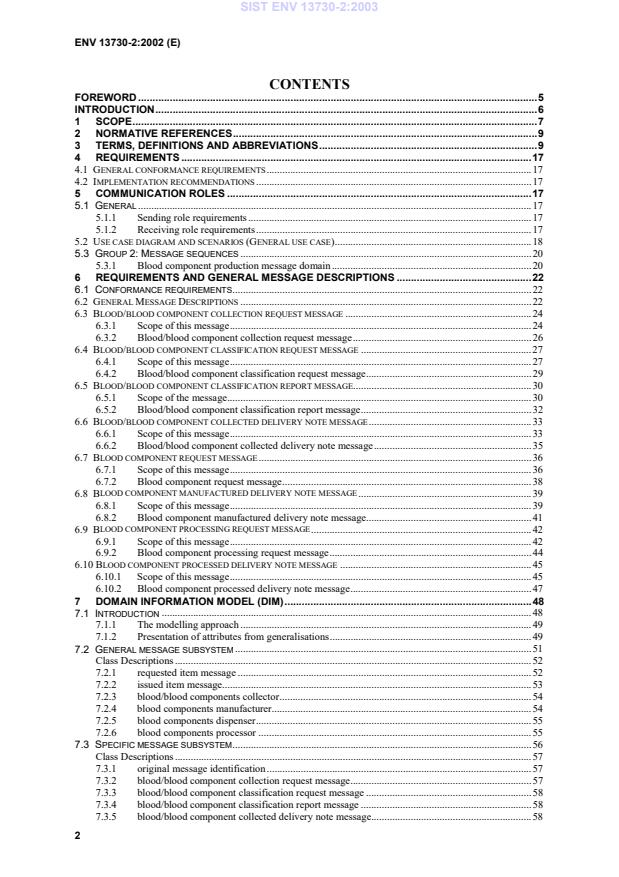
CONTENTS
FOREWORD .5
INTRODUCTION.6
1 SCOPE.7
2 NORMATIVE REFERENCES.9
3 TERMS, DEFINITIONS AND ABBREVIATIONS.9
4 REQUIREMENTS .17
4.1 GENERAL CONFORMANCE REQUIREMENTS.17
4.2 IMPLEMENTATION RECOMMENDATIONS.17
5 COMMUNICATION ROLES .17
5.1 GENERAL .17
5.1.1 Sending role requirements .17
5.1.2 Receiving role requirements.17
5.2 USE CASE DIAGRAM AND SCENARIOS (GENERAL USE CASE).18
5.3 GROUP 2: MESSAGE SEQUENCES .20
5.3.1 Blood component production message domain .20
6 REQUIREMENTS AND GENERAL MESSAGE DESCRIPTIONS .22
6.1 CONFORMANCE REQUIREMENTS.22
6.2 GENERAL MESSAGE DESCRIPTIONS .22
6.3 BLOOD/BLOOD COMPONENT COLLECTION REQUEST MESSAGE .24
6.3.1 Scope of this message.24
6.3.2 Blood/blood component collection request message.26
6.4 BLOOD/BLOOD COMPONENT CLASSIFICATION REQUEST MESSAGE .27
6.4.1 Scope of this message.27
6.4.2 Blood/blood component classification request message.29
6.5 BLOOD/BLOOD COMPONENT CLASSIFICATION REPORT MESSAGE.30
6.5.1 Scope of the message.30
6.5.2 Blood/blood component classification report message.32
6.6 BLOOD/BLOOD COMPONENT COLLECTED DELIVERY NOTE MESSAGE.33
6.6.1 Scope of this message.33
6.6.2 Blood/blood component collected delivery note message.35
6.7 BLOOD COMPONENT REQUEST MESSAGE .36
6.7.1 Scope of this message.36
6.7.2 Blood component request message.38
6.8 BLOOD COMPONENT MANUFACTURED DELIVERY NOTE MESSAGE.39
6.8.1 Scope of this message.39
6.8.2 Blood component manufactured delivery note message.41
6.9 BLOOD COMPONENT PROCESSING REQUEST MESSAGE.42
6.9.1 Scope of this message.42
6.9.2 Blood component processing request message.44
6.10 BLOOD COMPONENT PROCESSED DELIVERY NOTE MESSAGE .45
6.10.1 Scope of this message.45
6.10.2 Blood component processed delivery note message.47
7 DOMAIN INFORMATION MODEL (DIM).48
7.1 INTRODUCTION .48
7.1.1 The modelling approach .49
7.1.2 Presentation of attributes from generalisations.49
7.2 GENERAL MESSAGE SUBSYSTEM .51
Class Descriptions .52
7.2.1 requested item message .52
7.2.2 issued item message.53
7.2.3 blood/blood components collector.54
7.2.4 blood components manufacturer.54
7.2.5 blood components dispenser.55
7.2.6 blood components processor .55
7.3 SPECIFIC MESSAGE SUBSYSTEM.56
Class Descriptions .57
7.3.1 original message identification.57
7.3.2 blood/blood component collection request message.57
7.3.3 blood/blood component classification request message .58
7.3.4 blood/blood component classification report message .58
7.3.5 blood/blood component collected delivery note message.58
7.3.6 blood component request message .59
7.3.7 blood component manufactured delivery note message .59
7.3.8 blood component processing request message .60
7.3.9 blood component processed delivery note message .60
OMMUNICATING PARTIES SUBSYSTEM
7.4 C .61
Class descriptions.62
7.4.1 message sender .62
7.4.2 message receiver.62
7.5 HEALTHCARE AGENT SUBSYSTEM.63
Class descriptions.63
7.5.1 healthcare agent in context .64
7.5.2 healthcare agent relationship .64
7.5.3 healthcare agent [3.30] .65
7.5.4 healthcare party [3.33].65
7.5.5 healthcare organisation [3.32] .66
7.5.6 healthcare professional [3.34].66
7.6 COLLECTED ITEM SUBSYSTEM .67
Class descriptions.67
7.6.1 collected item.67
7.6.2 blood component [3.9].68
7.7 REQUESTED ITEM .70
Class Descriptions .70
7.7.1 requested item.70
7.7.2 requested blood component information .71
7.7.3 delivery location .72
7.8 ISSUED ITEM SUBSYSTEM.73
Class Descriptions .74
7.8.1 issued blood component .74
7.8.2 blood component characteristic .75
7.8.3 blood component unit .75
7.8.4 quantity of blood component.76
7.8.5 issued blood component administrative details .76
7.8.6 issued blood component information.77
7.8.7 unit (container) characteristic .77
7.9 PAYMENT GUARANTOR SUBSYSTEM .78
Class Descriptions .79
7.9.1 payment details.79
7.9.2 payment guarantor.79
7.9.3 payment authorisation.80
7.10 LABORATORY INVESTIGATION SUBSYSTEM.81
7.10.1 laboratory investigation (ENV 1613) .82
7.10.2 requested laboratory investigation (ENV 1613) .82
7.10.3 laboratory investigation report (ENV 1613).82
7.11 BLOOD DONOR SUBSYSTEM.83
Class Descriptions .83
7.11.1 blood donor [3.13].83
7.11.2 clinical information [3.18].84
7.11.3 clinical information item .84
7.12 COMMON SUBCLASSES .85
Class Descriptions .85
7.12.1 address.85
7.12.2 event date and time.85
7.12.3 general message information.86
7.12.4 identifier .86
7.12.5 language details .87
7.12.6 measurement.87
7.12.7 message identification .87
7.12.8 party identifier .87
7.12.9 person name details .88
7.12.10 structured address .88
7.12.11 structured person name.89
7.12.12 time interval.89
7.12.13 time period.89
7.12.14 unstructured address .89
7.12.15 unstructured name details .90
7.12.16 value of quantity.90
ANNEX A (INFORMATIVE) HOW TO READ THE MODELS .91
ANNEX B (INFORMATIVE) COMPOUND AND SIMPLE DATA TYPES RATIONALE AND HOW TO
USE THE DATA TYPES IN MESSAGES.96
ANNEX C (NORMATIVE) GUIDE TO USAGE OF CEN/TC 251/ENV 1613.101
INDEX.110
Foreword
This document (ENV 13730-2:2002) has been prepared by Technical Committee CEN/TC 251 “Health
informatics”, the secretariat of which is held by SIS.
It was developed by Project Team 32 under mandate M/255 given by the European Commission and the
European Free Trade Association, order voucher BC/CEN/97/23.
This is Part 2 of a multipart standard (ENV 13730) under the general heading Health informatics – Blood
transfusion related messages with the following parts:
Part 1: Subject of care related messages
Part 2: Production related messages
Annex C of this European Prestandard is normative, all other annexes are informative.
According to the CEN/CENELEC Internal Regulations, the national standards organizations of the following
countries are bound to announce this European Prestandard: Austria, Belgium, Czech Republic, Denmark,
Finland, France, Germany, Greece, Iceland, Ireland, Italy, Luxembourg, Malta, Netherlands, Norway, Portugal,
Spain, Sweden, Switzerland and the United Kingdom.
Introduction
Part 2 of this European Prestandard (ENV) provides a set of messages that enables the electronic transfer of
messages in the blood transfusion domain.
The motivation for this ENV derives from a combination of the following factors:
Electronic messages developed in the Healthcare Informatics domain contain sensitive healthcare information
about specified individuals that requires a high level of confidence both in the parties sending and receiving
messages and that the information being made available is unchanged. Standards are required to facilitate
electronic transfer of blood transfusion related messages and reports between the many systems currently used.
Information transferred in the blood transfusion related messages and any reports passing between healthcare
parties form part of the information system of each of the communicating parties. Electronic transfer of these
blood transfusion related messages and reports reduces the need for manual entry and the risk of transcription
errors. It also results in greater efficiency leading to better healthcare provision.
This ENV has been developed following the methods recommended in the CEN Report on "Medical Informatics
- Methodology for the development of healthcare messages" (CR 12587:1996). However, in accord with the
decisions of CEN TC251 WGI, a different modelling technique has been used. This is a subset of the Unified
Modelling Language (UML) as documented in Annex A.
This ENV specifies messages in a syntax independent form. Its requirements for conformance define the
minimum acceptable content and structure for these messages. Compliant messages can be developed in a
variety of implementation syntaxes and these syntax specific implementations may be the subject of future
Standards.
This ENV is directly relevant to suppliers of computer systems for use in development. Its provisions are also
relevant to those planning, specifying, procuring or implementing information systems for use in the blood
transfusion domain.
Particular note for implementers: Some attributes may have the same title but modified in meaning for use in
Part two than in Part one.
1 Scope
Transfusion of blood [3.7] and blood components [3.9] (blood products) to subjects of care [3.48] is a medical
activity that is subject to many legal regulations and constraints. Many problems may be encountered during
treatment due to immunological conditions, transmitted diseases, sustainability and other difficulties. Mistakes
and failures may have serious or even fatal consequences. Minimising human activity through the increased use
of data processing and automated messaging will introduce an additional safety mechanism.
This ENV specifies general messages [3.41] for electronic information interchange between computer systems
used by healthcare [3.29] parties [3.33] in the blood transfusion [3.16] domain. The content and structure of the
messages specified in this ENV have been developed with the aim of optimising the safety of blood transfusion
activity and to facilitate compliance monitoring and secure audit trails [3.2].
This ENV is applicable to blood transfusion related messages including those for:
- the collection of blood/blood components [3.22] from blood donor
- manufacturing [3.40] and processing [3.44] of blood components
- classification [3.19] of blood donations
- issue of blood components to the blood components dispenser
Within the blood transfusion process there are a number of actors:
(1) The blood components dispenser [ ] obtains blood components and blood products from one or more
3.10
providers, then stores and dispenses them to the user, in some countries this function is known as the
Hospital Blood Bank. This actor may appear as a separate entity, or as subdivision, within either the class
producer or user. In certain circumstances communication may be required with a different blood
components dispenser or with all dispensers within another region or a country.
(2) The blood components manufacturer [ ] prepares blood components for transfusion from donor blood
3.11
and issues blood components to the blood components dispenser [ ] a blood components processor or to
3.10
another blood components manufacturer. In many countries the production process utilises a special blood
transfusion data system providing internal communications between the subdivisions (blood collection,
collected blood classification [ ], manufacturing of blood components [ ], processing of blood
3.17 3.40
components [ ]), and issues blood components to a blood components dispenser.
3.52
(3) The blood components processor [3.12] receives blood components from a blood components
manufacturer [3.11] for processing into blood products.
(4) The Laboratory service provider [3.39] provides a laboratory service (serological, biochemical,
bacteriological and virological analyses), to classify a sample of donor blood received from the blood/blood
components collector. The laboratory can be an integral part of the healthcare organisation.
(5) The blood /blood components collector [3.8] provides the service of collecting blood from a blood donor, to
be delivered to the manufacturer, and to forward a sample of the blood to the Laboratory service provider
[3.46] for the classification of blood donation [3.17].
The messages identified within scope are :
The messages used in :
• collection,
• classification
• production activities
They communicate messages between separately organised units within blood collection and production.
Communication between the following parties should be exchanged according to ENV 1613 :
• the blood/blood components collector and the laboratory service provider
• the laboratory service provider and the blood/blood components manufacturer
Production related messages:
The use of the messages are dependent on the administrative procedures of the transfusion service provider and
are concerned with:
Blood/blood component collection request
Blood/blood component classification request
Blood/blood component classification report
Blood/blood component collected delivery note
Blood component request
Blood component manufactured delivery note
Blood component processing request
Blood component processed delivery note
Messages for the transmission of Requests for blood components, covered by the scope of this ENV, shall
enable electronic interchange of the semantic content defined in the General Message Descriptions (GMDs) for
Request for blood components in clause 6.
Messages for transmission of blood collection requests, covered by the scope of this ENV, shall enable
electronic interchange of the semantic content defined in the GMDs for blood collection requests in clause 6.
Messages for transmission of blood component classification requests/reports, covered by the scope of this
ENV, shall enable electronic interchange of the semantic content defined in the GMDs for blood component
classification request/reports in clause 6.
Messages for transmission of blood component processing requests, covered by the scope of this ENV, shall
enable electronic interchange of the semantic content defined in the GMDs for blood component processing
requests in clause 6.
Messages for transmission of blood component manufacturing delivery note and blood component processing
delivery note, covered by the scope of this ENV, shall enable electronic interchange of the semantic content
defined in the GMDs for blood component manufactured delivery notes in clause 6.
Messages for transmission of blood component processed delivery notes, covered by the scope of this ENV,
shall enable electronic interchange of the semantic content defined in the GMDs for blood component processed
delivery notes in clause 6.
Messages for transmission of applicative acknowledgement of the above messages covered by the scope of this
ENV are defined at an application level (ISO 9735-6:1999). They do not interfere with similar messages at
lower levels. These messages are reports that the target applicant has received the message, and whether or not
the message can be processed normally.
Implementable message specifications (IMS) [3.37] shall conform to the GMDs defined in this ENV. They shall
support both mandatory and optional objects, attribute [3.1] groups and attributes as defined in the GMDs of this
ENV. They shall also support the relationships between objects as defined by the GMDs.
Implementable message specifications should be expressed in terms of a syntax that is an International Standard
[3.55] except where the healthcare user requirements cannot be met by using such a standard syntax.
When implementing information exchange based upon this ENV, all generated messages must be acknowledged
by the receiver.
When implementing information exchange based upon this ENV, data protection and confidentiality principles
have to be guaranteed according to the laws actually in force in the different CEN member countries. The
mechanisms needed to secure data integrity [3.24], data protection and confidentiality, authentication [3.3] of
communicating parties and subjects of care are outside the scope of this ENV.
While the messages specified in this ENV may convey clinical and administrative information concerning
subjects of care, the way in which this information is treated in this ENV does not constrain the development of
future standards for the electronic healthcare record [ ] or for other clinical and administrative messages.
3.27
The provisions of this ENV have been validated for the purposes described above. However, since the messages
described in this ENV are designed for general application in the blood transfusion domain, the users are
required to decide for themselves whether or not these messages meet their particular requirements. A
requirement for using other messages, e.g. generic messages for cancellation or acknowledgement, in addition to
or instead of messages specified in this ENV, does not invalidate the use of this ENV.
2 Normative references
This European Standard incorporates by dated or undated reference, provisions from other publications. These
normative references are cited at the appropriate places in the text, and the publications are listed hereafter. For
dated references, subsequent amendments to or revisions of any of these publications apply to this European
Standard only when incorporated in it by amendment or revision. For undated references the latest edition of the
publication referred to applies (including amendments).
ISO 2382-4:1987 Information processing - Vocabulary Part 4: Organisation of data
ISO 5281 : 1997 Information interchange - Representation of human sexes
ISO/IEC 7826-1 : 1994 Information technology - General structure for the interchange of code values - Part 1 :
Identification of coding schemes
ISO/IEC 7826-2 : 1994 Information technology - General structure for the interchange of code values - Part 1 :
Registration of coding schemes
ENV 12539: 1997 Medical informatics – Request and report messages for diagnostic services departments
ENV 1613 : 1995 Medical informatics - messages for exchange of laboratory informations
3 Terms, definitions and abbreviations
For the purposes of this European Prestandard (ENV), the following terms and definitions (listed in alphabetical
order) apply:
3.1
attribute
characteristic of an object or entity
3.2
audit trail
record of the resources which were accessed and/or used by whom.
Note: This may involve a formal monitoring technique for comparison between the actual use of a medical
information system and pre-established criteria
[ISO 7498 – 2]
3.3
authentication
process of reliably identifying security subjects by securely associating an identifier and its authenticator
[ISO 7498 –2]
3.4
autologous transfusion
transfusion of any blood component that was donated by a blood donor who is also the subsequent recipient
3.5
availability
property of being accessible and useable upon demand by an authorised entity
[ISO 7498-2]
3.6
batch
amount of material which is uniform in character and quantity as shown by compliance with production and
quality assurance requirements and produced during a defined validated process of manufacture
NOTE A labile blood product batch is identified by a unique blood donation or pool number
[EN 375:1992 E][EN 376:1992 E]
3.7
blood
blood is a complex fluid, consisting of cellular components (approximately 45% of the total volume) suspended
in a fluid environment, the plasma. It circulates in the arteries and veins of human beings, animals, blood donors
(subjects of care) and acts both as a transport system and as a defence mechanism, fighting infection
3.8
blood/blood components collector
authorised healthcare party who collects blood/blood components from a blood donor to be forwarded to a blood
manufacturer for the production of blood components. In addition the blood collector forwards a sample of the
donated blood to a laboratory service provider for classification
3.9
blood component (BC)
blood component is supplied in accordance with a national specification and/or an order furnished by a user
and/or a blood components dispenser, giving it an (unique) component type identifier taken from approved
national or international lists and a unique donation number
EXAMPLE Blood components are whole blood, red cells, plasma, platelets, or cryoprecipitate
3.10
blood components dispenser
person or other entity who obtains blood components from one or more providers
NOTE The blood components dispenser stores and dispenses blood components in order to assemble, prepare
or dispense a blood component in accordance with a specification furnished by a blood components
manufacturer. (In UK and Scandinavia a blood components dispenser is a Hospital Blood Bank)
3.11
blood components manufacturer
authorised healthcare party qualified to manufacture blood components from blood donor and issue to a blood
components dispenser or blood processor
NOTE Blood is collected in sterile packs by the collector, subsequently forwarded to the manufacturer where
it undergoes manufacturing processes to produce blood components such as red cells, platelets and plasma
3.12
blood components processor
authorised healthcare party who receives blood components from a blood components manufacturer for
processing into blood products, e.g. irradiation
3.13
blood donor
healthy person with a good medical history selected to give blood for therapeutic use
NOTE Medical selection of blood donors excludes anyone whose blood might harm the recipient, for example
by transmitting infection. In various countries tests for example, may be completed for evidence of infection
with Hepatitis B, Hepatitis C, HIV-1, HIV-2 and syphilis. Each donation is tested to determine the most
important blood groups (ABO and RhD)
3.14
blood group
one of several classifications into which the blood may be grouped
NOTE It is determined by the presence or absence of specific antigens on the surface of the erythrocytes
3.15
blood product
therapeutic product derived by the fractionation of large volumes of plasma
NOTE It is identified by a product description and a batch number
3.16
blood transfusion
administration of blood components obtained and processed from blood donors into the bloodstream of a
recipient
3.17
classification of blood donation
set of biological tests performed by laboratory services provider, aimed to establish the immuno-haematologic
characteristics of the blood donated and to evaluate the safety of the blood donated to prevent the transfusion of
transmitted diseases, based on formal legal requirements
3.18
clinical information
refers to a subject of care or a blood donor, relevant to the health or treatment of that subject of care or the
processing and use of the collected blood
NOTE 1 The information concerning clinical information is recorded by or on behalf of a healthcare
professional
NOTE 2 Clinical information about a blood donor, may include information about the blood donor’s
environment, or related persons where this is relevant
3.19
code value
result of applying a coding scheme to a code meaning
EXAMPLE "CDG" as the representation of "Paris Charles-De-Gaulle" in the coding scheme for three-
letter representations of airport names
[ENV 7826] [ISO/IEC 7826][ISO 2382:1987, modified]
3.20
coding scheme
collection of rules that map the elements of one set on to the elements of a second set
[ISO/IEC 7826][ISO 2382-1987, modified]
3.21
collected item
information which identifies donated blood collected by the blood collector
3.22
collection of blood/blood components
process of a collection of blood/blood components from a blood donor to be forwarded to a blood manufacturer
for the production of blood components
3.23
confidentiality
property that information is not made available or disclosed to unauthorised individuals, entities or processes
[ISO 7498-2]
3.24
data integrity
property that data or a message’s content has not been altered or destroyed in an unauthorised manner
NOTE 1In order to achieve this requirement for the data, the integrity of all system assets must be preserved
including hardware, system design, software design, implementation and maintenance
NOTE 2This definition includes both accidental and intentional events and actions
[ISO 7498-2]
3.25
domain information model
conceptual model describing common concepts and their relationships for communication parties required to
facilitate exchange of information between these parties within a specific domain of healthcare
[CR 12587]
3.26
EDIFACT
Electronic Data Interchange for Administration, Commerce and Transport
NOTE They comprise a set of internationally agreed standards, directories and guidelines for the electronic
interchange of structured data. (Also referred to as UN/EDIFACT)
3.27
electronic healthcare record
healthcare record concerning the subject of care in computer readable form
[CEN ENV 13606-1]
3.28
general message description
subset of a domain information model [3.25] prescribing the information content and semantic structure of a
healthcare message used to meet one or more identified information interchange requirements
NOTE General message descriptions are independent of the syntax used for constructing an actual message.
They provide a statement of the information interchange requirements in a form that can be implemented using
different syntaxes
[CR 12587][ENV 1613]
3.29
healthcare
provision of health related services
NOTE This includes more than performing procedures on subjects of care. It includes also e.g. the
management of information about patients, their health status and their relationship with their healthcare
framework
[CEN TC/251 ENV 13606,1-4]
3.30
healthcare agent
healthcare professional [3.34], healthcare organisation [3.32], healthcare device or healthcare software
component that performs a particular role in a healthcare activity
[CEN TC/251 ENV 13606,1-4]
3.31
healthcare informatics
scientific discipline that is concerned with the cognitive, information processing and communication tasks of
healthcare practice, education and research, including the information science and technology to support these
tasks
[Directory of the European Standardization requirements for Healthcare Informatics and Telematics (version 2.1
1996.08.15)]
3.32
healthcare organisation
organisation involved in the direct or indirect provision of healthcare services to an individual, or to a
population or in the provision of healthcare related services
EXAMPLE Hospital, clinic
NOTE Groupings or subdivisions of an organisation, such as departments or sub-departments, may also be
considered as organisations where there is a need to identify them
[ENV 1613, modified]
3.33
healthcare party
organisation or person involved in the direct or indirect provision of healthcare services to an individual, or to a
population or involved in the provision of healthcare related services
NOTE Organisations responsible for the funding, payment, or reimbursement of healthcare provision are
healthcare parties
[ENV 1613]
3.34
healthcare professional
person entrusted with the direct or indirect provision of defined healthcare services to a subject of care or a
population of subjects of care
EXAMPLE Qualified medical practitioner, pharmacist, nurse, social worker, radiographer, medical
secretary or clerk
[ENV 1613:1995]
3.35
healthcare unit
dedicated unit within a healthcare organisation for the administration of blood transfusions
3.36
hierarchical general message description
generalised message description presented as a nested hierarchy of related objects rather than as a network of
inter-related objects
3.37
implementable message specification
specification of a general message description [3.28] in particular message syntax [3.49]
[CR 12587][ENV1613]
3.38
ISBT 128
internationally agreed coding standard which ensures globally unique identification of blood donations, and an
internationally approved coding system for blood components identification
3.39
laboratory service provider
laboratory service to provide serological, biochemical and virological investigations
3.40
manufacturing of blood components
manufacturing processes to produce blood components such as red cells, platelets and plasma from blood donor
3.41
message
identified and structured set of data elements and segments covering the requirements for a specified transaction
3.42
organisation
unique framework of authority within which a person or persons act, or are designated to act towards some
purpose
NOTE Groupings or subdivisions of an organisation may also be considered as organisations where there is
need to identify them for information interchange
[ISO 6523-1984]
3.43
plasma derivative (
...