

EN 14693:2017
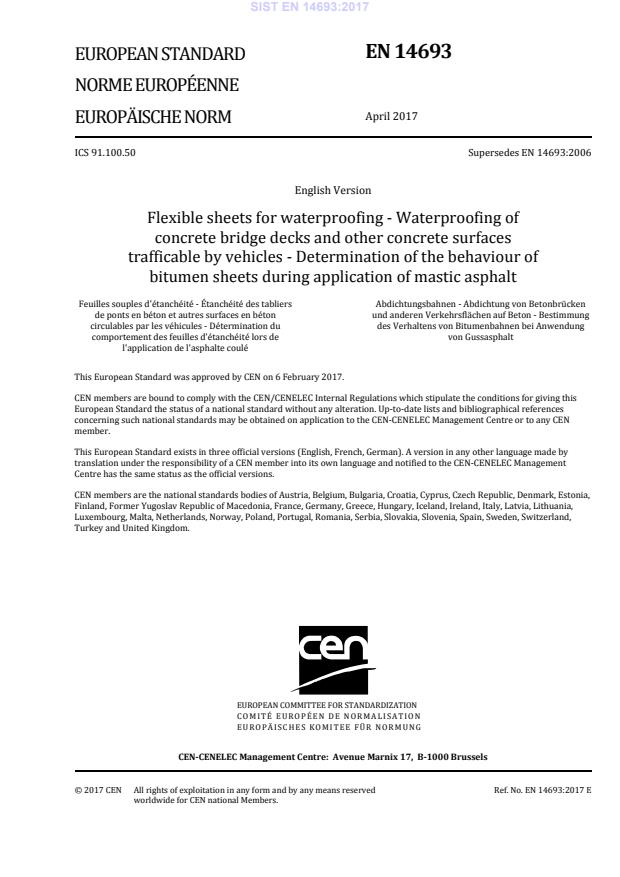
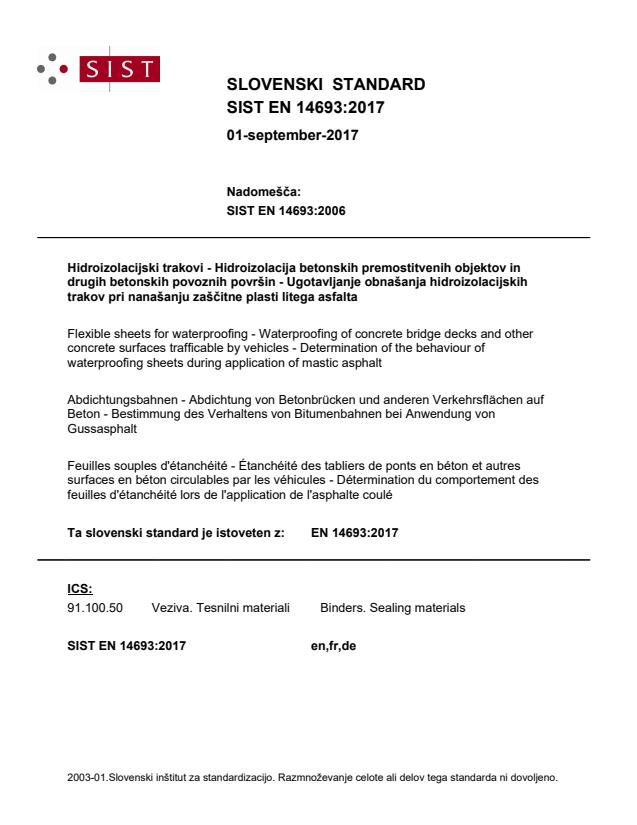
(Main)Flexible sheets for waterproofing - Waterproofing of concrete bridge decks and other concrete surfaces trafficable by vehicles - Determination of the behaviour of waterproofing sheets during application of mastic asphalt
- Abstract
This European Standard is applicable to bitumen sheets intended for use with a layer of mastic asphalt.
This European Standard specifies a test method for the evaluation of the resistance of bitumen sheets to the rising of the bitumen compound at the application of mastic asphalt in a non-floating manner.
Note This European Standard could also be used for bitumen sheets intended for use with other asphalt types as a protection layer.
- Status
- Published
- Publication Date
- 04-Apr-2017
- Withdrawal Date
- 30-Oct-2017
- Technical Committee
- CEN/TC 254 - Flexible sheets for water proofing
- Drafting Committee
- CEN/TC 254/WG 6 - Bridge deck waterproofing
- Current Stage
- 9093 - Decision to confirm - Review Enquiry
- Start Date
- 28-Jun-2023
- Completion Date
- 07-Oct-2026

Overview
EN 14693:2017 - published by CEN - defines a laboratory test method for evaluating the behaviour of flexible bitumen (waterproofing) sheets when overlaid with mastic asphalt on concrete bridge decks and other concrete surfaces trafficable by vehicles. The standard applies primarily to bitumen sheets intended for use with a layer of mastic asphalt and may also be used for other asphalt types used as protection layers.
Key topics and requirements
- Scope and purpose
- Evaluates sheet resistance to lifting/rising and degradation during the non‑floating application of mastic asphalt.
- Focuses on three measurable outcomes: surface specks, inclusions in asphalt, and sheet thickness changes.
- Test conditions
- Mastic asphalt temperature on leaving the boiler: 220 °C (±3 °C).
- Pouring height above sheet: 100–150 mm.
- Test specimen size and setup derived from EN 13375 / EN 1849-1 (concrete slab and sheet squares).
- Measurements and evaluation
- Surface proportion of sheet‑compound specks: determined by marking and weighing cut‑outs from a 50 mm × 50 mm transparent foil and expressed as a percentage.
- Sheet thickness after pouring: measured at regular intervals with a stereo optical measuring instrument (accuracy 0.1 mm); results expressed as change in thickness (mm).
- Sheet‑compound inclusions within the mastic asphalt: counted and classified as bonded or non‑bonded, with size/height criteria.
- Test report must record product ID, deviations, specimen preparation, procedure, and results (speck percentage, thickness change, inclusion count).
- Apparatus and materials
- Mastic asphalt boiler with stirring and indirect heating, stereo microscope, UV illumination (optional), concrete slabs, frames, sand bed, floats and clamps.
- Limitations
- Precision data for the method are not provided in the standard.
Applications and users
- Practical uses
- Quality control of waterproofing sheets intended for bridge decks, car parks, ramps and other vehicle‑trafficked concrete surfaces.
- Comparative assessment of bitumen sheet formulations or surface protection treatments prior to field application of mastic asphalt.
- Typical users
- Manufacturers of waterproofing / bitumen sheets, testing laboratories, specifiers, bridge engineers, construction contractors, and quality assurance teams.
Related standards
- EN 13375 - specimen preparation for bridge deck waterproofing tests
- EN 1849-1 - determination of thickness and mass per unit area (bitumen sheets)
- EN 13416 - sampling rules for bitumen/plastic/rubber sheets
- EN 14695 and prEN 17048 - related definitions and characteristics for reinforced bitumen and plastic/rubber sheets
Keywords: EN 14693:2017, waterproofing sheets, mastic asphalt, bitumen sheets, bridge decks, test method, sheet compound inclusions, thickness change, CEN.
Relations
- Effective Date
- 12-Apr-2017
- Effective Date
- 28-Jan-2026
- Effective Date
- 28-Jan-2026
- Effective Date
- 28-Jan-2026
- Effective Date
- 28-Jan-2026
- Effective Date
- 28-Jan-2026
- Effective Date
- 28-Jan-2026
- Effective Date
- 28-Jan-2026
Get Certified
Connect with accredited certification bodies for this standard

DIBt (Deutsches Institut für Bautechnik)
German Institute for Building Technology.
DIN CERTCO
DIN Group product certification.

Aboma Certification B.V.
Specialized in construction, metal, and transport sectors.
Sponsored listings
Frequently Asked Questions
EN 14693:2017 is a standard published by the European Committee for Standardization (CEN). Its full title is "Flexible sheets for waterproofing - Waterproofing of concrete bridge decks and other concrete surfaces trafficable by vehicles - Determination of the behaviour of waterproofing sheets during application of mastic asphalt". This standard covers: This European Standard is applicable to bitumen sheets intended for use with a layer of mastic asphalt. This European Standard specifies a test method for the evaluation of the resistance of bitumen sheets to the rising of the bitumen compound at the application of mastic asphalt in a non-floating manner. Note This European Standard could also be used for bitumen sheets intended for use with other asphalt types as a protection layer.
This European Standard is applicable to bitumen sheets intended for use with a layer of mastic asphalt. This European Standard specifies a test method for the evaluation of the resistance of bitumen sheets to the rising of the bitumen compound at the application of mastic asphalt in a non-floating manner. Note This European Standard could also be used for bitumen sheets intended for use with other asphalt types as a protection layer.
EN 14693:2017 is classified under the following ICS (International Classification for Standards) categories: 91.100.50 - Binders. Sealing materials. The ICS classification helps identify the subject area and facilitates finding related standards.
EN 14693:2017 has the following relationships with other standards: It is inter standard links to EN 14693:2006, EN 13416:2023, EN 1849-1:1999, FprEN 17048, EN 13375:2019, EN 14695:2010, EN 13375:2004, CEN/TS 17048:2024. Understanding these relationships helps ensure you are using the most current and applicable version of the standard.
EN 14693:2017 is associated with the following European legislation: EU Directives/Regulations: 305/2011; Standardization Mandates: M/124. When a standard is cited in the Official Journal of the European Union, products manufactured in conformity with it benefit from a presumption of conformity with the essential requirements of the corresponding EU directive or regulation.
EN 14693:2017 is available in PDF format for immediate download after purchase. The document can be added to your cart and obtained through the secure checkout process. Digital delivery ensures instant access to the complete standard document.
Standards Content (Sample)
2003-01.Slovenski inštitut za standardizacijo. Razmnoževanje celote ali delov tega standarda ni dovoljeno.]RODFLMVNLKAbdichtungsbahnen - Abdichtung von Betonbrücken und anderen Verkehrsflächen auf Beton - Bestimmung des Verhaltens von Bitumenbahnen bei Anwendung von GussasphaltFeuilles souples d'étanchéité - Étanchéité des tabliers de ponts en béton et autres surfaces en béton circulables par les véhicules - Détermination du comportement des feuilles d'étanchéité lors de l'application de l'asphalte couléFlexible sheets for waterproofing - Waterproofing of concrete bridge decks and other concrete surfaces trafficable by vehicles - Determination of the behaviour of waterproofing sheets during application of mastic asphalt91.100.50Veziva. Tesnilni materialiBinders. Sealing materialsICS:Ta slovenski standard je istoveten z:EN 14693:2017SIST EN 14693:2017en,fr,de01-september-2017SIST EN 14693:2017SLOVENSKI
STANDARDSIST EN 14693:20061DGRPHãþD
EUROPEAN STANDARD NORME EUROPÉENNE EUROPÄISCHE NORM
EN 14693
April
t r s y ICS
{ sä s r rä w r Supersedes EN
s v x { uã t r r xEnglish Version
Flexible sheets for waterproofing æ Waterproofing of concrete bridge decks and other concrete surfaces trafficable by vehicles æ Determination of the behaviour of bitumen sheets during application of mastic asphalt Feuilles souples d 5étanchéité æ Étanchéité des tabliers de ponts en béton et autres surfaces en béton circulables par les véhicules æ Détermination du comportement des feuilles d 5étanchéité lors de l 5application de l 5asphalte coulé
Abdichtungsbahnen æ Abdichtung von Betonbrücken und anderen Verkehrsflächen auf Beton æ Bestimmung des Verhaltens von Bitumenbahnen bei Anwendung von Gussasphalt This European Standard was approved by CEN on
x February
t r s yä
egulations which stipulate the conditions for giving this European Standard the status of a national standard without any alterationä Upætoædate lists and bibliographical references concerning such national standards may be obtained on application to the CENæCENELEC Management Centre or to any CEN memberä
translation under the responsibility of a CEN member into its own language and notified to the CENæCENELEC Management Centre has the same status as the official versionsä
CEN members are the national standards bodies of Austriaá Belgiumá Bulgariaá Croatiaá Cyprusá Czech Republicá Denmarká Estoniaá Finlandá Former Yugoslav Republic of Macedoniaá Franceá Germanyá Greeceá Hungaryá Icelandá Irelandá Italyá Latviaá Lithuaniaá Luxembourgá Maltaá Netherlandsá Norwayá Polandá Portugalá Romaniaá Serbiaá Slovakiaá Sloveniaá Spainá Swedená Switzerlandá Turkey and United Kingdomä
EUROPEAN COMMITTEE FOR STANDARDIZATION COMITÉ EUROPÉEN DE NORMALISATION EUROPÄISCHES KOMITEE FÜR NORMUNG
CEN-CENELEC Management Centre:
Avenue Marnix 17,
B-1000 Brussels
t r s y CEN All rights of exploitation in any form and by any means reserved worldwide for CEN national Membersä Refä Noä EN
s v x { uã t r s y ESIST EN 14693:2017
the new reference to prEN 17048 at Clause 2, Normative references, and substitution of the terms
“bitumen sheet” with the generic wording “waterproofing sheet”
at every clause where needed, including the title. According to the CEN-CENELEC Internal Regulations, the national standards organisations of the following countries are bound to implement this European Standard: Austria, Belgium, Bulgaria, Croatia, Cyprus, Czech Republic, Denmark, Estonia, Finland, Former Yugoslav Republic of Macedonia, France, Germany, Greece, Hungary, Iceland, Ireland, Italy, Latvia, Lithuania, Luxembourg, Malta, Netherlands, Norway, Poland, Portugal, Romania, Serbia, Slovakia, Slovenia, Spain, Sweden, Switzerland, Turkey and the United Kingdom. SIST EN 14693:2017
...