

FprEN 18278
(Main)Soil improvers and growing media - Detection of Salmonella spp.
- Abstract
This document specifies a method for the detection of Salmonella spp. in soil improvers and growing media. It is applicable to material in solid form (including pre-shaped growing media) and liquid form.
This document is applicable to fertilizing product blends, where a blend is a mix of two or more fertilizing products belonging to the categories of fertilizers, liming material, soil improvers, growing media, inhibitors and plant biostimulants, and where soil improvers and/or growing media comprise the highest percentage in the blend by mass or volume, or in the case of liquid form by dry mass. If soil improvers and/or growing media are not the components with the highest percentage in the blend, the European Standard relevant to the component with the highest percentage in the blend applies. In case a blend is composed of fertilizing products in equal quantity, the user of the standard decides which standard to apply.
Most of the Salmonella serovars are detected with the method described in this document. For the detection of some specific Salmonella serovars (e.g. Salmonella Typhi and Salmonella Paratyphi), additional cultivation steps can be necessary.
NOTE 1 A soil improver or a growing medium consists of a single bulky (volume-building) component or a mix of bulky (volume-building) components (for example peat, wood fibres, coconut coir, compost, expanded perlite).
NOTE 2 This method has been validated in an interlaboratory study with specific products (peat, biowaste compost, green compost and solid digestate) that were present on the market during the study (Annex C).
- Status
- Not Published
- Publication Date
- 09-Feb-2027
- Technical Committee
- CEN/TC 223 - Soil improvers and growing media
- Drafting Committee
- CEN/TC 223/WG 5 - Microbiology
- Current Stage
- 5060 - Closure of Vote - Formal Approval
- Start Date
- 12-Nov-2026
- Due Date
- 26-Mar-2026
- Completion Date
- 26-Mar-2026

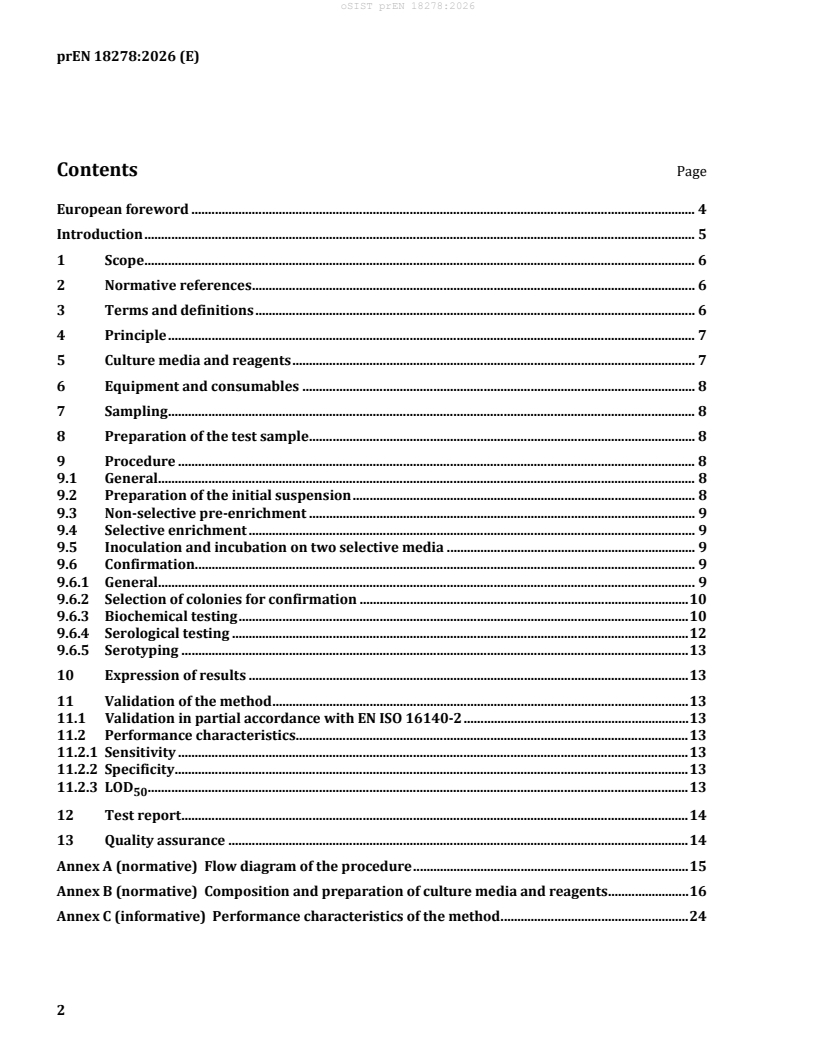
FprEN 18278 is a draft European Standard from CEN for the detection of Salmonella spp. in soil improvers and growing media. It specifies a laboratory method for solid and liquid materials, including certain fertilizing product blends, so users can determine whether Salmonella spp. is detected or not detected in a test portion. It is intended for laboratories, manufacturers, and control bodies that need to check hygienic requirements for these products.
What does FprEN 18278 specify?
FprEN 18278 specifies a culture-based method for detecting Salmonella spp. in soil improvers and growing media, and it also covers blends where these materials are the main component. The document is organized into clauses 1 to 13, plus Annexes A to E.
| Annex | What it covers |
|---|---|
| Annex A | Flow diagram of the procedure |
| Annex B | Composition and preparation of culture media and reagents |
| Annex C | Performance characteristics of the method |
| Annex D | Examples of selective media with different biochemical reactions characteristic for Salmonella spp. |
| Annex E | Additional examples and manufacturers of selective media with two different biochemical reactions characteristic for Salmonella spp. |
The scope includes material in solid form, including pre-shaped growing media, and liquid form. For fertilizing product blends, the standard applies when soil improvers and/or growing media make up the highest percentage of the blend by mass or volume, or by dry mass for liquids. This matters in practice because it helps the user choose the right standard for mixed products.
The method covers most Salmonella serovars, but the scope notes that some serovars such as Salmonella Typhi and Salmonella Paratyphi may need extra cultivation steps. That is important when a very specific serovar is being investigated.
What are the key requirements of FprEN 18278?
FprEN 18278 uses a staged enrichment-and-confirmation workflow. In practice, the laboratory first encourages any stressed or low-level target organisms to grow, then looks for presumptive colonies on selective media, and finally confirms them with biochemical or serological tests.
Sample handling and preparation
Clause 7 says sampling is not part of the method and refers the user to EN 12579. Clause 8 requires preparation of the test sample in accordance with prEN 13040-2. For the laboratory, this means the method starts with a representative, properly prepared sample rather than field sampling instructions.
Detection sequence
Clause 4 sets out four successive steps: non-selective pre-enrichment, selective enrichment, inoculation and incubation on two selective media, and confirmation of presumptive colonies. The initial suspension is made in buffered peptone water (BPW), then incubated for pre-enrichment, then transferred to Rappaport-Vassiliadis Soya (RVS) broth for selective enrichment. After that, two selective solid media based on different biochemical reactions are used.
This sequence matters because Salmonella spp. may be present in small numbers or in a stressed state. The enrichment steps are designed to improve recovery before the selective plates are read.
Culture conditions and media
Clause 9.2 uses a 25 g or 25 ml test portion and requires at least a ten-fold dilution in BPW. Clause 9.3 calls for incubation of the initial suspension at 36 °C, and clause 9.4 calls for RVS broth incubation at 41.5 °C. Clause 9.5 requires two selective media chosen by the testing laboratory, with incubation at 36 °C unless the manufacturer explicitly recommends otherwise.
In practice, the lab must control temperature and incubation time carefully, because these conditions shape which organisms grow and which are suppressed. Annex B gives the media compositions and preparation details needed to make or verify BPW, RVS broth, and the confirmation media.
Confirmation of presumptive colonies
Clause 9.6 allows biochemical or serological testing to confirm presumptive colonies. The biochemical route includes TSI agar, urea agar, and L-Lysine decarboxylation medium (LDC), with optional β-galactosidase and indole tests if the result is not clear. The serological route uses slide agglutination with polyvalent anti-O and anti-H sera after checking for auto-agglutination.
This matters because a colony that looks like Salmonella on selective media is only presumptive until it is confirmed. The document also allows other methods, such as PCR or MALDI-TOF, if they give the same result and are validated according to ISO 16140.
Result expression, validation, and reporting
Clause 10 requires the final result to be reported as Salmonella spp. detected or not detected in the test portion. Clause 11 states that the standardized reference method was validated in partial accordance with EN ISO 16140-2, and Annex C gives the performance characteristics from the interlaboratory study.
Clause 12 lists the minimum test report content, including the method used, sampling method, test portion size, deviations, and the final result. Clause 13 requires a laboratory quality control system, including positive controls, negative controls, and blanks. In practice, this supports traceable results and makes it easier to compare findings between laboratories.
What terms does FprEN 18278 define?
FprEN 18278 defines key terms in clause 3 and uses several abbreviations throughout the method.
- Salmonella spp. - bacteria that form typical colonies on the selective media in this document and show the expected morphological, physiological, and biochemical characteristics.
- Detection of Salmonella spp. - analysis for the presence or absence of Salmonella spp. in a particular mass or volume of product.
- Buffered peptone water (BPW) - the non-selective diluent used to prepare the initial suspension and support pre-enrichment.
- Rappaport-Vassiliadis Soya (RVS) broth - the selective enrichment broth used after pre-enrichment.
- L-Lysine decarboxylation medium (LDC) - a biochemical medium used in confirmation.
- Level of detection (LOD) - the concentration for which the probability of detection is 50%.
- Colony forming units (CFU) - the unit used in Annex C to express inoculation levels and LOD.
Who uses FprEN 18278?
FprEN 18278 is used by microbiology laboratories that test soil improvers, growing media, and fertilizing product blends. It is also relevant to manufacturers and quality managers who need to verify hygienic requirements during production and sanitation checks.
Regulators, inspection bodies, and buyers can use it when they need a recognized method for checking whether Salmonella spp. is present. The introduction also links the method to control of imposed hygienic requirements and to evaluation of the sanitation process in manufacturing.
Which standards are used with FprEN 18278?
FprEN 18278 refers to several standards that support sampling, sample preparation, laboratory practice, media quality, and validation.
- EN 12579 - used for sampling soil improvers and growing media.
- prEN 13040-2 - used for sample preparation for microbiological examination.
- prEN 17732 - supplies terminology for soil improvers and growing media.
- EN ISO 7218 - gives general microbiological laboratory requirements and guidance.
- EN ISO 11133 - supports preparation and performance testing of culture media.
- EN ISO 16140-2 - is the validation protocol named for the method validation work.
- EN ISO 6579-1 - is the horizontal method on which this detection method is based.
- CEN ISO/TR 6579-3 - gives guidance for serotyping Salmonella spp..
What does the FprEN 18278 document contain?
The document contains the full laboratory procedure, from sample preparation through enrichment, isolation, and confirmation. Annex A provides the workflow as a flow diagram, while Annex B gives media and reagent recipes, preparation steps, storage conditions, and practical notes for laboratory use.
Annex C reports the interlaboratory study and performance characteristics for four matrices: peat, biowaste compost, green compost, and solid digestate. Annex D lists selective media with different biochemical reactions used to isolate presumptive Salmonella colonies, and Annex E adds more examples and manufacturers for selective media used in confirmation or differentiation.
The document also contains a detailed test report clause and a quality assurance clause, so it is not only a test procedure but also a framework for controlled routine use.
Get Certified
Connect with accredited certification bodies for this standard

Control Union Certifications
Global certification for agriculture and sustainability.

ECOCERT
Organic and sustainability certification.

FSC International
Forest Stewardship Council certification.
Sponsored listings
Frequently Asked Questions
FprEN 18278 is a draft published by the European Committee for Standardization (CEN). Its full title is "Soil improvers and growing media - Detection of Salmonella spp.". This standard covers: This document specifies a method for the detection of Salmonella spp. in soil improvers and growing media. It is applicable to material in solid form (including pre-shaped growing media) and liquid form. This document is applicable to fertilizing product blends, where a blend is a mix of two or more fertilizing products belonging to the categories of fertilizers, liming material, soil improvers, growing media, inhibitors and plant biostimulants, and where soil improvers and/or growing media comprise the highest percentage in the blend by mass or volume, or in the case of liquid form by dry mass. If soil improvers and/or growing media are not the components with the highest percentage in the blend, the European Standard relevant to the component with the highest percentage in the blend applies. In case a blend is composed of fertilizing products in equal quantity, the user of the standard decides which standard to apply. Most of the Salmonella serovars are detected with the method described in this document. For the detection of some specific Salmonella serovars (e.g. Salmonella Typhi and Salmonella Paratyphi), additional cultivation steps can be necessary. NOTE 1 A soil improver or a growing medium consists of a single bulky (volume-building) component or a mix of bulky (volume-building) components (for example peat, wood fibres, coconut coir, compost, expanded perlite). NOTE 2 This method has been validated in an interlaboratory study with specific products (peat, biowaste compost, green compost and solid digestate) that were present on the market during the study (Annex C).
This document specifies a method for the detection of Salmonella spp. in soil improvers and growing media. It is applicable to material in solid form (including pre-shaped growing media) and liquid form. This document is applicable to fertilizing product blends, where a blend is a mix of two or more fertilizing products belonging to the categories of fertilizers, liming material, soil improvers, growing media, inhibitors and plant biostimulants, and where soil improvers and/or growing media comprise the highest percentage in the blend by mass or volume, or in the case of liquid form by dry mass. If soil improvers and/or growing media are not the components with the highest percentage in the blend, the European Standard relevant to the component with the highest percentage in the blend applies. In case a blend is composed of fertilizing products in equal quantity, the user of the standard decides which standard to apply. Most of the Salmonella serovars are detected with the method described in this document. For the detection of some specific Salmonella serovars (e.g. Salmonella Typhi and Salmonella Paratyphi), additional cultivation steps can be necessary. NOTE 1 A soil improver or a growing medium consists of a single bulky (volume-building) component or a mix of bulky (volume-building) components (for example peat, wood fibres, coconut coir, compost, expanded perlite). NOTE 2 This method has been validated in an interlaboratory study with specific products (peat, biowaste compost, green compost and solid digestate) that were present on the market during the study (Annex C).
FprEN 18278 is classified under the following ICS (International Classification for Standards) categories: 65.080 - Fertilizers. The ICS classification helps identify the subject area and facilitates finding related standards.
FprEN 18278 is associated with the following European legislation: EU Directives/Regulations: 2003/2003, 2019/1009; Standardization Mandates: M/564, M/564 Amd 1, M/564 Amd 2, M/XXX. When a standard is cited in the Official Journal of the European Union, products manufactured in conformity with it benefit from a presumption of conformity with the essential requirements of the corresponding EU directive or regulation.
FprEN 18278 is available in PDF format for immediate download after purchase. The document can be added to your cart and obtained through the secure checkout process. Digital delivery ensures instant access to the complete standard document.
Standards Content (Sample)
Contents
- Introduction
- 1 Scope
- 2 Normative references
- 3 Terms and definitions
- 3.1 Salmonella spp
- 3.2 detection of Salmonella spp
- 4 Principle
- 5 Culture media and reagents
- 6 Equipment and consumables
- 7 Sampling
- 8 Preparation of the test sample
- 9 Procedure
- 9.1 General
- 9.2 Preparation of the initial suspension
- 9.3 Non-selective pre-enrichment
- 9.4 Selective enrichment
- 9.5 Inoculation and incubation on two selective media
- 9.6 Confirmation
- 10 Expression of results
- 11 Validation of the method
- 11.2 Performance characteristics
- 12 Test report
- 13 Quality assurance
- Annex A
- Annex B
- Annex C
- Annex D
- Annex E
- Bibliography
Introduction
This document has been developed to detect Salmonella spp. in soil improvers and growing media in order to be able to control certain imposed hygienic requirements. The method described in this document is based on EN ISO 6579-1.
Salmonella spp. are rod-shaped Gram-negative bacteria of faecal/intestinal origin within the family Enterobacteriaceae. The presence of Salmonella spp. in soil improvers and growing media constitutes a hazard of infection to those handling these materials. Furthermore, it can be used as an indicator of faecal contamination and as a parameter to evaluate the sanitation process during the manufacturing process of soil improvers or growing media. The presence or absence of Salmonella spp. does not reflect the presence or absence of other pathogens in the material tested.
WARNING — In order to safeguard the health of laboratory personnel, it is essential that tests for the detection of Salmonella spp. are only undertaken in properly equipped laboratories, under the control of a skilled microbiologist, and that great care is taken in the disposal of all incubated materials. Persons using this document should be familiar with normal laboratory practice. This document does not purport to address all of the safety aspects, if any, associated with its use. It is the responsibility of the user to establish appropriate safety and health practices”
oSIST prEN 18278:2026 prEN 18278:2026 (E)
1 Scope
This document specifies a method for the detection of Salmonella spp. in soil improvers and growing media. It is applicable to material in solid form (including pre-shaped growing media) and liquid form. This document is applicable to fertilizing product blends, where a blend is a mix of two or more fertilizing products belonging to the categories of fertilizers, liming material, soil improvers, growing media, inhibitors and plant biostimulants, and where soil improvers and/or growing media comprise the highest percentage in the blend by mass or volume, or in the case of liquid form by dry mass. If soil improvers and/or growing media do not comprise the highest percentage in the blend, the European Standard for the highest percentage in the blend applies. In case a blend is composed of fertilising products in equal quantity, the user of the standard decides which standard to apply.
Most of the Salmonella serovars are detected with the method described in this document. For the detection of some specific Salmonella serovars (e.g. Salmonella Typhi and Salmonella Paratyphi), additional cultivation steps can be necessary.
NOTE 1 A soil improver or a growing medium consists of a single bulky (volume-building) component or a mix of bulky (volume-building) components (for example peat, wood fibres, coconut coir, compost, expanded perlite). NOTE 2 This method has been validated in an interlaboratory study with specific products that were present on the market during the study (Annex C).
2 Normative references
The following documents are referred to in the text in such a way that some or all of their content constitutes requirements of this document. For dated references, only the edition cited applies. For undated references, the latest edition of the referenced document (including any amendments) applies. EN 12579, Soil improvers and growing media - Sampling
prEN 13040-2, Soil improvers and growing media — Part 2: Sample preparation for microbiological examination
prEN 17732, Soil improvers and growing media — Terminology EN ISO 7218, Microbiology of the food chain - General requirements and guidance for microbiological examinations (ISO 7218)
3 Terms and definitions
For the purposes of this document, the terms and definitions given in prEN 17732, prEN 13040-2 and the following apply.
ISO and IEC maintain terminology databases for use in standardization at the following addresses:
- ISO Online browsing platform: available at https://www.iso.org/obp/
- IEC Electropedia: available at https://www.electropedia.org/
Under preparation. Stage at time of publication: prEN 13040-2:2025.
Under preparation. Stage at time of publication: prEN 17732:2025.
oSIST prEN 18278:2026 prEN 18278:2026 (E)
3.1 Salmonella spp
bacteria which form typical colonies on the solid selective media described in this document and which display the morphological, physiological and biochemical characteristics described when the analysis is carried out in accordance with this document
3.2 detection of Salmonella spp
analysis for the presence or absence of Salmonella spp. (3.1) in a particular mass or volume of product when tests are carried out in accordance with this document
4 Principle
The detection of Salmonella spp. requires four successive steps as specified in Annex A. The four steps are:
- non-selective pre-enrichment; - selective enrichment; - inoculation and incubation on two selective media; - confirmation of presumptive colonies with a serological or biochemical test. The initial suspension on buffered peptone water (BPW) is incubated at 36 °C for 22 h for a non-selective pre-enrichment. From the non-selective pre-enrichment obtained, Rappaport-Vassiliadis Soya (RVS) broth is inoculated and incubated at 41,5°C for 24 h. From the selective enrichment obtained, two different selective solid media based on different enzymatic reactions are inoculated and incubated at 36 °C for 24 h (or according to the manufacturer’s instructions if explicitly recommended). After incubation, and depending on the media chosen, it is determined if presumptive Salmonella spp. are present on the plates. Colonies of presumptive Salmonella spp. are subcultured on a non-selective agar (if needed). The identity of presumptive Salmonella spp. colonies is confirmed by means of appropriate serological or biochemical tests. NOTE 1 Salmonella spp. can be present in small numbers and are often accompanied by considerably larger numbers of other bacteria of the same family (Enterobacteriaceae) or of other families. Enrichment is used to allow the detection of low numbers of Salmonella spp. or stressed Salmonella spp.
NOTE 2 Stressed microorganisms are defined here as those present in the environment that can be injured or that can have developed in harsh environments. Such microorganisms can be difficult to detect because they struggle to grow on selective media. However, under suitable conditions, they can repair the cellular damages and recover their normal properties.
Validated alternative methods to detect Salmonella spp. based on molecular biology may be used if giving the same results as those given in this document (or e.g. comparable to EN ISO 7218) and if they are validated according to ISO 16140.
5 Culture media and reagents
Follow current laboratory practices in accordance with standards comparable to EN ISO 7218. The composition of culture media and reagents and their preparation are specified in Annex B. For performance testing of culture media, it is advised to follow the procedures of EN ISO 11133.
oSIST prEN 18278:2026 prEN 18278:2026 (E)
6 Equipment and consumables
Disposable equipment is an acceptable alternative to reusable glassware if it has suitable specifications. The usual microbiological laboratory equipment (see ISO 7218) and, in particular, the following shall be used. 6.1 Apparatus for dry sterilization (oven) and/or wet sterilization (autoclave). 6.2 Drying cabinet or oven, capable of operating between 25 °C and 50 °C. 6.3 Incubator(s), capable of operating in the ranges 36 °C ± 2 °C and 41,5 °C ± 1 °C. 6.4 Water bath, capable of operating at 36 °C ± 2 °C or at 47 °C to 50 °C. 6.5 Cooling unit, adjustable at 5 °C ± 3 °C.
6.6 Sterile loops, of 10 μl volume (approximate diameter 3 mm) and of 1 µl volume, inoculating needles or inoculating wires.
6.7 pH-meter, with a reading to the nearest 0,1 pH unit at 20 °C to 25 °C. 6.8 Sterile tubes, bottles or flasks with caps, of appropriate capacity. 6.9 Sterile filter, with a pore size of 0,22 μm.
6.10 Sterile Petri dishes with a diameter of approximately 90 mm or a diameter of approximately 140 mm (optional).
7 Sampling
Sampling is not part of the method specified in this document. Follow EN 12579 dealing with soil improvers and growing media. It is important that the laboratory receives a sample that is representative of the product under consideration. The sample should not have been damaged or changed during transport or storage.
8 Preparation of the test sample
Prepare the test sample from the laboratory sample in accordance with prEN 13040-2 . If there is no specific International Standard available, it is recommended that the parties concerned come to an agreement on this subject.
9 Procedure
9.1 General
The procedure as given in Annex A shall be followed.
9.2 Preparation of the initial suspension
The initial suspension shall be prepared according to prEN 13040-2 , based on a test portion of 25 g or 25 ml adding buffered peptone water (BPW) as diluent to yield a minimum ten-fold dilution (mass or volume).
oSIST prEN 18278:2026 prEN 18278:2026 (E)
9.3 Non-selective pre-enrichment
The initial suspension (9.2) shall be incubated at 36 °C (6.3) for 22 h ± 2 h. The pre-enrichment culture may be stored at 5 °C (6.5) for 72 h maximum after the incubation.
9.4 Selective enrichment
After the incubation, the RVS broth (B.2) shall be inoculated with 0,1 ml of the pre-enriched initial suspension (9.3). If the RVS broth has been stored at 5 °C (6.5), it shall be brought to room temperature before inoculation. It is recommended to minimize the transfer of particulate material from the pre-enrichment into the selective enrichment medium.
The inoculated RVS broth shall be incubated at 41,5°C (6.3) for 24 h ± 3 h. The selective enrichment may be stored at 5 °C (6.5) for 72 h maximum after the incubation.
9.5 Inoculation and incubation on two selective media
Two selective media based on different biochemical reactions characteristic for Salmonella spp. (Annex D) shall be chosen by the testing laboratory. From the selective enrichment (9.4), the surface of two selective media shall be inoculated by means of a 10 μl loop (6.6) or comparable, so that well-isolated colonies are obtained after incubation.
The plates with the two selective media shall be allowed to reach room temperature if they were stored at 5 °C (6.5). If necessary, dry the surface of the plates before use. To obtain well-isolated colonies, large-size Petri dishes (with a diameter of approximately 140 mm) or two normal-size plates (with a diameter of approximately 90 mm) may be used (6.10). The plates with the two selective media shall be incubated at 36 °C (6.3) for 24 h ± 3 h, or according to the manufacturer’s instructions if explicitly recommended.
After incubation, both selective media shall be checked for the presence of colonies which, from their characteristics, are considered to be presumptive Salmonella spp.
9.6 Confirmation
9.6.1 General
Biochemical or serological testing may be used to determine whether a presumptive colony belongs to the genus Salmonella or not.
For serological testing, it is recommended to subculture this colony on a non-selective agar (B.4) at 36 °C (6.3) for 24 h ± 3 h to get a pure culture with enough material to work with. For biochemical testing, it is recommended to use a selective medium (Annex D) for subculturing and to incubate it according to the manufacturer’s instructions, to ensure that there is a pure culture with enough material to work with. Any other method capable of unambiguously identifying Salmonella spp. than the one described in this document [e.g. polymerase chain reaction (PCR) analyses or Matrix-Assisted Laser Desorption Ionization - Time-of-Flight Mass Spectrometry (MALDI-TOF)] may be used for confirmation of Salmonella spp. if giving the same results as the method specified in this document.
In cases where identification of Salmonella spp. is unclear, after choosing either biochemical testing (9.6.3) or serological testing (9.6.4), the testing option that had not been chosen initially shall be tried. After that, if the identification of Salmonella spp. is still unclear, other tests shall be carried out (e.g. PCR).
oSIST prEN 18278:2026 prEN 18278:2026 (E) For the characterization of Salmonella spp. strains (optional), full serotyping is needed. Guidance for serotyping is given in e.g. CEN ISO/TR 6579-3.
9.6.2 Selection of colonies for confirmation
Mark presumptive colonies on each plate (9.5). If well-isolated colonies are available on the selective media (9.5), the biochemical or serological confirmation may be performed directly on a presumptive colony. It is recommended to subculture this colony.
Select one presumptive colony for confirmation. If the result is negative, select a combination of up to four presumptive colonies from both selective media (testing up to five colonies in total).
9.6.3 Biochemical testing
9.6.3.1 General
Inoculate the biochemical confirmation media with each of the cultures obtained from the colonies selected in 9.6.2. For biochemical confirmation of Salmonella spp., at least the tests specified in 9.6.3.2 to 9.6.3.4 shall be performed. The tests specified in 9.6.3.5 and 9.6.3.6 may also be performed when the results of the other confirmation tests do not give a clear identification. The use of biochemical strips (9.6.3.7) replaces the tests specified in 9.6.3.2 to 9.6.3.4.
9.6.3.2 Triple sugar/iron (TSI) agar
Colony material is spread on the slanted surface of the TSI agar (B.5) using an inoculation loop (6.6). The agar butt is then inoculated with the same colony material by stabbing it to the bottom with a needle (6.6). Incubate at 36 °C (6.3) for 24 h ± 3 h.
Interpret the changes in the medium as follows:
a) butt - yellow: glucose positive (glucose fermentation); - red or unchanged: glucose negative (no fermentation of glucose); - black: formation of hydrogen sulphide; - bubbles or cracks: gas formation from glucose; b) slant surface - yellow: lactose and/or sucrose positive (lactose and/or sucrose fermentation); - red or unchanged: lactose and sucrose negative (no fermentation of lactose or sucrose). The majority of the typical Salmonella cultures show alkaline (red) slants and acid (yellow) butts with gas formation (bubbles) and (in about 90 % of the cases) formation of hydrogen sulfide (blackening of the agar). When a lactose-positive Salmonella is isolated, the TSI slant is yellow. Thus, preliminary confirmation of Salmonella cultures shall not be based on the results of the TSI agar test only (see 9.6.3.1). NOTE Kligler-Hajna medium gives similar results as TSI agar.
oSIST prEN 18278:2026 prEN 18278:2026 (E)
...