

prEN 197-1
(Main)Cement - Part 1: Common cement - Performance assessment and declaration
- Abstract
This document covers calcium silicate cement (common cement) intended to be used:
- for the preparation of concrete, mortar, grout, and other mixes for construction and for the manufacture of construction products including structural and non-structural products, including white cement;
- for the preparation of mortar for bricklaying, blocklaying, rendering and plastering, including white cement;
- for the preparation of adhesives for other construction products;
- for soil stabilization or improvement, road bases and sub-bases, and capping layers.
Calcium aluminate cement, supersulfated cement, very low heat cement and alkali activated binder as well as masonry cement exclusively manufactured for the preparation of mortar for bricklaying, rendering and plastering are excluded from this product definition.
NOTE 1 Calcium silicate cements with an intended use as defined in this document belong to the product category "common cement".
The product definition of common cement covers the following combination of constituents expressed in percentage as mass, any other combination is outside the product definition:
a) primary cement (minimum of 95 % clinker);
NOTE 2 This refers to the designation code CEM I.
b) binary cements with clinker and a maximum of 95 % of blast furnace slag;
NOTE 3 This refers to the designation codes CEM II/A-S, CEM II/B-S, CEM III/A, CEM III/B, CEM III/C.
c) binary cements with clinker and a maximum of 10 % of silica fume;
NOTE 4 This refers to the designation code CEM II/A-D.
d) binary cements with clinker and a maximum of 35 % of one of the following constituents: natural pozzolana, natural activated pozzolana, fly ash, coal bottom ash, burnt shale, limestone or recycled concrete fines;
NOTE 5 This refers to the designation codes CEM II/A-P, CEM II/B-P, CEM II/A-Q, CEM II/B-Q, CEM II/A-V, CEM II/B-V, CEM II/A-W, CEM II/B-W, CEM II/A-Z, CEM II/B-Z, CEM II/A-T, CEM II/B-T, CEM II/A-F, CEM II/B-F, CEM II/A-L, CEM II/B-L, CEM II/A-LL, CEM II/B-LL.
e) pozzolanic cements with clinker and a maximum of 55 % of a combination of silica fume, natural pozzolana, natural activated pozzolana, fly ash and coal bottom ash with a maximum of 10 % silica fume;
NOTE 6 This refers to the designation codes CEM IV/A, CEM IV/B.
f) composite cement with a minimum of 50 % of clinker, a maximum of 29 % of recycled concrete fines and a maximum of 44 % of any combination of blast furnace slag, silica fume, natural pozzolana, natural activated pozzolana, fly ash, coal bottom ash, burn shale and limestone with a maximum of 10 % silica fume and a maximum of 35 % of the aggregation of limestone and recycled concrete fines;
NOTE 7 This refers to the designation codes CEM II/A-M, CEM II/B-M, CEM II/C-M (containing recycled concrete fines and other allowed constituents).
g) composite cement with a minimum of 50% of clinker and a maximum of 50% of any combination of blast furnace slag, silica fume, natural pozzolana, natural activated pozzolana, fly ash, coal bottom ash, burnt shale, limestone and recycled concrete fines with a maximum of 10% of silica fume, a maximum of 20% of recycled concrete fines, and a maximum of 35% of any combination of limestone and recycled concrete fines;
NOTE 8 This refers to the designation codes CEM II/A-M, CEM II/B-M, CEM II/C-M (containing allowed constituents).
h) composite cements with a minimum of 20 % of clinker, a maximum of 49 % of blast furnace slag and a maximum of 49 % of a combination of natural pozzolana, natural activated pozzolana, siliceous fly ash and coal bottom ash;
NOTE 9 This refers to the designation codes CEM V/A, CEM V/B.
i) composite cements with a minimum of 35 % clinker, a maximum of 59% of blast furnace slag and a maximum of 20 % of natural pozzolana, natural activated pozzolana, siliceous fly ash, coal bottom ash, limestone or recycled concrete fines;
...
- Status
- Not Published
- Publication Date
- 07-Sep-2027
- Technical Committee
- CEN/TC 51 - Cement and building limes
- Drafting Committee
- CEN/TC 51/WG 6 - Definitions and terminology of cement
- Current Stage
- 4060 - Closure of enquiry - Enquiry
- Start Date
- 01-Oct-2026
- Due Date
- 19-Aug-2026
- Completion Date
- 19-Aug-2026

prEN 197-1 is the CEN draft European Standard for common cement. It sets the product definition, the performance characteristics to be declared, and the assessment and verification process used to show constancy of performance and conformity. The standard is aimed at cement used for concrete, mortar, grout, adhesives, and soil stabilization or road layers.
What does prEN 197-1 specify?
prEN 197-1 specifies calcium silicate cement, called common cement, and the way its performance is assessed and declared. In practice, it tells a manufacturer what combinations of constituents belong to the product family, which characteristics must be tested, and how the cement is identified and documented.
The scope covers common cement intended for concrete, mortar, grout, other construction mixes, construction products, masonry mortar, adhesives for other construction products, and soil stabilization, road bases and sub-bases, and capping layers. It excludes calcium aluminate cement, supersulfated cement, very low heat cement, alkali activated binder, and masonry cement made only for bricklaying, rendering and plastering mortar.
The document is organized into clauses on scope, normative references, terms and definitions, characteristics, testing and sampling methods, assessment and verification, guidance for product information and safety information, and marking, labelling and packaging. It is followed by normative Annexes A to D, Annex E on specimen preparation for release of dangerous substances, informative Annex F with designation examples, and informative Annex ZA linking the standard to Regulation (EU) 2024/3110.
| Annex | What it covers |
|---|---|
| Annex A | Minor additional constituents, calcium sulfate and additives |
| Annex B | Implementation of assessment and verification, including FPC, autocontrol testing, inspections, surveillance and non-conformity actions |
| Annex C | Statistical criteria and assessment procedure |
| Annex D | Representativeness and accuracy of standard compressive strength - 28 days test results |
| Annex E | Test specimen format, size and preparation for release of dangerous substances |
| Annex F | Examples of cement designation |
| Annex ZA | Relationship with Regulation (EU) 2024/3110, DoPC, CE marking and AVS tasks |
What are the key requirements of prEN 197-1?
prEN 197-1 requires common cement to fit a defined product family and to meet declared performance values that are checked by specified methods. The practical effect is that producers must control composition, test results, and factory production control together, not as separate activities.
Product definition and permitted constituents
prEN 197-1 defines common cement as a calcium silicate cement family and lists the permitted combinations of clinker and other constituents. The scope includes primary cement, binary cements, pozzolanic cements, composite cements, and cements with recycled concrete fines in the allowed combinations.
The document also allows minor additional constituents up to 5% by mass, calcium sulfate to control setting, and additives up to 1.0% by mass. Annex A adds that organic additives are limited on a dry basis and that the added materials must not harm workability, durability, or reinforcement protection. For a buyer or quality manager, this means the designation alone is not enough - the composition behind it must still stay inside the permitted family.
Performance characteristics to be declared
Clause 4.2 and Table 2 specify the main characteristics for common cement. These include compressive strength at different ages, setting time, loss on ignition, soundness, heat of hydration, pozzolanicity, insoluble residue, sulfate and chloride content, total and effective alkali content, clinker phase contents, magnesium oxide, aluminium oxide, sulfur as sulfide ions, calcium oxide, and sulfate resistance.
The standard also uses performance classes for compressive strength, including minimum and maximum 28-day classes and minimum early-strength classes. In practice, the manufacturer must declare the class that matches the tested performance and use the corresponding strength designation in the product identification.
Testing and sampling
Clause 5 requires spot samples to be taken in accordance with EN 196-7. The reference method for each characteristic is given in the standard, and only results from the reference method are declared. Alternative methods may be used only if they are calibrated against the reference method or recognized reference materials and are at least as conservative.
For common cement, inspection by variables applies to minimum strength at 2, 7 and 28 days and maximum strength at 28 days. Inspection by attributes applies to the other characteristics. That matters because the statistical treatment is different: strength is assessed as a distribution, while most other properties are checked against pass-fail limits.
Dangerous substances and environmental sustainability
Clause 4.4 and 5.4 cover release of dangerous substances to soil and ground water. The standard requires leaching tests using EN 16637-2, with specimen preparation in Annex E, analysis of leachates by EN 17195 and EN 17332, and asbestos determination by CEN/TS 18020. The result is expressed as cumulative release, which is the form needed for product declaration and environmental assessment.
Clause 4.5 and 6.4 cover environmental sustainability characteristics. Where these are declared, the assessment must be validated against EN 15804 and EN 16908 together with the standard’s own provisions. For a manufacturer, this means the environmental declaration is not just a calculation - it needs documented inputs, modelling choices, and validation of the process.
Assessment, verification, and factory production control
Clause 6 and Annex B set out the assessment and verification system (AVS), factory production control (FPC), autocontrol testing, inspection, surveillance, and audit-testing. Annex B requires documented FPC, regular calibration of equipment, traceable sampling and testing, initial inspection of new plants, and continuing surveillance at least once per year.
The initial period starts after the first certificate or the first dispatch, lasts three months, and doubles the minimum sampling and control frequency. Annex B also requires random audit samples, separate handling of non-conformity, and a certificate of constancy of performance and conformity when the criteria are met. In practice, this is the backbone of market surveillance and certification.
Product information and marking
Clause 7 gives guidance for general product information, instructions for use and safety information. Clause 8 requires the cement to be accompanied by documentation and to be marked with the designation codes. Annex ZA adds the DoPC, CE marking and the tasks assigned to manufacturers, notified bodies and product certification bodies under Regulation (EU) 2024/3110.
What terms does prEN 197-1 define?
- Assessment and verification system (AVS) - The system used to check performance, factory control and conformity for common cement.
- Reactive calcium oxide (CaO) - The fraction of calcium oxide that can take part in normal hardening reactions.
- Reactive silicon dioxide (SiO) - The fraction of silicon dioxide that becomes soluble after the specified acid and alkali treatment.
- Autocontrol testing - Further testing of spot samples taken at the manufacturing plant or depot under the prescribed test plan.
- Control period - The production and dispatch period used to evaluate autocontrol test results.
- Initial period - The immediate period after the first certificate or first dispatch of a cement.
- Product group - A set of products from the same manufacturer for which one assessment result can apply to the others for the relevant characteristics.
Who uses prEN 197-1?
prEN 197-1 is used by cement manufacturers, plant quality managers, laboratory staff, product certification bodies and notified bodies. They use it to define a cement type, choose the correct test methods, run factory production control, and support certification and market declarations.
It is also relevant to distributors and importers who handle autocontrol testing in Annex B, and to buyers, engineers and specifiers who need to select a cement suitable for concrete, mortar, grout, adhesives, or soil stabilization work. In practice, it is the standard that links cement composition, test evidence, and product declaration.
What changed in prEN 197-1 from the previous edition?
prEN 197-1 supersedes EN 197-1:2011. The introduction states that the previous strength classes will no longer be used because they were partly overlapping.
Instead, the standard defines new classes for minimum standard compressive strength at 28 days, maximum standard compressive strength at 28 days, minimum early compressive strength at 2 days, and minimum early compressive strength at 7 days. The previous strength designations remain part of the common cement designation code so that familiar product names can still be used.
Which standards are used with prEN 197-1?
| Reference | What it contributes |
|---|---|
| EN 196-1 | Strength testing of cement |
| EN 196-2 | Chemical analysis of cement |
| EN 196-3 | Setting time and soundness |
| EN 196-5 | Pozzolanicity test |
| EN 196-6 | Fineness |
| EN 196-7 | Sampling and preparation of cement samples |
| EN 196-9 | Heat of hydration, semi-adiabatic method |
| EN 196-12 | Reactivity of cement constituents, including heat of hydration and bound water content methods |
| EN 196-13 | Effective alkali content |
| EN 196-14 | Clinker and cement phase determination |
| EN 196-15 / EN 196-16 | Sulfate resistance by flat prism and square prism methods |
| EN 196-17 | Glass content of granulated blast furnace slag |
| EN 196-18 | Whiteness or colour of cement and clinker |
| EN 206-1 | Concrete performance requirements and conformity criteria |
| EN 450-1 / EN 451-1 | Fly ash definition and free calcium oxide test |
| EN 933-9 | Clay content of fines by methylene blue test |
| EN 934-1 to EN 934-7 | Admixture requirements, conformity and sampling rules |
| EN 12390-2 | Preparation and curing of concrete specimens |
| EN 13639 | Total organic carbon in limestone |
| EN 15804 | Core rules for environmental product declarations |
| EN 16637-2 | Leaching test for construction products |
| EN 16908 | Cement and building lime product category rules for environmental declarations |
| EN 17195 / EN 17332 | Analysis of inorganic and organic substances in eluates |
| ISO 2854 | Statistical interpretation of data |
| ISO 9277 | Specific surface area by gas adsorption |
| ISO 9286 | Chemical analysis of silicon carbide |
| ISO 10694 | Organic and total carbon in soil by dry combustion |
| CEN/TS 18020 | Sampling and quantitative determination of asbestos in construction products |
What does the prEN 197-1 document contain?
prEN 197-1 contains the tables and procedures that support product declaration and verification. These include the characteristic tables for common cement and its constituents, the leaching characteristics, the environmental sustainability characteristics, the performance class table, and the audit-testing table.
It also contains the statistical formulas and criteria in Annex C, the comparison procedure for 28-day compressive strength data in Annex D, the specimen preparation rules in Annex E, and designation examples in Annex F. Annex B adds the practical certification flow, inspection rules, FPC checks, non-conformity actions and the procedure for issuing a certificate of constancy of performance and conformity.
Relations
- Effective Date
- 09-Jul-2025
Get Certified
Connect with accredited certification bodies for this standard

DIBt (Deutsches Institut für Bautechnik)
German Institute for Building Technology.

DIN CERTCO
DIN Group product certification.

Aboma Certification B.V.
Specialized in construction, metal, and transport sectors.
Sponsored listings
Frequently Asked Questions
prEN 197-1 is a draft published by the European Committee for Standardization (CEN). Its full title is "Cement - Part 1: Common cement - Performance assessment and declaration". This standard covers: This document covers calcium silicate cement (common cement) intended to be used: - for the preparation of concrete, mortar, grout, and other mixes for construction and for the manufacture of construction products including structural and non-structural products, including white cement; - for the preparation of mortar for bricklaying, blocklaying, rendering and plastering, including white cement; - for the preparation of adhesives for other construction products; - for soil stabilization or improvement, road bases and sub-bases, and capping layers. Calcium aluminate cement, supersulfated cement, very low heat cement and alkali activated binder as well as masonry cement exclusively manufactured for the preparation of mortar for bricklaying, rendering and plastering are excluded from this product definition. NOTE 1 Calcium silicate cements with an intended use as defined in this document belong to the product category "common cement". The product definition of common cement covers the following combination of constituents expressed in percentage as mass, any other combination is outside the product definition: a) primary cement (minimum of 95 % clinker); NOTE 2 This refers to the designation code CEM I. b) binary cements with clinker and a maximum of 95 % of blast furnace slag; NOTE 3 This refers to the designation codes CEM II/A-S, CEM II/B-S, CEM III/A, CEM III/B, CEM III/C. c) binary cements with clinker and a maximum of 10 % of silica fume; NOTE 4 This refers to the designation code CEM II/A-D. d) binary cements with clinker and a maximum of 35 % of one of the following constituents: natural pozzolana, natural activated pozzolana, fly ash, coal bottom ash, burnt shale, limestone or recycled concrete fines; NOTE 5 This refers to the designation codes CEM II/A-P, CEM II/B-P, CEM II/A-Q, CEM II/B-Q, CEM II/A-V, CEM II/B-V, CEM II/A-W, CEM II/B-W, CEM II/A-Z, CEM II/B-Z, CEM II/A-T, CEM II/B-T, CEM II/A-F, CEM II/B-F, CEM II/A-L, CEM II/B-L, CEM II/A-LL, CEM II/B-LL. e) pozzolanic cements with clinker and a maximum of 55 % of a combination of silica fume, natural pozzolana, natural activated pozzolana, fly ash and coal bottom ash with a maximum of 10 % silica fume; NOTE 6 This refers to the designation codes CEM IV/A, CEM IV/B. f) composite cement with a minimum of 50 % of clinker, a maximum of 29 % of recycled concrete fines and a maximum of 44 % of any combination of blast furnace slag, silica fume, natural pozzolana, natural activated pozzolana, fly ash, coal bottom ash, burn shale and limestone with a maximum of 10 % silica fume and a maximum of 35 % of the aggregation of limestone and recycled concrete fines; NOTE 7 This refers to the designation codes CEM II/A-M, CEM II/B-M, CEM II/C-M (containing recycled concrete fines and other allowed constituents). g) composite cement with a minimum of 50% of clinker and a maximum of 50% of any combination of blast furnace slag, silica fume, natural pozzolana, natural activated pozzolana, fly ash, coal bottom ash, burnt shale, limestone and recycled concrete fines with a maximum of 10% of silica fume, a maximum of 20% of recycled concrete fines, and a maximum of 35% of any combination of limestone and recycled concrete fines; NOTE 8 This refers to the designation codes CEM II/A-M, CEM II/B-M, CEM II/C-M (containing allowed constituents). h) composite cements with a minimum of 20 % of clinker, a maximum of 49 % of blast furnace slag and a maximum of 49 % of a combination of natural pozzolana, natural activated pozzolana, siliceous fly ash and coal bottom ash; NOTE 9 This refers to the designation codes CEM V/A, CEM V/B. i) composite cements with a minimum of 35 % clinker, a maximum of 59% of blast furnace slag and a maximum of 20 % of natural pozzolana, natural activated pozzolana, siliceous fly ash, coal bottom ash, limestone or recycled concrete fines; ...
This document covers calcium silicate cement (common cement) intended to be used: - for the preparation of concrete, mortar, grout, and other mixes for construction and for the manufacture of construction products including structural and non-structural products, including white cement; - for the preparation of mortar for bricklaying, blocklaying, rendering and plastering, including white cement; - for the preparation of adhesives for other construction products; - for soil stabilization or improvement, road bases and sub-bases, and capping layers. Calcium aluminate cement, supersulfated cement, very low heat cement and alkali activated binder as well as masonry cement exclusively manufactured for the preparation of mortar for bricklaying, rendering and plastering are excluded from this product definition. NOTE 1 Calcium silicate cements with an intended use as defined in this document belong to the product category "common cement". The product definition of common cement covers the following combination of constituents expressed in percentage as mass, any other combination is outside the product definition: a) primary cement (minimum of 95 % clinker); NOTE 2 This refers to the designation code CEM I. b) binary cements with clinker and a maximum of 95 % of blast furnace slag; NOTE 3 This refers to the designation codes CEM II/A-S, CEM II/B-S, CEM III/A, CEM III/B, CEM III/C. c) binary cements with clinker and a maximum of 10 % of silica fume; NOTE 4 This refers to the designation code CEM II/A-D. d) binary cements with clinker and a maximum of 35 % of one of the following constituents: natural pozzolana, natural activated pozzolana, fly ash, coal bottom ash, burnt shale, limestone or recycled concrete fines; NOTE 5 This refers to the designation codes CEM II/A-P, CEM II/B-P, CEM II/A-Q, CEM II/B-Q, CEM II/A-V, CEM II/B-V, CEM II/A-W, CEM II/B-W, CEM II/A-Z, CEM II/B-Z, CEM II/A-T, CEM II/B-T, CEM II/A-F, CEM II/B-F, CEM II/A-L, CEM II/B-L, CEM II/A-LL, CEM II/B-LL. e) pozzolanic cements with clinker and a maximum of 55 % of a combination of silica fume, natural pozzolana, natural activated pozzolana, fly ash and coal bottom ash with a maximum of 10 % silica fume; NOTE 6 This refers to the designation codes CEM IV/A, CEM IV/B. f) composite cement with a minimum of 50 % of clinker, a maximum of 29 % of recycled concrete fines and a maximum of 44 % of any combination of blast furnace slag, silica fume, natural pozzolana, natural activated pozzolana, fly ash, coal bottom ash, burn shale and limestone with a maximum of 10 % silica fume and a maximum of 35 % of the aggregation of limestone and recycled concrete fines; NOTE 7 This refers to the designation codes CEM II/A-M, CEM II/B-M, CEM II/C-M (containing recycled concrete fines and other allowed constituents). g) composite cement with a minimum of 50% of clinker and a maximum of 50% of any combination of blast furnace slag, silica fume, natural pozzolana, natural activated pozzolana, fly ash, coal bottom ash, burnt shale, limestone and recycled concrete fines with a maximum of 10% of silica fume, a maximum of 20% of recycled concrete fines, and a maximum of 35% of any combination of limestone and recycled concrete fines; NOTE 8 This refers to the designation codes CEM II/A-M, CEM II/B-M, CEM II/C-M (containing allowed constituents). h) composite cements with a minimum of 20 % of clinker, a maximum of 49 % of blast furnace slag and a maximum of 49 % of a combination of natural pozzolana, natural activated pozzolana, siliceous fly ash and coal bottom ash; NOTE 9 This refers to the designation codes CEM V/A, CEM V/B. i) composite cements with a minimum of 35 % clinker, a maximum of 59% of blast furnace slag and a maximum of 20 % of natural pozzolana, natural activated pozzolana, siliceous fly ash, coal bottom ash, limestone or recycled concrete fines; ...
prEN 197-1 is classified under the following ICS (International Classification for Standards) categories: 91.100.10 - Cement. Gypsum. Lime. Mortar. The ICS classification helps identify the subject area and facilitates finding related standards.
prEN 197-1 has the following relationships with other standards: It is inter standard links to EN 197-1:2011. Understanding these relationships helps ensure you are using the most current and applicable version of the standard.
prEN 197-1 is associated with the following European legislation: EU Directives/Regulations: 2024/3110, 305/2011; Standardization Mandates: M/114, M/128, M/615. When a standard is cited in the Official Journal of the European Union, products manufactured in conformity with it benefit from a presumption of conformity with the essential requirements of the corresponding EU directive or regulation.
prEN 197-1 is available in PDF format for immediate download after purchase. The document can be added to your cart and obtained through the secure checkout process. Digital delivery ensures instant access to the complete standard document.
Standards Content (Sample)
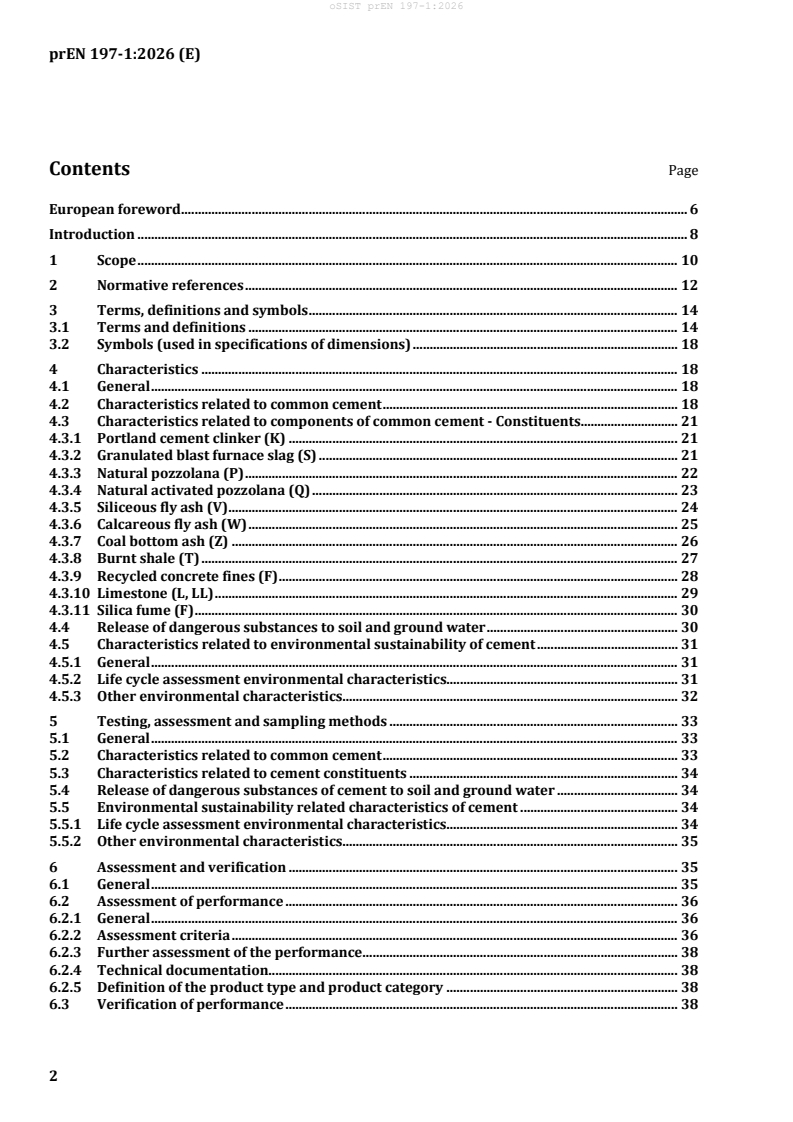
Contents
- Introduction
- 1 Scope
- 2 Normative references
- 3 Terms, definitions and symbols
- 3.1 Terms and definitions
- 3.1.1 AVS
- 3.1.2 reactive calcium oxide
- 3.1.3 reactive silicon dioxide
- 3.1.4 constituent
- 3.1.5 main constituent
- 3.1.6 minor additional constituent
- 3.1.7 raw material
- 3.1.8 component
- 3.1.9 designation of common cement
- 3.1.10 strength class of common cement
- 3.1.11 autocontrol testing
- 3.1.12 control period
- 3.1.14 characteristic value
- 3.1.15 specified characteristic value
- 3.1.16 single result limit value
- 3.1.17 allowable probability of acceptance CR
- 3.1.18 manufacturing plant
- 3.1.19 existing manufacturing plant
- 3.1.20 new manufacturing plant
- 3.1.21 depot
- 3.1.22 confidence interval
- 3.1.23 sampling plan
- 3.1.24 spot sample
- 3.1.25 heat of hydration
- 3.1.26 low heat common cement
- 3.1.27 white cement
- 3.1.28 total alkali content
- 3.1.29 effective alkali content
- 3.1.30 combined calcium silicates content
- 3.1.31 product group
- 3.1.32 certificate of constancy of performance and conformity
- 3.1.33 assessment of the performance
- 3.1.34 product certification body
- 3.1.35 FPC documentation
- 3.1.36 ratio
- 3.2 Symbols (used in specifications of dimensions)
- 4 Characteristics
- 4.1 General
- 4.2 Characteristics related to common cement
- 4.3 Characteristics related to constituents of common cement
- 4.4 Release of dangerous substances to soil and ground water
- 4.5 Characteristics related to environmental sustainability of cement
- 5 Testing, assessment and sampling methods
- 5.1 General
- 5.2 Characteristics related to common cement
- 5.3 Characteristics related to cement constituents
- 5.4 Release of dangerous substances of cement to soil and ground water
- 5.5 Environmental sustainability related characteristics of cement
- 6 Assessment and verification
- 6.1 General
- 6.2 Assessment of performance
- 6.3 Verification of performance
- 6.4 Environmental sustainability assessment validation
- 6.5 Confirmation of product type and product category determination
- 6.6 Initial inspection of the manufacturing plant to validate environmental
- 6.7 Initial inspection of manufacturing plant and FPC
- 6.8 Continuous surveillance of FPC
- 6.9 Verification of the technical documentation
- 6.10 Audit-testing of samples
- 7 Guidelines for the drawing up of general product information, instructions for
- 7.1 General
- 7.2 General product information
- 7.3 Instruction for use and safety information
- 8 Marking, labelling and packaging
- 8.1 Documentation
- 8.2 Marking
- Annex A
- Annex B
- Annex C
- Annex D
- Annex E
- Annex F
- Annex ZA
- 4.2 ML-1T-2 MPa class class 1+
- 4.2 ML-1T-2 MPa ≥ 1+
Introduction
The first European harmonized standard for common cement was published in 2000. The notation used for cement since then provides information about the type and quantity of cement constituents. This enables users to select the appropriate cements for their respective applications, based on practical construction experience, particularly with regard to durability. Application standards therefore use the cement notations.
To ensure that the systematics, which has proven itself over decades, can continue to be used, common cement will continue to be designated in a way that allows conclusions to be drawn about their composition. Table 1 gives an overview of the systematics of the designation code of common cement. Table 1 — Composition of cements with different designation codes Clinker Minor (main Other main constituents additional Main Type constituent) constituents Type name type notation Content Content [%] Type Content [%]
Portland CEM I CEM I 95-100 – 0-5 cement CEM Blast furnace slag, silica fume (up to 80-94 6-20 0-5 a II/A-X 10 %), natural pozzolana, natural activated pozzolana, siliceous fly ash, calcareous fly ash, coal bottom ash, CEM 65-79 21-35 0-5 a burnt shale, recycled concrete fines, II/B-X limestone Portland- CEM II composite CEM 80-88 12-20 Combination of blast furnace slag, 0-5 cement II/A-M silica fume (up to 10 %), natural CEM pozzolana, natural activated pozzolana, 65-79 21-35 0-5 II/B-M siliceous fly ash, calcareous fly ash, coal bottom ash, burnt shale, recycled CEM 50-64 36-50 concrete fines (up to 29 %), limestone 0-5 II/C-M CEM 35-64 36-65 0-5 III/A Blast CEM CEM III furnace 20-34 66-80 Blast furnace slag 0-5 III/B cement CEM 5-19 81-95 0-5 III/C CEM Natural pozzolana, natural activated 65-89 11-35 0-5 IV/A Pozzolanic pozzolana, siliceous fly ash, calcareous CEM IV cement fly ash, coal bottom ash, silica fume (up CEM 45-64 36-55 0-5 to 10 %) IV/B 18 % to 30 % blast furnace slag and 18 to 30 % natural pozzolana, natural CEM V/A 40-64 36-60 0-5 activated pozzolana, siliceous fly ash or Slagcoal bottom ash CEM V pozzolanic 31 % to 49 % blast furnace slag and cement 31 % to 49 % natural pozzolana, CEM V/B 20-38 62-80 0-5 natural activated pozzolana, siliceous fly ash or coal bottom ash
oSIST prEN 197-1:2026 prEN 197-1:2026 (E) Clinker Minor (main Other main constituents additional Main Type constituent) constituents Type name type notation Content Content [%] Type Content [%]
CEM VI/A 31 % to 59 % blast furnace slag and (S-P), 6 % to 20 % natural pozzolana, natural (S-Q), activated pozzolana, siliceous fly ash, 35-49 51-65 0-5 (S-V), coal bottom ash, recycled concrete (S-Z), Composite fines, or limestone (S-F), CEM VI cement (S-L), (S-LL) CEM VI/B 21 % to 49 % blast furnace slag and 21-49 51-79 0-5 21 % to 49 % limestone (S-L), (S-LL) a X stands for blast furnace slag, silica fume (up to 10 %), natural pozzolana, natural activated pozzolana, siliceous fly ash, calcareous fly ash, coal bottom ash, burnt shale, recycled concrete fines, limestone. The previously used strength classes will no longer be used in the future, as they were partially overlapping. Instead, the following new classes have been defined in this document:
- Classes of performance minimum standard compressive strength - 28 days
- Classes of performance maximum standard compressive strength - 28 days
- Classes of performance minimum early compressive strength - 2 days
- Classes of performance minimum early compressive strength - 7 days However, the previous strength designations are now part of the designation code for common cement. This will ensure that there is continued clarity for all stakeholders and that application rules can continue to refer to the well-known designations.
It is recognized that different common cements have different properties and performance. Those performance tests available (i.e. setting time, strength, soundness, heat of hydration) have been included in this standard. In addition, work is being carried out by CEN/TC 51 to identify any additional tests which are needed to specify further performance characteristics of common cement. Until further performance tests are available, it is necessary that the choice of common cement (especially the type and/or strength, in relation to the requirements for durability depending on the exposure class and the type of construction in which it is incorporated) follows the appropriate standards and/or regulations for concrete, mortar, grout, etc.
oSIST prEN 197-1:2026 prEN 197-1:2026 (E)
1 Scope
This document covers calcium silicate cement (common cement) intended to be used:
- for the preparation of concrete, mortar, grout, and other mixes for construction and for the manufacture of construction products including structural and non-structural products, including white cement; - for the preparation of mortar for bricklaying, blocklaying, rendering and plastering, including white cement; - for the preparation of adhesives for other construction products; - for soil stabilization or improvement, road bases and sub-bases, and capping layers. Calcium aluminate cement, supersulfated cement, very low heat cement and alkali activated binder as well as masonry cement exclusively manufactured for the preparation of mortar for bricklaying, rendering and plastering are excluded from this product definition. NOTE 1 Calcium silicate cements with an intended use as defined in this document belong to the product category “common cement”.
The product definition of common cement covers the following combination of constituents expressed in percentage as mass, any other combination is outside the product definition:
a) primary cement (minimum of 95 % clinker); NOTE 2 This refers to the designation code CEM I.
b) binary cements with clinker and a maximum of 95 % of blast furnace slag; NOTE 3 This refers to the designation codes CEM II/A-S, CEM II/B-S, CEM III/A, CEM III/B, CEM III/C. c) binary cements with clinker and a maximum of 10 % of silica fume; NOTE 4 This refers to the designation code CEM II/A-D.
d) binary cements with clinker and a maximum of 35 % of one of the following constituents: natural pozzolana, natural activated pozzolana, fly ash, coal bottom ash, burnt shale, limestone or recycled concrete fines; NOTE 5 This refers to the designation codes CEM II/A-P, CEM II/B-P, CEM II/A-Q, CEM II/B-Q, CEM II/A-V, CEM II/B-V, CEM II/A-W, CEM II/B-W, CEM II/A-Z, CEM II/B-Z, CEM II/A-T, CEM II/B-T, CEM II/A-F, CEM II/B- F, CEM II/A-L, CEM II/B-L, CEM II/A-LL, CEM II/B-LL.
e) pozzolanic cements with clinker and a maximum of 55 % of a combination of silica fume, natural pozzolana, natural activated pozzolana, fly ash and coal bottom ash with a maximum of 10 % silica fume; NOTE 6 This refers to the designation codes CEM IV/A, CEM IV/B. f) composite cement with a minimum of 50 % of clinker, a maximum of 29 % of recycled concrete fines and a maximum of 44 % of any combination of blast furnace slag, silica fume, natural pozzolana, natural activated pozzolana, fly ash, coal bottom ash, burn shale and limestone with a maximum of 10 % silica fume and a maximum of 35 % of the aggregation of limestone and recycled concrete fines; NOTE 7 This refers to the designation codes CEM II/A-M, CEM II/B-M, CEM II/C-M (containing recycled concrete fines and other allowed constituents).
oSIST prEN 197-1:2026 prEN 197-1:2026 (E) g) composite cement with a minimum of 50% of clinker and a maximum of 50% of any combination of blast furnace slag, silica fume, natural pozzolana, natural activated pozzolana, fly ash, coal bottom ash, burnt shale, limestone and recycled concrete fines with a maximum of 10% of silica fume, a maximum of 20% of recycled concrete fines, and a maximum of 35% of any combination of limestone and recycled concrete fines; NOTE 8 This refers to the designation codes CEM II/A-M, CEM II/B-M, CEM II/C-M (containing allowed constituents).
h) composite cements with a minimum of 20 % of clinker, a maximum of 49 % of blast furnace slag and a maximum of 49 % of a combination of natural pozzolana, natural activated pozzolana, siliceous fly ash and coal bottom ash; NOTE 9 This refers to the designation codes CEM V/A, CEM V/B.
i) composite cements with a minimum of 35 % clinker, a maximum of 59% of blast furnace slag and a maximum of 20 % of natural pozzolana, natural activated pozzolana, siliceous fly ash, coal bottom ash, limestone or recycled concrete fines; NOTE 10 This refers to the designation codes CEM VI/A (S-P), CEM VI/A (S-Q), CEM VI/A (S-V), CEM VI/A (S- Z), CEM VI/A (S-F), CEM VI/A (S-L), CEM VI/A (S-LL).
j) composite cements with a minimum of 21% clinker, a maximum of 49% of blast furnace slag and a maximum of 49% of limestone.
NOTE 11 This refers to the designation codes CEM VI/B (S-L), CEM VI/B (S-LL). All the above combinations can contain - up to 5 % of a minor additional constituent (A.1) as long as the same constituent is not used as a main constituent; minor constituents are specially selected, inorganic natural mineral materials and inorganic mineral materials derived from the clinker production process; - calcium sulfate (A.2) to control setting; - additives (A.3) up to 1,0% to improve the manufacture or the properties of the cement. NOTE 12 The proportions indicated take into account the constituents of cement, both main and minor, and not the other permitted components. In the common cement, the other components authorized in addition to a combination of constituents are calcium sulphate to control setting and additives to improve the manufacture or the properties of the cement.
oSIST prEN 197-1:2026 prEN 197-1:2026 (E)
2 Normative references
The following documents are referred to in the text in such a way that some or all of their content constitutes requirements of this document. For dated references, only the edition cited applies. For undated references, the latest edition of the referenced document (including any amendments) applies.
EN 196-1:2026, Methods of testing cement — Part 1: Determination of strength EN 196-2:2025, Methods of testing cement — Part 2: Chemical analysis of cement EN 196-3:2016, Methods of testing cement — Part 3: Determination of setting times and soundness EN 196-5:2011, Methods of testing cement — Part 5: Pozzolanicity test for pozzolanic cement EN 196-6:2018, Methods of testing cement — Part 6: Determination of fineness EN 196-7:2007, Methods of testing cement — Part 7: Methods of taking and preparing samples of cement EN 196-9:2010, Methods of testing cement — Part 9: Heat of hydration — Semi-adiabatic method EN 196-12:2024, Methods of testing cement — Part 12: Reactivity of cement constituents — Heat of hydration and bound water content methods
EN 196-13:2027, Methods of testing cement — Part 13: Effective alkali content
EN 196-14:2027, Methods of testing cement — Part 14: Determination of tricalcium silicate (C S),
dicalcium silicate (C S), tricalcium aluminate (C A) and tetracalcium aluminoferrite (C AF) of common 2 3 4 cement and clinker
EN 196-15:2027, Methods of testing cement — Part 15: Sulfate resistance — Flat prism method
EN 196-16:2027, Methods of testing cement — Part 16: Sulfate resistance — Square prism method
EN 196-17:2027, Methods of testing cement — Part 17: Determination glass content of granulated blast furnace slag as constituent for common cement
EN 196-18:2027, Methods of testing cement — Part 18: Determination of whiteness or colour of cement and clinker
Under preparation. Current stage: prEN 196-1:2026.
Under preparation. Current stage: prEN 196-13:2026.
Under preparation. Current stage: prEN 196-14:2026.
Under preparation. Current stage: prEN 196-15:2026.
Under preparation. Current stage: prEN 196-16:2026.
Under preparation. Current stage: prEN 196-17:2026.
Under preparation. Current stage: prEN 196-18:2026.
oSIST prEN 197-1:2026 prEN 197-1:2026 (E) EN 206-1:2026, Concrete — Specification, performance, production and conformity — Part 1: Performance, requirements, factory production control and assessment criteria for individual values EN 450-1:2012, Fly ash for concrete — Part 1: Definition, specifications and conformity criteria EN 451-1:2017, Method of testing fly ash — Part 1: Determination of free calcium oxide content EN 933-9:2022, Tests for geometrical properties of aggregates — Part 9: Assessment of fines — Methylene blue test EN 934-1:2008, Admixtures for concrete, mortar and grout — Part 1: Common requirements EN 934-2:2009+A1:2012, Admixtures for concrete, mortar and grout — Part 2: Concrete admixtures — Definitions, requirements, conformity, marking and labelling EN 934-3:2009+A1:2012, Admixtures for concrete, mortar and grout — Part 3: Admixtures for masonry mortar — Definitions, requirements, conformity and marking and labelling EN 934-4:2009, Admixtures for concrete, mortar and grout — Part 4: Admixtures for grout for prestressing tendons — Definitions, requirements, conformity, marking and labelling EN 934-5:2007, Admixtures for concrete, mortar and grout — Part 5: Admixtures for sprayed concrete — Definitions, requirements, conformity, marking and labelling EN 934-6:2019, Admixtures for concrete, mortar and grout — Part 6: Sampling, assessment and verification of the constancy of performance EN 934-7:2024, Admixtures for concrete, mortar and grout — Part 7: Shrinkage reducing admixtures — Definitions, requirements, conformity, marking and labelling EN 12390-2:2019, Testing hardened concrete — Part 2: Making and curing specimens for strength tests EN 13639:2017, Determination of total organic carbon in limestone
EN 15804:2012+A2:2019, Sustainability of construction works — Environmental product declarations — Core rules for the product category of construction products EN 16637-2:2023, Construction products — Assessment of release of dangerous substances — Part 2:
Horizontal dynamic surface leaching test
EN 16908:2027, Cement and building lime — Environmental product declarations — Product category rules complementary to EN 15804 EN 17195:2023, Construction products: Assessment of release of dangerous substances — Analysis of inorganic substances in eluates EN 17332:2023, Construction products: Assessment of release of dangerous substances — Analysis of organic substances in eluates
As impacted by EN 15804:2012+A2:2019/AC:2021.
Under preparation. Current stage: prEN 16908:2026.
oSIST prEN 197-1:2026 prEN 197-1:2026 (E) ISO 2854:1976, Statistical interpretation of data; Techniques of estimation and tests relating to means and variances ISO 9277:2022, Determination of the specific surface area of solids by gas adsorption — BET method ISO 9286:2021, Abrasive grains and crude — Chemical analysis of silicon carbide ISO 10694:1995, Soil quality — Determination of organic and total carbon after dry combustion (elementary analysis) CEN/TS 18020:2024, Construction products: Assessment of release of dangerous substances — Sampling and quantitative determination of asbestos in construction products
3 Terms, definitions and symbols
For the purposes of this document, the following terms, definitions and symbols apply. ISO and IEC maintain terminology databases for use in standardization at the following addresses:
- ISO Online browsing platform: available at https://www.iso.org/obp/
- IEC Electropedia: available at https://www.electropedia.org/
3.1 Terms and definitions
3.1.1 AVS
assessment and verification system (abbreviation)
3.1.2 reactive calcium oxide
CaO fraction of the calcium oxide which, under normal hardening conditions, can form calcium silicate hydrates or calcium aluminate hydrates Note 1 to entry: To evaluate this fraction, the total calcium oxide content (see EN 196-2:2025) is reduced by the fraction corresponding to calcium carbonate (CaCO ), based on the measured carbon dioxide (CO ) content emitted 3 2 after phosphoric acid decomposition of carbonates (see EN 196-2:2025), and the fraction corresponding to calcium sulfate (CaSO4), based on the measured sulfate (SO3) content (see EN 196-2:2025) after subtraction of the SO3 taken up by alkalis.
3.1.3 reactive silicon dioxide
SiO
fraction of the silicon dioxide which is soluble after treatment with hydrochloric acid (HCl) and with boiling potassium hydroxide (KOH) solution Note 1 to entry: The quantity of reactive silicon dioxide is determined by subtracting from the total silicon dioxide content (see EN 196-2:2025) the fraction contained in the residue insoluble in hydrochloric acid and potassium hydroxide (see EN 196-2:2025), both on a dry basis.
3.1.4 constituent
specially selected material used as main constituent (3.1.4) or minor additional constituent (3.1.5) of common cement
oSIST prEN 197-1:2026 prEN 197-1:2026 (E) Note 1 to entry: For each specific constituent, during the production process, constituents supplied by different suppliers or from different sources may be used. For the purposes of the factory production control (FPC), the definition refers to the combination of the constituents actually in use.
3.1.5 main constituent
specially selected inorganic material in a proportion exceeding 5 % by mass related to the sum of all main and minor additional constituents
3.1.6 minor additional constituent
specially selected inorganic material used in a proportion not exceeding a total of 5 % by mass related to the sum of all main and minor additional constituents
3.1.7 raw material
material used as feedstock for the production of clinker
3.1.8 component
main constituent, minor additional constituent, calcium sulfate or additive used for the production of cement
3.1.9 designation of common cement
one of the products in the family of common cements Note 1 to entry: Tables ZA.3.1 and ZA.3.2 contain information on the common cement designation code.
3.1.10 strength class of common cement
class of compressive strength
3.1.11 autocontrol testing
further testing of spot samples taken at the manufacturing plant at the point(s) of release from the manufacturing plant/depot in accordance with the prescribed test plan
3.1.12 control period
period of production and dispatch identified for the evaluation of the autocontrol test results 3. 1.13 initial period immediate period starting after the first issuing of the certificate of constancy of performance of the product for a cement and at the latest from the first dispatching of cement
3.1.14 characteristic value
value of a characteristic outside of which lies a specified percentage, the percentile P , of all the values of k the population
oSIST prEN 197-1:2026 prEN 197-1:2026 (E)
3.1.15 specified characteristic value
characteristic value of a mechanical, physical or chemical characteristic which in the case of an upper limit is not to be exceeded or in the case of a lower limit is, as a minimum, to be reached
3.1.16 single result limit value
value of a mechanical, physical or chemical characteristic which – for any single test result – in the case of an upper limit is not to be exceeded or in the case of a lower limit is, as a minimum, to be reached
3.1.17 allowable probability of acceptance CR
for a given sampling plan, allowed probability of acceptance of cement with a characteristic value outside the specified characteristic value
3.1.18 manufacturing plant
facility used by a manufacturer for the production of cement using equipment which is suitable for continuous mass production of cement including, in particular, equipment for adequate grinding and/or mixing and homogenization and the necessary silo capacity for the storage and dispatch of each cement produced Note 1 to entry: This equipment and the production control applied allow the control of production with sufficient accuracy.
3.1.19 existing manufacturing plant
facility which is already producing certified common cement(s)
...