


FprEN ISO 32543-2
(Main)Non-destructive testing - Characteristics of focal spots in industrial X-ray systems - Part 2: Edge method with hole or disk type test objects (ISO/FDIS 32543-2:2025)
Non-destructive testing - Characteristics of focal spots in industrial X-ray systems - Part 2: Edge method with hole or disk type test objects (ISO/FDIS 32543-2:2025)
This European standard specifies a method for the measurement of effective focal spot dimensions above 0,1 µm of X-ray systems by means of the edge method applied to digital images taken from hole type or disk type gauges. The imaging quality and the resolution of X-ray images depend highly on the characteristics of the effective focal spot, in particular the size and the two-dimensional intensity distribution as seen from the detector plane.
This document provides instructions for determining the effective size (dimensions) of standard, mini and micro focal spots of industrial X-ray tubes for users in applications where the pin hole method of EN12543-2 is not practicable. This determination is based on the measurement of a profile of an image of a hole or disk type gauge.
The method as described in this document can be used for long term monitoring of focal spot sizes without a pin hole camera.
The accuracy of this method is lower than the one of ISO 32543-1 (EN 12543-2), ISO/NP 32543-3 (EN 12543-5) and ISO/NP 32543-4 (future EN 12543-6), using ASTM hole plate IQIs (ASTM E 1025, E 1742), due to its manufacturer tolerance of 10%.
Zerstörungsfreie Prüfung - Charakterisierung von Brennflecken in Industrie-Röntgenanlagen - Teil 2: Kantenmethode mit Lochtestkörpern (ISO/FDIS 32543‑2:2025)
Dieses Dokument legt ein Verfahren für die Messung der effektiven Brennfleckgrößen > 0,2 µm für Röntgenanlagen mit Hilfe des Kanten-Verfahrens fest, das auf mit Lochprüfkörpern erfasste Digitalbilder angewendet wird, sofern kein Phasenkontrast beobachtet wurde. Die Bildgüte und die Auflösung von Röntgenbildern hängen in hohem Maße von den Eigenschaften des effektiven Brennflecks ab, insbesondere von seiner Größe und zweidimensionalen Intensitätsverteilung, wie von der Detektorebene aus gesehen.
Dieses Dokument legt Verfahren für die Bestimmung der effektiven Größe (Maße) von Standard , Mini und Mikro-Brennflecken industrieller Röntgenröhren in für Anwender in Anwendungen zur Verfügung, bei denen das in ISO 32543 1 festgelegte Lochkamera-Verfahren nicht anwendbar ist. Das in diesem Dokument festgelegte Verfahren ist anwendbar für die Messung und Langzeitüberwachung von Brennfleckgrößen ohne Lochkamera.
Dieses Dokument kann von Herstellern angewendet werden, wenn Sonderlochprüfkörper zur Anwendung kommen, die nach 6.2.1 mit geringeren Grenzabmaßen gefertigt sind (siehe Bild 1). Bei Messungen der effektiven Brennfleckgröße ist die Genauigkeit des in diesem Dokument festgelegten Verfahrens geringer als bei den in ISO 32543 1 (Lochkamera-Verfahren) und ISO 32543 3 (Mikrofokus-Röhren) festgelegten Verfahren, wenn ASTM Lochplatten-BPK verwendet werden (siehe ASTM E1025, ASTM E1742), da deren Fertigungstoleranz ±10 % beträgt.
ANMERKUNG Zur Charakterisierung handelsüblicher Röntgenröhren (d. h. zu Werbe oder Handelszwecken) werden die Nennwerte nach Anhang A empfohlen.
Essais non destructifs - Caractéristiques des foyers émissifs des tubes radiogènes industriels - Partie 2: Méthode par effet de bord avec jauges de type à trous (ISO/FDIS 32543-2:2025)
Neporušitveno preiskave - Značilnosti goriščne površine v industrijskih rentgenskih sistemih za neporušitveno preskušanje - 2. del: Metoda z robom z merilniki tipa luknje (ISO/FDIS 32543-2:2025)
General Information
- Status
- Not Published
- Publication Date
- 21-Jan-2026
- Technical Committee
- CEN/TC 138 - Non-destructive testing
- Drafting Committee
- CEN/TC 138/WG 1 - Ionizing radiation testing
- Current Stage
- 6055 - CEN Ratification completed (DOR) - Publishing
- Start Date
- 25-Dec-2025
- Due Date
- 18-Feb-2026
- Completion Date
- 25-Dec-2025
Relations
- Effective Date
- 13-Dec-2023
Overview
FprEN ISO 32543-2 - "Non-destructive testing - Characteristics of focal spots in industrial X‑ray systems - Part 2: Edge method with hole or disk type test objects" (ISO/DIS 32543‑2:2024) defines a practical, image‑based procedure to measure the effective focal spot size of industrial X‑ray tubes using the edge method applied to digital radiographic images of hole‑ or disk‑type gauges. The draft standard targets effective focal spot dimensions above 0.2 µm and is intended for routine field and laboratory monitoring of micro, mini and standard (macro) focal spots where pinhole methods are impractical.
Key topics and requirements
- Measurement principle: Uses the edge response function (ERF) and edge response values (ERV / ERV50) derived from profiles across hole or disk gauge images to calculate effective focal spot dimensions.
- Detectors: Covers computed radiography imaging plates and digital detector arrays (DDAs), with guidance on exposure, image processing, SNR/CNR and basic spatial resolution considerations.
- Test gauges / IQIs: Defines essential characteristics and tolerances for hole‑ or disk‑type Image Quality Indicators (IQIs); notes manufacturer tolerance (±10 %) can limit accuracy compared with pinhole techniques.
- Procedure: Specifies alignment, loading factors, imaging geometry, profile extraction (line profile), and options for automated evaluation using validated software.
- Classification & documentation: Provides classification of focal spot size classes, required reporting elements and recommendations for long‑term monitoring records.
- Limitations: Accuracy is lower than pinhole (ISO 32543‑1) and other micro‑focus methods (ISO 32543‑3 and future parts) when standard ASTM hole plate IQIs are used.
Practical applications and users
This standard is valuable for:
- NDT technicians and inspection laboratories performing industrial radiography quality control
- Manufacturers and maintenance teams monitoring X‑ray tube performance and image quality
- Quality assurance engineers establishing routine focal spot checks for radioscopy and computed radiography workflows
Practical uses include periodic focal spot monitoring, verification after tube servicing, detector/geometry validation for high‑resolution imaging, and maintaining traceable records to support consistent image resolution in industrial inspection (e.g., welding, castings, additive manufacturing workflows).
Related standards
- ISO 32543‑1 (pinhole method)
- ISO/DIS 32543‑3 (micro/mini focal spot measurement)
- ISO 19232‑5 (image unsharpness / spatial resolution)
- ASTM E1025, E1165, E2903, E1742 (hole‑plate IQIs, pinhole and focal spot test methods)
- ISO 12181, ISO 16371‑1 (related GPS and computed radiography guidance)
Keywords: FprEN ISO 32543‑2, edge method, focal spot size, industrial X‑ray systems, non‑destructive testing, hole type gauges, disk type gauges, effective focal spot, digital detector arrays, image quality.


Frequently Asked Questions
FprEN ISO 32543-2 is a draft published by the European Committee for Standardization (CEN). Its full title is "Non-destructive testing - Characteristics of focal spots in industrial X-ray systems - Part 2: Edge method with hole or disk type test objects (ISO/FDIS 32543-2:2025)". This standard covers: This European standard specifies a method for the measurement of effective focal spot dimensions above 0,1 µm of X-ray systems by means of the edge method applied to digital images taken from hole type or disk type gauges. The imaging quality and the resolution of X-ray images depend highly on the characteristics of the effective focal spot, in particular the size and the two-dimensional intensity distribution as seen from the detector plane. This document provides instructions for determining the effective size (dimensions) of standard, mini and micro focal spots of industrial X-ray tubes for users in applications where the pin hole method of EN12543-2 is not practicable. This determination is based on the measurement of a profile of an image of a hole or disk type gauge. The method as described in this document can be used for long term monitoring of focal spot sizes without a pin hole camera. The accuracy of this method is lower than the one of ISO 32543-1 (EN 12543-2), ISO/NP 32543-3 (EN 12543-5) and ISO/NP 32543-4 (future EN 12543-6), using ASTM hole plate IQIs (ASTM E 1025, E 1742), due to its manufacturer tolerance of 10%.
This European standard specifies a method for the measurement of effective focal spot dimensions above 0,1 µm of X-ray systems by means of the edge method applied to digital images taken from hole type or disk type gauges. The imaging quality and the resolution of X-ray images depend highly on the characteristics of the effective focal spot, in particular the size and the two-dimensional intensity distribution as seen from the detector plane. This document provides instructions for determining the effective size (dimensions) of standard, mini and micro focal spots of industrial X-ray tubes for users in applications where the pin hole method of EN12543-2 is not practicable. This determination is based on the measurement of a profile of an image of a hole or disk type gauge. The method as described in this document can be used for long term monitoring of focal spot sizes without a pin hole camera. The accuracy of this method is lower than the one of ISO 32543-1 (EN 12543-2), ISO/NP 32543-3 (EN 12543-5) and ISO/NP 32543-4 (future EN 12543-6), using ASTM hole plate IQIs (ASTM E 1025, E 1742), due to its manufacturer tolerance of 10%.
FprEN ISO 32543-2 is classified under the following ICS (International Classification for Standards) categories: 19.100 - Non-destructive testing. The ICS classification helps identify the subject area and facilitates finding related standards.
FprEN ISO 32543-2 has the following relationships with other standards: It is inter standard links to EN 12543-4:1999. Understanding these relationships helps ensure you are using the most current and applicable version of the standard.
You can purchase FprEN ISO 32543-2 directly from iTeh Standards. The document is available in PDF format and is delivered instantly after payment. Add the standard to your cart and complete the secure checkout process. iTeh Standards is an authorized distributor of CEN standards.
Standards Content (Sample)
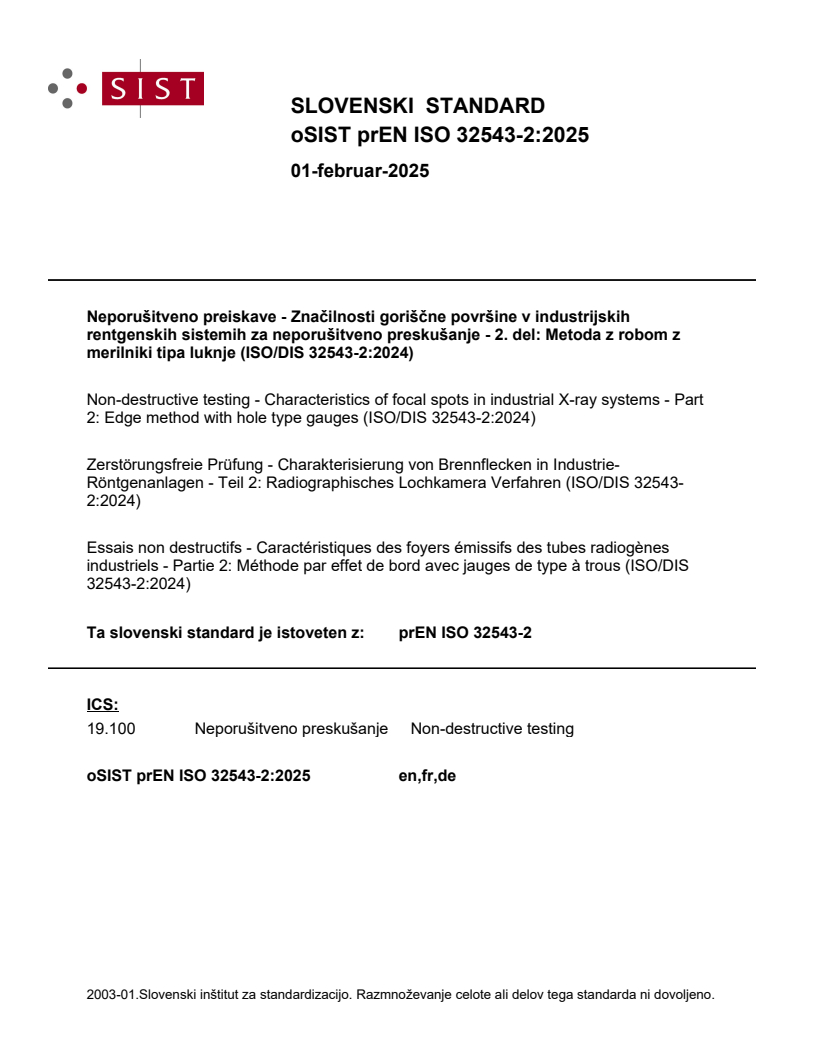
SLOVENSKI STANDARD
oSIST prEN ISO 32543-2:2025
01-februar-2025
Neporušitveno preiskave - Značilnosti goriščne površine v industrijskih
rentgenskih sistemih za neporušitveno preskušanje - 2. del: Metoda z robom z
merilniki tipa luknje (ISO/DIS 32543-2:2024)
Non-destructive testing - Characteristics of focal spots in industrial X-ray systems - Part
2: Edge method with hole type gauges (ISO/DIS 32543-2:2024)
Zerstörungsfreie Prüfung - Charakterisierung von Brennflecken in Industrie-
Röntgenanlagen - Teil 2: Radiographisches Lochkamera Verfahren (ISO/DIS 32543-
2:2024)
Essais non destructifs - Caractéristiques des foyers émissifs des tubes radiogènes
industriels - Partie 2: Méthode par effet de bord avec jauges de type à trous (ISO/DIS
32543-2:2024)
Ta slovenski standard je istoveten z: prEN ISO 32543-2
ICS:
19.100 Neporušitveno preskušanje Non-destructive testing
oSIST prEN ISO 32543-2:2025 en,fr,de
2003-01.Slovenski inštitut za standardizacijo. Razmnoževanje celote ali delov tega standarda ni dovoljeno.
oSIST prEN ISO 32543-2:2025
oSIST prEN ISO 32543-2:2025
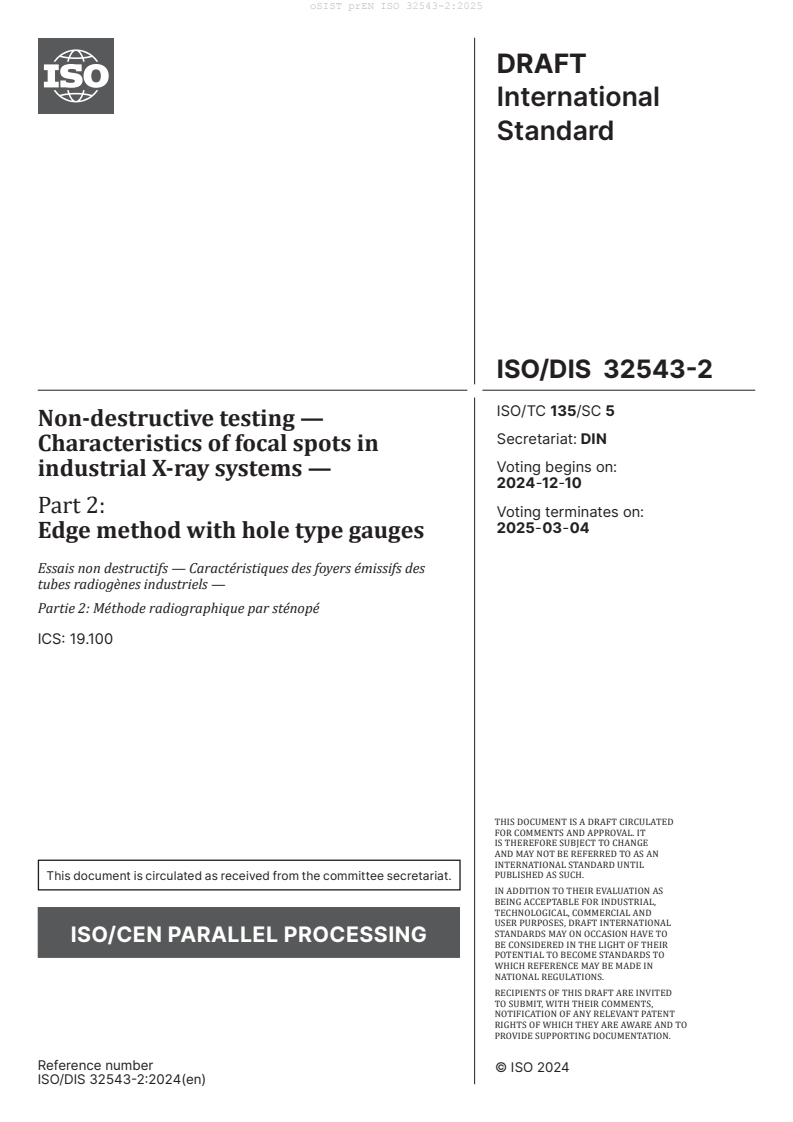
DRAFT
International
Standard
ISO/DIS 32543-2
ISO/TC 135/SC 5
Non-destructive testing —
Secretariat: DIN
Characteristics of focal spots in
Voting begins on:
industrial X-ray systems —
2024-12-10
Part 2:
Voting terminates on:
2025-03-04
Edge method with hole type gauges
Essais non destructifs — Caractéristiques des foyers émissifs des
tubes radiogènes industriels —
Partie 2: Méthode radiographique par sténopé
ICS: 19.100
THIS DOCUMENT IS A DRAFT CIRCULATED
FOR COMMENTS AND APPROVAL. IT
IS THEREFORE SUBJECT TO CHANGE
AND MAY NOT BE REFERRED TO AS AN
INTERNATIONAL STANDARD UNTIL
PUBLISHED AS SUCH.
This document is circulated as received from the committee secretariat.
IN ADDITION TO THEIR EVALUATION AS
BEING ACCEPTABLE FOR INDUSTRIAL,
TECHNOLOGICAL, COMMERCIAL AND
USER PURPOSES, DRAFT INTERNATIONAL
STANDARDS MAY ON OCCASION HAVE TO
ISO/CEN PARALLEL PROCESSING
BE CONSIDERED IN THE LIGHT OF THEIR
POTENTIAL TO BECOME STANDARDS TO
WHICH REFERENCE MAY BE MADE IN
NATIONAL REGULATIONS.
RECIPIENTS OF THIS DRAFT ARE INVITED
TO SUBMIT, WITH THEIR COMMENTS,
NOTIFICATION OF ANY RELEVANT PATENT
RIGHTS OF WHICH THEY ARE AWARE AND TO
PROVIDE SUPPORTING DOCUMENTATION.
Reference number
ISO/DIS 32543-2:2024(en)
oSIST prEN ISO 32543-2:2025
DRAFT
ISO/DIS 32543-2:2024(en)
International
Standard
ISO/DIS 32543-2
ISO/TC 135/SC 5
Non-destructive testing —
Secretariat: DIN
Characteristics of focal spots in
Voting begins on:
industrial X-ray systems —
Part 2:
Voting terminates on:
Edge method with hole type gauges
Essais non destructifs — Caractéristiques des foyers émissifs des
tubes radiogènes industriels —
Partie 2: Méthode radiographique par sténopé
ICS: 19.100
THIS DOCUMENT IS A DRAFT CIRCULATED
FOR COMMENTS AND APPROVAL. IT
IS THEREFORE SUBJECT TO CHANGE
AND MAY NOT BE REFERRED TO AS AN
INTERNATIONAL STANDARD UNTIL
PUBLISHED AS SUCH.
This document is circulated as received from the committee secretariat.
IN ADDITION TO THEIR EVALUATION AS
BEING ACCEPTABLE FOR INDUSTRIAL,
© ISO 2024
TECHNOLOGICAL, COMMERCIAL AND
USER PURPOSES, DRAFT INTERNATIONAL
All rights reserved. Unless otherwise specified, or required in the context of its implementation, no part of this publication may
STANDARDS MAY ON OCCASION HAVE TO
ISO/CEN PARALLEL PROCESSING
be reproduced or utilized otherwise in any form or by any means, electronic or mechanical, including photocopying, or posting on
BE CONSIDERED IN THE LIGHT OF THEIR
the internet or an intranet, without prior written permission. Permission can be requested from either ISO at the address below
POTENTIAL TO BECOME STANDARDS TO
WHICH REFERENCE MAY BE MADE IN
or ISO’s member body in the country of the requester.
NATIONAL REGULATIONS.
ISO copyright office
RECIPIENTS OF THIS DRAFT ARE INVITED
CP 401 • Ch. de Blandonnet 8
TO SUBMIT, WITH THEIR COMMENTS,
CH-1214 Vernier, Geneva
NOTIFICATION OF ANY RELEVANT PATENT
Phone: +41 22 749 01 11
RIGHTS OF WHICH THEY ARE AWARE AND TO
PROVIDE SUPPORTING DOCUMENTATION.
Email: copyright@iso.org
Website: www.iso.org
Published in Switzerland Reference number
ISO/DIS 32543-2:2024(en)
ii
oSIST prEN ISO 32543-2:2025
ISO/DIS 32543-2:2024(en)
Contents Page
Introduction .iv
1 Scope . 1
2 Normative references . 1
3 Terms and definitions . 2
4 Principle and detectors . 4
4.1 Principle .4
4.2 Detectors.4
4.2.1 General .4
4.2.2 Imaging plates for computed radiography .4
4.2.3 Digital Detector Arrays (DDA) .4
4.2.4 Exposure conditions and Image processing .5
5 Test equipment . 5
5.1 General .5
5.2 Essential characteristics of test gauge or Image Quality Indicator (IQI) .5
5.2.1 Nano- and microfocus tubes (spot size < 100 µm). .5
5.2.2 Mini- and macrofocus tubes (spot size ≥ 100 µm) .7
5.2.3 Alignment and position of the gauge in the beam .8
6 Loading factors . 10
7 Measurement procedure and determination of the focal spot size .10
7.1 Measurement procedure .10
7.2 Evaluation using a line profile .11
7.3 Automated evaluation using a validated software . 13
8 Classification and result of focal spot size evaluation . 14
9 Documentation . 14
Annex A (normative) Values for the classification of X-ray tube focal spot sizes .16
Bibliography .18
iii
oSIST prEN ISO 32543-2:2025
ISO/DIS 32543-2:2024(en)
Introduction
To cover the large range of effective focal spot sizes, four different methods are described in EN 12543 series.
In this document, the edge method is intended as user method for measurement of effective focal spot
sizes of nano, micro, mini and macro (standard) focus tubes. The edge method uses hole type gauges and is
intended for field and lab applications when the users need to observe the effective focal spot on a regular
basis and other methods are non-practical.
EN ISO 32543-1, the pin hole method, permits the measurement of spot shape and sizes ≥ 100 µm and EN
ISO 32543-3 covers the range of spot sizes for micro focus tubes from 5 µm to 300 µm.
Two further methods are in preparation as future part in ISO 32543 series, concerning:
— the line pair gauges for measuring the effective focal spot size of micro- and nanofocus X-ray tubes with
focal spot sizes of 0,2 µm to 100 µm. This method is intended for the use by manufacturers and users and
a measuring range between 0,2 µm to 100 µm;
— the reconstruction of the spot shape from hole gauge measurements. The results are equivalent to the
pin hole method down to 0,2 µm, if no phase contrast is observed.
In the overlapping ranges the different methods give similar values based on the edge response measurement,
which allow using the dedicated method also in a limited way outside the above specified ranges.
iv
oSIST prEN ISO 32543-2:2025
DRAFT International Standard ISO/DIS 32543-2:2024(en)
Non-destructive testing — Characteristics of focal spots in
industrial X-ray systems —
Part 2:
Edge method with hole type gauges
1 Scope
This document specifies a method for the measurement of effective focal spot dimensions above 0,2 µm of
X-ray systems by means of the edge method applied to digital images taken from hole type or disk type
gauges if no phase contrast is observed. The imaging quality and the resolution of X-ray images depend
highly on the characteristics of the effective focal spot, in particular the size and the two-dimensional
intensity distribution as seen from the detector plane.
This document provides instructions for determining the effective size (dimensions) of standard, mini and
micro focal spots of industrial X-ray tubes for users in applications where the pin hole method of ISO 32543-1
is not practicable. This determination is based on the measurement of a profile of an image of a hole or disk
type gauge.
The method as described in this document can be used for long term monitoring of focal spot sizes without
a pin hole camera.
The accuracy of this method is lower than the one of ISO 32543-1, ISO/DIS 32543-3 and the future standards
in preparation, for measurements of the effective focal spot size, using ASTM hole plate IQIs (as described
in ASTM E 1025, E 1742), due to its manufacturer tolerance of ±10 % of the hole diameter. It can be used by
manufacturers if special hole gauges, manufactured with lower tolerance, as described in 5.2.1 are applied
(see Figure 1).
2 Normative references
The following documents are referred to in the text in such a way that some or all of their content constitutes
requirements of this document. For dated references, only the edition cited applies. For undated references,
the latest edition of the referenced document (including any amendments) applies.
ISO 12181 (all parts), Geometrical product specifications (GPS) — Roundness
ISO 16371-1, Non-destructive testing — Industrial computed radiography with storage phosphor imaging plates
— Part 1: Classification of systems
ISO 19232-5, Non-destructive testing — Image quality of radiographs — Part 5: Determination of the image
unsharpness and basic spatial resolution value using duplex wire-type image quality indicators
ISO 32543-1, Non-destructive testing — Characteristics of focal spots in industrial X-ray systems — Part 1:
Pinhole camera radiographic method
ISO/DIS 32543-3, Non-destructive testing - Characteristics of focal spots in industrial X-ray systems for use in
non-destructive testing - Part 3: Measurement of the effective focal spot size of mini and micro focus X-ray tubes
ASTM E 2903, Standard Test Method for Measurement of the Effective Focal Spot Size of Mini and Micro Focus
X-ray Tubes
ASTM E 1165, Standard Test Method for Measurement of Focal Spots of Industrial X-Ray Tubes by Pinhole Imaging
oSIST prEN ISO 32543-2:2025
ISO/DIS 32543-2:2024(en)
ASTM E 2002, Standard Practice for Determining Total Image Unsharpness and Basic Spatial Resolution in
Radiography and Radioscopy
ASTM E 1742, Standard Practice for Radiographic Examination
ASTM E 1025, Standard Practice for Design, Manufacture, and Material Grouping Classification of Hole-Type
Image Quality Indicators (IQI) used for Radiology
ASTM E 1000, Standard Guide for Radioscopy
3 Terms and definitions
For the purposes of this document, the following terms and definitions apply.
ISO and IEC maintain terminology databases for use in standardization at the following addresses:
— ISO Online browsing platform: available at https:// www .iso .org/ obp/
— IEC Electropedia: available at https:// www .electropedia .org/
3.1
Thermal focal spot
X-ray producing area of the target as viewed from a position perpendicular to the target surface
Note 1 to entry: Also named as actual focal spot in ASTM E 1165.
3.2
Effective focal spot
X-ray producing area of the target as viewed by a detection device from the defined image plane
Note 1 to entry: Also named optical focal spot in other publications.
3.3
Effective size of focal spot
s
focal spot size measured in accordance with this document (s = s )
ERF50
3.4
Roundness
RON
t
value of the largest positive local roundness deviation added to the absolute value of the largest negative
local roundness deviation from a reference circle according to ISO 12181 series.
3.5
Effective size of focal spot measured from an ERV
s
ERV50
focal spot size derived from measured edge response function at edge response value 50 % (ERV ) (see 7.2)
as applied in ASTM E 2903 and ASTM E 1165, Annex A, according to Formula (7).
Note 1 to entry: ASTM E 1165, Annex A uses an extension value of 1,4 instead of 1,47 as used in the standard practice
of ASTM E1165 before Annex A.
3.6
Nominal focal spot size
SS
Value determined from Table A.1 based on the measured focal spot s = s
ERV50
3.7
Focal spot size class
FS
Classification value for X-ray tubes, which have a focal spot size in the defied range as defined ANNEX A,
Table A.1
oSIST prEN ISO 32543-2:2025
ISO/DIS 32543-2:2024(en)
3.8
Edge response function
ERF
Function determined by measuring the spatial distribution of the X-ray image of a sharp edge of a dense
material
3.9
Edge response value
ERV
value of the spatial distances, measured at 16 % and 84 % of the profile intensity of an ERF and extended to
0 % and 100 % in the profile line by a factor of 1,47 (=100/(84-16)).
[1]
Note 1 to entry: The concept was published by Klasens and is used also in ASTM E 1000 for measurement of the
unsharpness in radioscopic images.
Note 2 to entry: The value ERV corresponds to the spot size, s, as measured with the method of ISO 32543-1 or ASTM
E 1165 (without Annex)
3.10
Edge response value 50
ERV
value of the spatial distances, measured 2 times at 50 % and 84 % of the profile intensity of an ERF and
extended to 0 % and 100 % in the profile line by a factor of 1,47.
Note 1 to entry: The value ERV corresponds to the spot size, s, as measured with the method of ISO/DIS 32543-3 or
ASTM E 2903 and is used instead of ERV if an edge transmission of gauges needs to be considered.
3.11
Signal to noise ratio
SNR
ratio of mean grey value to the standard deviation of the grey values (noise) measured in a region of interest
Note 1 to entry: grey values are numeric values of pixels, which are directly proportional to the detector exposure
dose and having a value of zero, if the detector was not exposed
3.12
Contrast-to-noise ratio
CNR
ratio of the difference of the mean signal levels between two image areas to the averaged standard deviation
of the signal levels
3.13
Pixel coverage of a focal spot
N
number of pixels in an image by which it is blurred by the focal spot size in x- or y-direction (e.g. width or
length).
Note 1 to entry: N corresponds to the number of pixels across the spot edge profile.
3.14
basic spatial resolution value of a digital detector
detector
SR
b
half of the measured detector unsharpness in a digital image, which corresponds to the effective pixel size
and indicates the smallest geometrical detail which can be resolved with a digital detector at magnification
equal to one
Note 1 to entry: For this measurement, the duplex wire IQI is placed directly on the digital detector array (3.3) or
imaging plate.
Note 2 to entry: The measurement of unsharpness is described in ISO 19232-5. See also ASTM E1000 and ASTM E2736.
[SOURCE: ISO 17636-2:2022(en), definition 3.8]
oSIST prEN ISO 32543-2:2025
ISO/DIS 32543-2:2024(en)
3.15
Interpolated basic spatial resolution value of a digital detector
detector
iSR
b
smallest geometrical detail, which can be resolved in a digital image at magnification equal to one and
corresponds to half of the measured interpolated detector unsharpness, in a digital image and is determined
from a profile function in a digital image by interpolation from a linearized profile function and obtained by
interpolation to 20 % modulation depth from neighbour element modulations.
Note 1 to entry: The measurement of interpolated unsharpness is described in ISO 19232-5 and ASTM E 2002. See also
ASTM E1000 and ASTM E2736.
3.16
Anticipated focal spot size
afs
size of a focal spot as provided by a manufacturer, a specification or obtained by an older measurement
4 Principle and detectors
4.1 Principle
The method is based on indirect measurement of the focal spot size calculated from the geometric
unsharpness of the radiographs of hole or disk gauges. For this purpose, hole or disk gauges with sharp
edges are imaged either on an imaging plate (IP) by computed radiography (CR), or by means of a digital
detector array (DDA) using a suitable geometric magnification (see below for magnification requirements).
The edge unsharpness of the hole or disk structures is evaluated.
The hole method of ASTM E 1165, Annex A, will be adapted for this document for spot sizes ≥ 0,1 mm. Other
gauges are required to cover the range of spot sizes < 0,1 mm.
4.2 Detectors
4.2.1 General
The shape of focal spots is important for manufacturers and evaluation of possible changes in the X-ray tube
with operating time.
4.2.2 Imaging plates for computed radiography
The following equipment is required for the measurement, if using computed radiography (CR):
— a test object as described below;
— a computed radiography system, consisting of imaging plates and a scanner, configured such that the
pixel size is appropriate for the measurement (clause 5). The image shall be of a sufficient size to image
magnified test objects and the region around the test object to obtain a profile as shown in Figure 5b).
The computed radiography system shall meet the requirements of ISO16371-1 Class IP I, IP II or IP Special
and imaging plates shall be packed in low absorbing cassettes using no metal screens.
4.2.3 Digital Detector Arrays (DDA)
The following equipment is required for the measurement, if using digital detector array devices:
— test object as described in clause 5;
— DDA, configured such that the pixel size is appropriate for the measurement (clause 5). The image shall
be of sufficient size to image the magnified test object and a region around test object to obtain a profile
as shown in Figure 5b);
oSIST prEN ISO 32543-2:2025
ISO/DIS 32543-2:2024(en)
— DDA input window shall be of low attenuating material. The DDA shall be free of relevant bad pixel
clusters in the inspection area;
— DDA response shall be corrected (calibrated) to equalize the response of the different detector elements
and to correct bad pixels.
4.2.4 Exposure condition
...
Questions, Comments and Discussion
Ask us and Technical Secretary will try to provide an answer. You can facilitate discussion about the standard in here.
Loading comments...