

EN 1087-1:1995
(Main)Particleboards - Determination of moisture resistance - Part 1: Boil test
- Abstract
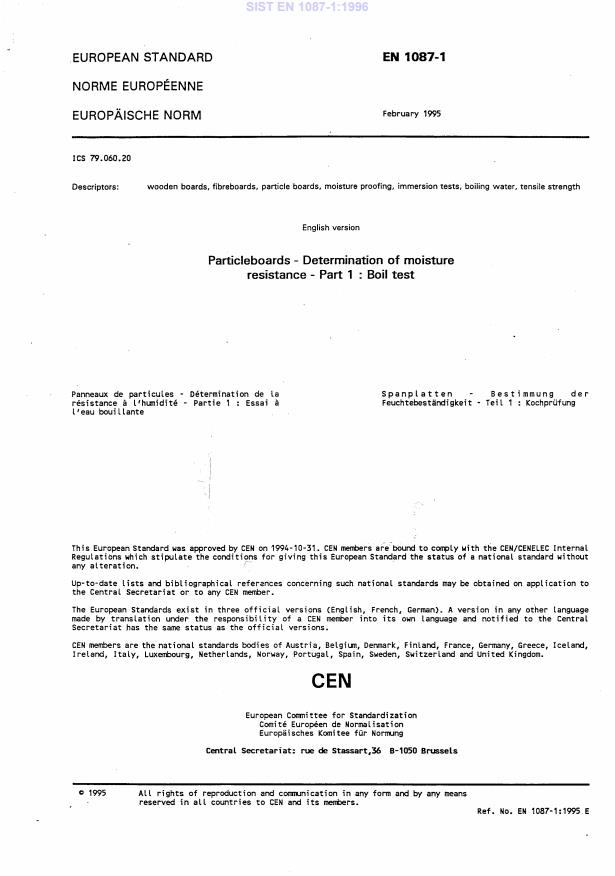
This European Standard specifies a method of test for evaluating the bond quality of particleboards, intended for use in humid conditions according to option 2 of prEN 312-5 and prEN 312-7.
- Status
- Published
- Publication Date
- 05-Feb-1995
- Technical Committee
- CEN/TC 112 - Woodbased panels
- Drafting Committee
- CEN/TC 112/WG 1 - Particle boards
- Current Stage
- 9093 - Decision to confirm - Review Enquiry
- Start Date
- 24-May-2023
- Completion Date
- 30-Sep-2026

Overview
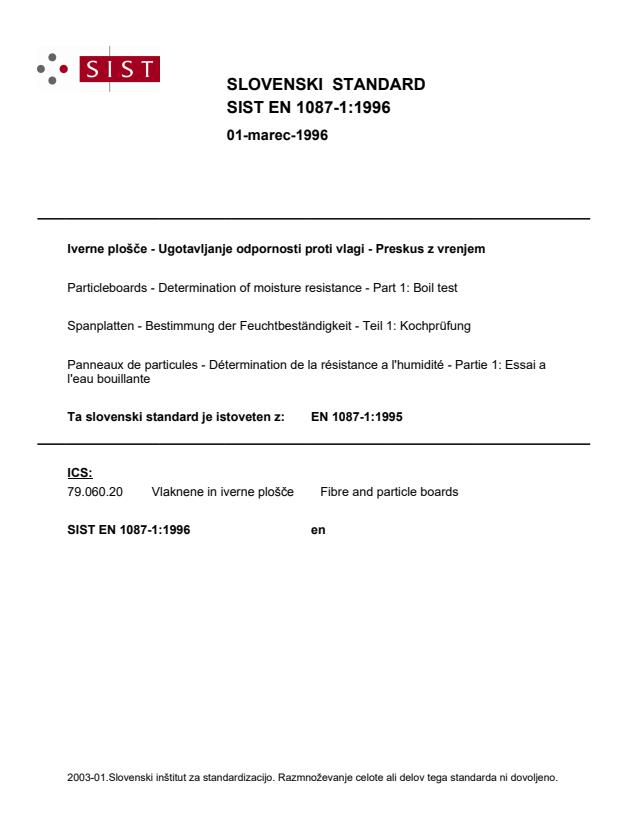
EN 1087-1:1995 (CEN) defines a standardized boil test method to assess the moisture resistance and bond quality of particleboards. The standard is intended to evaluate particleboard performance in humid conditions and is referenced for use with option 2 of prEN 312-5 and prEN 312-7. It is classified under ICS 79.060.20 (Fibre and particle boards) and has been adopted nationally (example: SIST EN 1087-1:1996).
Key topics and requirements
- Scope and purpose: Specifies a test method for determining how particleboard bond lines withstand exposure to boiling (the “boil test”) to simulate severe humid conditions.
- Test focus: Evaluation centers on the bond quality between particles and adhesives under moisture stress; the outcome informs suitability for humid-service applications.
- Standard test procedure elements (high-level): sample selection and preparation, conditioning, exposure to boiling, and post-test evaluation. (EN 1087-1 provides the procedural framework and acceptance criteria; consult the full standard for exact steps and measurement thresholds.)
- Assessment outcomes: Results are used to determine whether particleboards meet the moisture resistance level required by relevant product specifications (see prEN 312 series).
- Classification & documentation: Aligns test results with product classification for humid conditions and supports compliance documentation for manufacturers.
Practical applications
Who uses EN 1087-1:1995:
- Particleboard manufacturers - for quality control, product development, and verifying adhesive systems under humid conditions.
- Testing laboratories - to perform standardized moisture resistance testing and generate comparable data.
- Certification bodies and regulators - to assess conformity with European product requirements and national adoptions.
- Architects, specifiers and engineers - to select appropriate board types where moisture exposure is anticipated.
- R&D teams - to compare adhesives, resins, and board formulations for improved moisture performance.
Why it matters:
- Ensures consistent, repeatable evaluation of moisture resistance and bond durability.
- Supports product specification and compliance for applications in kitchens, bathrooms, exterior-protected components, and other humid environments.
Related standards
- prEN 312-5 and prEN 312-7 (referenced options for humid-use classification)
- EN 312 (general particleboard specifications) - consult for broader product requirements and classifications
- National adoptions (example: SIST EN 1087-1:1996)
For implementation or lab use, obtain the full EN 1087-1:1995 text from CEN or your national standards body to access complete test procedures and acceptance criteria.
Relations
- Referred By
EN 300:2006 - Oriented Strand Boards (OSB) - Definitions, classification and specifications - Effective Date
- 28-Jan-2026
- Effective Date
- 28-Jan-2026
- Effective Date
- 28-Jan-2026
- Effective Date
- 28-Jan-2026
- Effective Date
- 28-Jan-2026
- Effective Date
- 28-Jan-2026
- Effective Date
- 28-Jan-2026
- Effective Date
- 28-Jan-2026
- Effective Date
- 28-Jan-2026
- Effective Date
- 28-Jan-2026
- Referred By
EN 622-5:2009 - Fibreboards - Specifications - Part 5: Requirements for dry process boards (MDF) - Effective Date
- 28-Jan-2026
- Referred By
EN ISO 18613:2014 - Pallets for materials handling - Repair of flat wooden pallets (ISO 18613:2014) - Effective Date
- 28-Jan-2026
- Effective Date
- 28-Jan-2026
Get Certified
Connect with accredited certification bodies for this standard

Gozdarski inštitut Slovenije
Slovenian Forestry Institute. Forest management certification support, timber testing.
Sponsored listings
Frequently Asked Questions
EN 1087-1:1995 is a standard published by the European Committee for Standardization (CEN). Its full title is "Particleboards - Determination of moisture resistance - Part 1: Boil test". This standard covers: This European Standard specifies a method of test for evaluating the bond quality of particleboards, intended for use in humid conditions according to option 2 of prEN 312-5 and prEN 312-7.
This European Standard specifies a method of test for evaluating the bond quality of particleboards, intended for use in humid conditions according to option 2 of prEN 312-5 and prEN 312-7.
EN 1087-1:1995 is classified under the following ICS (International Classification for Standards) categories: 79.060.20 - Fibre and particle boards. The ICS classification helps identify the subject area and facilitates finding related standards.
EN 1087-1:1995 has the following relationships with other standards: It is inter standard links to EN 300:2006, EN 13698-1:2003, EN 13986:2004+A1:2015, EN 13986:2004, EN 312:2010, EN ISO 18613:2003, EN 13698-2:2009, EN 13810-1:2002, EN 622-3:2004, EN 622-2:2004, EN 622-5:2009, EN ISO 18613:2014, EN 15197:2007. Understanding these relationships helps ensure you are using the most current and applicable version of the standard.
EN 1087-1:1995 is associated with the following European legislation: EU Directives/Regulations: 305/2011, 89/106/EEC; Standardization Mandates: M/113. When a standard is cited in the Official Journal of the European Union, products manufactured in conformity with it benefit from a presumption of conformity with the essential requirements of the corresponding EU directive or regulation.
EN 1087-1:1995 is available in PDF format for immediate download after purchase. The document can be added to your cart and obtained through the secure checkout process. Digital delivery ensures instant access to the complete standard document.
Standards Content (Sample)
2003-01.Slovenski inštitut za standardizacijo. Razmnoževanje celote ali delov tega standarda ni dovoljeno.UHQMHPSpanplatten - Bestimmung der Feuchtbeständigkeit - Teil 1: KochprüfungPanneaux de particules - Détermination de la résistance a l'humidité - Partie 1: Essai a l'eau bouillanteParticleboards - Determination of moisture resistanc
...