

EN 15780:2011
(Main)Ventilation for buildings - Ductwork - Cleanliness of ventilation systems
- Abstract
This European Standard applies to both new and existing ventilation and air conditioning systems and specifies the assessment criteria of cleanliness, cleaning procedures of these systems, and the validation of the effectiveness of cleaning applies also to products, which conform to EN 1505, EN 1506, EN 13053, EN 13180 and EN 13403, used in air conditioning and ventilation systems for human occupancy defined in the scope of CEN/TC 156. This European Standard does not apply to installations for industrial processes.
Cleanliness of ventilation systems is considered important for human comfort and health, energy consumption, system service life and for cleanliness of operations or processes carried out in the ventilated area.
Considerations for change of component as an alternative for cleaning (e.g. in case of flexible ducts and air filters) are also included.
This European Standard specifies general requirements and procedures necessary in assessing and maintaining the cleanliness of ducted ventilation, including:
- cleanliness quality classification;
- how to assess the need for cleaning (visual, measurements);
- assessment frequency (general guidance); guidance of system inspections in accordance with EN 15239, and EN 15240 when relevant;
- selection of cleaning method – to be in line with handing over documentation according to
EN 12599;
- how to assess the result of cleaning.
This European Standard is a parallel standard to EN 12097, which specifies requirements for dimension, shape and location for access panels for cleaning and service in ductwork systems.
This European Standard is made as an umbrella standard with informative annexes that can be revised, completed and further added in future revisions of this European Standard for specific system types, and products or applications in the system, such as:
- Air Handling Units (AHU);
- filter;
- humidifiers;
- heat recovery units;
- decentralised air treatment units such as fan-coil units, indu
- Status
- Withdrawn
- Publication Date
- 25-Oct-2011
- Withdrawal Date
- 06-Oct-2026
- Technical Committee
- CEN/TC 156 - Ventilation for buildings
- Drafting Committee
- CEN/TC 156/WG 3 - Ductwork
- Current Stage
- 9960 - Withdrawal effective - Withdrawal
- Start Date
- 23-Jul-2025
- Completion Date
- 07-Oct-2026

Relations
- Replaced By
EN 15780:2025 - Ventilation for buildings - Ductwork - Cleanliness of ventilation systems - Effective Date
- 21-Jun-2023
- Effective Date
- 28-Jan-2026
- Effective Date
- 28-Jan-2026
- Effective Date
- 28-Jan-2026
- Effective Date
- 28-Jan-2026
Get Certified
Connect with accredited certification bodies for this standard

DIBt (Deutsches Institut für Bautechnik)
German Institute for Building Technology.
DIN CERTCO
DIN Group product certification.

Aboma Certification B.V.
Specialized in construction, metal, and transport sectors.
Sponsored listings
Frequently Asked Questions
EN 15780:2011 is a standard published by the European Committee for Standardization (CEN). Its full title is "Ventilation for buildings - Ductwork - Cleanliness of ventilation systems". This standard covers: This European Standard applies to both new and existing ventilation and air conditioning systems and specifies the assessment criteria of cleanliness, cleaning procedures of these systems, and the validation of the effectiveness of cleaning applies also to products, which conform to EN 1505, EN 1506, EN 13053, EN 13180 and EN 13403, used in air conditioning and ventilation systems for human occupancy defined in the scope of CEN/TC 156. This European Standard does not apply to installations for industrial processes. Cleanliness of ventilation systems is considered important for human comfort and health, energy consumption, system service life and for cleanliness of operations or processes carried out in the ventilated area. Considerations for change of component as an alternative for cleaning (e.g. in case of flexible ducts and air filters) are also included. This European Standard specifies general requirements and procedures necessary in assessing and maintaining the cleanliness of ducted ventilation, including: - cleanliness quality classification; - how to assess the need for cleaning (visual, measurements); - assessment frequency (general guidance); guidance of system inspections in accordance with EN 15239, and EN 15240 when relevant; - selection of cleaning method – to be in line with handing over documentation according to EN 12599; - how to assess the result of cleaning. This European Standard is a parallel standard to EN 12097, which specifies requirements for dimension, shape and location for access panels for cleaning and service in ductwork systems. This European Standard is made as an umbrella standard with informative annexes that can be revised, completed and further added in future revisions of this European Standard for specific system types, and products or applications in the system, such as: - Air Handling Units (AHU); - filter; - humidifiers; - heat recovery units; - decentralised air treatment units such as fan-coil units, indu
This European Standard applies to both new and existing ventilation and air conditioning systems and specifies the assessment criteria of cleanliness, cleaning procedures of these systems, and the validation of the effectiveness of cleaning applies also to products, which conform to EN 1505, EN 1506, EN 13053, EN 13180 and EN 13403, used in air conditioning and ventilation systems for human occupancy defined in the scope of CEN/TC 156. This European Standard does not apply to installations for industrial processes. Cleanliness of ventilation systems is considered important for human comfort and health, energy consumption, system service life and for cleanliness of operations or processes carried out in the ventilated area. Considerations for change of component as an alternative for cleaning (e.g. in case of flexible ducts and air filters) are also included. This European Standard specifies general requirements and procedures necessary in assessing and maintaining the cleanliness of ducted ventilation, including: - cleanliness quality classification; - how to assess the need for cleaning (visual, measurements); - assessment frequency (general guidance); guidance of system inspections in accordance with EN 15239, and EN 15240 when relevant; - selection of cleaning method – to be in line with handing over documentation according to EN 12599; - how to assess the result of cleaning. This European Standard is a parallel standard to EN 12097, which specifies requirements for dimension, shape and location for access panels for cleaning and service in ductwork systems. This European Standard is made as an umbrella standard with informative annexes that can be revised, completed and further added in future revisions of this European Standard for specific system types, and products or applications in the system, such as: - Air Handling Units (AHU); - filter; - humidifiers; - heat recovery units; - decentralised air treatment units such as fan-coil units, indu
EN 15780:2011 is classified under the following ICS (International Classification for Standards) categories: 91.140.30 - Ventilation and air-conditioning systems. The ICS classification helps identify the subject area and facilitates finding related standards.
EN 15780:2011 has the following relationships with other standards: It is inter standard links to EN 15780:2025, EN 12599:2012, EN 12792:2003, EN 14799:2007, EN ISO 9509:2006. Understanding these relationships helps ensure you are using the most current and applicable version of the standard.
EN 15780:2011 is available in PDF format for immediate download after purchase. The document can be added to your cart and obtained through the secure checkout process. Digital delivery ensures instant access to the complete standard document.
Standards Content (Sample)
2003-01.Slovenski inštitut za standardizacijo. Razmnoževanje celote ali delov tega standarda ni dovoljeno.Lüftung von Gebäuden - Luftleitungen - Sauberkeit von LüftungsanlagenVentilation des bâtiments - Réseaux de conduits - Propreté des systèmes de ventilationVentilation for buildings - Ductwork - Cleanliness of ventilation systems91.140.30VLVWHPLVentilation and air-conditioning91.060.40Dimniki, jaški, kanaliChimneys, shafts, ductsICS:Ta slovenski standard je istoveten z:EN 15780:2011SIST EN 15780:2012en,fr,de01-februar-2012SIST EN 15780:2012SLOVENSKI
STANDARD
EUROPEAN STANDARD NORME EUROPÉENNE EUROPÄISCHE NORM
EN 15780
October 2011 ICS 91.140.30 English Version
Ventilation for buildings - Ductwork - Cleanliness of ventilation systems
Ventilation des bâtiments - Réseaux de conduits -Propreté des systèmes de ventilation
Lüftung von Gebäuden - Luftleitungen - Sauberkeit von Lüftungsanlagen This European Standard was approved by CEN on 11 September 2011.
CEN members are bound to comply with the CEN/CENELEC Internal Regulations which stipulate the conditions for giving this European Standard the status of a national standard without any alteration. Up-to-date lists and bibliographical references concerning such national standards may be obtained on application to the CEN-CENELEC Management Centre or to any CEN member.
This European Standard exists in three official versions (English, French, German). A version in any other language made by translation under the responsibility of a CEN member into its own language and notified to the CEN-CENELEC Management Centre has the same status as the official versions.
CEN members are the national standards bodies of Austria, Belgium, Bulgaria, Croatia, Cyprus, Czech Republic, Denmark, Estonia, Finland, France, Germany, Greece, Hungary, Iceland, Ireland, Italy, Latvia, Lithuania, Luxembourg, Malta, Netherlands, Norway, Poland, Portugal, Romania, Slovakia, Slovenia, Spain, Sweden, Switzerland and United Kingdom.
EUROPEAN COMMITTEE FOR STANDARDIZATION
COMITÉ EUROPÉEN DE NORMALISATION EUROPÄISCHES KOMITEE FÜR NORMUNG
Management Centre:
Avenue Marnix 17,
B-1000 Brussels © 2011 CEN All rights of exploitation in any form and by any means reserved worldwide for CEN national Members. Ref. No. EN 15780:2011: ESIST EN 15780:2012
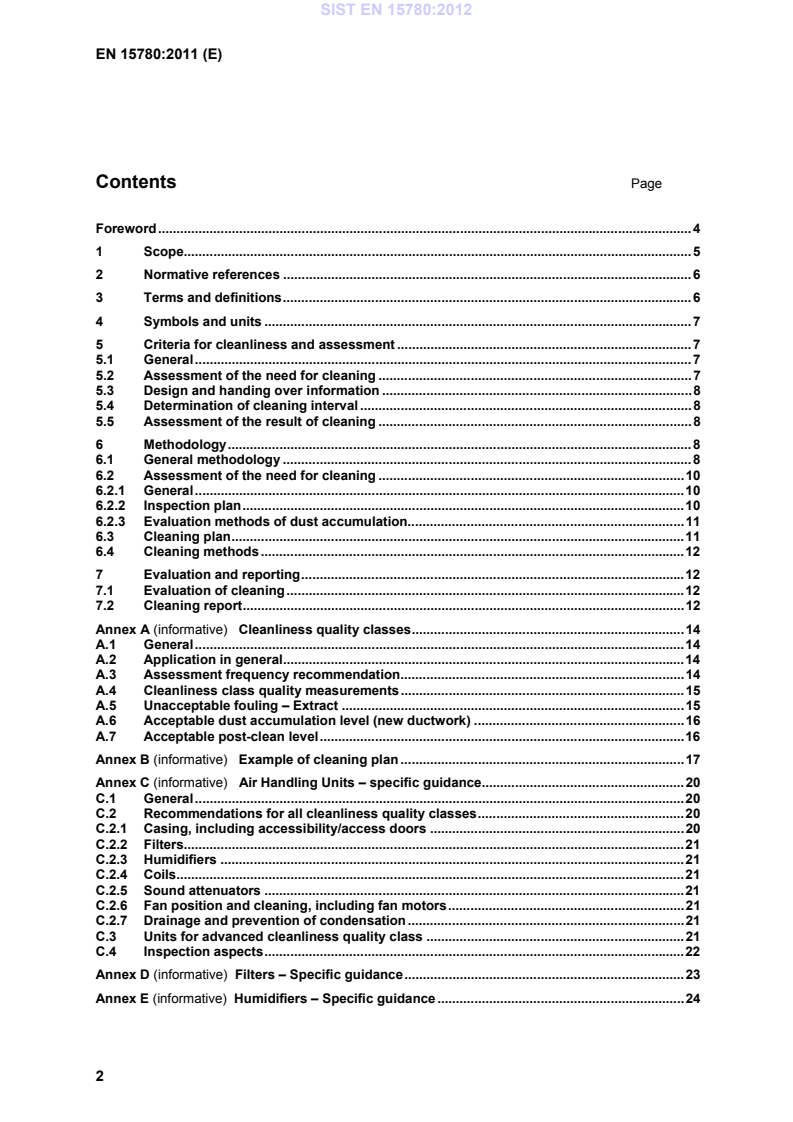
Cleanliness quality classes . 14A.1General . 14A.2Application in general. 14A.3Assessment frequency recommendation. 14A.4Cleanliness class quality measurements . 15A.5Unacceptable fouling – Extract . 15A.6Acceptable dust accumulation level (new ductwork) . 16A.7Acceptable post-clean level . 16Annex B (informative)
Example of cleaning plan . 17Annex C (informative)
Air Handling Units – specific guidance . 20C.1General . 20C.2Recommendations for all cleanliness quality classes . 20C.2.1Casing, including accessibility/access doors . 20C.2.2Filters. 21C.2.3Humidifiers . 21C.2.4Coils. 21C.2.5Sound attenuators . 21C.2.6Fan position and cleaning, including fan motors . 21C.2.7Drainage and prevention of condensation . 21C.3Units for advanced cleanliness quality class . 21C.4Inspection aspects . 22Annex D (informative)
Filters – Specific guidance . 23Annex E (informative)
Humidifiers – Specific guidance . 24SIST EN 15780:2012
Ductwork – Specific installation guidance . 25F.1Acceptable dust accumulation (new ductwork) . 25F.2Protection, Delivery and Installation (PDI) . 25F.3Application of cleanliness levels - airtightness . 27Annex G (informative)
Terminal devices and units – Specific guidance . 28Annex H (informative)
Measurement methods for dust accumulation . 29H.1Evaluation methods of dust accumulation. 29H.1.1General . 29H.1.2Visual inspection . 29H.1.3Methods of verifying deposited solid dust and micro-organisms . 30H.2Summary of methods for evaluation of cleanliness . 31Annex I (informative)
Preferred vacuum test method . 32I.1Test equipment . 32I.2Sampling procedure . 32I.3Analysis procedure . 33Bibliography . 34 SIST EN 15780:2012
1 Scope This European Standard applies to both new and existing ventilation and air conditioning systems and specifies the assessment criteria of cleanliness, cleaning procedures of these systems, and the validation of the effectiveness of cleaning applies also to products, which conform to EN 1505, EN 1506, EN 13053, EN 13180 and EN 13403, used in air conditioning and ventilation systems for human occupancy defined in the scope of CEN/TC 156. This European Standard does not apply to installations for industrial processes. Cleanliness of ventilation systems is considered important for human comfort and health, energy consumption, system service life and for cleanliness of operations or processes carried out in the ventilated area. Considerations for change of component as an alternative for cleaning (e.g. in case of flexible ducts and air filters) are also included. This European Standard specifies general requirements and procedures necessary in assessing and maintaining the cleanliness of ducted ventilation, including: cleanliness quality classification; how to assess the need for cleaning (visual, measurements); assessment frequency (general guidance); guidance of system inspections in accordance with EN 15239, and EN 15240 when relevant; selection of cleaning method – to be in line with handing over documentation according to
EN 12599; how to assess the result of cleaning. This European Standard is a parallel standard to EN 12097, which specifies requirements for dimension, shape and location for access panels for cleaning and service in ductwork systems. This European Standard is made as an umbrella standard with informative annexes that can be revised, completed and further added in future revisions of this European Standard for specific system types, and products or applications in the system, such as: Air Handling Units (AHU); filter; humidifiers; heat recovery units; decentralised air treatment units such as fan-coil units, induction units; terminal devices; kitchen extract equipment. The main target groups of this European Standard are specifiers of the cleanliness quality classes and cleaning methods primarily system designers who also specify the system of access, building owners, services companies, maintenance companies, end users and consultancy and control companies. SIST EN 15780:2012
EN 14799:2007 and the following apply. 3.1 acceptable cleanliness level amount of dust or other impurities not to be exceeded, according to the specified measurement method 3.2 acceptable post-clean level no loose dust is detected visually on the duct surface after cleaning and the system is capable reaching an acceptable cleanliness level according to a defined measurement method NOTE In case of conflict (e.g. between the building owner and the user), or uncertainty objective methods are needed to assess the cleanliness/dirtiness. 3.3 acceptable dust accumulation level (new ductwork) acceptable cleanliness level on new ductwork as handed over from builder to user NOTE In practice this means the quantity of pollution which is deemed acceptable. 3.4 cleanliness state or level of pollution defined as acceptable according to specification and a particular measurement method NOTE Cleanliness is not absolute, it is defined by limit values. Dirtiness is the exceeding of such a defined limit value. 3.5 cleanliness quality class in the scope of this standard there are three levels of cleanliness quality standards to be applied to various buildings and types of system A. Low B. Medium C. High SIST EN 15780:2012
Therefore it is necessary to specify the cleanliness quality class from the beginning and include in the specification both design and installation issues and means to maintain a sufficiently clean ventilation system for its whole lifetime. The design and installation issues shall include (as a minimum): cleanliness quality class; cleanliness criteria and measurement method; production of the system components; delivery to site; site storage; installation; protection of components after installation; handing over the system according to EN 12599 NOTE Annex A presents, as a common classification, three classes of cleanliness, application examples for ductwork, and recommendations for the frequency of regular inspections in accordance with EN 15239. 5.2 Assessment of the need for cleaning Inspection of functionality and cleanliness of ventilation system is a part of proper maintenance of the ventilation systems. Mostly the inspection of the cleanliness may arise from two purposes: to check if ventilation system is dirty and needs to be cleaned (exceeding of a "target level" of cleanliness); to evaluate cleanliness after the cleaning work (to check cleaning work). The assessment methodology is presented in 6.2. For existing buildings, the inspection shall include a study of the existing documentation and recommendations to complete and update the documents. SIST EN 15780:2012
For inspecting and sampling, the ventilation system can be divided in two parts, the ductwork and the rest of the system. Before inspection or sampling, the sites should be selected at random with the aid of the design documents. The sampling sites in the ductwork should be selected from the main duct starting from the AHU, main ducts, and branch ducts. The sampling sites should include straight duct lengths and ducts with changes of direction or terminations. In the rest of the system, filters or humidifiers give usually a good indication of the cleaning needs. NOTE 3 System cleanliness inspections should also make reference to other parts of the as described in 6.2.1, and with particular reference to critical components such as filters and wet areas. 6.2.3 Evaluation methods of dust accumulation Different methods to evaluate cleanliness of ventilation systems are available.
The simplest methods are based on more or less subjective visual observation of the cleanliness of ventilation system combined with use of some special instrumentation. The advanced techniques are able to give relatively accurate results that are comparable to given limit values. NOTE The various methods available are discussed in Annex H. In Annex A preferred measurement methods and limit values are given which relate to various cleanliness quality classes, and to post-clean verification of cleanliness. 6.3 Cleaning plan If, as assessed according to 6.2, cleaning is needed, a cleaning plan shall be provided. The cleaning plan shall include: a summary of the assessment including the list of the systems and parts that need to be cleaned; detailed time schedule of cleaning; cleaning methods to be applied; description of how access will be gained to ducts and equipment not visible in the rooms (ducts, air handling units); list of components to be removed for cleaning, and components to be replaced (when relevant); protection of the rooms in which the cleaning equipment is used; SIST EN 15780:2012
Cleanliness quality classes A.1 General This annex gives a summary of three cleanliness quality classes. It is a key issue to pay attention to cleanliness in design of systems and especially in component selection and specification. It may be modified to take better into account some existing national guidance such as FiSIAQ guideline and VDI 6022. Application examples are presented in A.2, and more specific applications in Annexes C and D. The following four major contaminants from all components may deteriorate IAQ and should be limited: residues of lubricant oils from duct manufacture; dust accumulated during manufacture and installation or debris from construction; dust accumulated during operation; deposited micro-organisms, particularly when toxigenic species are present and conditions are favourable for their survival and growth during storage, installation and operation. A.2 Application in general These levels of cleanliness quality class should be generally applied as follows: Table A.1 — Typical applications of cleanliness quality classes Quality Class Typical examplesLow rooms with only intermittent occupancy e.g. storage rooms, technical rooms
Medium offices, hotels, restaurants, schools, theatres, residential homes, shopping areas, exhibition buildings, sport buildings, general areas in hospitals and general working areas in industries
High
Laboratories, treatment areas in hospitals high quality offices A.3 Assessment frequency recommendation Assessment frequency described on Table A.2 should be considered as the minimum recommendations and the necessity of increasing them will depend on the environment conditions, on the activity and on mechanical and human conditions in both building and its surroundings. SIST EN 15780:2012
AHU Filtersa HumidifiersDucts TerminalsLow 24 12 12 48 48 Medium 12 12 6
24 24 High 12 6 6
12 12 Air handling units equipped with humidification or adiabatic cooling systems, or located in mild and wet weather conditions should be assessed at least twice a year, whatever the use of the building. a Filters should be inspected and maintained according to the manufacturer’s recommendations, with these intervals as the minimum ones.
A.4 Cleanliness class quality measurements The preferred measurement method is derived from the Finnish vacuum te
...