


EN ISO 18496:2021
(Main)Brazing - Fluxes for brazing - Classification and technical delivery conditions (ISO 18496:2020)
Brazing - Fluxes for brazing - Classification and technical delivery conditions (ISO 18496:2020)
This document specifies the classification of fluxes used for brazing metals and characterizes these fluxes on the basis of their properties and use, and gives technical delivery conditions and health and safety precautions.
This document covers two classes of flux, FH and FL. Class FH is used for the brazing of heavy metals (steels, stainless steels, copper and its alloys, nickel and its alloys, precious metals, molybdenum and tungsten). Class FL is used for the brazing of aluminium and its alloys.
Hartlöten - Flussmittel zum Hartlöten - Einteilung und technische Lieferbedingungen (ISO 18496:2020)
Brasage fort - Flux pour le brasage fort - Classification et conditions techniques de livraison (ISO 18496:2020)
Le présent document établit la classification des flux utilisés pour le brasage fort des métaux et caractérise ces flux d’après leurs propriétés et leurs applications, et donne des recommandations relatives aux conditions techniques de livraison et à l’hygiène et à la sécurité.
Le présent document définit deux classes de flux, FH et FL. La classe FH est utilisée pour le brasage fort des métaux lourds (les aciers ordinaires, les aciers inoxydables, le cuivre et ses alliages, le nickel et ses alliages, les métaux précieux, le molybdène et le tungstène). La classe FL est utilisée pour le brasage de l’aluminium et de ses alliages.
Trdo spajkanje - Talila za trdo spajkanje - Razvrstitev in tehnični dobavni pogoji (ISO 18496:2020)
Dokument razvršča talila, ki se uporabljajo za trdo spajkanje kovin, in jih opredeljuje na podlagi njihovih lastnosti in uporabe, obenem pa določa tehnične dobavne pogoje ter zdravstvene in varnostne ukrepe.
General Information
Relations
Overview
EN ISO 18496:2021 (ISO 18496:2020) defines the classification and technical delivery conditions for fluxes used in brazing. Published by CEN and adopted from ISO, the standard covers two main classes of brazing fluxes - Class FH for heavy metals and Class FL for aluminium and its alloys - and characterizes fluxes by composition, effective temperature range, residues and recommended removal or retention. It also specifies technical delivery conditions, packaging/marking, forms of delivery and health and safety precautions.
Key topics and technical requirements
- Classification of fluxes: Two classes - FH (heavy metals) and FL (light/aluminium metals). Each class is subdivided by type codes (FH10–FH40, FL10–FL30) that identify chemical makeup and intended brazing temperature range.
- Effective temperature ranges: Types are described by typical operating ranges (e.g., FH10 ≈ 550–800 °C, FH20 ≈ 700–1 000 °C, FH30 ≥ 1 000 °C). Annex A defines how to determine the effective temperature range.
- Chemical composition and residues:
- FH types commonly contain boron compounds, fluorides, chlorides, borates, phosphates or silicates. Some (e.g., FH40) are boron‑free for applications where boron is prohibited.
- FL types use lithium chlorides/fluorides or non‑hygroscopic fluorides and caesium fluoroaluminates for aluminium brazing.
- Residues may be corrosive (require washing or pickling) or non‑corrosive (may be left on the workpiece or removed mechanically).
- Technical delivery conditions: Specifies forms of delivery, packaging and marking requirements; Annex B gives typical technical properties and delivery forms.
- Health & safety: Identifies precautions for handling flux chemistries and their residues, including cleaning and disposal recommendations.
Applications and users
- Practical uses: selection and specification of brazing flux for joining steels, stainless steels, copper alloys, nickel alloys, precious metals, molybdenum, tungsten and aluminium.
- Who uses the standard:
- Welding, brazing and metallurgical engineers selecting fluxes for production
- Flux manufacturers and suppliers for product classification and labelling
- Quality managers and procurement teams specifying technical delivery conditions
- HSE officers implementing safe handling, cleaning and disposal procedures
- Standards writers and conformity assessors in welding and brazing industries
Related standards
- Supersedes EN 1045:1997; adopted from ISO 18496:2020. Prepared by ISO/TC 44 (Welding and allied processes), CEN/TC 121. For additional normative context consult national standards bodies and the ISO online catalogue.
Keywords: brazing fluxes, flux classification, FH flux, FL flux, flux residues, brazing temperature range, technical delivery conditions, health and safety.

Frequently Asked Questions
EN ISO 18496:2021 is a standard published by the European Committee for Standardization (CEN). Its full title is "Brazing - Fluxes for brazing - Classification and technical delivery conditions (ISO 18496:2020)". This standard covers: This document specifies the classification of fluxes used for brazing metals and characterizes these fluxes on the basis of their properties and use, and gives technical delivery conditions and health and safety precautions. This document covers two classes of flux, FH and FL. Class FH is used for the brazing of heavy metals (steels, stainless steels, copper and its alloys, nickel and its alloys, precious metals, molybdenum and tungsten). Class FL is used for the brazing of aluminium and its alloys.
This document specifies the classification of fluxes used for brazing metals and characterizes these fluxes on the basis of their properties and use, and gives technical delivery conditions and health and safety precautions. This document covers two classes of flux, FH and FL. Class FH is used for the brazing of heavy metals (steels, stainless steels, copper and its alloys, nickel and its alloys, precious metals, molybdenum and tungsten). Class FL is used for the brazing of aluminium and its alloys.
EN ISO 18496:2021 is classified under the following ICS (International Classification for Standards) categories: 25.160.50 - Brazing and soldering. The ICS classification helps identify the subject area and facilitates finding related standards.
EN ISO 18496:2021 has the following relationships with other standards: It is inter standard links to EN 1045:1997. Understanding these relationships helps ensure you are using the most current and applicable version of the standard.
You can purchase EN ISO 18496:2021 directly from iTeh Standards. The document is available in PDF format and is delivered instantly after payment. Add the standard to your cart and complete the secure checkout process. iTeh Standards is an authorized distributor of CEN standards.
Standards Content (Sample)
SLOVENSKI STANDARD
01-marec-2022
Nadomešča:
SIST EN 1045:1999
Trdo spajkanje - Talila za trdo spajkanje - Razvrstitev in tehnični dobavni pogoji
(ISO 18496:2020)
Brazing - Fluxes for brazing - Classification and technical delivery conditions (ISO
18496:2020)
Hartlöten - Flussmittel zum Hartlöten - Einteilung und technische Lieferbedingungen
(ISO 18496:2020)
Brasage fort - Flux pour le brasage fort - Classification et conditions techniques de
livraison (ISO 18496:2020)
Ta slovenski standard je istoveten z: EN ISO 18496:2021
ICS:
25.160.50 Trdo in mehko lotanje Brazing and soldering
2003-01.Slovenski inštitut za standardizacijo. Razmnoževanje celote ali delov tega standarda ni dovoljeno.
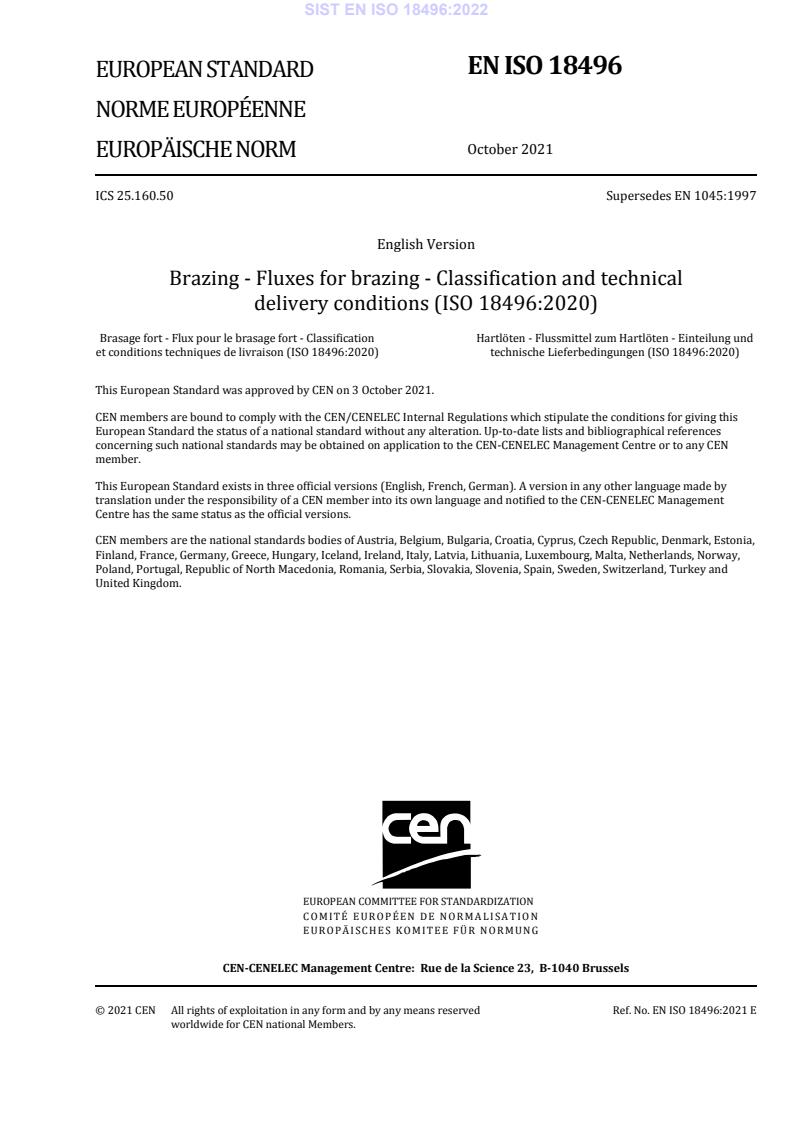
EN ISO 18496
EUROPEAN STANDARD
NORME EUROPÉENNE
October 2021
EUROPÄISCHE NORM
ICS 25.160.50 Supersedes EN 1045:1997
English Version
Brazing - Fluxes for brazing - Classification and technical
delivery conditions (ISO 18496:2020)
Brasage fort - Flux pour le brasage fort - Classification Hartlöten - Flussmittel zum Hartlöten - Einteilung und
et conditions techniques de livraison (ISO 18496:2020) technische Lieferbedingungen (ISO 18496:2020)
This European Standard was approved by CEN on 3 October 2021.
CEN members are bound to comply with the CEN/CENELEC Internal Regulations which stipulate the conditions for giving this
European Standard the status of a national standard without any alteration. Up-to-date lists and bibliographical references
concerning such national standards may be obtained on application to the CEN-CENELEC Management Centre or to any CEN
member.
This European Standard exists in three official versions (English, French, German). A version in any other language made by
translation under the responsibility of a CEN member into its own language and notified to the CEN-CENELEC Management
Centre has the same status as the official versions.
CEN members are the national standards bodies of Austria, Belgium, Bulgaria, Croatia, Cyprus, Czech Republic, Denmark, Estonia,
Finland, France, Germany, Greece, Hungary, Iceland, Ireland, Italy, Latvia, Lithuania, Luxembourg, Malta, Netherlands, Norway,
Poland, Portugal, Republic of North Macedonia, Romania, Serbia, Slovakia, Slovenia, Spain, Sweden, Switzerland, Turkey and
United Kingdom.
EUROPEAN COMMITTEE FOR STANDARDIZATION
COMITÉ EUROPÉEN DE NORMALISATION
EUROPÄISCHES KOMITEE FÜR NORMUNG
CEN-CENELEC Management Centre: Rue de la Science 23, B-1040 Brussels
© 2021 CEN All rights of exploitation in any form and by any means reserved Ref. No. EN ISO 18496:2021 E
worldwide for CEN national Members.
Contents Page
European foreword . 3
European foreword
The text of ISO 18496:2020 has been prepared by Technical Committee ISO/TC 44 "Welding and allied
processes” of the International Organization for Standardization (ISO) and has been taken over as
of which is held by DIN.
This European Standard shall be given the status of a national standard, either by publication of an
identical text or by endorsement, at the latest by April 2022, and conflicting national standards shall be
withdrawn at the latest by April 2022.
Attention is drawn to the possibility that some of the elements of this document may be the subject of
patent rights. CEN shall not be held responsible for identifying any or all such patent rights.
This document supersedes EN 1045:1997.
Any feedback and questions on this document should be directed to the users’ national standards body.
A complete listing of these bodies can be found on the CEN website.
According to the CEN-CENELEC Internal Regulations, the national standards organizations of the
following countries are bound to implement this European Standard: Austria, Belgium, Bulgaria,
Croatia, Cyprus, Czech Republic, Denmark, Estonia, Finland, France, Germany, Greece, Hungary, Iceland,
Ireland, Italy, Latvia, Lithuania, Luxembourg, Malta, Netherlands, Norway, Poland, Portugal, Republic of
North Macedonia, Romania, Serbia, Slovakia, Slovenia, Spain, Sweden, Switzerland, Turkey and the
United Kingdom.
Endorsement notice
The text of ISO 18496:2020 has been approved by CEN as EN ISO 18496:2021 without any modification.
INTERNATIONAL ISO
STANDARD 18496
First edition
2020-09
Brazing — Fluxes for brazing —
Classification and technical delivery
conditions
Brasage fort — Flux pour le brasage fort — Classification et
conditions techniques de livraison
Reference number
ISO 18496:2020(E)
©
ISO 2020
ISO 18496:2020(E)
© ISO 2020
All rights reserved. Unless otherwise specified, or required in the context of its implementation, no part of this publication may
be reproduced or utilized otherwise in any form or by any means, electronic or mechanical, including photocopying, or posting
on the internet or an intranet, without prior written permission. Permission can be requested from either ISO at the address
below or ISO’s member body in the country of the requester.
ISO copyright office
CP 401 • Ch. de Blandonnet 8
CH-1214 Vernier, Geneva
Phone: +41 22 749 01 11
Email: copyright@iso.org
Website: www.iso.org
Published in Switzerland
ii © ISO 2020 – All rights reserved
ISO 18496:2020(E)
Contents Page
Foreword .iv
1 Scope . 1
2 Normative references . 1
3 Terms and definitions . 1
4 Classification . 1
4.1 General . 1
4.2 Fluxes for brazing heavy metals (Class FH) . 1
4.2.1 General. 1
4.2.2 Type FH10 . 1
4.2.3 Type FH11 . 1
4.2.4 Type FH12 . 2
4.2.5 Type FH20 . 2
4.2.6 Type FH21 . 2
4.2.7 Type FH22 . 2
4.2.8 Type FH23 . 2
4.2.9 Type FH30 . 2
4.2.10 Type FH40 . 2
4.3 Fluxes for brazing light metals (Class FL) . . 2
4.3.1 General. 2
4.3.2 Type FL10 . 3
4.3.3 Type FL20 . 3
4.3.4 Type FL30 . 3
5 Designation . 5
6 Technical delivery conditions . 5
6.1 Forms of delivery . 5
6.2 Packaging and marking. 5
7 Health and safety precautions. 5
Annex A (informative) Determination of the effective temperature range .6
Annex B (informative) Technical properties and form of delivery . 9
ISO 18496:2020(E)
Foreword
ISO (the International Organization for Standardization) is a worldwide federation of national standards
bodies (ISO member bodies). The work of preparing International Standards is normally carried out
through ISO technical committees. Each member body interested in a subject for which a technical
committee has been established has the right to be represented on that committee. International
organizations, governmental and non-governmental, in liaison with ISO, also take part in the work.
ISO collaborates closely with the International Electrotechnical Commission (IEC) on all matters of
electrotechnical standardization.
The procedures used to develop this document and those intended for its further maintenance are
described in the ISO/IEC Directives, Part 1. In particular, the different approval criteria needed for the
different types of ISO documents should be noted. This document was drafted in accordance with the
editorial rules of the ISO/IEC Directives, Part 2 (see www .iso .org/ directives).
Attention is drawn to the possibility that some of the elements of this document may be the subject of
patent rights. ISO shall not be held responsible for identifying any or all such patent rights. Details of
any patent rights identified during the development of the document will be in the Introduction and/or
on the ISO list of patent declarations received (see www .iso .org/ patents).
Any trade name used in this document is information given for the convenience of users and does not
constitute an endorsement.
For an explanation of the voluntary nature of standards, the meaning of ISO specific terms and
expressions related to conformity assessment, as well as information about ISO's adherence to the
World Trade Organization (WTO) principles in the Technical Barriers to Trade (TBT), see www .iso .org/
iso/ foreword .html.
This document was prepared by Technical Committee ISO/TC 44, Welding and allied processes,
Subcommittee SC 13, Brazing materials and processes.
Any feedback or questions on this document should be directed to the user’s national standards body. A
complete listing of these bodies can be found at www .iso .org/ members .html.
Official interpretations of ISO/TC 44 documents, where they exist, are available from this page: https://
committee .iso .org/ sites/ tc44/ home/ interpretati
...
Questions, Comments and Discussion
Ask us and Technical Secretary will try to provide an answer. You can facilitate discussion about the standard in here.
Loading comments...