

EN 14820:2004
(Main)Single-use containers for human venous blood specimen collection
- Abstract
This document specifies requirements and test methods for single-use receptacles, intended by their manufacturer, for the collection of venous blood specimens derived from the human body, for the purposes of in vitro diagnostic examination. This document also applies to receptacles containing media for blood culture.
This document does not specify requirements for capillary blood specimen receptacles or arterial blood specimen receptacles. This document does not specify requirements and test methods for single-use receptacles intended for the collection of specimens, other than blood.
- Status
- Withdrawn
- Publication Date
- 31-Aug-2004
- Withdrawal Date
- 06-Oct-2026
- Technical Committee
- CEN/TC 140 - In vitro diagnostic systems
- Drafting Committee
- CEN/TC 140 - In vitro diagnostic systems
- Current Stage
- 9960 - Withdrawal effective - Withdrawal
- Start Date
- 06-Sep-2017
- Completion Date
- 07-Oct-2026
- Directive
- 98/79/EC - In vitro diagnostic medical devicesOJ Ref: C, C 103 OJ Date: 28-Apr-2005



Relations
- Replaced By
EN ISO 6710:2017 - Single-use containers for human venous blood specimen collection (ISO 6710:2017) - Effective Date
- 13-Sep-2017
- Effective Date
- 28-Jan-2026
- Effective Date
- 28-Jan-2026
Get Certified
Connect with accredited certification bodies for this standard

BSI Group
BSI (British Standards Institution) is the business standards company that helps organizations make excellence a habit.

TÜV Rheinland
TÜV Rheinland is a leading international provider of technical services.

TÜV SÜD
TÜV SÜD is a trusted partner of choice for safety, security and sustainability solutions.
Sponsored listings
Frequently Asked Questions
EN 14820:2004 is a standard published by the European Committee for Standardization (CEN). Its full title is "Single-use containers for human venous blood specimen collection". This standard covers: This document specifies requirements and test methods for single-use receptacles, intended by their manufacturer, for the collection of venous blood specimens derived from the human body, for the purposes of in vitro diagnostic examination. This document also applies to receptacles containing media for blood culture. This document does not specify requirements for capillary blood specimen receptacles or arterial blood specimen receptacles. This document does not specify requirements and test methods for single-use receptacles intended for the collection of specimens, other than blood.
This document specifies requirements and test methods for single-use receptacles, intended by their manufacturer, for the collection of venous blood specimens derived from the human body, for the purposes of in vitro diagnostic examination. This document also applies to receptacles containing media for blood culture. This document does not specify requirements for capillary blood specimen receptacles or arterial blood specimen receptacles. This document does not specify requirements and test methods for single-use receptacles intended for the collection of specimens, other than blood.
EN 14820:2004 is classified under the following ICS (International Classification for Standards) categories: 11.040.20 - Transfusion, infusion and injection equipment. The ICS classification helps identify the subject area and facilitates finding related standards.
EN 14820:2004 has the following relationships with other standards: It is inter standard links to EN ISO 6710:2017, EN ISO 80369-7:2021, EN ISO 3696:1995. Understanding these relationships helps ensure you are using the most current and applicable version of the standard.
EN 14820:2004 is associated with the following European legislation: EU Directives/Regulations: 98/79/EC; Standardization Mandates: M/252. When a standard is cited in the Official Journal of the European Union, products manufactured in conformity with it benefit from a presumption of conformity with the essential requirements of the corresponding EU directive or regulation.
EN 14820:2004 is available in PDF format for immediate download after purchase. The document can be added to your cart and obtained through the secure checkout process. Digital delivery ensures instant access to the complete standard document.
Standards Content (Sample)
2003-01.Slovenski inštitut za standardizacijo. Razmnoževanje celote ali delov tega standarda ni dovoljeno.Single-use containers for human venous blood specimen collectionKontejnerji (epruvete s podtlakom) za zbiranje venske krvi ob enkratni uporabiRécipients a usage unique pour prélevements de sang veineux humainGefäße zur einmaligen Verwendung für die venöse Blutentnahme beim MenschenTa slovenski standard je istoveten z:EN 14820:2004SIST EN 14820:2005en11.040.20Transfuzijska, infuzijska in injekcijska opremaTransfusion, infusion and injection equipmentICS:SLOVENSKI
STANDARDSIST EN 14820:200501-marec-2005
EUROPEAN STANDARDNORME EUROPÉENNEEUROPÄISCHE NORMEN 14820September 2004ICS 11.040.20 English versionSingle-use containers for human venous blood specimencollectionRécipients à usage unique pour prélèvements de sangveineux humainGefäße zur einmaligen Verwendung für die venöseBlutentnahme beim MenschenThis European Standard was approved by CEN on 27 May 2004.CEN members are bound to comply with the CEN/CENELEC Internal Regulations which stipulate the conditions for giving this EuropeanStandard the status of a national standard without any alteration. Up-to-date lists and bibliographical references concerning such nationalstandards may be obtained on application to the Central Secretariat or to any CEN member.This European Standard exists in three official versions (English, French, German). A version in any other language made by translationunder the responsibility of a CEN member into its own language and notified to the Central Secretariat has the same status as the officialversions.CEN members are the national standards bodies of Austria, Belgium, Cyprus, Czech Republic, Denmark, Estonia, Finland, France,Germany, Greece, Hungary, Iceland, Ireland, Italy, Latvia, Lithuania, Luxembourg, Malta, Netherlands, Norway, Poland, Portugal, Slovakia,Slovenia, Spain, Sweden, Switzerland and United Kingdom.EUROPEAN COMMITTEE FOR STANDARDIZATIONCOMITÉ EUROPÉEN DE NORMALISATIONEUROPÄISCHES KOMITEE FÜR NORMUNGManagement Centre: rue de Stassart, 36
B-1050 Brussels© 2004 CENAll rights of exploitation in any form and by any means reservedworldwide for CEN national Members.Ref. No. EN 14820:2004: E
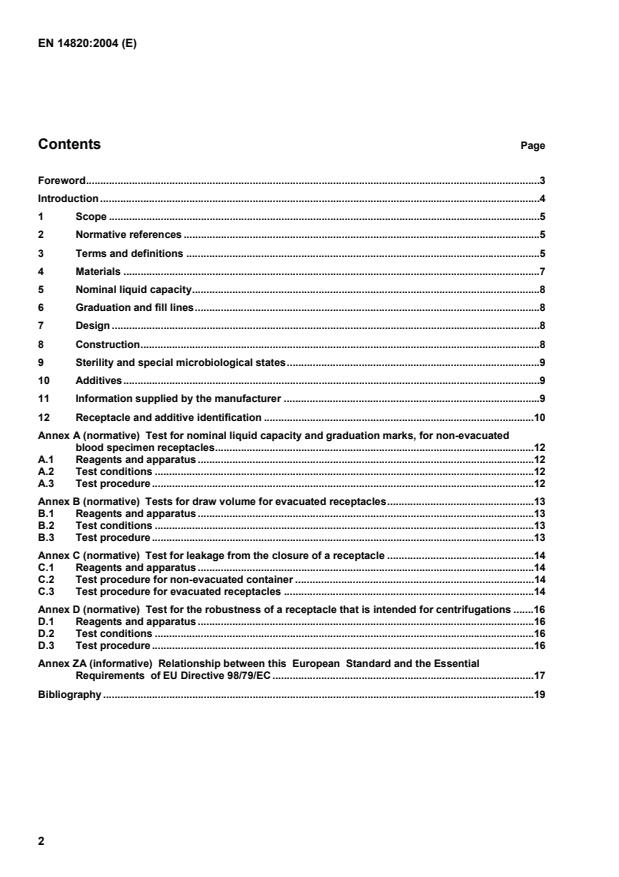
Test for nominal liquid capacity and graduation marks, for non-evacuated blood specimen receptacles.12 A.1 Reagents and apparatus.12 A.2 Test conditions.12 A.3 Test procedure.12 Annex B (normative)
Tests for draw volume for evacuated receptacles.13 B.1 Reagents and apparatus.13 B.2 Test conditions.13 B.3 Test procedure.13 Annex C (normative)
Test for leakage from the closure of a receptacle.14 C.1 Reagents and apparatus.14 C.2 Test procedure for non-evacuated container.14 C.3 Test procedure for evacuated receptacles.14 Annex D (normative)
Test for the robustness of a receptacle that is intended for centrifugations.16 D.1 Reagents and apparatus.16 D.2 Test conditions.16 D.3 Test procedure.16 Annex ZA (informative)
Relationship between this
European
Standard and the Essential Requirements
of EU Directive 98/79/EC.17 Bibliography.19
3.11 graduation mark mark on a container, or its label, to enable an estimation to be made of the volume of the specimen 3.12 gravimetric analysis method of determining the volume of a liquid by weighing and correcting for the mass density of the liquid NOTE For the purposes of this document 1,000 ml of water is considered to have a mass equal to 1,000 g. 3.13 maximum fill line mark on a container or its label, to indicate the maximum volume of specimen permitted to ensure that the in vitro diagnostic test for which the specimen is intended, will give accurate results 3.14 minimum fill line mark on a container, or its label, to indicate the minimum volume of specimen required to ensure that the in vitro diagnostic test, for which the specimen is intended, will give accurate results 3.15 needle and holder assembly device that is intended to be attached to an evacuated receptacle to enable venous puncture and subsequent blood collection to be performed 3.16 nominal liquid capacity volume of specimen with which the receptacle is intended to be filled plus the volume of any additive NOTE This volume is stated on the label and/or instructions for use. 3.17 nominal fill line mark on a container, or its label, to indicate the nominal liquid capacity of a receptacle 3.18 primary pack smallest pack of receptacles
4 Materials 4.1 If a receptacle is intended to contain a specimen for a specific examination, where the material of the closure, or container, or the interior coating, or the additive, or accessory, if present, may affect the final results of the examination, then the maximum level of the contamination with that substance, and the analytical method employed, shall be stated by the manufacturer in accompanying literature, or on the label, or packaging (see also 11.3). Validation of the suitability of material with regard to a receptacle's specifically intended use is the responsibility of the manufacturer. NOTE 1 This document does not specify a validation procedure for material suitability. NOTE 2 For certain infrequently performed examinations, limits of interference may not have been determined and the user is recommended to consult the manufacturer. NOTE 3 A container should be manufactured from a material which allows a clear view of its contents when subjected to visual inspection (see 3.22) unless exposure to ultra-violet light, or visible light would degrade the contents. NOTE 4 If the container is not made of material that allows a clear view of the contents, the closure may be removed, to facilitate the examination of the contents. 4.2 When subjected to visual inspection the material of the receptacle shall be free from foreign matter. 4.3 Receptacles containing a microbe-supporting additive shall have been subjected to a validated process to eliminate microbial contamination from the additive and the receptacle interior. Validation of the process is the responsibility of the manufacturer.
NOTE For the validation and routine control of sterilization procedures see EN 550, EN 552 and EN 554.
5.3 Where free space is intended to facilitate mixing there shall be sufficient free space to allow mixing by mechanical or manual means. 5.4 The manufacturer shall validate that adequate mixing of the blood specimen, with any additive present, can be achieved. NOTE This document does not specify a validation procedure for adequate mixing of the blood specimen. 6 Graduation and fill lines Evacuated receptacles that have a fill line on the container, or container label, shall fill such that the meniscus of the liquid does not exceed or fall below the position of the line by more than 10% when tested in accordance with the method specified in Annex B. When non-evacuated receptacles that have graduation marks are tested in accordance with methods specified in Annex A, the volume of the water shall be between 90% and 110% of the indicated volume. NOTE see Annex A, A.3.6 7 Design 7.1 The closure shall not become loose when tested for leakage in accordance with the method specified in Annex C. The receptacle shall pass the test for leakage if no fluorescence is observed. 7.2 Where a closure is intended to be removed, to gain access to the contents of the receptacle, it shall be designed, as far as is reasonable and practical to do, so that it can be removed by gripping with the fingers, and/or by mechanical means, without that part of the closure which may become contaminated by contact with the specimen, being touched by the fingers, or the mechanical removal device. NOTE It is desirable that specimen receptacles should be designed to avoid spontaneous discharge of the contents, when being opened. This document does not specify a test procedure for this because it has not been possible to devise an objective and reproducible test. 7.3 When the receptacle is tested for leakage in accordance with the method specified in Annex C, no fluorescence shall be detectable in the water in which the receptacle has been immersed. 8 Construction 8.1 Receptacles shall withstand 4 cycles of removal and replacement of the closure in accordance with
...