


EN 13523-29:2024
(Main)Coil coated metals - Test methods - Part 29: Resistance to environmental soiling (Dirt pick-up and striping)
Coil coated metals - Test methods - Part 29: Resistance to environmental soiling (Dirt pick-up and striping)
This part of the EN 13523 series specifies a procedure for the comparative evaluation of resistance to soiling of an organic coating on a metallic substrate (coil coating) in an outdoor exposure environment, particularly the soiling defect known as "Tiger stripes".
Bandbeschichtete Metalle - Prüfverfahren - Teil 29: Beständigkeit gegen Verschmutzung (Schmutzaufnahme und Streifenbildung)
Tôles prélaquées - Méthodes d'essai - Partie 29 : Résistance à la pollution environnementale (salissures)
Le présent document spécifie un mode opératoire à appliquer pour déterminer, par comparaison, la résistance à la pollution d’un revêtement organique appliqué sur un subjectile métallique (prélaquage en bandes continues) dans un environnement d’exposition à l’extérieur, en particulier la salissure appelé « zébrures ».
En plus des zébrures, d’autres types de rétention de salissure peuvent être observés.
Prevlečene kovine, ki se navijajo - Preskusne metode - 29. del: Odpornost proti onesnaženju iz okolja (nabiranje nesnage in nastanek prog)
Ta del skupine standardov EN 13523 določa postopek za primerjalno vrednotenje odpornosti organske prevleke na kovinski podlagi (prevlečene kovine, ki se navijajo) proti onesnaženju na prostem, zlasti proti učinku onesnaženja, ki se imenuje »tigrasti vzorec«.
General Information
- Status
- Published
- Publication Date
- 23-Apr-2024
- Technical Committee
- CEN/TC 139 - Paints and varnishes
- Drafting Committee
- CEN/TC 139/WG 9 - Testing of coil coated metals
- Current Stage
- 6060 - Definitive text made available (DAV) - Publishing
- Start Date
- 24-Apr-2024
- Due Date
- 06-Aug-2025
- Completion Date
- 24-Apr-2024
Relations
- Effective Date
- 03-May-2023
Overview
EN 13523-29:2024 - Coil coated metals: Test methods - Part 29: Resistance to environmental soiling (Dirt pick-up and striping) is a CEN standard that defines a comparative outdoor exposure procedure to evaluate how organic coatings on metallic substrates resist environmental soiling, in particular the soiling defect known as “tiger stripes”. The standard replaces EN 13523-29:2017 and is intended for coil coated metals used in architectural and industrial applications.
Key topics and requirements
- Test principle: Comparative outdoor exposure of test panels alongside two reference panels (one known good, one known poor) to concentrate atmospheric dirt and rainwater into rivulets that produce dirt pick-up and striping.
- Exposure rack: Uses the EN 13523-19 exposure rack area modified with a UV-stable polymeric collector (e.g., polycarbonate) set at 10°–12°. The collector is machined with grooves 3 mm wide × 3 mm deep at 3 mm spacing to channel runoff.
- Sample preparation: Panels must be flat, uncontaminated and sized 100 mm × (200–400 mm); coil samples should be cut with the longest dimension in the rolling direction.
- Test duration: Typically 3 months, with a maximum of 6 months, run continuously to avoid confounding weathering effects; start date should be recorded to reduce seasonal bias.
- Evaluation and ranking: Visual comparison and ranking relative to reference panels (better/same/in-between/worse); optional instrumental measurements of gloss (EN 13523-2) and colour (EN 13523-3) at specified measuring points (triplicate readings).
- Cleaning (wash) test: Left half of panel may be washed with water containing 0.5% non‑reactive detergent (pH 6–7) using a non‑abrasive cloth; washed vs unwashed areas are re-evaluated.
- Documentation: Photographic record and a test report including product identification, rack location, duration, results, deviations and anomalies.
Applications and users
EN 13523-29:2024 is used by:
- Coil coater manufacturers and quality control labs to assess resistance to environmental soiling and susceptibility to tiger stripes.
- Specifiers, architects and façade engineers when selecting coated metal products for outdoor exposure.
- Product development teams comparing coating formulations, topcoats or pretreatments.
- Independent test laboratories performing standardized comparative exposure tests.
This standard helps stakeholders validate product performance in service-like conditions, inform procurement specifications, and reduce field failures caused by dirt pick-up and striping.
Related standards
- EN 13523-0 (General introduction)
- EN 13523-19 (Panel design and atmospheric exposure)
- EN 13523-2 (Gloss) and EN 13523-3 (Colour difference)
- EN 1396; EN 10169 (related product specifications for coated aluminium and steel)
Keywords: EN 13523-29:2024, coil coated metals, resistance to environmental soiling, dirt pick-up, striping, tiger stripes, exposure test.
Frequently Asked Questions
EN 13523-29:2024 is a standard published by the European Committee for Standardization (CEN). Its full title is "Coil coated metals - Test methods - Part 29: Resistance to environmental soiling (Dirt pick-up and striping)". This standard covers: This part of the EN 13523 series specifies a procedure for the comparative evaluation of resistance to soiling of an organic coating on a metallic substrate (coil coating) in an outdoor exposure environment, particularly the soiling defect known as "Tiger stripes".
This part of the EN 13523 series specifies a procedure for the comparative evaluation of resistance to soiling of an organic coating on a metallic substrate (coil coating) in an outdoor exposure environment, particularly the soiling defect known as "Tiger stripes".
EN 13523-29:2024 is classified under the following ICS (International Classification for Standards) categories: 25.220.60 - Organic coatings. The ICS classification helps identify the subject area and facilitates finding related standards.
EN 13523-29:2024 has the following relationships with other standards: It is inter standard links to EN 13523-29:2017. Understanding these relationships helps ensure you are using the most current and applicable version of the standard.
You can purchase EN 13523-29:2024 directly from iTeh Standards. The document is available in PDF format and is delivered instantly after payment. Add the standard to your cart and complete the secure checkout process. iTeh Standards is an authorized distributor of CEN standards.
Standards Content (Sample)
SLOVENSKI STANDARD
01-september-2024
Nadomešča:
SIST EN 13523-29:2017
Prevlečene kovine, ki se navijajo - Preskusne metode - 29. del: Odpornost proti
onesnaženju iz okolja (nabiranje nesnage in nastanek prog)
Coil coated metals - Test methods - Part 29: Resistance to environmental soiling (Dirt
pick-up and striping)
Bandbeschichtete Metalle - Prüfverfahren - Teil 29: Beständigkeit gegen Verschmutzung
(Schmutzaufnahme und Streifenbildung)
Tôles prélaquées - Méthodes d'essai - Partie 29 : Résistance à la pollution
environnementale (salissures)
Ta slovenski standard je istoveten z: EN 13523-29:2024
ICS:
13.020.40 Onesnaževanje, nadzor nad Pollution, pollution control
onesnaževanjem in and conservation
ohranjanje
25.220.60 Organske prevleke Organic coatings
2003-01.Slovenski inštitut za standardizacijo. Razmnoževanje celote ali delov tega standarda ni dovoljeno.
EN 13523-29
EUROPEAN STANDARD
NORME EUROPÉENNE
April 2024
EUROPÄISCHE NORM
ICS 25.220.60 Supersedes EN 13523-29:2017
English Version
Coil coated metals - Test methods - Part 29: Resistance to
environmental soiling (Dirt pick-up and striping)
Tôles prélaquées - Méthodes d'essai - Partie 29 : Bandbeschichtete Metalle - Prüfverfahren - Teil 29:
Résistance à la pollution environnementale (salissures) Beständigkeit gegen Verschmutzung
(Schmutzaufnahme und Streifenbildung)
This European Standard was approved by CEN on 1 January 2024.
CEN members are bound to comply with the CEN/CENELEC Internal Regulations which stipulate the conditions for giving this
European Standard the status of a national standard without any alteration. Up-to-date lists and bibliographical references
concerning such national standards may be obtained on application to the CEN-CENELEC Management Centre or to any CEN
member.
This European Standard exists in three official versions (English, French, German). A version in any other language made by
translation under the responsibility of a CEN member into its own language and notified to the CEN-CENELEC Management
Centre has the same status as the official versions.
CEN members are the national standards bodies of Austria, Belgium, Bulgaria, Croatia, Cyprus, Czech Republic, Denmark, Estonia,
Finland, France, Germany, Greece, Hungary, Iceland, Ireland, Italy, Latvia, Lithuania, Luxembourg, Malta, Netherlands, Norway,
Poland, Portugal, Republic of North Macedonia, Romania, Serbia, Slovakia, Slovenia, Spain, Sweden, Switzerland, Türkiye and
United Kingdom.
EUROPEAN COMMITTEE FOR STANDARDIZATION
COMITÉ EUROPÉEN DE NORMALISATION
EUROPÄISCHES KOMITEE FÜR NORMUNG
CEN-CENELEC Management Centre: Rue de la Science 23, B-1040 Brussels
© 2024 CEN All rights of exploitation in any form and by any means reserved Ref. No. EN 13523-29:2024 E
worldwide for CEN national Members.
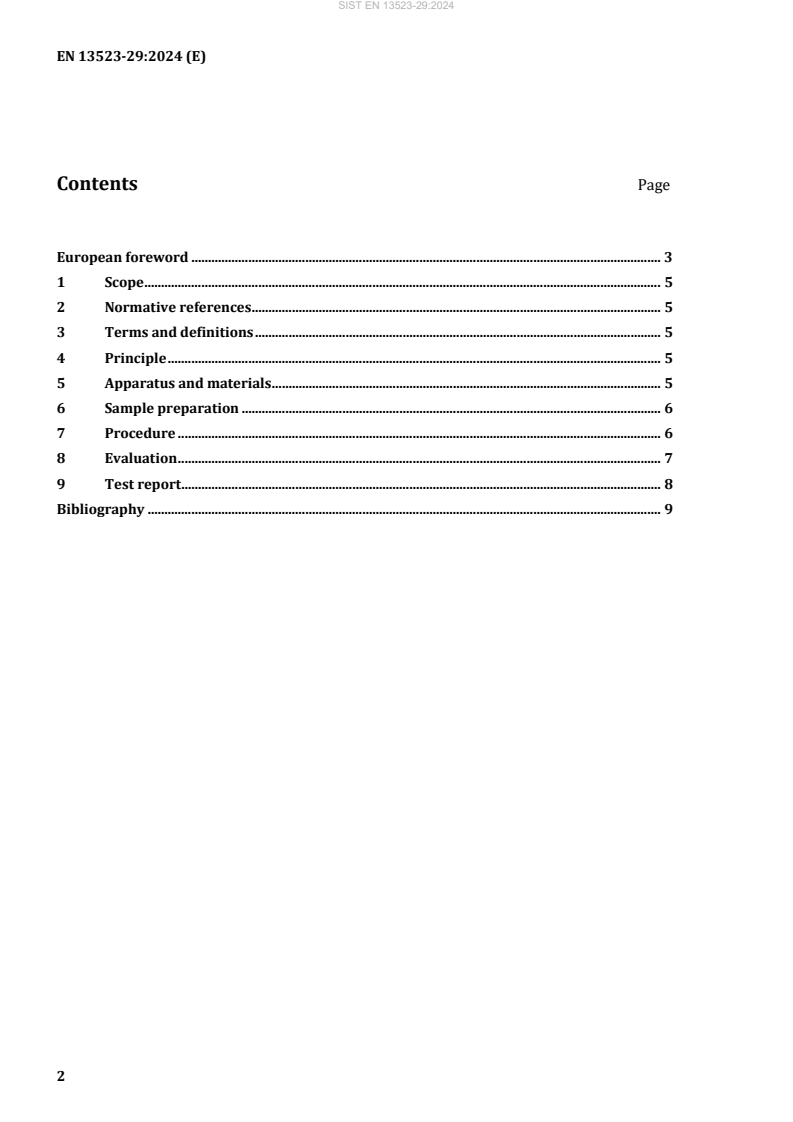
Contents Page
European foreword . 3
1 Scope . 5
2 Normative references . 5
3 Terms and definitions . 5
4 Principle . 5
5 Apparatus and materials . 5
6 Sample preparation . 6
7 Procedure . 6
8 Evaluation . 7
9 Test report . 8
Bibliography . 9
European foreword
This document (EN 13523-29:2024) has been prepared by Technical Committee CEN/TC 139 “Paints and
varnishes”, the secretariat of which is held by DIN.
This European Standard shall be given the status of a national standard, either by publication of an
identical text or by endorsement, at the latest by October 2024, and conflicting national standards shall
be withdrawn at the latest by October 2024.
Attention is drawn to the possibility that some of the elements of this document may be the subject of
patent rights. CEN shall not be held responsible for identifying any or all such patent rights.
This document supersedes EN 13523-29:2017.
29:2017:
a) the text has been editorially revised and the normative references have been updated.
The EN 13523 series, Coil coated metals — Test methods, consists of the following parts:
— Part 0: General introduction
— Part 1: Film thickness
— Part 2: Gloss
— Part 3: Colour difference and metamerism — Instrumental comparison
— Part 4: Pencil hardness
— Part 5: Resistance to rapid deformation (impact test)
— Part 6: Adhesion after indentation (cupping test)
— Part 7: Resistance to cracking on bending (T-bend test)
— Part 8: Resistance to salt spray (fog)
— Part 9: Resistance to water immersion
— Part 10: Resistance to fluorescent UV radiation and water condensation
— Part 11: Resistance to solvents (rubbing test)
— Part 12: Resistance to scratching
— Part 13: Resistance to accelerated ageing by the use of heat
— Part 14: Chalking (Helmen method)
— Part 16: Resistance to abrasion
— Part 17: Adhesion of strippable films
— Part 18: Resistance to staining
— Part 19: Panel design and method of atmospheric exposure testing
— Part 20: Foam adhesion
— Part 21: Evaluation of outdoor exposed panels
— Part 22: Colour difference — Visual comparison
— Part 23: Resistance to humid atmospheres containing sulfur dioxide
— Part 24: Resistance to blocking and pressure marking
— Part 25: Resistance to humidity
— Part 26: Resistance to condensation of water
— Part 27: Resistance to humid poultice (Cataplasm test)
— Part 29: Resistance to environmental soiling (Dirt pick-up and striping)
Any feedback and questions on this document should be directed to the users’ national standards body.
A complete li
...
Questions, Comments and Discussion
Ask us and Technical Secretary will try to provide an answer. You can facilitate discussion about the standard in here.
Loading comments...