


EN 14770:2023
(Main)Bitumen and bituminous binders - Determination of complex shear modulus and phase angle - Dynamic Shear Rheometer (DSR)
Bitumen and bituminous binders - Determination of complex shear modulus and phase angle - Dynamic Shear Rheometer (DSR)
This document specifies a general method of using a dynamic shear rheometer (DSR) for measuring the rheological properties of bituminous binders. The procedure involves determining the complex shear modulus and phase angle of binders over a range of test frequencies and test temperatures when tested in oscillatory shear.
From the test, the complex shear modulus, |G*|, and its phase angle, δ, at a given temperature and frequency are calculated, as well as the components G' and G" of the complex shear modulus.
This method is applicable to un-aged, aged, stabilized and recovered bituminous binders. The test procedure in accordance with this document is not applicable for bituminous binders with particles larger than 250 μm (e.g. filler material, granulated rubber).
WARNING - The use of this document can involve hazardous materials, operations and equipment. This document does not purport to address all of the safety problems associated with its use. It is the responsibility of the user of this document to establish appropriate safety and health practices and to determine the applicability of regulatory limitations prior to use.
Bitumen und bitumenhaltige Bindemittel - Bestimmung des komplexen Schermoduls und des Phasenwinkels - Dynamisches Scherrheometer (DSR)
Dieses Dokument legt ein allgemeines Verfahren fest, bei dem ein dynamisches Scherrheometer (DSR) zur Anwendung kommt, mit dem die rheologischen Eigenschaften von bitumenhaltigen Bindemitteln gemessen werden können. Die Durchführung schließt die Bestimmung des komplexen Schermoduls und des Phasenwinkels von Bindemitteln über einen Bereich von Prüffrequenzen und Prüftemperaturen bei der Prüfung im Oszillations-Modus ein.
Aus der Prüfung werden sowohl der komplexe Schermodul, |G*|, und der zugehörige Phasenwinkel, δ, für eine gegebene Temperatur und Frequenz als auch die Komponenten G' und G'' des komplexen Schermoduls berechnet.
Dieses Verfahren ist anwendbar für nicht gealterte, gealterte, stabilisierte und rückgewonnene bitumenhaltige Bindemittel. Das Prüfverfahren nach diesem Dokument ist nicht anwendbar für bitumenhaltige Bindemittel mit Partikeln größer als 250 μm (z. B. Füllermaterial, Gummigranulat).
WARNUNG - Die Anwendung dieses Dokuments kann den Umgang mit gefährlichen Substanzen und Ausrüstungsteilen und die Ausführung gefährlicher Arbeitsgänge einschließen. Dieses Dokument erhebt nicht den Anspruch, alle mit seiner Anwendung verbundenen Sicherheitsprobleme anzusprechen. Es liegt in der Verantwortung des Anwenders dieses Dokuments, geeignete Verhaltensregeln für den Arbeits- und Gesundheitsschutz festzulegen und vor der Anwendung zu klären, ob einschränkende Vorschriften zu berücksichtigen sind.
Bitumes et liants bitumineux - Détermination du module complexe en cisaillement et de l'angle de phase à l'aide d'un rhéomètre à cisaillement dynamique (DSR)
Ce document spécifie une méthode générale faisant appel à l’utilisation d’un rhéomètre à cisaillement dynamique (DSR) pour mesurer les caractéristiques rhéologiques de liants bitumineux. La procédure repose sur la détermination du module complexe en cisaillement et de l’angle de phase des liants sur une plage de fréquences et de températures d’essai, lorsqu’ils sont testés en cisaillement oscillatoire.
À partir de cet essai, il est possible de déterminer le module complexe en cisaillement |G*| et son angle de phase , à une température et à une fréquence données, ainsi que les composantes G’ et G" du module complexe en cisaillement.
Cette méthode est applicable aux liants bitumineux neufs, vieillis, stabilisés et récupérés. La méthode d'essai décrite dans ce document n'est pas applicable aux liants bitumineux contenant des particules de taille supérieure à 250 μm (par exemple : fines, grains de caoutchouc).
AVERTISSEMENT - L'utilisation de ce document peut impliquer l'utilisation de produits, d'opérations et d'équipements à caractère dangereux. Le présent document n'est pas censé aborder tous les problèmes de sécurité concernés par son usage. Il incombe à son utilisateur d'établir des règles d'hygiène et de sécurité appropriées et de déterminer l'applicabilité des restrictions réglementaires avant utilisation.
Bitumen in bitumenska veziva - Ugotavljanje kompleksnega strižnega modula in faznega kota - Dinamični strižni reometer (DSR)
Ta dokument določa splošno metodo, pri kateri se uporablja dinamični strižni reometer (DSR) za ugotavljanje reoloških lastnosti bitumenskih veziv. Postopek zajema ugotavljanje kompleksnega strižnega modula in faznega kota veziv za različne frekvence preskušanja in temperature pri preskušanju pod oscilatornimi strižnimi pogoji.
Na podlagi preskusa je mogoče izračunati kompleksni strižni modul (IG*I) in njegov fazni kot (δ) pri dani temperaturi in frekvenci ter komponente G', G'’ kompleksnega strižnega modula.
Ta metoda se uporablja za nestarana, starana in ponovno pridobljena bitumenska veziva.
OPOZORILO: Pri uporabi tega dokumenta so lahko prisotni nevarni materiali, postopki in oprema. Ta dokument ne obravnava vseh varnostnih težav, ki se navezujejo na njegovo uporabo. Za vzpostavitev ustreznih varnostnih in zdravstvenih praks ter za določitev uporabnosti regulativnih omejitev pred uporabo je odgovoren uporabnik tega dokumenta.
General Information
- Status
- Published
- Publication Date
- 04-Jul-2023
- Technical Committee
- CEN/TC 336 - Bituminous binders
- Drafting Committee
- CEN/TC 336/WG 1 - Bituminous binders for paving
- Current Stage
- 6060 - Definitive text made available (DAV) - Publishing
- Start Date
- 05-Jul-2023
- Due Date
- 10-Jun-2023
- Completion Date
- 05-Jul-2023
Relations
- Effective Date
- 18-Jan-2023
- Effective Date
- 28-Jan-2026
- Referred By
EN 16659:2015 - Bitumen and Bituminous Binders - Multiple Stress Creep and Recovery Test (MSCRT) - Effective Date
- 28-Jan-2026
- Effective Date
- 28-Jan-2026
- Effective Date
- 28-Jan-2026
Overview
EN 14770:2023 - Bitumen and bituminous binders: Determination of complex shear modulus and phase angle using a Dynamic Shear Rheometer (DSR) - specifies a general, harmonized method for measuring the rheological properties of bituminous binders in oscillatory shear. The standard defines how to determine the complex shear modulus (|G*|), phase angle (δ), and the elastic and viscous components (G' and G'') across specified test frequencies and temperatures. It applies to un‑aged, aged, stabilized and recovered binders, with a particle‑size restriction: not applicable for binders containing particles larger than 250 μm.
Key topics and technical requirements
- Measured parameters: complex shear modulus (|G*|), phase angle (δ), storage modulus (G'), loss modulus (G'').
- Test principle: oscillatory shear in the linear viscoelastic (LVE) range; either shear‑strain‑controlled or shear‑stress‑controlled modes.
- Apparatus requirements: Dynamic Shear Rheometer (DSR) with temperature control (nominal 5 °C to 85 °C, ±0.1 °C accuracy) and parallel‑plate geometries. Instrument capability examples include |G*| range 1 kPa–10 MPa and δ range 0°–90°. Typical plate diameters referenced: 25 mm, 8 mm, and 4 mm with specified gap settings.
- Specimen handling: guidance on heating, moulds (silicone), specimen manufacturing and storage to ensure reproducible filling and contact with plates.
- Test procedure elements: specimen placement, zero‑gap and gap compensation, temperature/frequency selection, equilibration time, and LVE range determination.
- Data presentation: isotherms, isochrones and calculation of parameters including TX and δTX (new in this edition).
- Precision & reporting: updated precision data and use of repeatability (r) and reproducibility (R) metrics; required test report content specified.
- Limitations & safety: not suitable for binders with large particles (>250 μm); standard includes a safety warning - users must ensure appropriate health and regulatory practices.
Applications and users
Who uses EN 14770:2023:
- Materials and pavement engineers assessing binder performance for asphalt mix design and specification.
- Quality control laboratories in bitumen production and asphalt plants for batch verification and acceptance testing.
- Research institutions and universities studying rheology, aging, modification and polymer‑modified bitumens.
- Regulatory bodies and specification authors requiring standardized rheological test data.
Practical uses:
- Characterizing temperature‑ and frequency‑dependent stiffness and viscoelastic balance of binders.
- Comparing un‑aged vs aged binder properties for durability studies.
- Evaluating effects of modifiers (polymers, additives) on binder rheology.
- Supporting pavement performance prediction and performance‑based specifications.
Related standards (referenced)
- EN 12594 (Preparation of test samples) - normative reference in EN 14770:2023.
- Additional bibliography and related documents noted in the standard: EN 12607‑1, EN 14023, EN 14769 and EN 1427 (see the standard for details).
For implementation, consult the full EN 14770:2023 text and follow laboratory safety and instrument manufacturer guidance when performing DSR testing.

Get Certified
Connect with accredited certification bodies for this standard

ABS Quality Evaluations Inc.
American Bureau of Shipping quality certification.

Element Materials Technology
Materials testing and product certification.

ICC Evaluation Service
Building products evaluation and certification.
Sponsored listings
Frequently Asked Questions
EN 14770:2023 is a standard published by the European Committee for Standardization (CEN). Its full title is "Bitumen and bituminous binders - Determination of complex shear modulus and phase angle - Dynamic Shear Rheometer (DSR)". This standard covers: This document specifies a general method of using a dynamic shear rheometer (DSR) for measuring the rheological properties of bituminous binders. The procedure involves determining the complex shear modulus and phase angle of binders over a range of test frequencies and test temperatures when tested in oscillatory shear. From the test, the complex shear modulus, |G*|, and its phase angle, δ, at a given temperature and frequency are calculated, as well as the components G' and G" of the complex shear modulus. This method is applicable to un-aged, aged, stabilized and recovered bituminous binders. The test procedure in accordance with this document is not applicable for bituminous binders with particles larger than 250 μm (e.g. filler material, granulated rubber). WARNING - The use of this document can involve hazardous materials, operations and equipment. This document does not purport to address all of the safety problems associated with its use. It is the responsibility of the user of this document to establish appropriate safety and health practices and to determine the applicability of regulatory limitations prior to use.
This document specifies a general method of using a dynamic shear rheometer (DSR) for measuring the rheological properties of bituminous binders. The procedure involves determining the complex shear modulus and phase angle of binders over a range of test frequencies and test temperatures when tested in oscillatory shear. From the test, the complex shear modulus, |G*|, and its phase angle, δ, at a given temperature and frequency are calculated, as well as the components G' and G" of the complex shear modulus. This method is applicable to un-aged, aged, stabilized and recovered bituminous binders. The test procedure in accordance with this document is not applicable for bituminous binders with particles larger than 250 μm (e.g. filler material, granulated rubber). WARNING - The use of this document can involve hazardous materials, operations and equipment. This document does not purport to address all of the safety problems associated with its use. It is the responsibility of the user of this document to establish appropriate safety and health practices and to determine the applicability of regulatory limitations prior to use.
EN 14770:2023 is classified under the following ICS (International Classification for Standards) categories: 75.140 - Waxes, bituminous materials and other petroleum products; 91.100.50 - Binders. Sealing materials. The ICS classification helps identify the subject area and facilitates finding related standards.
EN 14770:2023 has the following relationships with other standards: It is inter standard links to EN 14770:2012, EN 12594:2024, EN 16659:2015, EN 17643:2022, EN 16126:2012. Understanding these relationships helps ensure you are using the most current and applicable version of the standard.
EN 14770:2023 is available in PDF format for immediate download after purchase. The document can be added to your cart and obtained through the secure checkout process. Digital delivery ensures instant access to the complete standard document.
Standards Content (Sample)
SLOVENSKI STANDARD
01-november-2023
Nadomešča:
SIST EN 14770:2012
Bitumen in bitumenska veziva - Ugotavljanje kompleksnega strižnega modula in
faznega kota - Dinamični strižni reometer (DSR)
Bitumen and bituminous binders - Determination of complex shear modulus and phase
angle - Dynamic Shear Rheometer (DSR)
Bitumen und bitumenhaltige Bindemittel - Bestimmung des komplexen Schermoduls und
des Phasenwinkels - Dynamisches Scherrheometer (DSR)
Bitumes et liants bitumineux - Détermination du module complexe en cisaillement et de
l'angle de phase à l'aide d'un rhéomètre à cisaillement dynamique (DSR)
Ta slovenski standard je istoveten z: EN 14770:2023
ICS:
75.140 Voski, bitumni in drugi naftni Waxes, bituminous materials
proizvodi and other petroleum products
91.100.50 Veziva. Tesnilni materiali Binders. Sealing materials
2003-01.Slovenski inštitut za standardizacijo. Razmnoževanje celote ali delov tega standarda ni dovoljeno.
EN 14770
EUROPEAN STANDARD
NORME EUROPÉENNE
July 2023
EUROPÄISCHE NORM
ICS 75.140; 91.100.50 Supersedes EN 14770:2012
English Version
Bitumen and bituminous binders - Determination of
complex shear modulus and phase angle - Dynamic Shear
Rheometer (DSR)
Bitumes et liants bitumineux - Détermination du Bitumen und bitumenhaltige Bindemittel -
module complexe en cisaillement et de l'angle de phase Bestimmung des komplexen Schermoduls und des
à l'aide d'un rhéomètre à cisaillement dynamique Phasenwinkels - Dynamisches Scherrheometer (DSR)
(DSR)
This European Standard was approved by CEN on 28 May 2023.
CEN members are bound to comply with the CEN/CENELEC Internal Regulations which stipulate the conditions for giving this
European Standard the status of a national standard without any alteration. Up-to-date lists and bibliographical references
concerning such national standards may be obtained on application to the CEN-CENELEC Management Centre or to any CEN
member.
This European Standard exists in three official versions (English, French, German). A version in any other language made by
translation under the responsibility of a CEN member into its own language and notified to the CEN-CENELEC Management
Centre has the same status as the official versions.
CEN members are the national standards bodies of Austria, Belgium, Bulgaria, Croatia, Cyprus, Czech Republic, Denmark, Estonia,
Finland, France, Germany, Greece, Hungary, Iceland, Ireland, Italy, Latvia, Lithuania, Luxembourg, Malta, Netherlands, Norway,
Poland, Portugal, Republic of North Macedonia, Romania, Serbia, Slovakia, Slovenia, Spain, Sweden, Switzerland, Türkiye and
United Kingdom.
EUROPEAN COMMITTEE FOR STANDARDIZATION
COMITÉ EUROPÉEN DE NORMALISATION
EUROPÄISCHES KOMITEE FÜR NORMUNG
CEN-CENELEC Management Centre: Rue de la Science 23, B-1040 Brussels
© 2023 CEN All rights of exploitation in any form and by any means reserved Ref. No. EN 14770:2023 E
worldwide for CEN national Members.
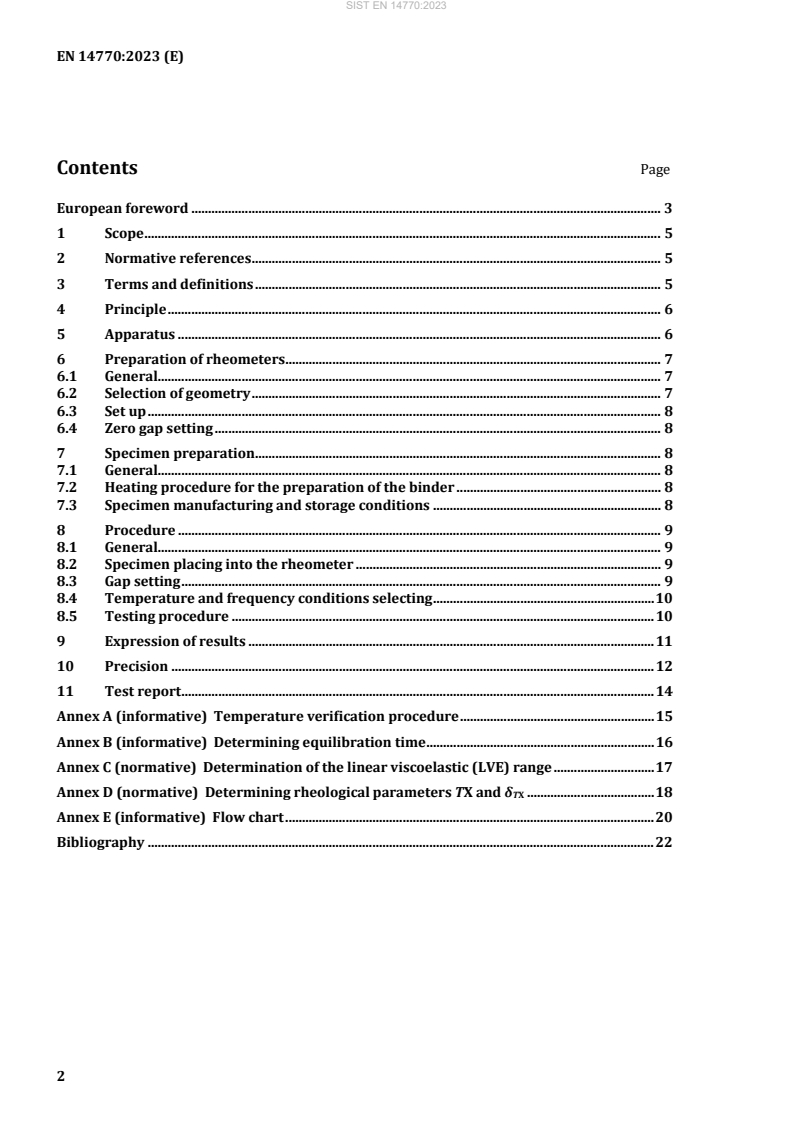
Contents Page
European foreword . 3
1 Scope . 5
2 Normative references . 5
3 Terms and definitions . 5
4 Principle . 6
5 Apparatus . 6
6 Preparation of rheometers . 7
6.1 General. 7
6.2 Selection of geometry . 7
6.3 Set up . 8
6.4 Zero gap setting . 8
7 Specimen preparation . 8
7.1 General. 8
7.2 Heating procedure for the preparation of the binder . 8
7.3 Specimen manufacturing and storage conditions . 8
8 Procedure . 9
8.1 General. 9
8.2 Specimen placing into the rheometer . 9
8.3 Gap setting . 9
8.4 Temperature and frequency conditions selecting . 10
8.5 Testing procedure . 10
9 Expression of results . 11
10 Precision . 12
11 Test report . 14
Annex A (informative) Temperature verification procedure . 15
Annex B (informative) Determining equilibration time . 16
Annex C (normative) Determination of the linear viscoelastic (LVE) range . 17
Annex D (normative) Determining rheological parameters TX and δTX . 18
Annex E (informative) Flow chart . 20
Bibliography . 22
European foreword
This document (EN 14770:2023) has been prepared by Technical Committee CEN/TC 336 “Bituminous
binders”, the secretariat of which is held by AFNOR.
This European Standard shall be given the status of a national standard, either by publication of an
identical text or by endorsement, at the latest by January 2024, and conflicting national standards shall
be withdrawn at the latest by January 2024.
Attention is drawn to the possibility that some of the elements of this document may be the subject of
patent rights. CEN shall not be held responsible for identifying any or all such patent rights.
This document supersedes EN 14770:2012.
In comparison with the previous edition, the main technical changes are:
a) restriction of particle size added in the scope;
b) reference to outdated standards IP PM CM-02 and XPT 66-065 removed;
c) integration of “complex compliance” removed;
d) use of the terms “shear strain” and “shear stress” unified;
e) use of the term “bituminous binder” unified;
f) reference to EN 1427 moved from Clause 2 to Bibliography; references to EN 12607-1, EN 14023 and
EN 14769 added to Bibliography;
g) definitions “shear strain controlled mode” and “shear stress controlled mode” added;
h) use of the term “range of linear viscoelastic behaviour” unified;
i) use of the term “complex shear modulus” together with the corresponding symbol |G*| unified;
description of the complex shear modulus revised;
j) 6.1, 7.1 and 8.1 added with reference to Annex E;
k) information on different plate diameters relocated from 5.1 to new 6.2; information about different
plate diameters in 6.2 updated and plate diameter of 4 mm added;
l) deviation for rheometer specification removed in 5.1;
m) suitable dimensions for silicone moulds added in 5.2;
n) vials for preparation of test specimen removed in 5.2, 7.2, 7.3 and 8.2;
o) use of the term “specimen” unified;
p) 6.4 “Zero gap setting” revised and clarified;
q) heating procedure in 7.2 simplified with reference to EN 12594;
r) paring of specimen at room temperature removed in 7.3;
s) storage conditions and storage duration of specimens revised in 7.3;
t) 8.2 “Specimen placing into the rheometer” and 8.3 “Gap setting” revised;
u) gap compensation added in 8.4;
v) explanation of different testing procedures added in 8.5;
w) isochrones added Clause 9;
x) calculation of TX and δ added in Clause 9 and new Annex D;
TX
y) Clause 10 revised and complemented with new precision data, instead of coefficient of variation
repeatability r and reproducibility R are now used;
z) terms c) and d) added in Clause 11;
aa) revision of Annex C “Determination of the linear viscoelastic (LVE) range”;
bb) Annex E “Flow Chart” added.
Any feedback and questions on this document should be directed to the users’ national standards body.
A complete listing of these bodies can be found on the CEN website.
According to the CEN-CENELEC Internal Regulations, the national standards organisations of the
following countries are bound to implement this European Standard: Austria, Belgium, Bulgaria, Croatia,
Cyprus, Czech Republic, Denmark, Estonia, Finland, France, Germany, Greece, Hungary, Iceland, Ireland,
Italy, Latvia, Lithuania, Luxembourg, Malta, Netherlands, Norway, Poland, Portugal, Republic of North
Macedonia, Romania, Serbia, Slovakia, Slovenia, Spain, Sweden, Switzerland, Türkiye and the United
Kingdom.
1 Scope
This document specifies a general method of using a dynamic shear rheometer (DSR) for measuring the
rheological properties of bituminous binders. The procedure involves determining the complex shear
modulus and phase angle of binders over a range of test frequencies and test temperatures when tested
in oscillatory shear.
From the test, the complex shear modulus, |G*|, and its phase angle, δ, at a given temperature and
frequency are calculated, as well as the components G' and G” of the complex shear modulus.
This method is applicable to un-aged, aged, stabilized and recovered bituminous binders. The test
procedure in accordance with this document is not applicable for bituminous binders with particles
larger than 250 μm (e.g. filler material, granulated rubber).
WARNING — The use of this document can involve hazardous materials, operations and equipment. This
document does not purport to address all of the safety problems associated with its use. It is the
responsibility of the user of this document to establish appropriate safety and health practices and to
determine the applicability of regulatory limitations prior to use.
2 Normative references
The following documents are referred to in the text in such a way that some or all of their content
constitutes requirements of this document. For dated references, only the edition cited applies. For
undated references, the latest edition of the referenced document (including any amendments) applies.
EN 12594, Bitumen and bituminous binders - Preparation of test samples
3 Terms and definitions
For the purposes of this document, the following terms and definitions apply.
ISO and IEC maintain terminology databases for use in standardization at the following addresses:
— ISO Online browsing platform: available at https://www.iso.org/obp
— IEC Electropedia: available at https://www.electropedia.org/
3.1
shear strain controlled mode
rheometer control mode where a demand angular displacement is applied to the specimen and the
corresponding torque is measured
Note 1 to entry: Using the shear strain factor of the measuring geometry, a specimen shear strain can be calculated
from the applied angular displacement. Using the shear stress factor of the measuring geometry, a specimen shear
stress can be calculated from the measured torque. Additional corrections can be applied to calculate true specimen
shear strain and true specimen shear stress. These corrections are automatically carried out by the instrument
software and are not the responsibility of the operator.
3.2
shear stress controlled mode
rheometer control mode where a demand torque is applied to the specimen and the corresponding
angular displacement is measured
Note 1 to entry: Using the shear stress factor of the measuring geometry, a specimen shear stress can be calculated
from the applied torque. Using the shear strain factor of the measuring geometry, a specimen shear strain can be
calculated from the measured angular displacement. Additional corrections can be applied to calculate true
specimen shear stress and true specimen shear strain. These corrections are automatically carried out by the
instrument software and are not the responsibility of the operator.
3.3
complex shear modulus
|G*|
ratio of the amplitude of the shear stress to the amplitude of the shear strain in harmonic sinusoidal
oscillation, in Pa
Note 1 to entry: The (mathematical) real part of the complex shear modulus |G*| is G´. It is associated with the
elastic part of material behaviour which represents energy stored during a shear cycle. The real part is the complex
shear modulus multiplied with cosine of phase angle expressed in degrees.
Note 2 to entry: The (mathematical) imaginary part of the complex shear modulus is G´´. It is associated with the
viscous part of material behaviour which represents energy dissipated during a shear cycle. The imaginary part is
the complex shear modulus multiplied with sine of phase angle expressed in degrees.
3.4
phase angle
δ
phase difference between shear stress and shear strain in harmonic oscillation, in °
3.5
isotherm
curve on a graph representing the behaviour of a material at a constant temperature
3.6
isochrone
curve on a graph representing the behaviour of a material at a constant frequency
3.7
range of linear viscoelastic behaviour
range in which complex shear modulus is independent of shear stress or shear strain
4 Principle
A known oscillatory shear stress is applied to the temperature controlled test geometry in which the
bituminous test specimen is held. The binder's shear strain response to the shear stress is measured.
Alternatively, a known oscillatory shear strain is applied to the test specimen and the resulting shear
stress is measured.
Except for specific purposes, the test is performed in the region of linear viscoelastic behaviour.
5 Apparatus
Usual laboratory apparatus and glassware, together with the following:
5.1 Dynamic shear rheometer (DSR), with either an integral temperature control system or
temperature control attachments, capable of controlling the temperature over a minimum range of 5 °C
to 85 °C with a maximum permissible error of ± 0,1 °C throughout the test period. The rheometer shall
be fitted with parallel plates, with a constant gap across the area of the plates. Depending on the expected
complex shear modulus range different plate diameters (for example 25 mm, 8 mm or 4 mm) are used
(see 6.2). The temperature control system shall encompass both plates to avoid temperature gradients
across the plates. When the test specimen is immersed in liquid other than water, ensure that the liquid
does not affect the properties of the material being analysed. The rheometer shall be capable to determine
|G*|, at least in the range of 1 kPa to 10 MPa and the phase angle δ, in the range 0° to 90°.
NOTE 1 When liquid is used to immerse the test specimen, a water/glycol mixture has been found to be suitable.
The proportions used depend on how low the temperature intended for testing is. Rheometers using radio
frequency (RF) heating and/or liquid gas cooling or other heating/cooling systems can be used in accordance with
the manufacturer's instructions.
Where the bottom plate is nominally the same diameter as the top plate, a visual check should be made
to ensure the two plates are vertically aligned. If there is any doubt as to the alignment of the top and
bottom plates, the manufacturer, or a qualified technician, should re-align the plate geometry.
NOTE 2 The fact that the temperature control range is 5 °C to 85 °C does not imply that accurate results will
necessarily be obtained for all binders over this range (see 6.2 and 6.3, NOTE 1). Furthermore, temperatures outside
this range can also be used, provided the results are not affected by material or instrument limitations (see 6.2).
5.2 Moulds or sheet materials, for the preparation of the test specimens. The moulds or sheet
material, where used, shall be of silicone or similar material, which does not adhere to the test specimen.
For a testing geometry with a diameter of 25 mm and a gap setting of 1 mm, a mould with a cavity of
approximately 18 mm in diameter and 2 mm deep may be used. For a testing geometry with a diameter
of 8 mm and a gap setting of 2 mm, a mould with a cavity of approximately 8 mm in diameter and 2,5 mm
deep may be used. For a testing geometry with a diameter of 4 mm with different gap settings, a mould
with a cavity of approximately 4 mm in diameter and 3 mm deep may be used. In any case, the operator
shall ensure adequate filling of the gap according to 8.3.
The use of grease or other anti-stick products should be avoided because they can affect the adherence
of the specimen to the rheometer plates.
5.3 Oven, ventilated laboratory model, capable of being controlled at temperatures between 50 °C and
200 °C with a maximum permissible error of ± 5 °C.
6 Preparation of rheometers
6.1 General
An informative flow chart for preparation of rheometers is given in Annex E, Figure E.1.
6.2 Selection of geometry
For different ranges of complex shear modulus plates of different diameters and gap settings shall be
used to respect the instruments limitations.
For determining complex shear modulus of bituminous binders in the range 1 kPa to 100 kPa, the
geometry with a diameter of 25 mm and a gap setting of 1,0 mm is suitable for most instruments. For
determining complex shear modulus of bituminous binders in the range 100 kPa to 10 MPa, the geometry
with a diameter of 8 mm and a gap setting of 2,0 mm is suitable for most instruments. Overlapping of test
results from both geometries is recommended (see 8.5).
For determining complex shear modulus of bituminous binders below 1 kPa, a geometry with a diameter
larger than 25 mm is recommended. Alternatively, the geometry with a diameter of 25 mm may be used
provided that test results in the expected range of the complex shear modulus are verified with a
calibrated fluid.
Plates of other diameters and other gap settings with different ranges of complex shear modulus may
also be used, ensuring compliance effects of the instrument do not affect the results (see 6.3, NOTE 1),
the minimum torque specification of the rheometer is respected and the testing is done in the linear
viscoelastic range (see Clause 8).
NOTE Recent research results demonstrate the suitability of a plate diameter of 4 mm for testing complex
shear modulus in a range 10 MPa to 1 GPa. Depending on the specimen installation procedure, a gap setting between
1,0 mm and 3,0 mm is generally suitable.
6.3 Set up
Set up the rheometer in the sequence given in the manufacturer's instructions, including the procedure
for selecting and setting the correct geometry and gap.
NOTE 1 The selection of system geometry can affect the accuracy of results. The manufacturer can have
determined the operational limits and this information can be available but if not, it can be determined by running
a test specimen over a range of test temperatures using all the test geometries likely to be used in practice, and
plotting |G*| against either frequency or phase angle δ. Where the divergence between the plots for each geometry
exceeds 15 %, this is an indication that compliance effects are affecting one or more of the geometries. The chosen
geometry(ies) which shows the more rapid fall in |G*|, or the lower phase angle, indicates that its accuracy limit has
been reached. Also, for most rheometers generally referred to in this document, irrespective of the geometry chosen,
values of |G*| in excess of 10 Pa are likely to be suspect. Software corrections to the stiffness can be acceptable
provided appropriate validation is supplied by the manufacturer.
The rheometer and temperature control system should be calibrated at regular intervals in accordance
with the quality assurance procedure of the laboratory. The rheometer and temperature control system
should be calibrated by a means traceable to a national standard. Also, it is advisable to verify the
accuracy of the temperature control system by means of a certified temperature-measuring device at
regular intervals. Take note that external devices read the accurate temperature value only if they are
calibrated correctly. A temperature verification procedure is described in Annex A.
NOTE 2 The temperature in the test specimen can differ from the temperature read by the device if insufficient
equilibration time is used. A procedure for determining equilibration time is described in Annex B.
6.4 Zero gap setting
For initialization, the gap between the plates shall be set to zero to give a reference for the gap change for
the thermal expansion of the geometry. Prior to loading the first test specimen, the zero gap is set with
both clean plates at ambient temperature.
NOTE For temperature control systems with minimized thermal gradients within the gap, the zero gap can be
set at any temperature assuring thermal equilibrium of the geometry.
If the DSR has no gap compensation feature, the zero gap can be set at the mid-point of the temperature
range to be tested.
7 Specimen preparation
7.1 General
WARNING — This document involves handling of apparatus and binders at very high temperatures.
Always wear protective gloves and eyeglasses when handling hot binder, and avoid contact with any
exposed skin.
An informative flow chart for specimen preparation is given in Annex E, Figure E.1.
7.2 Heating procedure for the preparation of the binder
Prepare the bituminous binder in accordance with EN 12594.
7.3 Specimen manufacturing and storage conditions
Moulds or sheet materials may be used for all types of binders.
When the binder reaches temperature after the heating period, stir and mix with a spatula to ensure
homogeneity (especially for polymer modified binders); or after the heating period, remove a sub-sample
of convenient size for handling safely and of sufficient volume, to prepare the required number of test
specimens plus approximately 50 %.
Pour into moulds or directly on to sheets. Care shall be taken to avoid air bubbles in the specimen. Choose
one or more test shapes that wi
...
Questions, Comments and Discussion
Ask us and Technical Secretary will try to provide an answer. You can facilitate discussion about the standard in here.
Loading comments...