

prEN 438-7
(Main)High-pressure decorative laminates (HPL) - Sheets based on thermosetting resins (Usually called Laminates) - Part 7: Compact laminate and HPL composite panels for internal and external wall and ceiling finishes
General Information
- Abstract
This document specifies characteristics for compact laminate panels and HPL composite panels both for non-structural uses in interior or external wall and ceiling finish applications (including in suspended ceiling).
This document deals with compact laminate panels of thickness 2 mm and greater.
The compact laminate panels are produced by using a high pressure process and the HPL composite panels are produced bonding an HPL sheet to a substrate.
This document covers compact laminate panels with the following types of laminates:
- compact laminates, as defined in EN 438 4:2016;
- exterior-grade compact laminates, as defined in EN 438 6:2016;
- pearlescent compact laminates, metal compact laminates and wood veneer compact laminates, as defined in EN 438 8:2018;
- coloured core layer compact laminates and metal reinforced core layer compact laminates, as defined in EN 438 9:2017.
This document covers full size and cut-to-size compact laminate panels and HPL composite panels, e.g. tiles and sidings.
This document specifies only compact laminate panels and HPL composite panels mechanically fixed using e. g. screws or rivets.
Both the compact laminate panels and HPL composite panels may contain flame retardant to improve their reaction to fire performance.
This document also specifies provisions for the assessment and verification of constancy of performance (AVCP) of the characteristics and includes provisions for marking these panels.
This document does not cover:
a) HPL sheets less than 2 mm thick as defined in EN 438-3:2016, EN 438-8:2018 or EN 438-9:2017, which are not glued on a substrate;
b) overlaid or veneered wood-based panels, where the overlay/veneer is not an HPL;
c) HPL composite panels intended for use as floor coverings;
d) panels used for fire protection of walls or ceilings;
e) performances of installed systems for walls and ceilings with compact or composite high pressure laminate panels.
- Status
- Not Published
- Publication Date
- 14-Oct-2021
- Withdrawal Date
- 14-Oct-2021
- Technical Committee
- CEN/TC 249 - Plastics
- Current Stage
- 4598 - Decision to abandon - Finalization for Vote
- Completion Date
- 25-Sep-2020



Overview
prEN 438-7 is a CEN draft standard that specifies requirements for compact laminate panels and HPL composite panels used as non‑structural internal and external wall and ceiling finishes (including suspended ceilings). It covers panels produced by a high‑pressure process (compact laminates, thickness ≥ 2 mm) and HPL sheets bonded to substrates (HPL composite panels). The standard applies to full‑size and cut‑to‑size items (tiles, sidings) that are mechanically fixed (e.g., screws, rivets) and may include flame retardants to improve reaction‑to‑fire performance.
Key topics and technical requirements
prEN 438-7 sets out the product characteristics, test methods and conformity assessment relevant to HPL finishes. Major technical topics include:
- Reaction to fire and related mounting/field‑of‑application provisions
- Water vapour permeability for internal/external applications
- Resistance to fixings for mechanically fastened panels
- Bonding strength for HPL composite panels
- Airborne sound insulation and flexural/tensile strength
- Thermal resistance and thermal shock resistance
- Durability under internal and external exposure conditions
- Emissions and content controls: formaldehyde, pentachlorophenol (PCP), VOC releases
- Testing, sampling and assessment procedures for each characteristic
- Assessment and Verification of Constancy of Performance (AVCP), including type testing and factory production control (FPC)
- Marking and labelling requirements
The standard explicitly covers the following laminate types as defined in related EN parts: compact laminates (EN 438-4), exterior‑grade compact (EN 438-6), pearlescent/metal/wood veneer compact (EN 438-8) and coloured/metal‑reinforced core compact (EN 438-9).
It does not cover HPL sheets < 2 mm not glued to a substrate, non‑HPL veneered wood panels, floor coverings, panels intended for active fire protection, or performance of complete installed wall/ceiling systems.
Applications and users
prEN 438-7 is directly applicable to:
- Manufacturers of HPL compact panels and HPL composite wall/ceiling panels
- Product designers and R&D teams specifying laminate constructions and substrates
- Architects, façade engineers and specifiers selecting finishes for internal/external walls and ceilings
- Test laboratories performing conformity and reaction‑to‑fire testing
- Building product certification bodies and regulatory authorities implementing AVCP and CPR (Regulation EU No. 305/2011)
Typical applications include ventilated façades, interior cladding, decorative ceilings and exterior sidings where durable, decorative, mechanically fixed HPL panels are required.
Related standards
- EN 438 series (Parts 2, 3, 4, 6, 8, 9) - HPL test methods and classifications
- EN ISO 13894-1 / -2 - HPL composite element test methods/specifications
- EN 13986 - Wood‑based panels for construction (relation to composite substrates)
- References to CPR (Regulation EU No. 305/2011) for construction product regulatory alignment
Keywords: prEN 438-7, HPL, compact laminate, HPL composite panels, wall and ceiling finishes, reaction to fire, AVCP, CEN.
Get Certified
Connect with accredited certification bodies for this standard

DIN CERTCO
DIN Group product certification.

Smithers Quality Assessments
US management systems and product certification.
Sponsored listings
Frequently Asked Questions
prEN 438-7 is a draft published by the European Committee for Standardization (CEN). Its full title is "High-pressure decorative laminates (HPL) - Sheets based on thermosetting resins (Usually called Laminates) - Part 7: Compact laminate and HPL composite panels for internal and external wall and ceiling finishes". This standard covers: This document specifies characteristics for compact laminate panels and HPL composite panels both for non-structural uses in interior or external wall and ceiling finish applications (including in suspended ceiling). This document deals with compact laminate panels of thickness 2 mm and greater. The compact laminate panels are produced by using a high pressure process and the HPL composite panels are produced bonding an HPL sheet to a substrate. This document covers compact laminate panels with the following types of laminates: - compact laminates, as defined in EN 438 4:2016; - exterior-grade compact laminates, as defined in EN 438 6:2016; - pearlescent compact laminates, metal compact laminates and wood veneer compact laminates, as defined in EN 438 8:2018; - coloured core layer compact laminates and metal reinforced core layer compact laminates, as defined in EN 438 9:2017. This document covers full size and cut-to-size compact laminate panels and HPL composite panels, e.g. tiles and sidings. This document specifies only compact laminate panels and HPL composite panels mechanically fixed using e. g. screws or rivets. Both the compact laminate panels and HPL composite panels may contain flame retardant to improve their reaction to fire performance. This document also specifies provisions for the assessment and verification of constancy of performance (AVCP) of the characteristics and includes provisions for marking these panels. This document does not cover: a) HPL sheets less than 2 mm thick as defined in EN 438-3:2016, EN 438-8:2018 or EN 438-9:2017, which are not glued on a substrate; b) overlaid or veneered wood-based panels, where the overlay/veneer is not an HPL; c) HPL composite panels intended for use as floor coverings; d) panels used for fire protection of walls or ceilings; e) performances of installed systems for walls and ceilings with compact or composite high pressure laminate panels.
This document specifies characteristics for compact laminate panels and HPL composite panels both for non-structural uses in interior or external wall and ceiling finish applications (including in suspended ceiling). This document deals with compact laminate panels of thickness 2 mm and greater. The compact laminate panels are produced by using a high pressure process and the HPL composite panels are produced bonding an HPL sheet to a substrate. This document covers compact laminate panels with the following types of laminates: - compact laminates, as defined in EN 438 4:2016; - exterior-grade compact laminates, as defined in EN 438 6:2016; - pearlescent compact laminates, metal compact laminates and wood veneer compact laminates, as defined in EN 438 8:2018; - coloured core layer compact laminates and metal reinforced core layer compact laminates, as defined in EN 438 9:2017. This document covers full size and cut-to-size compact laminate panels and HPL composite panels, e.g. tiles and sidings. This document specifies only compact laminate panels and HPL composite panels mechanically fixed using e. g. screws or rivets. Both the compact laminate panels and HPL composite panels may contain flame retardant to improve their reaction to fire performance. This document also specifies provisions for the assessment and verification of constancy of performance (AVCP) of the characteristics and includes provisions for marking these panels. This document does not cover: a) HPL sheets less than 2 mm thick as defined in EN 438-3:2016, EN 438-8:2018 or EN 438-9:2017, which are not glued on a substrate; b) overlaid or veneered wood-based panels, where the overlay/veneer is not an HPL; c) HPL composite panels intended for use as floor coverings; d) panels used for fire protection of walls or ceilings; e) performances of installed systems for walls and ceilings with compact or composite high pressure laminate panels.
prEN 438-7 is classified under the following ICS (International Classification for Standards) categories: 83.140.20 - Laminated sheets. The ICS classification helps identify the subject area and facilitates finding related standards.
prEN 438-7 is associated with the following European legislation: Standardization Mandates: M/113, M/113_Am1, M/121, M/121_Am1. When a standard is cited in the Official Journal of the European Union, products manufactured in conformity with it benefit from a presumption of conformity with the essential requirements of the corresponding EU directive or regulation.
prEN 438-7 is available in PDF format for immediate download after purchase. The document can be added to your cart and obtained through the secure checkout process. Digital delivery ensures instant access to the complete standard document.
Standards Content (Sample)
SLOVENSKI STANDARD
01-november-2019
Dekorativni visokotlačni laminati (HPL) - Plošče na osnovi duromernih smol - 7.
del: Kompaktni laminati in kompozitni paneli HPL za notranjo in zunanjo oblogo
zidov in stropov
High-pressure decorative laminates (HPL) - Sheets based on thermosetting resins
(Usually called Laminates) - Part 7: Compact laminate and HPL composite panels for
internal and external wall and ceiling finishes
Dekorative Hochdruck-Schichtpressstoffplatten (HPL) - Platten auf Basis härtbarer Harze
(Schichtpressstoffe) - Teil 7: Kompaktplatten und HPL-Mehrschicht-Verbundplatten für
Wand- und Deckenbekleidungen für Innen- und Außenanwendung
Stratifiés décoratifs haute pression (HPL) - Plaques à base de résines
thermodurcissables (communément appelées stratifiés) - Partie 7 : Panneaux stratifiés
compacts et composites HPL pour finitions des murs et plafonds intérieurs et/ou
extérieurs
Ta slovenski standard je istoveten z: prEN 438-7
ICS:
83.140.20 Laminatne plošče Laminated sheets
2003-01.Slovenski inštitut za standardizacijo. Razmnoževanje celote ali delov tega standarda ni dovoljeno.
DRAFT
EUROPEAN STANDARD
NORME EUROPÉENNE
EUROPÄISCHE NORM
August 2019
ICS 83.140.20 Will supersede EN 438-7:2005
English Version
High-pressure decorative laminates (HPL) - Sheets based
on thermosetting resins (Usually called Laminates) - Part
7: Compact laminate and HPL composite panels for
internal and external wall and ceiling finishes
Stratifiés décoratifs haute pression (HPL) - Plaques à Dekorative Hochdruck-Schichtpressstoffplatten (HPL)
base de résines thermodurcissables (communément - Platten auf Basis härtbarer Harze (Schichtpressstoffe)
appelées stratifiés) - Partie 7 : Panneaux stratifiés - Teil 7: Kompaktplatten und HPL-Mehrschicht-
compacts et composites HPL pour finitions des murs et Verbundplatten für Wand- und Deckenbekleidungen
plafonds intérieurs et/ou extérieurs für Innen- und Außenanwendung
This draft European Standard is submitted to CEN members for enquiry. It has been drawn up by the Technical Committee
CEN/TC 249.
If this draft becomes a European Standard, CEN members are bound to comply with the CEN/CENELEC Internal Regulations
which stipulate the conditions for giving this European Standard the status of a national standard without any alteration.
This draft European Standard was established by CEN in three official versions (English, French, German). A version in any other
language made by translation under the responsibility of a CEN member into its own language and notified to the CEN-CENELEC
Management Centre has the same status as the official versions.
CEN members are the national standards bodies of Austria, Belgium, Bulgaria, Croatia, Cyprus, Czech Republic, Denmark, Estonia,
Finland, France, Germany, Greece, Hungary, Iceland, Ireland, Italy, Latvia, Lithuania, Luxembourg, Malta, Netherlands, Norway,
Poland, Portugal, Republic of North Macedonia, Romania, Serbia, Slovakia, Slovenia, Spain, Sweden, Switzerland, Turkey and
United Kingdom.
Recipients of this draft are invited to submit, with their comments, notification of any relevant patent rights of which they are
aware and to provide supporting documentation.
Warning : This document is not a European Standard. It is distributed for review and comments. It is subject to change without
notice and shall not be referred to as a European Standard.
EUROPEAN COMMITTEE FOR STANDARDIZATION
COMITÉ EUROPÉEN DE NORMALISATION
EUROPÄISCHES KOMITEE FÜR NORMUNG
CEN-CENELEC Management Centre: Rue de la Science 23, B-1040 Brussels
© 2019 CEN All rights of exploitation in any form and by any means reserved Ref. No. prEN 438-7:2019 E
worldwide for CEN national Members.
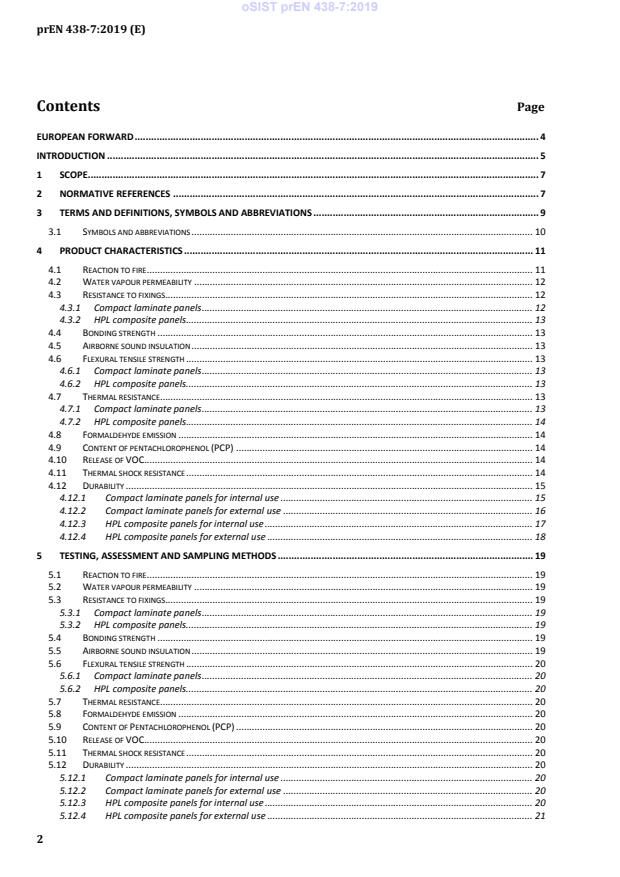
Contents Page
EUROPEAN FORWARD . 4
INTRODUCTION . 5
1 SCOPE . 7
2 NORMATIVE REFERENCES . 7
3 TERMS AND DEFINITIONS, SYMBOLS AND ABBREVIATIONS . 9
3.1 SYMBOLS AND ABBREVIATIONS . 10
4 PRODUCT CHARACTERISTICS . 11
4.1 REACTION TO FIRE . 11
4.2 WATER VAPOUR PERMEABILITY . 12
4.3 RESISTANCE TO FIXINGS . 12
4.3.1 Compact laminate panels . 12
4.3.2 HPL composite panels . 13
4.4 BONDING STRENGTH . 13
4.5 AIRBORNE SOUND INSULATION . 13
4.6 FLEXURAL TENSILE STRENGTH . 13
4.6.1 Compact laminate panels . 13
4.6.2 HPL composite panels . 13
4.7 THERMAL RESISTANCE. 13
4.7.1 Compact laminate panels . 13
4.7.2 HPL composite panels . 14
4.8 FORMALDEHYDE EMISSION . 14
4.9 CONTENT OF PENTACHLOROPHENOL (PCP) . 14
4.10 RELEASE OF VOC . 14
4.11 THERMAL SHOCK RESISTANCE . 14
4.12 DURABILITY . 15
4.12.1 Compact laminate panels for internal use . 15
4.12.2 Compact laminate panels for external use . 16
4.12.3 HPL composite panels for internal use . 17
4.12.4 HPL composite panels for external use . 18
5 TESTING, ASSESSMENT AND SAMPLING METHODS . 19
5.1 REACTION TO FIRE . 19
5.2 WATER VAPOUR PERMEABILITY . 19
5.3 RESISTANCE TO FIXINGS . 19
5.3.1 Compact laminate panels . 19
5.3.2 HPL composite panels . 19
5.4 BONDING STRENGTH . 19
5.5 AIRBORNE SOUND INSULATION . 19
5.6 FLEXURAL TENSILE STRENGTH . 20
5.6.1 Compact laminate panels . 20
5.6.2 HPL composite panels . 20
5.7 THERMAL RESISTANCE. 20
5.8 FORMALDEHYDE EMISSION . 20
5.9 CONTENT OF PENTACHLOROPHENOL (PCP) . 20
5.10 RELEASE OF VOC . 20
5.11 THERMAL SHOCK RESISTANCE . 20
5.12 DURABILITY . 20
5.12.1 Compact laminate panels for internal use . 20
5.12.2 Compact laminate panels for external use . 20
5.12.3 HPL composite panels for internal use . 20
5.12.4 HPL composite panels for external use . 21
6 ASSESSMENT AND VERIFICATION OF CONSTANCY OF PERFORMANCE - AVCP . 21
6.1 GENERAL . 21
6.2 TYPE TESTING . 21
6.2.1 General . 21
6.2.2 Test samples, testing and compliance criteria . 22
6.2.3 Test reports . 23
6.2.4 Shared other party results . 23
6.2.5 Cascading determination of the product type results . 24
6.3 FACTORY PRODUCTION CONTROL (FPC) . 25
6.3.1 General . 25
6.3.2 Requirement . 26
6.3.3 Product specific requirements . 30
6.3.4 Initial inspection of factory and of FPC . 31
6.3.5 Continuous surveillance of FPC for products covered by AVCP 1 . 31
6.3.6 Procedure for modifications . 32
6.3.7 One-off products, pre-production products (e.g. prototypes) and products produced in very low quantity . 32
7 MARKING AND LABELLING . 33
ANNEX A (NORMATIVE) SPECIMEN MOUNTING DETAILS AND EXTENDED APPLICATION RULES FOR SBI FIRE TESTING
.................................................................................................................................................................................... 34
A.1 STANDARD FRAME . 34
A.2 STANDARD SUBSTRATE . 34
A.3 MOUNTING INSTRUCTIONS . 34
A.4 FIELD OF APPLICATION OF TEST RESULTS . 35
ANNEX B (NORMATIVE) PANEL PARAMETERS DEFINING FAMILY OF PANELS IN RELATION TO REACTION TO FIRE
PERFORMANCE . 41
ANNEX ZA (INFORMATIVE) RELATIONSHIP OF THIS EUROPEAN STANDARD WITH REGULATION (EU) NO.305/2011 . 42
BIBLIOGRAPHY . 51
European forward
This document (prEN 438-7:2019) has been prepared by Technical Committee CEN/TC 249 “Plastics” the
secretariat of which is held by NBN.
This document is currently submitted to the CEN Enquiry.
This document will supersede EN 438-7:2005.
This document has been prepared under standardization request given to CEN by the European
Commission and the European Free Trade Association.
For relationship with Regulation EU 305/2011 (CPR), see informative Annex ZA, which is an integral part
of this document.
Introduction
An overview of European standards addressing compact laminate panels and HPL composite panels and
related products for building applications is given below.
EN 438-2:2016+A1:2018, High-pressure decorative laminates (HPL) — Sheets based
on thermosetting resins (usually called laminates) — Part 2: Determination of
properties
Test methods EN ISO 13894-1:2015, High-pressure decorative laminates — Composite elements —
Part 1: Test methods (ISO 13894-1)
EN 16094:2012, Laminate floor coverings — Test method for the determination of
micro-scratch resistance
EN 438-3:2016, High-pressure decorative laminates (HPL) — Sheets based on
thermosetting resins (usually called laminates) — Part 3: Classification and
specifications for laminates less than 2 mm thick intended for bonding to supporting
substrates
EN 438-4:2016, High-pressure decorative laminates (HPL) — Sheets based on
thermosetting resins (usually called laminates) — Part 4: Classification and
specifications for Compact laminates of thickness 2 mm and greater
EN 438-5:2016, High-pressure decorative laminates (HPL) — Sheets based on
thermosetting resins (usually called laminates) — Part 5: Classification and
specifications for flooring grade laminates less than 2 mm thick intended for bonding to
supporting substrates
EN 438-6:2016, High-pressure decorative laminates (HPL) — Sheets based on
Product
thermosetting resins (usually called laminates) — Part 6: Classification and
standards
specifications for Exterior-grade Compact laminates of thickness 2 mm and greater
Classification,
EN 438-8:2018, High-pressure decorative laminates (HPL) — Sheets based on
specifications
thermosetting resins (usually called laminates) — Part 8: Classification and
specifications for design laminates
EN 438-9:2017, High-pressure decorative laminates (HPL) — Sheets based on
thermosetting resins (usually called laminates) — Part 9: Classification and
specifications for alternative core laminates
EN ISO 13894-2:2015, High-pressure decorative laminates — Composite elements —
Part 2: Specifications for composite elements with wood-based substrates for interior
use (ISO 13894-2)
EN 13329:2016+A1:2017, Laminate floor coverings — Elements with a surface layer
based on aminoplastic thermosetting resins — Specifications, requirements and test
methods
EN ISO 10874:2012, Resilient, textile and laminate floor coverings — Classification
for internal and external wall and ceiling finishes (This document)
EN 13986:2004+A1:2015, Wood-based panels for use in construction —
Product
Characteristics, evaluation of conformity and marking
standards
EN 14041:2018, Resilient, textile and laminate floor coverings — Essential
characteristics
EN 13964:2014, Suspended ceilings — Requirements and test methods
EN 438-1:2016, High-pressure decorative laminates (HPL) — Sheets based on
General
thermosetting resins (usually called laminates) — Part 1: Introduction and general
standard
information
1 Scope
This document specifies characteristics for compact laminate panels and HPL composite panels both for
non-structural uses in interior or external wall and ceiling finish applications (including in suspended
ceiling).
This document deals with compact laminate panels of thickness 2 mm and greater.
The compact laminate panels are produced by using a high pressure process and the HPL composite
panels are produced bonding an HPL sheet to a substrate.
This document covers compact laminate panels with the following types of laminates:
— compact laminates, as defined in EN 438-4:2016;
— exterior-grade compact laminates, as defined in EN 438-6:2016;
— pearlescent compact laminates, metal compact laminates and wood veneer compact laminates, as
defined in EN 438-8:2018;
— coloured core layer compact laminates and metal reinforced core layer compact laminates, as defined
in EN 438-9:2017.
This document covers full size and cut-to-size compact laminate panels and HPL composite panels, e.g.
tiles and sidings.
This document specifies only compact laminate panels and HPL composite panels mechanically fixed
using e.g. screws or rivets.
Both the compact laminate panels and HPL composite panels may contain flame retardant to improve
their reaction to fire performance.
This document also specifies provisions for the assessment and verification of constancy of performance
(AVCP) of the characteristics and includes provisions for marking these panels.
This document does not cover:
a) HPL sheets less than 2 mm thick as defined in EN 438-3:2016, EN 438-8:2018 or EN 438-9:2017,
which are not glued on a substrate;
b) overlaid or veneered wood-based panels, where the overlay/veneer is not an HPL;
c) HPL composite panels intended for use as floor coverings;
d) panels used for fire protection of walls or ceilings;
e) performances of installed systems for walls and ceilings with compact or composite high pressure
laminate panels.
2 Normative references
The following documents are referred to in the text in such a way that some or all of their content
constitutes requirements of this document. For dated references, only the edition cited applies. For
undated references, the latest edition of the referenced document (including any amendments) applies.
EN 438-2:2016+A1:2014, High-pressure decorative laminates (HPL) — Sheets based on thermosetting
resins (usually called laminates) — Part 2: Determination of properties
EN 717-1:2004, Wood-based panels — Determination of formaldehyde release — Part 1: Formaldehyde
emission by the chamber method
EN 12664:2001, Thermal performance of building materials and products — Determination of thermal
resistance by means of guarded hot plate and heat flow meter methods — Dry and moist products of medium
and low thermal resistance
EN 13501-1:2018, Fire classification of construction products and building elements — Part 1:
Classification using data from reaction to fire tests
EN 13238:2010, Reaction to fire tests for building products — Conditioning procedures and general rules
for selection of substrates
EN 13823:2010+A1:2014, Reaction to fire tests for building products — Building products excluding
floorings exposed to the thermal attack by a single burning item
EN 13986:2004+A1:2015, Wood-based panels for use in construction — Characteristics, evaluation of
conformity and marking
EN 16516:2017, Construction products: Assessment of release of dangerous substances — Determination of
emissions into indoor air
EN ISO 178:2019, Plastics — Determination of flexural properties (ISO 178:2019)
EN ISO 1183-1:2019, Plastics — Methods for determining the density of non-cellular plastics — Part 1:
Immersion method, liquid pycnometer method and titration method (ISO 1183-1:2019)
EN ISO 7049:2011, Cross-recessed pan head tapping screws (ISO/FDIS 7049:2011)
EN ISO 10140-1:2016, Acoustics — Laboratory measurement of sound insulation of building elements —
Part 1: Application rules for specific products (ISO 10140-1:2016)
EN ISO 10140-2:2010, Acoustics — Laboratory measurement of sound insulation of building elements —
Part 2: Measurement of airborne sound insulation (ISO 10140-2:2010)
EN ISO 10140-4:2010, Acoustics — Laboratory measurement of sound insulation of building elements —
Part 4: Measurement procedures and requirements (ISO 10140-4:2010)
EN ISO 10140-5:2010, Acoustics — Laboratory measurement of sound insulation of building elements —
Part 5: Requirements for test facilities and equipment (ISO 10140-5:2010)
EN ISO 10456:2007, Building materials and products — Hygrothermal properties — Tabulated design
values and procedures for determining declared and design thermal values — Technical Corrigendum 1 (ISO
10456:2007)
EN ISO 10456:2007/AC:2009, Building materials and products — Hygrothermal properties — Tabulated
design values and procedures for determining declared and design thermal values — Technical Corrigendum
1 (ISO 10456:2007/Cor 1:2009)
EN ISO 12572:2016, Hygrothermal performance of building materials and products — Determination of
water vapour transmission properties — Cup method (ISO 12572:2016)
EN ISO 13894-1:2015, High-pressure decorative laminates — Composite elements — Part 1: Test methods
(ISO 13894-1:2000)
CEN/TR 14823:2003, Durability of wood and wood-based products — Quantitative determination of
pentachlorophenol in wood — Gas chromatographic method
3 Terms and definitions, symbols and abbreviations
3.1 Terms and definitions
For the purposes of this document, the following terms and definitions apply.
ISO and IEC maintain terminological databases for use in standardization at the following addresses:
— IEC Electropedia: available at http://www.electropedia.org/
— ISO Online browsing platform: available at http://www.iso.org/obp
3.1.1
high-pressure decorative laminate(s) (HPL)
sheet(s) consisting of decorative surface layer(s) and core layers bonded together by a high pressure
process
Note 1 to entry: Typical values for the high pressure process are: a temperature of ≥ 120 °C and a pressure
of ≥ 5 MPa.
3.1.2
surface layer
upper decorative layer consisting in one or more sheets of fibrous material (usually paper) impregnated
with aminoplastic thermosetting resins (usually melamine based resins) or other curable resins or other
decorative design surfaces which are not necessarily treated with thermosetting resin
Note 1 to entry: The surface layers can appear on one or both side(s) of the laminate(s). In case of one-sided
laminates, the back of the sheet(s) may be made suitable for adhesive bonding to a substrate.
Note 2 to entry: Examples of decorative design surface are metal foils, wood-veneers or textiles.
3.1.3
core layer
core layer consisting of fibrous materials (usually paper) impregnated with thermosetting resins (usually
phenolic based resins) or other curable resins, eventually reinforced by metal layer(s) or metal mesh(es)
and others which are not necessarily treated with thermosetting resin
3.1.4
compact laminate panel
panel consisting of decorative surface layer(s) and core layers bonded together by a high pressure process
with a thickness of 2 mm or greater
3.1.5
HPL composite panel
panel produced by adhesively bonding an HPL to one or both sides of a substrate
3.1.6
substrate of the HPL composite panels
board to which the HPL is bonded
Note 1 to entry: The substrate can be a wood based product (e.g. particleboard, plywood or fibreboard), a mineral
board (e.g. calcium silicate), an expanded honeycomb, a metal sheet or plastic material, organic or inorganic fibre
boards.
3.1.7
pearlescent compact laminate panel
compact laminate panel, the surface layer of which consists of a pearlescent effect decorative paper, which
is impregnated with aminoplastic thermosetting resins (usually melamine based resins)
3.1.8
metal compact laminate panel
compact laminate panel, the surface layer of which consists of a thin layer of metal
3.1.9
wood veneer compact laminate panel
compact laminate panel, the surface layer of which consists of a wood veneer, which is covered by a
protective melamine layer
3.1.10
coloured core layer compact laminate panel
compact laminate panel, the core layer of which consists of coloured fibrous materials (usually paper)
impregnated with aminoplastic thermosetting resins (usually melamine based resins) or fibrous
materials (usually paper) impregnated with coloured aminoplastic thermosetting resins (usually
melamine based resins)
3.1.11
metal reinforced core layer compact laminate panel
compact laminate panel, the core layer of which consists of metal layer(s) or mesh(es) and cellulosic
fibrous layers (usually paper) impregnated with phenolic thermosetting resins or aminoplastic
thermosetting resins (usually melamine based resins)
3.1.12
exterior-grade compact laminate panel
compact laminate panel for use under outdoor weather conditions such as direct sunlight rain and frost
3.1 Symbols and abbreviations
3.2.1 Symbols
For the purposes of this document, the following symbol applies.
t nominal thickness of the laminate
3.2.2 Abbreviations
For the purposes of this document, the following abbreviations apply.
ACF Pearlescent compact laminate with improved fire retardance
ACS Standard grade pearlescent compact laminate
BCS Standard grade Coloured core layer compact laminate
CGF Compact laminates with improved fire retardance
CGS Standard grade compact laminates
EDF Exterior-grade compact laminate with improved fire retardance, intended for severe outdoor
conditions
EDS Standard exterior-grade compact laminate, intended for severe outdoor conditions
EGF Exterior-grade compact laminate with improved fire retardance, intended for moderate outdoor
conditions
EGS Standard exterior-grade compact laminate, intended for moderate outdoor conditions
FR Flame Retardant
MCF Metal compact laminate with improved fire retardance
MCS Standard grade metal compact laminate
RCF Metal reinforced core layer compact laminate with improved fire retardance
RCS Metal reinforced core layer standard grade compact laminate
WCF Wood veneer compact laminate with improved fire retardance
WCS Standard grade wood veneer compact laminate
4 Product characteristics
4.1 Reaction to fire
4.1.1 The reaction to fire shall be assessed and classified in accordance with 5.1.
4.1.2 Only the interior grade non-flame retardant Compact laminate panels and HPL composite panels
1)
may be classified without the need for testing (CWT), as specified in Table 1 .
Table 1 — Classes of reaction-to-fire performance
Minimum
b
Minimum
Class
overall
a
Product detail density
Product (excluding
thickness
(kg/m )
floorings)
(mm)
Interior grade non-
Compact HPL meeting EN 438-4,
FR
1 350 6 D-s2,d0
Type CGS
Compact HPL panels
Composite panels comprising
Wood-
non-FR grade HPL meeting the
based core
requirements of EN 438-3,
minimum
12 mm wood-
adhesively bonded to both sides
density
Interior grade non- based core
of non-FR grade wood-based
FR HPL composite with
core of minimum thickness D-s2,d0
panels with wood- HPL ≥ 0,5 mm
12 mm complying with
based substrates bonded to
HPL
EN 13986, using PVAc or
both sides
minimum
thermosetting adhesive at an
density
application rate of 60 g/m to
1 350
120 g/m
a
Either directly fixed (i.e. with no air gap) to a material having a reaction to fire class of A2-s1,d0 or
better and a density of at least 600 kg/m ; or mounted on a timber or metal batten support frame, with a non-
ventilated (i.e. void open only at the top) air gap of at least 30 mm, the reverse face of the cavity so formed
having a reaction to fire classification of A2-s2,d0 or better.
b
Classes as provided for in Table 1 of the Annex to Decision 2000/147/EC.
NOTE Compact HPL panels are to be understood as compact laminate panels.
4.1.3 Compact laminate panels and HPL composite panels shall be tested according to 5.1.1 and the
results evaluated and expressed as class A1 to F together with the information to identify the mounting
and fixing conditions as provided in Annex A.
1) th
Commission Decision 2003/43/EC of 2003 January 17 (OJEU L 13 of 18.01.2003) as amended by
th
Commission Decision 2003/593/EC of 2003 August 7 (OJEU L 201 of 8.08.2003) establishing the classes of
reaction-to-fire of certain construction products.
4.1.4 For reaction to fire, the classification of the thinnest either compact laminate panels or HPL
composite panels of the family tested shall be valid for all thicker products of that family. However, testing
of thicker product may be used to prove a better classification.
Panel parameters defining family of panels in relation to reaction to fire performance shall be as listed in
Annex B, Table B.1.
4.2 Water vapour permeability
4.2.1 The water vapour permeability shall be expressed as the water vapour resistance factor μ.
4.2.2 The value of the water vapour resistance factor shall be taken from Table 2 in both conditions wet
and dry.
Table 2 — Water vapour resistance factors
Product Density Water vapour resistance factor
a
Wet cup μ Dry cup μ
Compact laminate ≥ 1 350 kg/m 110 250
panel
Particleboard substrate density 300 kg/m 10 50
HPL composite
Particleboard substrate density 600 kg/m 15 50
panel
Particleboard substrate density 900 kg/m 20 50
Fibreboard substrate density 400 kg/m 5 10
HPL composite
Fibreboard substrate density 600 kg/m 12 20
panel
Fibreboard substrate density 800 kg/m 20 30
a
Linear interpolation for intermediate density values is possible.
4.2.3 When a better performance is sought for declaration, the water vapour resistance factor of the
compact laminate panels and HPL composite panels shall be defined and determined in accordance with
5.2 and the values obtained shall be expressed in both conditions wet and dry.
4.3 Resistance to fixings
4.3.1 Compact laminate panels
4.3.1.1 The resistance to fixings of compact laminate panels shall be expressed as the screw holding
value from Table 3.
Table 3 — Screw holding value for compact laminate panels
Compact laminate panels thickness (t) Screw holding value
mm N
2 ≤ t < 4 250
4 ≤ t < 6 1 000
6 ≤ t < 8 2 000
8 ≤ t < 10 3 000
t ≥ 10 4 000
4.3.1.2 When tested, the resistance to fixings of compact laminate panels shall be done by
determining the resistance to the axial withdrawn force of wood screws from the panel in accordance
with 5.3.1. The value shall be expressed as screw holding value in newton (N).
4.3.2 HPL composite panels
The resistance to fixings of HPL composite panels shall be done by determining the resistance to the axial
withdrawn force of wood screws from the face (face screw-holding) in accordance with 5.3.2. The value
shall be expressed as screw holding value in newton (N).
4.4 Bonding strength
The bonding strength of HPL composite panels shall be done by determining the surface bond strength in
accordance with 5.4 and the obtained value shall be expressed in MPa.
4.5 Airborne sound insulation
The performance of the airborne sound insulation for compact laminate panels and for HPL composite
panels shall be determined as sound reduction index R (C;C ) in accordance with 5.5 and expressed as
w tr
value in dB.
4.6 Flexural tensile strength
4.6.1 Compact laminate panels
The flexural tensile strength of compact laminate panels shall be done by determining both the flexural
strength and the flexural modulus of elasticity in accordance with 5.6.1, and both results expressed in
values as MPa.
4.6.2 HPL composite panels
The flexural tensile strength of HPL composite panels shall be done by determining the perpendicular
tensile strength in accordance with 5.6.2 and the result expressed in value as MPa.
4.7 Thermal resistance
4.7.1 Compact laminate panels
4.7.1.1 The thermal resistance of compact laminate panels shall be expressed as value of thermal
conductivity of 0,3 W/(m K) according to EN ISO 10456:2007, Table 3 (see Material group: plastic solid,
phenolic resin).
4.7.1.2 When the thermal resistance of compact laminate panels is tested, it shall be done in
accordance with 5.7 and the result expressed as value in (m K/W).
4.7.2 HPL composite panels
4.7.2.1 The thermal resistance of HPL composite panels shall be calculated on the base of the thermal
conductivity value of each layers and their thicknesses and expressed as unique value of thermal
resistance in (m K/W).
4.7.2.2 When the thermal resistance of HPL composite panels is tested, it shall be done in accordance
with 5.7 and the result expressed as value in (m K/W).
4.8 Formaldehyde emission
4.8.1 Formaldehyde emission levels from compact laminate panels and from HPL composite panels
shall be measured according to 4.8.2 or/and 4.8.3.
4.8.2 When the formaldehyde emission is tested according to 5.8.2, the result shall be evaluated and
expressed according to Table 4.
Table 4 — Classes for emission of formaldehyde
Criteria for classes
Class E1 ≤ 0,13 mg/m air
Class E2 > 0,13 mg/m air
4.8.3 When the formaldehyde emission is tested according to 5.8.3 the result shall be expressed as value
in µg/m .
4.9 Content of pentachlorophenol (PCP)
4.9.1 Performance without testing
If in the relevant documentation provided by the supplier of the wood based substrate of HPL composite
panels is reported that it contains less than 5 ppm of pentachlorophenol (PCP), no testing of HPL
composite panels is necessary and the indication “PCP ≤ 5 ppm” shall be expressed.
4.9.2 Performance with testing
If the wood based substrate of HPL composite panels contains raw materials that include PCP, then the
substrate shall be tested according to 5.9.
When the obtained value of 5 ppm is exceeding, the indication “PCP > 5 ppm” shall be expressed for the
HPL composite panel, otherwise the declaration “PCP ≤ 5 ppm” shall be expressed.
4.10 Release of VOC
The release of volatile organic compounds (VOC) for compact laminate panels and HPL composite panels
is limited to the emissions of dangerous substances into indoor air with exception of formaldehyde and
PCP (already covered in 4.8 and 4.9).
The compact laminate panels and HPL composite panels shall be tested according to 5.10 and the result
expressed as value in µg/m .
4.11 Thermal shock resistance
4.11.1 The thermal shock resistance for compact laminate panels only shall be done by determining the
change of appearance, the change of flexural strength and the change of flexural modulus of elasticity
according to 5.11.
4.11.2 The obtained results of these characteristics shall be evaluated according to the concerned criteria
in Table 5.
Table 5 — Characteristics of thermal shock resistance performance
Compact laminate panels intended for
Characteristics
external application
Appearance rating ≥ 4
Change in flexural strength (D ) ≥ 0,80
s
Change in flexural modulus of elasticity (D ) ≥ 0,80
m
4.11.3 After evaluation of the results of the characteristics, the performance shall be jointly expressed
with indication “compliant”.
4.12 Durability
4.12.1 Compact laminate panels for internal use
4.12.1.1 General
The durability of the compact laminate panels for internal use shall be done by determining the resistance
to immersion in boiling water and the density, in accordance with 5.12.1 and expressing the results with
the corresponding values.
The resistance to immersion in boiling water is expressed as appearance, mass and thickness increase.
4.12.1.2 Appearance
The appearance shall be tested according to 5.12.1.1. The result shall be evaluated according to the
criteria in Table 6 for the respective type of compact laminate panels.
4.12.1.3 Mass increase
The mass increase shall be tested according to 5.12.1.1. The result shall be evaluated according to the
criteria in Table 6 for the respective type of compact laminate panels.
4.12.1.4 Thickness increase
The thickness increase shall be tested according to 5.12.1.1. The result shall be evaluated according to the
criteria in Table 6 for the respective type of compact laminate panels.
4.12.1.5 Density
The density shall be tested according to 5.12.1.2. The result shall be evaluated according to the criteria in
Table 7 for the respective type of compact laminate panels.
4.12.1.6 Evaluation of results
The results of the characteristics specified in 4.12.1.2 up to 4.12.1.5 shall be evaluated according to the
criteria reported in Table 6 and Table 7 for the respective type of compact laminate panels.
Table 6 — Minimum criteria for resistance to immersion in boiling water
Type of Compact laminate panels
Metal
Coloured
Pearlescent Metal Wood veneer reinforced
Compact core layer
Attribute Unit compact compact compact core layer
laminate compact
laminate laminate laminate compact
laminate
laminate
CGS CGF ACS ACF MCS MCF WCS WCF BCS RCS RCF
[%]
2 mm ≤ t < 5 mm ≤ 5, ≤ 7, ≤ 5,
Mass ≤ 7,0 NA NA NA NA ≤ 5,0
0 0 0 ≤ 5,0 ≤ 7,0
increase
t ≥ 5 mm ≤ 2, ≤ 3, ≤ 2,
≤ 3,0 NA NA NA NA ≤ 3,0 ≤ 2,0 ≤ 3,0
0 0 0
[%]
2 mm ≤ t < 5 mm ≤ 6, ≤ 9, ≤ 6,
Thickness ≤ 9,0 NA NA NA NA ≤ 6,0
0 0 0 ≤ 5,0 ≤ 7,0
increase
t ≥ 5 mm ≤ 2, ≤ 6, ≤ 2,
≤ 6,0 NA NA NA NA ≤ 4,0 ≤ 2,0 ≤ 3,0
0 0 0
Surface rating
Gloss finish ≥ 3 ≥ 3 ≥ 3 ≥ 3 NA NA NA NA ≥ 3 ≥ 3 ≥ 3
Other finishes ≥ 4 ≥ 4 ≥ 4 ≥ 4 NA NA NA NA ≥ 4 ≥ 4 ≥ 4
Appearance
Edge rating ≥ 3 ≥ 3 ≥ 3 ≥ 3 NA NA NA NA ≥ 3 ≥ 3 ≥ 3
No No No No
dela dela delam delam
Core delamination NA NA NA NA NA NA NA
mina mina inatio inatio
tion tion n n
NA: not applicable due to the composition of the material.
Table 7 — Minimum criteria for density
Type of Compact laminate panels
Coloure
Metal
Pearlescent Wood veneer d core
Compact Metal compact reinforced core
Unit Compact compact layer
laminate laminate layer compact
laminate laminate compact
laminate
laminate
CGS CGF ACS ACF MCS MCF WCS WCF BCS RCS RCF
[kg/m ≥ 1 35 ≥ 1 35 ≥ 1 35 ≥ 1 35 ≥ 1 35 ≥ 1 35 ≥ 1 10 ≥ 1 10 ≥ 1 35 ≥ 1 35
≥ 1 400
] 0 0 0 0 0 0 0 0 0 0
4.12.1.7 Expression of performance
After evaluation of the results of the characteristics specified in 4.12.1.2 up to 4.12.1.5, the performance
shall be jointly expressed with indication “compliant”.
4.12.2 Compact laminate panels for external use
4.12.2.1 General
The durability of the compact laminate panels for external use shall be done by determining the wet
conditions and the density in accordance with 5.12.2 and expressing the results with the corresponding
values.
The resistance to wet conditions is expressed as appearance and mass increase.
4.12.2.2 Appearance
The appearance shall be tested according to 5.12.2.1. The result shall be evaluated according to the
criteria in Table 8 for the respective type of compact laminate panels.
4.12.2.3 Mass increase
The mass increase shall be tested according to 5.12.2.1. The result shall be evaluated according to the
criteria in Table 8 for the respective type of compact laminate panels.
4.12.2.4 Density
The density shall be tested according to 5.12.2.2. The result shall be evaluated according to the criteria in
Table 8 for the respective type of compact laminate panel
...