


EN ISO 9455-3:2020
(Main)Soft soldering fluxes - Test methods - Part 3: Determination of acid value, potentiometric and visual titration methods (ISO 9455-3:2019)
Soft soldering fluxes - Test methods - Part 3: Determination of acid value, potentiometric and visual titration methods (ISO 9455-3:2019)
This document specifies two methods for the determination of the acid value of a flux of types 1 and 2 only, as defined in ISO 9454‑1.
Method A is a potentiometric titration method and is to be considered as the reference method.
Method B is an alternative, visual end‑point, titration method.
Flussmittel zum Weichlöten - Prüfverfahren - Teil 3: Bestimmung des Säurewertes, potentiometrische und visuelle Titrationsverfahren (ISO 9455-3:2020)
Dieses Dokument legt zwei Verfahren zur Bestimmung des Säurewertes eines Flussmittels der Typen 1 und 2 nach ISO 9454 1 fest.
Verfahren A ist eine potentiometrische Titration und ist als Referenzverfahren zu betrachten.
Verfahren B ist ein alternatives Titrationsverfahren mit visueller Endpunktbestimmung.
Flux de brasage tendre - Méthodes d'essai - Partie 3: Détermination de l'indice d'acide par des méthodes de titrage potentiométrique et visuel (ISO 9455-3:2019)
Le présent document spécifié deux méthodes de détermination de l'indice d'acide des flux de type 1 ou 2 uniquement tels que définis dans l'ISO 9454‑1.
La méthode A est une méthode de titrage potentiométrique. Elle est considérée comme la méthode de référence.
La méthode B est une variante de méthode de titrage à repérage visuel de la fin de la réaction.
Talila za mehko spajkanje - Preskusne metode - 3. del: Določevanje kislinskega števila s potenciometrično in vizualno titracijo (ISO 9455-3:2019)
General Information
- Status
- Published
- Publication Date
- 12-May-2020
- Withdrawal Date
- 29-Nov-2020
- Technical Committee
- CEN/TC 121 - Welding
- Drafting Committee
- CEN/TC 121 - Welding
- Current Stage
- 6060 - Definitive text made available (DAV) - Publishing
- Start Date
- 13-May-2020
- Completion Date
- 13-May-2020
Relations
- Effective Date
- 20-May-2020
Overview
EN ISO 9455-3:2020 - Soft soldering fluxes - Test methods - Part 3: Determination of acid value, potentiometric and visual titration methods (ISO 9455-3:2019) is a CEN-adopted ISO standard describing two validated laboratory methods for measuring the acid value of soft soldering fluxes of types 1 and 2 (as defined in ISO 9454‑1). The document specifies a potentiometric titration (Method A) as the reference method and an alternative visual end‑point titration (Method B), including reagents, apparatus, procedures (manual and automated), calculation and reporting requirements.
Key topics and technical requirements
- Scope: Applies only to flux types 1 and 2 (ISO 9454‑1).
- Methods:
- Method A - Potentiometric titration (reference): dissolve a weighed sample (≈0.5 g solid or 2.0 g liquid) in a suitable solvent (propan-2-ol, anhydrous ethanol, toluene or ethanol/toluene mix), titrate with 0.1 M tetrabutyl ammonium hydroxide, record pH or mV, plot titration curve and determine the end-point from the inflection (derivative) of the curve.
- Method B - Visual titration: alternative titration using a visual indicator to identify the end-point.
- Reagents: analytical grade solvents and a standardized tetrabutyl ammonium hydroxide solution (0.1 mol/l) are specified; solvents should be neutralized as indicated.
- Apparatus: pH/millivolt meter, glass electrode, saturated calomel or Ag/AgCl reference electrode, stirrer, burette, and optionally an automated titration system with processor unit.
- Procedure controls: carry out determinations in triplicate, use blank determinations, select solvent based on solubility, and document automated system settings per manufacturer manual.
- Reporting: calculation method and required test report content are defined; precision information is included in the standard.
Applications and users
This standard is practical for:
- Flux manufacturers performing quality control of soft soldering flux acidity.
- Independent testing laboratories and QC departments verifying conformity of flux batches.
- Electronics assemblers, soldering engineers and procurement teams needing objective acid value data for process control and material selection.
- Standards committees and compliance officers referencing harmonized European/ISO methods.
Practical benefits include standardized, reproducible acid-value measurement for process optimization, material comparison, and traceable QC records.
Related standards
- ISO 9454‑1 - Classification of soft soldering fluxes (flux types 1 and 2).
- ISO 9455‑1 / ISO 9455‑2 - Related test procedures referenced for non-volatile matter and sample handling.
- EN ISO 9455 series - other parts covering additional flux test methods.
Keywords: EN ISO 9455-3:2020, acid value, soft soldering fluxes, potentiometric titration, visual titration, tetrabutyl ammonium hydroxide, flux testing, ISO 9454-1, soldering flux QC.

Frequently Asked Questions
EN ISO 9455-3:2020 is a standard published by the European Committee for Standardization (CEN). Its full title is "Soft soldering fluxes - Test methods - Part 3: Determination of acid value, potentiometric and visual titration methods (ISO 9455-3:2019)". This standard covers: This document specifies two methods for the determination of the acid value of a flux of types 1 and 2 only, as defined in ISO 9454‑1. Method A is a potentiometric titration method and is to be considered as the reference method. Method B is an alternative, visual end‑point, titration method.
This document specifies two methods for the determination of the acid value of a flux of types 1 and 2 only, as defined in ISO 9454‑1. Method A is a potentiometric titration method and is to be considered as the reference method. Method B is an alternative, visual end‑point, titration method.
EN ISO 9455-3:2020 is classified under the following ICS (International Classification for Standards) categories: 25.160.50 - Brazing and soldering. The ICS classification helps identify the subject area and facilitates finding related standards.
EN ISO 9455-3:2020 has the following relationships with other standards: It is inter standard links to EN ISO 9455-3:1994. Understanding these relationships helps ensure you are using the most current and applicable version of the standard.
You can purchase EN ISO 9455-3:2020 directly from iTeh Standards. The document is available in PDF format and is delivered instantly after payment. Add the standard to your cart and complete the secure checkout process. iTeh Standards is an authorized distributor of CEN standards.
Standards Content (Sample)
SLOVENSKI STANDARD
01-september-2020
Nadomešča:
SIST EN ISO 9455-3:2001
Talila za mehko spajkanje - Preskusne metode - 3. del: Določevanje kislinskega
števila s potenciometrično in vizualno titracijo (ISO 9455-3:2019)
Soft soldering fluxes - Test methods - Part 3: Determination of acid value, potentiometric
and visual titration methods (ISO 9455-3:2019)
Flussmittel zum Weichlöten - Prüfverfahren - Teil 3: Bestimmung des Säurewertes,
potentiometrische und visuelle Titrationsmethoden (ISO 9455-3:2019)
Flux de brasage tendre - Méthodes d'essai - Partie 3: Détermination de l'indice d'acide
par des méthodes de titrage potentiométrique et visuel (ISO 9455-3:2019)
Ta slovenski standard je istoveten z: EN ISO 9455-3:2020
ICS:
25.160.50 Trdo in mehko lotanje Brazing and soldering
2003-01.Slovenski inštitut za standardizacijo. Razmnoževanje celote ali delov tega standarda ni dovoljeno.
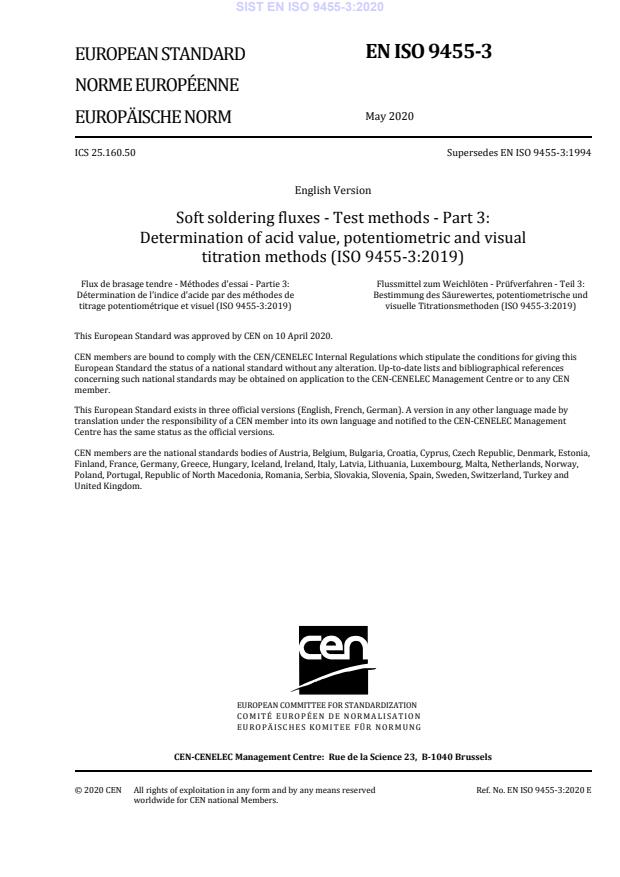
EN ISO 9455-3
EUROPEAN STANDARD
NORME EUROPÉENNE
May 2020
EUROPÄISCHE NORM
ICS 25.160.50 Supersedes EN ISO 9455-3:1994
English Version
Soft soldering fluxes - Test methods - Part 3:
Determination of acid value, potentiometric and visual
titration methods (ISO 9455-3:2019)
Flux de brasage tendre - Méthodes d'essai - Partie 3: Flussmittel zum Weichlöten - Prüfverfahren - Teil 3:
Détermination de l'indice d'acide par des méthodes de Bestimmung des Säurewertes, potentiometrische und
titrage potentiométrique et visuel (ISO 9455-3:2019) visuelle Titrationsmethoden (ISO 9455-3:2019)
This European Standard was approved by CEN on 10 April 2020.
CEN members are bound to comply with the CEN/CENELEC Internal Regulations which stipulate the conditions for giving this
European Standard the status of a national standard without any alteration. Up-to-date lists and bibliographical references
concerning such national standards may be obtained on application to the CEN-CENELEC Management Centre or to any CEN
member.
This European Standard exists in three official versions (English, French, German). A version in any other language made by
translation under the responsibility of a CEN member into its own language and notified to the CEN-CENELEC Management
Centre has the same status as the official versions.
CEN members are the national standards bodies of Austria, Belgium, Bulgaria, Croatia, Cyprus, Czech Republic, Denmark, Estonia,
Finland, France, Germany, Greece, Hungary, Iceland, Ireland, Italy, Latvia, Lithuania, Luxembourg, Malta, Netherlands, Norway,
Poland, Portugal, Republic of North Macedonia, Romania, Serbia, Slovakia, Slovenia, Spain, Sweden, Switzerland, Turkey and
United Kingdom.
EUROPEAN COMMITTEE FOR STANDARDIZATION
COMITÉ EUROPÉEN DE NORMALISATION
EUROPÄISCHES KOMITEE FÜR NORMUNG
CEN-CENELEC Management Centre: Rue de la Science 23, B-1040 Brussels
© 2020 CEN All rights of exploitation in any form and by any means reserved Ref. No. EN ISO 9455-3:2020 E
worldwide for CEN national Members.
Contents Page
European foreword . 3
European foreword
This document (EN ISO 9455-3:2020) has been prepared by Technical Committee ISO/TC 44 "Welding
and allied processes" in collaboration with Technical Committee CEN/TC 121 “Welding and allied
processes” the secretariat of which is held by DIN.
This European Standard shall be given the status of a national standard, either by publication of an
identical text or by endorsement, at the latest by November 2020, and conflicting national standards
shall be withdrawn at the latest by November 2020.
Attention is drawn to the possibility that some of the elements of this document may be the subject of
patent rights. CEN shall not be held responsible for identifying any or all such patent rights.
This document supersedes EN ISO 9455-3:1994.
According to the CEN-CENELEC Internal Regulations, the national standards organizations of the
following countries are bound to implement this European Standard: Austria, Belgium, Bulgaria,
Croatia, Cyprus, Czech Republic, Denmark, Estonia, Finland, France, Germany, Greece, Hungary, Iceland,
Ireland, Italy, Latvia, Lithuania, Luxembourg, Malta, Netherlands, Norway, Poland, Portugal, Republic of
North Macedonia, Romania, Serbia, Slovakia, Slovenia, Spain, Sweden, Switzerland, Turkey and the
United Kingdom.
Endorsement notice
The text of ISO 9455-3:2019 has been approved by CEN as EN ISO 9455-3:2020 without any
modification.
INTERNATIONAL ISO
STANDARD 9455-3
Second edition
2019-09
Soft soldering fluxes — Test
methods —
Part 3:
Determination of acid value,
potentiometric and visual titration
methods
Flux de brasage tendre — Méthodes d'essai —
Partie 3: Détermination de l'indice d'acide par des méthodes de
titrage potentiométrique et visuel
Reference number
ISO 9455-3:2019(E)
©
ISO 2019
ISO 9455-3:2019(E)
© ISO 2019
All rights reserved. Unless otherwise specified, or required in the context of its implementation, no part of this publication may
be reproduced or utilized otherwise in any form or by any means, electronic or mechanical, including photocopying, or posting
on the internet or an intranet, without prior written permission. Permission can be requested from either ISO at the address
below or ISO’s member body in the country of the requester.
ISO copyright office
CP 401 • Ch. de Blandonnet 8
CH-1214 Vernier, Geneva
Phone: +41 22 749 01 11
Fax: +41 22 749 09 47
Email: copyright@iso.org
Website: www.iso.org
Published in Switzerland
ii © ISO 2019 – All rights reserved
ISO 9455-3:2019(E)
Contents Page
Foreword .iv
1 Scope . 1
2 Normative references . 1
3 Terms and definitions . 1
4 Method A: Potentiometric titration method . 1
4.1 Principle . 1
4.2 Reagents. 1
4.3 Apparatus . 2
4.4 Procedure . 2
4.4.1 General. 2
4.4.2 Manual procedure . 2
4.4.3 Automated procedure. 3
4.5 Calculation of results . 3
5 Method B — Titration method with visual end‑point . 3
5.1 Principle . 3
5.2 Reagents. 4
5.3 Apparatus . 4
5.4 Procedure . 4
5.5 Calculation of results . 5
6 Precision . 5
6.1 Method A . 5
6.2 Method B . 5
7 Test report . 5
Bibliography . 6
ISO 9455-3:2019(E)
Foreword
ISO (the International Organization for Standardization) is a worldwide federation of national standards
bodies (ISO member bodies). The work of preparing International Standards is normally carried out
through ISO technical committees. Each member body interested in a subject for which a technical
committee has been established has the right to be represented on that committee. International
organizations, governmental and non-governmental, in liaison with ISO, also take part in the work.
ISO collaborates closely with the International Electrotechnical Commission (IEC) on all matters of
electrotechnical standardization.
The procedures used to develop this document and those intended for its further maintenance are
described in the ISO/IEC Directives, Part 1. In particular, the different approval criteria needed for the
different types of ISO documents should be noted. This document was drafted in accordance with the
editorial rules of the ISO/IEC Directives, Part 2 (see www .iso .org/directives).
Attention is drawn to the possibility that some of the elements of this document may be the subject of
patent rights. ISO shall not be held responsible for identifying any or all such patent rights. Details of
any patent rights identified during the development of the document will be in the Introduction and/or
on the ISO list of patent declarations received (see www .iso .org/patents).
Any trade name used in this document is information given for the convenience of users and does not
constitute an endorsement.
For an explanation of the voluntary nature of standards, the meaning of ISO specific terms and
expressions related to conformity assessment, as well as information about ISO's adherence to the
World Trade Organization (WTO) principles in the Technical Barriers to Trad
...
The article discusses a document, EN ISO 9455-3:2020, which specifies two methods for determining the acid value of certain soldering flux types. Method A is a potentiometric titration method and is considered the reference method. Method B is an alternative visual endpoint titration method.
記事タイトル:EN ISO 9455-3:2020 - Soft soldering fluxes - Test methods - Part 3: Determination of acid value, potentiometric and visual titration methods (ISO 9455-3:2019) 記事内容:この文書では、ISO 9454-1で定義された1型および2型のフラックスの酸価を2つの方法で定める方法を規定しています。 方法Aはポテンショメトリック滴定法であり、基準方法として考慮されます。 方法Bは代替の視覚的な終点滴定法です。
기사 제목: EN ISO 9455-3:2020 - 연속 납땜 플럭스 - 시험 방법 - 파트 3: 산도 값, 전위 측정법 및 시각적 산정법의 결정 (ISO 9455-3:2019) 기사 내용: 이 문서는 ISO 9454-1에서 정의된 1형과 2형 플럭스의 산도 값 결정을 위해 두 가지 방법을 명시합니다. A 방법은 전위 측정법으로, 참조 방법으로 간주되어야 합니다. B 방법은 대체되는 시각적 종점 산정법입니다.
Questions, Comments and Discussion
Ask us and Technical Secretary will try to provide an answer. You can facilitate discussion about the standard in here.
Loading comments...