


EN 1978:2022
(Main)Copper and copper alloys - Copper cathodes
Copper and copper alloys - Copper cathodes
This document specifies the composition and property requirements for cathodes of two copper grades, designated Cu-CATH-1 (CR001A) and Cu-CATH-2 (CR002A).
Annex A (normative) describes methods for sampling cathodes for use in cases of dispute between the purchaser and the supplier. Annex B (informative) gives information on the relationships between electrical resistivity and conductivity of copper.
Kupfer und Kupferlegierungen - Kupfer-Kathoden
Dieses Dokument legt die Zusammensetzung und die Eigenschaftsanforderungen an Kathoden aus zwei Kupfersorten fest, die mit Cu CATH 1 (CR001A) und Cu CATH 2 (CR002A) bezeichnet werden.
Der Anhang A (normativ) beschreibt Verfahren für die Probenentnahme von Kathoden für den Fall von Unstimmigkeiten zwischen dem Käufer und dem Lieferanten. Anhang B (informativ) beschreibt die Beziehung zwischen spezifischem elektrischem Widerstand und spezifischer elektrischer Leitfähigkeit von Kupfer.
Cuivre et alliages de cuivre - Cathodes en cuivre
Le présent document spécifie la composition et les exigences en matière de propriétés de deux nuances de cathodes en cuivre, nommées Cu-CATH-1 (CR001A) et Cu-CATH-2 (CR002A).
L’Annexe A (normative) décrit des méthodes d’échantillonnage des cathodes en cas de litige entre le client et le fournisseur. L’Annexe B (informative) donne des informations sur les rapports entre la résistivité électrique et la conductivité du cuivre.
Baker in bakrove zlitine - Bakrove katode
Ta dokument določa zahteve glede sestave in lastnosti za katode dveh razredov bakra, označene s Cu-CATH-1 (CR001A) in Cu-CATH-2 (CR002A).
Dodatek A (normativni) opisuje metode za vzorčenje katod za uporabo v primerih spora med kupcem in dobaviteljem. Dodatek B (informativni) vsebuje informacije o razmerjih med električno upornostjo in prevodnostjo bakra.
General Information
- Status
- Published
- Publication Date
- 20-Sep-2022
- Technical Committee
- CEN/TC 133 - Copper and copper alloys
- Drafting Committee
- CEN/TC 133/WG 1 - Unwrought copper products
- Current Stage
- 6060 - Definitive text made available (DAV) - Publishing
- Start Date
- 21-Sep-2022
- Due Date
- 19-Dec-2022
- Completion Date
- 21-Sep-2022
Relations
- Effective Date
- 11-May-2020
Overview
EN 1978:2022 (CEN) specifies composition and property requirements for copper cathodes produced by electrolytic deposition. It covers two refined copper grades: Cu‑CATH‑1 (CR001A) - intended primarily for high‑conductivity copper (e.g., drawing stock) - and Cu‑CATH‑2 (CR002A) - intended for other wrought electrical and general‑purpose products. The standard includes mandatory requirements for composition, electrical properties (mass resistivity at 20 °C), dimensions, surface condition, sampling and test methods. Annex A (normative) sets dispute sampling and sample‑preparation procedures; Annex B (informative) explains relationships between resistivity and conductivity.
Key topics and technical requirements
- Material grades and designation: standardized product designation (cathode + EN 1978 + material symbol or number).
- Composition limits: tabulated maximums for impurities and minimum copper content (Cu‑CATH‑2 has a copper minimum of 99.90 %). Specific element group limits and special notes (e.g., sulfur determined on cast samples) are given.
- Electrical properties: mass resistivity limits at 20 °C are specified for both grades; corresponding nominal volume resistivity and conductivity values are given (see Annex B for conversion and % IACS explanation).
- Dimensions and surface condition: cathodes may be supplied whole or cut to agreed sizes; cathodes must withstand ordinary handling and be reasonably free from nodules, electrolyte residue and extraneous material.
- Sampling and testing:
- Routine sampling at sampler’s discretion.
- Annex A prescribes sampling, bulk sample casting and analysis sample preparation for dispute resolution.
- Test methods reference IEC 60468 (resistivity) and EN 16117‑2 (electrolytic copper determination) among others.
- Ordering and documentation: purchaser should specify quantity, denomination, EN number and material designation; options for declaration of conformity and inspection documentation are covered.
Applications and who uses this standard
EN 1978:2022 is used by:
- Copper refiners and cathode producers to certify product quality.
- Metal traders and commodity buyers for procurement specifications.
- Wire rod, drawing stock and general wrought‑copper manufacturers assessing feedstock suitability.
- Quality control laboratories and inspection bodies for sampling and testing protocols.
- Procurement and compliance teams specifying contractual requirements (marking, certificates, inspection documents).
Practical applications include specifying cathode feedstock for melting, ensuring electrical conductivity targets for downstream electrical products, and resolving composition or resistivity disputes through standardized sampling and test procedures.
Related standards
- EN 1976 - Cast unwrought copper products
- EN 1977 - Copper drawing stock (wire rod)
- EN 16117‑2 - Determination of copper content (electrolytic method)
- IEC 60468 - Measurement of resistivity of metallic materials
Keywords: EN 1978:2022, copper cathodes, Cu‑CATH‑1, Cu‑CATH‑2, copper cathode specifications, electrical resistivity, CEN, sampling methods, copper alloys standard.

Frequently Asked Questions
EN 1978:2022 is a standard published by the European Committee for Standardization (CEN). Its full title is "Copper and copper alloys - Copper cathodes". This standard covers: This document specifies the composition and property requirements for cathodes of two copper grades, designated Cu-CATH-1 (CR001A) and Cu-CATH-2 (CR002A). Annex A (normative) describes methods for sampling cathodes for use in cases of dispute between the purchaser and the supplier. Annex B (informative) gives information on the relationships between electrical resistivity and conductivity of copper.
This document specifies the composition and property requirements for cathodes of two copper grades, designated Cu-CATH-1 (CR001A) and Cu-CATH-2 (CR002A). Annex A (normative) describes methods for sampling cathodes for use in cases of dispute between the purchaser and the supplier. Annex B (informative) gives information on the relationships between electrical resistivity and conductivity of copper.
EN 1978:2022 is classified under the following ICS (International Classification for Standards) categories: 77.150.30 - Copper products. The ICS classification helps identify the subject area and facilitates finding related standards.
EN 1978:2022 has the following relationships with other standards: It is inter standard links to EN 1978:1998. Understanding these relationships helps ensure you are using the most current and applicable version of the standard.
You can purchase EN 1978:2022 directly from iTeh Standards. The document is available in PDF format and is delivered instantly after payment. Add the standard to your cart and complete the secure checkout process. iTeh Standards is an authorized distributor of CEN standards.
Standards Content (Sample)
SLOVENSKI STANDARD
01-november-2022
Nadomešča:
SIST EN 1978:1999
Baker in bakrove zlitine - Bakrove katode
Copper and copper alloys - Copper cathodes
Kupfer und Kupferlegierungen - Kupfer-Kathoden
Cuivre et alliages de cuivre - Cathodes en cuivre
Ta slovenski standard je istoveten z: EN 1978:2022
ICS:
77.150.30 Bakreni izdelki Copper products
2003-01.Slovenski inštitut za standardizacijo. Razmnoževanje celote ali delov tega standarda ni dovoljeno.
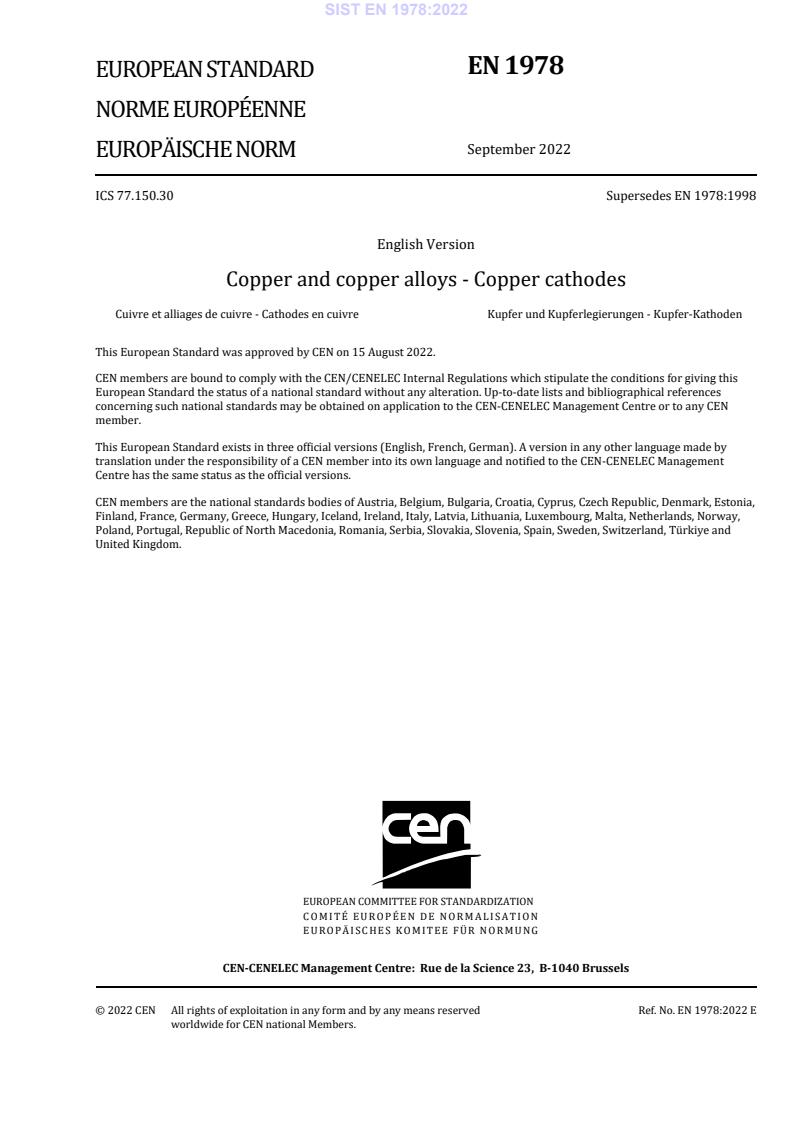
EN 1978
EUROPEAN STANDARD
NORME EUROPÉENNE
September 2022
EUROPÄISCHE NORM
ICS 77.150.30 Supersedes EN 1978:1998
English Version
Copper and copper alloys - Copper cathodes
Cuivre et alliages de cuivre - Cathodes en cuivre Kupfer und Kupferlegierungen - Kupfer-Kathoden
This European Standard was approved by CEN on 15 August 2022.
CEN members are bound to comply with the CEN/CENELEC Internal Regulations which stipulate the conditions for giving this
European Standard the status of a national standard without any alteration. Up-to-date lists and bibliographical references
concerning such national standards may be obtained on application to the CEN-CENELEC Management Centre or to any CEN
member.
This European Standard exists in three official versions (English, French, German). A version in any other language made by
translation under the responsibility of a CEN member into its own language and notified to the CEN-CENELEC Management
Centre has the same status as the official versions.
CEN members are the national standards bodies of Austria, Belgium, Bulgaria, Croatia, Cyprus, Czech Republic, Denmark, Estonia,
Finland, France, Germany, Greece, Hungary, Iceland, Ireland, Italy, Latvia, Lithuania, Luxembourg, Malta, Netherlands, Norway,
Poland, Portugal, Republic of North Macedonia, Romania, Serbia, Slovakia, Slovenia, Spain, Sweden, Switzerland, Türkiye and
United Kingdom.
EUROPEAN COMMITTEE FOR STANDARDIZATION
COMITÉ EUROPÉEN DE NORMALISATION
EUROPÄISCHES KOMITEE FÜR NORMUNG
CEN-CENELEC Management Centre: Rue de la Science 23, B-1040 Brussels
© 2022 CEN All rights of exploitation in any form and by any means reserved Ref. No. EN 1978:2022 E
worldwide for CEN national Members.
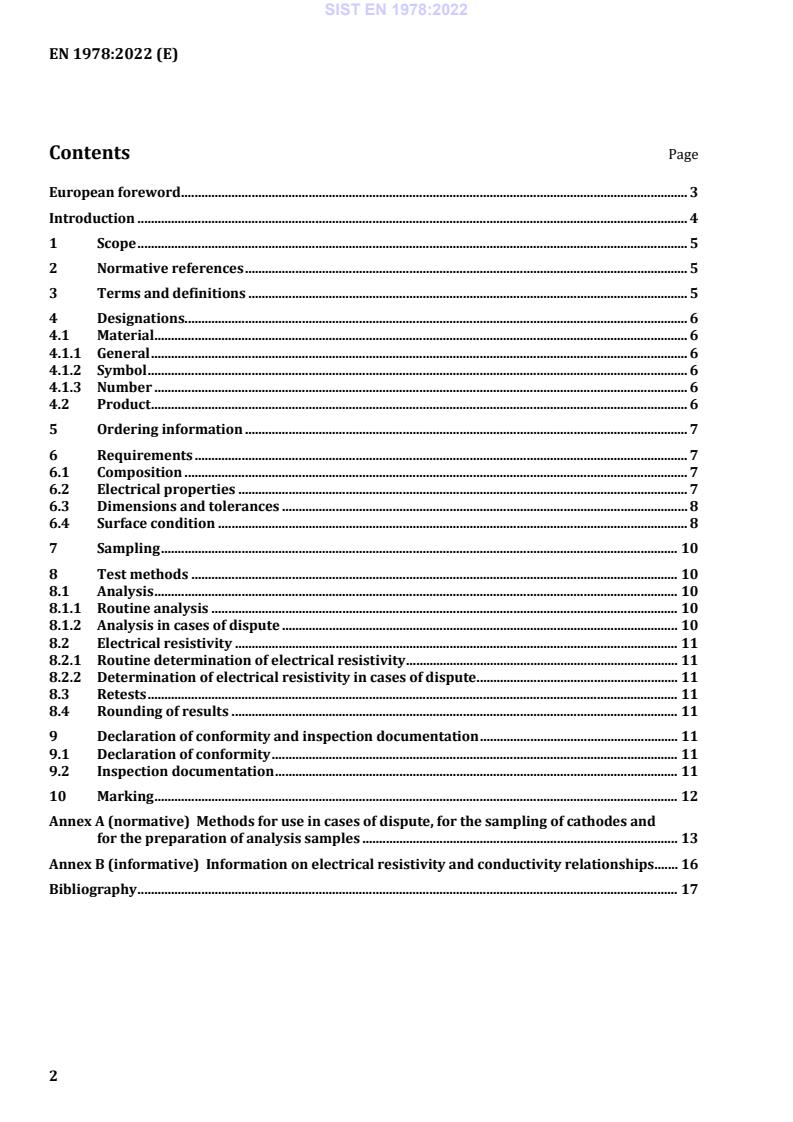
Contents Page
European foreword . 3
Introduction . 4
1 Scope . 5
2 Normative references . 5
3 Terms and definitions . 5
4 Designations. 6
4.1 Material . 6
4.1.1 General . 6
4.1.2 Symbol . 6
4.1.3 Number . 6
4.2 Product . 6
5 Ordering information . 7
6 Requirements . 7
6.1 Composition . 7
6.2 Electrical properties . 7
6.3 Dimensions and tolerances . 8
6.4 Surface condition . 8
7 Sampling . 10
8 Test methods . 10
8.1 Analysis . 10
8.1.1 Routine analysis . 10
8.1.2 Analysis in cases of dispute . 10
8.2 Electrical resistivity . 11
8.2.1 Routine determination of electrical resistivity . 11
8.2.2 Determination of electrical resistivity in cases of dispute . 11
8.3 Retests . 11
8.4 Rounding of results . 11
9 Declaration of conformity and inspection documentation . 11
9.1 Declaration of conformity . 11
9.2 Inspection documentation . 11
10 Marking . 12
Annex A (normative) Methods for use in cases of dispute, for the sampling of cathodes and
for the preparation of analysis samples . 13
Annex B (informative) Information on electrical resistivity and conductivity relationships . 16
Bibliography . 17
European foreword
This document (EN 1978:2022) has been prepared by Technical Committee CEN/TC 133 “Copper and
copper alloys”, the secretariat of which is held by DIN.
This European Standard shall be given the status of a national standard, either by publication of an
identical text or by endorsement, at the latest by March 2023, and conflicting national standards shall be
withdrawn at the latest by March 2023.
Attention is drawn to the possibility that some of the elements of this document may be the subject of
patent rights. CEN shall not be held responsible for identifying any or all such patent rights.
This document supersedes EN 1978:1998.
In comparison with the previous edition, the following technical modifications have been made:
a) The reference to EN 1655 has been replaced by EN ISO/IEC 17050-1 and EN ISO/IEC 17050-2.
This is one of a series of European Standards for products manufactured from refined copper grades.
Other products are specified as follows:
— EN 1976, Copper and copper alloys - Cast unwrought copper products
— EN 1977, Copper and copper alloys - Copper drawing stock (wire rod)
Any feedback and questions on this document should be directed to the users’ national standards body.
A complete listing of these bodies can be found on the CEN website.
According to the CEN-CENELEC Internal Regulations, the national standards organisations of the
following countries are bound to implement this European Standard: Austria, Belgium, Bulgaria, Croatia,
Cyprus, Czech Republic, Denmark, Estonia, Finland, France, Germany, Greece, Hungary, Iceland, Ireland,
Italy, Latvia, Lithuania, Luxembourg, Malta, Netherlands, Norway, Poland, Portugal, Republic of North
Macedonia, Romania, Serbia, Slovakia, Slovenia, Spain, Sweden, Switzerland, Türkiye and the United
Kingdom.
Introduction
This document was prepared to combine the various requirements and methods of test for copper
cathodes, previously dealt with in a range of separate national standards.
Copper cathodes are intended for melting. Cu-CATH-1 (CR001A) is primarily intended for the production
of high conductivity copper, such as for drawing stock. Cu-CATH-2 (CR002A) is intended for the
production of other wrought products for electrical and general purposes.
1 Scope
This document specifies the composition and property requirements for cathodes of two copper grades,
designated Cu-CATH-1 (CR001A) and Cu-CATH-2 (CR002A).
Annex A (normative) describes methods for sampling cathodes for use in cases of dispute between the
purchaser and the supplier. Annex B (informative) gives information on the relationships between
electrical resistivity and conductivity of copper.
2 Normative references
The following documents are referred to in the text in such a way that some or all of their content
constitutes requirements of this document. For dated references, only the edition cited applies. For
undated references, the latest edition of the referenced document (including any amendments) applies.
IEC 60468, Method of measurement of resistivity of metallic materials
EN 16117-2, Copper and copper alloys - Determination of copper content - Part 2: Electrolytic
determination of copper in materials with copper content higher than 99,80 %
3 Terms and definitions
For the purposes of this document, the following terms and definitions apply.
ISO and IEC maintain terminological databases for use in standardization at the following addresses:
— IEC Electropedia: available at https://www.electropedia.org/
— ISO Online browsing platform: available at https://www.iso.org/obp
3.1
cathode
flat, unwrought product made by electrolytic deposition
3.2
lot
quantity of copper cathodes weighing over 25 t and up to and including 200 t, consisting of one
consignment, or part of one consignment, produced by one refinery
3.3
bundle
total amount of a certain number of cathodes, typically 20 to 60, stacked together and secured, generally
by steel bands
3.4
sample of cathodes
number of cathodes randomly selected from the lot, and considered in total to be representative of the
lot
3.5
cathode sample
portion of one of the sampled cathodes (see 3.4) obtained by systematic cutting of vertical strips
3.6
bulk sample
sample produced by melting and casting the cathode samples (see 3.5) obtained from all the sampled
cathodes into a suitable mould (or moulds)
Note to entry 1: This is considered to be representative of the lot.
3.7
analysis sample
representative fractions of swarf taken from the swarf arising from drilling, milling or sawing the bulk
sample castings (see 3.6)
4 Designations
4.1 Material
4.1.1 General
The material is designated either by symbol or number (see Table 1).
4.1.2 Symbol
The material symbol designation is based on the designation system given in ISO 1190-1.
4.1.3 Number
The material number designation is in accordance with the system given in EN 1412.
4.2 Product
The product designation provides a standardized pattern of designation from which a rapid and
unequivocal description of a product is conveyed in communication. It provides mutual comprehension
at the international level with regard to products which meet the requirements of the relevant European
Standard.
The product designation is not substitute for the full content of the standard.
The product designation for products to this document shall consist of:
— denomination (cathode);
— number of this document (EN 1978);
— material designation, either symbol or number (see Table 1).
The derivation of a product designation is shown in the following example.
EXAMPLE Cathode conforming to this document, in material designated either Cu-CATH-1 or CR001A, will be
designated as follows.
5 Ordering information
In order to facilitate the enquiry, order and confirmation of order procedures between the purchaser and
the supplier, the purchaser shall state on his enquiry and order the following information:
a) quantity of product required (mass);
b) denomination (cathode);
c) number of this document (EN 1978);
d) material designation (see Table 1).
It is recommended that the product designation, as described in 4.2 is used for items b) to d).
In addition, the purchaser shall also state on the enquiry and order any of the following, if required:
e) the dimensions and tolerances required, if the cathodes are to be supplied cut to size (see 6.3);
f) whether a declaration of conformity is required (see 9.1);
g) whether an inspection document is required, and if so, which type (see 9.2).
EXAMPLE Ordering details for 100 t of cathode conforming to EN 1978, in material designated either Cu-
CATH-1 or CR001A:
100 t Cathode EN 1978 – Cu-CATH-1
or
100 t Cathode EN 1978 – CR001A
6 Requirements
6.1 Composition
The composition shall conform to the requirements for the appropriate grade given in Table 1.
6.2 Electrical properties
The electrical properties shall conform to the requirements for the appropriate grade given in Table 2.
The tests shall be carried out in accordance with 8.2.
NOTE Mass resistivity is the mandatory electrical property requirement in this document. The relationship
between mass resistivity and the corresponding volume resistivity and conductivity is given in Annex B.
6.3 Dimensions and tolerances
The cathodes shall be either whole or cut to sizes as agreed between the purchaser and the supplier and
stated in the purchaser's order [see Clause 5 e)].
6.4 Surface condition
Cathodes shall withstand ordinary handling without breakage. They shall be reasonably free from
nodules, outgrowth edges and from all extraneous materials such as electrolyte residue
...
SIST EN 1978:2022は、銅および銅合金に関する標準文書であり、主に銅カソードの2つのグレード(Cu-CATH-1 (CR001A)およびCu-CATH-2 (CR002A))の組成および特性要件を規定しています。この標準は、銅カソードの製造及び取引における明確で統一された基準を提供するため、業界において非常に重要な役割を果たしています。 この標準の強みには、まず第一に、具体的な数値と基準値が提供されている点が挙げられます。これにより、製造者と購入者の両者が品質を確認し、製品のコンプライアンスを容易に判断できます。さらに、附属文書Aでは、購入者と供給者間での対立が発生した場合に備えたカソードのサンプリング方法が詳細に説明されているため、標準に基づいた冷静な解決が図れます。 また、附属文書Bにおいては、銅の電気抵抗率と導電率の関係についての情報が提供されており、これは技術者や研究者にとって非常に有益です。これによって、銅カソードの特性に基づいた選択や応用がしやすくなります。 全体として、SIST EN 1978:2022は、銅カソードの製造及び取引における標準化を進めるための信頼性の高いガイドラインであり、業界内での一貫性と透明性を促進します。銅及び銅合金の使用に関連する企業や専門家にとって、これらの標準は非常に意義深いものであり、その関連性は今後も増していくでしょう。
The standard EN 1978:2022 provides comprehensive specifications for copper cathodes, specifically addressing two distinct copper grades: Cu-CATH-1 (CR001A) and Cu-CATH-2 (CR002A). This document plays a crucial role in standardizing the composition and property requirements of copper cathodes, ensuring consistency and reliability in the production and use of these materials across various applications. One of the primary strengths of EN 1978:2022 lies in its well-defined scope, which not only clarifies the grading of copper cathodes but also establishes clear criteria for their physical and chemical properties. This specificity aids manufacturers and suppliers in maintaining quality control throughout the supply chain, thereby enhancing the overall efficiency of copper production and distribution. The inclusion of Annex A is particularly valuable, as it outlines standardized methods for sampling cathodes, allowing for objective resolution of disputes that may arise between purchasers and suppliers. This provision fosters transparency and trust in transactions, a significant factor in the copper market where material quality is paramount. Moreover, the informative Annex B of the standard adds additional depth by elucidating the correlations between electrical resistivity and conductivity of copper. This aspect not only enhances the understanding of copper properties for end-users but also supports manufacturers in optimizing their production processes to meet specific performance requirements. Overall, EN 1978:2022 stands out for its clarity, thoroughness, and relevance to the industry. It establishes a solid foundation for quality assurance in the production of copper cathodes, aligning industry practices with internationally recognized standards, thus playing a pivotal role in the advancement of copper and copper alloys standards.
SIST EN 1978:2022 표준은 구리 및 구리 합금 분야에서 중요한 기준을 제시합니다. 이 문서는 Cu-CATH-1 (CR001A) 및 Cu-CATH-2 (CR002A) 두 가지 구리 등급의 카소드에 대한 조성과 특성 요구 사항을 명확히 하여, 품질 관리와 산업 표준ization에 기여합니다. 이 표준의 주요 강점 중 하나는 구리 카소드의 특성과 조성을 상세히 규정함으로써, 공급업체와 구매자 간의 분쟁 상황에서 신뢰할 수 있는 기준을 제공한다는 점입니다. Annex A에는 카소드를 샘플링하는 방법이 규정되어 있어, 발생할 수 있는 분쟁을 효과적으로 해결할 수 있는 지침을 마련합니다. 이러한 점은 구리 카소드 품질을 보장하고, 시장에서의 일관성을 유지하는 데 큰 도움이 됩니다. 더욱이 Annex B는 구리의 전기 저항성과 전도도 사이의 관계를 기술하고 있어, 이러한 물리적 특성에 대한 이해를 돕고, 실용적인 응용에 대한 정보를 제공합니다. 이로 인해, 연구개발 및 산업 실무자들이 구리를 보다 효과적으로 활용할 수 있는 기반을 마련합니다. SIST EN 1978:2022 표준은 구리 카소드의 산업 적용에서 필수적인 참고자료로 자리 잡고 있으며, 구리 및 구리 합금의 시장에서의 공정성과 품질을 높이는 데 중요한 역할을 합니다.
Die Norm EN 1978:2022 legt die Anforderungen an die Zusammensetzung und die Eigenschaften von Kupferkathoden fest, insbesondere für die beiden Kupfergrade Cu-CATH-1 (CR001A) und Cu-CATH-2 (CR002A). Diese standardisierte Dokumentation ist von großer Bedeutung für die Industrie, da sie klare und präzise Spezifikationen liefert, die für die Qualitätssicherung und die Einhaltung von Sicherheitsstandards entscheidend sind. Ein herausragendes Merkmal der Norm ist der strukturierte Ansatz zur Definition der Eigenschaften von Kupferkathoden. Durch die klare Differenzierung zwischen den beiden Kupfergraden wird nachvollziehbar, welche Anforderungen an die jeweilige Materialqualität gestellt werden. Dies fördert nicht nur die Transparenz auf dem Markt, sondern auch das Vertrauen zwischen Käufern und Lieferanten. Der Anhang A, der normative Methoden zur Probenahme beschreibt, ist besonders pertinent. Diese Verfahren bieten eine Lösung für mögliche Streitigkeiten zwischen Käufern und Lieferanten und tragen dazu bei, eine faire und sachkundige Beurteilung der Materialqualität zu gewährleisten. Das Vorhandensein von soliden Prüfmethoden ist ein bedeutender Vorteil, da es den Parteien ermöglicht, bei Unstimmigkeiten auf objektive Standards zurückzugreifen. Darüber hinaus bietet Anhang B informative Hinweise zur Beziehung zwischen elektrischer Widerstandsfähigkeit und Leitfähigkeit von Kupfer. Diese Informationen sind nicht nur für die Produktspezifikation wichtig, sondern unterstützen auch Ingenieure und Techniker bei der Anwendung von Kupferkathoden in verschiedenen technischen Kontexten. Die Verbindung dieser physikalischen Eigenschaften zu praktischen Anwendungen unterstreicht die Relevanz der Norm EN 1978:2022 in der aktuellen Technologie- und Elektrobranche. Zusammenfassend lässt sich sagen, dass die Norm EN 1978:2022 eine essentielle Grundlage für die Verwendung von Kupfer und Kupferlegierungen in der Branche darstellt. Sie bietet nicht nur klare Vorgaben für die Zusammensetzung und Eigenschaften, sondern auch wertvolle Informationen zur Qualitätssicherung und Anwendung von Kupferkathoden.
La norme SIST EN 1978:2022 offre un cadre exhaustif pour la spécification des cathodes de cuivre, en définissant clairement les exigences de composition et de propriétés pour deux grades de cuivre, à savoir Cu-CATH-1 (CR001A) et Cu-CATH-2 (CR002A). Cette standardisation est essentielle pour garantir la qualité et la fiabilité des produits en cuivre, ce qui est crucial dans de nombreuses applications industrielles. Un des points forts de cette norme est son annexe A, qui fournit des méthodes normatives pour échantillonner les cathodes de cuivre en cas de litige entre l'acheteur et le fournisseur. Cela renforce la confiance dans les transactions commerciales et assure un processus équitable pour les deux parties. De plus, grâce à cette approche normative, la norme contribue à réduire les litiges potentiels et à améliorer la transparence dans le commerce des cathodes de cuivre. L'annexe B, bien qu'informative, apporte une valeur ajoutée en exposant les relations entre la résistivité électrique et la conductivité du cuivre. Cela permet aux utilisateurs de mieux comprendre les propriétés physiques du cuivre et d’optimiser leur utilisation selon les besoins spécifiques de leurs applications. La norme SIST EN 1978:2022 demeure particulièrement pertinente dans un contexte où la qualité des matériaux est primordiale, notamment dans les secteurs de l'électrotechnique, de l'électronique et d'autres domaines nécessitant des matériaux conducteurs de haute performance. En établissant des standards clairs pour les cathodes de cuivre, elle facilite l'harmonisation des pratiques au sein de l'industrie, tout en répondant aux exigences Croissantes de durabilité et de performance. En somme, cette norme représente un document essentiel pour les industries utilisant des alliages de cuivre, offrant des lignes directrices précises qui favorisent une meilleure maîtrise des matériaux ainsi qu'une amélioration continue des processus de fabrication et d’inspection.
Questions, Comments and Discussion
Ask us and Technical Secretary will try to provide an answer. You can facilitate discussion about the standard in here.
Loading comments...