

EN 16641:2019
(Main)Textile floor coverings - Guidelines for acceptable colour deviations
- Abstract
This standard gives guidance in case of complaints when a colour deviation is observed after installation of a textile floor covering by the installer and/or end user.
The colour deviation can be observed within different parts of the installation or between the installed textile floor covering and the initially presented sample on which the choice for ordering was made.
- Status
- Published
- Publication Date
- 29-Oct-2019
- Withdrawal Date
- 29-Apr-2020
- Technical Committee
- CEN/TC 134 - Resilient and textile floor coverings
- Drafting Committee
- CEN/TC 134/WG 8 - Textile floor coverings
- Current Stage
- 9092 - Decision on results of review/2YR ENQ - revise - Review Enquiry
- Start Date
- 18-Dec-2025
- Completion Date
- 07-Oct-2026

Overview
EN 16641:2019 - Textile floor coverings - Guidelines for acceptable colour deviations - provides practical guidance for handling complaints when a colour deviation is observed after installation of textile floor coverings (carpets, carpet tiles, etc.). The standard covers deviations seen within an installation or between the installed product and the original sample used to order. It clarifies assessment method, acceptance criteria and reporting requirements to ensure consistent, objective outcomes in production, installation and after-sales disputes.
Key topics and technical requirements
- Scope and applicability: Guidance for installer and end‑user complaints arising from colour differences after installation.
- Causes noted: Manufacturing dyeing variations, different dye lots, visual assessment limits, production dates and installation factors.
- Installation requirements: Follow CEN/TS 14472-2 and manufacturer instructions. Prefer single production batch per room; plan large projects to use colour-equal batches. Pile direction must be consistent when colour uniformity is required.
- Assessment method:
- Use the larger grey scales from EN 20105‑A02 (five pairs representing colour fastness grades 5 to 1).
- Compare deviation by colour tone, depth and purity against the grey scale pairs.
- Assess on an area representative of the complaint.
- Minimum three independent assessors; report the median of their scores as the final result.
- Acceptance criteria:
- Grade 5 = no visible deviation.
- Grade 4 = production-bound but acceptable.
- Grade 3 = conditional - acceptance depends on the degree to which the deviation harms the overall appearance.
- Less than grade 3 = not acceptable.
- Reporting: Reports must record location, room description, number of assessors, each assessor’s result, the median, and reference EN 16641:2019.
Practical applications & users
Who uses EN 16641:2019:
- Carpet and textile floor covering manufacturers (quality control, production planning)
- Flooring installers and contractors (pre‑installation checks, on-site assessment)
- Project specifiers, architects and interior designers (setting acceptance criteria)
- Facility managers and building owners (complaint resolution)
- Laboratories and third‑party assessors (objective colour evaluation and reporting)
Benefits:
- Provides objective, repeatable assessment procedures for colour disputes.
- Reduces uncertainty in warranty and acceptance decisions.
- Helps planning to avoid batch mismatches on large installations.
Related standards
- CEN/TS 14472‑2 - Design, preparation and installation - Part 2: Textile floor coverings
- EN 20105‑A02 - Grey scale for assessing change in colour (used for assessment)
- ISO 2424 - Textile floor coverings - Vocabulary
- EN ISO 105‑A01 - General principles of testing (referenced in bibliography)
Keywords: EN 16641:2019, textile floor coverings, colour deviations, grey scale, EN 20105‑A02, carpet installation, acceptance criteria, colour assessment.
Relations
- Effective Date
- 06-Nov-2019
- Effective Date
- 25-Aug-2026
- Effective Date
- 28-Jan-2026
- Effective Date
- 28-Jan-2026
- Effective Date
- 28-Jan-2026
Frequently Asked Questions
EN 16641:2019 is a standard published by the European Committee for Standardization (CEN). Its full title is "Textile floor coverings - Guidelines for acceptable colour deviations". This standard covers: This standard gives guidance in case of complaints when a colour deviation is observed after installation of a textile floor covering by the installer and/or end user. The colour deviation can be observed within different parts of the installation or between the installed textile floor covering and the initially presented sample on which the choice for ordering was made.
This standard gives guidance in case of complaints when a colour deviation is observed after installation of a textile floor covering by the installer and/or end user. The colour deviation can be observed within different parts of the installation or between the installed textile floor covering and the initially presented sample on which the choice for ordering was made.
EN 16641:2019 is classified under the following ICS (International Classification for Standards) categories: 97.150 - Floor coverings. The ICS classification helps identify the subject area and facilitates finding related standards.
EN 16641:2019 has the following relationships with other standards: It is inter standard links to CEN/TS 16641:2014, ISO 2424:2007, EN 20105-A02:1994, CEN/TS 14472-2:2003, EN 4637:2010. Understanding these relationships helps ensure you are using the most current and applicable version of the standard.
EN 16641:2019 is available in PDF format for immediate download after purchase. The document can be added to your cart and obtained through the secure checkout process. Digital delivery ensures instant access to the complete standard document.
Standards Content (Sample)
SLOVENSKI STANDARD
01-januar-2020
Nadomešča:
SIST-TS CEN/TS 16641:2014
Tekstilne talne obloge - Smernice za sprejemljiva barvna odstopanja
Textile floor coverings - Guidelines for acceptable colour deviations
Textile Bodenbeläge - Richtlinien für akzeptablen Farbdifferenzen
Revêtements de sol textiles - Guidance pour les déviations de couleur acceptables
Ta slovenski standard je istoveten z: EN 16641:2019
ICS:
97.150 Talne obloge Floor coverings
2003-01.Slovenski inštitut za standardizacijo. Razmnoževanje celote ali delov tega standarda ni dovoljeno.
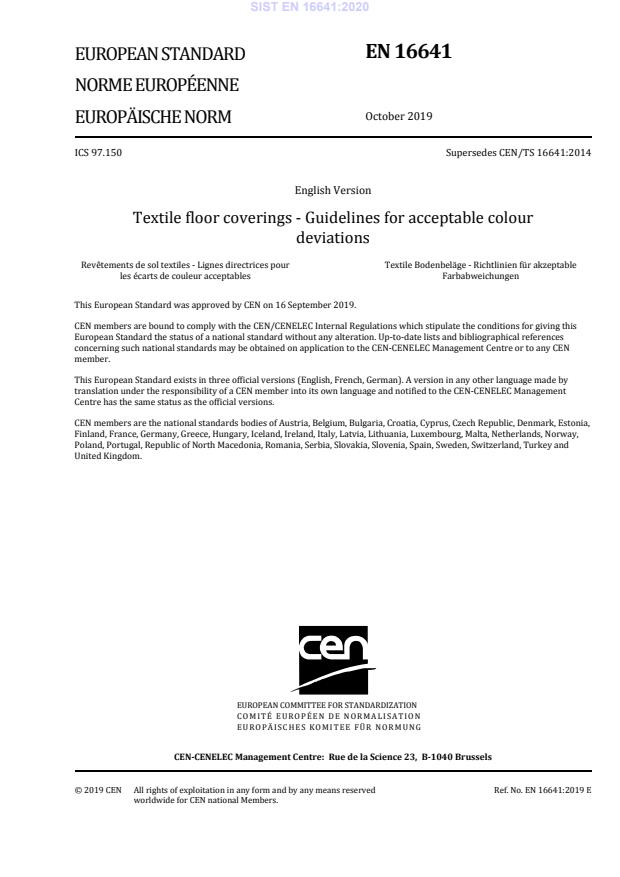
EN 16641
EUROPEAN STANDARD
NORME EUROPÉENNE
October 2019
EUROPÄISCHE NORM
ICS 97.150 Supersedes CEN/TS 16641:2014
English Version
Textile floor coverings - Guidelines for acceptable colour
deviations
Revêtements de sol textiles - Lignes directrices pour Textile Bodenbeläge - Richtlinien für akzeptable
les écarts de couleur acceptables Farbabweichungen
This European Standard was approved by CEN on 16 September 2019.
CEN members are bound to comply with the CEN/CENELEC Internal Regulations which stipulate the conditions for giving this
European Standard the status of a national standard without any alteration. Up-to-date lists and bibliographical references
concerning such national standards may be obtained on application to the CEN-CENELEC Management Centre or to any CEN
member.
This European Standard exists in three official versions (English, French, German). A version in any other language made by
translation under the responsibility of a CEN member into its own language and notified to the CEN-CENELEC Management
Centre has the same status as the official versions.
CEN members are the national standards bodies of Austria, Belgium, Bulgaria, Croatia, Cyprus, Czech Republic, Denmark, Estonia,
Finland, France, Germany, Greece, Hungary, Iceland, Ireland, Italy, Latvia, Lithuania, Luxembourg, Malta, Netherlands, Norway,
Poland, Portugal, Republic of North Macedonia, Romania, Serbia, Slovakia, Slovenia, Spain, Sweden, Switzerland, Turkey and
United Kingdom.
EUROPEAN COMMITTEE FOR STANDARDIZATION
COMITÉ EUROPÉEN DE NORMALISATION
EUROPÄISCHES KOMITEE FÜR NORMUNG
CEN-CENELEC Management Centre: Rue de la Science 23, B-1040 Brussels
© 2019 CEN All rights of exploitation in any form and by any means reserved Ref. No. EN 16641:2019 E
worldwide for CEN national Members.
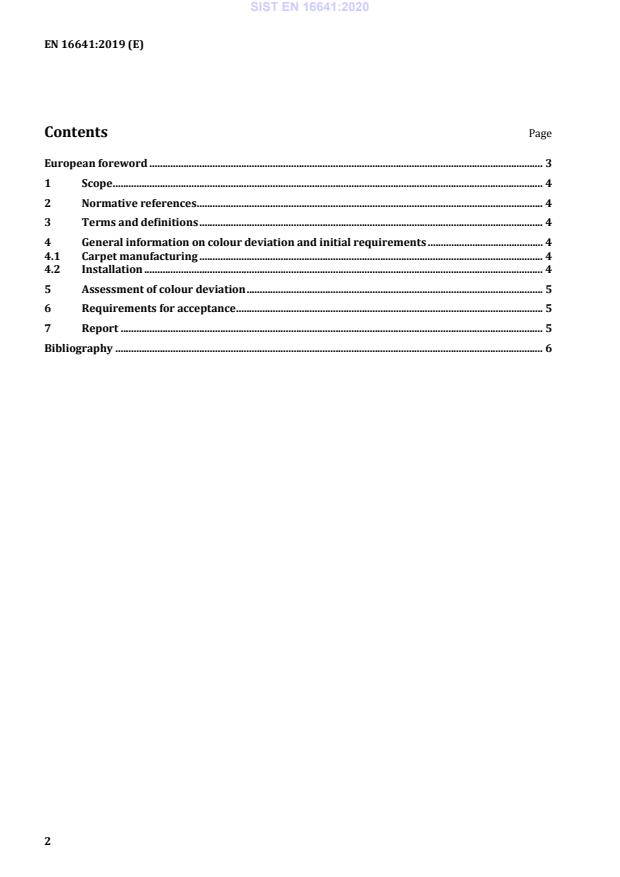
Contents Page
European foreword . 3
1 Scope . 4
2 Normative references . 4
3 Terms and definitions . 4
4 General information on colour deviation and initial requirements . 4
4.1 Carpet manufacturing . 4
4.2 Installation . 4
5 Assessment of colour deviation . 5
6 Requirements for acceptance . 5
7 Report . 5
Bibliography . 6
European foreword
This document (EN 16641:2019) has been prepared by Technical Committee CEN/TC 134 “Resilient,
textile and laminate floor coverings”, the secretariat of which is held by NBN.
This European Standard shall be given the status of a national standard, either by publication of an
identical text or by endorsement, at the latest by April 2020, and conflicting national standards shall be
withdrawn at the latest by April 2020.
Attention is drawn to the possibility that some of the elements of this document may be the subject of
patent rights. CEN shall not be held responsible for identifying any or all such patent rights.
This document supersedes CEN/TS 16641:2014.
In comparison with the previous edition, a number of technical and editorial changes for clarification
were introduced in clause 6.
According to the CEN-CENELEC Internal Regulations, the national standards organisations of the
following countries are bound to implement this European Standard: Austria, Belgium, Bulgaria,
Croatia, Cyprus, Czech Republic, Denmark, Estonia, Finland, France, Germany, Greece, Hungary, Iceland,
Ireland, Italy, Latvia, Lithuania, Luxembourg, Malta, Netherlands, Norway, Poland, Portugal, Republic of
North Macedonia, Romania, Serbia, Slovakia, Slovenia, Spain, Sweden, Switzerland, Turkey and the
United Kingdom.
1 Scope
This document gives guidance in c
...