


EN 12420:2014
(Main)Copper and copper alloys - Forgings
Copper and copper alloys - Forgings
This European Standard specifies the composition, the property requirements and tolerances on dimensions and form for copper and copper alloy die and hand forgings.
The sampling procedures, the methods of test for verification of conformity to the requirements of this standard, and the delivery conditions are also specified.
Kupfer und Kupferlegierungen - Schmiedestücke
Diese Europäische Norm legt die Zusammensetzung, die Anforderungen an die Eigenschaften und Maß und Formtoleranzen für Gesenk und Freiformschmiedestücke aus Kupfer und Kupferlegierungen fest.
Der Ablauf der Probenentnahme, die Prüfverfahren zur Feststellung der Übereinstimmung mit den Anforderungen dieser Norm und die Lieferbedingungen sind ebenfalls festgelegt.
Cuivre et alliages de cuivre - Pièces forgées
La présente Norme européenne spécifie la composition, les propriétés et les tolérances dimensionnelles et de forme des pièces forgées par matriçage et des pièces forgées libres en cuivre et alliages de cuivre.
Les modes opératoires d’échantillonnage, les méthodes d’essai pour la vérification de la conformité aux exigences de la présente norme et les conditions de livraison sont également spécifiés.
Baker in bakrove zlitine - Izkovki
EN 12420 določa sestavo, zahteve glede lastnosti in dopustna odstopanja od dimenzij in oblik za baker, barve bakrovih zlitin in izkovke. Določeni so tudi postopki vzorčenja, preskusne metode za preverjanje skladnosti z zahtevami tega evropskega standarda in dobavni pogoji.
General Information
- Status
- Withdrawn
- Publication Date
- 24-Jun-2014
- Withdrawal Date
- 13-Apr-2025
- Technical Committee
- CEN/TC 133 - Copper and copper alloys
- Drafting Committee
- CEN/TC 133/WG 4 - Extruded and drawn products, forgings and scrap
- Current Stage
- 9960 - Withdrawal effective - Withdrawal
- Start Date
- 16-Oct-2024
- Completion Date
- 14-Apr-2025
Relations
- Effective Date
- 08-Jun-2022
- Effective Date
- 18-Jan-2023
Frequently Asked Questions
EN 12420:2014 is a standard published by the European Committee for Standardization (CEN). Its full title is "Copper and copper alloys - Forgings". This standard covers: This European Standard specifies the composition, the property requirements and tolerances on dimensions and form for copper and copper alloy die and hand forgings. The sampling procedures, the methods of test for verification of conformity to the requirements of this standard, and the delivery conditions are also specified.
This European Standard specifies the composition, the property requirements and tolerances on dimensions and form for copper and copper alloy die and hand forgings. The sampling procedures, the methods of test for verification of conformity to the requirements of this standard, and the delivery conditions are also specified.
EN 12420:2014 is classified under the following ICS (International Classification for Standards) categories: 77.150.30 - Copper products. The ICS classification helps identify the subject area and facilitates finding related standards.
EN 12420:2014 has the following relationships with other standards: It is inter standard links to EN 12420:1999, EN 12420:2024. Understanding these relationships helps ensure you are using the most current and applicable version of the standard.
EN 12420:2014 is associated with the following European legislation: EU Directives/Regulations: 2014/68/EU, 97/23/EC; Standardization Mandates: M/071. When a standard is cited in the Official Journal of the European Union, products manufactured in conformity with it benefit from a presumption of conformity with the essential requirements of the corresponding EU directive or regulation.
You can purchase EN 12420:2014 directly from iTeh Standards. The document is available in PDF format and is delivered instantly after payment. Add the standard to your cart and complete the secure checkout process. iTeh Standards is an authorized distributor of CEN standards.
Standards Content (Sample)
2003-01.Slovenski inštitut za standardizacijo. Razmnoževanje celote ali delov tega standarda ni dovoljeno.Baker in bakrove zlitine - IzkovkiKupfer und Kupferlegierungen - SchmiedestückeCuivre et alliages de cuivre - Pièces forgéesCopper and copper alloys - Forgings77.150.30Bakreni izdelkiCopper productsICS:Ta slovenski standard je istoveten z:EN 12420:2014SIST EN 12420:2014en,fr,de01-september-2014SIST EN 12420:2014SLOVENSKI
STANDARDSIST EN 12420:19991DGRPHãþD
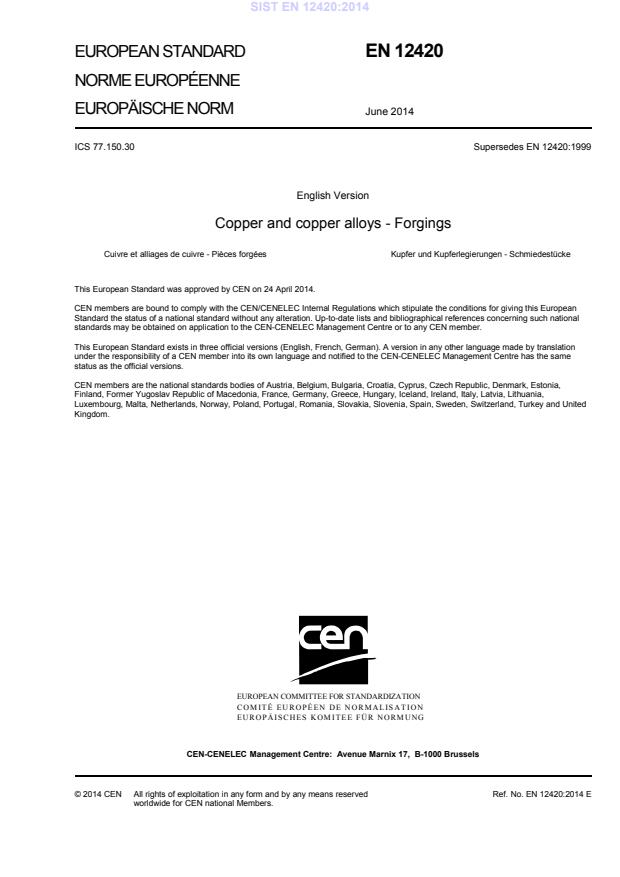
EUROPEAN STANDARD NORME EUROPÉENNE EUROPÄISCHE NORM
EN 12420
June 2014 ICS 77.150.30 Supersedes EN 12420:1999English Version
Copper and copper alloys - Forgings
Cuivre et alliages de cuivre - Pièces forgées
Kupfer und Kupferlegierungen - Schmiedestücke This European Standard was approved by CEN on 24 April 2014.
CEN members are bound to comply with the CEN/CENELEC Internal Regulations which stipulate the conditions for giving this European Standard the status of a national standard without any alteration. Up-to-date lists and bibliographical references concerning such national standards may be obtained on application to the CEN-CENELEC Management Centre or to any CEN member.
This European Standard exists in three official versions (English, French, German). A version in any other language made by translation under the responsibility of a CEN member into its own language and notified to the CEN-CENELEC Management Centre has the same status as the official versions.
CEN members are the national standards bodies of Austria, Belgium, Bulgaria, Croatia, Cyprus, Czech Republic, Denmark, Estonia, Finland, Former Yugoslav Republic of Macedonia, France, Germany, Greece, Hungary, Iceland, Ireland, Italy, Latvia, Lithuania, Luxembourg, Malta, Netherlands, Norway, Poland, Portugal, Romania, Slovakia, Slovenia, Spain, Sweden, Switzerland, Turkey and United Kingdom.
EUROPEAN COMMITTEE FOR STANDARDIZATION
COMITÉ EUROPÉEN DE NORMALISATION EUROPÄISCHES KOMITEE FÜR NORMUNG
CEN-CENELEC Management Centre:
Avenue Marnix 17,
B-1000 Brussels © 2014 CEN All rights of exploitation in any form and by any means reserved worldwide for CEN national Members. Ref. No. EN 12420:2014 ESIST EN 12420:2014
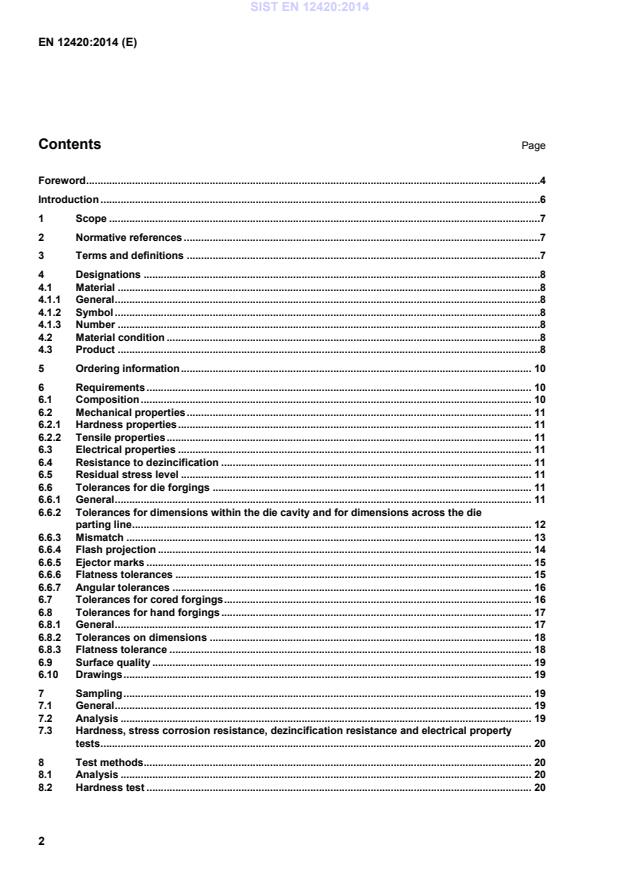
Recommended guidelines for design . 39 A.1 Introduction . 39 A.2 General information . 39 A.3 Guidelines for die forgings . 40 A.3.1 Drafts . 40 A.3.2 Web thicknesses . 40 A.3.3 Side wall thicknesses . 41 A.3.4 Rib design . 42 A.3.5 Cores . 43 A.3.6 Flash . 44 A.3.7 Transition radii . 45 A.3.8 Clamping lengths and clamping areas for finish machining . 47 A.3.9 Design for cross-sectional shapes . 47 A.3.10 Recommended machining allowances and total allowances . 48 A.4 Guidelines for hand forgings . 50 A.4.1 General . 50 A.4.2 General information . 50 A.4.3 Section changes and transitions . 51 A.4.4 Recommended machining allowances . 51 A.4.5 Total allowances per side of forging . 52 A.5 Guidelines for marking . 52 Annex B (informative)
Tensile properties . 54 Annex ZA (informative)
Relationship between this European Standard and the Essential Requirements of EU Directive 97/23/EC, Pressure Equipment Directive (PED) . 58 Bibliography . 59
EXAMPLE 2 Forging conforming to this standard, in material designed either CuZn40Pb2 or CW617N, for the use in contact with drinking water DW, in material condition H070, will be designated as follows:
200 pieces Forging EN 12420 — CuZn40Pb2 — DW — H070 — drawing number XY000
or
200 pieces Forging EN 12420 — CW617N — DW — H070 — drawing number XY000 6 Requirements 6.1 Composition The composition shall conform to the requirements for the appropriate material given in Tables 1 to 8. In the same tables the hot working attitude is also reported. SIST EN 12420:2014
phase for CuZn38As (CW511L), CuZn36Pb2As (CW602N), CuZn35Pb1,5AlAs (CW625N), CuZn33Pb1,5AlAs (CW626N), CuZn32Pb2AsFeSi (CW709R) and CuZn33Pb1AlSiAs (CW725R) shall be less than 3 %. The test shall be carried out in accordance with 8.4. NOTE The supplied material for forgings may not necessarily meet this requirement unless suitably heat treated. The test is intended to demonstrate that forgings produced are capable of being processed so as to pass the test requirement. Products in alloys other than CuZn21Si3P (CW724R) shall be subjected to heat treatment approximately in the range 500 °C to 550 °C after hot stamping. Should the user need to heat the material above 530 °C (i.e. soldering, brazing or welding operations) then advice should be sought from the supplier. 6.5 Residual stress level Forgings ordered in the stress relieved condition (see 4.2, 2nd paragraph) shall show no evidence of cracking when tested. The tests shall be carried out in accordance with 8.5. 6.6 Tolerances for die forgings 6.6.1 General Tolerances on dimensions and on form indicated in the drawings of a forging shall conform to the tolerances specified in this standard. If no tolerances are indicated in the drawings, the tolerances according to SIST EN 12420:2014
Key a direction of forging a direction of forging Figure 1 — Dimensions n within the die cavity Figure 2 — Dimensions t across the die parting line
Figure 3 — Die forging For recommended machining allowances and total allowances see A.3.10 and Table A.6. 6.6.2 Tolerances for dimensions within the die cavity and for dimensions across the die parting line The dimensions n and t shall conform to the tolerances given in Table 12 for material group I, Table 13 for material group II and Table 14 for material group III. SIST EN 12420:2014
Figure 4 — Area A (in mm2) = nmax × n The tolerances given in Tables 12 to 14 are also applicable for die forgings which are produced with a die cavity in one die half only facing a plane opposite die half. The tolerance need not necessarily be applied symmetrically about the nominal dimension; it may be all plus or all minus. 6.6.3 Mismatch Mismatch is not associated with a particular direction (see Figure 5). The mismatch shall be determined by reference to the largest nominal dimension nmax as viewed in the direction of forging (see Figure 5). The permissible mismatch is given in Tables 12 to 14. The maximum permitted mismatch shall be indicated above the title block or in the title block of the drawing of the forging, e.g.: mismatch max. 0,5 mm. Mismatch is not included in the tolerances for dimensions within the die cavity: the tolerances for dimensions within the die cavity and for mismatch are in this case independently applied (see Figure 6 and Figure 7). SIST EN 12420:2014
Key
Key a mismatch a mismatch b reference dimension for mismatch
Figure 5 — Mismatch Figure 6 — Intended construction Figure 7 — Permanent actual dimensions 6.6.4 Flash projection The flash projection is determined by reference to the largest nominal dimension nmax perpendicular to the direction of forging (see Figure 8). The permissible flash projection is given in Tables 12 to 14. The flash originating from the die parting line shall be trimmed by the manufacturer. Flash caused by deburring, punching or piercing or through-die inserts (see G1, G2, G3 and G4 in Figure 9) is permissible, provided that it is either removed during machining or is not objectionable if left on the finished part. This flash shall be indicated in the drawing and shall not exceed 1,5 mm.
Key a direction of forging a production by choice
b work-holder
c finished part
d permitted flash projection Figure 8 — Dimension nmax used as reference dimension for flash projection Figure 9 — Types of flash Flash projection is applied independently of dimensional tolerances. SIST EN 12420:2014
Key a mismatch b residual flash projection Figure 10 — Flash projection NOTE As the flash of type samples is generally trimmed by hand they do not represent the quality of trimming during bulk production. 6.6.5 Ejector marks If ejectors are necessary for manufacturing reasons, ejector marks can result as ridges (convex) or indentations (concave) (see Figure 11 and Tables 12 to 14). If the ejector marks may be either concave only or convex only, the total permissible variation applies. EXAMPLE — Permissible ejector mark: ± 0,3 mm; — Ejector mark only raised: + 0,6 mm; — Ejector mark only recessed: – 0,6 mm.
Key a ejector mark recessed b ejector mark raised Figure 11 — Ejector marks 6.6.6 Flatness tolerances In addition to the tolerances caused by the forging process, deviation from flatness may result from distortion, when ejecting, flash clipping, or any heat treatment. Flatness tolerances shall be determined by reference to the largest nominal dimension nmax as viewed in the direction of forging, see Figure 12 and Tables 12 to 14, and they are applied independently from all tolerances of form or position. SIST EN 12420:2014
Key nmax reference dimension for the flatness tolerance Figure 12 — Dimension nmax used as reference dimension of flatness tolerance 6.6.7 Angular tolerances The tolerances in Table 16 apply to all angles . (see Figure 13) except draft angles. NOTE For draft angles see guidelines for design in Annex A.
Key a shorter leg Figure 13 — Definition of shorter leg 6.7 Tolerances for cored forgings External diameter a and internal diameter b and depth of core penetration h for cored forgings shown schematically in Figure 14 and 15 shall conform to the tolerances given in Table 17. Circularity tolerance relating to outer diameter shall be calculated by summing the absolute values of n or tmax of Table 12. SIST EN 12420:2014
Key 1 parting line Figure 14 — Cored forgings (products cored in the forging direction)
Key 1 parting line Figure 15 — Cored forgings (products cored normally to the forging direction) 6.8 Tolerances for hand forgings 6.8.1 General The purchaser may supply nominal dimensions and/or a toleranced drawing of the forging or finished part but the tolerances on dimensions and on form shall conform to the requirements of 6.8.2 and 6.8.3. It is recommended that reference to this standard is made on drawings. SIST EN 12420:2014
Figure 16 — Dimensions t and n
Figure 17 — Dimensions + a and – a As variations in the finished diameter of discs and stepped hand forgings are difficult to control due to spread and edge distortion, no tolerances are specified. It is recommended either that these tolerances be agreed between purchaser and supplier or that these parts are supplied in the pre-machined condition. 6.8.3 Flatness tolerance In addition to the tolerances caused by the forging operation, there will be deviations from flatness due to bending, twisting or the release of stresses, particularly during any subsequent heat treatment. Forgings shall conform to the flatness tolerances given in Table 19, which are related to the length of the forging and are applied independently from dimensional tolerances. Dependent on the forging geometry (e.g. different section thicknesses) the deviation from flatness may be checked using a straightedge or surface plate. Where this is not possible, a datum plane shall be established by positioning the forging on three datum points. SIST EN 12420:2014
...
EN 12420:2014 is a European Standard that defines the composition, property requirements, tolerances on dimensions and form, sampling procedures, methods of test, and delivery conditions for copper and copper alloy die and hand forgings.
記事のタイトル:EN 12420:2014 - 銅および銅合金 - 鍛造品 記事の内容:この欧州規格は、銅および銅合金製のダイおよびハンドフォージングの成分、特性要件、寸法および形状の許容範囲を指定しています。また、この規格の要件に対する適合性の検証のための抽出手順、試験方法、および配送条件も指定されています。
기사 제목: EN 12420:2014 - 구리 및 구리 합금 - 단조물 기사 내용: 이 유럽 표준은 구리 및 구리 합금 다이와 손수 단조물의 조성, 물성 요구 사항 및 치수 및 형태에 대한 허용 범위를 정의합니다. 이 표준의 요구 사항에 대한 준수 검증을 위한 표본 추출 절차, 시험 방법 및 배송 조건도 지정됩니다.
The article is about EN 12420:2014, a European Standard that provides specifications on the composition, properties, dimensions, and form of copper and copper alloy die and hand forgings. It also outlines the sampling procedures, methods of testing for verifying conformity to the standard, and delivery conditions.
記事のタイトル:EN 12420:2014 - 銅および銅合金- 鍛造 記事の内容:このヨーロッパ規格では、銅および銅合金のダイおよび手作業での鍛造品の組成、物性要件、寸法および形状の許容範囲を指定しています。また、この規格の要求事項への適合の検証のためのサンプリング手順、試験方法、納入条件も明示されています。
기사 제목: EN 12420:2014 - 구리 및 구리 합금 - 단조품 기사 내용: 이 유럽 표준은 구리 및 구리 합금 다이 및 수작업 단조품에 대한 구성, 속성 요구 사항, 치수와 형식에 대한 허용 범위를 명시합니다. 이 표준의 요구 사항을 확인하기 위한 샘플링 절차, 시험 방법 및 납품 조건도 명시되어 있습니다.
Questions, Comments and Discussion
Ask us and Technical Secretary will try to provide an answer. You can facilitate discussion about the standard in here.
Loading comments...