

prEN 14187-9
(Main)Cold applied joint sealants - Test methods - Part 9: Function testing of joint sealants
- Abstract
This European Standard specifies a function test for cold applied joint sealants intended for use in joints in roads and airfield pavements in cold climate areas where the total joint movement can be greater than 35 % and the temperature can go below -25 °C.
- Status
- Not Published
- Publication Date
- 27-Jun-2016
- Withdrawal Date
- 27-Dec-2016
- Technical Committee
- CEN/TC 227 - Road materials
- Current Stage
- 4098 - Decision to abandon - Enquiry
- Start Date
- 11-Dec-2015
- Completion Date
- 07-Oct-2026


Overview - prEN 14187-9: Cold applied joint sealants (Function testing)
prEN 14187-9 is a CEN draft European Standard for function testing of cold applied joint sealants used in road and airfield pavement joints in cold-climate areas. It specifies an accelerated test method to assess sealant performance where total joint movement can exceed 35% and service temperatures may fall below –25 °C. The method evaluates durability against fluctuating temperatures, water exposure and simultaneous dynamic loading.
Key topics and technical requirements
- Scope and purpose: Function test for cold-applied sealants intended for roads and airfields in severe cold conditions.
- Test specimens: At least three specimens mounted between concrete test blocks manufactured per EN 13880-12.
- Preparation: Follow manufacturer instructions; determine gelation/tack-free time using EN 14187-2 and EN ISO 7390 procedures.
- Apparatus:
- Motor-driven tensile/compression test rig capable of controlled, backlash-free movement and force recording (measurement uncertainty ≤ 2%).
- Climate chamber able to cycle temperatures between –30 °C and +30 °C and perform timed water spray (20% of conditioning time).
- Temperature indicator (accuracy ±1 °C).
- Conditioning cycle (minimum 3 days or longer if required by manufacturer):
- Temperature cycling between (10 ±1) °C and (25 ±1) °C with prescribed extension/compression movements and slow deformation rate (~0.010 mm/min).
- Water spraying: intermittent (1 min spray / 4 min pause) at 10–20 °C for 20% of conditioning time.
- Test cycle:
- Temperature range from (11 ±1) °C down to (–30 ±1) °C and up to (24 ±1) °C.
- Specified compression (20%) and extension (60%) movements for three cycles; continuous force recording.
- Results and reporting:
- Convert force at –30 °C to tensile stress (σ = F / A) and report maximum tensile stress.
- Visually inspect for adhesion and cohesion failures after conditioning and after notched extension tests.
- Test report must include product identifiers, primer, batch info, specimen preparation conditions, cycle details and failure assessment.
Practical applications and users
This standard is relevant to:
- Sealant manufacturers for product development and performance claims in cold climates.
- Independent testing laboratories conducting type approval or quality control.
- Road and airfield authorities, pavement engineers and specifiers requiring validated joint sealant performance under extreme thermal movement and water exposure.
- Procurement and quality assurance teams verifying compliance with performance requirements for pavement joints.
Related standards
- EN 14187 series (Parts 1–8) - other test methods for cold applied joint sealants (rate of cure, tack free time, flow, fuel resistance, hydrolysis, adhesion/cohesion, flame resistance, UV ageing)
- EN 13880-12 - manufacture of concrete test blocks for bond testing
- EN 14188-4 - primers for joint sealants
- EN ISO 6927, EN ISO 7390 - vocabulary and flow/resistance test methods
Keywords: prEN 14187-9, cold applied joint sealants, function testing, road pavements, airfield pavements, cold climate, tensile/compression test rig, climate chamber, adhesion, cohesion.
Relations
- Effective Date
- 18-Jan-2023
Get Certified
Connect with accredited certification bodies for this standard

Zavod za gradbeništvo Slovenije (ZAG) - Inšpekcija
ZAG inspection body for construction products, structures, and materials.
Sponsored listings
Frequently Asked Questions
prEN 14187-9 is a draft published by the European Committee for Standardization (CEN). Its full title is "Cold applied joint sealants - Test methods - Part 9: Function testing of joint sealants". This standard covers: This European Standard specifies a function test for cold applied joint sealants intended for use in joints in roads and airfield pavements in cold climate areas where the total joint movement can be greater than 35 % and the temperature can go below -25 °C.
This European Standard specifies a function test for cold applied joint sealants intended for use in joints in roads and airfield pavements in cold climate areas where the total joint movement can be greater than 35 % and the temperature can go below -25 °C.
prEN 14187-9 is classified under the following ICS (International Classification for Standards) categories: 93.080.20 - Road construction materials. The ICS classification helps identify the subject area and facilitates finding related standards.
prEN 14187-9 has the following relationships with other standards: It is inter standard links to EN 14187-9:2006. Understanding these relationships helps ensure you are using the most current and applicable version of the standard.
prEN 14187-9 is available in PDF format for immediate download after purchase. The document can be added to your cart and obtained through the secure checkout process. Digital delivery ensures instant access to the complete standard document.
Standards Content (Sample)
SLOVENSKI STANDARD
01-november-2014
Hladno nanosljive tesnilne mase za stike - Preskusne metode - 9. del: Preskušanje
funkcionalnosti tesnilnih mas za stike
Cold applied joint sealants - Test methods - Part 9: Function testing of joint sealants
Kalt verarbeitbare Fugenmassen - Prüfverfahren - Teil 9: Funktionsprüfung von
Fugenmassen
Produits de scellement de joint appliqués à froid - Méthodes d'essais - Partie 9 : Test
fonctionnel sur scellement de joints
Ta slovenski standard je istoveten z: prEN 14187-9
ICS:
91.100.50 Veziva. Tesnilni materiali Binders. Sealing materials
93.080.20 Materiali za gradnjo cest Road construction materials
2003-01.Slovenski inštitut za standardizacijo. Razmnoževanje celote ali delov tega standarda ni dovoljeno.
EUROPEAN STANDARD
DRAFT
NORME EUROPÉENNE
EUROPÄISCHE NORM
September 2014
ICS 93.080.20 Will supersede EN 14187-9:2006
English Version
Cold applied joint sealants - Test methods - Part 9: Function
testing of joint sealants
Produits de scellement de joint appliqués à froid - Méthodes Kalt verarbeitbare Fugenmassen - Prüfverfahren - Teil 9:
d'essais - Partie 9 : Test fonctionnel sur scellement de joints Funktionsprüfung von Fugenmassen
This draft European Standard is submitted to CEN members for enquiry. It has been drawn up by the Technical Committee CEN/TC 227.
If this draft becomes a European Standard, CEN members are bound to comply with the CEN/CENELEC Internal Regulations which
stipulate the conditions for giving this European Standard the status of a national standard without any alteration.
This draft European Standard was established by CEN in three official versions (English, French, German). A version in any other language
made by translation under the responsibility of a CEN member into its own language and notified to the CEN-CENELEC Management
Centre has the same status as the official versions.
CEN members are the national standards bodies of Austria, Belgium, Bulgaria, Croatia, Cyprus, Czech Republic, Denmark, Estonia,
Finland, Former Yugoslav Republic of Macedonia, France, Germany, Greece, Hungary, Iceland, Ireland, Italy, Latvia, Lithuania,
Luxembourg, Malta, Netherlands, Norway, Poland, Portugal, Romania, Slovakia, Slovenia, Spain, Sweden, Switzerland, Turkey and United
Kingdom.
Recipients of this draft are invited to submit, with their comments, notification of any relevant patent rights of which they are aware and to
provide supporting documentation.
Warning : This document is not a European Standard. It is distributed for review and comments. It is subject to change without notice and
shall not be referred to as a European Standard.
EUROPEAN COMMITTEE FOR STANDARDIZATION
COMITÉ EUROPÉEN DE NORMALISATION
EUROPÄISCHES KOMITEE FÜR NORMUNG
CEN-CENELEC Management Centre: Avenue Marnix 17, B-1000 Brussels
© 2014 CEN All rights of exploitation in any form and by any means reserved Ref. No. prEN 14187-9:2014 E
worldwide for CEN national Members.
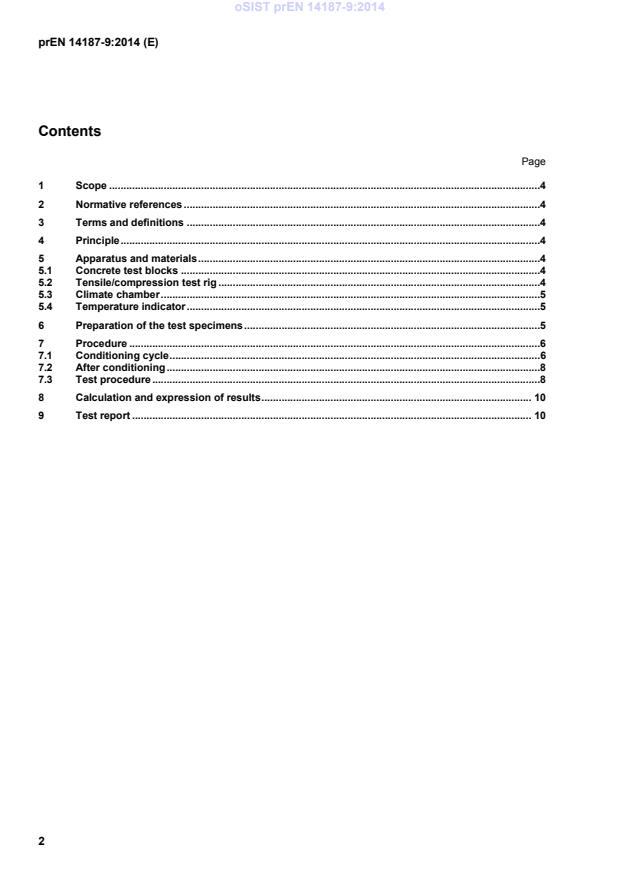
Contents
Page
1 Scope .4
2 Normative references .4
3 Terms and definitions .4
4 Principle .4
5 Apparatus and materials .4
5.1 Concrete test blocks .4
5.2 Tensile/compression test rig .4
5.3 Climate chamber .5
5.4 Temperature indicator .5
6 Preparation of the test specimens .5
7 Procedure .6
7.1 Conditioning cycle .6
7.2 After conditioning .8
7.3 Test procedure .8
8 Calculation and expression of results . 10
9 Test report . 10
Foreword
This document (prEN 14187-9:2014) has been prepared by Technical Committee CEN/TC 227 “Road
materials”, the secretariat of which is held by DIN.
This document is currently submitted to the CEN Enquiry.
This document will supersede EN 14187-9:2006.
This European Standard is one of a series of standards as listed below:
EN 14187-1, Cold applied joint sealants — Test methods — Part 1: Determination of rate of cure.
EN 14187-2, Cold applied joint sealants — Test methods — Part 2: Determination of tack free time.
EN 14187-3, Cold applied joint sealants — Test methods — Part 3: Determination of self-levelling properties.
EN 14187-4, Cold applied joint sealants — Test methods — Part 4: Determination of the change in mass and
volume after immersion in test fuels and liquid chemicals.
EN 14187-5, Cold applied joint sealants — Test methods — Part 5: Determination of the resistance to
hydrolysis.
EN 14187-6, Cold applied joint sealants — Test methods — Part 6: Determination of the adhesion/cohesion
properties after immersion in test fuels and liquid chemicals.
EN 14187-7, Cold applied joint sealants — Test methods — Part 7: Determination of the resistance to flame.
EN 14187-8, Cold applied joint sealants — Test methods — Part 8: Determination of the artificial weathering
by UV-irradiation.
EN 14187-9, Cold applied joint sealants — Test methods — Part 9: Function testing of joint sealants.
1 Scope
This European Standard specifies a function test for cold applied joint sealants intended for use in joints in
roads and airfield pavements in cold climate areas where the total joint movement can be greater than 35 %
and the temperature can go below –25 ºC.
2 Normative references
The following documents, in whole or in part, are normatively referenced in this document and are
indispensable for its application. For dated references, only the edition cited applies. For undated references,
the latest edition of the referenced document (including any amendments) applies.
EN 13880-12, Hot applied joint sealants — Part 12: Test method for the manufacture of concrete test blocks
for bond testing (recipe methods)
EN 14188-4, Joint fillers and sealants — Part 4: Specifications for primers to be used with joint sealants
EN 14187-2, Cold applied joint sealants — Part 2: Test method for the determination of tack free time
EN ISO 6927, Buildings and civi
...