


prEN 13075-1
(Main)Bitumens and bituminous binders - Determination of breaking behaviour - Part 1: Determination of breaking value of cationic bituminous emulsions, mineral filler method
Bitumens and bituminous binders - Determination of breaking behaviour - Part 1: Determination of breaking value of cationic bituminous emulsions, mineral filler method
This document specifies a method for the determination of the breaking value of cationic bituminous emulsions.
WARNING - Use of this document can involve hazardous materials, operations and equipment. This document does not purport to address all of the safety problems associated with its use. It is the responsibility of the user of this document to identify the hazards and assess the risks involved in performing this test method and to implement sufficient control measures to protect individual operators (and the environment). This includes appropriate safety and health practices and determination of the applicability of regulatory limitations prior to use.
Bitumen und bitumenhaltige Bindemittel - Bestimmung des Brechverhaltens - Teil 1: Bestimmung des Brechwertes kationischer Bitumenemulsionen, Verfahren mit Feinmineralstoff
Le présent document spécifie une méthode de détermination de l’indice de rupture des émulsions bitumineuses cationiques.
AVERTISSEMENT - L'utilisation de ce document peut impliquer la mise en oeuvre de produits, d'opérations et d'équipements à caractère dangereux. Le présent document n'est pas censé aborder tous les problèmes de sécurité concernés par son usage. Il incombe à son utilisateur d'établir des règles d'hygiène et de sécurité appropriées et de déterminer l'applicabilité des restrictions réglementaires avant utilisation.
Bitumes et liants bitumineux - Détermination du comportement à la rupture - Partie 1 : Détermination de l'indice de rupture des émulsions bitumineuses cationiques, méthode des fines minérales
Le présent document spécifie une méthode de détermination de l’indice de rupture des émulsions bitumineuses cationiques.
AVERTISSEMENT - L'utilisation de ce document peut impliquer la mise en oeuvre de produits, d'opérations et d'équipements à caractère dangereux. Le présent document n'est pas censé aborder tous les problèmes de sécurité concernés par son usage. Il incombe à son utilisateur d'établir des règles d'hygiène et de sécurité appropriées et de déterminer l'applicabilité des restrictions réglementaires avant utilisation.
Bitumen in bitumenska veziva - Določanje stopnje stabilnosti - 1. del: Določanje hitrosti razpada kationskih bitumenskih emulzij, metoda z mineralnim polnilom
General Information
- Status
- Not Published
- Publication Date
- 04-Nov-2026
- Technical Committee
- CEN/TC 336 - Bituminous binders
- Drafting Committee
- CEN/TC 336/WG 2 - Emulsions and fluxed bitumens
- Current Stage
- 4599 - Dispatch of FV draft to CMC - Finalization for Vote
- Start Date
- 20-May-2026
- Due Date
- 04-Jan-2027
- Completion Date
- 20-May-2026

Relations
- Effective Date
- 14-Dec-2022
Overview
prEN 13075-1: Bitumens and Bituminous Binders – Determination of Breaking Behaviour – Part 1: Determination of Breaking Value of Cationic Bituminous Emulsions, Mineral Filler Method is a European standard developed by CEN/TC 336. This standard outlines a test method for quantifying the breaking value of cationic bituminous emulsions using a mineral filler method. The breaking value is a critical indicator of emulsion stability, impacting material performance in road construction and maintenance.
The procedure defined in prEN 13075-1 supports laboratories and quality control operations in the bitumen and construction industries by ensuring consistent evaluation of emulsion stability. It addresses both manual and semi-automatic procedures, providing guidance on equipment, reference fillers, calculation methods, and reporting requirements.
Safety Notice: This document involves hazardous materials, equipment, and procedures. Users must conduct appropriate risk assessments and implement safety measures in compliance with health, safety, and environmental regulations.
Key Topics
- Breaking value: Determination of the amount of mineral filler required to cause cationic bituminous emulsions to break (coagulate) under controlled conditions.
- Cationic bituminous emulsions: Emulsions commonly used in road construction where stability is essential for product performance.
- Reference fillers: Use of Forshammer SE, Q92, or Sikaisol filler with specified particle size and composition.
- Sample preparation and equipment: Procedures for preparing samples, handling fillers, and operating both manual and semi-automatic equipment.
- Test method precision: Guidelines for repeatability and reproducibility, helping ensure quality and comparability between laboratories.
- Test reporting: Standardized requirements for documentation, including identification, procedures, results, and any deviations.
Applications
The test method described in prEN 13075-1 is crucial for a range of applications in the field of bituminous materials and road construction, including:
- Quality control: Reliable evaluation of cationic bituminous emulsions ensures they meet performance and durability requirements before use in road surfacing, patching, and sealing.
- Product development: Enables material scientists to compare breaking behaviour of different emulsion formulations or filler types, aiding innovation and optimization.
- Comparative studies: Ensures consistent assessment across different laboratories, facilitating benchmarking and approval of bituminous binders in public works.
- Compliance and specification: Supports contractors and suppliers in demonstrating compliance with European and international standards for construction materials.
- Laboratory accreditation: Laboratories can use this standardized approach to meet accreditation requirements and demonstrate methodological competence.
Related Standards
prEN 13075-1 both references and complements several important standards in the domain of bituminous materials and aggregates:
- EN 58: Bitumen and bituminous binders - Sampling bituminous binders
- EN 12594: Bitumens and bituminous binders - Preparation of test samples
- EN 12597: Bitumens and bituminous binders - Terminology
- EN 1430: Determination of particle polarity of bituminous emulsions
- EN 933-1: Tests for geometrical properties of aggregates - Determination of particle size distribution
- EN 933-10: Assessment of fines - Grading of filler aggregates (air jet sieving)
- EN 13075-2: Bitumen and bituminous binders - Determination of breaking behaviour - Part 2: Fines mixing time of cationic bituminous emulsions
Conclusion: By specifying a repeatable method for determining the breaking value of cationic bituminous emulsions, prEN 13075-1 plays a vital role in ensuring the performance, consistency, and reliability of bituminous materials in road and infrastructure projects across Europe.
Get Certified
Connect with accredited certification bodies for this standard

DIBt (Deutsches Institut für Bautechnik)
German Institute for Building Technology.
DIN CERTCO
DIN Group product certification.

Element Materials Technology
Materials testing and product certification.
Sponsored listings
Frequently Asked Questions
prEN 13075-1 is a draft published by the European Committee for Standardization (CEN). Its full title is "Bitumens and bituminous binders - Determination of breaking behaviour - Part 1: Determination of breaking value of cationic bituminous emulsions, mineral filler method". This standard covers: This document specifies a method for the determination of the breaking value of cationic bituminous emulsions. WARNING - Use of this document can involve hazardous materials, operations and equipment. This document does not purport to address all of the safety problems associated with its use. It is the responsibility of the user of this document to identify the hazards and assess the risks involved in performing this test method and to implement sufficient control measures to protect individual operators (and the environment). This includes appropriate safety and health practices and determination of the applicability of regulatory limitations prior to use.
This document specifies a method for the determination of the breaking value of cationic bituminous emulsions. WARNING - Use of this document can involve hazardous materials, operations and equipment. This document does not purport to address all of the safety problems associated with its use. It is the responsibility of the user of this document to identify the hazards and assess the risks involved in performing this test method and to implement sufficient control measures to protect individual operators (and the environment). This includes appropriate safety and health practices and determination of the applicability of regulatory limitations prior to use.
prEN 13075-1 is classified under the following ICS (International Classification for Standards) categories: 75.140 - Waxes, bituminous materials and other petroleum products; 91.100.50 - Binders. Sealing materials. The ICS classification helps identify the subject area and facilitates finding related standards.
prEN 13075-1 has the following relationships with other standards: It is inter standard links to EN 13075-1:2016. Understanding these relationships helps ensure you are using the most current and applicable version of the standard.
prEN 13075-1 is available in PDF format for immediate download after purchase. The document can be added to your cart and obtained through the secure checkout process. Digital delivery ensures instant access to the complete standard document.
Standards Content (Sample)
SLOVENSKI STANDARD
01-marec-2026
Bitumen in bitumenska veziva - Določanje stopnje stabilnosti - 1. del: Določanje
hitrosti razpada kationskih bitumenskih emulzij, metoda z mineralnim polnilom
Bitumens and bituminous binders - Determination of breaking behaviour - Part 1:
Determination of breaking value of cationic bituminous emulsions, mineral filler method
Bitumen und bitumenhaltige Bindemittel - Bestimmung des Brechverhaltens - Teil 1:
Bestimmung des Brechwertes kationischer Bitumenemulsionen, Verfahren mit
Feinmineralstoff
Bitumes et liants bitumineux - Détermination du comportement à la rupture - Partie 1 :
Détermination de l'indice de rupture des émulsions bitumineuses cationiques, méthode
des fines minérales
Ta slovenski standard je istoveten z: prEN 13075-1
ICS:
75.140 Voski, bitumni in drugi naftni Waxes, bituminous materials
proizvodi and other petroleum products
91.100.50 Veziva. Tesnilni materiali Binders. Sealing materials
2003-01.Slovenski inštitut za standardizacijo. Razmnoževanje celote ali delov tega standarda ni dovoljeno.
DRAFT
EUROPEAN STANDARD
NORME EUROPÉENNE
EUROPÄISCHE NORM
January 2026
ICS 75.140; 91.100.50 Will supersede EN 13075-1:2016
English Version
Bitumens and bituminous binders - Determination of
breaking behaviour - Part 1: Determination of breaking
value of cationic bituminous emulsions, mineral filler
method
Bitumes et liants bitumineux - Détermination du Bitumen und bitumenhaltige Bindemittel -
comportement à la rupture - Partie 1 : Détermination Bestimmung des Brechverhaltens - Teil 1: Bestimmung
de l'indice de rupture des émulsions bitumineuses des Brechwertes kationischer Bitumenemulsionen,
cationiques, méthode des fines minérales Verfahren mit Feinmineralstoff
This draft European Standard is submitted to CEN members for enquiry. It has been drawn up by the Technical Committee
CEN/TC 336.
If this draft becomes a European Standard, CEN members are bound to comply with the CEN/CENELEC Internal Regulations
which stipulate the conditions for giving this European Standard the status of a national standard without any alteration.
This draft European Standard was established by CEN in three official versions (English, French, German). A version in any other
language made by translation under the responsibility of a CEN member into its own language and notified to the CEN-CENELEC
Management Centre has the same status as the official versions.
CEN members are the national standards bodies of Austria, Belgium, Bulgaria, Croatia, Cyprus, Czech Republic, Denmark, Estonia,
Finland, France, Germany, Greece, Hungary, Iceland, Ireland, Italy, Latvia, Lithuania, Luxembourg, Malta, Netherlands, Norway,
Poland, Portugal, Republic of North Macedonia, Romania, Serbia, Slovakia, Slovenia, Spain, Sweden, Switzerland, Türkiye and
United Kingdom.
Recipients of this draft are invited to submit, with their comments, notification of any relevant patent rights of which they are
aware and to provide supporting documentation.
Warning : This document is not a European Standard. It is distributed for review and comments. It is subject to change without
notice and shall not be referred to as a European Standard.
EUROPEAN COMMITTEE FOR STANDARDIZATION
COMITÉ EUROPÉEN DE NORMALISATION
EUROPÄISCHES KOMITEE FÜR NORMUNG
CEN-CENELEC Management Centre: Rue de la Science 23, B-1040 Brussels
© 2026 CEN All rights of exploitation in any form and by any means reserved Ref. No. prEN 13075-1:2026 E
worldwide for CEN national Members.
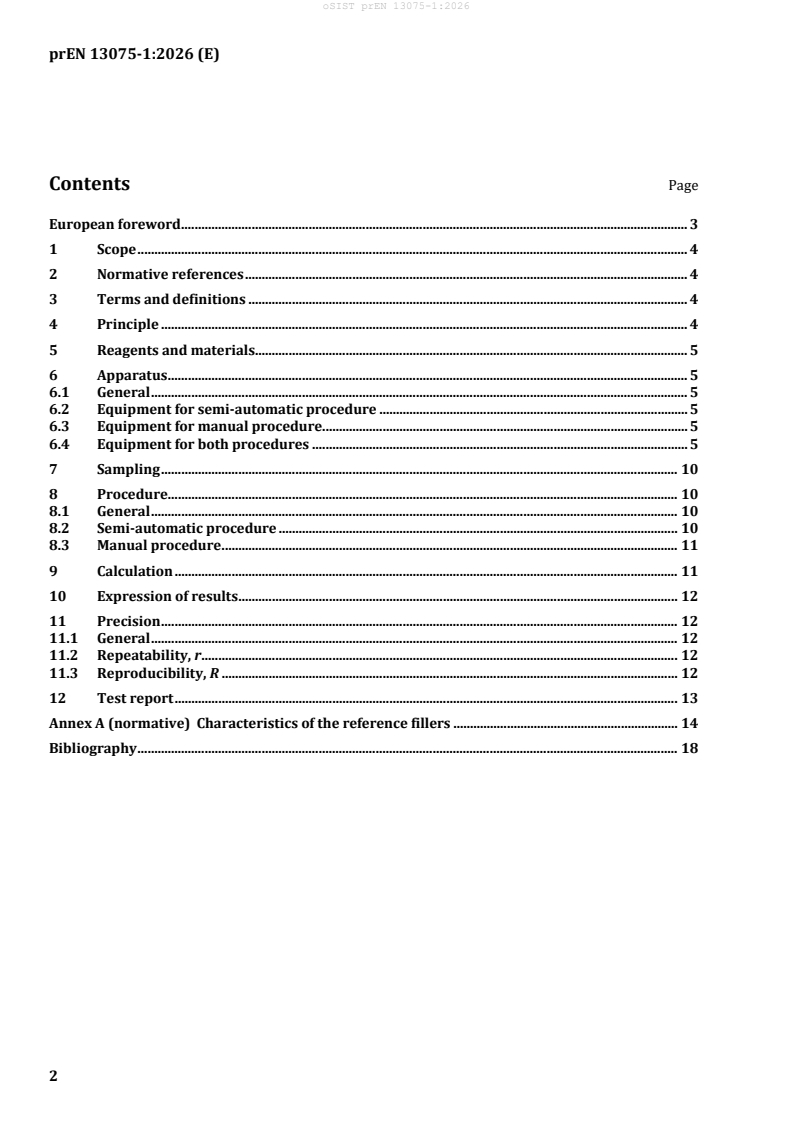
Contents Page
European foreword . 3
1 Scope . 4
2 Normative references . 4
3 Terms and definitions . 4
4 Principle . 4
5 Reagents and materials . 5
6 Apparatus . 5
6.1 General . 5
6.2 Equipment for semi-automatic procedure . 5
6.3 Equipment for manual procedure. 5
6.4 Equipment for both procedures . 5
7 Sampling . 10
8 Procedure. 10
8.1 General . 10
8.2 Semi-automatic procedure . 10
8.3 Manual procedure . 11
9 Calculation . 11
10 Expression of results . 12
11 Precision . 12
11.1 General . 12
11.2 Repeatability, r . 12
11.3 Reproducibility, R . 12
12 Test report . 13
Annex A (normative) Characteristics of the reference fillers . 14
Bibliography . 18
European foreword
This document (prEN 13075-1:2025) has been prepared by Technical Committee CEN/TC 336 “Bitumens
and bituminous binders”, the secretariat of which is held by AFNOR.
This document is currently submitted to the CEN Enquiry.
This document will supersede EN 13075-1:2016.
a) Clause 5, “Reagents and materials”: in paragraph 5.1 the naming “Caolin” for the Q92 filler, which
could lead to confusion with the mineralogical nature of kaolin, has been removed;
b) Clause 6, “Apparatus”, has been updated and revised, standardizing the use of the metrological
concept of “maximal permissible measurement error” for describing the measurement precision;
c) in paragraph 6.2.2, the description of the stirrer has been clarified;
d) Annex A, “Characteristics of the reference fillers”: the Sikaisol filler, which production has been
disrupted, has been downgraded to the third place in the reference fillers list;
e) in paragraph A2 the particle size distribution envelope of the Q92 filler has been updated and
tightened, thanks to the to process improvements brought by the producer.
1 Scope
This document specifies a method for the determination of the breaking value of cationic bituminous
emulsions.
WARNING — Use of this document can involve hazardous materials, operations and equipment. This
document does not purport to address all of the safety problems associated with its use. It is the
responsibility of the user of this document to identify the hazards and assess the risks involved in
performing this test method and to implement sufficient control measures to protect individual operators
(and the environment). This includes appropriate safety and health practices and determination of the
applicability of regulatory limitations prior to use.
2 Normative references
The following documents are referred to in the text in such a way that some or all of their content
constitutes requirements of this document. For dated references, only the edition cited applies. For
undated references, the latest edition of the referenced document (including any amendments) applies.
EN 58, Bitumen and bituminous binders — Sampling bituminous binders
EN 12594, Bitumens and bituminous binders — Preparation of test samples
EN 12597, Bitumens and bituminous binders — Terminology
3 Terms and definitions
For the purposes of this document, the terms and definitions given in EN 12597 and the following apply.
ISO and IEC maintain terminology databases for use in standardization at the following addresses:
— ISO Online browsing platform: available at https://www.iso.org/obp
— IEC Electropedia: available at https://www.electropedia.org/
3.1
breaking value
BV
dimensionless number corresponding to the mass of reference filler, in grams, needed to coagulate 100 g
of bituminous emulsion
4 Principle
A reference filler is added at a uniform rate to a specified quantity of stirred cationic bituminous emulsion.
When the emulsion has completely broken, the mass of added filler is determined by weighing. The mass
of filler (in grams), multiplied by 100 and divided by the mass of emulsion (in grams), is the breaking
value (3.1).
NOTE The cationic or anionic nature of an emulsion can be determined with EN 1430 [1].
5 Reagents and materials
5.1 Reference fillers
1 1 1
The Forshammer SE filler , the Q92 filler or the Sikaisol filler shall be used as reference fillers while
applying the conversion factors given in Clause 9 and shall comply with the respective characteristics
given in Annex A.
In case of dispute, the same filler and the same procedure (manual or semi-automatic) shall be used by
the testing laboratories.
5.2 Cleaning agents, as used conventionally in laboratories.
6 Apparatus
6.1 General
The usual laboratory apparatus and glassware, together with the specific equipment described in 6.2 or
6.3, depending on the used procedure (semi-automatic or manual) and 6.4, shall be used.
For the semi-automatic procedure, an explanatory sketch of the equipment set-up is described in
Figure 1.
6.2 Equipment for semi-automatic procedure
6.2.1 Stirrer motor, as shown in Figure 1, with an output power of at least 25 W, and a speed of
(260 ± 60) r/min.
6.2.2 Stirrer, with blades having the dimensions given in Figure 4 and Figure 5. An example of a stirrer
is shown in Figure 2 and Figure 3.
6.2.3 Metal cans, cylindrical, having an approximate capacity of 500 ml, an approximate height of
95 mm and an approximate internal diameter of 90 mm. Ensure that the internal diameter of the metal
allows the stirrer blades to be below the surface of the emulsion during the test.
6.3 Equipment for manual procedure
6.3.1 Enamelled or stainless steel dish, having an approximate inner diameter of 20 cm and an
approximate height of 10 cm.
6.3.2 Spatula, made of nickel or stainless steel, having an approximate length of 20 cm.
6.4 Equipment for both procedures
6.4.1 Oven, capable of maintaining a temperature of 110 °C with a maximal permissible measurement
error of ± 5 °C.
This information is given for the convenience of users of this document and does not constitute an endorsement
by CEN of the products named. Equivalent products may be used if they can be shown to lead to the same results,
or if a correlation between the prod
...