

EN 14342:2005
(Main)Wood flooring - Characteristics, evaluation of conformity and marking
- Abstract
This document defines and specifies for wood and parquet flooring the relevant characteristics and the appropriate test methods to determine these characteristics for internal use as flooring. It also applies to wood veneer floor coverings.
This document covers flooring defined in EN 13226, EN 13227, EN 13228, EN 13488, EN 13489, EN 13990, EN 13629, prEN 14761 and EN 14354. It does not specify dimensional limits or tolerances, which are given by these same standards.
It provides for the evaluation of conformity and the requirements for marking these products.
This document does not apply to products sold as tactile surfaces or to aid visibility, e.g. products sold with tactile or visible strip applied.
- Status
- Withdrawn
- Publication Date
- 17-May-2005
- Withdrawal Date
- 27-May-2008
- Technical Committee
- CEN/TC 175 - Round and sawn timber
- Drafting Committee
- CEN/TC 175 - Round and sawn timber
- Current Stage
- 9960 - Withdrawal effective - Withdrawal
- Start Date
- 28-May-2008
- Completion Date
- 28-May-2008
89/106/EEC - Construction productsOJ Ref: C, C 319 OJ Date: 14-Dec-2005

Relations
- Merged Into
EN 14342:2005+A1:2008 - Wood flooring - Characteristics, evaluation of conformity and marking - Effective Date
- 22-Dec-2008
- Effective Date
- 28-Jan-2026
- Effective Date
- 28-Jan-2026
- Amended By
EN 14342:2005/prA1 - Wood flooring - Characteristics, evaluation of conformity and marking - Effective Date
- 22-Dec-2008
- Corrected By
EN 14342:2005/AC:2007 - Wood flooring - Characteristics, evaluation of conformity and marking - Effective Date
- 22-Dec-2008
Get Certified
Connect with accredited certification bodies for this standard

Gozdarski inštitut Slovenije
Slovenian Forestry Institute. Forest management certification support, timber testing.
Sponsored listings
Frequently Asked Questions
EN 14342:2005 is a standard published by the European Committee for Standardization (CEN). Its full title is "Wood flooring - Characteristics, evaluation of conformity and marking". This standard covers: This document defines and specifies for wood and parquet flooring the relevant characteristics and the appropriate test methods to determine these characteristics for internal use as flooring. It also applies to wood veneer floor coverings. This document covers flooring defined in EN 13226, EN 13227, EN 13228, EN 13488, EN 13489, EN 13990, EN 13629, prEN 14761 and EN 14354. It does not specify dimensional limits or tolerances, which are given by these same standards. It provides for the evaluation of conformity and the requirements for marking these products. This document does not apply to products sold as tactile surfaces or to aid visibility, e.g. products sold with tactile or visible strip applied.
This document defines and specifies for wood and parquet flooring the relevant characteristics and the appropriate test methods to determine these characteristics for internal use as flooring. It also applies to wood veneer floor coverings. This document covers flooring defined in EN 13226, EN 13227, EN 13228, EN 13488, EN 13489, EN 13990, EN 13629, prEN 14761 and EN 14354. It does not specify dimensional limits or tolerances, which are given by these same standards. It provides for the evaluation of conformity and the requirements for marking these products. This document does not apply to products sold as tactile surfaces or to aid visibility, e.g. products sold with tactile or visible strip applied.
EN 14342:2005 is classified under the following ICS (International Classification for Standards) categories: 79.080 - Semi-manufactures of timber. The ICS classification helps identify the subject area and facilitates finding related standards.
EN 14342:2005 has the following relationships with other standards: It is inter standard links to EN 14342:2005+A1:2008, EN 13732:2013, EN 13732:2002+A2:2009, EN 14342:2005/prA1, EN 14342:2005/AC:2007. Understanding these relationships helps ensure you are using the most current and applicable version of the standard.
EN 14342:2005 is associated with the following European legislation: EU Directives/Regulations: 305/2011, 89/106/EEC; Standardization Mandates: M/119. When a standard is cited in the Official Journal of the European Union, products manufactured in conformity with it benefit from a presumption of conformity with the essential requirements of the corresponding EU directive or regulation.
EN 14342:2005 is available in PDF format for immediate download after purchase. The document can be added to your cart and obtained through the secure checkout process. Digital delivery ensures instant access to the complete standard document.
Standards Content (Sample)
2003-01.Slovenski inštitut za standardizacijo. Razmnoževanje celote ali delov tega standarda ni dovoljeno.HYDQMHParkett und Holzfußböden - Eigenschaften, Bewertung der Konformität und KennzeichnungPlanchers et parquets en bois - Caractéristiques, évaluation de conformité et marquageWood flooring - Characteristics, evaluation of conformity and marking97.150Netekstilne talne oblogeNon-textile floor coverings79.080Polizdelki iz lesaSemi-manufactures of timberICS:Ta slovenski standard je istoveten z:EN 14342:2005SIST EN 14342:2005en01-september-2005SIST EN 14342:2005SLOVENSKI
STANDARD
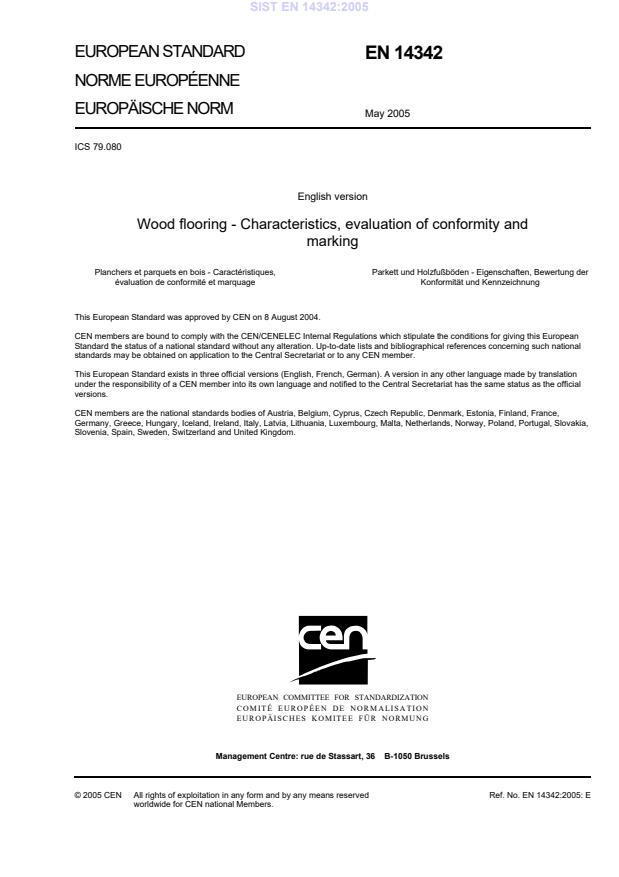
EUROPEAN STANDARDNORME EUROPÉENNEEUROPÄISCHE NORMEN 14342May 2005ICS 79.080English versionWood flooring - Characteristics, evaluation of conformity andmarkingPlanchers et parquets en bois - Caractéristiques,évaluation de conformité et marquageParkett und Holzfußböden - Eigenschaften, Bewertung derKonformität und KennzeichnungThis European Standard was approved by CEN on 8 August 2004.CEN members are bound to comply with the CEN/CENELEC Internal Regulations which stipulate the conditions for giving this EuropeanStandard the status of a national standard without any alteration. Up-to-date lists and bibliographical references concerning such nationalstandards may be obtained on application to the Central Secretariat or to any CEN member.This European Standard exists in three official versions (English, French, German). A version in any other language made by translationunder the responsibility of a CEN member into its own language and notified to the Central Secretariat has the same status as the officialversions.CEN members are the national standards bodies of Austria, Belgium, Cyprus, Czech Republic, Denmark, Estonia, Finland, France,Germany, Greece, Hungary, Iceland, Ireland, Italy, Latvia, Lithuania, Luxembourg, Malta, Netherlands, Norway, Poland, Portugal, Slovakia,Slovenia, Spain, Sweden, Switzerland and United Kingdom.EUROPEAN COMMITTEE FOR STANDARDIZATIONCOMITÉ EUROPÉEN DE NORMALISATIONEUROPÄISCHES KOMITEE FÜR NORMUNGManagement Centre: rue de Stassart, 36
B-1050 Brussels© 2005 CENAll rights of exploitation in any form and by any means reservedworldwide for CEN national Members.Ref. No. EN 14342:2005: ESIST EN 14342:2005
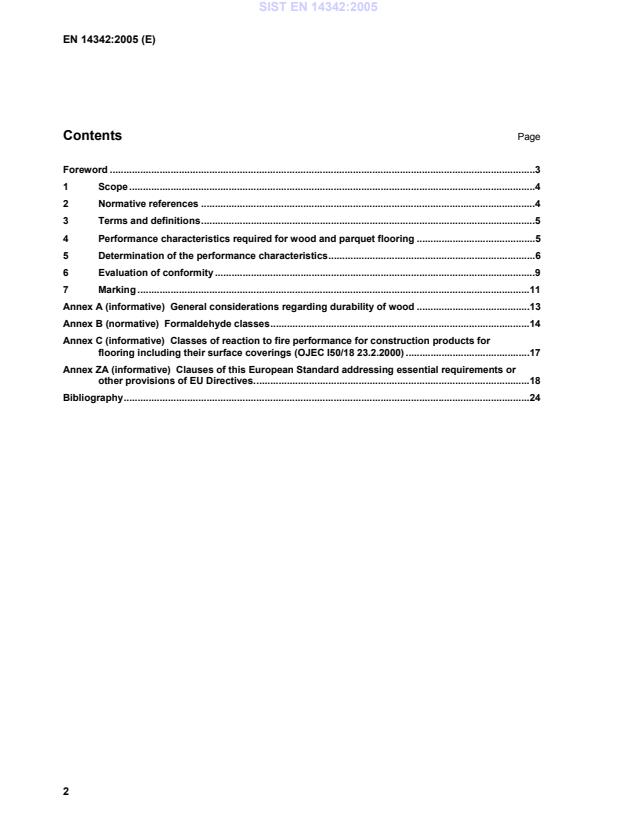
General considerations regarding durability of wood.13 Annex B (normative)
Formaldehyde classes.14 Annex C (informative)
Classes of reaction to fire performance for construction products for flooring including their surface coverings (OJEC I50/18 23.2.2000).17 Annex ZA (informative)
Clauses of this European Standard addressing essential requirements or other provisions of EU Directives.18 Bibliography.24
1 Scope This document defines and specifies for wood and parquet flooring the relevant characteristics and the appropriate test methods to determine these characteristics for internal use as flooring. It also applies to wood veneer floor coverings. This document covers flooring defined in EN 13226, EN 13227, EN 13228, EN 13488, EN 13489, EN 13990, EN 13629, prEN 14761 and EN 14354. It does not specify dimensional limits or tolerances, which are given by these same standards. It provides for the evaluation of conformity and the requirements for marking these products.
This document does not apply to products sold as tactile surfaces or to aid visibility, e.g. products sold with tactile or visible strip applied. 2 Normative references The following referenced documents are indispensable for the application of this document. For dated references, only the edition cited applies. For undated references, the latest edition of the referenced document (including amendments) applies. EN 120, Wood based panels – Determination of formaldehyde content – Extraction method called the perforator method. EN 335-1, Durability of wood and wood-based products – Definition of hazard classes of biological attack – Part 1: General. EN 335-2, Durability of wood and wood-based products – Definition of hazard classes of biological attack – Part 2: Application to solid wood. EN 717-1, Wood based panels – Determination of formaldehyde release – Part 1: Formaldehyde emission by the chamber method. EN 717-2, Wood based panels – Determination of formaldehyde release – Part 2: Formaldehyde release by the gas analysis method. EN 844-9:1997, Round and sawn timber – Terminology – Part 9: Terms relating to features of sawn timber. EN 1339:2003, Concrete paving flags – Requirements and test methods. EN 1533, Wood and parquet flooring – Determination of bending properties – Test methods. EN 12524, Building materials and products – Hygrothermal properties – Tabulated design values. EN 12664, Thermal performance of building materials and products – Determination of thermal resistance by means of guarded hot plate and heat flow meter methods – Dry and moist products of medium and low thermal resistance. EN 13226:2002, Wood flooring – Solid parquet elements with grooves and/or tongues. EN 13227:2002, Wood flooring – Solid lamparquet products. EN 13228:2002, Wood flooring – Solid wood overlay elements including blocks with an interlocking system. SIST EN 14342:2005
EN 844-9:1997 and those in the product standards EN 13226:2002, EN 13227:2002, EN 13228:2002, EN 13488:2002, EN 13489:2002, EN 13990:2004, EN 13629:2002, prEN 14761:2004 and EN 14354:2004 apply. Not applicable. 4 Performance characteristics required for wood and parquet flooring 4.1 General For construction precautions see Annex A. For moisture content, the equilibrium of wood and parquet flooring will depend on the surrounding temperature and relative humidity of the site before installation and on the service conditions. Dimensional characteristics of products shall be respected in accordance with those defined in the product standard to which the product belongs. Furthermore the type of laying may limit the use of the product. Consequently, indications of use linked to the type of laying (nailed, glued, floating) has to be indicated and it is linked to the type of use. NOTE The following characteristics, mentioned in the mandate issued to CEN by the European Commission and the European Free Trade Association, under the EU Construction Products Directive (see Annex ZA), listed hereafter are not relevant to wood flooring: emission of radioactivity, release of asbestos, water tightness or tactility/visibility. 4.2 List of performance characteristics required for wood and parquet flooring The following performance characteristics shall, where the manufacturer wishes to claim performance (e.g. where the product is subject to regulatory requirements), be determined: – reaction to fire: see 5.1; – release of formaldehyde: see 5.2; SIST EN 14342:2005
Solid flooring of oak or beech with surface coating Beech: 680 Oak: 650
8 Glued to substrate 6) Cfl-s1
-“- Solid flooring of oak, beech or spruce and with surface coating Beech: 680 Oak: 650 Spruce: 450 20 With or without air gap underneath Cfl-s1
-“- Solid wood flooring with surface coating and not specified above 390 8 Without air gap underneath Dfl-s1
-“-
-“- 390 20 With or without air gap underneath Dfl-s1 Wood parquet Multilayer parquet with a top layer of oak of at least 5 mm thickness and with surface coating 650
(top layer) 10 Glued to substrate 6) Cfl-s1
-“-
-“- 650
(top layer) 14 2) With or without air gap underneath Cfl-s1
-“- Multilayer parquet with surface coating and not specified above 500 8 Glued to substrate Dfl-s1
-“-
-“- 500 10 Without air gap underneath Dfl-s1
-“-
-“- 500 14 2) With or without air gap underneath Dfl-s1 Veneered floor covering Veneered floor covering with surface coating 800 6 2) Without air gap underneath Dfl-s1 1) Mounted in accordance with EN ISO 9239-1, on a substrate of at least Class D-s2,d0 and with minimum density of 400 kg/m3 or with an air gap underneath. 2) An interlayer of at least Class E and with maximum thickness 3 mm may be included in applications without an air gap, for parquet products with 14 mm thickness or more and for veneered floor coverings. 3) Class as provided for in Commission Decision 2000/147/EC Annex Table 2. 4) Type and quantity of surface coatings included are acrylic, polyurethane or soap, 50-100 g/m2, and oil, 20-60 g/m2. 5) Conditioned according to EN 13238 (50 % RH 23 oC) 6) Substrate at least Class A2-s1,d0. 7)
Applies also to steps of stairs. NOTE The details of this Table 1 will be given by the Fire regulators without any possibility of modification. SIST EN 14342:2005
where t is the thickness of the wood flooring in m and λ is the thermal conductivity in W/m K. The thermal resistance R of a multi-layer parquet is given by the formula: where each layer is characterised by its thickness t and its thermal conductivity λ.
λtR=∑=λtRSIST EN 14342:2005
at a moisture content of 12 %
( kg/m3) Thermal conductivity
( W/(m K)) (design value) Solid wood and plywood 300 500 700 1 000 0,09 0,13 0,17 0,24 Particleboard 300 600 900 0,10 0,14 0,18 Fibreboard 400 600 800 0,10 0,14 0,18 a For densities not given in this table,
may be found by interpolation.
6 Evaluation of conformity 6.1 General The conformity of wood flooring products with the requirements of this standard shall be demonstrated by: - initial type testing or assessment; - factory production control by the manufacturer. 6.2 Initial type testing or assessment The initial type testing/assessment shall be performed to demonstrate conformity with this standard or be demonstrated according to information given in this standard. Tests previously performed in accordance with the provisions of this standard (same product, same characteristic, test method, system of attestation of conformity, etc.) may be taken into account for initial type testing. For the purposes of testing, products may be grouped into families, where it is considered that a given property or properties is/are common for all products within the family. When the product specification is amended, which could significantly change one or more of the characteristics (listed in 4.2 and Clause 5), the type assessment or testing shall be repeated for the appropriate characteristic(s). The verification of the characteristic(s) itself is not necessary when tabulated SIST EN 14342:2005
The producer shall maintain, establish, document and have a production control system to ensure that the products placed on the market conform with the stated performance characteristics. The control system shall consist of procedures, regular inspections and test/or assessment; the results shall be used to control raw and other incoming materials or components, equipment, the production process and the product shall be sufficiently detailed to ensure that the conformity of the product is apparent. If a manufacturer claims compliance with FPC requirements by operating an EN ISO 9001 system,
EN ISO 9001 shall be applied in full and shall be made specific to the requirements of this standard.
The performance characteristics relevant to the intended application shall be controlled according to the provisions of 6.3.4. 6.3.2 Procedures when control criteria are not met Procedures to be followed when control values and criteria are not met shall be established by the producer. 6.3.3 Record of documentation The result of inspections, tests or assessments requiring action shall be recorded. Records shall be kept for at least two years, but shall also fulfil the regulatory system and/or the legal requirements of the country concerned. 6.3.4 FPC testing 6.3.4.1 General For the purposes of factory production control (FPC) according to this standard, indirect testing and documentary control may be used as an alternative to the test methods used for initial type testing, as long as the manufacturer is able to demonstrate a relationship between the indirect method(s) and the characteristic in question. 6.3.4.2 For reaction to fire (expressed in term of classes) The manufacturer shall control regularly the composition of the elements produced, at a sufficient frequency to ensure that, for CWFT products, the requirements of Table 1 are satisfied and, for tested products, to ensure that the product remains in the same class as that obtained in the initial type test. If a fire retardant treated product is used, the indications given by the manufacturer to maintain the characteristics shall be observed. The classification requirements shall be satisfied with a probability Pk of 100 % that the test value is no less than that required, with an allowable probability of acceptance, CR, of the product not conforming of 5 %, i.e. a confidence level of 0,95. 6.3.4.3 For formaldehyde content (expressed in term of classes) Where the manufacturer uses no formaldehyde containing materials, the manufacturer shall continue to check, with a frequency defined in his FPC manual, that no such material is used. For formaldehyde containing materials, the manufacturer shall use the provisions of Table B.1 or B.2 with a frequency sufficient to ensure that the class is obtained, with a probability Pk of 90 % and with an allowable probability of acceptance, CR, of the product not SIST EN 14342:2005
Where a manufacturer claims a breaking strength value, tests shall be made according to EN 1533 with a sampling of 30 elements or strips. For FPC, the manufacturer shall ensure that the species used remain the same, and elements have the same composition and class (visual class) on a continuous basis, so that no faults likely to reduce the breaking strength are present. 6.3.4.6 Slipperiness (expressed in term of values or classes) If a slipperiness value is declared, the manufacturer shall ensure that the wood used in the wear layer, and the surface finish or finishing (e.g. the addition of varnish or polish) remain the same as that submitted for initial type testing. Tests shall be made according to the indications given in 5.5 with a sampling of
30 elements. No FPC testing is necessary as long as the wood used in the wear layer, the surface finish or the surface finishing do not change. If they do change, the manufacturer shall repeat the initial type test.
6.3.4.7 Thermal conductivity (expressed in terms of values) Where a thermal conductivity value is declared, the manufacturer shall ensure that the continuous mean density of the material does not change by more than ± 5 % (wit
...