

prEN 646
(Main)Paper and board intended to come into contact with foodstuffs - Determination of colour fastness of dyed paper and board
- Abstract
This document describes procedures for the testing of dyed paper and board intended to come into contact with foodstuffs. Some procedures depending on the foreseeable use of the material are given.
Visual evaluation against a grey scale provides grading of the bleeding.
For samples having significant different sides, a migration can occur from one glass fibre to the other and could lead to wrong interpretation of the fastness of one side. It is advisable to check these samples using large sampling procedure to prevent cross contamination of the glass fibre during the migration procedure. The procedure is described in Annex A. If lower limit of detection is required, this procedure could also be used.
- Status
- Not Published
- Publication Date
- 07-Dec-2027
- Technical Committee
- CEN/TC 172 - Pulp, paper and board
- Current Stage
- 4060 - Closure of enquiry - Enquiry
- Start Date
- 06-Aug-2026
- Due Date
- 18-Nov-2026
- Completion Date
- 06-Aug-2026

prEN 646 is a CEN draft European Standard for paper and board intended to come into contact with foodstuffs. It specifies procedures for determining the colour fastness of dyed paper and board by visual grading of staining on glass fibre papers after contact with water, acetic acid, alkaline salt solution, or vegetable oil. It is meant for laboratories, manufacturers, and users who need to judge whether a dyed paper or board behaves acceptably under the intended food-contact conditions.
What does prEN 646 specify?
prEN 646 covers test procedures for dyed paper and board used in food contact, and it grades colour transfer by comparison with a grey scale. The document is organised into general test provisions, a standard procedure, a large-sample alternative, and precision data.
| Annex | What it covers |
|---|---|
| Annex A | Normative large-sample method, including special test-piece preparation and reporting |
| Annex B | Informative precision data from proficiency and interlaboratory testing |
The scope ties the method to the foreseeable use of the material, so the chosen procedure should match the contact situation the paper or board is expected to face. This matters because the same material may behave differently in short contact, long contact, or hot contact.
What are the key requirements of prEN 646?
Clause 4 sets out the principle: the sample is pressed against saturated unstained glass fibre papers for a specified time and temperature, then the staining is rated visually against a grey scale. In practice, the test simulates food-contact staining and gives a simple grading that can be compared across samples.
Materials, reagents, and sampling
Clause 5 specifies the main equipment, including unstained glass fibre papers, glass plates, polyethylene film, a 1 kg weight, and a grey scale in accordance with EN ISO 105-A03. The glass fibre papers have controlled properties, and that matters because the support itself must not influence the result.
Clause 6 defines the test fluids: distilled or deionised water, 3.0 % acetic acid, an alkaline salt solution, and castor oil or sunflower oil. Clause 7 requires sampling in accordance with EN ISO 186 when a lot is tested. Clause 8 requires test pieces cut or punched to a smooth-edged 50 mm × 20 mm format, which helps keep the contact area consistent.
Procedure and test conditions
Clause 9 describes the assembly of the test stack and the handling steps, including saturation of two glass fibre sheets, loading, protection from direct light, and drying after exposure. For materials above 140 g/m², the clause requires enough layers of glass fibre paper on each side so that both sides are treated symmetrically.
Clause 10 gives four procedures:
- Procedure A - long duration contact
- Procedure B - medium time contact
- Procedure C - short time contact
- Procedure D - hot contact in oil or water
This means the laboratory can choose the contact condition that matches the intended use, rather than forcing every material into one exposure.
Evaluation and reporting
Clause 11 requires the stain to be judged on the side that was in contact with the test piece, using the grey scale and the specified lighting/viewing arrangement. If the two sides of the test piece differ, the report has to identify which side the result applies to.
Clause 12 lists the report items, including the standard reference, sample identification, glass fibre quality, test fluids, procedure used, result, deviations, unusual features, and test date. Annex A uses the same method for large samples, but with different specimen dimensions and report wording.
What terms does prEN 646 define?
- Colour fastness - the lack of colour transfer from the paper to the unstained glass fibre paper during the test.
- Grey scale - the visual reference scale used to judge staining after exposure.
- Bleeding - the colour transfer that is observed and graded on the glass fibre paper.
- Test fluid - the liquid or oil used to simulate the expected contact condition.
- Large samples - the Annex A case where larger test pieces are prepared and reported separately.
- Repeatability limit r - the within-laboratory precision limit reported in Annex B.
- Reproducibility limit R - the between-laboratory precision limit reported in Annex B.
Who uses prEN 646?
This standard is used by test laboratories, paper and board manufacturers, converters, and quality assurance teams working with dyed paper and board for food contact. Buyers and specifiers use it when they need a defined method for comparing products. It is also relevant to organisations checking whether staining behaviour is acceptable for the intended contact use.
What changed in prEN 646 from the previous edition?
prEN 646 will supersede EN 646:2018. The foreword states these significant technical changes:
- updated materials and equipment in Clause 5
- modified the type of oil that can be used in 6.4
- more precise guidance for evaluating staining in Clause 11
- a new Annex B on precision data
- a revised Annex A
- editorial changes
Which standards are used with prEN 646?
- EN ISO 105-A03 - provides the grey scale used for assessing staining.
- EN ISO 186 - provides the sampling method for lots of paper and board.
- EN ISO 3696 - defines the water quality for the distilled or deionised water used in the test.
- EN ISO 4787 - supports the laboratory glass and plastic ware used in the procedure.
- ISO 6588-2 - provides the hot extraction method used to check the pH of the glass fibre papers.
- EN ISO/IEC 17043 - is named in Annex B as the basis for the proficiency tests used to generate precision data.
What does the prEN 646 document contain?
The document contains a complete test method, a large-sample variant, and supporting precision information. Table 1 gives the composition of the alkaline salt solution, and Table 2 sets out the four contact conditions A to D. Figure 1 shows the lighting and viewing arrangement for the grey-scale evaluation. Annex B summarises precision data from proficiency tests and an interlaboratory test, which helps users understand the expected variability of the method in practice.
Relations
- Effective Date
- 08-Oct-2025
Get Certified
Connect with accredited certification bodies for this standard

BSI Group
BSI (British Standards Institution) is the business standards company that helps organizations make excellence a habit.

Bureau Veritas
Bureau Veritas is a world leader in laboratory testing, inspection and certification services.

DNV
DNV is an independent assurance and risk management provider.
Sponsored listings
Frequently Asked Questions
prEN 646 is a draft published by the European Committee for Standardization (CEN). Its full title is "Paper and board intended to come into contact with foodstuffs - Determination of colour fastness of dyed paper and board". This standard covers: This document describes procedures for the testing of dyed paper and board intended to come into contact with foodstuffs. Some procedures depending on the foreseeable use of the material are given. Visual evaluation against a grey scale provides grading of the bleeding. For samples having significant different sides, a migration can occur from one glass fibre to the other and could lead to wrong interpretation of the fastness of one side. It is advisable to check these samples using large sampling procedure to prevent cross contamination of the glass fibre during the migration procedure. The procedure is described in Annex A. If lower limit of detection is required, this procedure could also be used.
This document describes procedures for the testing of dyed paper and board intended to come into contact with foodstuffs. Some procedures depending on the foreseeable use of the material are given. Visual evaluation against a grey scale provides grading of the bleeding. For samples having significant different sides, a migration can occur from one glass fibre to the other and could lead to wrong interpretation of the fastness of one side. It is advisable to check these samples using large sampling procedure to prevent cross contamination of the glass fibre during the migration procedure. The procedure is described in Annex A. If lower limit of detection is required, this procedure could also be used.
prEN 646 is classified under the following ICS (International Classification for Standards) categories: 67.250 - Materials and articles in contact with foodstuffs; 85.060 - Paper and board. The ICS classification helps identify the subject area and facilitates finding related standards.
prEN 646 has the following relationships with other standards: It is inter standard links to EN 646:2018. Understanding these relationships helps ensure you are using the most current and applicable version of the standard.
prEN 646 is available in PDF format for immediate download after purchase. The document can be added to your cart and obtained through the secure checkout process. Digital delivery ensures instant access to the complete standard document.
Standards Content (Sample)
SLOVENSKI STANDARD
01-julij-2026
Papir, karton in lepenka, namenjeni za stik z živili - Ugotavljanje obstojnosti barve
v obarvanem papirju, kartonu in lepenki
Paper and board intended to come into contact with foodstuffs - Determination of colour
fastness of dyed paper and board
Papier und Pappe vorgesehen für den Kontakt mit Lebensmitteln - Bestimmung der
Farbechtheit von gefärbtem Papier und Pappe
Papiers et cartons destinés à entrer en contact avec les denrées alimentaires -
Détermination de la solidité de la couleur des papiers et cartons colorés
Ta slovenski standard je istoveten z: prEN 646
ICS:
67.250 Materiali in predmeti v stiku z Materials and articles in
živili contact with foodstuffs
85.060 Papir, karton in lepenka Paper and board
2003-01.Slovenski inštitut za standardizacijo. Razmnoževanje celote ali delov tega standarda ni dovoljeno.
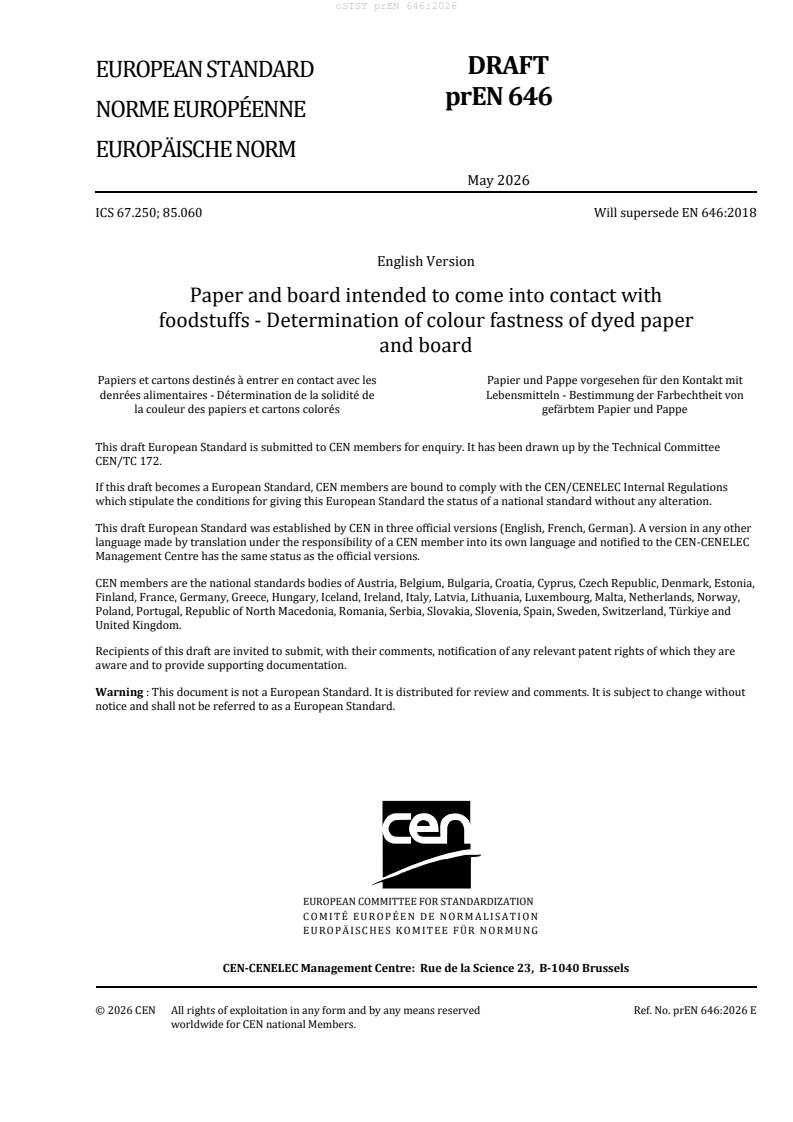
DRAFT
EUROPEAN STANDARD
NORME EUROPÉENNE
EUROPÄISCHE NORM
May 2026
ICS 67.250; 85.060 Will supersede EN 646:2018
English Version
Paper and board intended to come into contact with
foodstuffs - Determination of colour fastness of dyed paper
and board
Papiers et cartons destinés à entrer en contact avec les Papier und Pappe vorgesehen für den Kontakt mit
denrées alimentaires - Détermination de la solidité de Lebensmitteln - Bestimmung der Farbechtheit von
la couleur des papiers et cartons colorés gefärbtem Papier und Pappe
This draft European Standard is submitted to CEN members for enquiry. It has been drawn up by the Technical Committee
CEN/TC 172.
If this draft becomes a European Standard, CEN members are bound to comply with the CEN/CENELEC Internal Regulations
which stipulate the conditions for giving this European Standard the status of a national standard without any alteration.
This draft European Standard was established by CEN in three official versions (English, French, German). A version in any other
language made by translation under the responsibility of a CEN member into its own language and notified to the CEN-CENELEC
Management Centre has the same status as the official versions.
CEN members are the national standards bodies of Austria, Belgium, Bulgaria, Croatia, Cyprus, Czech Republic, Denmark, Estonia,
Finland, France, Germany, Greece, Hungary, Iceland, Ireland, Italy, Latvia, Lithuania, Luxembourg, Malta, Netherlands, Norway,
Poland, Portugal, Republic of North Macedonia, Romania, Serbia, Slovakia, Slovenia, Spain, Sweden, Switzerland, Türkiye and
United Kingdom.
Recipients of this draft are invited to submit, with their comments, notification of any relevant patent rights of which they are
aware and to provide supporting documentation.
Warning : This document is not a European Standard. It is distributed for review and comments. It is subject to change without
notice and shall not be referred to as a European Standard.
EUROPEAN COMMITTEE FOR STANDARDIZATION
COMITÉ EUROPÉEN DE NORMALISATION
EUROPÄISCHES KOMITEE FÜR NORMUNG
CEN-CENELEC Management Centre: Rue de la Science 23, B-1040 Brussels
© 2026 CEN All rights of exploitation in any form and by any means reserved Ref. No. prEN 646:2026 E
worldwide for CEN national Members.
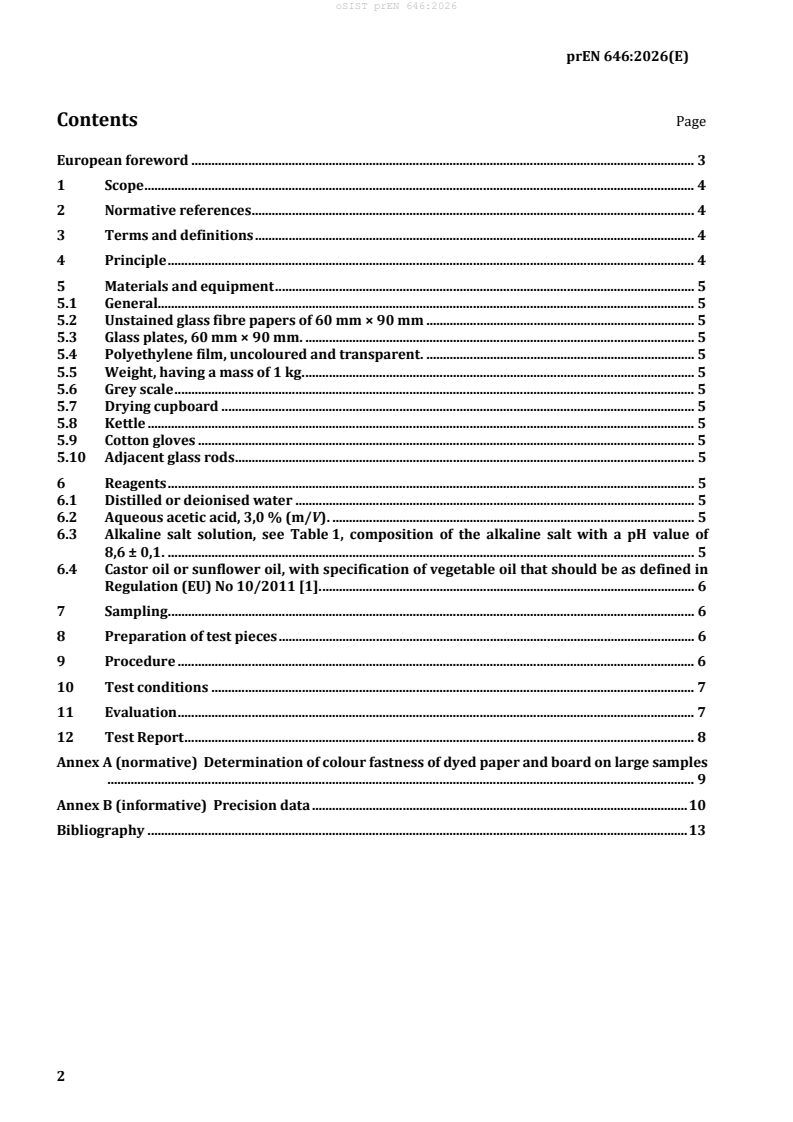
Contents Page
European foreword . 3
1 Scope . 4
2 Normative references . 4
3 Terms and definitions . 4
4 Principle . 4
5 Materials and equipment . 5
5.1 General. 5
5.2 Unstained glass fibre papers of 60 mm × 90 mm . 5
5.3 Glass plates, 60 mm × 90 mm. . 5
5.4 Polyethylene film, uncoloured and transparent. . 5
5.5 Weight, having a mass of 1 kg. . 5
5.6 Grey scale . 5
5.7 Drying cupboard . 5
5.8 Kettle . 5
5.9 Cotton gloves . 5
5.10 Adjacent glass rods . 5
6 Reagents . 5
6.1 Distilled or deionised water . 5
6.2 Aqueous acetic acid, 3,0 % (m/V). . 5
6.3 Alkaline salt solution, see Table 1, composition of the alkaline salt with a pH value of
8,6 ± 0,1. . 5
6.4 Castor oil or sunflower oil, with specification of vegetable oil that should be as defined in
Regulation (EU) No 10/2011 [1]. . 6
7 Sampling . 6
8 Preparation of test pieces . 6
9 Procedure . 6
10 Test conditions . 7
11 Evaluation . 7
12 Test Report . 8
Annex A (normative) Determination of colour fastness of dyed paper and board on large samples
............................................................................................................................................................................... 9
Annex B (informative) Precision data . 10
Bibliography . 13
European foreword
This document (prEN 646:2026) has been prepared by Technical Committee CEN/TC 172 “Pulp, paper
and board”, the secretariat of which is held by DIN.
This document is currently submitted to the CEN Enquiry.
This document will supersede EN 646:2018.
This document includes the following significant technical changes with respect to EN 646:2018:
a) Update of materials and equipment (Clause 5);
b) modification of the type of oil which can be used (6.4);
c) precision in evaluating the staining (Clause 11);
d) addition of an Annex on precision data (Annex B);
e) revision of Annex A;
f) editorial changes.
1 Scope
This document describes procedures for the testing of dyed paper and board intended to come into
contact with foodstuffs. Some procedures depending on the foreseeable use of the material are given.
Visual evaluation against a grey scale provides grading of the bleeding.
For samples having significant different sides, a migration can occur from one glass fibre to the other and
could lead to wrong interpretation of the fastness of one side. It is advisable to check these samples using
large sampling procedure to prevent cross contamination of the glass fibre during the migration
procedure. The procedure is described in Annex A. If lower limit of detection is required, this procedure
could also be used.
2 Normative references
The following documents are referred to in the text in such a way that some or all of their content
constitutes requirements of this document. For dated references, only the edition cited applies. For
undated references, the latest edition of the referenced document (including any amendments) applies.
EN ISO 105-A03, Textiles — Tests for colour fastness — Part A03: Grey scale for assessing
staining (ISO 105-A03)
EN ISO 186, Paper and board — Sampling to determine average quality (ISO 186)
EN ISO 3696, Water for analytical laboratory use — Specification and test methods (ISO 3696)
EN ISO 4787, Laboratory glass and plastic ware — Volumetric instruments — Methods for testing of
capacity and for use (ISO 4787)
ISO 6588-2, Paper, board and pulps — Determination of pH of aqueous extracts — Part 2: Hot extraction
3 Terms and definitions
For the purposes of this document, the following terms and definitions apply.
ISO and IEC maintain terminology databases for use in standardization at the following addresses:
— ISO Online browsing platform: available at https://www.iso.org/obp/
— IEC Electropedia: available at https://www.electropedia.org/
3.1
colour fastness
lack of transfer of colour from a paper to a non-stained glass-fibre paper, saturated with a test fluid and
evaluated visually for staining against a grey scale
4 Principle
A sample is brought into contact with glass fibre papers which have been saturated with a test fluid and
placed unde
...