

EN ISO 10271:2001/AC:2006
(Corrigendum)Dental metallic materials - Corrosion test methods (ISO 10271:2001/Cor.1:2005)
- Abstract
ISO - Taking over of a ISO Technical Corrigendum
- Status
- Withdrawn
- Publication Date
- 18-Apr-2006
- Withdrawal Date
- 31-Jul-2011
- Technical Committee
- CEN/TC 55 - Dentistry
- Drafting Committee
- CEN/TC 55 - Dentistry
- Current Stage
- 9960 - Withdrawal effective - Withdrawal
- Start Date
- 01-Aug-2011
- Completion Date
- 01-Aug-2011

Relations
- Replaced By
EN ISO 10271:2011 - Dentistry - Corrosion test methods for metallic materials (ISO 10271:2011) - Effective Date
- 06-Aug-2011
- Effective Date
- 08-Jun-2022
Get Certified
Connect with accredited certification bodies for this standard

BSI Group
BSI (British Standards Institution) is the business standards company that helps organizations make excellence a habit.

TÜV Rheinland
TÜV Rheinland is a leading international provider of technical services.

TÜV SÜD
TÜV SÜD is a trusted partner of choice for safety, security and sustainability solutions.
Sponsored listings
Frequently Asked Questions
EN ISO 10271:2001/AC:2006 is a corrigendum published by the European Committee for Standardization (CEN). Its full title is "Dental metallic materials - Corrosion test methods (ISO 10271:2001/Cor.1:2005)". This standard covers: ISO - Taking over of a ISO Technical Corrigendum
ISO - Taking over of a ISO Technical Corrigendum
EN ISO 10271:2001/AC:2006 is classified under the following ICS (International Classification for Standards) categories: 11.060.10 - Dental materials. The ICS classification helps identify the subject area and facilitates finding related standards.
EN ISO 10271:2001/AC:2006 has the following relationships with other standards: It is inter standard links to EN ISO 10271:2011, EN ISO 10271:2001. Understanding these relationships helps ensure you are using the most current and applicable version of the standard.
EN ISO 10271:2001/AC:2006 is available in PDF format for immediate download after purchase. The document can be added to your cart and obtained through the secure checkout process. Digital delivery ensures instant access to the complete standard document.
Standards Content (Sample)
2003-01.Slovenski inštitut za standardizacijo. Razmnoževanje celote ali delov tega standarda ni dovoljeno.Dentalni kovinski materiali – Preskusne metode ugotavljanja korozije (ISO 10271:2001/Cor.1:2005)Dentale metallische Werkstoffe - Korrosionsprüfverfahren (ISO 10271:2001/Cor.1:2005)Produits dentaires métalliques - Méthodes pour les essais de corrosion (ISO 10271:2001/Cor.1:2005)Dental metallic materials - Corrosion test methods (ISO 10271:2001/Cor.1:2005)11.060.10Dental materialsICS:Ta slovenski standard je istoveten z:EN ISO 10271:2001/AC:2006SIST EN ISO 10271:2002/AC:2006en,fr,de01-julij-2006SIST EN ISO 10271:2002/AC:2006SLOVENSKI
STANDARD
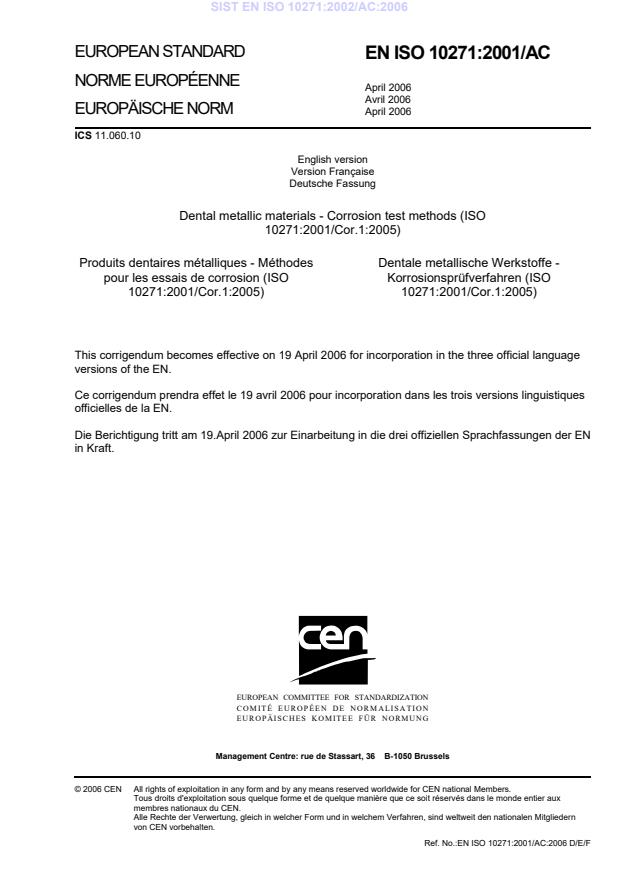
EUROPEAN STANDARDNORME EUROPÉENNEEUROPÄISCHE NORMEN ISO 10271:2001/ACApril 2006Avril 2006April 2006ICS 11.060.10English versionVersion FrançaiseDeutsche FassungDental metallic materials - Corrosion test methods (ISO10271:2001/Cor.1:2005)Produits dentaires métalliques - Méthodespour les essais de corrosion (ISO10271:2001/Cor.1:2005)Dentale metallische Werkstoffe -Korrosionsprüfverfahren (ISO10271:2001/Cor.1:2005)This corrigendum becomes effective on 19 April 2006 for incorporation in the three official languageversions of the EN.Ce corrigendum prendra effet le 19 avril 2006 pour incorporation dans les trois versions linguistiquesofficielles de la EN.Die Berichtigung tritt am 19.April 2006 zur Einarbeitung in die drei offiziellen Sprachfassungen der ENin Kraft.EUROPEAN COMMITTEE FOR STANDARDIZATIONCOMITÉ EUROPÉEN DE NORMALISATIONEUROPÄISCHES KOMITEE FÜR NORMUNGManagement Centre: rue de Stassart, 36
B-1050 Brussels© 2006 CENAll rights of exploitation in any form and by any means reserved worldwide for CEN national Members.Tous droits d'exploitation sous quelque forme et de quelque manière que ce soit réservés dans le monde entier auxmembres nationaux du CEN.Alle Rechte der Verwertung, gleich in welcher Form und in welchem Verfahren, sind weltweit den nationalen Mitgliedernvon CEN vorbehalten.Ref. No.:EN ISO 10271:2001/AC:2006 D/E/FSIST EN ISO 10271:2002/AC:2006
Endorsement Notice
The text of ISO 10271:2001/Cor.1:2005 has been approved by CEN as EN ISO 10271:2001/AC:2006 without any modifications.
Version française
Notice d’entérinement
Le texte de l’ISO 10271:2001/Cor.1:2005 a été approuvé par le CEN comme EN ISO 10271:2001/AC:2006 sans aucune modification.
Deutsche Fassung Anerkennungsnotiz Der Text von ISO 10271:2001/Cor.1:2005 wurde vom CEN als EN/ISO 10271:2001/AC:2006 ohne irgendeine Abänderung genehmigt.
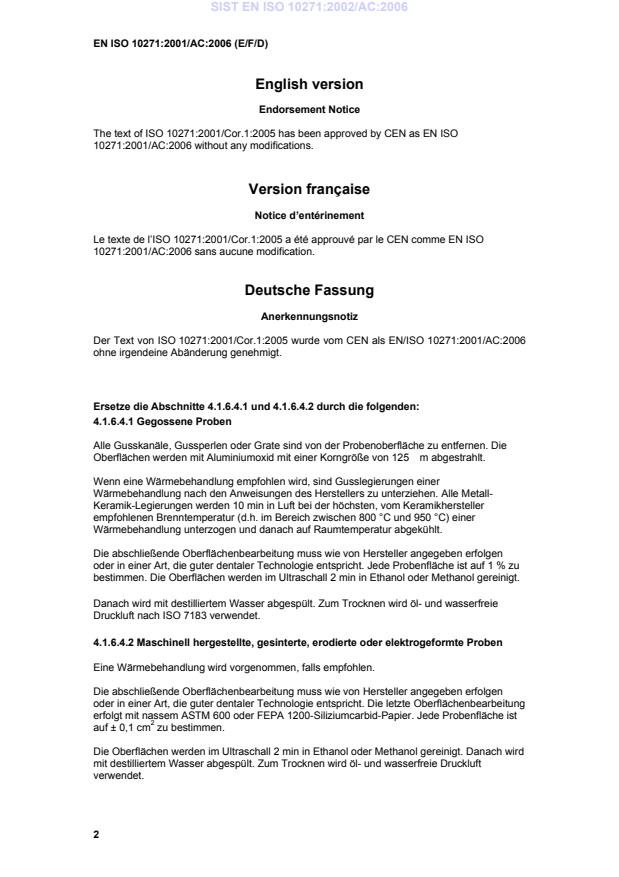
Ersetze die Abschnitte 4.1.6.4.1 und 4.1.6.4.2 durch die folgenden: 4.1.6.4.1 Gegossene Proben Alle Gusskanäle, Gussperlen oder Grate sind von der Probenoberfläche zu entfernen. Die Oberflächen werden mit Aluminiumoxid mit einer Korngröße von 125 m abgestrahlt.
Wenn eine Wärmebehandlung empfohlen wird, sind Gusslegierungen einer Wärmebehandlung nach den Anweisungen des Herstellers zu unterziehen. Alle Metall-Keramik-Legierungen werden 10 min in Luft bei der höchsten, vom Keramikhersteller empfohlenen Brenntemperatur (d.h. im Bereich zwischen 800 °C und 950 °C) einer Wärmebehandlung unterzogen und danach auf Raumtemperatur abgekühlt.
Die abschließende Oberflächenbearbeitung muss wie von Hersteller angegeben erfolgen oder in einer Art, die guter dentaler Technologie entspricht. Jede Probenfläche ist auf 1 % zu bestimmen. Die Oberflächen werden im Ultraschall 2 min in Ethanol oder Methanol gereinigt.
Danach wird mit destilliertem Wasser abgespült. Zum Trocknen wird öl- und wasserfreie Druckluft nach ISO 7183 verwendet.
4.1.6.4.2 Maschinell hergestellte, gesinterte, erodierte oder elektrogeformte Proben Eine Wärmebehandlung wird vorgenommen, falls empfohlen.
Die abschließende Oberflächenbearbeitung muss wie von Hersteller angegeben erfolgen oder in einer Art, die guter dentaler Technologie entspricht. Die letzte Oberflächenbearbeitung erfolgt mit nassem ASTM 600 oder FEPA 1200-Siliziumcarbid-Papier. Jede Probenfläche ist auf ± 0,1 cm2 zu bestimmen.
Die Oberflächen werden im Ultraschall 2 min in Etha
...