

prEN 196-16
(Main)Methods of testing cement - Part 16 - Sulfate resistance - Square prism method
- Abstract
This document describes a test method applicable to cast test specimens for evaluating the Sulfate
Resistance (SR characteristic) of cements. Sulfate resistance means that these binders can be used in
concrete bodies submitted to sulfate attacks. In these methods, the test is carried out under controlled
exposure conditions using a defined concentration of sulfate solution. The chosen test conditions are
intended to accelerate external sulfate attack.
This test method is appropriate in particular for CEM III/A cements and other various binders, in
particular those with pozzolanic main constituents. It is adapted from the CUR - NL - Civieltechnisch
Centrum Uitvoering Research en Regelgeving (Centre for Civil Engineering Research and Codes) -
Recommendation 48 - Suitability test for new cements for application in concrete.
This test method is listed in European Assessment Document - EAD 150004-00-0301, Annex B.
- Status
- Not Published
- Publication Date
- 24-May-2028
- Technical Committee
- CEN/TC 51 - Cement and building limes
- Drafting Committee
- CEN/TC 51/WG 12 - Special performance criteria
- Current Stage
- 4020 - Submission to enquiry - Enquiry
- Start Date
- 06-Aug-2026
- Due Date
- 11-Feb-2027
- Completion Date
- 06-Aug-2026

prEN 196-16 is a draft CEN standard for the square prism method used to assess the sulfate resistance of cement. It specifies how mortar prisms are prepared, cured, exposed to a defined sulfate solution, measured over time, and reported so laboratories can judge the SR characteristic of cements, especially CEM III/A cements and binders with pozzolanic main constituents.
What does prEN 196-16 specify?
prEN 196-16 specifies a laboratory test on cast mortar specimens for evaluating sulfate resistance under controlled exposure conditions. The method is intended to accelerate external sulfate attack by using a fixed sulfate solution concentration and a long exposure period.
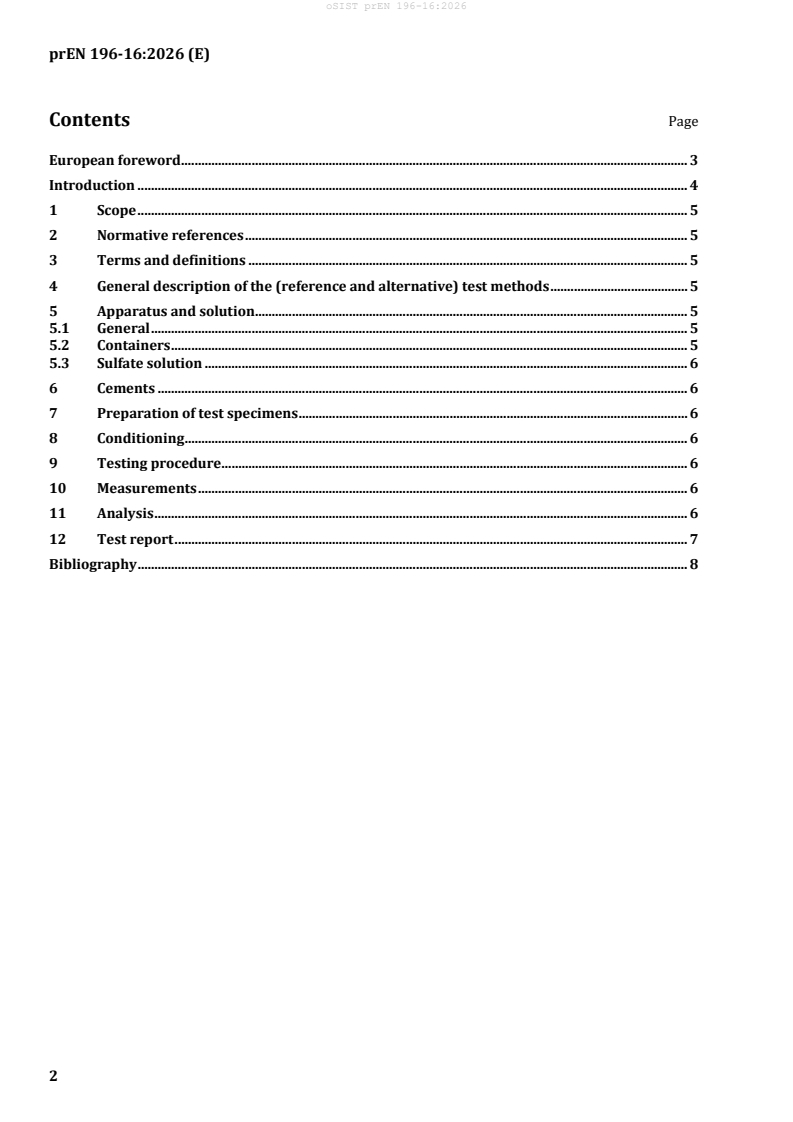
prEN 196-16 is organized into clauses 1 to 12: scope, normative references, terms and definitions, general description, apparatus and solution, cements, preparation of test specimens, conditioning, testing procedure, measurements, analysis, and test report, followed by a bibliography. The structure takes a user from specimen preparation through to the final report.
What are the key requirements of prEN 196-16?
Clause 4 - test principle: prEN 196-16 evaluates sulfate resistance with the square-based prisms method (SQPM) on mortar specimens cured in water for 28 days and then immersed in sulfate solution at 20 ± 2 °C. In practice, this creates a controlled comparison between specimens kept in water and specimens exposed to sulfate attack.
Clause 5.2 - containers: prEN 196-16 requires light-proof, non-reactive containers with enough volume for 1.0 ± 0.1 l of solution and a solution depth of at least 25 mm. This matters because the exposure conditions must stay stable and the container must not affect the specimens or solution.
Clause 5.3 - sulfate solution: prEN 196-16 uses a sulfate solution with a concentration of 16 ± 0.5 g SO4/l, prepared from Na2SO4 or Na2SO4·10 H2O of analytical purity. This gives a defined and repeatable exposure severity.
Clauses 7 and 8 - specimen preparation and conditioning: prEN 196-16 uses mortar made according to EN 196-1, with 6 prisms of (20 × 20 × 160) mm and two stainless steel studs. After demoulding, 3 prisms are placed in each of 2 containers with distilled water, with spacing around the prisms and supports under them. For the reader, this fixes specimen geometry and storage so results are comparable.
Clause 9 - start of exposure: prEN 196-16 measures the prism length at 28 days after curing, using calibrated equipment and a reference bar, before moving 3 prisms to distilled water and 3 to sulfate solution. The sulfate solution is replaced every 28 days, while the water is kept and topped up if needed.
Clause 10 - monitoring: prEN 196-16 requires length measurements after 4, 8, 12, 16, 20, 26, 29, 40 and 52 weeks, with photographs and notes on visible damage such as cracks, exudations and deposits. This gives both numerical expansion data and a visual record of deterioration.
Clause 11 - analysis: prEN 196-16 calculates length change relative to the 160 mm prism length, excluding pins, and reports mean values from 3 specimens versus time. In practice, the user tracks expansion as a durability indicator and can plot it to show the trend clearly.
Clause 12 - test report: prEN 196-16 requires the report to identify the cement, specimen type and size, dates, curing and conditioning, exposure periods, gauge length, individual and mean results for length, mass and specific weight, any deviations, and photographic records. This makes the test auditable and usable for technical decisions.
What terms does prEN 196-16 define?
- Sulfate resistance (SR characteristic): the ability of a cement binder to be used in concrete exposed to sulfate attack.
- Square-based prisms method (SQPM): the test method used in prEN 196-16 for measuring prism length change during sulfate exposure.
- CEM III/A: a cement type named in the scope as a particularly suitable application for this method.
- Pozzolanic main constituents: main cement constituents highlighted in the scope as relevant to this test method.
- Na2SO4: sodium sulfate, used to prepare the sulfate solution in the test.
- Reference bar: the calibration item used before length measurements to check or adjust the measuring apparatus.
Who uses prEN 196-16?
prEN 196-16 is used by cement laboratories, testing organizations, and quality teams that need to assess sulfate resistance of cements and related binders. It is relevant to cement producers, purchasers, and technical specifiers working with CEM III/A cements and binders with pozzolanic main constituents. It is also useful for conformity assessment and product qualification work where controlled durability testing is needed.
Which standards are used with prEN 196-16?
- EN 196-1: provides the mortar and strength-testing framework used for preparing the specimens in this method.
- EN 197-1: is the framework mentioned in the introduction for the cements to which this test method is applied.
- EAD 150004-00-0301, Annex B: lists this test method and shows its use in European Assessment Document work.
What does the prEN 196-16 document contain?
prEN 196-16 contains the test apparatus requirements, including the container dimensions and the sulfate solution preparation. It also gives the specimen preparation sequence, the conditioning arrangement, the exposure schedule, and the measurement intervals. The analysis clause provides the way to calculate length variation and present it over time.
The document also specifies what the report must record, including specimen identification, curing and conditioning details, individual results, mean values, mass and specific weight changes, deviations, and photographic records. In practice, this means the standard supports both technical testing and traceable reporting.
Get Certified
Connect with accredited certification bodies for this standard

DIBt (Deutsches Institut für Bautechnik)
German Institute for Building Technology.
DIN CERTCO
DIN Group product certification.

Aboma Certification B.V.
Specialized in construction, metal, and transport sectors.
Sponsored listings
Frequently Asked Questions
prEN 196-16 is a draft published by the European Committee for Standardization (CEN). Its full title is "Methods of testing cement - Part 16 - Sulfate resistance - Square prism method". This standard covers: This document describes a test method applicable to cast test specimens for evaluating the Sulfate Resistance (SR characteristic) of cements. Sulfate resistance means that these binders can be used in concrete bodies submitted to sulfate attacks. In these methods, the test is carried out under controlled exposure conditions using a defined concentration of sulfate solution. The chosen test conditions are intended to accelerate external sulfate attack. This test method is appropriate in particular for CEM III/A cements and other various binders, in particular those with pozzolanic main constituents. It is adapted from the CUR - NL - Civieltechnisch Centrum Uitvoering Research en Regelgeving (Centre for Civil Engineering Research and Codes) - Recommendation 48 - Suitability test for new cements for application in concrete. This test method is listed in European Assessment Document - EAD 150004-00-0301, Annex B.
This document describes a test method applicable to cast test specimens for evaluating the Sulfate Resistance (SR characteristic) of cements. Sulfate resistance means that these binders can be used in concrete bodies submitted to sulfate attacks. In these methods, the test is carried out under controlled exposure conditions using a defined concentration of sulfate solution. The chosen test conditions are intended to accelerate external sulfate attack. This test method is appropriate in particular for CEM III/A cements and other various binders, in particular those with pozzolanic main constituents. It is adapted from the CUR - NL - Civieltechnisch Centrum Uitvoering Research en Regelgeving (Centre for Civil Engineering Research and Codes) - Recommendation 48 - Suitability test for new cements for application in concrete. This test method is listed in European Assessment Document - EAD 150004-00-0301, Annex B.
prEN 196-16 is classified under the following ICS (International Classification for Standards) categories: 91.100.10 - Cement. Gypsum. Lime. Mortar. The ICS classification helps identify the subject area and facilitates finding related standards.
prEN 196-16 is available in PDF format for immediate download after purchase. The document can be added to your cart and obtained through the secure checkout process. Digital delivery ensures instant access to the complete standard document.
Standards Content (Sample)
SLOVENSKI STANDARD
01-oktober-2026
Metode preskušanja cementa - 16. del - Odpornost proti sulfatom - Metoda
kvadratne prizme
Methods of testing cement - Part 16 - Sulfate resistance - Square prism method
Prüfverfahren für Zement - Teil 16: Sulfatbeständigkeit - Quadratische Prismenmethode
Méthodes d'essais des ciments - Partie 16 : Résistance aux sulfates - Méthode du
prisme carré
Ta slovenski standard je istoveten z: prEN 196-16
ICS:
91.100.10 Cement. Mavec. Apno. Malta Cement. Gypsum. Lime.
Mortar
2003-01.Slovenski inštitut za standardizacijo. Razmnoževanje celote ali delov tega standarda ni dovoljeno.
DRAFT
EUROPEAN STANDARD
NORME EUROPÉENNE
EUROPÄISCHE NORM
August 2026
ICS 91.100.10
English Version
Methods of testing cement - Part 16 - Sulfate resistance -
Square prism method
Méthodes d'essais des ciments - Partie 16 : Résistance Prüfverfahren für Zement - Teil 16: Sulfatbeständigkeit
aux sulfates - Méthode du prisme carré - Quadratische Prismenmethode
This draft European Standard is submitted to CEN members for enquiry. It has been drawn up by the Technical Committee
CEN/TC 51.
If this draft becomes a European Standard, CEN members are bound to comply with the CEN/CENELEC Internal Regulations
which stipulate the conditions for giving this European Standard the status of a national standard without any alteration.
This draft European Standard was established by CEN in three official versions (English, French, German). A version in any other
language made by translation under the responsibility of a CEN member into its own language and notified to the CEN-CENELEC
Management Centre has the same status as the official versions.
CEN members are the national standards bodies of Austria, Belgium, Bulgaria, Croatia, Cyprus, Czech Republic, Denmark, Estonia,
Finland, France, Germany, Greece, Hungary, Iceland, Ireland, Italy, Latvia, Lithuania, Luxembourg, Malta, Netherlands, Norway,
Poland, Portugal, Republic of North Macedonia, Romania, Serbia, Slovakia, Slovenia, Spain, Sweden, Switzerland, Türkiye and
United Kingdom.
Recipients of this draft are invited to submit, with their comments, notification of any relevant patent rights of which they are
aware and to provide supporting documentation.
Warning : This document is not a European Standard. It is distributed for review and comments. It is subject to change without
notice and shall not be referred to as a European Standard.
EUROPEAN COMMITTEE FOR STANDARDIZATION
COMITÉ EUROPÉEN DE NORMALISATION
EUROPÄISCHES KOMITEE FÜR NORMUNG
CEN-CENELEC Management Centre: Rue de la Science 23, B-1040 Brussels
© 2026 CEN All rights of exploitation in any form and by any means reserved Ref. No. prEN 196-16:2026 E
worldwide for CEN national Members.
Contents Page
European foreword . 3
Introduction . 4
1 Scope . 5
2 Normative references . 5
3 Terms and definitions . 5
4 General description of the (reference and alternative) test methods . 5
5 Apparatus and solution . 5
5.1 General . 5
5.2 Containers . 5
5.3 Sulfate solution . 6
6 Cements . 6
7 Preparation of test specimens . 6
8 Conditioning . 6
9 Testing procedure . 6
10 Measurements . 6
11 Analysis . 6
12 Test report . 7
Bibliography . 8
European foreword
This document (prEN 196-16: 2026) has been prepared by Technical Committee CEN/TC 51 “Cement
and building limes”, the secretariat of which is held by NBN.
This document is currently submitted to the CEN Enquiry.
Introduction
This document describes a test method applicable to cast test specimens for evaluating the sulfate
resistance (SR characteristic) of cements. Sulfate resistance means that these binders can be used in
concrete bodies submitted to sulfate attack.
They are established within the framework of EN 197-1.
Precision data, coming from broad round robin tests and valid for a European standard, are not yet
available.
1 Scope
This document describes a test method applicable to cast test specimens for evaluating the Sulfate
Resistance (SR characteristic) of cements. Sulfate resistance means that these binders can be used in
concrete bodies submitted to sulfate attacks. In these methods, the test is carried out under controlled
exposure conditions using a defined concentration of sulfate solution. The chosen test conditions are
intended to accelerate external sulfate attack.
This test method is appropriate in particular for CEM III/A cements and other various binders, in
particular those with pozzolanic main constituents. It is adapted from the CUR – NL – Civieltechnisch
Centrum Uitvoering Research en Regelgeving (Centre for Civil Engineering Research a
...