

EN 14904:2006
(Main)Surfaces for sports areas - Indoor surfaces for multi-sports use - Specification
- Abstract
This European Standard specifies requirements for surfaces for indoor facilities for multi-sports use. It also covers surface systems which include both their supporting and upper layers whether prefabricated, produced in situ or a combination of the two. It also provides for the evaluation of conformity of products to the requirements of this European Standard. This European Standard is not applicable to indoor tennis halls.
NOTE "Multi-sports" will be defined by appropriate national provisions.
- Status
- Published
- Publication Date
- 11-Apr-2006
- Withdrawal Date
- 30-Oct-2006
- Technical Committee
- CEN/TC 217 - Surfaces for sport areas
- Drafting Committee
- CEN/TC 217/WG 2 - Surfaces of sports halls
- Current Stage
- 6060 - Definitive text made available (DAV) - Publishing
- Start Date
- 12-Apr-2006
- Completion Date
- 12-Apr-2006
- Directive
- 305/2011 - Regulation (eu) No 305/2011 of the European Parliament and of the Council of 9 march 2011 laying down harmonised conditions for the marketing of construction products and repealing council directive 89/106/eecOJ Ref: C, C 259 OJ Date: 08-Aug-2014
89/106/EEC - Construction productsOJ Ref: C, C 304 OJ Date: 13-Dec-2006

Overview
EN 14904:2006 is a European Standard developed by the European Committee for Standardization (CEN) that specifies requirements for indoor sports flooring systems intended for multi-sports use. It applies to a wide range of sports facility surfaces, except those for indoor tennis. The standard covers both prefabricated and in-situ constructed floor systems, focusing on supporting and upper layers. EN 14904:2006 also provides conformity assessment criteria, ensuring that products meet stringent performance and safety requirements essential for contemporary sports environments.
By adhering to this standard, facility managers, manufacturers, and architects gain assurance on aspects such as safety in use, technical performance, and durability, supporting sports performance and injury prevention.
Key Topics
EN 14904:2006 addresses several critical aspects of indoor multi-sports flooring:
- Safety Requirements: Outlines minimum safety criteria focusing on shock absorption, friction, and evenness, all vital for injury prevention and optimal sports performance.
- Performance Characteristics: Establishes detailed requirements for:
- Shock absorption and vertical deformation
- Ball bounce and vertical ball behaviour
- Resistance to rolling loads, wear, impact, and indentation
- Reaction to fire and formaldehyde emissions
- Surface properties such as specular reflectance and gloss
- Product Conformity: Describes specific procedures for:
- Initial type testing and factory production control
- Ongoing product assessment and traceability
- Marking and Labelling: Specifies information that must accompany compliant products, including standard reference, manufacturer identification, and batch details.
Applications
EN 14904:2006 is applicable to a variety of indoor environments where multiple sports are played, such as:
- Sports halls and gymnasiums: Facilities hosting basketball, volleyball, handball, five-a-side football, and other physical education activities.
- Community recreation centers: Spaces designed for diverse sporting activities in schools, universities, or public sports complexes.
- Commercial fitness centers: Multi-use rooms or studios that require resilient, safe, and durable flooring.
- Event venues: Locations that need to accommodate frequent changes in activity and equipment while maintaining surface integrity and safety.
Compliant sports surfaces deliver consistently safe playing conditions, help extend the lifespan of floors, and facilitate easier maintenance and inspection. The requirements also assist building managers and procurement professionals in selecting suitable flooring systems aligned with European regulations.
Related Standards
Implementing EN 14904:2006 often involves reference to or compliance with several other European and international standards, including:
- EN 717-1/EN 717-2: Testing and classification for formaldehyde emission from wood-based panels.
- EN 1516/EN 1517: Determination of resistance to indentation and impact.
- EN ISO 5470-1: Measuring abrasion resistance of coatings and floor surfaces.
- EN 12235: Ball behaviour test methods for sports areas.
- EN 13501-1: Fire classification for building products.
- EN 14808/EN 14809: Assessments of shock absorption and vertical deformation.
- EN 13036-4/EN 13036-7: Slip/skid resistance and surface evenness assessments.
EN 14904:2006 is essential for designing, constructing, and maintaining indoor multi-sports surfaces that meet the highest benchmarks for safety, performance, and regulatory conformity. Using flooring systems tested to this standard ensures robust, long-term support for multi-sports facilities throughout Europe and beyond.
Relations
- Refers
ISO 11379:1997 - Textile floor coverings — Laboratory cleaning procedure using spray extraction - Effective Date
- 25-Aug-2026
- Effective Date
- 25-Aug-2026
- Effective Date
- 05-Aug-2026
- Effective Date
- 28-Jan-2026
- Effective Date
- 28-Jan-2026
- Effective Date
- 28-Jan-2026
- Refers
EN 1569:2020 - Surfaces for sports areas - Determination of the behaviour under a rolling load - Effective Date
- 28-Jan-2026
- Effective Date
- 28-Jan-2026
- Effective Date
- 28-Jan-2026
- Effective Date
- 28-Jan-2026
- Effective Date
- 28-Jan-2026
- Effective Date
- 28-Jan-2026
- Effective Date
- 28-Jan-2026
- Effective Date
- 28-Jan-2026
- Effective Date
- 28-Jan-2026
Frequently Asked Questions
EN 14904:2006 is a standard published by the European Committee for Standardization (CEN). Its full title is "Surfaces for sports areas - Indoor surfaces for multi-sports use - Specification". This standard covers: This European Standard specifies requirements for surfaces for indoor facilities for multi-sports use. It also covers surface systems which include both their supporting and upper layers whether prefabricated, produced in situ or a combination of the two. It also provides for the evaluation of conformity of products to the requirements of this European Standard. This European Standard is not applicable to indoor tennis halls. NOTE "Multi-sports" will be defined by appropriate national provisions.
This European Standard specifies requirements for surfaces for indoor facilities for multi-sports use. It also covers surface systems which include both their supporting and upper layers whether prefabricated, produced in situ or a combination of the two. It also provides for the evaluation of conformity of products to the requirements of this European Standard. This European Standard is not applicable to indoor tennis halls. NOTE "Multi-sports" will be defined by appropriate national provisions.
EN 14904:2006 is classified under the following ICS (International Classification for Standards) categories: 97.220.10 - Sports facilities. The ICS classification helps identify the subject area and facilitates finding related standards.
EN 14904:2006 has the following relationships with other standards: It is inter standard links to ISO 11379:1997, ISO 1957:2000, EN 13238:2026, EN 14809:2005, EN ISO 12460-3:2023, EN 13238:2010, EN 1569:2020, EN 13501-1:2018, EN ISO 25178-603:2013, EN 12235:2013, EN 13036-7:2003, EN ISP 10609-12:1996, EN 13745:2004, EN 1517:2020, EN 12673:1998. Understanding these relationships helps ensure you are using the most current and applicable version of the standard.
EN 14904:2006 is associated with the following European legislation: EU Directives/Regulations: 305/2011, 89/106/EEC; Standardization Mandates: M/119. When a standard is cited in the Official Journal of the European Union, products manufactured in conformity with it benefit from a presumption of conformity with the essential requirements of the corresponding EU directive or regulation.
EN 14904:2006 is available in PDF format for immediate download after purchase. The document can be added to your cart and obtained through the secure checkout process. Digital delivery ensures instant access to the complete standard document.
Standards Content (Sample)
2003-01.Slovenski inštitut za standardizacijo. Razmnoževanje celote ali delov tega standarda ni dovoljeno.Surfaces for sports areas - Indoor surfaces for multi-sports use - Specification6SHFLILNDFLMDSols sportifs - Sols multi-sports intérieurs - SpécificationSportböden - Sportböden für Hallen und Räume mehrfunktionale Sportnutzung und Mehrzwecknutzung - AnforderungenTa slovenski standard je istoveten z:EN 14904:2006SIST EN 14904:2006en,fr,de97.220.10ICS:SLOVENSKI
STANDARDSIST EN 14904:200601-julij-2006
EUROPEAN STANDARDNORME EUROPÉENNEEUROPÄISCHE NORMEN 14904April 2006ICS 97.220.10 English VersionSurfaces for sports areas - Indoor surfaces for multi-sports use -SpecificationSols sportifs - Sols multi-sports intérieurs - SpécificationSportböden - Mehrzweck-Sporthallenböden -AnforderungenThis European Standard was approved by CEN on 2 March 2006.CEN members are bound to comply with the CEN/CENELEC Internal Regulations which stipulate the conditions for giving this EuropeanStandard the status of a national standard without any alteration. Up-to-date lists and bibliographical references concerning such nationalstandards may be obtained on application to the Central Secretariat or to any CEN member.This European Standard exists in three official versions (English, French, German). A version in any other language made by translationunder the responsibility of a CEN member into its own language and notified to the Central Secretariat has the same status as the officialversions.CEN members are the national standards bodies of Austria, Belgium, Cyprus, Czech Republic, Denmark, Estonia, Finland, France,Germany, Greece, Hungary, Iceland, Ireland, Italy, Latvia, Lithuania, Luxembourg, Malta, Netherlands, Norway, Poland, Portugal, Romania,Slovakia, Slovenia, Spain, Sweden, Switzerland and United Kingdom.EUROPEAN COMMITTEE FOR STANDARDIZATIONCOMITÉ EUROPÉEN DE NORMALISATIONEUROPÄISCHES KOMITEE FÜR NORMUNGManagement Centre: rue de Stassart, 36
B-1050 Brussels© 2006 CENAll rights of exploitation in any form and by any means reservedworldwide for CEN national Members.Ref. No. EN 14904:2006: E
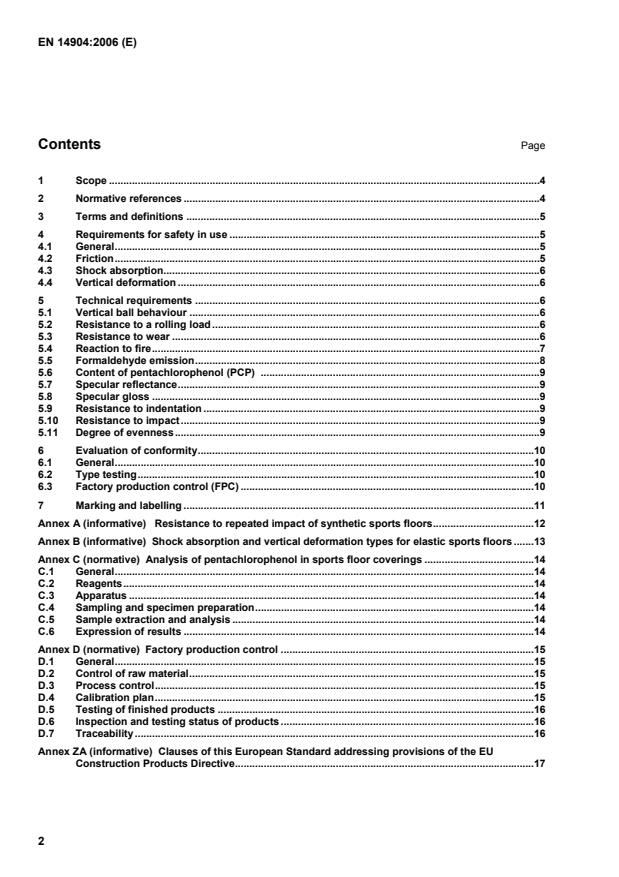
Resistance to repeated impact of synthetic sports floors.12 Annex B (informative)
Shock absorption and vertical deformation types for elastic sports floors.13 Annex C (normative)
Analysis of pentachlorophenol in sports floor coverings.14 C.1 General.14 C.2 Reagents.14 C.3 Apparatus.14 C.4 Sampling and specimen preparation.14 C.5 Sample extraction and analysis.14 C.6 Expression of results.14 Annex D (normative)
Factory production control.15 D.1 General.15 D.2 Control of raw material.15 D.3 Process control.15 D.4 Calibration plan.15 D.5 Testing of finished products.16 D.6 Inspection and testing status of products.16 D.7 Traceability.16 Annex ZA (informative)
Clauses of this European Standard addressing provisions of the EU Construction Products Directive.17
This European Standard has been prepared under a mandate given to CEN by the European Commission and the European Free Trade Association, and supports essential requirements of EU Directive(s). For relationship with EU Directive(s), see informative Annex ZA, which is an integral part of this European Standard. According to the CEN/CENELEC Internal Regulations, the national standards organizations of the following countries are bound to implement this European Standard: Austria, Belgium, Cyprus, Czech Republic, Denmark, Estonia, Finland, France, Germany, Greece, Hungary, Iceland, Ireland, Italy, Latvia, Lithuania, Luxembourg, Malta, Netherlands, Norway, Poland, Portugal, Romania, Slovakia, Slovenia, Spain, Sweden, Switzerland and United Kingdom.
EN 717-1, Wood-based panels - Determination of formaldehyde release - Part 1: Formaldehyde emission by the chamber method EN 717-2, Wood-based panels - Determination of formaldehyde release - Part 2: Formaldehyde release by the gas analysis method EN 1516, Surfaces for sports areas - Determination of resistance to indentation EN 1517, Surfaces for sports areas - Determination of resistance to impact EN 1569, Surfaces for sports areas - Determination of the behaviour under a rolling load EN 12235, Surfaces for sports areas - Determination of vertical ball behaviour EN 12673, Water quality - Gas chromatographic determination of some selected chlorophenols in water EN 13036-4, Road and airfield surface characteristics - Test methods - Part 4: Method for measurement of slip/skid resistance of a surface - The pendulum test EN 13036-7, Road and airfield surface characteristics - Test methods - Part 7: Irregularity measurement of pavement courses - the straightedge test EN 13238, Reaction to fire tests for building products - Conditioning procedures and general rules for selection of substrates EN 13501-1, Fire classification of construction products and building elements - Part 1: Classification using test data from reaction to fire tests EN 13745, Surfaces for sports areas - Determination of specular reflectance EN 14808, Surfaces for sports areas — Determination of shock absorption EN 14809, Surfaces for sports areas — Determination of vertical deformation EN ISO 2813, Paints and varnishes - Measurement of specular gloss of non-metallic paint films at 20°, 60° and 85° (ISO 2813:1994, including Technical Corrigendum 1:1997) EN ISO 5470-1, Rubber- or plastics-coated fabrics - Determination of abrasion resistance - Part 1: Taber abrader (ISO 5470-1:1999) ISO 1957, Machine-made textile floor coverings - Selection and cutting of specimens for physical tests
1 000 cycles shall be 80 mg.
(25 °C ± 10 °C) and the second and third cleaning cycle with water at ambient temperature without any addition of chemicals. 5.4.4 Classification If a claim for reaction to fire performance is made, the sports floor covering shall be tested and classified according to the requirements of EN 13501-1 and the resulting class and subclass shall be declared. If it is decided to make no claim for reaction to fire performance, i.e. it is decided to place a product or family of products on the market as Class Ffl, no testing is required for this product or family of products. 5.4.5 Product parameters influencing reaction to fire performance The product parameters shown in Table 1 influence the reaction to fire performance of sports floor coverings and this table shall be followed if testing a range of products.
Table 3. NOTE Products of Class E1 can be used without causing an indoor air concentration greater than 0,1 x 10⁻⁶ mg/kg (0,1 ppm) of formaldehyde. The test requirement does not apply to sports floor coverings to which no formaldehyde-containing materials were added during production or post-production processing. These need not be classified, but may, without any testing, be declared as Class E1.
Table 2 — Formaldehyde Class E1
Test method Requirement Initial type testing a EN 717-1 Release ≤ 0,124 mg/m3 EN 717-1 Release ≤ 0,124 mg/m3
Factory production control EN 717-2 Release ≤ 3,5 mg/m2h a
For established products, initial type testing may also be carried out on the basis of existing data with EN 717-2 testing, either from factory production control or from external inspection.
Test method Requirement EN 717-1 Release > 0,124 mg/m3
Initial type testing EN 717-2 Release > 3,5 mg/m2h to ≤ 8 mg/m2h EN 717-1 Release > 0,124 mg/m3
Factory production control EN 717-2 Release > 3,5 mg/m2h to ≤ 8 mg/m2h
5.6 Content of pentachlorophenol (PCP) 1) Sports floor coverings shall not contain pentachlorophenol or a derivative thereof as a component in the production process of the product or of its raw materials. In cases where verification is required, if the content is less than 0,1 % by mass by the method described in Annex C, this requirement shall be considered to be met. 5.7 Specular reflectance Where required, the specular reflectance shall be measured using the method described in EN 13745, using an angle of 85°, and the mean value obtained shall be reported. 5.8 Specular gloss When tested by the method described in EN ISO 2813 using an angle of incidence of 85°, the specular gloss shall be ≤ 30 % for matt surfaces and ≤ 45 % for lacquered surfaces. 5.9 Resistance to indentation When tested by the method described in EN 1516, the mean residual indentation measured 5 min after removal of the load shall be reported and the mean residual indentation measured 24 h after removal of the load shall be ≤ 0,5 mm. For area-elastic sports floors, test only the upper layer supported on a rigid structure. 5.10 Resistance to impact After conditioning for 14 day at
...